



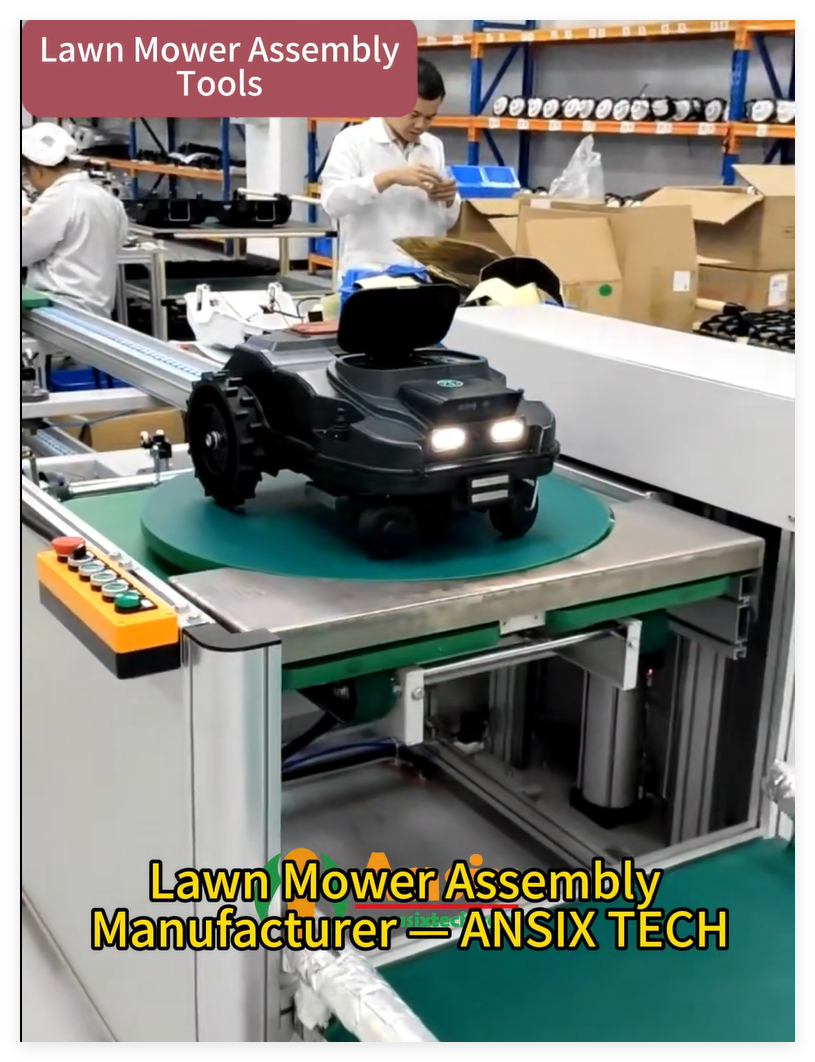
Lawn Mower Assembly Manufacturer — ANSIX TECH
Lawn Mower Assembly Manufacturer — ANSIX TECH

Precision in Motion: How Ansix Tech is Redefining the Economics of Lawn Mower Assembly Manufacturing
In the sprawling landscape of outdoor power equipment, the lawn mower stands as a paradox. It is simultaneously one of the most ubiquitous machines in the world and one of the most demanding to manufacture. Exposed to relentless vibration, moisture, temperature extremes, and impact from debris, every component must function with military precision while surviving the chaos of a suburban backyard. For original equipment manufacturers (OEMs) in this sector, the margin for error is measured not just in tolerances, but in brand reputation.
For over 28 years, Ansix Tech has positioned itself not merely as a supplier, but as a strategic pillar for the world’s leading lawn mower brands. Specializing in the design and manufacturing of complex lawn mower assembly components, Ansix Tech has built a reputation on a singular promise: reducing the total "hard cost" of production while simultaneously elevating quality standards. In an industry where seasonal demand creates crushing pressure for on-time delivery, and where material costs fluctuate wildly, Ansix Tech’s vertically integrated approach—spanning prototype design, mold manufacturing, injection molding, and final assembly verification—offers a blueprint for resilience.
This article explores the full lifecycle of Ansix Tech’s lawn mower assembly operations, detailing the engineering rigor, material science expertise, and manufacturing strategies that solve the industry’s most persistent problems.
The Genesis: Project Initiation and Client-Centric Problem Solving
The relationship between Ansix Tech and its clients typically begins not with a purchase order, but with a problem. Lawn mower OEMs often face a common set of challenges: components that warp under the heat of a running engine, decks that crack under stress, complex assemblies that introduce bottlenecks in the final production line, or simply a unit cost that erodes profitability in a highly competitive market.
Ansix Tech’s project initiation phase is designed to dismantle these issues before they ever reach the factory floor. Unlike transactional suppliers who simply await a finalized design, Ansix Tech embeds its engineering team within the client’s development cycle. The firm’s value proposition hinges on its ability to align product standards with specific client and market demands, acknowledging that a mower designed for the European consumer market—where lightweight maneuverability is paramount—requires vastly different material and structural considerations than one destined for the rugged terrain of the North American market.
During the initial discovery phase, Ansix Tech’s engineers conduct a comprehensive audit of the client’s intended use-case scenarios. They ask critical questions: What is the expected lifecycle under continuous vibration? What is the chemical exposure—fertilizers, oils, gasoline? What are the aesthetic requirements for Class A surfaces versus hidden structural ribs? By defining these parameters upfront, Ansix Tech establishes a clear roadmap that targets cost reduction not through corner-cutting, but through precision engineering.
Material Science: The Foundation of Durability
The selection of raw materials is where Ansix Tech begins to deliver tangible value in “hard cost” reduction. Lawn mower components—ranging from wheel housings and engine shrouds to grass bags, control levers, and complex deck components—demand a nuanced understanding of polymer science.
Ansix Tech’s material selection strategy is driven by performance metrics and cost optimization. For structural components that must withstand high impact and vibration, such as mower decks and transmission housings, the company frequently specifies Glass-Filled Polypropylene (PP) , specifically grades such as PP-GF30 or PP-GF40. These materials offer exceptional stiffness, creep resistance, and thermal stability, with heat deflection temperatures (HDT) exceeding 120°C (248°F) under load—a critical requirement for components adjacent to the engine. The chemical composition of these grades typically includes a polypropylene homopolymer matrix reinforced with 30% to 40% by weight of E-glass fibers, utilizing coupling agents like maleic anhydride grafted polypropylene (MAPP) to ensure fiber-to-matrix adhesion, which is essential for maximizing tensile strength (often exceeding 80 MPa) and flexural modulus.
For components requiring high wear resistance—such as wheel gears, height adjusters, and pivot points—Ansix Tech employs Polyoxymethylene (POM) , commonly known as Acetal. Grades such as POM-H (Delrin 500P) are selected for their low coefficient of friction, high fatigue endurance, and dimensional stability in humid environments. When aesthetics and UV resistance are paramount for visible components like rear flaps and covers, the company utilizes ASA (Acrylonitrile Styrene Acrylate) or ASA/PC blends. Unlike standard ABS, ASA offers superior resistance to UV degradation and weathering, preventing the color fading and embrittlement that plague outdoor equipment after prolonged sun exposure.
Crucially, Ansix Tech’s cost-reduction strategy involves material consolidation. By recommending a single polymer family (such as PP) with varying filler loads for multiple components across an assembly, the company enables clients to reduce SKU complexity and achieve better economies of scale in resin purchasing. Furthermore, the firm’s expertise in incorporating Post-Consumer Recycled (PCR) materials—specifically high-grade PCR polypropylene—allows clients to meet stringent sustainability targets (such as EU Green Deal requirements) without compromising the mechanical integrity of the final product.
Engineering Precision: Mold Flow Analysis and Design for Manufacturability (DFM)
Before a single piece of steel is cut for a mold, Ansix Tech engages in a rigorous Mold Flow Analysis (MFA) . This is the linchpin of the firm’s design for manufacturability (DFM) protocol. In lawn mower assemblies, geometry is often complex, featuring large surface areas, deep ribs for structural support, and intricate bosses for fastener retention. Without scientific analysis, these geometries are prone to weld lines, air traps, and sink marks that compromise both structural integrity and appearance.
Using advanced simulation software (such as Autodesk Moldflow), Ansix Tech’s engineers simulate the injection molding process digitally. They analyze the filling pattern to predict where weld lines will occur. In a lawn mower deck, a weld line located near a mounting boss could become a failure point under vibration. Through MFA, Ansix Tech optimizes gate locations to either eliminate these weak points or reposition them to low-stress zones.
The DFM phase also addresses the critical challenge of shrinkage and warpage. Lawn mower components often have large, flat surfaces. If the Mold Design does not account for anisotropic shrinkage (where the material shrinks differently in flow direction vs. cross-flow direction), the resulting part will look like a potato chip. Ansix Tech uses MFA data to define nominal wall thicknesses—typically targeting 2.5mm to 3.5mm for structural components, with gradual transitions to prevent flow hesitation and sink.
Mold Manufacturing: The Art of High-Volume Tooling
The mold is the heart of the manufacturing process. For a lawn mower component destined for production runs in the hundreds of thousands or millions per year, the mold must be a paragon of durability and precision. Ansix Tech’s mold manufacturing division leverages its 28 years of expertise to build tools that optimize cycle times and minimize downtime.
Critical Considerations in Mold Design
For high-volume lawn mower production, mold design focuses on three pillars: hardness, cooling, and maintenance. Ansix Tech typically constructs molds using DIN 1.2343 (X38CrMoV5-1) or DIN 1.2344 (X40CrMoV5-1) hot-work tool steels. These chromium-molybdenum-vanadium alloys offer exceptional toughness, high wear resistance, and the ability to maintain hardness (typically 48-52 HRC) under the extreme thermal cycling of high-speed injection molding. For abrasive materials like glass-filled nylon or PP-GF40, the company employs powder metallurgy (PM) tool steels or applies PVD (Physical Vapor Deposition) coatings like TiAlN (Titanium Aluminum Nitride) to critical wear surfaces, extending tool life by up to 300% compared to uncoated steel.
The Mold Processing Workflow
The construction of these high-precision molds follows a meticulous workflow:
Steel Roughing: CNC machining centers rough out the mold base and cavities, leaving allowances for heat treatment distortion.
Heat Treatment: The steel undergoes vacuum hardening and tempering to achieve the desired core hardness, ensuring the mold can withstand clamping forces of 500 to 2,000 tons over millions of cycles.
EDM (Electrical Discharge Machining): For complex geometries—such as deep ribs or fine texturing for grain patterns—EDM provides the precision that conventional milling cannot achieve.
High-Speed Milling: Final finishing using carbide micro-tools achieves tolerances within ±0.01mm, ensuring that the mating surfaces of a two-piece housing fit perfectly without requiring secondary trimming.
Advanced Cooling and Flow Systems
The single biggest factor in injection molding cycle time is cooling. For lawn mower components, where cycle times directly correlate to production capacity, Ansix Tech has perfected the design of conformal cooling channels.
Traditional cooling lines are straight drilled holes. Ansix Tech utilizes additive manufacturing or advanced 5-axis machining to create cooling channels that follow the contour of the part geometry. In a lawn mower deck, for instance, conformal channels running directly beneath the thickest sections of the part can reduce cooling time by 25% to 40%, dramatically increasing production capacity without requiring additional molding machines.
The runner and gating systems are engineered for efficiency and automation. For most lawn mower components, Ansix Tech employs hot runner systems with valve gates. While the upfront investment is higher than cold runners, the hot runner eliminates runner waste (saving 15-30% in material costs), reduces clamp tonnage requirements, and allows for sequential valve gating to control weld lines and eliminate internal stresses in large, flat components.
The ejection system is another area where Ansix Tech prevents costly production delays. Lawn mower parts often feature deep ribs that can act as “suction cups” against the core. The company designs complex ejection systems utilizing hydraulic ejector plates, air poppets, and strategically placed ejector pins (often cylindrical pins in POM or beryllium-copper for thermal conductivity) to ensure clean, balanced ejection without part deformation, enabling fully automated, lights-out manufacturing.
The Injection Molding Process: Optimization for Efficiency
Once the mold is validated, the focus shifts to the injection molding process itself. Ansix Tech operates a fleet of injection molding machines ranging from 80 to 2,000 tons, specifically configured for the large format requirements of lawn mower assemblies.
Optimization of injection parameters is a continuous process at Ansix Tech, governed by a scientific molding approach. The goal is to establish a process window that is both robust (insensitive to environmental fluctuations) and efficient.
Key parameters are meticulously controlled:
Melt Temperature: For glass-filled materials, precise temperature control (typically 200°C to 280°C depending on the resin) is critical. Too low, and the glass fibers do not properly wet out, leading to poor surface finish and weak structural integrity. Too high, and the polymer degrades, causing gas traps and brittleness.
Injection Velocity: High-speed injection is often required to fill thin-walled rib structures (common in mower decks for weight reduction) before the material freezes off. Ansix Tech uses multi-stage injection profiles, slowing the flow front at the end of fill to prevent flash, while maintaining high velocity in the initial stages to achieve the necessary melt flow length.
Packing and Holding Pressure: This is where Ansix Tech controls shrinkage and ensures dimensional accuracy. By utilizing cavity pressure sensors embedded in the mold (a key aspect of their validation process), the company implements closed-loop process control. The machine automatically adjusts packing pressure in real-time to maintain consistent part weight and dimensions, compensating for viscosity variations in the incoming resin.
This level of process control yields massive efficiency gains. By reducing cycle times through optimized cooling and parameter tuning, Ansix Tech can increase the output of a single molding cell by 15-20%, effectively adding production capacity without capital expenditure on new machinery. This operational efficiency translates directly to reduced unit costs for the client.
Quality Validation: Rigor Beyond the Standard
In the lawn mower industry, failure is not an option. A failed wheel adjuster or a cracked housing can lead to safety recalls costing millions. Ansix Tech’s quality validation protocols are designed to simulate years of abuse in a matter of weeks.
The validation lifecycle begins at First Article Inspection (FAI) . Using coordinate measuring machines (CMM) and optical comparators, Ansix Tech verifies that every critical dimension—from boss diameters to rib spacing—meets the print tolerance.
However, the company’s true differentiation lies in its in-process and environmental validation:
Vibration and Thermal Cycling: Ansix Tech operates in-house testing chambers that subject assembled components to combined vibration and thermal cycles (e.g., -20°C to 80°C) to validate that fasteners remain torqued and no stress fractures develop.
Impact Testing: Using instrumented drop towers and Izod impact testers, the company verifies that materials maintain toughness, particularly at low temperatures where many polymers become brittle.
Chemical Resistance: Components are exposed to common lawn and garden chemicals (nitrogen-based fertilizers, gasoline, oil) to ensure no environmental stress cracking occurs.
Crucially, Ansix Tech implements Statistical Process Control (SPC) on the production floor. Every shift, operators sample parts and record critical dimensions. If the SPC charts show a trend toward the upper control limit, engineers intervene proactively to adjust the process, preventing the production of non-conforming parts before they occur. This proactive quality assurance ensures that defect rates are measured in parts per million (PPM), not percentages.
Manufacturing Workflow and Rapid Delivery
Ansix Tech’s manufacturing facility is organized around the principle of flow. Raw material silos feed centralized drying systems (desiccant dryers for hygroscopic materials like nylon) that deliver dried resin directly to the molding machines via closed-loop vacuum systems, eliminating moisture-related defects.
The workflow is designed for rapid delivery:
Injection Molding: Automated robotic arms remove parts from the mold within seconds of ejection.
In-Line De-Gating: Robots deliver parts to trim fixtures where gates are removed automatically.
Assembly and Insertion: For lawn mower assemblies, Ansix Tech often performs secondary operations, including ultrasonic welding of components, heat staking of metal inserts (brass or stainless steel), and snap-fit assembly.
Automated Visual Inspection: Machine vision systems equipped with AI algorithms inspect for surface defects, flash, or short shots at speeds unattainable by human inspectors.
Packaging: The final step in cost control is packaging. Ansix Tech designs custom dunnage and packaging solutions that maximize container density for shipping, reducing logistics costs. Parts are packaged in a “pick-to-light” sequence, meaning they are arranged in the box in the exact order they will be used on the client’s final assembly line, reducing labor costs for the OEM.
This integrated workflow allows Ansix Tech to compress lead times dramatically. Where traditional supply chains might require 12-16 weeks for tooling and production ramp-up, Ansix Tech’s in-house capabilities often reduce this to 6-8 weeks, ensuring that clients can capitalize on seasonal market windows.
Reducing Hard Costs: The Ansix Tech Value Equation
The recurring theme throughout Ansix Tech’s operations is the relentless pursuit of reducing the client’s “hard costs.” This goes beyond simply offering a lower piece-part price.
Material Cost Optimization: By utilizing glass-filled and mineral-filled materials, Ansix Tech replaces more expensive metals and engineering resins with lower-cost alternatives without sacrificing performance. The use of structural foam molding for large mower decks allows for thicker walls without sink marks, using less dense material than solid injection molding.
Tooling Efficiency: By designing molds with modular inserts and standardized components, Ansix Tech reduces the initial capital expenditure (CapEx) required for tooling. If a client needs to modify a design post-launch, modular tooling allows for changes to specific inserts rather than scrapping an entire mold.
Cycle Time Reduction: Every second shaved off a cycle time translates to increased capacity and lower cost per part. Through conformal cooling and optimized automation, Ansix Tech routinely achieves cycle times 20-30% faster than industry benchmarks for comparable parts.
Supply Chain Consolidation: By offering a “one-stop-shop” from material procurement to assembly, Ansix Tech eliminates the logistical costs and risks associated with managing multiple vendors. Clients no longer have to manage a molder, a painter, a metal stamper, and a separate assembly house. Ansix Tech delivers a ready-to-install sub-assembly.
Waste Elimination: The company’s rigorous process controls result in dramatically lower scrap rates. In high-volume production, reducing scrap from 3% to 0.5% can save hundreds of thousands of dollars annually in raw material alone.
Conclusion: Engineering Reliability for the Long Haul
With over 28 years of manufacturing expertise, Ansix Tech has witnessed the evolution of the lawn mower industry from simple push units to sophisticated, sensor-laden machines. Throughout that evolution, the fundamentals have remained constant: the need for durable, precisely manufactured components delivered on time and at a cost that allows brands to remain competitive.
Ansix Tech’s mastery of the entire lifecycle—from the molecular structure of the raw material to the final assembly verification—provides its clients with a distinct competitive advantage. By solving the complex engineering challenges of mold design, optimizing injection parameters for efficiency, and validating products against real-world abuse, Ansix Tech ensures that its clients can focus on brand and market expansion without worrying about the integrity of their supply chain.
In an industry where the grass is always growing and the seasonal clock is always ticking, Ansix Tech stands as a partner capable of delivering the reliability, capacity, and cost structure required to lead the market. Through strategic optimization and a relentless commitment to quality, the company continues to prove that in lawn mower assembly manufacturing, precision is not just a detail—it is the foundation of success.


Ansix Tech Co Ltd
If you have any plans related to Lawn Mower Assembly Manufacturer — ANSIX TECH , you can contact us at any time. We will turn your ideas into reality, let you realize your dreams, and obtain large orders from the market. Our contact information is info@ansixtech.com. Or contact our CTO, mail: stephen@ansixtech.com
#www.ansixtech.com #ansixtech.com #Lawn Mower Assembly Manufacturer — ANSIX TECH #Lawn Mower Assembly Manufacturer — ANSIX TECH #Lawn Mower Assembly Manufacturer — ANSIX TECH injection molding company #Lawn Mower Assembly Manufacturer — ANSIX TECH injection mold companies #Ansix #Ansix moulds #Ansix china #Ansix tech china #Ansix tech company #Ansix facotry #Ansix Tech #Ansix molds #Ansix injection molding #Ansix mold factory #injection molding Lawn Mower Assembly Manufacturer — ANSIX TECH #Ansix mold factory #Lawn Mower Assembly Manufacturer — ANSIX TECH china #Lawn Mower Assembly Manufacturer — ANSIX TECH molds #injection factory #Lawn Mower Assembly Manufacturer — ANSIX TECH injection molding #Lawn Mower Assembly Manufacturer — ANSIX TECH injection molding factory #injection molding company #Lawn Mower Assembly Manufacturer — ANSIX TECH injection mold companies #Lawn Mower Assembly Manufacturer — ANSIX TECH#Lawn Mower Assembly Manufacturer — ANSIX TECH mold limited #Ansix mold china #Ansix companies #Ansix company China #Lawn Mower Assembly Manufacturer — ANSIX TECH facotry #Ansix Tech #Ansix Tech mould #Lawn Mower Assembly Manufacturer — ANSIX TECH injection moulding #injection moulding company #Ansix Lawn Mower Assembly Manufacturer — ANSIX TECH parts injection mold companies #Lawn Mower Assembly Manufacturer — ANSIX TECH #Lawn Mower Assembly Manufacturer — ANSIX TECH china #Lawn Mower Assembly Manufacturer — ANSIX TECH china factory #Ansix moulding companies #Ansix molding company #Lawn Mower Assembly Manufacturer — ANSIX TECH injection moulding facotry #Ansix Tech mold #Lawn Mower Assembly Manufacturer — ANSIX TECH mould #Lawn Mower Assembly Manufacturer — ANSIX TECH plastic injection molding #ansix plastic mold #Mold manufacturing #Lawn Mower Assembly Manufacturer — ANSIX TECH parts manufacturing #Lawn Mower Assembly Manufacturer — ANSIX TECH plastic parts factory #Lawn Mower Assembly Manufacturer — ANSIX TECH injection parts mold #Lawn Mower Assembly Manufacturer — ANSIX TECH PRECISION MANUFACTURING #Lawn Mower Assembly Manufacturer — ANSIX TECH #China mold #Lawn Mower Assembly Manufacturer — ANSIX TECH injection moulding china #Lawn Mower Assembly Manufacturer — ANSIX TECH mould china #china precision mold #mold in china #Lawn Mower Assembly Manufacturer — ANSIX TECH mold china #Precision molds #High-precision molds #Lawn Mower Assembly Manufacturer — ANSIX TECH #Injection molds #Lawn Mower Assembly Manufacturer — ANSIX TECH Factory #Lawn Mower Assembly Manufacturer — ANSIX TECH Company #Super Large Injection Mold Factory #Large Tonnage Injection Molding Factory #Lawn Mower Assembly Manufacturer — ANSIX TECH Company #Lawn Mower Assembly Manufacturer — ANSIX TECH Factory #2800T Injection Molding Factory #3000 Ton Injection Molding #4500 Ton Injection Molding Factory #Large Mold Injection Molding #Large Plastic Mold Injection Molding Factory #Large Injection Mold Manufacturer #Plastic Mold Factory #Injection Mold #Plastic Mold