



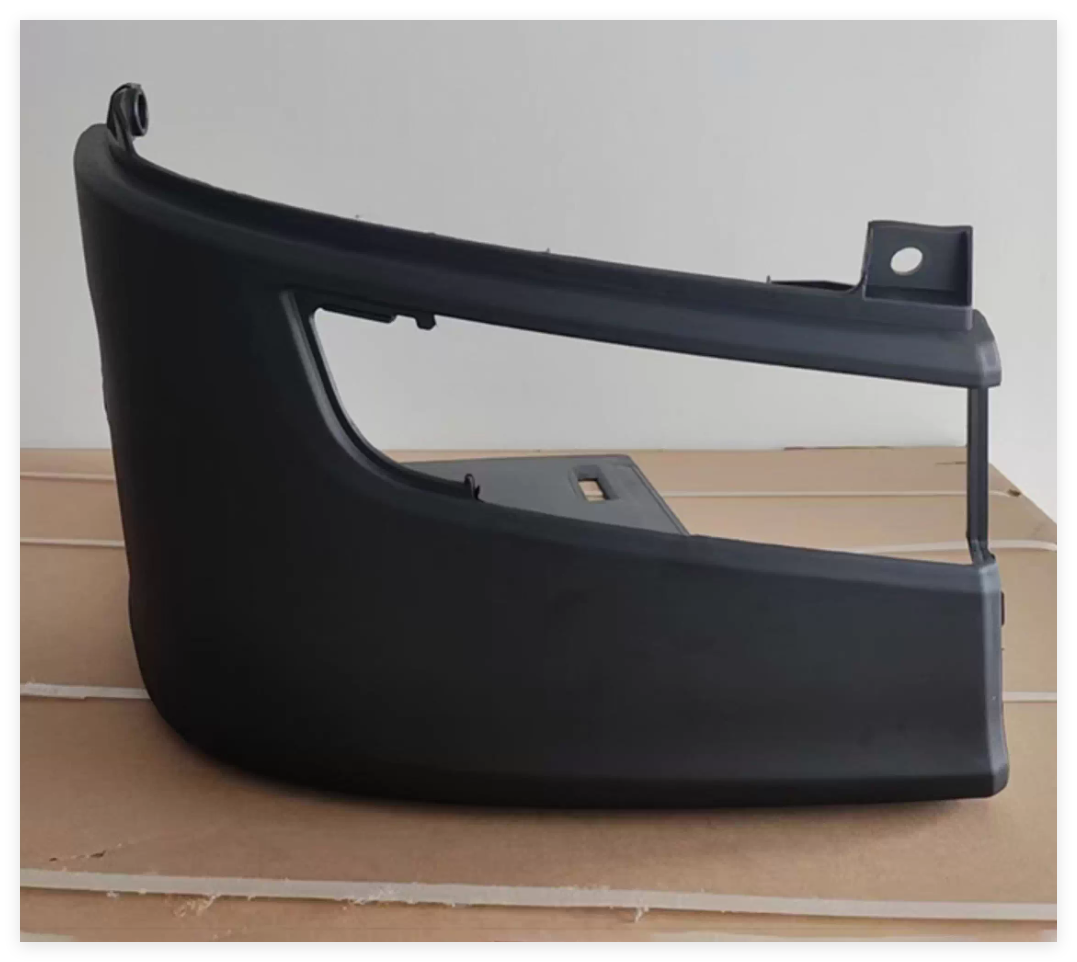
New Scania truck bumper middle section mold
New Scania truck bumper middle section mold

Engineering Excellence: Inside Ansix Tech's Journey to Master the New Scania Truck Bumper Mold
A single, invisible geometry ratio—precisely calibrated between 2.8 and 3.0—lies at the heart of Ansix Tech's success in creating a flawless, high-gloss bumper mold for Scania, demonstrating how deep technical mastery drives both quality and cost efficiency.
The middle section of a modern truck's bumper is far more than a simple piece of plastic. It is a complex structural panel that must withstand road debris, minor impacts, and harsh environmental conditions, all while presenting a flawless, high-gloss "Class A" surface that defines the vehicle's aesthetic appeal. For Ansix Tech, a leader in Precision Mold manufacturing, the project to produce the injection mold for the New Scania truck's bumper middle section represented a pinnacle of engineering challenge and opportunity.
This article delves into Ansix Tech's comprehensive process, from initial design to final delivery, revealing how the company leverages advanced simulation, material science, and process optimization to not only meet stringent automotive standards but also deliver significant cost savings to partners like Scania.
The Blueprint: Decoding Scania's Design Philosophy
The project's foundation was Scania's own patented design for vehicle panel components, a blueprint engineered to solve a persistent industry problem: visible sink marks on the exterior surface caused by internal reinforcement structures.
Scania's innovation centers on a specific "doghouse" or kennel-type fastener—a box-like structure molded into the back of the panel for attachment. The key to preventing defects lies in a critical thickness ratio. Scania's patent specifies that the ratio of the main panel's thickness (T1) to the side wall thickness of the fastener at the panel's inner surface (T2) must be maintained between 1.75 and 3.5, with an optimal sweet spot between 2.8 and 3.0.
Geometry in Action: By carefully controlling this ratio, the differential cooling and shrinkage between the thick panel and the thinner fastener walls are minimized, preventing the tell-tale sink mark on the visible A-surface.
Integrated Design: Ansix Tech's mold design team began by meticulously modeling this geometry, ensuring that every drafted wall, reinforcing rib, and fastener in the bumper's complex middle section adhered to these fundamental principles for manufacturability.
Scania’s patent also reveals sophisticated tweaks to the fastener design itself, such as inclining the side walls at the opening and incorporating recesses in the back wall to further guide material flow and reduce stress. This aligns perfectly with the modern trend towards modular bumper systems, where the middle section is a distinct, replaceable component designed for efficiency in both production and aftermarket service.
From Virtual to Physical: Prototyping and Design Validation
Before cutting any steel, Ansix Tech's engineers subjected the initial 3D model to rigorous Mold Flow Analysis (DFM). This virtual simulation is the first and most crucial line of defense against costly defects.
"We simulate the journey of every polymer molecule," explains a senior Ansix Tech process engineer. The software predicts how the melted plastic will fill the mold cavity, where weld lines might form as separate flow fronts meet, and how the part will cool and shrink.
For a large, complex part like a bumper, the analysis focused on several critical outcomes:
Balanced Filling: Ensuring the cavity fills evenly to prevent warpage.
Gate Location Optimization: Determining the optimal entry points for the plastic to minimize flow length and visible knit lines on critical surfaces.
Cooling Efficiency: Modeling the cooling system to predict and eliminate hot spots that cause uneven shrinkage and dimensional instability.
Following a successful virtual validation, Ansix Tech proceeded with a prototype mold, often using aluminum or softer steel for speed and lower initial cost. This phase is not about mass production but about empirical verification. The team produces sample parts to physically check for issues like sink marks (especially behind fasteners), warpage, and to confirm the ejection mechanism works without marking the part.
Any discrepancy between simulation and reality is fed back into the design in an iterative loop, refining the final mold design before the commitment to high-cost, hardened production steel is made.
The Foundation: Strategic Material Selection
The choice of material is a decisive factor in the performance, appearance, and total cost of the molded part. Scania’s patent indicates a preference for thermoplastic materials based on polycarbonate (PC) and its blends, which offer an excellent balance of toughness, dimensional stability, and surface gloss.
However, for a bumper middle section requiring high impact resistance and cost-effectiveness, industry practice often leans toward advanced polypropylene (PP) compounds or polybutylene terephthalate (PBT) blends.
Ansix Tech’s role involves deep consultation to align material properties with the mold design:
Flow Characteristics: Materials must have sufficient melt flow index to fill the large, thin-walled bumper section without excessive injection pressure.
Shrinkage Rate: Precise knowledge of the material's shrinkage (typically 1.5-2.0% for semi-crystalline plastics like PP) is directly engineered into the mold cavity dimensions.
Thermal Performance: The material must withstand the paint shop's bake ovens without distortion.
The following table contrasts two common material candidates for such an application:

By guiding the customer toward the most efficient material for the application, Ansix Tech provides the first major lever for long-term cost control, influencing everything from cycle time to scrap rates.
Building the Heart of Production: Key Aspects of Mold Design
The production mold is a masterpiece of mechanical engineering. Every system within it must work in perfect harmony.
Steel Selection: For a high-volume automotive part, pre-hardened or through-hardened tool steels like P20 or H13 are standard. They provide the necessary wear resistance for millions of cycles. Critical areas forming high-gloss surfaces are often made from premium stainless steels (e.g., S136) that can be polished to a mirror finish and resist corrosion from cooling water.
The Cooling System: This is arguably the most critical system for cycle time and part quality. Ansix Tech designs conformal cooling channels that follow the precise contours of the part at a near-constant distance. Compared to traditional drilled channels, conformal cooling provides up to 40% faster heat extraction, leading to shorter cycle times and more uniform cooling, which directly reduces warpage and improves dimensional stability.
Gating and Runner System: The choice between a hot runner and a cold runner system is a major economic decision. For a large part like a bumper produced in high volumes, a hot runner system is almost always justified.
Hot Runner System: Maintains the plastic in a molten state within heated manifolds, injecting directly into the cavity. It eliminates the solid runner waste, reduces injection pressure, and allows for better control over filling. While the initial mold cost is higher, the savings in material and cycle time provide a rapid return on investment for high-volume production.
Ejection System: The system must apply perfectly balanced force to release the large, flexible bumper from the mold without causing distortion, sticking, or visible ejector pin marks. Ansix Tech employs a network of large-diameter pins, sleeve ejectors for core pins, and sometimes air blasts or stripper plates for complex geometries.
Taming the Process: Injection Molding Challenges & Optimization
Molding a large, complex part like a bumper middle section presents unique challenges. Ansix Tech’s process engineers are specialists in diagnosing and solving these issues.
Common Defects & Solutions:
Sink Marks: The core challenge addressed by Scania’s design. If they appear, solutions include increasing packing pressure, extending packing time, or optimizing local cooling behind thick sections.
Weld Lines: Where separate plastic flow fronts meet, a weak, visible line can form. Remedies involve adjusting melt temperature, injection speed, or modifying gate locations to reposition the weld line to a non-critical area.
Warpage: Caused by uneven shrinkage. It is tackled by ensuring balanced cooling, optimizing packing pressure profiles, and sometimes adding strategic constraints to the part's design.
Process Optimization for Efficiency: Ansix Tech’s goal is to establish a robust, repeatable process window. Using data from initial runs, they fine-tune parameters to achieve the shortest possible cycle time without compromising quality.
Parameters: Typical optimization involves precise settings for injection speed (e.g., 25 cm³/sec), melt temperature (e.g., 270°C), and a carefully orchestrated pack-and-hold phase (e.g., 40 Bar for 3.0 seconds) to compensate for shrinkage.
Multidisciplinary Optimization (MDO): Advanced frameworks allow for the simultaneous optimization of cooling, gating, and structural design to minimize cycle time and pressure drop, yielding a Pareto-optimal solution for cost and performance.
A Culture of Precision: Quality Control and Assurance
Quality is not inspected in; it is built into every step. Ansix Tech’s quality management system for a project of this caliber involves multiple layers of validation.
First Article Inspection (FAI): A complete dimensional and functional analysis of the first parts from the production mold, using Coordinate Measuring Machines (CMM) and 3D scanning to verify compliance with all CAD data.
Process Control: Once in steady-state production, critical process parameters (temperatures, pressures, times) are continuously monitored and recorded. Any deviation triggers an alert.
Statistical Process Control (SPC): Key dimensions on sampled parts are measured and tracked using control charts to detect any trends toward specification limits before non-conforming parts are produced.
Comprehensive Defect Management: A clear plan is established for common bumper defects—from short shots and burn marks to contamination—with defined root-cause analysis procedures and corrective actions.
The Final Mile: Packaging and Rapid Delivery
For a high-value, high-precision mold, packaging is a critical logistics operation. Ansix Tech employs custom-designed, climate-controlled crating to protect the mold from physical shock, humidity, and temperature fluctuations during shipping. Every component, from inserts to spare ejector pins, is securely housed and documented.
The rapid delivery process is underpinned by the company's "systematic management and order progress transparency". From the outset, the project is managed with integrated digital tools that provide real-time visibility into every milestone—design completion, steel procurement, machining status, and assembly. This proactive communication and structured workflow are what enable Ansix Tech to function as a true "manufacturing partner," reliably delivering complex tooling on schedule.
Conclusion: Delivering Reliability and Value Beyond the Mold
The creation of the New Scania truck bumper middle section mold is a testament to Ansix Tech’s holistic engineering philosophy. It demonstrates that true value in injection molding is not merely about manufacturing a tool; it is about integrating design for manufacturability, material science, and process mastery into a seamless, efficient system.
By deeply understanding and applying foundational patents like Scania's, leveraging advanced simulation to prevent defects before they occur, and implementing optimized cooling and gating systems, Ansix Tech achieves a powerful result: a significant reduction in the total cost of ownership for their customers. This cost saving is realized through less material waste, shorter cycle times, higher part quality yielding lower scrap rates, and a more reliable, durable production tool.
In the competitive world of automotive manufacturing, where every second and every cent counts, partners like Ansix Tech provide the technical leadership and operational reliability that allow global brands to bring high-quality, innovative products to market efficiently and confidently.




Ansix Tech Co Ltd
If you have any plans related to New Scania truck bumper middle section mold, you can contact us at any time. We will turn your ideas into reality, let you realize your dreams, and obtain large orders from the market. Our contact information is info@ansixtech.com. Or contact our CTO, mail: stephen@ansixtech.com
#www.ansixtech.com #ansixtech.com #New Scania truck bumper middle section mold #Ansix mold factory #Ansix injection molding #Ansix moud Ltd #New Scania truck bumper middle section mold injection molding factory #Ansix injection mould #New Scania truck bumper middle section mold factory #New Scania truck bumper middle section mold injection molding company #New Scania truck bumper middle section mold injection mold companies #Ansix #Ansix moulds #Ansix china #Ansix tech china #Ansix tech company #Ansix facotry #Ansix Tech #Ansix molds #Ansix injection molding #Ansix mold factory #injection molding New Scania truck bumper middle section mold # Ansix mold factory #New Scania truck bumper middle section mold china #New Scania truck bumper middle section mold precision molds #injection factory #New Scania truck bumper middle section mold precision injection molding #New Scania truck bumper middle section mold injection molding factory #injection molding company #New Scania truck bumper middle section mold injection mold companies #New Scania truck bumper middle section mold mould factory #New Scania truck bumper middle section mold mold limited #Ansix mold china #Ansix companies #Ansix company China #New Scania truck bumper middle section mold facotry #Ansix Tech #Ansix Tech mould #New Scania truck bumper middle section mold injection moulding #injection moulding company #Ansix New Scania truck bumper middle section mold parts injection mold companies #New Scania truck bumper middle section mold #New Scania truck bumper middle section mold china #New Scania truck bumper middle section mold china factory #Ansix moulding companies #Ansix molding company #New Scania truck bumper middle section mold injection moulding facotry #Ansix Tech mold #New Scania truck bumper middle section mold precision mould #New Scania truck bumper middle section mold plastic injection molding #ansix plastic mold #Mold manufacturing #New Scania truck bumper middle section mold parts manufacturing #New Scania truck bumper middle section mold plastic parts factory #New Scania truck bumper middle section mold injection parts mold #New Scania truck bumper middle section mold PRECISION MANUFACTURING #New Scania truck bumper middle section mold precision #China mold #New Scania truck bumper middle section mold injection moulding china #New Scania truck bumper middle section mold mould china #china precision mold #mold in china #New Scania truck bumper middle section mold precision mold china #Precision molds #High-precision molds #Household appliance molds #Injection molds #New Scania truck bumper middle section mold Factory #New Scania truck bumper middle section mold Company #Super Large Injection Mold Factory #Large Tonnage Injection Molding Factory #New Scania truck bumper middle section mold Company #Super New Scania truck bumper middle section mold Factory #2800T Injection Molding Factory #3000 Ton Injection Molding #4500 Ton Injection Molding Factory #Large Mold Injection Molding #Large Plastic Mold Injection Molding Factory #Large Injection Mold Manufacturer #Plastic Mold Factory #Injection Mold #Plastic Mold