



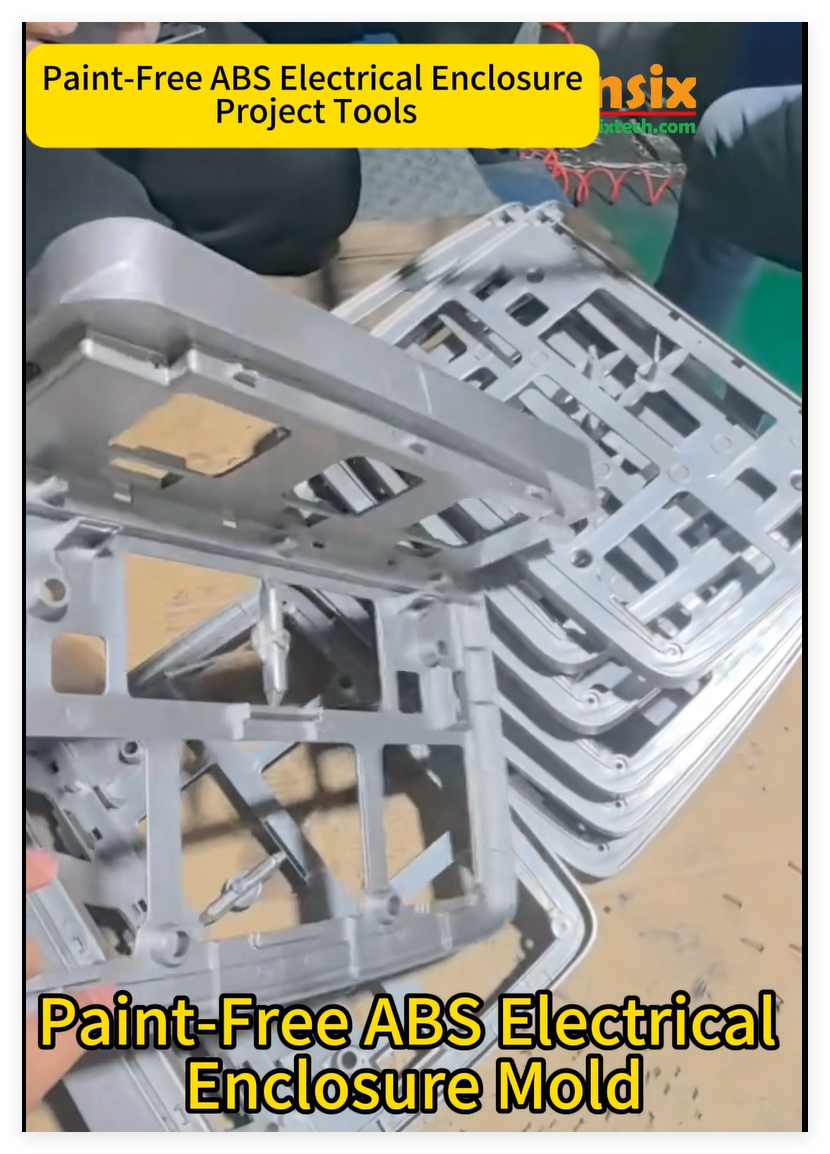
Paint-Free ABS Electrical Enclosure Mold
Paint-Free ABS Electrical EnClosure Mold

The Paint-Free Revolution: How Ansix Tech is Redefining Aesthetics and Cost Structure in ABS Electrical Enclosure Molding
In the competitive landscape of electrical component manufacturing, surface finish has long been a costly bottleneck. For decades, achieving a high-gloss, defect-free exterior on ABS electrical enclosures has necessitated a secondary painting or coating operation—a process fraught with environmental compliance hurdles, labor inefficiencies, and the ever-present risk of adhesion failure or surface blemishes.
However, a paradigm shift is underway. Spearheading this movement is Ansix Tech, a specialized manufacturer with over 28 years of expertise in the design and manufacturing of Paint-Free ABS Electrical Enclosure Molds. In an exclusive industry deep-dive, we examine how Ansix Tech is not merely manufacturing tools but is fundamentally altering the total cost of ownership (TCO) for electrical component manufacturers by eliminating paint through superior mold engineering.
This article explores the initiation of Ansix Tech’s dedicated paint-free mold projects, the rigorous methodologies employed to validate quality, and the strategic engineering interventions that allow for the mass production of enclosure systems that meet—and often exceed—the aesthetic standards of painted alternatives, all while slashing the "hard costs" associated with production.
The Genesis: Initiating the Paint-Free ABS Mold Project
The decision to move from painted to paint-free enclosures is rarely a simple one for original equipment manufacturers (OEMs). It requires a fundamental rethinking of supply chain logistics and quality assurance. For Ansix Tech, the initiation of a paint-free project begins not with steel cutting, but with a consultative design review.
Historically, OEMs accepted the "paint or coat" paradigm because they believed it was the only way to hide surface imperfections inherent in the molding process—weld lines, sink marks, or flow hesitation. Ansix Tech’s strategic market positioning flips this narrative. By aligning product standards with specific client and market demands from the outset, the company’s engineering team treats the mold as a precision optical instrument rather than a simple forming tool.
When Ansix Tech initiates a project, the primary focus is the final application. Is the enclosure destined for a clean-room environment where outgassing from paint is unacceptable? Is it for consumer-facing electronics where scratch resistance is paramount? By defining these parameters early, the team establishes the baseline for the Paint-Free ABS Electrical Enclosure Mold specifications. The goal is simple: to extract the aesthetic quality of Class-A automotive surfaces directly from the mold cavity, eliminating the need for a paint shop entirely.
Value Delivery: Solving the "Hard Cost" Equation
The most tangible value Ansix Tech delivers to its clients is the drastic reduction of "hard costs." In manufacturing vernacular, hard costs refer to the direct, quantifiable expenses tied to production—raw materials, labor, energy, and capital equipment. Painting operations are notorious for inflating these categories.
By transitioning clients to paint-free molds, Ansix Tech eliminates:
Material Costs: Liquid paint, primers, and thinners constitute a recurring consumable expense. By removing these, clients see immediate material cost savings.
Labor & Throughput: Painting lines require dedicated labor for masking, spraying, curing, and inspection. These steps add hours to the production cycle. Paint-free molding allows for a single-step process: melt, inject, cool, eject.
Capital Expenditure: The elimination of paint booths, drying ovens, and environmental abatement systems reduces the capital barrier to entry for scaling production.
Yield Loss: Paint defects (orange peel, runs, dust inclusions) typically account for a 3-8% scrap rate in traditional finishing. Paint-free molds, when executed correctly, shift the quality burden to the molding machine, where statistical process control (SPC) can maintain yields above 98%.
As one Ansix Tech senior engineer noted, "We are not just selling a mold; we are selling the closure of an entire factory department. When we remove paint, we remove complexity. Complexity is the enemy of cost control."
Material Science: The Foundation of the Paint-Free Surface
The success of a paint-free enclosure hinges entirely on the selection of raw materials. Standard ABS, while robust, often contains flow modifiers and release agents that can cause "marbling" or "splay" on large, flat surfaces—defects that paint would normally conceal.
Ansix Tech employs a rigorous material selection protocol for Paint-Free ABS Electrical Enclosure Mold components. The company specifies high-gloss, UV-stabilized ABS grades specifically engineered for cosmetic applications. Key material characteristics include:
Chemical Composition: The team prioritizes materials with optimized lubricant packages. Excess lubricant (calcium stearate or amide waxes) migrates to the surface during injection, creating a haze. Ansix Tech’s material specifications demand low-volatility, high-fluidity grades that maintain structural integrity without surface contamination.
Specific Grades: For high-gloss applications, the company frequently utilizes specialized grades such as *LG ABS HI-121H* or *CHIMEI POLYLAC PA-747*, known for their superior flow properties and mirror-finish capability. For applications requiring flame retardancy (UL94 V-0) combined with a paint-free finish, the engineering team leverages modified ABS/PC blends that resist the shear degradation typically caused by flame-retardant additives, which often result in surface discoloration in standard molding processes.
The selection process also accounts for shrinkage consistency. In paint-free molds, even a 0.1% variance in shrinkage can result in witness lines or texture mismatches. Ansix Tech validates material batches through capillary rheometry to ensure viscosity stability across the intended processing window before the first mold is machined.
Pre-Engineering: Mold Flow Analysis and DFM
Before the first chip of steel is cut, the digital simulation phase begins. Ansix Tech utilizes advanced Mold Flow Analysis software to de-risk the paint-free strategy. Because there is no paint to hide sink marks or weld lines, the simulation must predict and eliminate these defects in the virtual environment.
Mold Flow Analysis (MFA)
The MFA for a paint-free ABS enclosure focuses intensely on:
Filling Imbalance: For multi-cavity molds, ensuring that each cavity fills simultaneously to prevent overpacking in one cavity while another is still filling.
Air Traps: Predicting venting requirements to prevent "gas burns" that would appear as black specks on the final unpainted surface.
Shear Heating: ABS is sensitive to shear. Excessive shear during injection degrades the polymer, causing splay (silver streaks). MFA allows Ansix Tech to optimize runner diameters to maintain shear rates below the degradation threshold of the specific ABS grade.
Design for Manufacturability (DFM)
The DFM phase is critical for aligning the client’s design intent with the realities of paint-free molding. Ansix Tech provides detailed feedback on:
Wall Thickness Uniformity: Transition zones are redesigned to be gradual. Sharp steps in wall thickness create differential cooling rates, leading to sink marks opposite ribs or bosses—an aesthetic death sentence for paint-free parts.
Draft Angles: While painted parts can often get away with 0.5° to 1° of draft, paint-free parts, particularly those with gloss or textured finishes, require optimized draft angles (typically 1.5° to 3°) to prevent scuffing during ejection.
Mold Design and Manufacturing: Where Precision Meets Aesthetics
The manufacturing of a Paint-Free ABS Electrical Enclosure Mold represents the apex of precision machining. Unlike standard molds where minor surface imperfections can be buffed out or hidden by texture, paint-free molds require optical-grade surface finishing on the cavity steel.
Critical Considerations in Mold Design
The design architecture of the mold itself dictates the success of the paint-free finish. Ansix Tech employs a "zero-defect" design philosophy focusing on three pillars:
Steel Selection: The mold material must be homogenous and capable of taking a high polish without pitting. Ansix Tech predominantly utilizes Stavax ESR (Electro-Slag Remelting) or Bohler M333 for cavity plates. These stainless tool steels offer superior corrosion resistance (critical for cooling channel integrity) and allow for polishing to SPI (Society of the Plastics Industry) A-1 diamond-grade finishes—the equivalent of a flawless mirror.
Machining Process Workflow: Achieving an A-1 finish requires a specific machining workflow. Ansix Tech employs high-speed CNC machining with carbide micro-tools to achieve the initial geometry, followed by electrical discharge machining (EDM) for sharp internal corners. However, the critical step is the transition from machining to manual polishing. The company utilizes a combination of ultrasonic polishing and manual diamond compound lapping to remove machining lines without introducing "orange peel" (waviness) that can distort reflections.
Parting Line Management: On a painted part, the parting line is often obscured by the paint film. On a paint-free part, the parting line must be virtually invisible. Ansix Tech utilizes precision locking mechanisms (tapered interlocks) and zero-draft shutoffs where necessary to ensure that the steel-to-steel contact is so precise that the resulting witness line is imperceptible to the naked eye.
Advanced Systems: Cooling, Gating, and Ejection
The "invisible" systems within the mold—cooling, runners, and ejection—are arguably the most critical for paint-free quality.
Cooling System Design
Uniform cooling is the holy grail of paint-free molding. Differential cooling leads to differential shrinkage, which creates "stress marks" and "gloss differentials" on the surface.
Ansix Tech employs conformal cooling strategies for complex enclosure geometries. Using 3D-printed inserts or precision-machined beryllium-copper alloy components in high-heat zones, the company ensures that the mold temperature remains uniform across the entire cavity surface. This is not just about speed; it is about maintaining a consistent surface energy. If one section of the cavity is 60°C and another is 80°C, the ABS will crystallize (or solidify) at different rates, resulting in a patchy appearance.
Runner and Gating Systems
The gate location is a strategic decision. For paint-free enclosures, the gate must be placed to avoid flow hesitation and to eliminate "gate blush"—a halo effect around the gate caused by shear heating and jetting.
Ansix Tech favors large, fan gates or submarine (tunnel) gates located on non-cosmetic surfaces (such as the interior of the enclosure or mounting flanges) whenever possible. If a direct gate on the cosmetic surface is unavoidable, the company designs the gate geometry to act as a "shear stress reliever," gradually expanding the flow front to reduce jetting.
Ejection Systems
Ejection marks are a common failure point. Standard ejector pins, if slightly misaligned, can leave witness marks on the exterior surface. For high-gloss paint-free molds, Ansix Tech utilizes:
Hydraulic Stripper Plates: Instead of pins, a full stripper plate ejects the part evenly, distributing force across the entire perimeter to prevent deformation.
Surface Pins: Where pins must be used, they are designed with "witness-proof" geometry, placing the pin contact on a textured area or utilizing vacuum ejection systems to eliminate mechanical contact altogether.
Validation and Injection Molding Optimization
Once the mold is machined and assembled, the validation phase begins. This is where Ansix Tech’s 28 years of manufacturing expertise transitions from engineering theory to production reality.
Validation of Paint-Free Molds
The initial molding trials are conducted under strict conditions. The team runs a Design of Experiments (DOE) to map the process window. For paint-free parts, the validation focuses on:
Surface Gloss Units (GU): Using gloss meters to verify that the entire surface meets the target gloss rating (typically >90 GU for high-gloss applications).
Haze and Clarity: Inspecting for bloom (migrating additives) after 24 hours of aging.
Stress Testing: Utilizing polariscope analysis to view stress patterns. High residual stress in a paint-free part will eventually lead to environmental stress cracking (ESC) when exposed to cleaning agents or electrical contact coolants.
Technical Difficulties in Injection Molding
Even with a perfect mold, the injection molding process presents challenges for paint-free parts. Common technical difficulties addressed by Ansix Tech include:
Splay: Caused by moisture in the resin. Ansix Tech mandates the use of desiccant dryers to ensure moisture content is below 0.02% before processing.
Weld Lines: Unavoidable around venting holes or assembly features. The team optimizes melt temperature and injection speed to ensure weld lines are "over-packed" sufficiently to render them visually negligible.
Dust Contamination: In a standard facility, airborne dust settles on the mold face between cycles. For paint-free production, Ansix Tech recommends or implements Class 100,000 cleanroom environments for the injection presses to prevent particulate inclusion on the glossy surface.
Optimization of Injection Molding Parameters
Efficiency gains in paint-free molding come from the elimination of secondary operations. However, the primary process must be finely tuned to maintain speed without sacrificing cosmetics.
Ansix Tech employs a closed-loop process control strategy:
Velocity Control: Using high injection velocities (fast fill) to freeze the surface skin before it can develop haze, followed by a controlled pack/hold phase to fill the shrinkage without creating sink marks.
Mold Temperature Control: Utilizing high-temperature water or oil units (ranging from 60°C to 80°C for high-gloss ABS) to maintain the cavity surface temperature above the glass transition temperature long enough to replicate the steel polish exactly.
Cost Control: By optimizing cycle times through conformal cooling and robotic part removal, Ansix Tech ensures that the cost-per-part remains competitive with—or lower than—painted alternatives, despite the higher initial tooling investment.
Quality Assurance and Rapid Delivery Workflow
Ansix Tech’s commitment extends beyond the mold shop to the final assembly and delivery. The company offers a vertical integration model: from prototype design, through manufacturing and validation, to mass production and assembly verification.
Quality Control and Assurance Protocols
Quality protocols for paint-free projects are more stringent than standard injection molding. Every part is inspected for:
Optical Defects: Automated vision systems equipped with high-resolution cameras scan the surface of each enclosure for scratches, pits, or flow lines that are invisible to the naked eye under standard lighting but would be unacceptable to the end-user.
Dimensional Accuracy: Utilizing coordinate measuring machines (CMM) and optical comparators to ensure that the elimination of paint—which typically adds 0.001” to 0.003” of thickness—does not affect the fit of internal components. The mold is engineered to account for the "paint gap," ensuring that the fit of components is precise without the cushion of a paint layer.
Manufacturing Workflow Ensuring Rapid Delivery
Speed to market is a critical metric. Ansix Tech has refined its workflow to compress the timeline for paint-free molds:
Concurrent Engineering: DFM analysis is delivered within 72 hours of receiving the client CAD model, allowing for immediate modifications.
Steel Sourcing: Pre-hardened and pre-treated steel stocks are maintained in inventory for standard projects, shaving weeks off lead times.
In-House Machining: With CNC, EDM, and polishing all performed in-house, there are no delays from third-party vendors.
Sampling & Ship: A dedicated team handles the transition from mold trial to mass production, ensuring that the mold is shipped with a validated process sheet, allowing the client (or Ansix Tech’s own molding division) to achieve "first-time-right" production.
Reliability and Industry Experience
With over 28 years in the trenches of injection molding and toolmaking, Ansix Tech brings a historical perspective to modern manufacturing challenges. The company has witnessed the evolution of ABS materials, the rise of automation, and the shifting demands of electrical safety standards (UL, IEC).
This experience translates to reliability. Clients engaging with Ansix Tech for Paint-Free ABS Electrical Enclosure Mold projects benefit from institutional knowledge that prevents common pitfalls. For instance, the company’s engineers know from experience that a specific UL94 V-0 ABS grade may require a 15°C higher mold temperature than a standard grade to achieve the same gloss finish—a nuance that is often missed by less experienced toolmakers.
Furthermore, the company’s focus on assembly verification ensures that the enclosures produced not only look good but function flawlessly. By validating the assembly process—ensuring that bosses do not crack under screw torque and that snap-fits retain their elasticity—Ansix Tech guarantees that the elimination of paint does not come at the expense of structural integrity.
Conclusion: The Future of Enclosure Manufacturing
As global supply chains continue to tighten and environmental regulations around volatile organic compounds (VOCs) become stricter, the demand for paint-free solutions will only accelerate. Ansix Tech has positioned itself at the vanguard of this shift.
By treating the mold as the primary finishing tool rather than just a forming tool, Ansix Tech demonstrates that superior aesthetics and superior cost structures are not mutually exclusive. Through strategic material selection, precision mold manufacturing, and rigorous process validation, the company consistently delivers reliability and value to its clients.
The "hard costs" saved by eliminating paint—material, labor, capital, and compliance—provide OEMs with a significant competitive advantage. In an industry where margins are tight and quality expectations are rising, the engineering of Paint-Free ABS Electrical Enclosure Molds represents not just a manufacturing advancement, but a strategic imperative.
For companies seeking to modernize their production lines and deliver superior, ready-to-use electrical enclosures directly out of the mold, Ansix Tech’s 28-year legacy offers a clear path forward: a future where the paint shop is obsolete, and the perfect finish begins with the steel.



Ansix Tech Co Ltd
If you have any plans related to Paint-Free ABS Electrical Enclosure Mold , you can contact us at any time. We will turn your ideas into reality, let you realize your dreams, and obtain large orders from the market. Our contact information is info@ansixtech.com. Or contact our CTO, mail: stephen@ansixtech.com
#www.ansixtech.com #ansixtech.com #Paint-Free ABS Electrical Enclosure Mold #Paint-Free ABS Electrical Enclosure Mold #Paint-Free ABS Electrical Enclosure Mold injection molding company #Paint-Free ABS Electrical Enclosure Mold injection mold companies #Ansix #Ansix moulds #Ansix china #Ansix tech china #Ansix tech company #Ansix facotry #Ansix Tech #Ansix molds #Ansix injection molding #Ansix mold factory #injection molding Paint-Free ABS Electrical Enclosure Mold #Ansix mold factory #Paint-Free ABS Electrical Enclosure Mold china #Paint-Free ABS Electrical Enclosure Mold molds #injection factory #Paint-Free ABS Electrical Enclosure Mold injection molding #Paint-Free ABS Electrical Enclosure Mold injection molding factory #injection molding company #Paint-Free ABS Electrical Enclosure Mold injection mold companies #Paint-Free ABS Electrical Enclosure Mold#Paint-Free ABS Electrical Enclosure Mold mold limited #Ansix mold china #Ansix companies #Ansix company China #Paint-Free ABS Electrical Enclosure Mold facotry #Ansix Tech #Ansix Tech mould #Paint-Free ABS Electrical Enclosure Mold injection moulding #injection moulding company #Ansix Paint-Free ABS Electrical Enclosure Mold parts injection mold companies #Paint-Free ABS Electrical Enclosure Mold #Paint-Free ABS Electrical Enclosure Mold china #Paint-Free ABS Electrical Enclosure Mold china factory #Ansix moulding companies #Ansix molding company #Paint-Free ABS Electrical Enclosure Mold injection moulding facotry #Ansix Tech mold #Paint-Free ABS Electrical Enclosure Mold mould #Paint-Free ABS Electrical Enclosure Mold plastic injection molding #ansix plastic mold #Mold manufacturing #Paint-Free ABS Electrical Enclosure Mold parts manufacturing #Paint-Free ABS Electrical Enclosure Mold plastic parts factory #Paint-Free ABS Electrical Enclosure Mold injection parts mold #Paint-Free ABS Electrical Enclosure Mold PRECISION MANUFACTURING #Paint-Free ABS Electrical Enclosure Mold #China mold #Paint-Free ABS Electrical Enclosure Mold injection moulding china #Paint-Free ABS Electrical Enclosure Mold mould china #china precision mold #mold in china #Paint-Free ABS Electrical Enclosure Mold mold china #Precision molds #High-precision molds #Paint-Free ABS Electrical Enclosure Mold #Injection molds #Paint-Free ABS Electrical Enclosure Mold Factory #Paint-Free ABS Electrical Enclosure Mold Company #Super Large Injection Mold Factory #Large Tonnage Injection Molding Factory #Paint-Free ABS Electrical Enclosure Mold Company #Paint-Free ABS Electrical Enclosure Mold Factory #2800T Injection Molding Factory #3000 Ton Injection Molding #4500 Ton Injection Molding Factory #Large Mold Injection Molding #Large Plastic Mold Injection Molding Factory #Large Injection Mold Manufacturer #Plastic Mold Factory #Injection Mold #Plastic Mold