



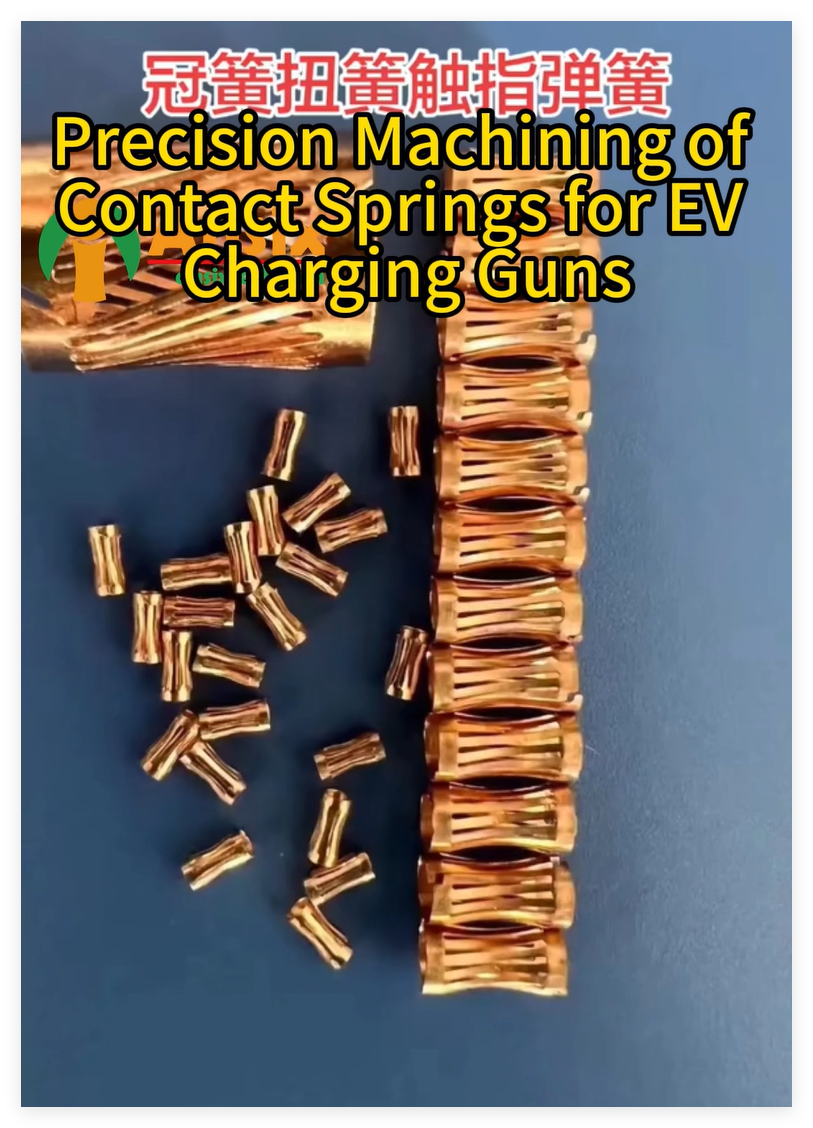
Precision Machining of Contact Springs for EV Charging Guns
Precision Machining of Contact Springs for EV Charging Guns

Precision Under Pressure: How Ansix Tech is Redefining the Metallurgical Backbone of EV Charging Infrastructure
As the global automotive industry pivots decisively toward electrification, the spotlight often falls on battery density, motor efficiency, and software integration. Yet, lurking beneath the surface of every electric vehicle (EV) is a component that is arguably as critical as the battery cells themselves: the contact spring inside the charging gun. This unassuming metal component is the first point of physical interface between the grid and the vehicle. It must withstand thousands of insertion cycles, resist corrosion from the elements, and manage the thermal stress of ultra-fast charging—all while maintaining microscopic tolerances to ensure signal integrity and safety.
In this high-stakes arena, the difference between a reliable charging session and a catastrophic arc fault often comes down to microns. For over 28 years, Ansix Tech has been operating in this exact space of precision, evolving from a specialized manufacturer into a strategic partner for the EV ecosystem. With the recent initiation of a dedicated high-volume project for the precision machining of contact springs, Ansix Tech is not merely supplying parts; it is redefining the economic and engineering model for how these mission-critical components are brought to market.
This article delves into the engineering rigor, manufacturing philosophy, and strategic cost-containment measures that define Ansix Tech’s approach to the EV charging gun sector.
The Genesis of a Specialized Project
The initiation of Ansix Tech’s latest project for contact springs was not born out of a simple request for quotation (RFQ). It was the result of a confluence of market pressures facing the EV industry: the need for higher amperage (leading to 500A+ charging), the demand for lighter charging handles, and the relentless pressure to reduce the total cost of ownership for charging station operators.
Traditional contact spring manufacturing often involved a fragmented supply chain—one vendor for stamping, another for plating, and yet another for assembly. This fragmentation introduces variables that can compromise the final mechanical performance. Ansix Tech’s project initiation was predicated on a vertically integrated solution. By centralizing the design, tooling, machining, and validation under one roof, Ansix Tech aimed to eliminate the tolerance stack-ups that plague multi-vendor supply chains.
The company’s approach begins not with metal, but with data. Utilizing Advanced Mold Flow Analysis and Design for Manufacturability (DFM) protocols, Ansix Tech’s engineering team deconstructs the client’s performance requirements before the first piece of steel is cut. For contact springs, which often serve a dual purpose of electrical conductivity and mechanical resilience (spring force), the DFM phase is critical. The team analyzes the spring’s deflection path, cycle life expectations, and the specific insertion force required by the charging gun’s locking mechanism. By simulating the injection molding process that will encapsulate or support these springs, Ansix ensures that the metal component will interact flawlessly with the plastic housing, preventing issues like stress cracking or misalignment during thermal expansion.
Solving the Core Problems: Heat, Wear, and Signal Integrity
The primary problems Ansix Tech solves for its clients revolve around the physics of contact.
Thermal Management: As EV charging speeds escalate to 350kW and beyond, contact temperatures can spike. Excessive heat leads to oxidation, which increases resistance, creating a dangerous feedback loop. Ansix Tech solves this through material selection and geometric precision.
Fretting Corrosion: The micro-movements caused by vehicle vibration and thermal cycling can wear away surface plating, exposing base metals to corrosion. Ansix Tech’s precision machining ensures that the surface finish and geometry are optimized to maintain consistent contact pressure, minimizing fretting.
Mating Cycle Longevity: Charging guns are expected to endure 10,000 to 20,000 mating cycles. Inconsistent manufacturing leads to premature "looseness." By maintaining tolerances within ±0.01mm, Ansix Tech guarantees that the spring’s mechanical properties remain consistent throughout the product’s lifespan.
The Metallurgy of Conductivity: Raw Material Selection
The foundation of any high-performance contact spring is the raw material. Ansix Tech does not take a one-size-fits-all approach. The selection of the copper alloy is a strategic decision based on the client’s specific amperage and mechanical requirements.
For high-power applications requiring superior conductivity, Ansix Tech frequently specifies C18000 (Copper-Nickel-Chromium) or C19400 (Copper-Iron) .
C18000 is selected for applications demanding high stress relaxation resistance at elevated temperatures. With a conductivity rating of approximately 80% IACS (International Annealed Copper Standard), it provides the necessary electrical efficiency while maintaining mechanical integrity at the 180°C+ temperatures that can occur during continuous fast charging.
C19400 is often the choice for applications where cost optimization is balanced against performance. It offers good strength and conductivity (approx. 65% IACS) and is highly formable, making it ideal for complex machined geometries that require tight bend radii without micro-fracturing.
For scenarios where the contact spring serves as a grounding or signal interface rather than a power carrier, Ansix Tech utilizes Phosphor Bronze (C54400 or C51000) . These alloys are chosen for their exceptional fatigue resistance and low coefficient of friction. The material composition includes a precise balance of tin (4-6%) and phosphorus, which acts as a deoxidant, improving the spring’s ability to return to its original shape after repeated compression.
Ansix Tech’s procurement strategy involves direct partnerships with mills to ensure that the grain structure of the incoming rod or wire is consistent. For precision machining, inconsistencies in grain direction can lead to "stringiness" during cutting, resulting in burrs that can compromise electrical contact. By controlling the material grade and temper (typically ½ hard to full hard), Ansix ensures that the machinability is optimized for the specific turning or milling process.
The Tooling Crucible: Engineering for High-Volume Production
The transition from a validated prototype to a million-unit-per-year production line hinges entirely on the tooling. For precision-machined contact springs—which are often produced on Swiss-type automatic lathes rather than traditional stamping presses for higher complexity—the tooling strategy must account for speed, wear, and repeatability.
Mold Flow Analysis and DFM
For components that are overmolded (i.e., the metal spring is inserted into a plastic housing via injection molding), Ansix Tech performs exhaustive Mold Flow Analysis. This simulation predicts how the molten plastic (often high-temperature nylons like PA6T or PA9T) will flow around the metal insert. The analysis identifies weld lines, air traps, and potential deformation of the metal insert due to Injection Pressure. The DFM feedback loop often results in subtle changes to the metal part—such as adding flats or dimples—to ensure rotational stability within the mold cavity.
Mold Design Considerations
The mold design for contact springs is a study in precision. Because these components are often small (ranging from 5mm to 50mm in length), the mold must be a multi-cavity configuration (16, 32, or even 64 cavities) to achieve the throughput required for EV mass production.
Key considerations include:
Parting Line Placement: Ansix Tech strategically places parting lines away from critical electrical contact surfaces to prevent flash that could interfere with conductivity.
Core and Cavity Alignment: For insert molding, the mold features hardened steel fingers that precisely locate the metal contact spring. Any deviation here results in "steel safe" conditions where the plastic encapsulates the contact face. Ansix Tech uses guided ejection systems and robust interlocking devices to maintain alignment over millions of cycles.
Challenges in Mold Manufacturing
The technical challenges in mold manufacturing for this sector are twofold: geometry and wear. Contact springs often feature undercuts, knurled surfaces (for wire termination), or conical tapers. Machining these features in the mold steel requires 5-axis CNC machining centers capable of holding tolerances of ±0.002mm.
Ansix Tech utilizes hard milling techniques, machining the mold components after they have been heat-treated to 48-52 HRC. This eliminates the tolerance errors associated with electrode wear in EDM (Electrical Discharge Machining) for certain geometries, ensuring that the mold cavity is a perfect negative of the desired spring housing.
Mold Processing Workflow
The workflow is rigidly structured:
Steel Selection: For high-cavitation molds, Ansix selects S136 (Stavax) stainless steel for its corrosion resistance and polishability, ensuring that the plastic parts eject cleanly without drag marks.
Machining: High-speed machining centers rough out the cavities, followed by finishing passes with carbide micro-tools (as small as 0.3mm diameter).
EDM (if required): For intricate internal corners where a cutter cannot reach, CNC EDM is employed using precision-ground electrodes.
Polishing: Critical surfaces, particularly those that will form the sealing areas around the spring, are polished to a mirror finish (SPI A-1) to prevent plastic adhesion.
Cooling Systems and Gating
To meet high-volume demands, cycle time is king. Ansix Tech’s mold design incorporates conformal cooling channels—3D-printed inserts that follow the contour of the part. Unlike traditional straight-line cooling, conformal cooling reduces cycle times by up to 30% by extracting heat uniformly from the complex geometry of the contact spring housing.
The gating system is meticulously designed. For contact springs, the gate location is critical to avoid jetting, which can wash away the lubricants applied to the metal spring or distort the surrounding plastic geometry. Ansix typically employs submarine (tunnel) gates or hot runner systems with valve gates to precisely control the fill speed, ensuring that the high-viscosity, glass-filled plastics used in EV charging components do not impinge directly on the critical contact interface.
Runner and Ejection Systems
To minimize material waste—a key component of cost reduction—Ansix Tech utilizes cold runner systems with optimized runner diameters to balance fill pressure across all cavities. The ejection system utilizes a combination of ejector pins and stripper plates. For contact springs, where the plastic part often has thin walls, stripper plates provide a larger surface area for ejection, preventing deformation of the part as it is pushed off the core pins.
Injection Molding: Validation and Process Optimization
Once the mold is mounted on a high-speed injection molding machine (typically electric machines for their precision and energy efficiency), the validation process begins.
The technical challenges during injection molding are significant. The high-temperature engineering plastics used (such as PBT or PA66 with 30% glass fiber) are abrasive and have narrow processing windows. If the melt temperature is too low, the plastic will not flow around the metal insert completely, causing voids. If too high, the plastic degrades, releasing gases that can plate out onto the mold surface, causing cosmetic rejects that can affect the sealing of the charging gun.
Ansix Tech’s process optimization focuses on efficiency gains and cost control.
Scientific Molding: The company employs a scientific molding methodology, where they perform a Design of Experiments (DOE) to identify the optimal fill speed, pack pressure, and cooling time. The goal is to achieve a CpK (Process Capability Index) of >1.33 for critical dimensions—the distance between the contact spring tip and the plastic datum.
Automation: To control labor costs, Ansix integrates robotic arms for insert loading. For contact springs, which are delicate and often require specific orientation, vision-guided robots place the metal components into the mold with sub-millimeter accuracy. This not only speeds up the cycle but also eliminates the risk of human error causing mold damage (a significant hidden cost).
Quality Assurance and Hard Cost Reduction
A central theme of Ansix Tech’s value proposition is its ability to reduce "hard costs" for clients. Hard costs refer to the direct, tangible expenses of production: raw materials, consumables, labor, and scrap.
Ansix Tech achieves this reduction through several strategic levers:
Material Utilization: In precision machining of contact springs (turning), material waste is often high. Ansix Tech utilizes Swiss-type CNC machining which supports bar feeders and minimizes remnant lengths. By optimizing the cut-off process and collaborating with material suppliers to provide custom bar lengths, Ansix has reduced material waste by an average of 15-20% compared to standard industry practices.
Process Integration: By combining stamping, machining, and injection molding in-house, Ansix eliminates the logistics costs and markup associated with external vendors. The company also conducts assembly verification in-line. Instead of shipping components to a client for assembly, Ansix Tech provides sub-assemblies where the contact springs are already integrated into the plastic housing, tested for conductivity and insertion force, reducing the client’s assembly line complexity and overhead.
Zero-Defect Mindset: The cost of poor quality in the EV industry is catastrophic (recalls, safety liabilities). Ansix Tech implements rigorous quality control protocols. Every production batch undergoes:
First Article Inspection (FAI): A complete dimensional layout using CNC vision measuring systems.
In-Process Monitoring: Real-time SPC (Statistical Process Control) on critical features like spring height (force) and plating thickness (if post-machining plated).
100% Automated Optical Inspection (AOI): For high-volume runs, AOI systems verify that no burrs exist on the contact points and that the plastic housing is free of flash that could prevent proper mating.
Packaging and Rapid Delivery Workflow
In the fast-paced EV market, delivery delays can cost a manufacturer their contract. Ansix Tech has engineered its logistics to be as precise as its machining.
The workflow ensures rapid delivery through a tiered inventory strategy. For long-lead items (custom molds and specific raw material alloys), Ansix maintains a "strategic stock" based on forecasted client demand. This allows the company to trigger production immediately upon release of a purchase order, bypassing the typical 8-12 week wait for raw materials.
Packaging is treated as an extension of the manufacturing process. For contact springs, which can be easily tangled or damaged, static-dissipative trays are custom-designed to hold each component in isolation. For parts that are overmolded, Ansix utilizes tube packing or tray-on-reel systems compatible with automated SMT (Surface Mount Technology) assembly lines used by clients to integrate the sub-components into the final charging gun handle. This ensures that the components arrive at the client’s line ready for automated pick-and-place, eliminating the need for manual sorting—another hidden cost saved.
Conclusion: Reliability as a Service
With over 28 years of manufacturing experience, Ansix Tech’s position in the EV charging gun market is not merely that of a supplier, but of a reliability partner. The company understands that the shift to EVs is not just a technological shift but a sociological one; consumer trust in EVs is directly tied to the reliability of the charging experience.
By initiating dedicated projects focused on the precision machining of contact springs, Ansix Tech has demonstrated a commitment to the specific nuances of this sector. From the granular selection of C18000 copper alloy to resist stress relaxation at high temperatures, to the design of conformal cooling channels in 64-cavity molds that ensure 2-second cycle times, every decision is made to balance performance with cost.
The company’s comprehensive services—spanning prototype design, manufacturing, validation, mass production, and assembly verification—offer a seamless lifecycle management that reduces friction for EV manufacturers. By solving the complex problems of thermal management, fretting corrosion, and tolerance alignment through superior tooling and process control, Ansix Tech ensures that when a driver plugs in, the connection is instantaneous, safe, and durable.
In an industry where the margin for error is zero and the demand for volume is exponential, Ansix Tech’s ability to lower hard costs while elevating quality standards sets a new benchmark. For EV charging gun manufacturers looking to scale, the message from Ansix Tech is clear: precision is not just a specification; it is the foundation of the electric future.


Ansix Tech Co Ltd
If you have any plans related to Precision Machining of Contact Springs for EV Charging Guns , you can contact us at any time. We will turn your ideas into reality, let you realize your dreams, and obtain large orders from the market. Our contact information is info@ansixtech.com. Or contact our CTO, mail: stephen@ansixtech.com
#www.ansixtech.com #ansixtech.com #Precision Machining of Contact Springs for EV Charging Guns #Precision Machining of Contact Springs for EV Charging Guns#Precision Machining of Contact Springs for EV Charging Guns injection molding company #Precision Machining of Contact Springs for EV Charging Guns injection mold companies #Ansix #Ansix moulds #Ansix china #Ansix tech china #Ansix tech company #Ansix facotry #Ansix Tech #Ansix molds #Ansix injection molding #Ansix mold factory #injection molding Precision Machining of Contact Springs for EV Charging Guns #Ansix mold factory #Precision Machining of Contact Springs for EV Charging Guns china #Precision Machining of Contact Springs for EV Charging Guns molds #injection factory #Precision Machining of Contact Springs for EV Charging Guns injection molding #Precision Machining of Contact Springs for EV Charging Guns injection molding factory #injection molding company #Precision Machining of Contact Springs for EV Charging Guns injection mold companies #Precision Machining of Contact Springs for EV Charging Guns#Precision Machining of Contact Springs for EV Charging Guns mold limited #Ansix mold china #Ansix companies #Ansix company China #Precision Machining of Contact Springs for EV Charging Guns facotry #Ansix Tech #Ansix Tech mould #Precision Machining of Contact Springs for EV Charging Guns injection moulding #injection moulding company #Ansix Precision Machining of Contact Springs for EV Charging Guns parts injection mold companies #Precision Machining of Contact Springs for EV Charging Guns #Precision Machining of Contact Springs for EV Charging Guns china #Precision Machining of Contact Springs for EV Charging Guns china factory #Ansix moulding companies #Ansix molding company #Precision Machining of Contact Springs for EV Charging Guns injection moulding facotry #Ansix Tech mold #Precision Machining of Contact Springs for EV Charging Guns mould #Precision Machining of Contact Springs for EV Charging Guns plastic injection molding #ansix plastic mold #Mold manufacturing #Precision Machining of Contact Springs for EV Charging Guns parts manufacturing #Precision Machining of Contact Springs for EV Charging Guns plastic parts factory #Precision Machining of Contact Springs for EV Charging Guns injection parts mold #Precision Machining of Contact Springs for EV Charging Guns PRECISION MANUFACTURING #Precision Machining of Contact Springs for EV Charging Guns #China mold #Precision Machining of Contact Springs for EV Charging Guns injection moulding china #Precision Machining of Contact Springs for EV Charging Guns mould china #china precision mold #mold in china #Precision Machining of Contact Springs for EV Charging Guns mold china #Precision molds #High-precision molds #Precision Machining of Contact Springs for EV Charging Guns #Injection molds #Precision Machining of Contact Springs for EV Charging Guns Factory #Precision Machining of Contact Springs for EV Charging Guns Company #Super Large Injection Mold Factory #Large Tonnage Injection Molding Factory #Precision Machining of Contact Springs for EV Charging Guns Company #Precision Machining of Contact Springs for EV Charging Guns Factory #2800T Injection Molding Factory #3000 Ton Injection Molding #4500 Ton Injection Molding Factory #Large Mold Injection Molding #Large Plastic Mold Injection Molding Factory #Large Injection Mold Manufacturer #Plastic Mold Factory #Injection Mold #Plastic Mold