



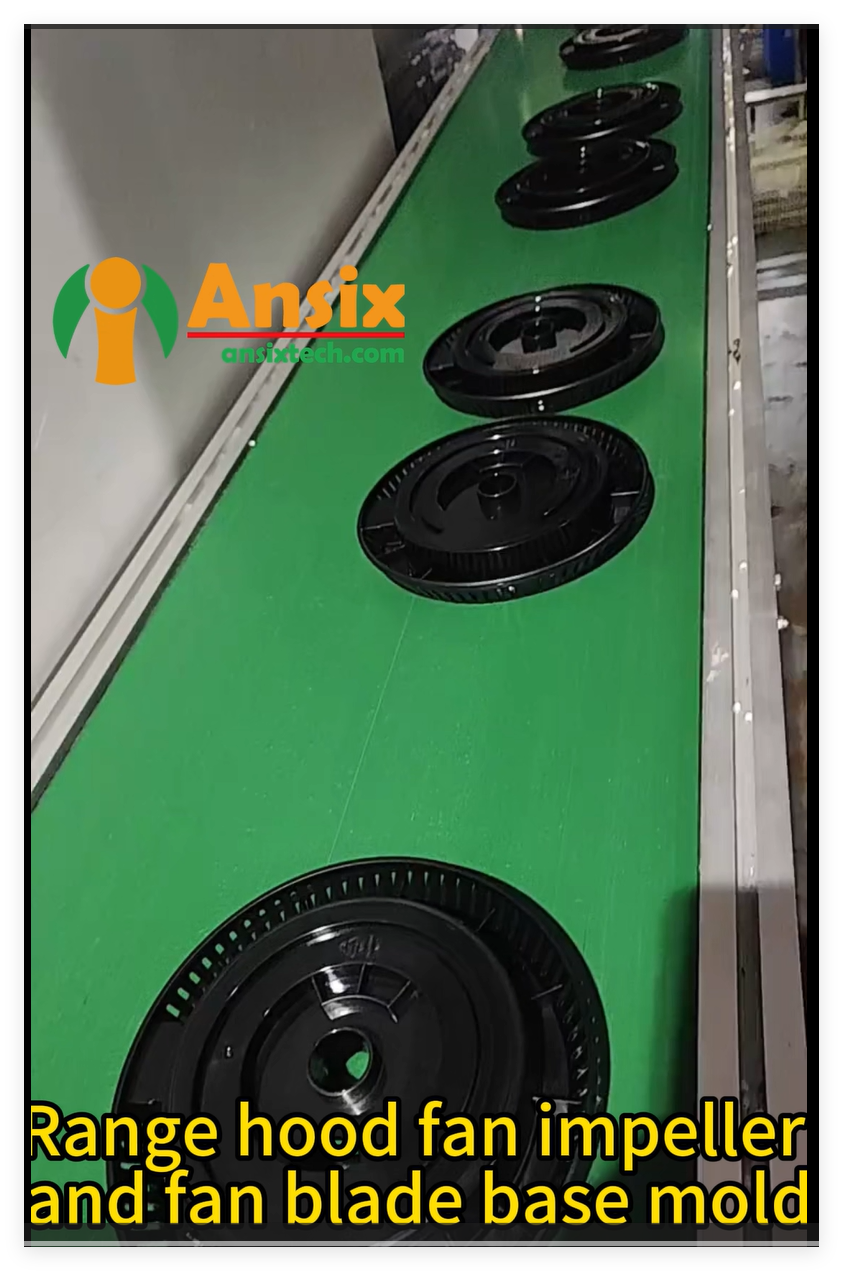
Range hood fan impeller and fan blade base mold
Range hood fan impeller and fan blade base mold

Mastering Precision: How Ansix Tech Revolutionizes Range Hood Fan Manufacturing
The Critical Role of Mold Design in Range Hood Performance
In the competitive world of kitchen appliance manufacturing, the range hood represents a complex convergence of aesthetic design, aerodynamic efficiency, and functional durability. At the heart of these ventilation systems lie two critical components: the fan impeller and fan blade base, which together determine airflow efficiency, noise levels, and long-term reliability. For over two decades, Ansix Tech has pioneered advancements in injection Molding Technology specifically for these components, developing proprietary processes that significantly reduce manufacturing costs while enhancing performance.
This article explores the comprehensive journey of creating high-performance range hood components, from initial design concepts to final delivery, highlighting how strategic innovation at every stage delivers exceptional value to manufacturers and consumers alike.
Strategic Design and Material Selection: The Foundation of Performance
The manufacturing journey begins with strategic design considerations that balance performance requirements with manufacturing efficiency. Range hood fan blades present unique challenges: they must maintain precise dimensional stability under varying thermal conditions, achieve critical aerodynamic profiles for optimal airflow, and demonstrate exceptional balance characteristics to minimize vibration and noise—often operating at specifications requiring axial jumping control within 1mm and specialized balancing protocols.
Material selection forms the cornerstone of this process. Ansix Tech engineers typically recommend glass-fiber reinforced plastics for range hood applications. According to industry analyses of similar components, glass-fiber reinforced ABS (GFRABS) and glass-fiber reinforced AS (GFRAS) provide superior strength, heat resistance, hardness, and dimensional stability compared to their non-reinforced counterparts. Through extensive testing, Ansix has determined that a 20% glass fiber content optimizes the balance between structural reinforcement and material workability, minimizing shrinkage while avoiding the brittleness associated with higher fiber concentrations.
Table: Common Plastic Materials for Range Hood Components
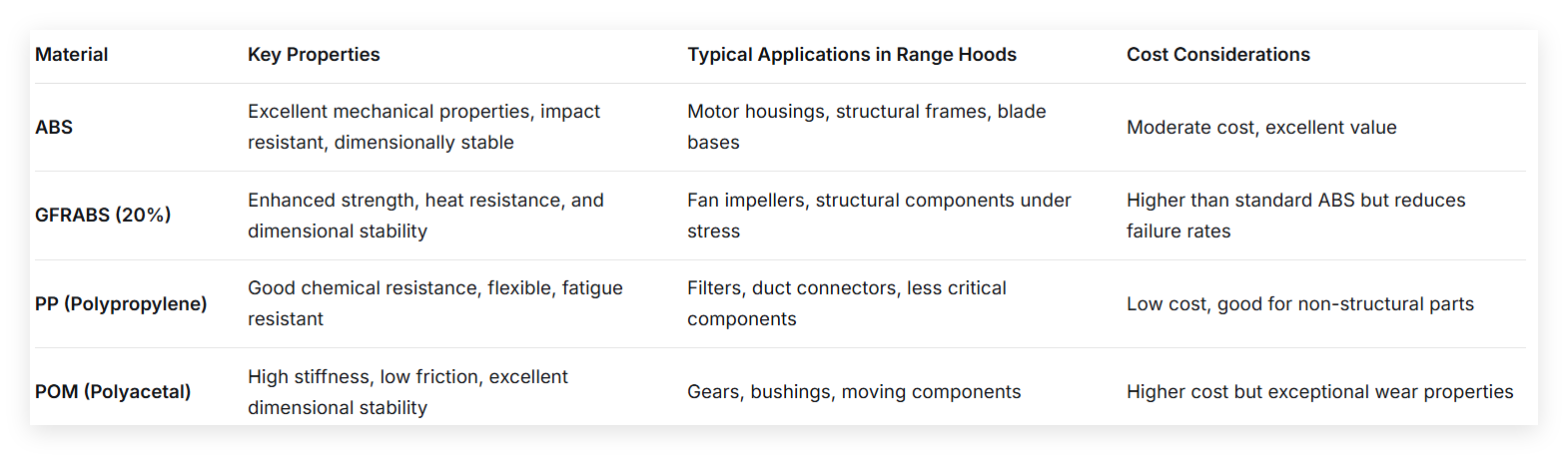
Beyond reinforcement percentages, Ansix Tech emphasizes material batch consistency as a critical quality factor. "We work closely with suppliers to ensure large batch uniformity," explains Michael Chen, Ansix's Director of Materials Engineering. "Variations between material batches introduce unpredictable variables that compromise our precision molding processes and ultimately affect component balance and performance."
Advanced Mold Design: Engineering for Precision and Efficiency
The transition from component design to mold creation represents perhaps the most critical phase in the manufacturing process. Ansix employs a multi-stage verification protocol beginning with comprehensive Design for Manufacturability (DFM) analysis, where engineers identify and eliminate potential production challenges before tooling begins.
For fan blade molds, Ansix utilizes specialized designs incorporating hydraulic compression systems that enhance product shaping force and structural integrity. These systems feature reinforced plates connected to hydraulic pumps that apply precise pressure to core components, ensuring tight structural formation while maintaining high precision. Particularly innovative is their implementation of silicone-protected arc segments within the mold, which safeguard delicate forming surfaces and significantly extend tooling lifespan.
Mold flow analysis represents another crucial step in Ansix's process. Using advanced simulation software like Moldex3D Flow, engineers create three-dimensional models predicting resin flow patterns, temperature gradients, and pressure distribution throughout the injection cycle. This virtual prototyping allows identification and correction of potential issues—such as weld lines, air traps, or uneven filling—that could compromise structural integrity or surface quality.
"The simulation software enables us to optimize gate locations, runner systems, and processing parameters long before we cut steel," notes Sarah Rodriguez, Ansix's Senior Mold Flow Analyst. "This predictive approach typically eliminates 2-3 physical prototyping cycles, saving weeks of development time and substantial material costs."
Mold Manufacturing: Precision Tooling for Critical Components
The selection of appropriate mold steels represents a foundational decision in the manufacturing process. Ansix Tech follows established industry guidelines where material choice depends on component material characteristics, surface finish requirements, and projected production volumes. For range hood components requiring textured surfaces or subjected to glass-filled materials that accelerate wear, Ansix specifies premium steels with enhanced hardness and often employs nitriding treatments to extend tooling life.
Cooling system design receives particular attention, as it directly impacts both component quality and production efficiency. Proper cooling accelerates plastic solidification, reduces cycle times, and ensures dimensional consistency. Ansix engineers employ various cooling strategies based on component geometry:
Direct cooling channels for flat or uniformly thick sections
Baffle systems incorporating copper sheets to direct coolant flow in thicker areas
Heat-conductive inserts using materials like beryllium copper for concentrated heat extraction
Spiral cooling channels in core pins for optimal thermal management in challenging geometries
These systems follow engineering principles maintaining consistent channel-to-surface distances (typically 10mm minimum), prioritizing cooling at gate locations, and avoiding proximity to weld lines. The result is a balanced thermal environment that minimizes warpage—a critical consideration for fan blades where dimensional distortion directly impacts aerodynamic performance and balance.
Runner and gating systems present another optimization opportunity. Ansix designs these material distribution networks to facilitate high-volume, low-velocity flow, minimizing shear stress that can degrade glass fibers and compromise material properties. For multi-cavity fan blade molds, they implement geometrically balanced runners that ensure uniform filling across all cavities, essential for maintaining consistent weight and balance between components.
Injection Molding Process: Precision Execution of Complex Geometries
The actual molding of range hood components demands exceptional process control to meet stringent performance specifications. Fan blades and impellers present particular challenges due to their thin-walled sections, complex curvature, and critical balance requirements. Even minor variations in material distribution or internal stress can result in components that fail to meet vibration specifications.
Ansix addresses these challenges through a multi-parameter optimization approach:
Temperature Management: Precise control over both barrel temperatures and mold temperatures proves essential. For GFRAS materials, processing temperatures typically run approximately 10°C higher than for non-reinforced counterparts to compensate for reduced flow characteristics. Mold temperatures maintained between 65-75°C optimize filling behavior while minimizing cycle times.
Injection Velocity Profiling: Unlike simpler components, fan blades require carefully staged injection speeds. Initial slow injection prevents jetting and reduces air entrapment, while subsequent increased velocity ensures complete filling before material begins to solidify. Ansix typically employs 70-80% of maximum injection velocity for these components.
Pressure Sequencing: Injection pressure, packing pressure, and back pressure each receive individual optimization. Excessive pressures induce molecular orientation that leads to warpage and imbalance upon cooling. Ansix utilizes moderate pressure settings combined with optimized timing to achieve complete filling while minimizing residual stress.
Cycle Time Optimization: With cooling accounting for 40-60% of overall cycle time, Ansix's advanced cooling systems deliver substantial efficiency gains. "Our proprietary cooling designs typically reduce cycle times by 15-20% compared to conventional approaches," states David Wang, Ansix's Process Engineering Manager. "When multiplied across hundreds of thousands of components, these savings become substantial."
Quality Assurance: Ensuring Performance Through Systematic Verification
Quality control for aerodynamic components extends far beyond dimensional checks. Ansix implements a tiered verification system beginning with ISO 9001:2015 certified processes and extending to component-specific performance validation.
In-process monitoring tracks critical parameters including material moisture content (pre-dried to specified levels to prevent surface defects), barrel temperature stability, and injection pressure consistency. Post-molding, components undergo comprehensive evaluation including:
Dimensional verification using coordinate measuring machines (CMM) for critical tolerances
Visual inspection for surface defects, weld lines, or flow marks
Balance testing using dynamic balancing equipment to measure and correct mass distribution
Material property verification through sample testing for mechanical properties
Particular attention addresses the cooling stabilization period before final measurement. "Components continue to stabilize for up to 24 hours after molding," explains Lisa Thompson, Quality Director at Ansix Tech. "We account for this in our measurement protocols to ensure specifications are met consistently throughout the product lifecycle."
For components requiring metal inserts (such as motor mounting points in blade bases), Ansix implements additional verification protocols ensuring proper insert placement, orientation, and bonding integrity.
Cost Optimization: Engineering Value at Every Stage
Perhaps Ansix Tech's most significant contribution to the range hood industry lies in their systematic approach to cost optimization without compromising quality. This philosophy permeates every aspect of their operation:
Material Efficiency: Through advanced flow simulation and gate optimization, Ansix typically achieves 5-7% material reduction compared to conventional designs. Their runner systems minimize waste, and they've developed proprietary processes for incorporating controlled percentages of regrind material (typically around 10%) without compromising mechanical properties.
Energy Reduction: Optimized thermal management, both in cooling system design and process parameter selection, reduces energy consumption per component by an estimated 18-22%. "Our molds reach thermal equilibrium faster and maintain it with less energy input," notes Chen.
Tooling Longevity: Through premium material selection, protective surface treatments, and intelligent design that minimizes wear, Ansix extends mold life by 30-40% over industry averages. This substantially reduces per-component tooling costs, particularly for high-volume production runs.
Production Efficiency: Reduced cycle times, automated part handling, and optimized packaging workflows collectively improve overall equipment effectiveness (OEE) by significant margins. "We measure success not just in component cost, but in total cost of ownership for our customers," says Rodriguez. "That includes everything from reduced assembly time to lower warranty claims due to improved component reliability."
Packaging and Delivery: Protecting Precision Through the Supply Chain
The careful engineering invested in component manufacturing extends through to final packaging and delivery. Fan blades and impellers remain susceptible to deformation if improperly handled or stored, particularly in the hours immediately following molding when material continues to stabilize.
Ansix implements specialized packaging protocols:
Components are placed on custom contoured trays that support critical surfaces without inducing stress
Interleaf materials prevent surface contact between components
Corner reinforcements and rigid outer packaging protect against transportation impacts
Climate-controlled storage and transportation maintain consistent environmental conditions
"Improper handling after molding can undo all our precision engineering," Thompson emphasizes. "We've developed packaging solutions that protect these sensitive components through the entire supply chain, ensuring they arrive in perfect condition for assembly."
Industry Experience and Future Directions
With over two decades specializing in aerodynamic component manufacturing, Ansix Tech has developed proprietary methodologies addressing the unique challenges of range hood systems. Their experience spans multiple generations of kitchen ventilation technology, from basic extraction systems to today's intelligent, sensor-controlled units with advanced filtration.
Looking forward, Ansix is investing in several strategic areas:
Industry 4.0 Integration: Implementing IoT sensors in molds and presses to enable real-time process adjustment and predictive maintenance.
Sustainable Material Development: Researching bio-based composites and more efficient recycling protocols for production waste.
Additive Manufacturing Integration: Exploring hybrid approaches where 3D-printed mold inserts enable more complex geometries for next-generation aerodynamic designs.
Advanced Simulation: Expanding virtual prototyping capabilities to encompass complete system performance prediction, including aerodynamic and acoustic simulations.
"Ultimately, our goal is to deliver not just components, but complete performance solutions," concludes David Wang. "By understanding how our parts function within complete ventilation systems, we can optimize our manufacturing processes to deliver better outcomes for manufacturers and quieter, more efficient range hoods for consumers."
Conclusion
The manufacturing of range hood fan components represents a compelling intersection of material science, precision engineering, and process optimization. Through systematic attention to every phase of design and production, Ansix Tech demonstrates how strategic manufacturing approaches can simultaneously enhance performance, improve reliability, and reduce costs. Their comprehensive methodology—spanning intelligent material selection, advanced mold design, precisely controlled processing, and rigorous quality assurance—provides a blueprint for manufacturing excellence in an increasingly competitive global market.
As kitchen ventilation technology continues evolving toward greater efficiency, intelligence, and integration, the foundational components produced through these refined processes will remain essential to delivering the quiet, powerful, and reliable performance that defines premium range hood systems.


Ansix Tech Co Ltd
If you have any plans related to Range hood fan impeller and fan blade base mold, you can contact us at any time. We will turn your ideas into reality, let you realize your dreams, and obtain large orders from the market. Our contact information is info@ansixtech.com. Or contact our CTO, mail: stephen@ansixtech.com
#www.ansixtech.com #ansixtech.com #Range hood fan impeller and fan blade base mold #Ansix mold factory #Ansix injection molding #Ansix moud Ltd #Range hood fan impeller and fan blade base mold injection molding factory #Ansix injection mould #Range hood fan impeller and fan blade base mold factory #Range hood fan impeller and fan blade base mold injection molding company #Range hood fan impeller and fan blade base mold injection mold companies #Ansix #Ansix moulds #Ansix china #Ansix tech china #Ansix tech company #Ansix facotry #Ansix Tech #Ansix molds #Ansix injection molding #Ansix mold factory #injection molding Range hood fan impeller and fan blade base mold # Ansix mold factory #Range hood fan impeller and fan blade base mold china #Range hood fan impeller and fan blade base mold precision molds #injection factory #Range hood fan impeller and fan blade base mold precision injection molding #Range hood fan impeller and fan blade base mold injection molding factory #injection molding company #Range hood fan impeller and fan blade base mold injection mold companies #Range hood fan impeller and fan blade base mold mould factory #Range hood fan impeller and fan blade base mold mold limited #Ansix mold china #Ansix companies #Ansix company China #Range hood fan impeller and fan blade base mold facotry #Ansix Tech #Ansix Tech mould #Range hood fan impeller and fan blade base mold injection moulding #injection moulding company #Ansix Range hood fan impeller and fan blade base mold parts injection mold companies #Range hood fan impeller and fan blade base mold #Range hood fan impeller and fan blade base mold china #Range hood fan impeller and fan blade base mold china factory #Ansix moulding companies #Ansix molding company #Range hood fan impeller and fan blade base mold injection moulding facotry #Ansix Tech mold #Range hood fan impeller and fan blade base mold precision mould #Range hood fan impeller and fan blade base mold plastic injection molding #ansix plastic mold #Mold manufacturing #Range hood fan impeller and fan blade base mold parts manufacturing #Range hood fan impeller and fan blade base mold plastic parts factory #Range hood fan impeller and fan blade base mold injection parts mold #Range hood fan impeller and fan blade base mold PRECISION MANUFACTURING #Range hood fan impeller and fan blade base mold precision #China mold #Range hood fan impeller and fan blade base mold injection moulding china #Range hood fan impeller and fan blade base mold mould china #china precision mold #mold in china #Range hood fan impeller and fan blade base mold precision mold china #Precision molds #High-precision molds #Household appliance molds #Injection molds #Range hood fan impeller and fan blade base mold Factory #Range hood fan impeller and fan blade base mold Company #Super Large Injection Mold Factory #Large Tonnage Injection Molding Factory #Range hood fan impeller and fan blade base mold Company #Super Range hood fan impeller and fan blade base mold Factory #2800T Injection Molding Factory #3000 Ton Injection Molding #4500 Ton Injection Molding Factory #Large Mold Injection Molding #Large Plastic Mold Injection Molding Factory #Large Injection Mold Manufacturer #Plastic Mold Factory #Injection Mold #Plastic Mold