



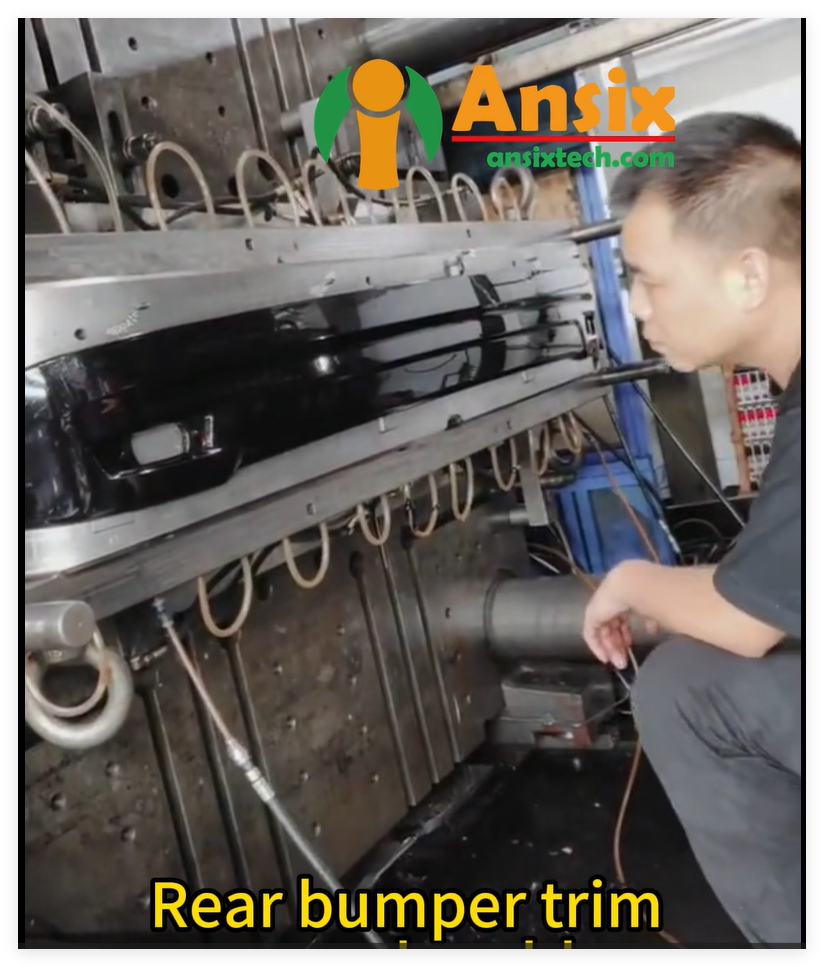
Rear bumper trim panel mold
Rear bumper trim panel mold

Engineering Excellence in Automotive Plastics: How Ansix Tech Redefines Value in Rear Bumper Trim Panel Manufacturing
Executive Summary
In the competitive landscape of automotive manufacturing, the injection molding of exterior components like rear bumper trim panels presents a critical nexus of design, material science, and precision engineering. For global suppliers, achieving the perfect balance between aesthetic integrity, structural performance, and cost-efficiency is paramount. This article provides an in-depth examination of Ansix Tech's comprehensive approach to the rear bumper trim panel mold project, detailing a process that spans from initial Design for Manufacturability (DFM) to final rapid delivery. By leveraging advanced materials like AAS resin, implementing cutting-edge mold flow simulation, and optimizing every facet of the injection Molding Workflow, Ansix Tech has established a benchmark for delivering superior reliability and significant cost savings to its automotive clients.
Introduction: The Critical Role of Precision Molding in Modern Automotive Design
The automotive bumper system is more than a protective feature; it is a key element of a vehicle's aerodynamic profile, safety rating, and brand identity. The trim panel, in particular, must withstand environmental extremes, minor impacts, and UV exposure while maintaining a flawless Class A surface finish. Ansix Tech enters this demanding field with a philosophy grounded in proactive engineering and value-driven solutions. Their process for the rear bumper trim panel mold project exemplifies a holistic methodology where cost reduction is not an afterthought but an integral component of the initial design and manufacturing strategy.
Phase 1: Foundational Design and Advanced Simulation
Design for Manufacturability (DFM) and Prototype Verification
The journey begins with a meticulous DFM analysis. Ansix Tech engineers conduct a thorough review of the part's 3D data, examining wall thickness uniformity, draft angles, rib design, and boss geometries to ensure the part can be reliably and efficiently molded. For the rear bumper trim panel, which often features complex curves and integrated attachment points, this stage is critical. Traditional static DFM checks are augmented by dynamic simulation. As noted in industry analysis, static checks alone are insufficient, as "plastic injection molding is a dynamic production process" where material and machine variability can introduce unforeseen defects.
Ansix Tech employs this principle by creating rapid CNC-machined prototypes from affordable materials like aluminum or high-density urethane. This allows for physical verification of fit, form, and function with mating vehicle components long before committing to costly production-grade steel molds, mitigating substantial downstream risk.
Material Selection: The Science Behind AAS Resin
Selecting the optimal polymer is a cornerstone of Ansix Tech's value proposition. For exterior trim applications demanding exceptional weatherability and impact resistance, Acrylonitrile-Acrylate-Styrene (AAS) resin has emerged as a superior choice.
The company specifies AAS for its unique "core-shell" molecular structure, where an acrylate rubber core is grafted with a styrene-acrylonitrile (SAN) shell. This structure provides outstanding resistance to UV degradation and thermal aging, with performance reportedly up to ten times more durable than standard ABS in outdoor applications. Key properties driving this selection for the bumper trim panel include:
Density: 1.07–1.09 g/cm³, contributing to lightweighting goals.
Notched Impact Strength: 9.8–24.5 kJ/m², ensuring toughness against road debris and minor impacts.
Heat Deflection Temperature (HDT): 80–88°C, sufficient to withstand baking cycles in automotive paint shops.
By expertly navigating material data sheets and collaborating with resin suppliers, Ansix Tech engineers can often recommend a grade of AAS that meets all performance criteria while avoiding the cost premium of over-specified, more exotic polymers.
Mold Flow Analysis (DFM): Predicting and Perfecting the Process
To transform static design into a predictable dynamic process, Ansix Tech utilizes advanced CAE software like Moldex3D. Engineers perform comprehensive simulations to analyze fill patterns, weld line locations, air traps, cooling efficiency, and post-molding shrinkage and warpage.
For a large, thin-walled part like a bumper trim, achieving balanced fill is essential to prevent warpage. As illustrated in a connector case study, unbalanced flow can lead to significant deformation that renders a part non-functional. Ansix Tech's simulation experts use these tools to iteratively optimize gate locations, runner systems, and cooling channel layouts virtually. This "virtual molding" process identifies potential issues—such as sink marks over ribs or excessive shear stress—enabling corrections in the mold design phase where changes are inexpensive, thereby avoiding costly mold rework and production delays.
Phase 2: Precision Mold Design and Engineering
Core Mold Design Philosophy and Steel Selection
Ansix Tech's mold design is guided by the principle that "a mold is both a pressure vessel and a heat exchanger". For the bumper trim panel mold, which features a large surface area, this demands robust construction and superior thermal management.
Steel Selection: Core and cavity inserts are typically machined from pre-hardened mold steels such as P20 or 718 for an excellent balance of machinability, polishability, and durability. For high-volume production or resins with abrasive fillers, hardened tool steels like H13 are selected for critical areas to resist wear and extend mold life.
Gating System: A hot runner system is typically employed to eliminate cold runner waste, reduce cycle time, and provide precise, independent control over melt delivery to multiple points on the large part. Valve gate controls can be sequenced to optimize fill balance and minimize weld line visibility.
Cooling System: Efficient cooling is the primary driver of cycle time. Ansix Tech designs conformal cooling channels that follow the contour of the part as closely as possible to extract heat uniformly and rapidly. This prevents hot spots that cause differential cooling and warpage, while also slashing the cooling portion of the cycle time.
Ejection System: Given the panel's size and potential for sticking, a meticulously calculated ejection system is designed. It incorporates a sufficient number of ejector pins, sleeves, and blades placed in strategic locations (behind ribs, bosses, and on stiffening geometries) to ensure the part releases smoothly and without distortion.
Overcoming Inherent Manufacturing Challenges
Bumper trim panels present distinct challenges that Ansix Tech's design proactively addresses:
Warpage Control: Caused by uneven shrinkage, this is mitigated through balanced filling (from mold flow analysis), uniform cooling (from optimized water lines), and strategic ribbing designed per DFM guidelines (e.g., rib thickness at 50-60% of the nominal wall).
Sink Marks: These are minimized by ensuring adequate packing pressure and designing underlying rib and boss geometries with recommended thickness ratios to prevent material accumulation.
Surface Defects: To achieve a flawless Class A finish, the mold steel is polished to a mirror finish, and the process parameters are finely tuned to avoid flow marks, jetting, or blush.
Table: Traditional vs. Ansix Tech Optimized Approach to Key Challenges

Phase 3: Process Optimization for Efficiency and Cost Control
Ansix Tech's commitment to customer value shines in its systematic approach to optimizing the injection molding process. The company operationalizes industry-best practices, such as those outlined by RJG Inc., to drive down total component cost.
Scientific Molding & Process Stability: Instead of relying on anecdotal "tweaking," Ansix Tech develops a robust, documentable process using decoupled molding principles. Key parameters (fill speed, pack pressure, cooling time) are set based on data, not intuition, creating a wide, stable process window that is repeatable across machines and shifts.
Automation Integration: Automated systems for part removal, degating, and packaging are implemented. This eliminates human variability in cycle time, reduces labor costs, and minimizes handling damage. As noted, automation "begins to remove these fluctuations, improves efficiency, improves quality, and increases available space".
Cycle Time Reduction: Every second saved per cycle translates directly to lower cost per part. Ansix Tech focuses on all levers: optimizing fill time, minimizing required packing pressure and time, and, most significantly, maximizing cooling efficiency through superior mold design.
Material Strategy: The company employs a dual-strategy for material savings. First, through precise scientific process control using cavity pressure sensors, they can consistently produce quality parts with lower viscosity variation, enabling the potential use of more economical "wide-spec" resins without sacrificing quality. Second, the elimination of scrap through a stable process means less purchased material is wasted.
Phase 4: Quality Assurance and Delivery
A Proactive Quality Paradigm
Ansix Tech's quality system is built on prevention rather than detection. In-mold cavity pressure sensors are a critical tool, acting as the "fingerprint" of a good part. By monitoring the pressure curve within the mold during every shot, the system can automatically reject any part that falls outside the validated process window, often before the mold even opens. This is complemented by automated vision systems for surface inspection and periodic coordinate measuring machine (CMM) audits for critical dimensions.
Packaging and Rapid Delivery
Understanding the just-in-time demands of the automotive industry, Ansix Tech designs custom, returnable packaging that protects the delicate trim panels from scratches and deformation during transit. Their supply chain and production planning are integrated to support sequenced delivery, ensuring parts arrive at the customer's assembly line in the correct order and quantity, minimizing inventory costs for the client.
Conclusion: Delivering Unmatched Value through Integrated Expertise
The manufacturing of a rear bumper trim panel is a complex symphony of engineering disciplines. Ansix Tech distinguishes itself by conducting this symphony with a relentless focus on delivering tangible value to the customer. From the material science of selecting AAS resin for its optimal cost-to-performance ratio, to the virtual world of CAE simulation that prevents real-world defects, and onto the production floor where scientific molding and automation ensure flawless efficiency, every step is calibrated for reliability and cost savings.
By investing deeply in upfront design, simulation, and process engineering, Ansix Tech absorbs complexity internally to provide its automotive partners with a simplified, dependable, and cost-effective supply chain. In an industry where margins are perpetually under pressure, this commitment to engineering-driven value is not just a service—it is a powerful competitive advantage for both Ansix Tech and the customers it serves.


Ansix Tech Co Ltd
If you have any plans related to Rear bumper trim panel mold, you can contact us at any time. We will turn your ideas into reality, let you realize your dreams, and obtain large orders from the market. Our contact information is info@ansixtech.com. Or contact our CTO, mail: stephen@ansixtech.com
#www.ansixtech.com #ansixtech.com #Rear bumper trim panel mold #Ansix mold factory #Ansix injection molding #Ansix moud Ltd #Rear bumper trim panel mold injection molding factory #Ansix injection mould #Rear bumper trim panel mold factory #Rear bumper trim panel mold injection molding company #Rear bumper trim panel mold injection mold companies #Ansix #Ansix moulds #Ansix china #Ansix tech china #Ansix tech company #Ansix facotry #Ansix Tech #Ansix molds #Ansix injection molding #Ansix mold factory #injection molding Rear bumper trim panel mold # Ansix mold factory #Rear bumper trim panel mold china #Rear bumper trim panel mold precision molds #injection factory #Rear bumper trim panel mold precision injection molding #Rear bumper trim panel mold injection molding factory #injection molding company #Rear bumper trim panel mold injection mold companies #Rear bumper trim panel mold mould factory #Rear bumper trim panel mold mold limited #Ansix mold china #Ansix companies #Ansix company China #Rear bumper trim panel mold facotry #Ansix Tech #Ansix Tech mould #Rear bumper trim panel mold injection moulding #injection moulding company #Ansix Rear bumper trim panel mold parts injection mold companies #Rear bumper trim panel mold #Rear bumper trim panel mold china #Rear bumper trim panel mold china factory #Ansix moulding companies #Ansix molding company #Rear bumper trim panel mold injection moulding facotry #Ansix Tech mold #Rear bumper trim panel mold precision mould #Rear bumper trim panel mold plastic injection molding #ansix plastic mold #Mold manufacturing #Rear bumper trim panel mold parts manufacturing #Rear bumper trim panel mold plastic parts factory #Rear bumper trim panel mold injection parts mold #Rear bumper trim panel mold PRECISION MANUFACTURING #Rear bumper trim panel mold precision #China mold #Rear bumper trim panel mold injection moulding china #Rear bumper trim panel mold mould china #china precision mold #mold in china #Rear bumper trim panel mold precision mold china #Precision molds #High-precision molds #Household appliance molds #Injection molds #Rear bumper trim panel mold Factory #Rear bumper trim panel mold Company #Super Large Injection Mold Factory #Large Tonnage Injection Molding Factory #Rear bumper trim panel mold Company #Super Rear bumper trim panel mold Factory #2800T Injection Molding Factory #3000 Ton Injection Molding #4500 Ton Injection Molding Factory #Large Mold Injection Molding #Large Plastic Mold Injection Molding Factory #Large Injection Mold Manufacturer #Plastic Mold Factory #Injection Mold #Plastic Mold