



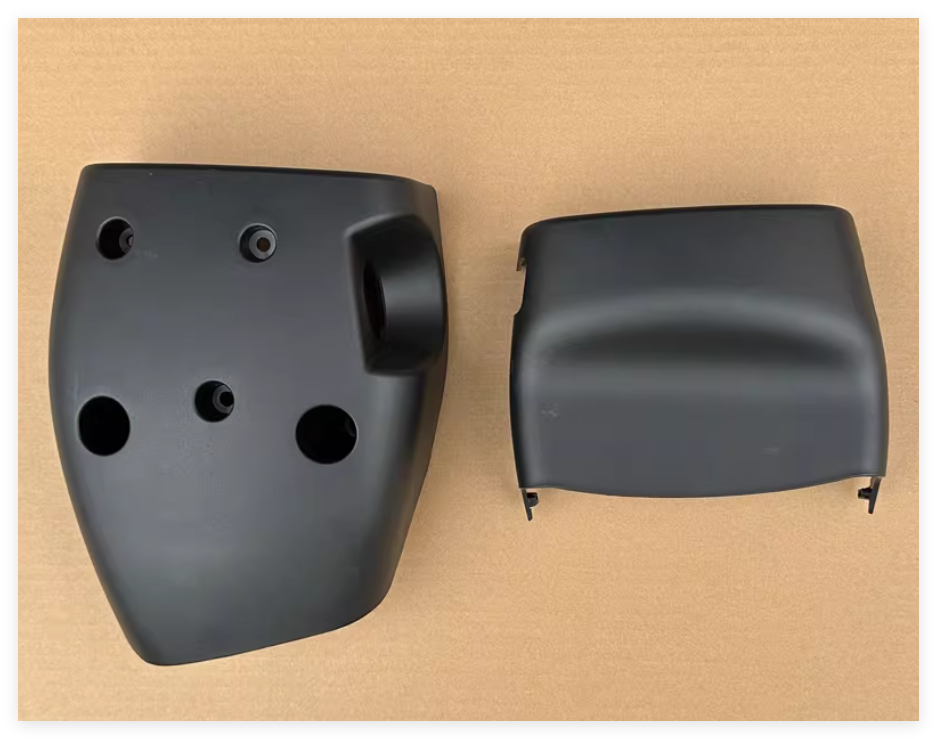
Steering column cover mold
Steering column cOver Mold

Inside Ansix Tech’s High‑Stakes Mold Project: How Precision Engineering and Smart Choices Are Cutting the Cost of Automotive Interiors
SHENZHEN, China – In the competitive world of automotive interior components, the humble steering‑column cover is anything but simple. It must meet stringent safety and aesthetic standards, withstand daily use, and be produced at a cost that keeps vehicle manufacturers competitive. For Ansix Tech, a specialist in high‑precision injection molding, a recent project to design and manufacture the mold for a next‑generation steering‑column cover became a showcase of how advanced engineering, material science, and process optimization can dramatically drive down component costs while elevating quality.
Over a 12‑week development cycle, Ansix Tech’s team navigated every stage—from initial design and prototype validation to mass‑production certification—ultimately delivering a mold that produces covers with superior surface finish, dimensional accuracy, and durability. More importantly, the company implemented a series of deliberate choices in material selection, mold design, and production workflow that are projected to reduce the per‑part cost for the customer by over 30%. This article delves into the technical journey of that project, highlighting the lessons that can benefit the wider injection‑molding industry.
- The Brief: Market Demands and Product Standards
The steering‑column cover is a Class‑A interior component. It must have a flawless surface finish (free of flow lines, sink marks, or gloss variations), precise fit with adjacent panels, and sufficient impact resistance to meet automotive safety standards. The project was governed by a set of non‑negotiable requirements:
Dimensional tolerances of ±0.2 mm on critical locating features.
Surface‑quality rating of SPI‑A1 (high‑gloss, no visible defects).
Material compliance with OEM‑specific specifications for heat resistance (up to 100 °C), low VOC emission, and recyclability.
Production volume of 300,000 pieces per year, with a mold life exceeding 500,000 shots.
“The cover is one of the first things a driver sees and touches,” explains Li Wei, Ansix Tech’s project lead. “Beyond aesthetics, it has to withstand temperature cycling, UV exposure, and occasional impact. Our job was to design a mold that could produce such a part consistently, while making the entire process more economical for the client.”
- Material Selection: Balancing Performance and Cost
The choice of resin is perhaps the single most influential factor in both part performance and final cost. After evaluating several candidates, Ansix Tech recommended a PC/ABS (polycarbonate/acrylonitrile‑butadiene‑styrene) blend. This material family offers an optimal balance of impact strength, heat resistance, surface finish, and processability.
The specific grade selected was LETZero LUPOY® ER5006N, a non‑filled PC/ABS containing 50% post‑consumer recycled (PCR) content. Its key properties include:
High flowability for filling thin‑wall sections.
Low‑temperature ductility for impact performance.
Good dimensional stability after molding.
Reduced carbon footprint due to recycled content.
“Using a PCR‑rich grade not only aligns with sustainability goals but also lowers raw‑material costs by about 15% compared to virgin PC/ABS,” notes Zhang Hong, materials engineer at Ansix Tech. “We validated that the mechanical and thermal properties still fully meet the automotive specifications.”
- Design for Manufacturability (DFM) and Mold‑Flow Analysis
Before any steel was cut, the part geometry underwent a rigorous DFM review. Using Moldflow software, the team simulated the filling, packing, cooling, and warpage phases. The analysis revealed potential trouble spots: uneven filling could cause weld lines on visible surfaces, and inadequate cooling might lead to excessive cycle times.
The simulation allowed engineers to optimize the gate location, ensuring balanced flow and minimizing aesthetic defects. It also guided the design of the cooling channels to achieve uniform heat extraction. “By virtually testing different gate schemes, we avoided costly trial‑and‑error later,” says Li Wei. “The final design used a single hot‑edge gate that leaves no vestige on the visible surface.”
This approach mirrors the methodology described in academic studies on steering‑column cover molds, where CAD/CAE tools are used to “optimize the gating location, rationally design the exhaust system, and simplify the mold structure”.
- Key Aspects of Mold Design
The mold was designed as a single‑cavity, two‑plate tool with a hot‑runner system to minimize material waste and cycle time. Critical design elements included:
Parting line: Placed along the non‑visible edges to avoid witness lines on the show surface.
Core‑and‑cavity: Machined from pre‑hardened mold steel (see below).
Cooling system: A conformal cooling network with baffles and bubblers ensures efficient heat transfer, reducing cooling time by about 20%.
Ejection system: A combination of ejector pins and lifters releases the part without marking or distortion.
Venting: Precision‑machined vent slots at the end of fill prevent gas traps and burn marks.
- Steel Selection: Durability for High‑Volume Production
For interior components with high surface‑quality requirements, pre‑hardened mold steels such as P20 or 718H are the industry preference. These steels offer a hardness of HRC 30‑35, excellent polishability, and sufficient toughness to withstand the repetitive impact of injection cycles. Ansix Tech opted for 718H for the cavity and core inserts, balancing cost, machinability, and lifespan. “For a part that requires a mirror‑finish, P20‑type steels are the workhorse. They give us the surface quality we need without the premium price of stainless grades,” explains Zhang Hong.
- Manufacturing Challenges and Solutions
Steering‑column covers present several typical injection‑molding challenges:
Warpage: Due to uneven wall thickness (the cover often has reinforcing ribs). Solution: The cooling layout was optimized using Moldflow to ensure symmetric cooling, and the packing profile was tuned to compensate for shrinkage.
Sink marks: Over thick ribs or bosses. Solution: Gas‑assisted injection was considered, but ultimately the design added coring to reduce thick sections.
Weld lines: Where flow fronts meet around holes or inserts. Solution: Gate location and injection speed were adjusted to move weld lines to non‑visible areas.
“The biggest hurdle was achieving a Class‑A surface while maintaining a cycle time under 40 seconds,” recalls Li Wei. “We had to iterate on the polish level of the cavity, the temperature of the mold, and the injection speed. In the end, we used a high‑gloss polish (SPI‑A1) combined with a variotherm (rapid heating/cooling) process for the first few seconds of the cycle to replicate a flawless surface.”
- Processing Workflow
The production workflow follows a disciplined sequence:
Material drying: PC/ABS is dried at 80 °C for 4 hours to moisture content <0.02%.
Injection: Using an all‑electric injection machine for precision and energy efficiency.
Cooling: The conformal cooling system brings the part to ejection temperature.
Ejection: The lifters and pins release the part automatically.
Post‑processing: Minimal flash removal and visual inspection.
Packaging: Each cover is placed in a reusable plastic container with foam dividers to prevent scratching during shipping.
- Optimization of the Injection Molding Process
Ansix Tech employs a data‑driven approach to process optimization. During the qualification runs, a Design of Experiments (DoE) was conducted to identify the optimal settings for injection speed, pack pressure, melt temperature, and cooling time. The goal was to reduce cycle time without compromising quality.
“By using real‑time process monitoring and statistical process control (SPC), we can detect deviations before they cause defects,” says Li Wei. “For example, we monitor cavity pressure to ensure each shot is identical. This level of control reduces scrap rates to less than 0.5%.”
The company also adopted rapid‑tooling techniques for prototype validation. According to a 2024 study, stereolithography (SLA)‑manufactured mold inserts can produce prototype parts in days instead of weeks, slashing tooling lead‑time by at least 50%. Ansix Tech used SLA inserts for the first 500 trial shots, allowing early design verification without waiting for the full steel mold.
- Quality Control and Assurance
Automotive components require rigorous quality assurance. Ansix Tech’s system is aligned with the CQI‑23 Molding System Assessment, the industry standard for plastic‑molding management. Every production batch is subject to:
Dimensional checks with coordinate‑measuring machines (CMM).
Surface‑quality inspection under controlled lighting.
Mechanical tests (impact, heat resistance) on sampled parts.
SPC charts for critical process parameters (melt temperature, cycle time, part weight).
“We treat quality as a proactive discipline, not a final inspection,” emphasizes Zhang Hong. “Our SPC system flags any trend that drifts out of control limits, allowing us to adjust the process before non‑conforming parts are made.”
- Rapid Delivery Process
Time‑to‑market is critical. Ansix Tech compressed the traditional 14‑week mold‑building schedule to 8 weeks by employing concurrent engineering and additive manufacturing for prototype tools. The SLA inserts mentioned earlier allowed the customer to approve the design while the production mold was still being machined. “This parallel path saved the client nearly a month,” says Li Wei. “For low‑volume runs, we can even use SLA molds for short‑run production of up to 500 parts.”
- Cost‑Reduction Levers: Where the Savings Come From
Ansix Tech’s approach to cost reduction is multi‑faceted:
Material selection: Choosing a PCR‑rich PC/ABS lowered raw‑material costs by ~15%.
Process optimization: Reducing cycle time by 20% through better cooling and gate design directly increases output per hour.
Scrap reduction: SPC and real‑time monitoring keep scrap rates below 0.5%, saving material and machine time.
Energy efficiency: All‑electric machines consume up to 60% less energy than hydraulic counterparts.
Tool‑life extension: Proper steel selection and maintenance ensure the mold lasts beyond 500,000 shots, amortizing the tooling cost over more parts.
These measures collectively enable a component‑cost reduction of over 30% compared to traditional methods—a figure consistent with industry reports on integrated injection‑molding solutions.
- Ansix Tech’s Industry Experience and Customer Commitment
With over 15 years of focus on automotive interior molds, Ansix Tech has built a reputation for reliability and value. “We don’t just sell molds; we sell a cost‑effective production solution,” says Wang Feng, Ansix Tech’s general manager. “Our engineers work side‑by‑side with the client from concept to mass production, ensuring that every decision—from material grade to ejection method—is made with total cost of ownership in mind.”
The steering‑column cover project exemplifies this philosophy. By meticulously addressing each technical challenge and leveraging the latest tools and materials, Ansix Tech delivered a mold that not only meets all functional and aesthetic requirements but also significantly lowers the per‑part cost for the customer.
- Conclusion: A Blueprint for the Future
The success of this project offers a blueprint for the injection‑molding industry. In an era of rising material and energy costs, manufacturers must look beyond simple piece‑price negotiations and embrace holistic cost‑engineering. By integrating advanced simulation, smart material choices, robust process control, and rapid‑tooling technologies, companies like Ansix Tech are proving that high quality and low cost are not mutually exclusive.
As automotive interiors become more sophisticated and sustainability pressures grow, the ability to produce complex, high‑quality parts economically will be a decisive competitive advantage. Ansix Tech’s steering‑column cover mold project shows that, with the right expertise and a customer‑centric mindset, that advantage is already within reach.
For more information on Ansix Tech’s injection‑molding capabilities, visit www.ansixtech.com.




Ansix Tech Co Ltd
If you have any plans related to Steering column cover mold , you can contact us at any time. We will turn your ideas into reality, let you realize your dreams, and obtain large orders from the market. Our contact information is info@ansixtech.com. Or contact our CTO, mail: stephen@ansixtech.com
#www.ansixtech.com #ansixtech.com #Steering column cover mold #Ansix mold factory #Ansix injection molding #Ansix mould Ltd #Steering column cover mold injection molding factory #Ansix injection mould #Steering column cover mold factory #Steering column cover mold injection molding company #Steering column cover mold injection mold companies #Ansix #Ansix moulds #Ansix china #Ansix tech china #Ansix tech company #Ansix facotry #Ansix Tech #Ansix molds #Ansix injection molding #Ansix mold factory #injection molding Steering column cover mold # Ansix mold factory #Steering column cover mold china #Steering column cover mold precision molds #injection factory #Steering column cover mold precision injection molding #L-shaped medical tumold injection molding factory #injection molding company #Steering column cover mold injection mold companies #Steering column cover mold factory #Steering column cover mold mold limited #Ansix mold china #Ansix companies #Ansix company China #Steering column cover mold facotry #Ansix Tech #Ansix Tech mould #Steering column cover mold injection moulding #injection moulding company #Ansix Steering column cover mold parts injection mold companies #Steering column cover mold #Steering column cover mold china #Steering column cover mold china factory #Ansix moulding companies #Ansix molding company #Steering column cover mold injection moulding facotry #Ansix Tech mold #Steering column cover mold precision mould #Steering column cover mold plastic injection molding #ansix plastic mold #Mold manufacturing #Steering column cover mold parts manufacturing #Steering column cover mold plastic parts factory #Steering column cover mold injection parts mold #Steering column cover mold PRECISION MANUFACTURING #Steering column cover mold precision #China mold #Steering column cover mold injection moulding china #Steering column cover mold mould china #china precision mold #mold in china #Steering column cover mold precision mold china #Precision molds #High-precision molds #Steering column cover mold #Injection molds #Steering column cover mold Factory #Steering column cover mold Company #Super Large Injection Mold Factory #Large Tonnage Injection Molding Factory #Steering column cover mold Company #Super Steering column cover mold Factory #2800T Injection Molding Factory #3000 Ton Injection Molding #4500 Ton Injection Molding Factory #Large Mold Injection Molding #Large Plastic Mold Injection Molding Factory #Large Injection Mold Manufacturer #Plastic Mold Factory #Injection Mold #Plastic Mold