



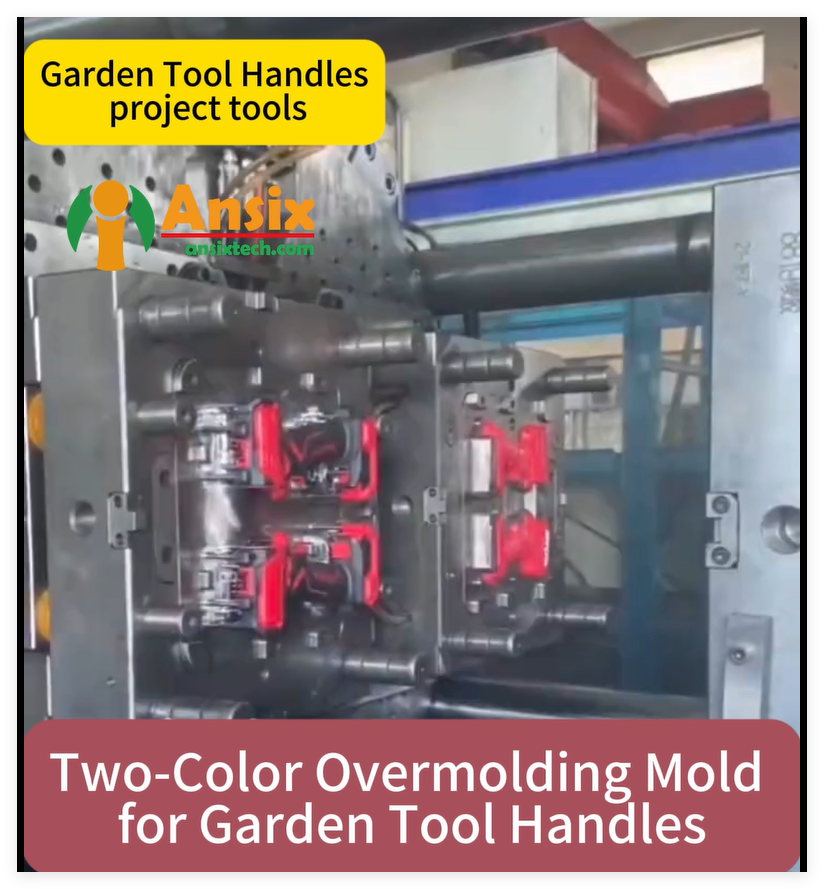
Two-Color Overmolding Mold for Garden Tool Handles
Two-Color OverMolding Mold for Garden Tool Handles

The Grip of Innovation: How Ansix Tech is Redefining Garden Tool Ergonomics Through Advanced Two-Color Overmolding Molds
In the competitive landscape of garden tool manufacturing, the interface between the human hand and the implement is no longer an afterthought—it is the product. As consumer demand for ergonomic comfort, durability, and aesthetic appeal reaches new heights, the technical complexity of producing high-performance handles has become a defining differentiator for brands worldwide. At the epicenter of this engineering evolution stands Ansix Tech, a company that has spent over 28 years mastering the intricate science of two-color overmolding molds.
For garden tool handles, the "soft-touch" revolution is in full swing. Yet, behind every seamless, fatigue-reducing grip lies a world of precision engineering, metallurgical science, and advanced polymer chemistry. This article delves into Ansix Tech’s comprehensive approach to two-color overmolding—from project initiation and raw material selection to rigorous validation and mass production—detailing how the company consistently reduces client costs while elevating product quality to meet the exacting standards of the global market.
The Genesis of a Project: Initiation and Collaborative Design
The journey of a superior garden tool handle begins long before steel is cut. At Ansix Tech, project initiation is treated as a strategic partnership rather than a transactional order. The process starts with a deep dive into the client’s market positioning, ergonomic requirements, and production timelines.
When a client approaches Ansix Tech for a two-color overmolding solution—typically combining a rigid structural core (such as polypropylene or glass-filled nylon) with a soft, tactile outer layer (such as thermoplastic elastomer, or TPE)—the initial phase is defined by intense collaboration. The company’s engineering team engages in a comprehensive Design for Manufacturability (DFM) analysis.
This is not merely a feasibility study; it is a value-engineering workshop. Ansix Tech’s engineers analyze the client’s initial 3D CAD models to identify potential pitfalls specific to two-color molding, such as material bond strength, undercut complexities, and parting line locations. They ask critical questions: How will the soft material bond chemically to the rigid substrate? Can the geometry be optimized to eliminate secondary operations?
By leveraging over two decades of experience, Ansix Tech often provides "design for molding" modifications that reduce cycle times by 15–20% before a single prototype is produced. This proactive approach de-risks the project, ensuring that the tool will not only function but will do so at the lowest possible unit cost during mass production.
The Material Science: Selecting the Right Chemistry
The tactile sensation of a garden trowel or pruner handle is dictated by material science. Ansix Tech’s expertise lies in its ability to specify and process the exact chemical compositions required for durability and comfort. For two-color overmolding, the pairing of the substrate (first shot) and the overmold (second shot) is critical; they must form a chemical bond, not merely a mechanical lock.
For high-end garden tools requiring UV resistance and all-weather grip, Ansix Tech frequently specifies Santoprene™ 111-45 (from ExxonMobil) for the soft-touch component. This is a thermoplastic vulcanizate (TPV) with a specific gravity of 0.97. Its chemical composition—a cross-linked EPDM rubber phase dispersed in a polypropylene matrix—provides exceptional flex fatigue resistance and a coefficient of friction that remains stable even when wet. For the rigid substrate, PP (Polypropylene) Sabic PC1000 is often selected. This homopolymer offers high tensile strength (34 MPa) and the necessary thermal stability to withstand the melt temperature of the overmold without deforming.
For heavy-duty applications—such as axes, shovels, or hammers—where impact resistance is paramount, Ansix Tech opts for PA6 (Nylon 6) with 30% glass fiber (e.g., BASF Ultramid B3WG6). This substrate provides the structural backbone required for high-impact loads. The overmold then shifts to a high-adhesion TPE-S (Styrenic Block Copolymer) , such as Kraiburg TPE TCP series. The chemical composition of this TPE is engineered specifically to bond with polar materials like PA6. Ansix Tech meticulously validates these pairings using ASTM D903 peel tests to ensure the bond strength exceeds 8 N/mm, guaranteeing that the soft grip will never delaminate, even after thousands of cycles in wet, abrasive soil conditions.
Engineering the Architecture: Mold Flow Analysis and Critical Design Considerations
Once materials are selected, the focus shifts to the mold itself. Two-color molds are among the most complex tools in injection molding, requiring rotating plates or core-back systems. Ansix Tech utilizes advanced Mold Flow Analysis (MFA) software to simulate the behavior of both materials before manufacturing begins.
For a typical garden tool handle, the MFA reveals critical data. The first shot (rigid core) must be filled with high pressure to ensure the glass fibers (if used) are oriented correctly to maximize strength. The analysis identifies the weld line locations; for a handle, a weld line in the stress-bearing area is unacceptable. Ansix Tech’s engineers adjust gate locations in the virtual environment until the weld lines are relocated to non-critical zones, such as the bottom of the handle flange.
Critical design considerations specific to two-color overmolding include:
Mechanical Interlocks: While chemical bonding is preferred, Ansix Tech incorporates micro-porous features or mechanical undercuts in the substrate design. These allow the second shot to flow into recesses, creating a "mushroom" anchor effect that guarantees the grip stays in place, especially in extreme temperature fluctuations.
Shrinkage Compatibility: Different polymers shrink at different rates. The rigid core (e.g., PA6+GF30) typically shrinks 0.3–0.5%, while the soft TPE overmold shrinks 1.0–1.5%. If not accounted for, this differential can cause warpage or residual stress. Ansix Tech compensates by engineering the steel geometry to account for "shrinkage mismatch," ensuring the final assembly remains straight and stress-free.
The Machining Challenge: Manufacturing the Mold
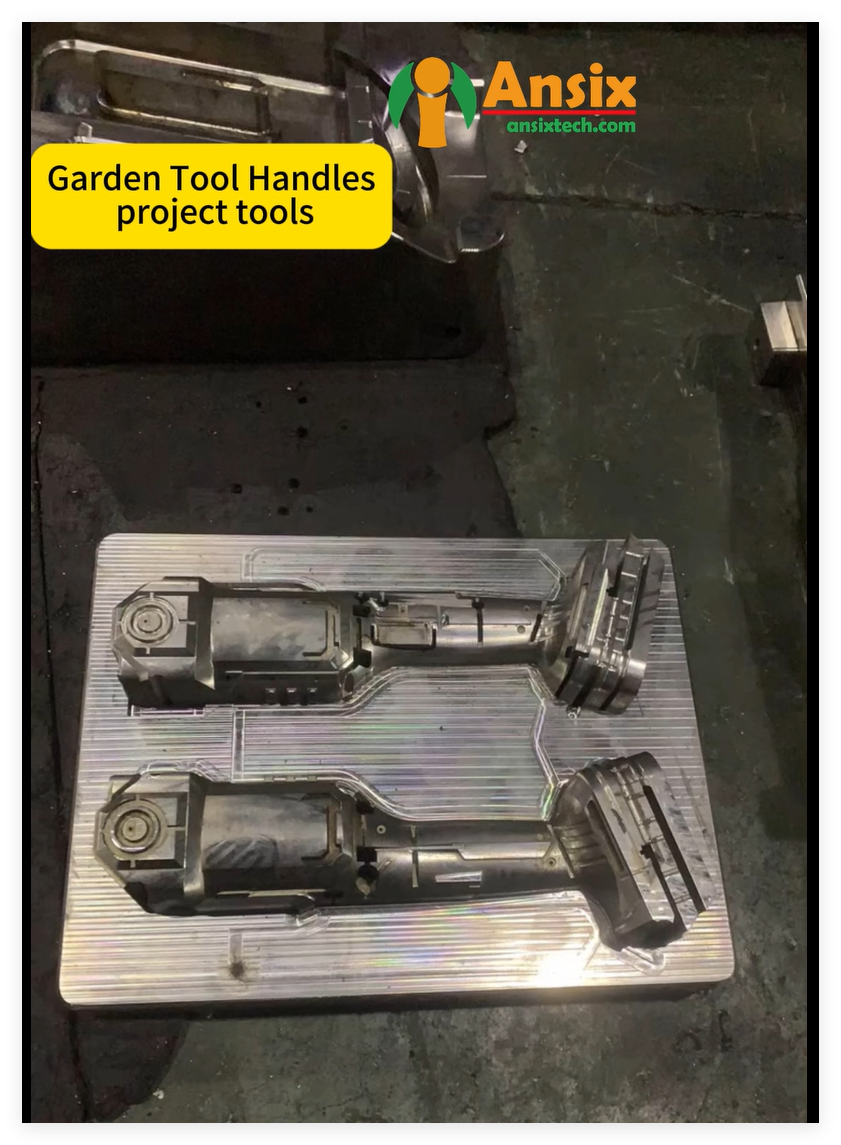
The manufacturing of the mold itself is where Ansix Tech’s 28 years of expertise manifest in tangible precision. Two-color molds often feature complex geometries, including rotating platens and intricate contour interfaces where the first and second shots meet. Achieving a seamless transition—where the soft material does not flash over the rigid material—requires machining tolerances of ±0.005 mm.
Ansix Tech employs a workflow centered on High-Speed Machining (HSM) and Electrical Discharge Machining (EDM) . The process begins with the selection of the mold base steel. For longevity in high-volume production (exceeding 1 million cycles), Ansix Tech utilizes DIN 1.2343 (AISI H11) for cavity plates. This chromium-molybdenum-vanadium alloyed steel offers exceptional toughness and resistance to heat checking, a common failure in two-color molds where the tool is constantly heated and cooled.
For the core inserts that form the intricate grip patterns—such as diamond textures or biometric finger grooves—Ansix Tech uses DIN 1.2767 (AISI 6F7) . This nickel-chromium-molybdenum steel provides superior polishability and wear resistance. The machining process involves:
Roughing: Using carbide tooling to remove bulk material, leaving 0.3 mm of stock.
Heat Treatment: Hardening the steel to 48–52 HRC to ensure dimensional stability during production.
Sinker EDM: For the complex textures and sharp internal corners that cannot be reached by a milling cutter, Ansix Tech utilizes advanced EDM with graphite electrodes. The electrodes are machined on 5-axis CNC mills to ensure that the texture depth is consistent to within 0.01 mm across the entire handle surface, ensuring uniform grip feel.
Thermal Regulation: The Cooling System, Runners, and Gating
In high-volume production, cycle time is money. For two-color overmolding, the cooling system must manage two separate thermal loads. Ansix Tech employs conformal cooling strategies—cooling channels that follow the contour of the handle—to achieve uniform temperature distribution.
Using 3D metal printing or strategic 5-axis drilling, they place cooling channels as close as 8–10 mm from the mold surface. For the rigid substrate (first shot), a rapid cooling rate (achieved by circulating water at 15–20°C) is critical to crystallize the polymer quickly and eject the part solidly. For the second shot (overmold), the cooling is slightly slower to allow for proper crystallization of the TPE, preventing shrinkage cavities at the bond line.
The runner system and gating are equally critical. Two-color molds typically require two independent hot runner systems. Ansix Tech utilizes valve gate hot runners for both stages. For the first shot (rigid core), they position a valve gate at the thickest section to allow for high packing pressure, minimizing sink marks. For the second shot (soft overmold), they use a fan gate that distributes the TPE evenly over the surface of the rigid core. This fan gate design is crucial; it reduces shear stress on the TPE (preventing material degradation) and ensures a laminar flow front that pushes air out ahead of the melt, eliminating air traps that would create cosmetic blistering.
The ejection system must also account for the delicate nature of a soft-touch product. Traditional ejector pins can mar the surface of a TPE grip. Ansix Tech employs stripper plates and air blast ejection systems. The stripper plate engages the rigid core (which maintains dimensional stability) while the soft grip is lifted off the core pins uniformly. This prevents the "stretching" or deformation that can occur if ejector pins are used directly on the soft material.
Validation: Rigorous Testing and Process Optimization
Validation is the phase where theoretical engineering meets the realities of production. Ansix Tech’s validation process is exhaustive, designed to simulate years of use in a matter of weeks.
The process begins with Trial Shot Analysis. Using the mold installed on a 250-ton two-color injection molding machine, Ansix Tech runs a designed experiment (DOE) to optimize the injection parameters. Key variables adjusted include:
Melt Temperatures: For PA6+GF30, they target 250–270°C; for the TPE overmold, 190–210°C.
Rotation Speed: The core plate rotation time is minimized to under 5 seconds to prevent heat loss before the second shot.
Transfer Position: The switch-over from injection to packing is calibrated to ensure the rigid core is 98% filled before packing, preventing flash in the second shot.
Technical Challenges During Injection Molding:
One of the most common issues in two-color molding is "bond-line failure" or "delamination." During the validation of a recent ergonomic hoe handle, Ansix Tech encountered adhesion issues. The initial bond strength was only 4 N/mm. Through thermal imaging and viscosity analysis, they discovered that the rigid core surface temperature had dropped below 80°C before the TPE was injected. To solve this, they increased the mold temperature in the second station using a dedicated oil thermolator, maintaining the core surface at 95°C. This allowed the TPE to melt a thin surface layer of the core, creating a true chemical fusion. Bond strength subsequently exceeded 9 N/mm.
Quality Control and Assurance:
Ansix Tech implements a Statistical Process Control (SPC) system during validation to establish control limits for critical-to-quality (CTQ) characteristics. Every 30 minutes during production runs, parts are subjected to:
3D Optical Scanning: Comparing the handle geometry to the CAD model to detect warpage or shrinkage beyond 0.1 mm.
Peel Tests: Destructive testing of overmold adhesion from a representative sample.
Durometer Testing: Ensuring the Shore A hardness of the TPE (typically 65–75A) remains consistent, which is critical for user comfort.
Cost Reduction Strategies and Operational Efficiency
While precision is non-negotiable, Ansix Tech’s value proposition is heavily weighted toward cost reduction. The company achieves this not by compromising quality, but through strategic optimization of materials, manufacturing processes, and operational efficiency.
- Material Optimization:
Ansix Tech often advises clients on "right-sizing" material specifications. For instance, if a client specifies an expensive, high-performance TPE for the entire handle, Ansix Tech’s engineers might propose a hybrid solution: using the premium TPE only in the palm contact zones (mapped via mold flow) and a less expensive, but chemically compatible, TPE for the secondary zones. Similarly, for the rigid core, they analyze the mechanical requirements. If a tool does not require the impact resistance of 30% glass-filled nylon, they may suggest a 20% talc-filled polypropylene, reducing raw material costs by up to 30% while maintaining structural integrity.
- Cycle Time Reduction:
In high-volume manufacturing, shaving seconds off the cycle time yields significant savings. Through conformal cooling and optimized handling, Ansix Tech consistently achieves target cycle times of 45–60 seconds for complex two-color handles. For a project producing 500,000 units annually, reducing the cycle time by just 10 seconds can save over $50,000 per year in machine time and labor costs.
- Automation and Assembly Verification:
To reduce labor costs and ensure precision, Ansix Tech integrates robotic take-out systems. These articulated robots remove the two-color handle from the mold, trim the fan gate using integrated hot-cutters (eliminating a secondary trimming operation), and place the part onto a conveyor belt for automated assembly verification. Using vision systems, they check that the overmold covers the correct area and that no flash is present. This automated verification ensures that only perfect parts move to packaging, eliminating the cost of manual sorting.
Boosting Capacity and Ensuring On-Time Delivery
With over 28 years in the industry, Ansix Tech has developed a manufacturing ecosystem designed for scalability. The company maintains a fleet of over 50 injection molding machines, ranging from 80 tons to 650 tons, specifically configured for two-color and multi-material applications.
To boost production capacity for large-scale orders, Ansix Tech employs a "multi-cavity" strategy. While a typical two-color mold may be a 1+1 (one core, one cavity per side), high-volume projects utilize 4+4 or 8+8 configurations. Manufacturing an 8+8 two-color mold requires immense technical skill; the balance of the hot runner system must be perfect so that all eight cavities fill simultaneously. Ansix Tech’s use of Husky and Synventive hot runner systems ensures balanced filling, allowing for a 400% increase in output compared to single-cavity tools without sacrificing quality.
On-time delivery is ensured through Integrated ERP and MES (Manufacturing Execution System) . Every stage—from steel procurement to heat treatment to final assembly—is tracked in real-time. Ansix Tech maintains a "critical spares" inventory for high-wear components (core pins, slide inserts) for every active mold. This proactive inventory management means that if a component wears out during a 24/7 production run, the repair is completed within hours, not days, guaranteeing that client deadlines are met without interruption.
Packaging and Rapid Delivery Workflow
The final stage of the value chain—packaging and delivery—is treated with the same precision as mold design. Ansix Tech understands that garden tool handles are often cosmetically sensitive; scratches or abrasions render a product unsellable.
The company employs a clean-room assembly and packaging area for final-stage operations. Handles are automatically packed into custom corrugated trays with anti-static foam dividers that prevent surface-to-surface contact during transit. For clients requiring just-in-time (JIT) delivery, Ansix Tech manages vendor-managed inventory (VMI) hubs, ensuring that shipments of 10,000–50,000 units arrive exactly when needed for the client’s final assembly line.
The workflow from order to delivery is streamlined:
Order Entry: Client PO triggers raw material requisition.
Material Preparation: Drying of hygroscopic materials (PA6, etc.) 4 hours prior to production.
Mold Installation: Tool changeover completed in under 90 minutes using standardized clamp plates.
Production: Automated molding with SPC monitoring.
Secondary Operations: Robotic degating and vision inspection.
Packaging: Automated counting and tray loading.
Logistics: Shipping via air or sea with full customs documentation.
Conclusion: Delivering Reliability Through Experience
In the niche yet demanding sector of two-color overmolding molds for garden tool handles, experience is the ultimate arbiter of success. Ansix Tech’s 28-year trajectory is not merely a timeline; it is a repository of solved problems, optimized workflows, and client successes.
The value delivered to clients extends far beyond the physical mold. It is found in the DFM analysis that eliminates costly design revisions; it is in the material science expertise that prevents delamination and ensures UV stability; it is in the strategic cost reductions that make high-end ergonomics accessible to the mass market; and it is in the robust cooling and ejection systems that guarantee 24/7 production uptime.
By integrating prototype design, manufacturing, validation, and mass production under one roof, Ansix Tech offers a seamless transition from concept to market. The company’s rigorous quality validation—encompassing everything from chemical bond strength to texture consistency—ensures that every handle meets the precise standards required by global clients and discerning end-users.
Ultimately, Ansix Tech’s core competency lies in its ability to significantly reduce clients’ tangible product costs through strategic optimization. By refining material selections, machining workflows, and injection molding parameters, they deliver tools that are not only more comfortable and durable but also more profitable for their clients. In an industry where the grip defines the tool, Ansix Tech has proven that the grip on the market is defined by engineering excellence.



Ansix Tech Co Ltd
If you have any plans related to Two-Color Overmolding Mold for Garden Tool Handles , you can contact us at any time. We will turn your ideas into reality, let you realize your dreams, and obtain large orders from the market. Our contact information is info@ansixtech.com. Or contact our CTO, mail: stephen@ansixtech.com
#www.ansixtech.com #ansixtech.com #Two-Color Overmolding Mold for Garden Tool Handles #Two-Color Overmolding Mold for Garden Tool Handles #Two-Color Overmolding Mold for Garden Tool Handles injection molding company #Two-Color Overmolding Mold for Garden Tool Handles injection mold companies #Ansix #Ansix moulds #Ansix china #Ansix tech china #Ansix tech company #Ansix facotry #Ansix Tech #Ansix molds #Ansix injection molding #Ansix mold factory #injection molding Two-Color Overmolding Mold for Garden Tool Handles #Ansix mold factory #Two-Color Overmolding Mold for Garden Tool Handles china #Two-Color Overmolding Mold for Garden Tool Handles molds #injection factory #Two-Color Overmolding Mold for Garden Tool Handles injection molding #Two-Color Overmolding Mold for Garden Tool Handles injection molding factory #injection molding company #Two-Color Overmolding Mold for Garden Tool Handles injection mold companies #Two-Color Overmolding Mold for Garden Tool Handles#Two-Color Overmolding Mold for Garden Tool Handles mold limited #Ansix mold china #Ansix companies #Ansix company China #Two-Color Overmolding Mold for Garden Tool Handles facotry #Ansix Tech #Ansix Tech mould #Two-Color Overmolding Mold for Garden Tool Handles injection moulding #injection moulding company #Ansix Two-Color Overmolding Mold for Garden Tool Handles parts injection mold companies #Two-Color Overmolding Mold for Garden Tool Handles #Two-Color Overmolding Mold for Garden Tool Handles china #Two-Color Overmolding Mold for Garden Tool Handles china factory #Ansix moulding companies #Ansix molding company #Two-Color Overmolding Mold for Garden Tool Handles injection moulding facotry #Ansix Tech mold #Two-Color Overmolding Mold for Garden Tool Handles mould #Two-Color Overmolding Mold for Garden Tool Handles plastic injection molding #ansix plastic mold #Mold manufacturing #Two-Color Overmolding Mold for Garden Tool Handles parts manufacturing #Two-Color Overmolding Mold for Garden Tool Handles plastic parts factory #Two-Color Overmolding Mold for Garden Tool Handles injection parts mold #Two-Color Overmolding Mold for Garden Tool Handles PRECISION MANUFACTURING #Two-Color Overmolding Mold for Garden Tool Handles #China mold #Two-Color Overmolding Mold for Garden Tool Handles injection moulding china #Two-Color Overmolding Mold for Garden Tool Handles mould china #china precision mold #mold in china #Two-Color Overmolding Mold for Garden Tool Handles mold china #Precision molds #High-precision molds #Two-Color Overmolding Mold for Garden Tool Handles #Injection molds #Two-Color Overmolding Mold for Garden Tool Handles Factory #Two-Color Overmolding Mold for Garden Tool Handles Company #Super Large Injection Mold Factory #Large Tonnage Injection Molding Factory #Two-Color Overmolding Mold for Garden Tool Handles Company #Two-Color Overmolding Mold for Garden Tool Handles Factory #2800T Injection Molding Factory #3000 Ton Injection Molding #4500 Ton Injection Molding Factory #Large Mold Injection Molding #Large Plastic Mold Injection Molding Factory #Large Injection Mold Manufacturer #Plastic Mold Factory #Injection Mold #Plastic Mold