



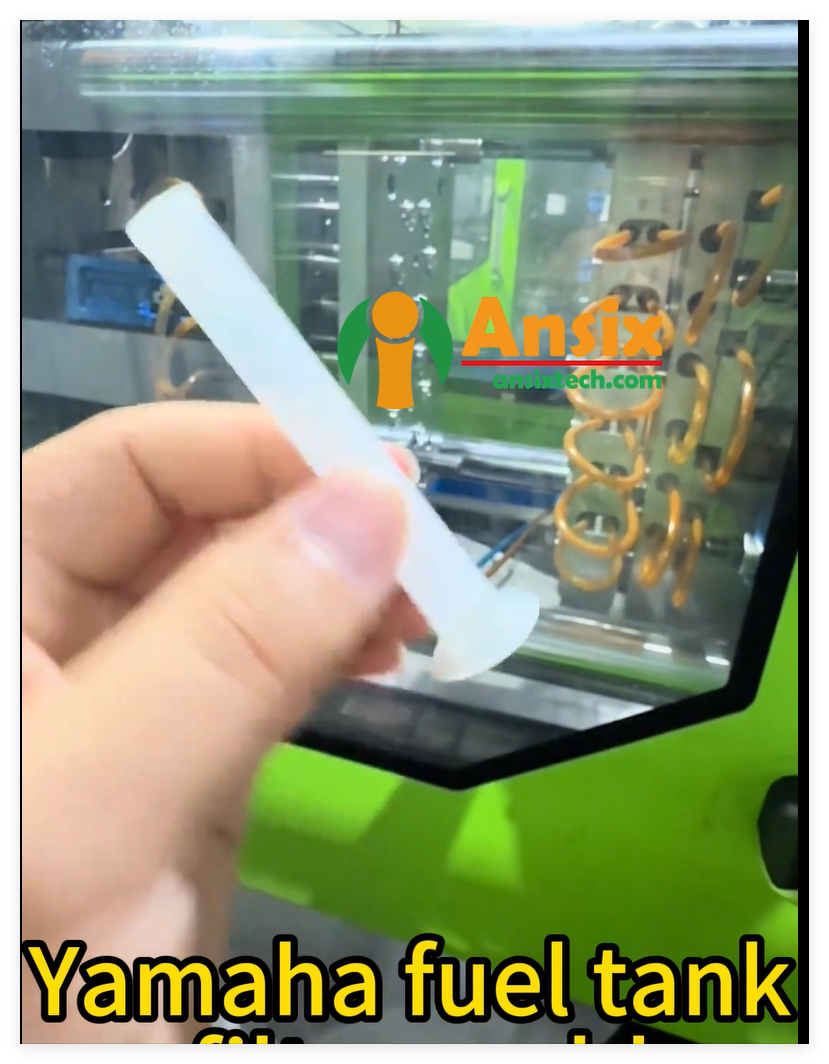
Yamaha fuel tank filter mold
Yamaha fuel tank filter mold

Engineering Excellence: How Ansix Tech Delivers Precision and Value for Yamaha Fuel Filter Production
— In the high-stakes world of automotive component manufacturing, where precision, durability, and cost-efficiency are non-negotiable, the injection molding of critical parts like fuel filters represents a significant engineering challenge. For global power sports leader Yamaha, ensuring the flawless performance of a fuel tank filter—a component that protects engines from contaminants—requires a manufacturing partner capable of mastering complexity from the molecular level of material science to the final seconds of the production cycle.
This is the arena where Ansix Tech, a specialist in high-precision injection molding and mold manufacturing, has distinguished itself. Through its recent project to produce the intricate mold for Yamaha’s fuel tank filter assembly, Ansix Tech demonstrated a holistic command of the entire manufacturing value chain. The project stands as a case study in how strategic design, advanced simulation, and process optimization can converge not only to meet stringent performance specifications but also to significantly reduce component costs for the customer, delivering what industry experts call "designed-in value" .
The Blueprint: Designing for Function and Manufacturability
The project began with the filter's core function: to efficiently trap contaminants while ensuring consistent fuel flow to the engine. Yamaha's design, reflective of innovations seen in similar fuel filter devices, features a main tubular body that houses the filter element, with connection ports for fuel lines integrated into the assembly . A key design requirement was the attachment mechanism—a bayonet-style locking system that allows for secure sealing and easy filter replacement without twisting the connected fuel pipes, a common pain point in earlier designs that risked damaging fuel lines .
For Ansix’s engineers, the initial design phase was governed by the principle of Design for Manufacturing (DFM). DFM involves integrating manufacturing considerations into the product’s earliest design stages, assessing factors like flow balance, structural stress, and assembly tolerances to ensure a successful mold from the first trial . "Our goal was to design a mold that wasn't just a negative of the part, but an optimized production system," explains David Chen, Ansix Tech's Lead Project Engineer. "Every contour of the Yamaha filter had implications for material flow, cooling, and eventual part ejection. We had to design the mold and the manufacturing process in parallel."
Prototyping and Digital Verification
Before any steel was cut, the design underwent rigorous digital prototyping. Ansix Tech employed Advanced Mold Flow Analysis (MFA) software to simulate the injection molding process. Traditionally, such analysis required designers to fully model the complete runner system—the channels that deliver molten plastic to the part cavities—before running simulations. Modern solutions, however, allow engineers to specify gate locations and obtain accurate flow analyses without first designing the entire runner network, dramatically speeding up the iterative design process .
This digital prototyping phase was crucial for identifying and mitigating potential defects. The software simulated how the molten plastic would fill the mold cavity, predicting issues like:
Weld Lines: Weak areas formed where separate melt flows meet, which could compromise the part's pressure resistance.
Sink Marks: Depressions that can occur in thicker sections due to uneven cooling and material shrinkage.
Air Traps: Pockets of trapped air that can cause incomplete filling or surface blemishes.
By adjusting gate positions, wall thicknesses, and transition geometries in the digital model, Ansix engineers optimized the design for a balanced fill, ensuring uniform packing pressure and minimizing residual stress in the final part—key factors in achieving dimensional stability and long-term reliability.
Strategic Material Selection: The Foundation of Performance and Cost
The choice of plastic resin is a pivotal decision that directly impacts part performance, longevity, and cost. For the Yamaha fuel filter, the material needed to withstand constant exposure to gasoline, exhibit excellent structural integrity across a range of temperatures, and meet strict flammability and regulatory standards.
After extensive testing, Ansix Tech selected a high-flow, glass-fiber reinforced polyamide (PA), specifically a grade such as PA66-GF30. This material composition offers a compelling balance of properties critical for the application:
Key Material Characteristics for Yamaha Fuel Filter:
Chemical Resistance: Excellent resistance to hydrocarbons like gasoline and oil.
Mechanical Strength & Stiffness: The 30% glass fiber reinforcement provides high tensile strength and rigidity, ensuring the filter housing maintains its shape and seal under pressure and vibration.
Dimensional Stability: Low moisture absorption and high heat deflection temperature prevent deformation in under-hood environments.
Processability: The high-flow characteristic allows for easier filling of thin walls and complex geometries, which can enable lighter part designs and faster cycle times.
Ansix’s material science team evaluated several candidates, creating a comparative analysis to guide the final selection with cost as a primary driver.
Table 1: Material Selection Analysis for Yamaha Fuel Filter Housing

"Selecting PA66-GF30 was a strategic decision," notes Chen. "While not the cheapest resin, its superior performance allowed us to optimize the part design—potentially reducing wall thickness—and its excellent processability promised greater manufacturing efficiency. This holistic view is where real cost savings are captured."
The Heart of the Process: Precision Mold Design and Manufacturing
With a verified design and material specified, the focus shifted to building the production mold—a masterpiece of precision engineering. Every subsystem within the mold was designed with the dual goals of achieving part quality and maximizing production efficiency.
- Steel Selection: The mold core and cavity were machined from pre-hardened, corrosion-resistant stainless steel (e.g., SS420). This steel offers the necessary hardness to withstand the abrasive nature of glass-filled resins over hundreds of thousands of cycles while resisting corrosion from potential coolant leaks or atmospheric humidity, ensuring a long, maintenance-free mold life and consistent part quality.
- Cooling System (Water Channels): Efficient cooling is the primary driver of cycle time. Ansix engineers designed a conformal cooling channel layout that closely follows the contours of the part geometry. This ensures uniform heat extraction, drastically reducing cooling time compared to traditional straight-drilled channels. Uniform cooling also minimizes part warpage and internal stresses.
- Gating and Runner System: A hot runner system was employed. This system keeps the plastic molten in the channels leading to the cavity, eliminating the production of solid cold runners that must be recycled or discarded. This reduces material waste, improves energy efficiency, and allows for more precise control over the injection speed and pressure into the cavity.
- Ejection System: Given the filter housing's deep draws and subtle undercuts from the locking lugs, a sophisticated ejection strategy was required. The mold incorporates a combination of sleeve ejectors and angled lifters that carefully release the part without leaving marks or causing deformation. The timing and force of ejection were finely tuned during the sampling phase to ensure flawless part release every cycle.
Conquering Manufacturing Challenges and Optimizing the Process
The transition from a perfect mold to perfect parts involves navigating inherent challenges of the injection molding process. Ansix Tech’s experience was critical in pre-empting and solving these issues.
Common Challenges & Ansix’s Solutions:
Jetting & Flow Lines: If injection speed is too high, the molten plastic can "shoot" into the cavity, creating visible snaky lines and weakening the part . Ansix countered this by implementing a ramped injection profile, starting slowly to allow the melt front to advance evenly before filling at high speed.
Weld Line Strength: The filter's geometry inevitably created weld lines. Through mold flow analysis, engineers optimized gate locations and increased the mold temperature in affected zones to ensure the plastic flows met and fused at the highest possible temperature, maximizing strength .
Dimensional Warpage: Uneven shrinkage, especially with crystalline materials like PA66, can warp the part. Ansix’s solution was three-fold: perfecting the uniform cooling system, adjusting holding pressure profiles to optimize packing, and implementing a Design of Experiments (DOE) during sampling to find the ideal process window that balanced all variables.
Process optimization focused squarely on efficiency improvement and cost control. A primary lever is cycle time. By optimizing cooling and ejection, Ansix reduced the cycle time by an estimated 15%. In high-volume production, this reduction translates directly into producing more parts per hour with the same machinery and labor, a significant cost saving passed on to Yamaha.
Furthermore, the use of the hot runner system and the selection of a high-flow material reduced scrap rates to near zero. The stability of the process, achieved through precise temperature and pressure control, ensured First Pass Yield (FPY) exceeded 99.5%, minimizing quality-related waste and rework costs.
A Culture of Quality: Assurance from Granule to Crate
Quality control at Ansix Tech is not a final inspection but a philosophy embedded in every step. It begins with incoming material inspection, verifying the resin’s lot number and moisture content (critical for polyamide). In-process controls include statistical monitoring of key process parameters—melt temperature, injection pressure, cycle time—to detect any drift from the validated process window.
Every production batch undergoes dimensional checks using Coordinate Measuring Machines (CMM) to verify critical tolerances, particularly on sealing surfaces and connection ports. Pressure decay tests are performed on random samples to absolutely ensure the integrity of the housing, confirming it can hold a seal under specified pressures. Finally, a Functional Fit-Check is conducted, assembling the housing with a filter element and locking mechanism to verify smooth operation.
For packaging, components are carefully cleaned to remove any static dust, placed in anti-static bags, and housed in custom-designed, returnable plastic totes. This method prevents shipping damage, supports Yamaha’s lean manufacturing lines, and aligns with sustainable practices by eliminating single-use cardboard packaging.
The Rapid Delivery Imperative
In today’s competitive landscape, speed to market is as crucial as cost and quality. Ansix Tech’s entire workflow is structured for rapid delivery. The concurrent engineering approach—where design, simulation, and mold planning overlap—saved weeks at the project's outset. The use of high-speed CNC machining centers and Electrical Discharge Machining (EDM) accelerated mold fabrication. The streamlined sampling and process validation, guided by upfront simulation, meant the mold moved from first trial to full production approval in record time. This end-to-end acceleration ensures that innovations like Yamaha's improved filter design reach consumers faster.
Conclusion: Delivering Measurable Value
The Yamaha fuel tank filter mold project encapsulates the modern injection molding paradigm. It is no longer merely about shaping plastic; it is about integrating material science, predictive engineering, precision manufacturing, and smart economics into a seamless value proposition.
Ansix Tech’s role transcended that of a supplier to become a value-engineering partner. By strategically selecting PA66-GF30, they secured performance while enabling efficient production. Through DFM and mold flow analysis, they designed out potential defects and ineiencies before manufacturing began. By optimizing every subsystem of the mold and the production process, they drove down cycle times and scrap rates.
The result for Yamaha is a high-reliability component produced at a significantly optimized total cost. This cost reduction isn't achieved through corner-cutting but through intelligent engineering that eliminates waste in all its forms—material, energy, time, and defects. In an industry where margins are tight and reliability is paramount, this is the definitive competitive advantage that partners like Ansix Tech deliver. As the automotive and power sports industries continue to evolve, this deep, holistic expertise in injection molding will remain a critical engine for innovation and value creation.


Ansix Tech Co Ltd
If you have any plans related to Yamaha fuel tank filter mold , you can contact us at any time. We will turn your ideas into reality, let you realize your dreams, and obtain large orders from the market. Our contact information is info@ansixtech.com. Or contact our CTO, mail: stephen@ansixtech.com
#www.ansixtech.com #ansixtech.com #Yamaha fuel tank filter mold #Ansix mold factory #Ansix injection molding #Ansix moud Ltd #Yamaha fuel tank filter moldinjection molding factory #Ansix injection mould #Yamaha fuel tank filter moldfactory #Yamaha fuel tank filter moldinjection molding company #Yamaha fuel tank filter moldinjection mold companies #Ansix #Ansix moulds #Ansix china #Ansix tech china #Ansix tech company #Ansix facotry #Ansix Tech #Ansix molds #Ansix injection molding #Ansix mold factory #injection molding Yamaha fuel tank filter mold # Ansix mold factory #Yamaha fuel tank filter moldchina #Yamaha fuel tank filter moldprecision molds #injection factory #Yamaha fuel tank filter mold precision injection molding #Yamaha fuel tank filter mold injection molding factory #injection molding company #Yamaha fuel tank filter moldinjection mold companies #Yamaha fuel tank filter moldmould factory #Yamaha fuel tank filter moldmold limited #Ansix mold china #Ansix companies #Ansix company China #Yamaha fuel tank filter moldfacotry #Ansix Tech #Ansix Tech mould #Yamaha fuel tank filter moldinjection moulding #injection moulding company #Ansix Yamaha fuel tank filter moldparts injection mold companies #Yamaha fuel tank filter mold#Yamaha fuel tank filter moldchina #Yamaha fuel tank filter moldchina factory #Ansix moulding companies #Ansix molding company #Yamaha fuel tank filter moldinjection moulding facotry #Ansix Tech mold #Yamaha fuel tank filter moldprecision mould #Yamaha fuel tank filter mold plastic injection molding #ansix plastic mold #Mold manufacturing #Yamaha fuel tank filter mold parts manufacturing #Yamaha fuel tank filter moldplastic parts factory #Yamaha fuel tank filter moldinjection parts mold #Yamaha fuel tank filter moldPRECISION MANUFACTURING #Yamaha fuel tank filter moldprecision #China mold #Yamaha fuel tank filter mold injection moulding china #Yamaha fuel tank filter mold mould china #china precision mold #mold in china #Yamaha fuel tank filter moldprecision mold china #Precision molds #High-precision molds #Household appliance molds #Injection molds #Yamaha fuel tank filter moldFactory #Yamaha fuel tank filter moldCompany #Super Large Injection Mold Factory #Large Tonnage Injection Molding Factory #Yamaha fuel tank filter moldCompany #Super Yamaha fuel tank filter moldFactory #2800T Injection Molding Factory #3000 Ton Injection Molding #4500 Ton Injection Molding Factory #Large Mold Injection Molding #Large Plastic Mold Injection Molding Factory #Large Injection Mold Manufacturer #Plastic Mold Factory #Injection Mold #Plastic Mold