



PU foam for car seats
FEATURES
HARD INFRASTRUCTURE—The Foundation of Customer Trust
1.1 Advanced Mold Manufacturing Equipment
Ansix Tech operates a world-class mold-making facility equipped with 5-axis high-speed machining centers (HSM) capable of processing complex contoured surfaces with precision up to 0.002mm. The 5-axis HSM enables simultaneous five-sided machining without repositioning—eliminating parting line misalignment and reducing setup time by up to 70%.
What this means for customers:
Smoother sealing surfaces with minimal post-molding flash—eliminating secondary flash removal operations
Lower manual labor costs and consistent sealing performance across millions of production cycles
Design freedom—complex geometries that competitors cannot produce become routine production realities
The facility also maintains slow-wire EDM (Electrical Discharge Machining) with capability to fabricate fine micro-holes and narrow slots down to 0.03mm. Localized cooling channels ensure minimal risk of thin-wall deformation during production.
-
Mold Description
Product Materials:
PU FOAM
Soft rubber: PU
Mold Material:
S136ESR
Number of Cavities:
1
Glue Feeding Method:
Hot runner
Cooling Method:
Water cooling
Molding Cycle
42.5s
- The mold manufacturing process and product material selection
Complete mold processing and inspection equipment includes:
Precision coordinate measuring machines (CMM) for full 3D dimensional verification
Optical measurement systems and profile projectors
Cavity pressure monitoring systems for real-time process control
Mold flow analysis software for predictive process optimization
Customer value translation: Every mold delivered undergoes full dimensional reporting. Critical dimensions achieve CPK ≥ 1.33 before production begins—meaning your production line starts with guaranteed capability, not guesswork.
1.2 Injection Molding Machine Fleet
Ansix Tech operates a comprehensive injection molding machine fleet spanning clamping forces from 30 tons to 4,000 tons, covering product sizes from miniature precision components to large-format automotive parts.
-
What this means for customers:
Single-source solution—regardless of whether your project calls for a tiny precision component or a large-format assembly
No need to qualify multiple suppliers for different product sizes
Consistent quality standards across your entire product portfolio
All machines are equipped with full servo-electric drives, achieving stable injection repeatability of ±0.1%.
Customer value translation: Every single shot mirrors the previous one, batch after batch, shift after shift, across millions of cycles. When you receive parts from Ansix Tech, consistency is guaranteed—no dimensional drift, no unexpected variation, no costly re-inspection.
1.3 Quality Certifications and Systems
Ansix Tech has successfully passed ISO9001, IATF16949 (automotive), ISO13485 (medical), ISO14001 (environmental), and BSCI certifications.
What this means for customers:
Automotive-grade quality systems already in place—no need to audit or develop new quality frameworks
Global supply chain compliance—meeting the requirements of Tier 1 suppliers and OEMs worldwide
Proven quality track record—over 28 years of manufacturing experience across automotive, medical, consumer electronics, and smart home industries
PART TWO: MOLD MANUFACTURING—The Core Competitiveness
2.1 Mold Steel Selection and Lifespan
Dimension Technical Specification Customer Value
Mold Base P20 steel Foundation stability for long-term production
Core & Cavity S136, 2344, 2343, 8407, SKD11/61, DC53, M340, 4Cr13, 9Cr18, NAK80, H13 Tailored material selection based on production volume and part complexity
Mold Lifespan 500,000 cycles for glass-fiber reinforced materials; 1,000,000 cycles for standard plastics Long-term production without mold replacement—lower amortized tooling cost per part
Material Documentation Full material certificates + heat treatment curves provided Traceability and quality assurance—no material-related surprises
Why H13 for high-wear areas: For high-wear areas in long-term automotive projects, premium steels like H13 hot-work tool steel are selected. While initial cost is higher, their superior wear resistance, toughness, and thermal conductivity ensure the mold maintains critical dimensions over millions of cycles—protecting your investment and ensuring part quality consistency.
2.2 Mold Types and Capabilities
Ansix Tech manufactures a comprehensive range of mold types:
Hot runner molds —reduces material waste and cycle time
Stack molds —doubles production efficiency
Two-color/multi-material molds —enables complex multi-component parts in a single cycle
High-gloss molds (Ra < 0.05μm) —suitable for transparent and appearance-grade components
2.3 Gating System Optimization
Through mold flow analysis, Ansix Tech predicts weld line and air trap locations before steel is cut, optimizing gate location and quantity to ensure balanced filling.
What this means for customers:
No trial-and-error on your production line—the mold works the first time
Reduced scrap rates from filling defects
Lower development costs—problems are solved digitally, not physically
2.4 Delivery Standards
Mold Complexity Standard Lead Time Expedited Lead Time
Simple molds 10 days N/A
Medium complexity 25–45 days 20 days (with validation steps maintained)
High complexity 45–60 days 35 days
Customer value translation: Expedited delivery does not mean compromised quality—validation steps are maintained, ensuring the mold performs as specified from the first shot.
2.5 Cooling System Design
Proper thermal management is the behind-the-scenes hero of efficient, high-quality injection molding. Ansix Tech designs cooling systems with:
Zoned temperature control using mold temperature controllers
Temperature differential between core and cavity maintained within 2°C—reducing warpage and distortion
Conformal cooling channels for complex geometries
What this means for customers:
Faster cycle times —efficient cooling reduces production time per part
Lower residual stress in finished parts—better dimensional stability
Reduced warpage —parts fit assembly fixtures consistently
PART THREE: INJECTION MOLDING—Process Control Excellence
3.1 Process Standardization and MES Integration
All machines are networked—molding parameters (temperature, pressure, speed, time) are locked into the MES system. Only authorized engineers can make adjustments.
What this means for customers:
No operator variability—the process runs the same way every shift
Full traceability—every batch is produced under identical conditions
First-article and last-article inspection for every production run—no gradual process drift
3.2 Dimensional Stability Control
Ansix Tech employs:
Ultrasonic wall thickness sensors providing real-time feedback on wall thickness fluctuations with automatic compensation of holding pressure
In-mold temperature and pressure sensors enabling closed-loop control
Zoned mold temperature control keeping core-cavity temperature differential within 2°C
Proven result: For similar support components, three consecutive production batches over one week showed critical hole spacing fluctuation ≤ 0.02mm.
3.3 Surface Quality Grades
Surface Requirement Achievable Specification Customer Benefit
Transparent parts No bubbles, no flow marks Optical clarity—no rework
Plating-grade parts No gas marks Consistent plating adhesion—no rejects
High-gloss parts Surface roughness Ra ≤ 0.2μm Class-A surface—ready for final assembly
For products requiring painting or printing: Compensation for deformation can be预留, with printing registration accuracy controlled to ±0.1mm.
3.4 Special Material Capabilities
Ansix Tech maintains extensive experience with engineering materials including:
PC/ABS, PC, PPS+40%GF, PEEK, PTFE/PFA, PA6+GF30, PBT, PEI, PPS, LCP, Liquid Silicone Rubber (LSR)
Material-specific requirements addressed:
Flame retardancy (UL94 V-0) for safety-critical applications
Weather resistance (UV testing up to 3,000 hours without discoloration) for exterior applications
Heat resistance (continuous use up to 180°C) for under-hood applications
3.5 Flash Control
Ansix Tech achieves 0.005mm mold fitting precision on parting surfaces and employs self-locking clamp force compensation to ensure flash is controlled to within 0.03mm per batch—eliminating manual deburring operations.
What this means for customers: No secondary flash removal, lower labor costs, and consistent part appearance.
PART FOUR: FULL-SERVICE CAPABILITIES—Reducing Customer Management Costs
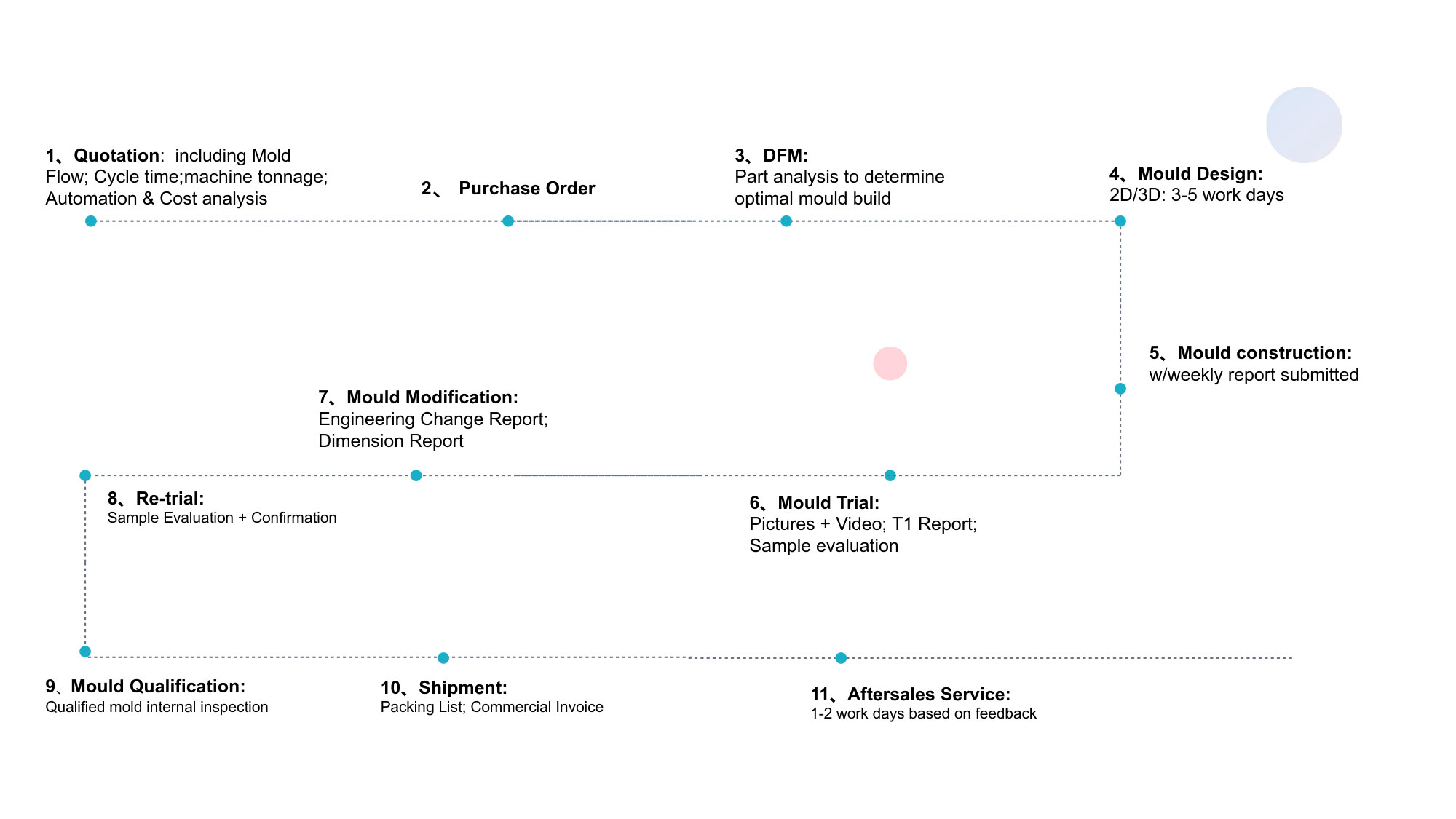
4.1 Early Design Intervention (DFM Reports)
Before any contract is signed, Ansix Tech provides a comprehensive Design for Manufacturability (DFM) report.
What the DFM report includes:
Draft angle recommendations—ensuring easy part ejection
Wall thickness optimization—preventing sink marks and shrinkage
Gate location analysis—ensuring balanced filling
Ejector pin mark location recommendations—keeping marks out of visible areas
Weld line and air trap prediction—identifying and solving problems before steel is cut
Customer value translation: Avoid the cost and delay of discovering a part cannot be manufactured after the mold is already built. DFM is your first and most critical cost-saving opportunity.
4.2 Sampling and Iterative Validation (T0 to T3)
Ansix Tech provides T0 through T3 trial samples, with each round accompanied by a detailed improvement report.
What this means for customers:
Rapid design iteration—quickly replace inserts to validate different approaches without rebuilding the entire mold
Transparent development process—you see exactly what is being improved and why
No hidden costs—improvement rounds are structured and predictable
4.3 Pre-Production Validation
Before full-scale production begins, Ansix Tech provides 100–500 shot trial production runs with statistical validation:
Yield rate analysis
CPK calculation for critical dimensions
Process capability confirmation before production ramp-up
Customer value translation: You do not commit to full production until the process is proven stable and capable. No expensive production surprises.
4.4 Maintenance and Spare Parts
Spare parts (ejector pins, core inserts) delivered with the mold—no waiting for replacements
Mold maintenance provided every 200,000 cycles—proactive, not reactive
Lifetime repair at cost price—no inflated service charges
PART FIVE: DIFFERENTIATED ADVANTAGES—Direct Answers to Common Industry Pain Points
Common Customer Complaint Ansix Tech's Commitment How We Deliver
"Molds constantly need repair—disrupting production" "We deliver with a 2,000-shot aging test and wear report; 3-year structural warranty (excluding normal wear of consumables)" Aging test validates durability before delivery; warranty protects your production uptime
"Excessive flash means expensive secondary finishing" "We achieve 0.005mm parting surface fit with self-locking clamp force compensation; flash controlled to within 0.03mm per batch" Eliminates manual deburring—lower labor cost, faster throughput
"Dimensions drift from batch to batch" "Ultrasonic wall thickness sensors provide real-time feedback with automatic pressure compensation; in-mold sensors enable closed-loop control" Every batch matches the first—no re-inspection, no scrap
"Mold repairs take too long" "In-house electrode machining and EDM workshops—repairs stay on-site; routine welding/insert replacement restored within 24 hours" Minimizes downtime—keeps your production line running
The Ansix Tech Philosophy
"For our customers, a mold is not a piece of metal—it is a money-printing machine."
When Ansix Tech designs a mold, we simultaneously plan for:
Rigidity during injection—no deflection under pressure
Venting paths—no air traps or burn marks
Thermal balance—consistent cooling for dimensional stability
The result: A mold that arrives at your production line ready to run—no debugging, minimal flash, long life.
PU FOAM FOR CAR SEATS—Product and Process Overview
Product Introduction
PU (polyurethane) foam for car seats is a high-resilience, flexible foam material engineered for automotive seating applications. It provides:
Superior comfort through optimized density and hardness profiles
Excellent durability—withstands years of compression cycles
Low VOC emissions—meeting stringent automotive interior air quality standards
Design flexibility—can be molded into complex 3D geometries
The Manufacturing Process
1. Raw Material Preparation
Polyol component (A-side)—polyether or polyester polyols with specific functionality and molecular weight
Isocyanate component (B-side)—TDI or MDI-based systems
Catalysts, blowing agents, chain extenders, and additives—formulated for specific foam properties
2. Cold Cure (High-Resilience) Foam Process
The dominant global production method for automotive seating foam. The foam mixture (isocyanates, polyols, catalysts, and additives) is injected into a closed mold where it rises and expands.
3. Mold Design for Foam
Foam molds differ from injection molds:
Two-piece or three-piece construction
Epoxy or aluminum mold cavities for thermal management and surface finish
Venting design critical for foam expansion and surface quality
4. Post-Processing
Demolding—foam parts are removed after curing
Post-curing—hanging chain aging process for dimensional stabilization
Trimming and finishing—removal of flash and excess material
Quality Assurance for PU Foam
Density control—ensuring consistent part weight and comfort
Hardness (ILD/IFD) testing—validating comfort characteristics
Tear strength and tensile testing—ensuring durability
VOC and fogging testing—meeting interior air quality standards
Dimensional inspection—ensuring fit with seat frames and covers
Delivery Efficiency
With 260 injection molding machines across four production bases, Ansix Tech maintains:
Rapid response to order fluctuations
Multiple production lines for parallel processing
Efficient supply chain management with long-term supplier relationships
Cost Control Leadership
Ansix Tech achieves cost leadership through:
Material optimization—recommending the right material grade for the application, avoiding over-specification
Process efficiency—optimized cycle times and reduced scrap
Scale economies—260 machines across four plants spread fixed costs
Vertical integration—in-house mold manufacturing eliminates outsourcing markup
Design-for-manufacturing—solving problems digitally before steel is cut
After-Sales Service Quality
Technical support—professional engineering team available for ongoing production support
Mold maintenance—scheduled preventive maintenance programs
Spare parts availability—critical components stocked for rapid replacement
12-hour response time to customer inquiries
Conclusion: The Ansix Tech Value Proposition
Ansix Tech transforms PU foam for car seats from a commodity component into a strategic advantage for automotive customers by:
Solving problems before they happen—through DFM analysis and mold flow simulation
Reducing total cost of ownership—through material optimization, process efficiency, and mold longevity
Mitigating supply chain risk—through multiple production bases, certified quality systems, and proven scalability
Accelerating time-to-market—through rapid prototyping, parallel processing, and expedited delivery options
Customer value is not an add-on at Ansix Tech—it is engineered into every decision, from material selection to final delivery.
Ansix Tech Co Ltd
If you have any plans related to PU foam for car seats , you can contact us at any time. We will turn your ideas into reality, let you realize your dreams, and obtain large orders from the market. Our contact information is info@ansixtech.com. Or contact our CTO, mail: stephen@ansixtech.com
#www.ansixtech.com #ansixtech.com #PU foam for car seats #PU foam for car seats #PU foam for car seats Canopy Mold injection mold companies #Ansix #Ansix moulds #Ansix china #Ansix tech china #Ansix tech company #Ansix facotry #PU foam for car seats injection molding #PU foam for car seats injection tools #PU foam for car seats injection moulds #PU foam for car seats plastic mould #PU foam for car seats plastic tools #Ansix Tech #Ansix molds #Ansix injection molding #Ansix mold factory #injection molding PU foam for car seats#Ansix mold factory #PU foam for car seats china #PU foam for car seats molds #injection factory #PU foam for car seats injection molding #PU foam for car seats injection molding factory #injection molding company #PU foam for car seats injection mold companies #PU foam for car seats Tooling #PU foam for car seats mold limited #Ansix mold china #Ansix companies #Ansix company China #PU foam for car seats facotry #Ansix Tech #Ansix Tech mould #PU foam for car seats injection moulding #injection moulding company #Ansix PU foam for car seats parts injection mold companies #medical injection molding companieschina #PU foam for car seats china factory #Ansix moulding companies #Ansix molding company #PU foam for car seats injection moulding facotry #Ansix Tech mold #PU foam for car seats mould #PU foam for car seats plastic injection molding #ansix plastic mold #Mold manufacturing #PU foam for car seats parts manufacturing #PU foam for car seats plastic parts factory #PU foam for car seats injection parts mold #PU foam for car seats PRECISION MANUFACTURING #PU foam for car seats #China mold #PU foam for car seats injection moulding china #PU foam for car seats mould china #china precision mold #mold in china #PU foam for car seats mold china #Precision molds #High-precision molds #PU foam for car seats #Injection molds #PU foam for car seats Factory #PU foam for car seats Company #Super Large Injection Mold Factory #Large Tonnage Injection Molding Factory #PU foam for car seats Company #PU foam for car seats Factory #2800T Injection Molding Factory #3000 Ton Injection Molding #4500 Ton Injection Molding Factory #Large Mold Injection Molding #Large Plastic Mold Injection Molding Factory #Large Injection Mold Manufacturer #Plastic Mold Factory #Injection Mold #Plastic Mold