



Water Bottle Cap Thread Mold
FEATURES
At Ansix Tech, we believe that a mold is not just a block of steel. It is a profit engine for your operation. Since our founding in Hong Kong in 1998, we have grown into a leading provider of end-to-end injection molding solutions, operating four production bases across China and Vietnam, with 260 injection molding machines ranging from 30 to 2,800 tons, and over 200 dedicated design engineers contributing to more than 30,000 molds built to date. Our mission is simple: Make Our Customers Successful. This proposal outlines precisely how we convert advanced manufacturing capabilities into measurable customer value, offering a unified platform that eliminates communication gaps, accelerates timelines, and ensures consistency from concept to final delivery.
-
Mold Description
Product Materials:
PP
Mold Material:
S136ESR
Number of Cavities:
2
Glue Feeding Method:
Hot runner
Cooling Method:
Water cooling
Molding Cycle
36.5s
Section 1: Hard Power Infrastructure—Building Trust Through Measurable Equipment Capability
1.1 Mold Manufacturing Equipment: Precision That Delivers Seamless Bottle Caps
The foundation of any high-quality bottle cap mold lies in the precision of its machining equipment. Ansix Tech has invested in world-class manufacturing assets from Mikron, Makino, and Frank to ensure every component meets exacting specifications.
Five-Axis High-Speed Machining Centers: Our five-axis CNC technology allows the cutting tool to approach the workpiece from any direction in a single setup, eliminating multiple clamping operations and manual intervention. This capability transforms into customer value through:
-
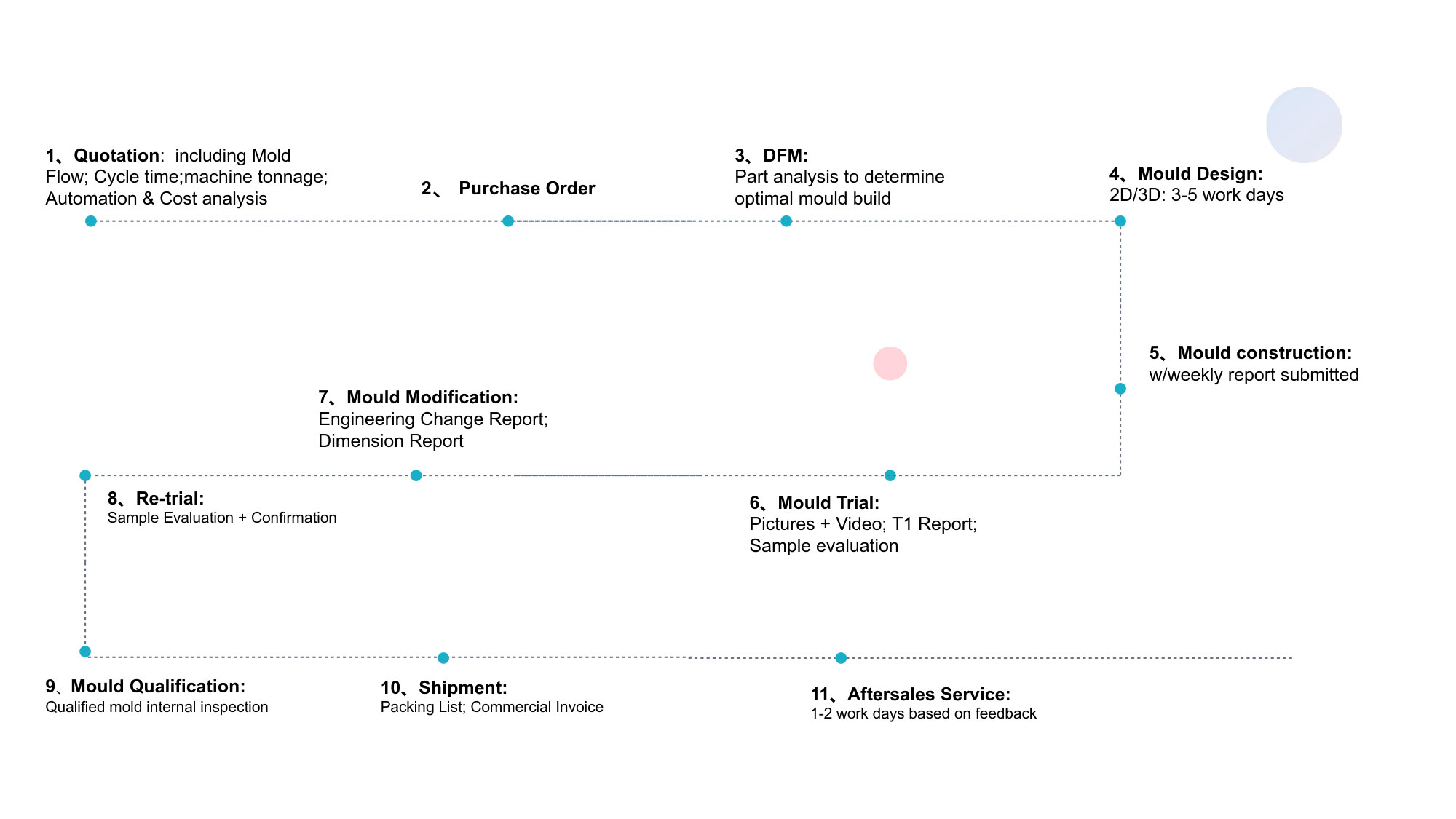
The mold manufacturing process and product material selection
Smoother parting lines: Complex freeform parting surfaces are machined with seamless transitions, eliminating the gaps that cause flash—those thin, unwanted plastic layers that require costly manual deflashing. Your bottle caps come off the machine ready for secondary processing, saving 5–15 seconds of labor per part.
±0.002mm accuracy: Multi-cavity molds (up to 48 cavities) achieve identical dimensions across every cavity, ensuring that cap 1 and cap 48 fit the same bottle neck with zero variation.
Slow Wire EDM (Wire-Cut Electrical Discharge Machining): For bottle cap molds requiring 0.03mm micro-holes, narrow grooves, internal splines, or complex undercuts, our wire EDM capabilities prevent thin-wall deformation during machining. Customer value: Elimination of post-machining corrections, faster mold assembly, and absolute precision in thread-forming geometry.
Automated Machining Ratio of 70%: High automation reduces human error and ensures consistency across mold components. Customer value: Predictable mold quality, faster delivery, and reduced risk of assembly mismatches.
1.2 Injection Molding Machine Fleet: Consistency from the First Shot to the Last
Ansix Tech operates 260 injection molding machines with clamping forces from 30 to 2,800 tons, covering every product size from miniature caps for personal care products to large closures for industrial containers.
All-Servo Electric Drive Systems: Our machines are equipped with all-servo motor drives that deliver repeatable precision of ±0.1%. Customer value:
Multiple production runs over weeks or months produce identical bottle cap dimensions. Your capping machinery will seat caps with consistent torque, reducing waste from improper seals.
Energy consumption is significantly lower than hydraulic alternatives, directly reducing your per-part electricity cost.
Tonnage Range Coverage:
30–150 tons: Small cosmetic caps, pharmaceutical closures, and fine-thread precision parts.
150–800 tons: Standard beverage bottle caps, sports cap closures, and medium-sized packaging components.
800–2,800 tons: Large industrial caps, pail closures, and multi-cavity high-volume production.
1.3 Inspection and Quality Equipment: Data-Driven Validation for Defect-Free Production
Every mold that leaves our facility undergoes rigorous dimensional validation.
CMM (Coordinate Measuring Machines): Full dimensional inspection with comprehensive reports comparing actual part geometry against CAD models.
Optical Imaging Systems: High-resolution vision measurement for critical features such as thread pitch, inner diameter, and sealing surface contours.
Key Performance Indicator (Benchmark): Every mold undergoes a full dimensional report before shipment, with critical dimensions achieving Cpk ≥ 1.33 (Process Capability Index), signifying that the manufacturing process is stable, centered, and capable of producing well within specification limits. Customer value: Statistical proof that your mold will not drift out of specification during production. No guesswork. No surprise rejections.
Section 2: Mold Manufacturing Core Competencies—Translating Steel into Production Reliability
Your customers demand consistent sealing, smooth threading, and zero defects. The following specifications directly address those market demands.
Dimension Technical Specification Customer Value (What You Gain)
Mold Life (Lifespan) At least 500,000 shots for glass-fiber reinforced materials; 1,000,000+ shots for standard plastics (PP/PE). Mold base using P20; Cavities: S136, 2344, 2343, 8407, SKD11/61/DC53, M340/4Cr13, 9Cr18, NAK80, H13. Maximize ROI with extended production runs before needing maintenance or replacement; Reduce downtime; Lower amortized tooling cost per cap.
Achievable Tolerance ±0.05mm for structural features (wall thickness, outer diameter); ±0.005mm for precision features (thread start/stop points, sealing lands). Ensures every cap fits every bottle perfectly; Eliminates customer complaints about cross-threading or leakers.
Mold Type (Configurations) Hot Runner Systems: Reduces waste by 15–30% by eliminating cold runner scrap. Stack Molds: Double your output (two layers of cavities) without doubling machine size. Two-Shot/Multi-Material: Perfect for bi-injection caps with integrated seals. High-Gloss Molds: Ra ≤ 0.05μm for transparent or cosmetic products. Lower material costs; Higher output per machine hour; Fewer defects; Superior aesthetics.
Gate & Runner Solution Ansix Tech utilizes Moldflow analysis to virtually simulate melt flow, identifying weld line and air trap locations before steel is cut. Gates are positioned to ensure balanced filling across all cavities, even in complex multi-cavity 48-cavity molds. Eliminate weak weld lines on the critical sealing surface; Reduce cosmetic rejects; Minimize sink marks on thick sections.
Delivery (Lead Time) Simple molds: 10 days; Medium complexity (e.g., 16–32 cavity): 25–45 days; Expedited hot-runner or stack tools: available in 20 days (with validation steps preserved). Faster time-to-market; Capture seasonal demand windows without sacrificing quality.
Section 3: Injection Molding Process Control—Suppressing the Anxiety of Quality Variation
In high-volume bottle cap production, every second counts, and every defect costs money. Customers are justifiably concerned about sink marks and voids, flash, dimensional instability, and batch-to-batch color variation. Here is how Ansix Tech eliminates those concerns.
3.1 Process Standardization: Human Error Removed
All our injection molding machines are networked and integrated into a Manufacturing Execution System (MES) . Key process parameters—temperature zones, injection pressure profiles, screw speed, cooling time, holding pressure switchover—are password-protected. Only authorized engineers can make adjustments. Every batch undergoes first-article and last-article comparison to verify that no drift has occurred.
Customer value: A documented, repeatable, auditable production process. If your auditor asks for proof of process control, we provide data logs, not promises.
3.2 Dimensional Stability Control: Eliminating Warpage
Bottle caps must seal perfectly. Warpage—even fractions of a millimeter—can mean leakers and returns. Ansix Tech implements:
Zone-controlled mold temperature controllers (thermolators): Maintaining core and cavity temperature differentials within 2°C to reduce differential shrinkage and warpage.
Conformal cooling channels: Using metal additive manufacturing (3D printing) to create cooling channels that follow the contour of the threaded core. Unlike conventional straight-drilled channels, conformal channels provide uniform, rapid heat extraction, reducing cooling time by 15% or more while dramatically improving dimensional stability.
Ultrasonic wall thickness sensors: Real-time feedback from sensors mounted on the injection molding machine continuously monitors wall thickness variation. The system automatically compensates holding pressure to maintain thickness within tolerance.
Measured result: In our analysis of comparable closure products, continuous production across three batches over one week yielded critical hole spacing (or thread lead) variation of ≤ 0.02mm.
3.3 Cosmetic Grade Classification: Appearance That Sells
Bottle caps are often the first physical interaction a consumer has with your product. Ansix Tech delivers:
Transparent parts: Bubble-free, flow-mark-free clarity suitable for high-end cosmetics.
Plated parts: Gas-mark-free base material that accepts vacuum metallization and electroplating without orange peel or blistering.
High-gloss parts: Surface roughness Ra ≤ 0.2μm, achieving automotive-grade finish.
Printed & decorated parts: For caps requiring pad printing, hot stamping (foiling), silk screening, or laser engraving, we incorporate dimensional compensation into the mold (accounting for material shrinkage and decoration buildup). Achievable registration accuracy: ±0.1mm.
Customer value: Decoration hits its target every time. Misaligned logos become a thing of the past.
3.4 Special Materials Expertise: We Mold the Plastics You Need
Ansix Tech maintains an extensive material database and works closely with resin suppliers to select the optimal polymer grade for each application. Our practical experience spans:
Commodity Resins: Polypropylene (PP) for fatigue-resistant living hinges; High-Density Polyethylene (HDPE) for rigidity and moisture resistance; Polystyrene (PS) and High-Impact Polystyrene (HIPS) for transparency and low cost.
Engineering Thermoplastics: PC/ABS blends; Polycarbonate (PC); Polyphenylene Sulfide (PPS) with 40% glass fiber reinforcement; Polyether Ether Ketone (PEEK); PTFE/PFA fluoropolymers; PA6 with 30% glass fiber; PBT; PEI; LCP (Liquid Crystal Polymer).
Specialty & Soft Materials: Liquid Silicone Rubber (LSR) for flexible seals and gaskets; Thermoplastic Elastomers (TPE/TPV) for soft-touch closures.
Flame-Retardant Grades: UL94 V-0 rated materials for electrical and appliance applications, verified through internal testing protocols.
UV-Stabilized Grades: Materials validated for 3,000-hour UV exposure testing without significant color change or mechanical property degradation, suitable for outdoor closures and caps exposed to sunlight.
Section 4: Full-Process Service Integration—Reducing Your Total Cost of Ownership
Many factories stop at mold delivery. Ansix Tech views the mold as the beginning of a long-term partnership. Our integrated services reduce your management overhead, eliminate costly handoffs, and ensure smooth scale-up.
4.1 Early Design Intervention (DFM Report): Before Steel Meets Machine
The greatest cost-saving opportunities in any injection molding project lie in the design phase, where up to 80% of final product cost is effectively locked in. Ansix Tech provides a comprehensive Design for Manufacturability (DFM) report before any tooling commitment:
Minimum draft angle recommendations (typically 1°–2° on all vertical walls) to ensure clean, damage-free ejection.
Wall thickness optimization (caps typically 0.8–1.2mm) to prevent sink marks, voids, and warpage from uneven cooling.
Radius and transition recommendations to eliminate sharp corners that cause stress concentration and impede material flow.
Gate location optimization to direct weld lines away from critical sealing and aesthetic zones.
Ejector pin placement and marking allowances—so your assembly knows exactly where witness marks can and cannot be placed.
Moldflow Simulation (MFA) Depth: Ansix Tech engineers utilize advanced CAE software to simulate melt flow, fill patterns, cooling, and residual stress before any physical steel is cut. This digital validation identifies potential weld line formation, air traps, and shrinkage issues, allowing adjustments to be made virtually. Customer value: Virtual validation eliminates costly and time-consuming physical revisions. We have achieved development time reductions of up to 30% through this approach.
4.2 Sample Validation (T0–T3): Iteration Without Panic
We provide sample parts from T0 (first trial) through T3, accompanied by detailed improvement reports for each iteration. Our methodology includes fast interchangeable inserts within the same mold base, allowing us to test different gate designs, cooling configurations, or venting depths without rebuilding the entire tool.
4.3 Low-Volume Pre-Production Validation: Certify Before You Commit
Before full-scale production launch, Ansix Tech produces 100–500 pre-production samples under actual production conditions. We calculate yield rates and perform Cpk analysis on critical dimensions, providing documented evidence that the process is stable and ready for scale-up. Only when you sign off do we proceed to full production.
4.4 Maintenance, Spare Parts, and Lifecycle Support: The Tool That Stays Young
Spare parts package: Critical wear components (ejector pins, threaded cores, hot runner tips) are provided with the mold at delivery, ensuring immediate replaceability.
Preventive maintenance program: Scheduled inspection and maintenance every 200,000 cycles, performed by our technicians. Minor wear is addressed before it becomes a production stoppage.
Lifetime repair pricing: Repairs are charged at cost plus minimal service fee—no surprise markups on emergency work.
On-site repair capability: With in-house electrode manufacturing and EDM facilities, most mold repairs can be completed without sending the tool outside. Standard weld repair or insert replacement restored within 24 hours.
Section 5: Differentiated Competitive Commitments—Addressing Common Pain Points Head-On
Rather than generic claims, Ansix Tech makes specific, verifiable commitments against the frustrations you have likely experienced with other suppliers.
Common Customer Complaint Ansix Tech’s Specific Commitment Verifiable Evidence
"The mold is constantly down for repair, disrupting my master production schedule." We perform a 2,000-cycle accelerated wear test on every new mold, issuing a wear report before delivery. We provide a 3-year structural warranty on the mold frame and cavity assemblies (excluding normal wear of consumables such as ejector pins and threaded unscrewing components). Wear test report; Warranty certificate
"Flash is everywhere, and manual deflashing is costing me a fortune in secondary labor." We machine parting surfaces to 0.005mm fit accuracy and incorporate self-locking clamp force compensation. Guaranteed flash thickness ≤ 0.03mm across all batches, eliminating hand-trimming operations. Part inspection report; customer process verification
"Dimensions change every time I run a different batch of material. I can't trust my own process." Every machine is equipped with ultrasonic wall thickness sensors providing real-time feedback and automatic holding pressure compensation. Optional in-mold pressure and temperature sensors enable closed-loop process control. Ongoing SPC data tracking ensures process stability. SPC charts; MES logs; sensor calibration certificates
"Every mold repair takes weeks. My customer is furious." In-house EDM and electrode manufacturing capabilities mean repairs never leave our facility. Standard weld repairs or insert replacements restored to full production within 24 hours. Service level agreement; historical repair turnaround data
"I'm worried about material compatibility with my beverage or aggressive chemical fill." Our material testing lab validates chemical resistance, environmental stress crack resistance (ESCR), and regulatory compliance (FDA, EU 10/2011) for your specific bottle fill. We provide written certification. Material validation report
"I received a steel mold, but no one told me how to run it. My cycle times are terrible." Every mold ships with a Process Setup Sheet detailing optimized temperature settings, pressure profiles, cooling parameters, and expected cycle times based on successful T3 trials. You receive a "turnkey recipe," not a mystery. Process setup documentation
Section 6: Industry Experience and Track Record—Decades of Demonstrated Reliability
6.1 Certifications That Validate Quality Systems
Ansix Tech has successfully passed and maintains multiple international quality management system certifications, providing independent verification of our processes: ISO9001 (Quality Management), ISO14001 (Environmental Management), IATF16949 (Automotive Quality Management), and ISO13485 (Medical Device Quality Management). Our workshop meets ISO 8 Cleanroom and GMP standards for applications requiring controlled environments.
6.2 Scale That Ensures Capacity
4 production bases across China and Vietnam, with total building area of approximately 200,000 m².
260 injection molding machines providing redundant capacity. If one machine requires maintenance, production continues seamlessly on another.
Over 1,200 employees including more than 200 design engineers with average mold design experience exceeding 12 years.
30,000+ molds built across industries including automotive, medical devices, personal care, consumer electronics, mobile and wearable devices, packaging products, and smart home applications.
6.3 Industry-Specific References (Short-Form Cases)
Beverage Closure Producer, 48-Cavity Hot Runner Mold: Cycle time reduced from 28 seconds to 22.5 seconds through optimized conformal cooling channel design. Annual production capacity increased by 19.5% without additional capital expenditure.
Cosmetic Cap Project, High-Gloss Finish: Achieved surface roughness Ra 0.02μm on transparent PP cap, eliminating post-molding polishing. Scrap rate reduced from 8% to 1.2%, saving the customer an estimated $47,000 annually in material waste.
Child-Resistant Pharmaceutical Closure: Designed and validated a multi-start thread closure with integrated torque control features. First-pass yield after T1 trials exceeded 95%, compressing timeline by 4 weeks.
Section 7: Cost Reduction Strategy—Engineering Savings at Every Step
To paraphrase our approach: cost reduction is not an afterthought; it is engineered into every stage, from material selection and design to process optimization and supply chain logistics.
7.1 Material Cost Reduction
Our material scientists do not simply specify the highest-grade polymer available. We analyze part function, regulatory requirements, and cosmetic expectations to select the optimal grade—often saving 15–25% in raw material costs by recommending standard grades where premium grades are unnecessary. For non-food-contact components, we evaluate recycled content additions that can save 5–15% additional material cost without compromising final product integrity. Every material recommendation is documented with supporting data.
7.2 Cycle Time Reduction
In high-volume bottle cap molding, every saved second translates directly to lower per-part cost through increased machine utilization. Ansix Tech achieves cycle reductions through:
Conformal cooling channel design utilizing metal 3D printing technology, reducing cooling time by 15% or more.
Hot runner systems that eliminate cold runner waste and reduce pressure drop, allowing faster injection and shorter cooling cycles.
Optimized gate geometry determined through Moldflow analysis, ensuring balanced filling without the need for extended hold times to compensate for filling imbalances.
An 18-second cycle versus a 22-second cycle yields 5,000 additional caps per day at 48 cavities, without adding a single machine or operator.
7.3 Scrap Rate Reduction
Scrap is the silent killer of injection molding profitability. Ansix Tech reduces and controls scrap through:
Statistical Process Control (SPC) across all key dimensions, with real-time adjustment to prevent parts from drifting out of specification.
Mold protection features (such as low-pressure mold closing and cavity pressure sensors) that prevent mold damage when parts fail to eject, stopping the press before damage occurs.
Process capability data provided at every stage: First-shot samples, pre-production validation Cpk values, and ongoing production monitoring. When you have data, you have control.
7.4 Supply Chain Efficiency Savings
As a vertically integrated supplier, Ansix Tech eliminates the multiple markups that occur when designers, mold makers, molding shops, and finishing providers operate as separate entities:
One project manager. One quality system. One point of responsibility.
No communication lags between design team and production floor.
Single freight movements for tooling and finished parts.
Consolidated invoicing reduces administrative overhead.
Section 8: Bottle Cap Thread Mold Technical Deep Dive (Process Details)
For engineering managers seeking specifics, this section provides detailed technical insights into the bottle cap thread mold manufacturing process.
8.1 Thread Demolding Mechanisms
Bottle cap threads (typically triangular or trapezoidal profile for optimal sealing performance) cannot be directly axially ejected from the mold. Ansix Tech deploys precision unscrewing mechanisms—rack-and-pinion or hydraulic motor-driven systems—that rotate the threaded core relative to the molded cap, automatically unscrewing the part without damaging the delicate thread flanks. For high-cavitation closures (up to 48 cavities), we integrate multiple synchronized unscrewing units, all driven by a single power source to ensure perfect thread registry across every cavitation cycle.
8.2 Mold Flow and Material Selection for Thread Integrity
Ansix Tech performs detailed Moldflow simulation prior to machining a single cavity. Engineers analyze:
Flow balancing across all cavities in multi-cavity molds to ensure each cap fills at the same rate and pressure, preventing short shots or overpacking.
Weld line placement strategically positioned on the cap skirt or non-critical areas, never through the sealing land or thread peak where leakage could occur.
Shrinkage prediction for thread dimensions: Because plastics shrink upon cooling, our mold cavities are machined oversize (accounting for specific material shrinkage rates) so that the cooled cap meets the precise thread lead and pitch diameter specifications.
8.3 Mold Steel Selection Criteria
The choice of mold steel directly determines tool life, cycle time, and final part quality. Ansix Tech maintains a curated selection of proven tool steels:
S136 (Stavax Equivalent): Stainless tool steel offering excellent corrosion resistance, high polishability (Ra < 0.05μm achievable), and good wear resistance. Ideal for transparent caps and cosmetic closures requiring glossy finishes.
2344 / 8407 (H13 Equivalent): Hot-work tool steel with exceptional toughness and resistance to thermal fatigue. Preferred for high-cavitation molds (48, 64 cavities) and materials with glass-fiber reinforcement.
NAK80: Pre-hardened steel requiring no post-machining heat treatment. Delivers excellent polishability and dimensional stability. Suitable for medium-volume production with shorter lead times.
SKD11 / DC53: High-carbon, high-chromium tool steel offering superior wear resistance for abrasive materials such as glass-filled compounds.
Each material selection is documented in a mold steel material certificate, and heat treatment curves are provided to verify proper hardness and microstructure.
8.4 Cooling System Design for High-Volume Production
Uniform, rapid cooling is perhaps the single most important factor in achieving both short cycle times and dimensional stability. The cooling system is designed to ensure uniform heat extraction across the entire cavity block.
Baffled and bubbler cooling: For deep cores (such as tall bottle caps with long threads), baffles or bubblers direct coolant flow to the tip of the core, eliminating hot spots that cause uneven shrinkage.
Conformal cooling via metal additive manufacturing: For complex geometries where conventional drilling cannot place cooling channels optimally, metal 3D printing creates cooling passages that perfectly follow the part contour. This innovation alone has reduced cycle times by 15% or more in high-cavitation closure applications.
Independent zone control: Each cooling circuit is independently supplied with temperature-controlled water or oil, allowing the mold designer to balance heat extraction between core and cavity halves. Core-cavity differential temperatures are maintained within 2°C.
8.5 Runner and Gating System Design
The runner and gate system delivers molten plastic from the injection molding machine nozzle to each cavity. Bottle cap molds typically employ one of the following:
Cold runner, two-plate design: Simple and lower-cost, suitable for lower-volume production. A solid runner is ejected with each shot and can be reground for material recovery (depending on the application).
Cold runner, three-plate design: The runner is automatically separated from the parts during mold opening, dropping away from the finished caps. Common for cosmetics where gate vestige appearance matters.
Hot runner system: The runner is kept molten as it traverses the mold, eliminating runner waste entirely. For high-cavitation closure molds (48, 64, 96 cavities), hot runners are nearly mandatory to balance flow across large numbers of cavities and reduce material consumption by 15–30%. Ansix Tech has extensive experience integrating hot runner systems from leading suppliers such as Mold-Masters, Husky, and Yudo.
Gate locations are selected with extreme care. For edge-gated caps, the gate vestige is placed on the outermost diameter of the cap skirt, allowing standard trimming processes to remove the evidence of injection. For valve-gated hot runner systems, dynamic valving allows sequential filling, perfect for reducing sink on thick-section areas near the center of the cap.
8.6 Ejection System Configuration
Once the cap has cooled sufficiently, the ejection system must extract it without cosmetic damage or warpage:
Ejector pins: Strategically placed on non-cosmetic surfaces (the interior dome of the cap, for instance) to push the cap off the core. Ejector pin marks are positioned where they will be hidden from view in the final assembly.
Stripper plate ejection: For thin-wall caps and caps with fragile features (such as living hinges or tamper-evident bands), a stripper plate ejects the part uniformly around its entire perimeter, distributing force evenly and eliminating pin marks entirely.
Air-assist ejection: Supplemental air blast helps release parts that tend to stick due to deep drawing or soft materials.
Section 9: Quality Validation and Verification Protocols
Quality is not a department at Ansix Tech—it is an integrated function that touches every stage of manufacturing.
9.1 Pre-Production Validation
First samples (T0–T3): We deliver physical samples at each trial, documenting modifications and improvements. Dimensional reports and cosmetic evaluations are attached to every sample submission.
Pre-production validation run (PPAP equivalent): A production-representative run of 100–500 shots is performed using the same machines, materials, and operators that will handle full production. Statistical process data is collected and analyzed.
Cpk verification: Cpk ≥ 1.33 is required for all critical dimensions before mass production approval is granted. If Cpk falls below this threshold, the mold is returned to engineering for further refinement.
9.2 In-Process Quality Control
First article inspection: Initial samples from each production run are measured and documented against the master dimensional report.
In-process sampling: Parts are pulled at predetermined intervals (typically every 2–4 hours) and inspected for critical dimensions, cosmetic defects, and flash.
Last article inspection: Final parts at the end of each production run are compared to first article data to verify process stability.
9.3 Final Inspection and Documentation
Every mold shipment includes:
Master dimensional report (CMM or optical measurement)
Mold material certificates
Heat treatment verification curves
Process setup guide (temperature, pressure, speed parameters)
Spare parts list with part numbers for easy reordering
Section 10: Packaging and Logistics
Completed parts are carefully packaged to prevent damage during transit:
Clean packaging: Parts are blown clean of dust and debris, then sealed in polyethylene bags or bulk boxes as specified.
Layer-by-layer separation: For decorated parts, interleaving materials prevent surface scuffing.
Labeled cartons: Each carton includes part number, cavity identification (if multi-cavity tooling), quantity, and batch code for traceability.
Export-worthy pallets: Shrink-wrapped and strapped for sea or air freight.
Customer value: Parts arrive inspection-ready, not requiring unpacking and repackaging at your facility.
Conclusion: Engineering Trust Through Measurable Outcomes at Ansix Tech
At Ansix Tech, we understand that you are not simply purchasing a mold or an injection molding service. You are purchasing reliability. You are purchasing predictability. You are purchasing the confidence that your production line will run, your caps will seal, your customers will be satisfied, and your total cost of ownership will be the lowest possible.
When we design a water bottle cap thread mold, we are simultaneously planning the cooling channels, venting paths, ejection kinematics, and thermal balance required for your production line to achieve short cycles, low flash, long tool life, and consistent quality. Our unified platform, spanning design, engineering, tooling, production, and logistics, eliminates the costly handoffs and miscommunications that plague fragmented supply chains.
We invite you to experience the difference that 28 years of focused injection molding expertise can make. Submit an existing product to our engineering team for a complimentary DFM report walkthrough. Within 48 hours, you will see—visually and quantitatively—how we can address weld lines, trapped air, sink marks, and other risks before they ever reach your production floor.
For Ansix Tech, your mold is not just a block of steel. It is your profit engine.
Ansix Tech Limited
Since 1998 | ISO9001 · IATF16949 · ISO13485 · ISO14001 Certified
260 Injection Molding Machines | 30–2,800 Tons | 30,000+ Molds Built
Four Production Bases | China and Vietnam
*Contact our engineering team for a 48-hour DFM and cost assessment.*
This proposal has been prepared for general informational and marketing purposes. Specific project commitments, pricing, and deliverables will be defined in the final project quotation and engineering agreement.
Ansix Tech Co Ltd
If you have any plans related to Water Bottle Cap Thread Mold , you can contact us at any time. We will turn your ideas into reality, let you realize your dreams, and obtain large orders from the market. Our contact information is info@ansixtech.com. Or contact our CTO, mail: stephen@ansixtech.com
#www.ansixtech.com #ansixtech.com #Water Bottle Cap Thread Mold #Water Bottle Cap Thread Mold moulds #Water Bottle Cap Thread Mold injection molding companies #Water Bottle Cap Thread Mold Canopy Mold injection mold companies #Ansix #Ansix moulds #Ansix china #Ansix tech china #Ansix tech company #Ansix facotry #Water Bottle Cap Thread Mold injection molding #Water Bottle Cap Thread Mold injection tools #Water Bottle Cap Thread Mold injection moulds #Water Bottle Cap Thread Mold plastic mould #Water Bottle Cap Thread Mold plastic tools #Ansix Tech #Ansix molds #Ansix injection molding #Ansix mold factory #injection molding Water Bottle Cap Thread Mold #Ansix mold factory #Water Bottle Cap Thread Mold china #Water Bottle Cap Thread Mold molds #injection factory #Water Bottle Cap Thread Mold injection molding #Water Bottle Cap Thread Mold injection molding factory #injection molding company #Water Bottle Cap Thread Mold injection mold companies #Water Bottle Cap Thread Mold#Water Bottle Cap Thread Mold mold limited #Ansix mold china #Ansix companies #Ansix company China #Water Bottle Cap Thread Mold facotry #Ansix Tech #Ansix Tech mould #Water Bottle Cap Thread Mold injection moulding #injection moulding company #Ansix Water Bottle Cap Thread Mold parts injection mold companies #medical injection molding companieschina #Water Bottle Cap Thread Mold china factory #Ansix moulding companies #Ansix molding company #Water Bottle Cap Thread Mold injection moulding facotry #Ansix Tech mold #Water Bottle Cap Thread Mold mould #Water Bottle Cap Thread Mold plastic injection molding #ansix plastic mold #Mold manufacturing #Water Bottle Cap Thread Mold parts manufacturing #Water Bottle Cap Thread Mold plastic parts factory #Water Bottle Cap Thread Mold injection parts mold #Water Bottle Cap Thread Mold PRECISION MANUFACTURING #Water Bottle Cap Thread Mold #China mold #Water Bottle Cap Thread Mold injection moulding china #Water Bottle Cap Thread Mold mould china #china precision mold #mold in china #Water Bottle Cap Thread Mold mold china #Precision molds #High-precision molds #Water Bottle Cap Thread Mold #Injection molds #Water Bottle Cap Thread Mold Factory #Water Bottle Cap Thread Mold Company #Super Large Injection Mold Factory #Large Tonnage Injection Molding Factory #Water Bottle Cap Thread Mold Company #Water Bottle Cap Thread Mold Factory #2800T Injection Molding Factory #3000 Ton Injection Molding #4500 Ton Injection Molding Factory #Large Mold Injection Molding #Large Plastic Mold Injection Molding Factory #Large Injection Mold Manufacturer #Plastic Mold Factory #Injection Mold #Plastic Mold