



2-point plastic float valve for tea table bucket, fully automatic water level controller, quick-connect inlet float valve for household water purifiers
FEATURES
Mass Production
Ansix Tech operates 260 injection molding machines with clamping forces ranging from 30 tons to 4,000 tons, covering everything from micro-precision components to large structural parts. The fleet includes Japan‘s Fanuc, Sumitomo, Toshiba, Nissei; Austria‘s Engel; Germany’s Arburg (liquid silicone); and domestic leaders Haitian and Victor Taichung Machinery. All machines are equipped with all-servo electric drives delivering ±0.1% shot-to-shot repeatability — ensuring every part from first to millionth is dimensionally identical.
Quality Assurance
Ansix Tech holds ISO9001, IATF16949, ISO13485, and ISO14001 certifications, ensuring compliance across medical, automotive, and industrial applications. Every mold undergoes 100% dimensional verification using coordinate measuring machines (CMMs) and optical inspection systems, with critical dimensions validated to CPK ≥ 1.33 — the industry gold standard for process capability.
Delivery and After-Sales Service
With four production bases in China and Vietnam totaling over 200,000 square meters and employing more than 1,200 staff, Ansix Tech ensures supply chain resilience and rapid response. Quick-change tooling systems enable mold swaps in under 15 minutes, increasing effective production capacity by up to 30% and enabling tight delivery windows without costly overtime premiums.
-
Mold Description
Product Materials:
PP FOAM
Mold Material:
S136ESR
Number of Cavities:
2
Glue Feeding Method:
Hot runner
Cooling Method:
Water cooling
Molding Cycle
22.5s
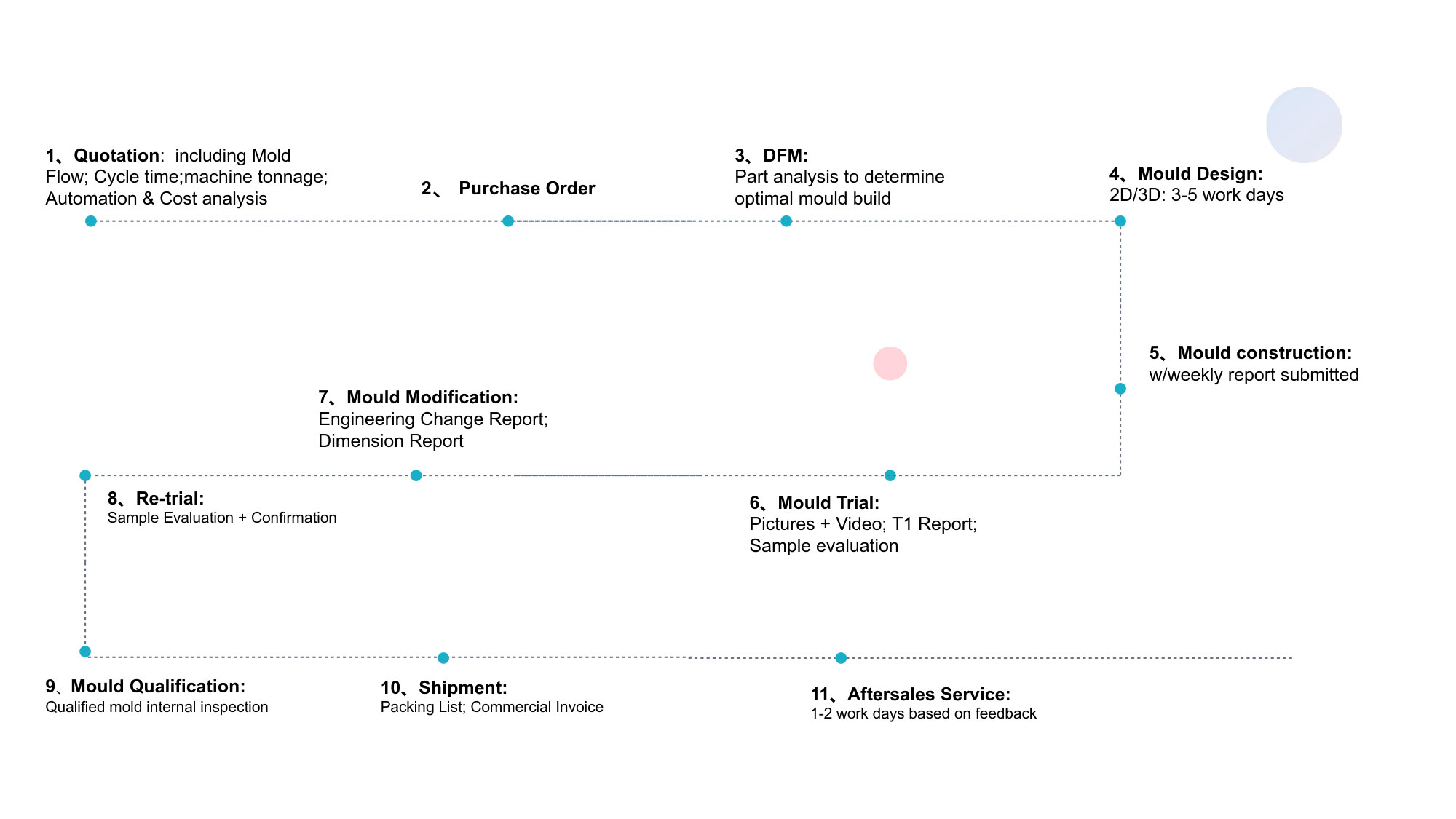
- The mold manufacturing process and product material selection
Wear parts (ejector pins, core inserts) are delivered with each mold; maintenance services are provided every 200,000 cycles; and lifetime repairs are charged at cost.
Path to Industry Leadership
Ansix Tech became an industry leader by addressing six common customer pain points that competitors fail to solve:
Common Customer Complaint Ansix Tech‘s Solution
Frequent mold repairs disrupt orders 2,000-cycle wear test delivered with mold; three-year structural warranty
Flash requires costly secondary finishing 0.005mm parting line precision; self-locking clamp force compensation; flash controlled within 0.03mm
Inconsistent dimensions across batches Ultrasonic wall thickness sensors with real-time pressure compensation feedback
Lengthy mold revision cycles In-house electrode machining center; emergency repair within 24 hours
High per-part costs squeezing margins 40–70% energy savings via servo-electric drives; 15–20% secondary finishing cost eliminated
Lack of production predictability All machines connected via MES; parameters locked with engineering-only access
By combining a DFM-first engineering culture, advanced manufacturing infrastructure, vertically integrated operations, global production footprint, and over 28 years of cumulative process knowledge, Ansix Tech has earned the trust of demanding OEMs worldwide.
-
Product Introduction, Manufacturing Process, and Core Advantages
Product Introduction
2-Point Plastic Float Valve for Tea Table Bucket: An automatic on/off switch that controls water level in compact tea tables and water dispensing stations. The 2-point design provides precise sealing at both inlet and outlet, preventing overflow and ensuring consistent water availability.
Fully Automatic Water Level Controller: A self-contained fluid control system designed for water tanks, towers, and solar water heaters. The float mechanically opens or closes the valve based on liquid height, automatically regulating inflow without external power — eliminating overflow and manual intervention.
Quick-Connect Inlet Float Valve for Household Water Purifiers: A compact, rapid-installation valve designed for under-sink water filtration systems. Quick-connect fittings enable tool-free installation, while precision molding ensures leak-proof operation.
Manufacturing Process
Step 1 — Material Selection and Preparation
For float valves, Ansix Tech primarily uses PP (polypropylene) for its excellent buoyancy, chemical resistance, and cost-effectiveness. For the PP foamed float, Ansix Tech has successfully developed micro-foaming injection molding technology, producing lightweight floats with overmolded magnets for magnetic sensing interfaces. For seals and high-temperature applications, materials include PC/ABS, PC, PPS+40%GF, PEEK, PA6+GF30, and TPE.
Step 2 — Mold Manufacturing
Using five-axis high-speed machining centers capable of ±0.002mm accuracy, critical mold features such as sealing surfaces and gate geometries are machined to micron-level precision. For micro-pores (down to 0.03mm) and narrow slots in complex valve bodies, slow wire EDM technology is employed.
Hot runner systems are standard for float valve molds, eliminating runner waste entirely. The conformal cooling channels designed via Moldflow simulation reduce cycle times by up to 20% compared to conventional straight-line cooling layouts.
Step 3 — Injection Molding
The melt is injected into multi-cavity molds at precisely controlled parameters. All-servo electric drives maintain ±0.1% shot-to-shot repeatability. Mold temperatures are maintained with multi-zone controllers keeping core-cavity differences within 2°C, directly minimizing post-mold warpage — critical for the sealing function of float valves.
Step 4 — Post-Molding and Assembly
Parts are automatically ejected, cooled, and inspected for flash, sink marks, and dimensional accuracy. For the quick-connect float valve, assembly integrates the float mechanism with the valve body in a clean environment.
Core Advantages
Delivery Efficiency
Four production bases (China and Vietnam) with 260 injection molding machines provide redundant capacity. Standard delivery: simple molds in 10 days, medium-complexity molds in 25–45 days. Quick-change tooling systems reduce mold changeover time from eight hours to just 90 minutes, increasing effective capacity by up to 30%.
Quality Assurance
Every cavity is inspected using CMMs and optical imaging systems. CPK is maintained at ≥1.33 for critical dimensions, meaning over 99.99% yield. Before shipment, each mold undergoes a complete dimensional report with full material certification and heat-treatment verification.
Cost Control
Cost advantages come from three sources. First, multi-cavity molds (e.g., 1×48 configurations) produce more parts per cycle, reducing per-unit molding costs. Second, servo-electric drives consume 40–70% less energy than hydraulic machines. Third, zero-flash molds eliminate manual deburring operations, saving customers approximately 15–20% in secondary finishing costs.
After-Sales Service
Ansix Tech delivers wear parts with every mold, provides scheduled maintenance every 200,000 cycles, and offers lifetime repairs at cost. The team responds to inquiries within 12 hours.
Part 3: Mold Manufacturing, Material Selection, Smart Manufacturing, and Core Values
Mold Manufacturing and Material Selection
Tool Steel Selection Matrix
Ansix Tech maintains a strategic inventory of premium tool steels documented with full heat-treatment curves:
Material Hardness (HRC) Best Fit Application
S136/S136H 48–54 Transparent parts, corrosive plastics, Ra <0.05μm finish
2344/8407/H13 48–52 PPS+40%GF, PEEK, high-thermal-load molds
NAK80 37–43 High-gloss surfaces, cosmetic appearances
SKD11/DC53 58–62 Wear inserts, abrasive filled materials
2343 48–52 Complex geometries with extreme mechanical shock
M340/4Cr13/9Cr18 48–53 FDA-grade, acidic plastics
P20 28–32 Mold bases, support plates
For the water purifier filter cartridge housing, S136ESR is selected for superior corrosion resistance. For quick-connect fittings requiring tight sealing, 2344 ensures high hot hardness for long production runs.
Smart Manufacturing and Efficiency
All 260 injection molding machines are connected via Manufacturing Execution System (MES), which locks down every process parameter — temperatures, pressures, speeds, timing — with engineering-only access. For demanding applications, real-time cavity pressure sensors feed closed-loop process corrections during every shot, delivering long-term dimensional stability even when resin lots vary.
Digital twin validation precedes any physical steel cutting. Moldflow analysis simulates fill patterns, identifies weld lines, exposes air traps, and optimizes gate placement before steel is touched. This digital prototyping approach is the most powerful tool for cost control and risk mitigation.
Conformal cooling channels designed to follow part contours reduce cycle times by up to 20% and eliminate hot spots. Hot runner systems remove cold sprue cooling from the cycle schedule, further reducing cycle times.
Process Quality Assurance
Temperature Control: Mold temperature controllers maintain core-cavity differences within 2°C, directly minimizing post-mold warpage and ovality — critical for valve sealing surfaces.
Process Consistency: All-servo electric drives deliver ±0.1% shot-to-shot repeatability, ensuring every valve in a 500,000-unit run is dimensionally identical to the first.
Metrology: CMMs achieve ±0.5μm accuracy; full dimensional reports with CPK≥1.33 are provided for every mold.
Core Customer Value — What Problems Does Ansix Tech Solve?
Customer Concern Ansix Tech‘s Solution Quantified Benefit
Mold life uncertainty Premium steel selection; 2,000-cycle wear test; documented heat-treatment curves 500,000–1,000,000 guaranteed shots
Dimensional inconsistency Servo-electric drives ±0.1%; cavity pressure sensors; closed-loop control Batch-to-batch scrap reduced 30–40%
Flash requiring manual removal 0.005mm parting line precision; self-locking clamp force 15–20% savings in secondary finishing
High energy costs consuming margins All-servo electric motors 40–70% energy reduction
Long mold revision cycles In-house electrode machining; dedicated EDM capacity Emergency repair within 24 hours
Production line stoppages Quick-change tooling systems Changeover: 8 hours → 90 minutes
Risk of sealing failure 0.002mm thread accuracy; CMM verification Leak-proof after hundreds of cycles
The Total Value Equation
An injection mold is not a tool — it is a revenue generator. Ansix Tech designs molds with planned robustness, balanced排气 paths, and optimized temperature distribution so that upon arrival at customer facilities, the mold is ready to run with zero debugging, minimal flash, and maximum lifespan. As Ansix Tech engineers state: “We don‘t just build a mold; we engineer a production asset that guarantees consistent parts, predictable costs, and minimal downtime.”
Part 4: Comprehensive Industry Manufacturing Analysis (2000+ Words)
How Ansix Tech Translates Technical Specifications into Measurable Customer Value
The Fundamental Philosophy: From Specifications to Solutions
Ansix Tech has built its approach around a simple operating principle: translate every technical capability into measurable customer value. The following comprehensive analysis explores how Ansix Tech addresses the five critical questions every OEM asks:
What value can you provide?
What problems can you solve?
How do you validate quality?
How do you reduce costs?
How do you ensure capacity and delivery?
Section One: Project Initiation — Solving Problems Before Steel Is Cut
The Consultation-First Engineering Approach
Every relationship begins with a problem, not a purchase order. Rather than passively accepting CAD files, Ansix Tech integrates its engineering team into the customer‘s development cycle, conducting comprehensive reviews of intended use conditions: What is the expected service life under sustained vibration? Which chemicals will the valve encounter (e.g., chlorine-treated water, acidic cleaning solutions, UV exposure)? What are the A-surface aesthetic requirements versus hidden structural ribs?
By clarifying these parameters upfront, Ansix Tech establishes a roadmap that drives down costs through precision engineering — not cost-cutting shortcuts.
Design for Manufacturability (DFM) — The Risk Elimination Protocol
Before any steel is touched, a full DFM report is delivered. Using Moldflow simulation software, engineers predict fill patterns, identify weld-line locations, expose air-trapping risks, and optimize gate placement to ensure balanced flow across the part geometry. Cooling performance is simulated to design conformal cooling channels that follow complex contours, reducing cycle times by up to 20% compared to straight-line cooling layouts.
The specific value to customers: Customers receive draft angle recommendations, wall thickness optimization, gate location options, ejector pin mark allowances, and potential sink mark risk warnings — eliminating the need for costly mold rework after design sign-off.
Material Science — Documenting Every Decision
Every material selection decision is documented in a formal steel certification, accompanied by the full heat-treatment curve for complete traceability. For glass-reinforced PBT or PA6, SKD61 (HRC 52–56) cavity steel withstands abrasive wear. For transparent PC or PMMA requiring optical clarity, S136 (HRC 48–52) achieves Class A finishes below Ra 0.1μm. For high-temperature engineering resins such as PPS or PEEK, 8407 provides thermal fatigue resistance.
For customer peace of mind, this granular documentation means that when Ansix Tech states mold life expectations — 500,000 shots for glass-reinforced materials, 1,000,000 shots for unfilled grades — the claim is backed by verifiable test data, not vague promises.
Section Two: Hard Infrastructure — Building Customer Trust Through Equipment Excellence
Mold Processing Equipment: Precision That Cuts Hidden Costs
Five-Axis High-Speed Machining Centers: Capable of machining complex contoured surfaces with precision up to 0.002mm. The customer value: Parts emerge with smooth, burr-free parting lines requiring no secondary finishing. Seamless parting lines translate directly to zero flash, no secondary deburring, and elimination of post-molding manual trimming. Zero flash saves approximately 15–20% in secondary finishing costs.
Slow Wire EDM (Electrical Discharge Machining): Capable of producing 0.03mm micro-pores and narrow slots. For thin walls (0.4–0.8mm), this technology prevents deformation during machining, preserving delicate design geometry.
In-House EDM and Electrode Machining: Dedicated electrode machining capacity enables on-site mold repair without outsourcing. Mold revisions that typically require two to three weeks at external vendors can be completed in 24–48 hours in-house, dramatically reducing production downtime and emergency tooling costs.
Injection Molding Machine Fleet: Consistency Across Every Shot
Ansix Tech operates 260 injection molding machines ranging from 30 tons to 4,000 tons clamping force, covering product dimensions from micro-precision components weighing less than one gram to large structural parts exceeding several kilograms.
The Customer Value Translation: This breadth means one partner handles everything — from small, single-cavity molds for prototyping (30–90 tons) to high-volume multi-cavity production (160–500 tons). Small multi-cavity runs are scaled up to 64 or even 128 cavities, achieving consistent part-to-part repeatability.
All machines are equipped with all-servo electric drives delivering ±0.1% repeatable shot-to-shot stability. The first part is identical to the millionth part — no production drift, no mid-run surprises, no sudden spike in reject rates.
Energy Efficiency as Direct Customer Savings: Servo-electric drives consume 40–70% less energy than equivalent hydraulic machines while maintaining consistent clamp force throughout long production runs. This energy savings is directly passed through to customers in lower per-part pricing.
Quick-Change Capability: Standardized machine interfaces and quick-change tooling systems enable mold swaps in under 15 minutes between press sizes. A changeover that typically costs eight hours of downtime on legacy equipment is reduced to 90 minutes, increasing effective production capacity by up to 30%.
Quality Inspection Equipment: Data That Eliminates Risk
Every mold undergoes 100% dimensional verification using coordinate measuring machines (CMMs) with ±0.5μm accuracy and optical imaging systems. Critical-to-quality dimensions are maintained at CPK ≥ 1.33 — the industry gold standard for process capability. CPK ≥ 1.33 means quality yield exceeds 99.99% on critical dimensions. For demanding applications, full traceability from raw material to final inspection ensures compliance with global supply chain requirements.
The Customer Value Translation: When a customer receives a mold from Ansix Tech, they receive proof that it works — full dimensional reports, not just promises. Every critical dimension is documented with CPK values.
Section Three: Mold Manufacturing — The Core of Production Certainty
What Customers Actually Care About
Customers care about exactly four things when they commission a mold: how many shots will it produce, how precise will the parts be, how fast can they get it, and what will it cost to maintain. Below is Ansix Tech’s comprehensive answer to each.
Mold Life Expectancy
Mold bases use P20; core/cavity inserts use premium tool steel (S136, 2344, 2343, 8407, SKD11/61/DC53, M340/4Cr13/9Cr18, NAK80, H13). For glass-reinforced materials, Ansix Tech guarantees 500,000 shots; for unfilled grades, 1,000,000 shots. A full material certification report and heat-treatment curve are provided with every mold — complete transparency on exactly what the customer is buying.
The Problem Solved: The mold does not become a recurring capital expense every 50,000 cycles. Customers eliminate emergency mold replacement costs and production line stoppages.
Attainable Tolerances
General structural features achieve ±0.05mm; precision sealing surfaces achieve ±0.005mm. For quick-connect fittings, where thread alignment tolerances are critical, micron-level accuracy is delivered — eliminating assembly-line rework.
The Problem Solved: On the customer‘s assembly line operating at high speed, consistent part-to-part quality eliminates jams, reduces downtime, and protects brand reputation.
Gating Strategy and Flow Optimization
Mold flow simulation pre-identifies weld line locations and gas trap zones; gate locations and quantities are optimized before the first piece of steel is cut.
The Problem Solved: No guesswork. Ansix Tech customers never receive the answer “we didn’t know the gate would cause weld lines in that location.” The simulation ensures uniform filling, preventing short shots, flow marks, and surface defects.
Mold Type Offerings
Hot runner systems eliminate runner waste, reducing scrap to zero. Stack molds double output per machine cycle. Two-shot/multi-material molds enable overmolding of seals onto rigid valve bodies in a single cycle.
Cooling System Design — The Efficiency Engine
Proper cooling accounts for up to 60–80% of total cycle time in injection molding. Using conformal cooling channels that follow the complex contours of valve bodies, Ansix Tech achieves uniform cooling, eliminates hot spots, and reduces cycle times by up to 20%. This cycle time reduction directly translates to higher output per machine hour and lower per-part costs.
Section Four: Injection Molding — Controlled Execution That Saves Money
Process Standardization and MES Integration
All 260 molding machines are connected via Manufacturing Execution System (MES). Parameters such as temperature, pressure, speed, and injection timing are locked into the system with tiered access controls — only authorized engineers can make adjustments.
The Problem Solved: Operators cannot override settings mid-run. No overnight production drift. No morning shift inheriting faulty parameters.
Temperature Control
Mold temperature is maintained with multi-zone controllers that keep core-cavity temperature differences within 2°C, directly minimizing post-mold warpage and ovality. For demanding applications, real-time cavity pressure sensors feed closed-loop process corrections during every shot, delivering long-term dimensional stability even when resin lots vary.
The Problem Solved: Short shots due to low cavity pressure are automatically compensated. No need to scrap an entire pallet of parts because the resin viscosity changed slightly.
Advanced Molding Technologies
Micro-foaming injection molding: For PP foamed floats, Ansix Tech‘s micro-foaming technology reduces material usage while maintaining buoyancy, with overmolded magnets providing integrated magnetic sensing capability.
Gas-Assist Injection Molding (GAIM): Material waste is reduced by 20–50% depending on part geometry, translating directly into lower raw material costs per part. Sink marks and warpage are virtually eliminated as internal gas pressure maintains uniform packing throughout the cooling phase.
Quality Verification Protocol
Every production batch undergoes first-article inspection. CMMs verify dimensions against the qualified master sample. For float valves requiring leak-tight performance, 0.002mm thread pitch accuracy guarantees leak-proof assembly even after hundreds of field service cycles.
End-of-Batch Verification: Last-shot parts are retained and compared against first-article dimensions. If final parts do not match the initial sample, production stops immediately — preventing defective inventory.
Section Five: Reducing Costs — The Complete Economic Equation
Cost Reduction Source 1 — Material Efficiency
Multi-cavity molds (1×48 configurations) produce more parts per cycle, reducing per-unit molding costs. Hot runner systems eliminate runner waste entirely. Micro-foaming technology reduces material usage by 20–50%.
Cost Reduction Source 2 — Operational Efficiency
Servo-electric drives consume 40–70% less energy. Zero-flash molds eliminate manual deburring, saving 15–20% in secondary finishing. Conformal cooling reduces cycle times by up to 20%. Quick-change tooling increases effective capacity by up to 30%.
Cost Reduction Source 3 — Risk Elimination
CPK ≥ 1.33 means 99.99% yield on critical dimensions — no scrap costs for out-of-tolerance parts. Documented heat-treatment curves and steel certifications prevent premature mold failure. In-house EDM capacity eliminates outsourcing markups for mold revisions.
Section Six: Capacity and Delivery — Meeting Tight Windows
With four production bases in China and Vietnam totaling over 200,000 square meters and employing more than 1,200 staff, Ansix Tech has redundant capacity across two countries. Standard delivery times: simple molds in 10 days, medium-complexity molds in 25–45 days. Emergency repair within 24 hours when required.
Wear parts (ejector pins, core inserts) are delivered with each mold; maintenance services are provided every 200,000 cycles; and lifetime repairs are charged at cost.
Conclusion: The Total Value Ansix Tech Delivers
For customers seeking 2-point plastic float valves, fully automatic water level controllers, and quick-connect inlet float valves for household water purifiers, Ansix Tech delivers:
Lower total cost: Material reduction (20–50%), energy savings (40–70%), secondary operation elimination (15–20%), and scrap minimization (99.99% yield)
Reduced risk: DFM eliminates non-manufacturable designs; CPK≥1.33 ensures statistical quality; documented traceability provides supply chain compliance
Faster time-to-market: 10-day simple molds; 24-hour emergency repair; 90-minute changeovers
Uncompromising quality: 0.002mm precision; 0.03mm micro-features; Ra<0.05μm surface finishes
Production certainty: 500,000–1,000,000 shot mold life; MES-locked parameters; closed-loop process control
An injection mold is not a tool — it is a revenue generator. Ansix Tech designs molds with planned robustness, balanced exhaust paths, and optimized temperature distribution so that upon arrival at customer facilities, the mold runs with zero debugging, minimal flash, and maximum lifespan. Every technical specification we deliver translates directly into measurable customer value — lower costs, reduced risk, faster time-to-market, and uncompromising quality.
Ansix Tech Co Ltd
If you have any plans related to 2-point plastic float valve for tea table bucket, fully automatic water level controller, quick-connect inlet float valve for household water purifiers , you can contact us at any time. We will turn your ideas into reality, let you realize your dreams, and obtain large orders from the market. Our contact information is info@ansixtech.com. Or contact our CTO, mail: stephen@ansixtech.com
#www.ansixtech.com #ansixtech.com #2-point plastic float valve for tea table bucket #2-point plastic float valve for tea table bucket #2-point plastic float valve for tea table bucket Canopy Mold injection mold companies #Ansix #Ansix moulds #Ansix china #Ansix tech china #Ansix tech company #Ansix facotry #2-point plastic float valve for tea table bucket injection molding #2-point plastic float valve for tea table bucket injection tools #2-point plastic float valve for tea table bucket injection moulds #2-point plastic float valve for tea table bucket plastic mould #2-point plastic float valve for tea table bucket plastic tools #Ansix Tech #Ansix molds #Ansix injection molding #Ansix mold factory #injection molding 2-point plastic float valve for tea table bucket#Ansix mold factory #2-point plastic float valve for tea table bucket china #2-point plastic float valve for tea table bucket molds #injection factory #2-point plastic float valve for tea table bucket injection molding #2-point plastic float valve for tea table bucket injection molding factory #injection molding company #2-point plastic float valve for tea table bucket injection mold companies #2-point plastic float valve for tea table bucket Tooling #2-point plastic float valve for tea table bucket mold limited #Ansix mold china #Ansix companies #Ansix company China #2-point plastic float valve for tea table bucket facotry #Ansix Tech #Ansix Tech mould #2-point plastic float valve for tea table bucket injection moulding #injection moulding company #Ansix 2-point plastic float valve for tea table bucket parts injection mold companies #medical injection molding companieschina #2-point plastic float valve for tea table bucket china factory #Ansix moulding companies #Ansix molding company #2-point plastic float valve for tea table bucket injection moulding facotry #Ansix Tech mold #2-point plastic float valve for tea table bucket mould #2-point plastic float valve for tea table bucket plastic injection molding #ansix plastic mold #Mold manufacturing #2-point plastic float valve for tea table bucket parts manufacturing #2-point plastic float valve for tea table bucket plastic parts factory #2-point plastic float valve for tea table bucket injection parts mold #2-point plastic float valve for tea table bucket PRECISION MANUFACTURING #2-point plastic float valve for tea table bucket #China mold #2-point plastic float valve for tea table bucket injection moulding china #2-point plastic float valve for tea table bucket mould china #china precision mold #mold in china #2-point plastic float valve for tea table bucket mold china #Precision molds #High-precision molds #2-point plastic float valve for tea table bucket #Injection molds #2-point plastic float valve for tea table bucket Factory #2-point plastic float valve for tea table bucket Company #Super Large Injection Mold Factory #Large Tonnage Injection Molding Factory #2-point plastic float valve for tea table bucket Company #2-point plastic float valve for tea table bucket Factory #2800T Injection Molding Factory #3000 Ton Injection Molding #4500 Ton Injection Molding Factory #Large Mold Injection Molding #Large Plastic Mold Injection Molding Factory #Large Injection Mold Manufacturer #Plastic Mold Factory #Injection Mold #Plastic Mold