



90-degree elbow PP float switch water level tank diesel engine oil tank side-mounted liquid level sensor factory float
FEATURES
PRODUCT INTRODUCTION & TECHNICAL SPECIFICATIONS
1.1 Product Overview
The 90-degree elbow PP float switch is a side-mounted liquid level sensor designed for tank installations where top or bottom access is restricted or unavailable. The 90-degree elbow configuration enables installation in confined spaces, making it ideal for water tanks, diesel engine oil tanks, industrial vessels, and wastewater treatment applications.
Key Product Features:
Mounting Configuration: 90-degree side-mount elbow design for space-constrained installations
Material: High-performance polypropylene (PP) offering excellent chemical resistance to acids, alkalis, detergents, and organic chemicals
Operating Principle: Magnetic float mechanism with hermetically sealed reed switch
Applications: Water level detection, diesel/oil level monitoring, industrial liquid level control, pump control, alarm systems
-
Mold Description
Product Materials:
PP FOAM
Mold Material:
S136ESR
Number of Cavities:
8
Glue Feeding Method:
COLD runner
Cooling Method:
Water cooling
Molding Cycle
12.5s
- The mold manufacturing process and product material selection
Material Selection & Properties
Polypropylene (PP) is selected as the primary material for its exceptional combination of properties:
Property Specification Customer Value
Chemical Resistance Excellent resistance to acids, alkalis, oils, and organic solvents Long-term reliability in harsh chemical environments; reduced replacement frequency
Operating Temperature -10°C to 100°C Versatile application across diverse operating conditions
Density 0.90-0.91 g/cm³ Lightweight float design ensuring proper buoyancy
Water Absorption <0.01% Dimensional stability; no swelling in wet environments
Mechanical Strength High impact resistance Durability in vibration-prone applications (diesel engines)
FDA Compliance Food-grade options available Safe for potable water applications
Material Grade Options:
Standard PP: General-purpose water and chemical applications
Glass-filled PP (PP+GF): Enhanced stiffness and dimensional stability for high-temperature applications
UV-stabilized PP: Extended outdoor service life (tested to 3,000 hours UV exposure)
-
MOLD DESIGN & MANUFACTURING
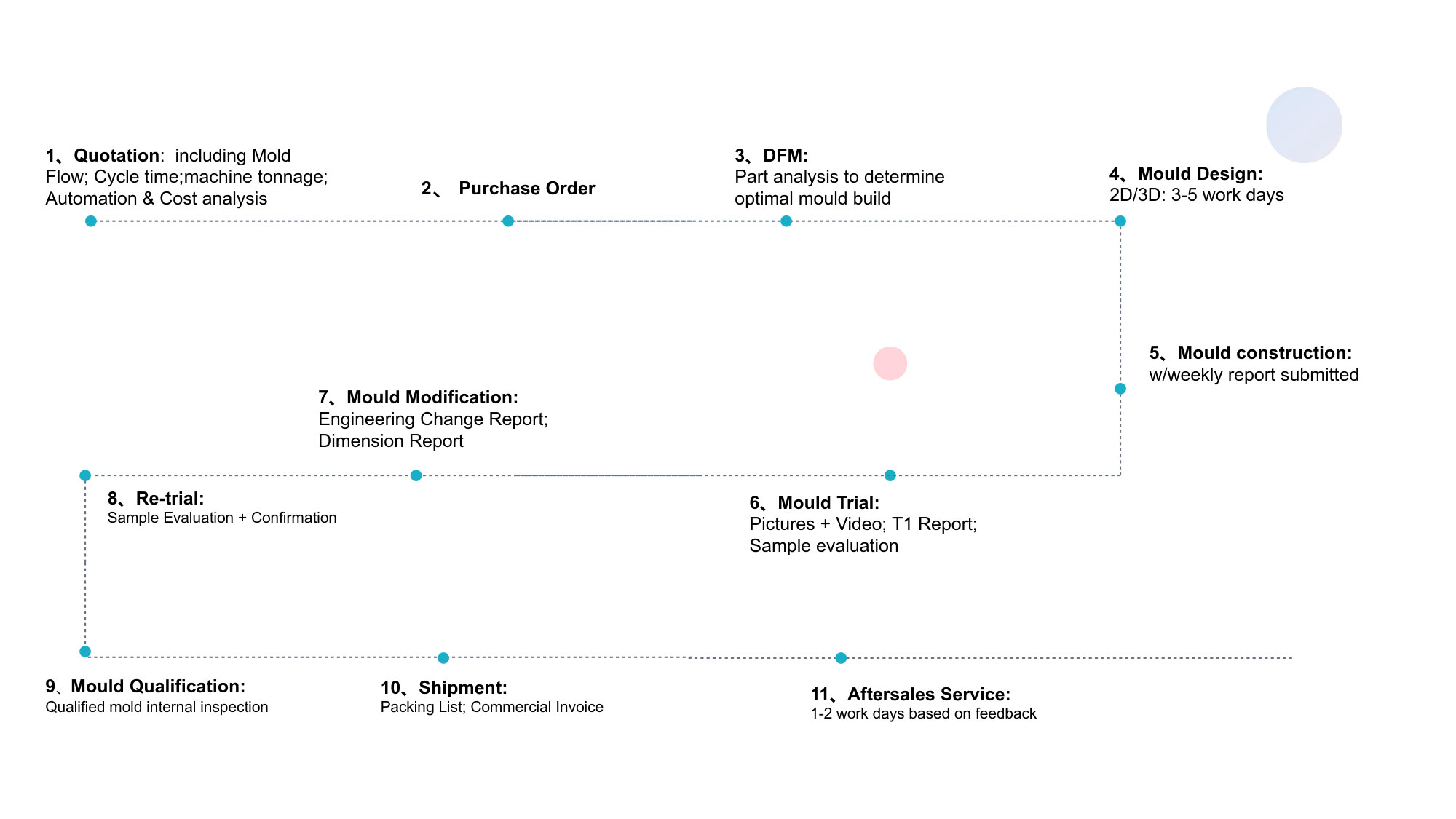
2.1 Design for Manufacturing (DFM) Analysis
Ansix employs comprehensive DFM analysis before任何 tooling begins, identifying potential manufacturing issues early to save time and costs.
DFM Process Flow:
Part Geometry Review: Analysis of wall thickness, draft angles, rib placement, and parting line positioning
Mold Flow Simulation: Using specialized software (e.g., Sigmasoft) to simulate melt flow, heat flux, and warpage
Gate Location Optimization: Strategic placement of injection gates to ensure balanced filling and minimize weld lines
Ejection System Design: Optimal placement of ejector pins to avoid cosmetic defects
Shrinkage Compensation: Precise calculation of PP shrinkage rates (typically 1.5-2.5%) for dimensional accuracy
DFM Deliverables to Customers:
Comprehensive mold feasibility analysis report
Wall thickness optimization recommendations
Draft angle suggestions (typically 1-3° for PP)
Gate location and witness mark position mapping
Ejector pin mark location approval
2.2 Mold Manufacturing Capabilities
Mold Processing Equipment:
Equipment Specification Capability
5-Axis High-Speed Machining Centers 0.002mm positioning accuracy Complex surface machining; smooth parting lines; no burrs
Slow Wire EDM (Wire Cut) 0.03mm fine hole capability Narrow slots; thin-wall features without deformation
CNC EDM (Spark Erosion) High-precision cavity machining Complex internal geometries; tight-tolerance features
Precision Surface Grinders ±0.002mm flatness Critical mating surface preparation
Mold Steel Selection:
Steel Grade Application Customer Value
P20 (Mold Base) General-purpose mold base Cost-effective; good machinability
S136 / 2344 / 2343 / 8407 High-wear cavity/core components Extended mold life; corrosion resistance
SKD11 / SKD61 / DC53 Wear-resistant inserts Superior abrasion resistance for glass-filled materials
M340 / 4Cr13 / 9Cr18 Corrosion-resistant applications Stainless properties for aggressive environments
NAK80 High-polish requirements Excellent surface finish; suitable for transparent parts
H13 High-temperature applications Thermal stability; hot-work applications
Mold Life Guarantee:
Glass-fiber reinforced materials: 500,000 cycles minimum
Standard PP materials: 1,000,000 cycles minimum
Full material certification and heat treatment curves provided
2.3 Mold Cooling System Design
Effective cooling is critical for cycle time reduction and dimensional stability:
Cooling System Specifications:
Conformal Cooling: 3D-printed cooling channels following part contours for uniform temperature distribution
Zone Temperature Control: Independent temperature control for core and cavity (temperature differential ≤2°C)
Baffle and Bubbler Systems: Optimized cooling for deep-cavity features
Thermal Analysis: Mold flow simulation validates cooling efficiency before manufacturing
Cooling System Benefits:
Reduced cycle time (20-40% improvement)
Minimized warpage and shrinkage variation
Consistent part quality across production batches
Extended mold life through thermal stress reduction
2.4 Runner & Gate System Design
Runner System Options:
Cold Runner: Conventional system; suitable for standard production runs
Hot Runner: Minimizes material waste; ideal for high-volume production
Insulated Runner: Balance between cold and hot runner benefits
Gate Types:
Edge Gate: Standard option for most PP applications
Submarine Gate: Automatic degating; reduces post-molding operations
Pinpoint Gate: Precision filling; minimal gate vestige
Film Gate: Wide, thin gates for large flat parts
Valve Gate: Hot runner with valve pin; eliminates gate vestige
Gate Optimization:
Mold flow analysis identifies optimal gate数量和位置
Weld line and air trap prediction and mitigation
Balanced filling ensures uniform part properties
2.5 Ejection System Design
Ejection Mechanisms:
Ejector Pins: Standard ejection for most features
Ejector Sleeves: For ejection around core pins
Stripper Plates: For thin-walled or delicate parts
Air Ejection: For parts with deep undercuts or sensitive surfaces
Ejector Pin Placement:
Strategic placement avoiding cosmetic surfaces
Customer approval of ejector pin witness mark locations
Sufficient ejection area to prevent part deformation
PART THREE: INJECTION MOLDING PROCESS
3.1 Injection Molding Machine Capabilities
Machine Fleet:
Parameter Range Application Coverage
Clamping Force 30 tons - 4,000 tons From small precision components to large tank fittings
Injection Pressure Up to 2,500 bar High-pressure capability for glass-filled materials
Shot Size 5g - 50,000g Covers全部 product size ranges
Drive System All-servo electric Energy efficiency; ±0.1% repeatability
All-Servo Electric Drive Advantages:
±0.1% shot-to-shot repeatability
40-70% energy savings vs. hydraulic machines
Precision process control
Reduced noise and maintenance
3.2 Process Parameter Control
Standard Process Parameters for PP:
Parameter Typical Range Control Method
Melt Temperature 200-260°C Closed-loop barrel zone control
Mold Temperature 40-80°C Water/oil temperature controller
Injection Speed Multi-stage profile Velocity-controlled injection
Packing Pressure 30-70% of injection pressure Pressure profile control
Cooling Time Optimized per part geometry Timer-controlled; validated by simulation
Back Pressure 5-15 bar Consistent melt density
Process Control Systems:
All machines networked to MES (Manufacturing Execution System)
Process parameters locked; only authorized engineers can modify
Real-time monitoring of temperature, pressure, speed, and time
Automatic alarm for parameter deviations
3.3 Production Efficiency Optimization
Cycle Time Reduction Strategies:
Cooling Optimization: Conformal cooling reduces cooling time by 20-40%
Hot Runner Systems: Eliminate runner cooling time
Multi-Cavity Molds: 2, 4, 8, or 16 cavities per mold
Stack Molds: Double production output with same machine footprint
Automated Part Handling: Robots for part removal and sorting
Quick Mold Change Systems: <10 minutes for mold changeover
Production Capacity:
24/7 production capability
Multiple shifts to meet urgent delivery requirements
Rapid response for加急 orders (dedicated production cells)
3.4 Special Material Processing Capabilities
Ansix has extensive experience processing a wide range of engineering plastics:
Material Application Processing Considerations
PP (Polypropylene) Standard float applications Easy flow; moderate shrinkage
PC/ABS High-impact applications Higher temperatures; moisture-sensitive
PC (Polycarbonate) Transparent/clear applications High melt temperature; moisture drying required
PPS+40%GF High-temperature, chemical-resistant High processing temperature; abrasive
PEEK Extreme high-temperature Very high processing temperature; expensive
PTFE/PFA Chemical-resistant, non-stick Difficult to mold; specialized equipment
PA6+GF30 High-strength, engineering applications Moisture-sensitive; good flow
PBT Electrical applications Good electrical properties; low moisture absorption
PEI/PPS/LCP High-performance engineering High-temperature; specialized processing
LSR (Liquid Silicone Rubber) Flexible sealing applications Specialized injection equipment
UL94 Flammability Rating:
V-0 rating available for electrical housing applications
Full UL certification documentation provided
PART FOUR: QUALITY ASSURANCE & VERIFICATION
4.1 Inspection & Measurement Equipment
Equipment Specification Application
Coordinate Measuring Machine (CMM) ±0.002mm accuracy Full dimensional inspection; mold qualification
Optical Image Measuring System 0.001mm resolution Precision feature measurement; vision inspection
Surface Roughness Tester Ra measurement Surface finish verification
Hardness Tester Rockwell/Shore Material hardness verification
Ultrasonic Wall Thickness Gauge ±0.01mm Real-time wall thickness monitoring in production
Profile Projector 0.005mm resolution Complex profile verification
Color Spectrophotometer ΔE < 0.3 Color consistency verification
4.2 Quality Control Process
Incoming Material Control:
Raw material certification from approved suppliers
Material test report verification (density, MFI, mechanical properties)
Moisture content verification before processing
In-Process Quality Control (IPQC):
First article inspection (FAI) for each production run
In-process inspection every 2 hours
Process parameter monitoring via MES
Visual inspection for surface defects
Dimensional verification per control plan
Outgoing Quality Control (OQC):
100% functional testing for critical products
Statistical sampling per AQL standards
Full dimensional report for each batch
Packaging integrity verification
Key Quality Metrics:
CPK ≥ 1.33 for critical dimensions
Dimensional stability: ≤0.02mm variation across production batches (validated on similar bracket products)
Flash control: ≤0.03mm at parting lines
Surface finish: Ra ≤0.2μm for high-gloss applications
4.3 Product Validation Process
Validation Stages:
T0 (First Trial): Initial mold试模; identification of issues
T1 (First Modification): Addressing mold issues; sample provision
T2 (Second Modification): Fine-tuning;验证 improvements
T3 (Production Validation): Full production validation; CPK verification
Trial Deliverables:
Sample parts from each trial stage
Improvement reports documenting changes
Dimensional inspection reports
Process parameter documentation
Small-Batch Verification:
100-500 parts pre-production run
Yield rate and CPK statistical analysis
Process stability confirmation
Customer approval before full production
4.4 Testing Capabilities
Test Type Standard/Method Purpose
Dimensional Inspection CMM/Optical measurement Verify specifications
Functional Testing Float operation test Verify switching function
Leak Test Pressure decay / immersion Verify seal integrity
Temperature Cycling -20°C to 100°C cycle Verify thermal stability
Chemical Resistance Immersion in various fluids Verify material compatibility
Mechanical Durability Cycle testing Verify long-term reliability
Aging Test Accelerated aging Predict service life
UV Resistance 3,000 hours UV exposure Verify outdoor durability
PART FIVE: COST CONTROL STRATEGIES
5.1 Material Cost Optimization
Bulk Procurement:
Strategic partnerships with major resin suppliers
Volume purchasing for cost reduction
Material standardization across product lines
Alternative material recommendations for cost optimization without quality compromise
Material Utilization:
Hot runner systems reduce runner waste to <2%
Regrind recovery and reuse program (where specifications allow)
Optimized part nesting in multi-cavity molds
Gate optimization minimizes material consumption
Supplier Management:
Approved supplier list with quality certification
Long-term supply agreements for price stability
Competitive bidding for material sourcing
Material substitution options when advantageous
5.2 Process Efficiency Cost Savings
Cycle Time Reduction:
Strategy Potential Savings
Conformal cooling 20-40% cycle time reduction
Hot runner systems 15-30% cycle time reduction
Multi-cavity molds 50-400% output increase
Stack molds 100% output increase per machine
Process optimization 5-15% cycle time reduction
Energy Cost Reduction:
All-servo electric machines: 40-70% energy savings vs. hydraulic
Insulated barrels reduce heat loss
Optimized cooling water management
LED lighting and efficient facility management
Labor Cost Optimization:
Automated part handling reduces manual labor
In-mold labeling and decorating where applicable
Automated inspection systems reduce QC labor
Trained multi-skilled operators increase flexibility
5.3 Design for Manufacturability Cost Savings
DFM-Driven Savings:
Eliminating unnecessary features reduces mold complexity
Optimized wall thickness reduces material usage
Design simplification reduces cycle time
Standardized features reduce tooling costs
Tooling Cost Optimization:
Modular mold design for interchangeable components
Standardized component sizes reduce tooling costs
Family molds for similar parts reduce per-part tooling investment
Rapid tooling options for prototyping and low-volume production
PART SIX: DELIVERY & LOGISTICS
6.1 Production Scheduling
Order Management Process:
Customer order receipt and review
Material availability verification
Production scheduling in MES
Mold preparation and setup
Production execution
Quality inspection
Packaging and labeling
Shipping documentation
Lead Time Standards:
Order Type Standard Lead Time Expedited Option
Simple mold 10 days 7 days
Medium-complexity mold 25-45 days 20 days
Complex mold 45-60 days 35 days
Production parts 7-15 days 3-5 days
Expedited Service:
Dedicated production cell for urgent orders
24/7 manufacturing capability
Air freight options for urgent deliveries
Prioritized engineering support
6.2 Production Capacity
Manufacturing Capacity:
24/7 production capability
Multiple shifts for continuous operation
Scalable production capacity for volume increases
Dedicated production lines for high-volume customers
Capacity Management:
MES-based production planning
Real-time capacity visibility
Flexible resource allocation
Buffer capacity for urgent orders
6.3 Packaging & Logistics
Packaging Solutions:
Custom packaging design per customer requirements
Protective packaging to prevent damage during transit
Moisture-barrier packaging where required
Recyclable and sustainable packaging options
Shipping Options:
Air freight for urgent deliveries
Sea freight for cost-effective large-volume shipping
Land transport for regional deliveries
Door-to-door delivery service
Documentation:
Commercial invoice
Packing list
Bill of lading / airway bill
Certificate of origin
Material test reports
Inspection certificates
PART SEVEN: AFTER-SALES SERVICE & SUPPORT
7.1 Warranty & Guarantee
Mold Warranty:
3-year structural warranty (excluding normal wear parts)
2000-cycle mold aging test before delivery
Wear report provided with mold delivery
Product Warranty:
Standard product warranty per specification
Defective product replacement or credit
Quality issue investigation and corrective action
7.2 Maintenance & Repair
Spare Parts Provision:
Spare wear parts (ejector pins, cores, inserts) provided with mold
Recommended spare parts list with each mold delivery
Preventive Maintenance:
Maintenance schedule provided with mold
Recommended maintenance every 200,000 cycles
Maintenance checklist and procedures
Repair Services:
In-house repair capability (electrode machining, EDM, welding)
Standard repair turnaround: 24 hours for welding/insert replacement
Cost-based pricing for non-warranty repairs
Global service support capability
7.3 Technical Support
Pre-Production Support:
DFM report and recommendations
Material selection guidance
Design optimization suggestions
Cost estimation and value engineering
Production Support:
Process optimization assistance
Troubleshooting support
Yield improvement recommendations
Training for customer personnel
Post-Production Support:
Continuous improvement suggestions
Product lifecycle support
Design change management
Obsolescence management
PART EIGHT: CUSTOMER VALUE PROPOSITION
8.1 What Problems Ansix Solves
Customer Pain Point Ansix Solution
Frequent mold repairs affecting orders 2000-cycle aging test before delivery; 3-year structural warranty
Excessive flash requiring costly post-processing 0.005mm parting line precision; self-locking clamp force compensation; flash ≤0.03mm
Inconsistent dimensions across batches In-mold ultrasonic wall thickness sensors; closed-loop pressure compensation; ±0.02mm batch-to-batch stability
Long mold repair lead times In-house electrode and EDM workshop; 24-hour repair turnaround
High material costs Bulk procurement; material optimization; regrind recovery
Quality risk from untested molds Full DFM analysis; T0-T3 trial stages; small-batch verification
8.2 Key Value Drivers
1. Risk Reduction:
Comprehensive DFM analysis identifies issues before tooling
Full validation process ensures production readiness
Statistical process control ensures consistent quality
CPK ≥1.33 guarantees process capability
2. Cost Savings:
Cycle time optimization reduces per-part cost by 20-40%
Material optimization reduces material cost by 5-15%
Reduced scrap and rework through process control
Lower tooling cost through DFM optimization
3. Quality Assurance:
Full dimensional reporting for every mold
In-process quality control at every stage
100% functional testing where required
Material certification and traceability
4. Delivery Reliability:
MES-based production planning
Dedicated capacity for priority customers
Expedited options for urgent requirements
Real-time production status visibility
8.3 Competitive Advantages
Technical Differentiation:
Capability Ansix Advantage
Precision machining 0.002mm 5-axis machining; 0.03mm EDM capability
Mold life 500,000-1,000,000 cycles depending on material
Dimensional precision ±0.05mm standard; ±0.005mm for precision applications
Production capacity 30-4,000 ton machine range; all-servo electric
Process control MES-locked parameters; closed-loop control
Material expertise 20+ engineering plastics; UL94 V-0 capability
Quality systems CPK ≥1.33; full traceability
PART NINE: INDUSTRY EXPERIENCE & TRACK RECORD
9.1 28 Years of Manufacturing Excellence
Ansix Tech brings over 28 years of specialized experience in injection molding and mold manufacturing. This extensive track record translates into:
Process Maturity: Optimized processes refined over decades
Problem-Solving Expertise: Encountered and resolved virtually every manufacturing challenge
Supplier Relationships: Established partnerships with material suppliers
Customer Trust: Proven reliability across industries and applications
Continuous Improvement: Culture of ongoing process enhancement
9.2 Application Experience
Water Level Detection:
Potable water systems
Wastewater treatment
Cooling towers
HVAC systems
Agricultural irrigation
Diesel & Oil Systems:
Diesel engine oil tanks
Fuel storage tanks
Hydraulic systems
Lubrication systems
Marine applications
Industrial Applications:
Chemical processing
Pharmaceutical manufacturing
Food and beverage processing
Semiconductor manufacturing
Automotive systems
PART TEN: CONCLUSION
10.1 Summary of Capabilities
Ansix Tech's comprehensive manufacturing capabilities for 90-degree elbow PP float switch water level sensors encompass:
Full-Service Design: From concept DFM analysis to production-ready tooling
Precision Mold Manufacturing: 5-axis machining, EDM, and precision grinding
Advanced Injection Molding: 30-4,000 ton all-servo electric machines
Comprehensive Quality Assurance: CMM, optical inspection, and statistical process control
Cost-Effective Production: Optimized cycles, material utilization, and energy efficiency
Reliable Delivery: MES-based scheduling and dedicated capacity
Complete After-Sales Support: Warranty, maintenance, and technical support
10.2 Customer Commitment
At Ansix Tech, we view every mold not as a piece of steel, but as a revenue-generating asset for our customers. Our design process simultaneously optimizes:
Moldability: Ensuring trouble-free production
Venting: Preventing gas traps and burn marks
Temperature Balance: Minimizing warpage and shrinkage
Production Readiness: Delivering molds that require minimal调试
We invite customers to experience our DFM process firsthand – through a comprehensive design review that demonstrates how we proactively address weld lines, gas traps, shrinkage, and other potential defects before tooling begins.
For detailed technical specifications, mold design consultation, or production inquiries, please contact Ansix Tech's engineering team. We are committed to delivering precision-engineered solutions that exceed customer expectations while reducing total cost of ownership.
Ansix Tech Co Ltd
If you have any plans related to 90-degree elbow PP float switch water level tank diesel engine oil tank side-mounted liquid level sensor factory float , you can contact us at any time. We will turn your ideas into reality, let you realize your dreams, and obtain large orders from the market. Our contact information is info@ansixtech.com. Or contact our CTO, mail: stephen@ansixtech.com
#www.ansixtech.com #ansixtech.com #90-degree elbow PP float switch water level tank diesel engine oil tank #90-degree elbow PP float switch water level tank diesel engine oil tank #90-degree elbow PP float switch water level tank diesel engine oil tank Canopy Mold injection mold companies #Ansix #Ansix moulds #Ansix china #Ansix tech china #Ansix tech company #Ansix facotry #90-degree elbow PP float switch water level tank diesel engine oil tank injection molding #90-degree elbow PP float switch water level tank diesel engine oil tank injection tools #90-degree elbow PP float switch water level tank diesel engine oil tank injection moulds #90-degree elbow PP float switch water level tank diesel engine oil tank plastic mould #90-degree elbow PP float switch water level tank diesel engine oil tank plastic tools #Ansix Tech #Ansix molds #Ansix injection molding #Ansix mold factory #injection molding 90-degree elbow PP float switch water level tank diesel engine oil tank#Ansix mold factory #90-degree elbow PP float switch water level tank diesel engine oil tank china #90-degree elbow PP float switch water level tank diesel engine oil tank molds #injection factory #90-degree elbow PP float switch water level tank diesel engine oil tank injection molding #90-degree elbow PP float switch water level tank diesel engine oil tank injection molding factory #injection molding company #90-degree elbow PP float switch water level tank diesel engine oil tank injection mold companies #90-degree elbow PP float switch water level tank diesel engine oil tank Tooling #90-degree elbow PP float switch water level tank diesel engine oil tank mold limited #Ansix mold china #Ansix companies #Ansix company China #90-degree elbow PP float switch water level tank diesel engine oil tank facotry #Ansix Tech #Ansix Tech mould #90-degree elbow PP float switch water level tank diesel engine oil tank injection moulding #injection moulding company #Ansix 90-degree elbow PP float switch water level tank diesel engine oil tank parts injection mold companies #medical injection molding companieschina #90-degree elbow PP float switch water level tank diesel engine oil tank china factory #Ansix moulding companies #Ansix molding company #90-degree elbow PP float switch water level tank diesel engine oil tank injection moulding facotry #Ansix Tech mold #90-degree elbow PP float switch water level tank diesel engine oil tank mould #90-degree elbow PP float switch water level tank diesel engine oil tank plastic injection molding #ansix plastic mold #Mold manufacturing #90-degree elbow PP float switch water level tank diesel engine oil tank parts manufacturing #90-degree elbow PP float switch water level tank diesel engine oil tank plastic parts factory #90-degree elbow PP float switch water level tank diesel engine oil tank injection parts mold #90-degree elbow PP float switch water level tank diesel engine oil tank PRECISION MANUFACTURING #90-degree elbow PP float switch water level tank diesel engine oil tank #China mold #90-degree elbow PP float switch water level tank diesel engine oil tank injection moulding china #90-degree elbow PP float switch water level tank diesel engine oil tank mould china #china precision mold #mold in china #90-degree elbow PP float switch water level tank diesel engine oil tank mold china #Precision molds #High-precision molds #90-degree elbow PP float switch water level tank diesel engine oil tank #Injection molds #90-degree elbow PP float switch water level tank diesel engine oil tank Factory #90-degree elbow PP float switch water level tank diesel engine oil tank Company #Super Large Injection Mold Factory #Large Tonnage Injection Molding Factory #90-degree elbow PP float switch water level tank diesel engine oil tank Company #90-degree elbow PP float switch water level tank diesel engine oil tank Factory #2800T Injection Molding Factory #3000 Ton Injection Molding #4500 Ton Injection Molding Factory #Large Mold Injection Molding #Large Plastic Mold Injection Molding Factory #Large Injection Mold Manufacturer #Plastic Mold Factory #Injection Mold #Plastic Mold