



4680 power battery cell holder
FEATURES
Hard Power Foundation — Building Customer Trust Through Equipment Capability
1.1 Mold Processing Equipment
Ansix Tech's mold manufacturing capabilities are built on a foundation of world-class precision equipment. The company is equipped with five-axis high-speed machining centers capable of machining complex curved surfaces with 0.002mm precision —ensuring that product parting lines remain smooth and burr-free. This capability directly translates to customer value: smoother parting lines mean less post-processing, reduced labor costs, and superior aesthetic quality for the end product.
The company also operates slow wire EDM (Electrical Discharge Machining) equipment capable of cutting 0.03mm fine micro-holes and narrow slots. This is critical for 4680 cell holders, which often feature complex geometries with thin-walled sections. By maintaining an in-house EDM workshop, Ansix eliminates the need to outsource precision machining, reducing lead times and ensuring quality control throughout the manufacturing chain.
Value to customers: When you partner with Ansix, you are not relying on third-party machinists with variable quality standards. Every mold component is machined in-house under strict quality control, ensuring consistency and reliability from the very first step of the manufacturing process.
-
Mold Description
Product Materials:
PPO+GF30
Mold Material:
S136ESR
Number of Cavities:
1
Glue Feeding Method:
Hot runner
Cooling Method:
Water cooling
Molding Cycle
22.5s
- The mold manufacturing process and product material selection
Injection Molding Machine Fleet
Ansix operates 260 injection molding machines with clamping forces ranging from 30 tons to 2,800 tons. This extensive range allows the company to accommodate 4680 cell holders of virtually any size and complexity—from small precision components to large structural battery pack elements.
All machines are equipped with all-servo motor drives, delivering stable repeatability accuracy of ±0.1% . This means that whether you are producing the first batch or the hundredth batch, every single molded part maintains identical dimensions and quality. The machines feature high precision, high efficiency, high stability, and automation functions, with premium brands including Japan's Fanuc, Sumitomo, Toshiba, and Germany's Arburg liquid silicone two-color injection molding machines.
Value to customers: Servo-driven machines consume significantly less energy than hydraulic alternatives, reducing your per-part production costs. More importantly, the ±0.1% repeatability means you can scale production without worrying about dimensional drift—a common problem that plagues less sophisticated manufacturers and leads to costly field failures.
-
Inspection and Metrology Equipment
Ansix maintains a comprehensive quality inspection infrastructure including CMM (Coordinate Measuring Machines) and optical imaging inspection systems. Every mold undergoes a full dimensional report comparison before leaving the factory, with critical dimensions maintained at CPK ≥ 1.33.
Value to customers: A CPK of 1.33 means your parts will consistently meet specification with minimal variation. This translates to fewer assembly issues, reduced scrap rates, and ultimately, lower total cost of ownership for your battery pack manufacturing line.
Part Two: Mold Manufacturing — The Core Competitiveness
2.1 Mold Steel Selection and Life Expectancy
The longevity and performance of a mold are fundamentally determined by the materials from which it is constructed. Ansix selects mold steels based on the specific requirements of each 4680 cell holder project:
Mold Component Steel Grades Application Value
Mold Base P20 Cost-effective, excellent machinability, suitable for standard applications
Mold Core/Cavity S136, 2344, 2343, 8407, SKD11/61, DC53, M340, 4Cr13, 9Cr18, NAK80, H13 High wear resistance, excellent polishability, superior thermal conductivity
For glass fiber-reinforced materials commonly used in battery applications, Ansix guarantees 500,000 mold cycles; for standard plastics, the guarantee extends to 1,000,000 mold cycles.
Value to customers: A mold that lasts 1 million cycles means you can produce millions of parts without the capital expense of building a new mold. This dramatically reduces your per-part tooling amortization cost. Additionally, Ansix provides material certificates and heat treatment curves for all mold steels—full transparency that builds trust and allows you to audit quality at every stage.
2.2 Achievable Tolerances
Precision is non-negotiable in battery applications where cell holders must maintain exact positioning to ensure proper electrical connections and thermal management.
Standard structural components: ±0.05mm
Precision gears and medical-grade components: ±0.005mm
For 4680 cell holders, Ansix typically achieves tolerances that ensure each battery cell sits perfectly within its holder, maintaining consistent spacing for optimal thermal dissipation and electrical performance.
Value to customers: A 0.05mm tolerance might not sound impressive, but in a battery pack with hundreds of cells, cumulative dimensional errors can render the entire assembly unusable. Ansix's precision ensures that every cell fits perfectly, eliminating assembly rework and reducing warranty claims.
2.3 Mold Types and Capabilities
Ansix offers a comprehensive range of mold technologies to optimize production for specific 4680 cell holder requirements:
Hot runner systems: Reduce material waste by eliminating cold runners, lowering per-part material costs and improving cycle times
Stack molds: Double production efficiency by molding two layers of parts simultaneously
Two-shot/multi-material molds: Enable overmolding of different materials for integrated functionality
High-gloss molds: Achieve surface roughness Ra < 0.05μm for transparent or aesthetic components
Value to customers: The right mold technology can cut your per-part cost by 20-40%. Hot runner systems alone can save 15-30% in material costs by eliminating sprue waste. Stack molds can double your output without doubling your machine investment.
2.4 Gate and Runner System Design
Through Moldflow CAE simulation, Ansix pre-analyzes weld line formation, gas trap locations, and filling imbalances before any steel is cut. This allows the engineering team to optimize gate location and quantity in advance, ensuring balanced filling and eliminating common defects.
Value to customers: Weld lines and gas traps are the primary causes of structural weakness and cosmetic defects in injection molded parts. By identifying and eliminating these issues in the virtual world, Ansix saves you weeks of trial-and-error mold modifications and prevents costly production delays.
2.5 Mold Delivery Standards
Ansix's mold manufacturing lead times are among the fastest in the industry:
Mold Complexity Standard Lead Time Express Lead Time
Simple molds 10 days N/A
Medium-complexity molds 25-45 days 20 days
Complex/high-cavity molds 45-60 days 30-35 days
Value to customers: Time-to-market is critical in the fast-moving EV industry. Every week saved in mold development is a week of revenue sooner. Ansix's express service, when required, is delivered without compromising the validation process—ensuring you get a production-ready mold, not a rushed prototype.
2.6 Mold Cooling System Design
Proper cooling is essential for both part quality and production efficiency. Ansix designs cooling systems with zone temperature control, maintaining core and cavity temperature differentials within 2°C to minimize warpage and distortion.
Value to customers: A well-designed cooling system reduces cycle times by 20-40%, directly increasing your production capacity. More importantly, uniform cooling eliminates warpage—a common cause of out-of-spec parts that leads to scrap and rework.
Part Three: Injection Molding — Process Control Excellence
3.1 Process Standardization and MES Integration
All Ansix injection molding machines are connected to a MES (Manufacturing Execution System) that locks and monitors all process parameters—temperature, pressure, speed, and time. Only authorized engineers can adjust these parameters, and every batch undergoes first-article and last-article inspection to verify consistency.
Value to customers: When you order a second batch six months after the first, you receive parts that are dimensionally identical. This consistency eliminates the need for production line adjustments and ensures your assembly process runs smoothly every time.
3.2 Dimensional Stability Control
For 4680 cell holders, where critical hole spacing determines cell alignment, Ansix has demonstrated that key hole spacing fluctuations remain ≤ 0.02mm across three consecutive production batches within a one-week period.
Value to customers: This level of stability means you can trust that every batch of cell holders will fit your battery cells perfectly. No rework, no scrapped assemblies, no production line downtime.
3.3 Appearance Quality Standards
Ansix achieves industry-leading surface finish quality across multiple categories:
Application Quality Standard Customer Benefit
Transparent components No bubbles, no flow marks Optical clarity for inspection windows
Electroplated components No flow lines, no gas marks Superior adhesion for plated surfaces
High-gloss components Surface roughness Ra ≤ 0.2μm Premium aesthetic quality
Printed/coated components Registration accuracy ±0.1mm Consistent branding and labeling
Value to customers: Appearance isn't just about looks—it's about functionality. Flow lines and gas marks indicate internal stress that can lead to premature failure. Ansix's surface quality standards ensure both beauty and durability.
3.4 Specialty Material Capabilities
Ansix has extensive production experience with a wide range of engineering thermoplastics commonly specified for 4680 cell holders:
PC/ABS blends
Polycarbonate (PC)
PPS + 40% glass fiber
PEEK (high-temperature, high-strength)
PTFE/PFA (chemical resistance)
PA6 + GF30 (impact resistance)
PBT (dimensional stability)
PEI/PPS/LCP (high-performance engineering plastics)
Liquid Silicone Rubber (LSR)
The company also supports materials with specific UL94 V-0 flame retardancy ratings for battery safety compliance and UV stability testing up to 3,000 hours without discoloration.
Value to customers: The 4680 battery environment is demanding—high temperatures, potential electrolyte exposure, and stringent safety requirements. Ansix's material expertise ensures your cell holder will perform reliably under these conditions, reducing warranty risk and liability.
3.5 Vacuum Injection Molding for Battery Applications
For 4680 battery insulation holders, Ansix employs vacuum injection molding technology. This process eliminates the risk of electrolyte渗透 by removing air bubbles and voids that could compromise the holder's insulating properties.
Value to customers: In battery applications, even microscopic voids can allow electrolyte to penetrate and cause electrical shorts or corrosion. Vacuum molding eliminates this risk, protecting your battery pack's integrity and safety.
Part Four: Full-Process Service — Reducing Customer Management Costs
4.1 Early Intervention: DFM (Design for Manufacturability) Reports
Before any steel is cut, Ansix provides a comprehensive DFM feasibility analysis report that includes:
Draft angle recommendations
Wall thickness optimization
Gate location analysis
Ejector pin mark location allowances
Weld line and gas trap identification
Warpage and shrinkage predictions
Value to customers: Most mold problems are designed in, not manufactured in. By identifying potential issues before tooling begins, Ansix saves you from discovering after mold completion that your design cannot be manufactured. This typically saves 2-4 weeks of development time and $10,000-$50,000 in mold modifications.
4.2 Trial Molding and Sampling
Ansix provides T0 through T3 trial samples, with improvement reports after each iteration. The company can quickly replace inserts to test different design variations without building an entirely new mold.
Value to customers: Instead of waiting weeks for mold modifications, you receive iterative improvements in days. This rapid prototyping capability accelerates your time-to-market and allows you to optimize your design without the cost of multiple complete molds.
4.3 Low-Volume Validation
Before full-scale mass production, Ansix offers 100-500 shot pilot runs to statistically validate yield rates and CPK values.
Value to customers: Scaling from prototype to mass production is where many projects fail. Ansix's pilot validation ensures your production process is stable before you commit to large material orders and production schedules—reducing your financial risk.
4.4 Maintenance and Spare Parts
Every mold delivered by Ansix includes a complete set of spare wear parts (ejector pins, core inserts). The company provides maintenance service every 200,000 cycles and offers lifetime repair at cost for molds beyond the warranty period.
Value to customers: Mold maintenance is often an afterthought until something breaks. By providing spares upfront and scheduled maintenance, Ansix prevents unplanned downtime that could cost you thousands of dollars per hour in lost production.
Part Five: Competitive Differentiation — Addressing Common Industry Pain Points
5.1 Frequent Mold Repairs (Industry Average: Every 50,000-100,000 Cycles)
Ansix Solution: Every mold undergoes a 2,000-cycle aging test before delivery, complete with a wear report. Ansix provides a 3-year structural warranty on all molds (excluding normal wear on consumable parts).
Customer Value: You receive a mold that has already proven its durability, not one that will fail after your first production run. The 3-year warranty provides peace of mind and protects your capital investment.
5.2 Excessive Flash and High Post-Processing Costs
Industry Problem: Poorly fitted parting lines create flash (excess material) that must be manually removed, adding labor costs and slowing production.
Ansix Solution: Ansix machines parting surfaces to 0.005mm fit precision and employs self-locking clamp force compensation technology. Flash is consistently maintained below 0.03mm, eliminating the need for manual deflashing.
Customer Value: Eliminating manual deflashing reduces per-part labor costs by $0.10-$0.50 and increases production throughput by 10-20%.
5.3 Inconsistent Dimensions Between Batches
Industry Problem: Many molders cannot maintain consistent dimensions across production batches, forcing customers to adjust assembly lines for each new shipment.
Ansix Solution: Ansix machines are equipped with ultrasonic wall thickness sensors that provide real-time feedback, automatically compensating holding pressure to maintain consistent dimensions. Additionally, in-mold temperature and pressure sensors enable closed-loop process control.
Customer Value: Parts that are consistent batch-to-batch mean your assembly line runs smoothly without adjustments. This reduces labor costs, eliminates scrap, and ensures on-time delivery.
5.4 Long Mold Repair Lead Times
Industry Problem: When a mold needs repair, many manufacturers must send it to external shops, causing weeks of downtime.
Ansix Solution: Ansix maintains in-house electrode machining centers and EDM workshops. Routine repairs (weld repair/insert replacement) can be completed and production restored within 24 hours.
Customer Value: When your mold needs repair, every hour of downtime costs money. Ansix's in-house repair capability means your production line is back up and running in hours, not weeks.
Part Six: 4680 Power Battery Cell Holder — Product Introduction and Manufacturing Workflow
6.1 Product Overview
The 4680 power battery cell holder is a precision injection-molded plastic component designed to secure and organize cylindrical 4680 battery cells within a battery pack. These holders must provide:
Precise cell positioning for proper electrical connections
Electrical insulation between cells
Thermal management through proper spacing and airflow channels
Structural integrity to withstand vibration and mechanical shock
Flame retardancy to meet UL94 V-0 safety standards
The 4680 cell holder is typically a one-piece injection-molded component featuring complex geometries including cell-receiving cavities, insertion chamfers for easy assembly, and structural ribs for strength.
6.2 Material Selection
Material selection for 4680 cell holders is driven by the demanding operating environment:
Property Requirement Typical Materials Why It Matters
High heat resistance PC, PPS, PEEK Battery operating temperatures can exceed 80°C
Dimensional stability PBT, PC/ABS Precise cell spacing must be maintained
Flame retardancy UL94 V-0 grades Safety compliance for battery applications
Chemical resistance PTFE/PFA, PPS Resistance to electrolyte exposure
Mechanical strength PA6+GF30, PPS+40%GF Withstand vibration and mechanical shock
Value to customers: The wrong material choice can lead to premature failure, safety hazards, or regulatory non-compliance. Ansix's material science expertise ensures you get the right material for your specific application—balancing performance, cost, and manufacturability.
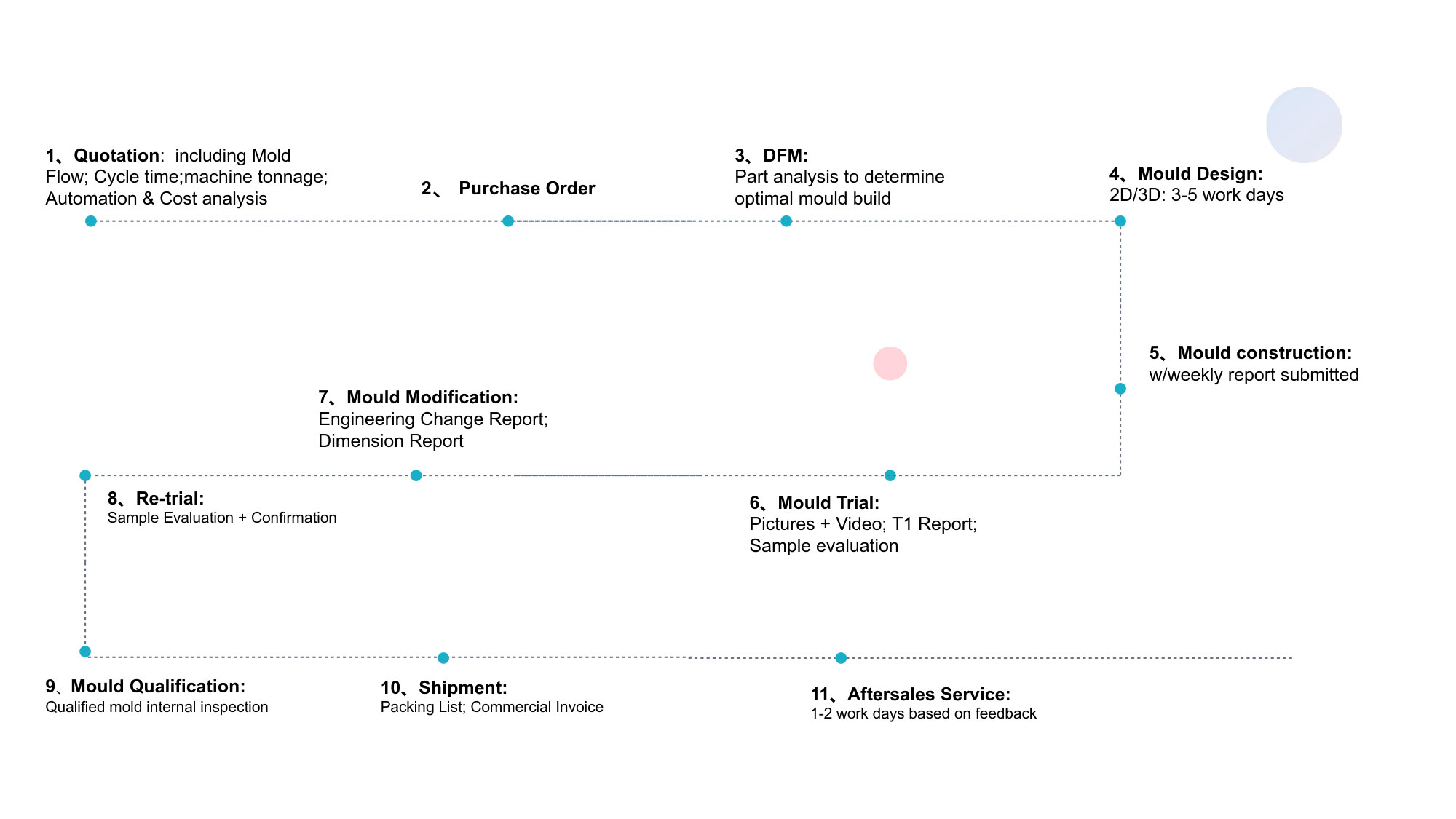
6.3 Manufacturing Workflow
The complete manufacturing workflow for 4680 cell holders follows a disciplined, quality-controlled process:
Stage 1: Design and Development
Customer requirement analysis
3D CAD modeling and design optimization
Moldflow CAE simulation for fill analysis, weld line prediction, and warpage assessment
DFM report preparation and customer review
Stage 2: Mold Manufacturing
Mold steel selection based on expected production volume and material type
Precision machining using five-axis CNC and EDM equipment
Heat treatment with documented heat treatment curves
Assembly and fit-up with 0.005mm parting surface precision
2,000-cycle aging test with wear report
Stage 3: Process Validation
T0-T3 trial runs with improvement reports after each iteration
Dimensional inspection using CMM and optical measurement
CPK calculation for all critical dimensions (target: ≥1.33)
Appearance inspection for surface defects, flow lines, and gate marks
Stage 4: Pilot Production
100-500 shot pilot run for process validation
Statistical process control implementation
First-article inspection and customer approval
Stage 5: Mass Production
MES-controlled process parameters
Real-time monitoring with in-mold sensors and ultrasonic wall thickness measurement
In-line quality inspection with automated rejection of non-conforming parts
Batch sampling per AQL standards
Stage 6: Post-Processing and Packaging
Deflashing (minimal due to precision parting surfaces)
Surface treatment (if required)
Cleanroom packaging to prevent contamination
Labeling and documentation with traceability codes
Stage 7: Delivery and After-Sales
Just-in-time delivery coordination
Spare parts kit included with each mold
Scheduled maintenance at 200,000-cycle intervals
Lifetime technical support
6.4 Production Efficiency and Cost Control
Ansix achieves industry-leading cost efficiency through multiple optimization vectors:
Material Cost Optimization:
Hot runner systems reduce material waste by eliminating cold runners
Material selection optimization balances performance with cost
Regrind capability for non-critical applications reduces virgin material consumption
Cycle Time Optimization:
Advanced cooling system design reduces cooling time by 20-40%
High-speed, all-servo machines enable faster injection and ejection
Automated part removal reduces human intervention time
Energy Efficiency:
All-servo drives consume 40-60% less energy than hydraulic alternatives
Intelligent machine scheduling optimizes energy usage across the production floor
Yield Improvement:
Closed-loop process control reduces scrap rates to <1%
In-line inspection catches defects early, preventing waste of downstream processes
Value to customers: These optimizations typically reduce per-part costs by 15-35% compared to less sophisticated manufacturers. For high-volume 4680 cell holder production, this translates to millions of dollars in annual savings.
6.5 Quality Assurance System
Ansix's quality assurance system is built on multiple layers of inspection and control:
Incoming Material Control:
Raw material certification and verification
Material traceability from receipt to finished part
In-Process Control:
MES-locked process parameters prevent unauthorized adjustments
First-article inspection at start of each shift
In-line sensors for real-time quality monitoring
Statistical process control with real-time CPK tracking
Final Inspection:
100% critical dimension inspection (automated)
AQL sampling for secondary dimensions
Functional testing per customer specifications
Full dimensional report with each shipment
Documentation:
Material certificates and heat treatment curves
Process parameter records for every batch
Inspection reports with CPK values
Traceability codes on every part
Value to customers: When you receive a shipment from Ansix, you receive complete documentation proving that every part meets specification. This documentation is essential for regulatory compliance and customer audits.
Part Seven: Cost Reduction — The Ansix Advantage
7.1 Material Cost Reduction
Ansix reduces material costs through:
Material substitution recommendations that maintain performance at lower cost
Hot runner systems that eliminate 15-30% material waste
Precision molding that reduces flash and scrap
Bulk purchasing power across four production bases
Typical savings: 10-25% of material costs
7.2 Process Cost Reduction
Ansix reduces process costs through:
Cycle time optimization (20-40% faster than industry average)
Automation that reduces labor content by 30-50%
Energy-efficient all-servo machines (40-60% less energy consumption)
High-yield production (scrap rates <1% vs. industry average 3-5%)
Typical savings: 15-30% of processing costs
7.3 Tooling Cost Reduction
Ansix reduces tooling costs through:
Optimized mold design that uses less steel without compromising durability
Standardized components where possible
In-house manufacturing that eliminates supplier markups
Extended mold life (1 million cycles) that spreads tooling cost over more parts
Typical savings: 20-40% of tooling investment
7.4 Logistics Cost Reduction
Ansix reduces logistics costs through:
Strategic production locations in China and Vietnam near major shipping ports
Consolidated shipping for multiple product lines
Just-in-time delivery that reduces customer inventory carrying costs
Typical savings: 10-20% of logistics costs
Part Eight: Conclusion — The Ansix Value Proposition
For customers seeking a manufacturing partner for 4680 power battery cell holders, Ansix Tech offers a compelling value proposition built on four pillars:
1. Technical Excellence
With 28 years of experience, over 30,000 molds built, and precision capabilities reaching 0.002mm, Ansix has the technical expertise to handle the most demanding 4680 cell holder applications. The company's investment in advanced equipment—five-axis machining centers, EDM workshops, all-servo injection machines, and comprehensive inspection systems—ensures that your parts are manufactured to the highest standards.
2. Quality Assurance
With ISO9001, IATF16949, ISO13485, and ISO14001 certifications, Ansix operates under the most rigorous quality management systems. Every mold undergoes full dimensional inspection with CPK ≥1.33. Every production batch is monitored with MES-controlled processes and real-time quality feedback.
3. Cost Efficiency
Through material optimization, cycle time reduction, energy efficiency, and high yields, Ansix delivers per-part costs that are 15-35% lower than less sophisticated competitors. The company's in-house manufacturing capabilities eliminate supply chain markups and reduce lead times.
4. Full-Service Partnership
From DFM analysis before any steel is cut through pilot validation, mass production, and lifetime maintenance support, Ansix provides a complete turnkey solution. The company's early intervention approach identifies and solves problems before they become costly delays.
The Ansix Promise
"To us, a mold is not just a piece of steel—it's a money-printing machine. When we design a mold, we simultaneously plan for the flow characteristics, venting paths, and thermal balance needed to ensure that when it reaches your production line, it runs flawlessly with minimal flash and maximum longevity."
For customers ready to see this commitment in action, Ansix offers a full DFM report walkthrough on an existing product—demonstrating exactly how the company identifies and eliminates risks like weld lines, gas traps, and shrinkage before production begins.
Contact Ansix Tech today to discuss how their 28 years of manufacturing expertise can bring your 4680 battery cell holder project to market faster, at lower cost, and with uncompromising quality.
Ansix Tech Co Ltd
If you have any plans related to 4680 power battery cell holder , you can contact us at any time. We will turn your ideas into reality, let you realize your dreams, and obtain large orders from the market. Our contact information is info@ansixtech.com. Or contact our CTO, mail: stephen@ansixtech.com
#www.ansixtech.com #ansixtech.com #4680 power battery cell holder #4680 power battery cell holder#4680 power battery cell holder Canopy Mold injection mold companies #Ansix #Ansix moulds #Ansix china #Ansix tech china #Ansix tech company #Ansix facotry #4680 power battery cell holderinjection molding #4680 power battery cell holderinjection tools #4680 power battery cell holderinjection moulds #4680 power battery cell holderplastic mould #4680 power battery cell holderplastic tools #Ansix Tech #Ansix molds #Ansix injection molding #Ansix mold factory #injection molding Customized stainless steel float switch for water level, oil level, high liquid level alarm#Ansix mold factory #4680 power battery cell holderchina #4680 power battery cell holdermolds #injection factory #4680 power battery cell holderinjection molding #4680 power battery cell holderinjection molding factory #injection molding company #4680 power battery cell holderinjection mold companies #4680 power battery cell holderTooling #4680 power battery cell holdermold limited #Ansix mold china #Ansix companies #Ansix company China #4680 power battery cell holderfacotry #Ansix Tech #Ansix Tech mould #4680 power battery cell holderinjection moulding #injection moulding company #Ansix 4680 power battery cell holderparts injection mold companies #medical injection molding companieschina #4680 power battery cell holderchina factory #Ansix moulding companies #Ansix molding company #4680 power battery cell holderinjection moulding facotry #Ansix Tech mold #4680 power battery cell holdermould #4680 power battery cell holderplastic injection molding #ansix plastic mold #Mold manufacturing #4680 power battery cell holderparts manufacturing #4680 power battery cell holderplastic parts factory #4680 power battery cell holderinjection parts mold #4680 power battery cell holderPRECISION MANUFACTURING #4680 power battery cell holder#China mold #4680 power battery cell holderinjection moulding china #4680 power battery cell holdermould china #china precision mold #mold in china #4680 power battery cell holdermold china #Precision molds #High-precision molds #4680 power battery cell holder#Injection molds #4680 power battery cell holderFactory #4680 power battery cell holderCompany #Super Large Injection Mold Factory #Large Tonnage Injection Molding Factory #4680 power battery cell holderCompany #4680 power battery cell holderFactory #2800T Injection Molding Factory #3000 Ton Injection Molding #4500 Ton Injection Molding Factory #Large Mold Injection Molding #Large Plastic Mold Injection Molding Factory #Large Injection Mold Manufacturer #Plastic Mold Factory #Injection Mold #Plastic Mold