



Chery Automobile Battery Mounting Bracket Mold Cell Holder
FEATURES
Hard Power Infrastructure — Building Customer Trust Through Equipment Foundation
Before discussing process sophistication, customers need to trust the physical assets that make precision possible. Ansix Tech has strategically invested in equipment specifically selected for automotive battery component molding applications.
A. Precision Mold Machining Equipment
Five-Axis High-Speed Machining Centers: Ansix Tech operates multiple five-axis high-speed machining centers capable of achieving 0.002mm machining accuracy. For the Chery Battery Mounting Bracket, this means complex curved surfaces and critical parting lines are machined with extreme fidelity. Customer Value: Seamless parting lines translate to no flash, no secondary deburring, and no post-molding manual trimming—eliminating one of the most common hidden costs in automotive molding.
Slow-Speed Wire Electrical Discharge Machines (EDM): With cutting precision of ±0.003mm, capable of generating 0.03mm–0.10mm diameter micro-pins and narrow slots with sub-0.01mm positional accuracy. Customer Value: Enables production of fine features required for complex bracket geometries; prevents thin-wall deformation during ejection; reduces rework rates.
CNC Electrical Discharge Machining (Sinker EDM): ±0.005mm cavity depth control with electrode wear compensation algorithms. Customer Value: Produces sharp internal corners and deep rib structures essential for bracket rigidity; ensures uniform wall thickness distribution.
High-Precision Surface/Profile Grinding: Flatness ≤0.003mm per 300mm length; surface finish Ra≤0.1μm on critical parting surfaces. Customer Value: Guarantees perfect mold closure under clamp pressure; eliminates flash along the entire bracket perimeter.
All five-axis CNC machines are equipped with Renishaw probing systems for in-process part verification, reducing setup errors and ensuring that every electrode and cavity block is machined to print before assembly.
-
Mold Description
Product Materials:
PA66+GF40 PPS+GF40 PPO+GF40
Mold Material:
S136ESR
Number of Cavities:
1
Glue Feeding Method:
Hot runner
Cooling Method:
Water cooling
Molding Cycle
42.5s
- The mold manufacturing process and product material selection
Injection Molding Machine Fleet
Ansix Tech operates 260 injection molding machines with clamp forces ranging from 30 tons to 2,800 tons, strategically deployed across four manufacturing campuses. This breadth covers the entire spectrum of automotive component production—from small precision components to large structural parts.
Key Machine Specifications:
Specification Detail Customer Value
Clamp Force Range 30–2,800 tons Covers bracket sizes from small cell holders to full battery mounting frames
Drive Technology All-servomotor electric and hybrid servo-hydraulic systems ±0.1% shot-to-shot weight repeatability; every bracket in a million-part run is dimensionally identical
Injection Pressure Up to 2,500 bar Sufficient for high-viscosity engineering plastics including glass-filled nylons and high-performance blends
Screw Design General-purpose and barrier-type screws with wear-resistant coatings Handles glass-filled materials without material degradation or screw wear
Premium Machine Brands: Japan's Fanuc, Sumitomo, Toshiba, Nissei, Engel; Germany's Arburg (specializing in liquid silicone with two-component capabilities); domestic machines from Haitian and Victor Taichung Machinery.
Every machine is integrated into a centralized MES (Manufacturing Execution System), with molding parameters—temperature, pressure, speed, hold time—locked to engineer-authorization only. This prevents unauthorized floor adjustments that could drift parts out of specification.
-
Measurement and Validation Equipment
Coordinate Measuring Machines (CMMs): Capable of sub-micron resolution, generating full dimensional reports for every mold before shipment. Customer Value: Every mold is validated against print before production begins; critical dimensions are verified with CPK ≥1.33.
Optical Imaging Systems: Sub-micron resolution for visual inspection and dimensional verification.
Section Two: Mold Manufacturing Core Competitiveness — Speaking with Specific Metrics
Customers care most about lifespan, precision, lead time, and repair costs. Ansix Tech addresses each dimension with quantifiable commitments.
A. Mold Life and Material Selection
Dimension Technical Specification Customer-Understandable Value
Mold Base P20 pre-hardened alloy steel Structural integrity保证50万模次以上
Mold Core/Insert S136, 2344, 2343, 8407, SKD11/61, DC53, M340, 4Cr13, 9Cr18, NAK80, H13 Each steel grade selected based on application requirements
Mold Life Commitment Glass-fiber reinforced materials: 500,000 shots; Standard plastics: 1,000,000 shots Predictable tooling lifespan eliminates unexpected replacement costs
Documentation Full material certificates + heat treatment curves provided Complete traceability for quality audits
For glass-fiber-filled compounds like PA+GF30, Ansix selects mold materials that withstand the abrasive nature of such materials. Hot work tool steels like DIN 1.2343 (X38CrMoV5-1) and DIN 1.2344 (X40CrMoV5-1) are used for their exceptional toughness.
B. Achievable Tolerances
Application Achievable Tolerance Customer Value
Standard Structural Components ±0.05mm Reliable fit with mating parts
Precision Gears/Medical Components ±0.005mm Critical for high-precision applications
Parting Surface Fit 0.005mm Flash控制在0.03mm以内, eliminating manual deburring
C. Mold Types and Capabilities
Ansix Tech offers a comprehensive range of mold technologies:
Hot Runner Systems: Reduce material waste and improve fill quality
Stack Molds: Double production efficiency per machine cycle
Two-Shot/Multi-Material Molds: Complex overmolding and material combinations
High-Gloss Molds: Surface roughness Ra<0.05μm, suitable for transparent or aesthetic components
Gas-Assist Injection Molding (GAIM): Optimized for structural automotive components with hollow sections
D. Gate and Feed System Optimization
Through comprehensive Moldflow CAE simulations before any steel is cut, Ansix Tech optimizes gas injection timing, gas channel geometry, and gate placement. The simulation process includes:
Weld line prediction: Identifying and mitigating potential weak points
Gas trap identification: Preventing void formation
Fill balance optimization: Ensuring uniform filling across multi-cavity configurations
Cooling channel layout: Optimizing for minimal cycle time and consistent part quality
Customer Value: Virtual validation eliminates costly trial-and-error on the shop floor; reduced time-to-market; first-time-right tooling.
E. Lead Time Standards
Mold Complexity Standard Lead Time Express Option
Simple Molds 10 days —
Medium Complexity 25–45 days As low as 20 days
High Complexity 45–60+ days Expedited with validation protocols maintained
Critical Note: Express options do not skip validation steps—validation rigor is maintained regardless of timeline.
Section Three: Injection Molding Process Control — Eliminating Quality Anxiety
Customers fear: sink marks, flash, dimensional instability, and batch-to-batch color variation. Ansix Tech addresses each systematically.
A. Process Standardization and Control
All machines are networked with molding parameters locked into the MES system—only engineers authorized to make adjustments. Each batch undergoes first-off and last-off part comparison to verify dimensional stability throughout production.
Customer Value: Complete process traceability; any quality issue can be traced to specific parameters and corrected; batch-to-batch consistency guaranteed.
B. Dimensional Stability Control
Molds are equipped with zone-controlled mold temperature controllers, maintaining core and cavity temperature differential within 2°C to minimize warpage and distortion.
Real-World Performance Data: For similar automotive bracket products, three consecutive production batches over one week showed key hole spacing fluctuation ≤0.02mm—demonstrating exceptional process stability.
Advanced Process Controls:
Ultrasonic wall thickness sensors: Real-time wall thickness monitoring with automatic compensation of holding pressure
In-mold temperature and pressure sensors: Closed-loop control for optimal filling and packing
Servo motor drive systems: ±0.1% repeatable precision ensuring the 10,000th part is identical to the first
C. Surface Finish and Appearance Grades
Requirement Achievable Specification Customer Value
Transparent Parts No bubbles, no flow marks Optical clarity for inspection windows
Plated Parts No gas marks Consistent plating adhesion
High-Gloss Parts Surface roughness Ra≤0.2μm Paint-ready surfaces reducing preparation costs
Printed/Coated Parts Deformation compensation预留; print registration ±0.1mm Reliable decoration quality
D. Special Material Capabilities
Ansix Tech has extensive production experience with a wide range of engineering thermoplastics:
Material Key Properties Automotive Battery Application
PPS (Polyphenylene Sulfide) Withstands 800V+; dimensional stability in humid environments High-voltage connector housings, charging ports, structural end plates
PPS + 40% GF Enhanced stiffness and strength Structural brackets and end plates
PBT Excellent electrical properties Battery module components, connectors
PA6 + GF30 High strength, thermal stability Mounting brackets, structural components
PC/ABS Impact resistance, aesthetics Interior and exterior automotive components
PEEK Extreme temperature resistance High-reliability applications
LCP (Liquid Crystal Polymer) Outstanding dimensional stability Precision connectors, thin-wall components
LSR (Liquid Silicone Rubber) Flexibility, sealing Seals, gaskets
Flame Retardancy: UL94 V-0 rated materials available for battery housings and safety-critical components.
Weatherability: UV testing validated to 3,000 hours without discoloration—critical for components exposed to environmental conditions.
Section Four: Full-Process Service — Reducing Customer Management Costs
A. Early Intervention (DFM Reports)
Before any steel is cut, Ansix Tech delivers a comprehensive Design for Manufacturing (DFM) report. This proactive approach identifies potential issues virtually, preventing costly discoveries after mold opening.
DFM Report Contents:
Draft angle recommendations: Optimizing for clean ejection
Wall thickness optimization: Preventing sink marks and warpage
Gate location planning: Ensuring balanced fill
Vent placement: Preventing gas traps and burn marks
Ejector pin mark allowances: Defining acceptable locations
Gas channel design requirements: For gas-assist applications
Customer Value: Design issues resolved before tooling investment; reduced risk of costly late-stage modifications; accelerated time-to-market.
B. Trial Molding and Samples
Ansix Tech provides T0 through T3 trial samples, each accompanied by improvement reports.
Trial Process:
T0: First trial—identify fundamental issues
T1: Corrective actions implemented—verify improvements
T2: Fine-tuning—optimize parameters
T3: Pre-production validation—ready for release
Quick-Change Insert Capability: Alternative designs can be validated by swapping inserts rather than rebuilding entire molds—significantly reducing validation costs and time.
C. Small-Batch Validation
Before full production release, Ansix Tech provides 100–500 shot trial production runs to statistically validate yield rates and CPK values. Only after confirming process stability does mass production commence.
Customer Value: No surprises in mass production; confirmed capability before volume commitment; predictable delivery schedules.
D. Maintenance and Spare Parts
Spare parts kit: Ejector pins, core inserts, and other wear components delivered with the mold
Scheduled maintenance: Every 200,000 shots
Lifetime repairs: At cost-plus pricing
In-house repair capability: Self-owned electrode machining and EDM workshop enables routine repairs within 24 hours without outsourcing
Section Five: Differentiated Value Proposition — Direct Answers to Common Customer Complaints
Common Customer Complaint Ansix Tech's Commitment Proof Point
"Molds require frequent repairs, disrupting orders." 2,000-shot aging test before delivery with wear report; 3-year mold structure warranty (excluding normal wear parts) Documented wear data; predictable maintenance schedule
"Excessive flash drives up post-processing costs." Parting surface machined to 0.005mm fit precision; self-locking clamp force compensation; flash controlled to ≤0.03mm per batch Eliminates manual deburring; first-shot flash-free parts
"Dimensions vary from batch to batch." Ultrasonic wall thickness sensors with automatic pressure compensation; in-mold temperature/pressure sensors with closed-loop control Three consecutive batches: key hole spacing fluctuation ≤0.02mm
"Mold repair takes too long." In-house electrode machining and EDM workshop; standard repairs (weld repair/insert replacement) restored within 24 hours No outsourcing delays; minimal production interruption
Ansix Tech's Core Philosophy
"For us, a mold is not just a block of steel—it is a profit-generating asset for our customers."
When designing molds, Ansix Tech simultaneously plans for:
Steel retention for long-term durability
Exhaust paths to eliminate gas traps
Thermal balance for consistent cooling and minimal warpage
The result: A mold that arrives at the customer's production line requiring no debugging, producing minimal flash, and delivering extended service life.
The Value Translation Principle
Ansix Tech's core strategy lies in transforming technical terminology into tangible Customer Value. The company does not simply boast about advanced equipment—it articulates precisely what these capabilities solve for customers, how much cost they save, and what risks they mitigate.
Example: "We operate five-axis high-speed machining centers with 0.002mm accuracy" becomes "Your parting lines will be seamless—no flash, no manual deburring, eliminating thousands of dollars in secondary labor costs."
Raw Material Selection and Characteristics for Chery Battery Mounting Bracket
Material Selection Criteria
The Chery Automobile Battery Mounting Bracket Mold Cell Holder demands materials that balance:
Mechanical strength for structural integrity
Dimensional stability across temperature ranges
Chemical resistance to battery electrolytes and coolants
Flame retardancy for safety compliance
Cost-effectiveness for mass production viability
Primary Material Candidates
Material Grade/Composition Key Characteristics Application Rationale
PPS + 40% GF Polyphenylene Sulfide with 40% glass fiber 800V+ voltage withstand; dimensional stability in humid environments; UL94 V-0 High-voltage battery bracket components
PA6 + GF30 Polyamide 6 with 30% glass fiber High strength-to-weight ratio; excellent thermal stability; good chemical resistance Structural mounting brackets
PBT Polybutylene Terephthalate Excellent electrical insulation; good dimensional stability Connector housings, module brackets
PP-LGF30 Polypropylene with 30% long glass fiber Lower cost; one-step forming capability; replaces metal assemblies Cost-optimized battery brackets
PC/ABS Polycarbonate/Acrylonitrile Butadiene Styrene blend Impact resistance; aesthetics; good flow characteristics Interior-visible components
PPS/PPO Alloy Polyphenylene Sulfide/Polyphenylene Oxide blend Weight reduction; enhanced toughness Impact-prone areas
Material Composition and Grade Specifics
PPS (Polyphenylene Sulfide):
Linear or branched structure
High crystallinity (typical 50-65%)
Continuous use temperature: 200-240°C
Glass transition temperature: ~85°C
Melting temperature: 280-290°C
Dielectric strength: >15 kV/mm
UL94 V-0 rating (inherent flame retardancy)
PA6 (Polyamide 6):
Semi-crystalline thermoplastic
Melting point: ~220°C
Glass transition temperature: ~50°C
Moisture absorption: ~2-3% (equilibrium)
Excellent wear resistance
Good chemical resistance to fuels and oils
PBT (Polybutylene Terephthalate):
Semi-crystalline engineering thermoplastic
Melting point: ~225°C
Glass transition temperature: ~40-45°C
Excellent electrical insulation
Low moisture absorption (<0.5%)
Good dimensional stability
Mold Design and Manufacturing Process for Chery Battery Mounting Bracket
DFM and Moldflow Analysis
Before any steel is cut, Ansix Tech performs comprehensive Moldflow CAE simulations:
Fill Analysis: Simulating melt flow to identify:
Weld line locations
Gas trap positions
Flow imbalance between cavities
Optimal gate location and count
Packing Analysis: Optimizing:
Packing pressure profiles
Hold time
Volume shrinkage compensation
Cooling Analysis: Evaluating:
Cooling channel effectiveness
Thermal gradient across the mold
Cycle time optimization
Warpage prediction
Warpage Analysis: Predicting:
Part distortion after ejection
Compensation strategies
Fixturing requirements
Customer Value: Virtual validation of the entire molding process before committing to tooling steel—eliminating costly trial-and-error.
Mold Design Priorities for Battery Mounting Bracket
1. Cooling System Design:
Conformal cooling channels following part geometry
Zone-controlled temperature management
Core and cavity temperature differential ≤2°C
Minimized cycle time while ensuring uniform cooling
2. Gate and Feed System:
Hot runner systems to minimize sprue scrap
Balanced runner design for multi-cavity configurations
Gate location selected to minimize weld lines and optimize外观
Valve gate options for cosmetic surfaces
3. Ejection System:
Strategic ejector pin placement avoiding critical surfaces
Ejector pin mark allowances defined in DFM
Balanced ejection forces to prevent part distortion
Air ejection options for delicate features
4. Venting System:
Adequate venting at fill end positions
Vent depth optimized for material (typically 0.02-0.05mm for engineering plastics)
Prevent gas traps and burn marks
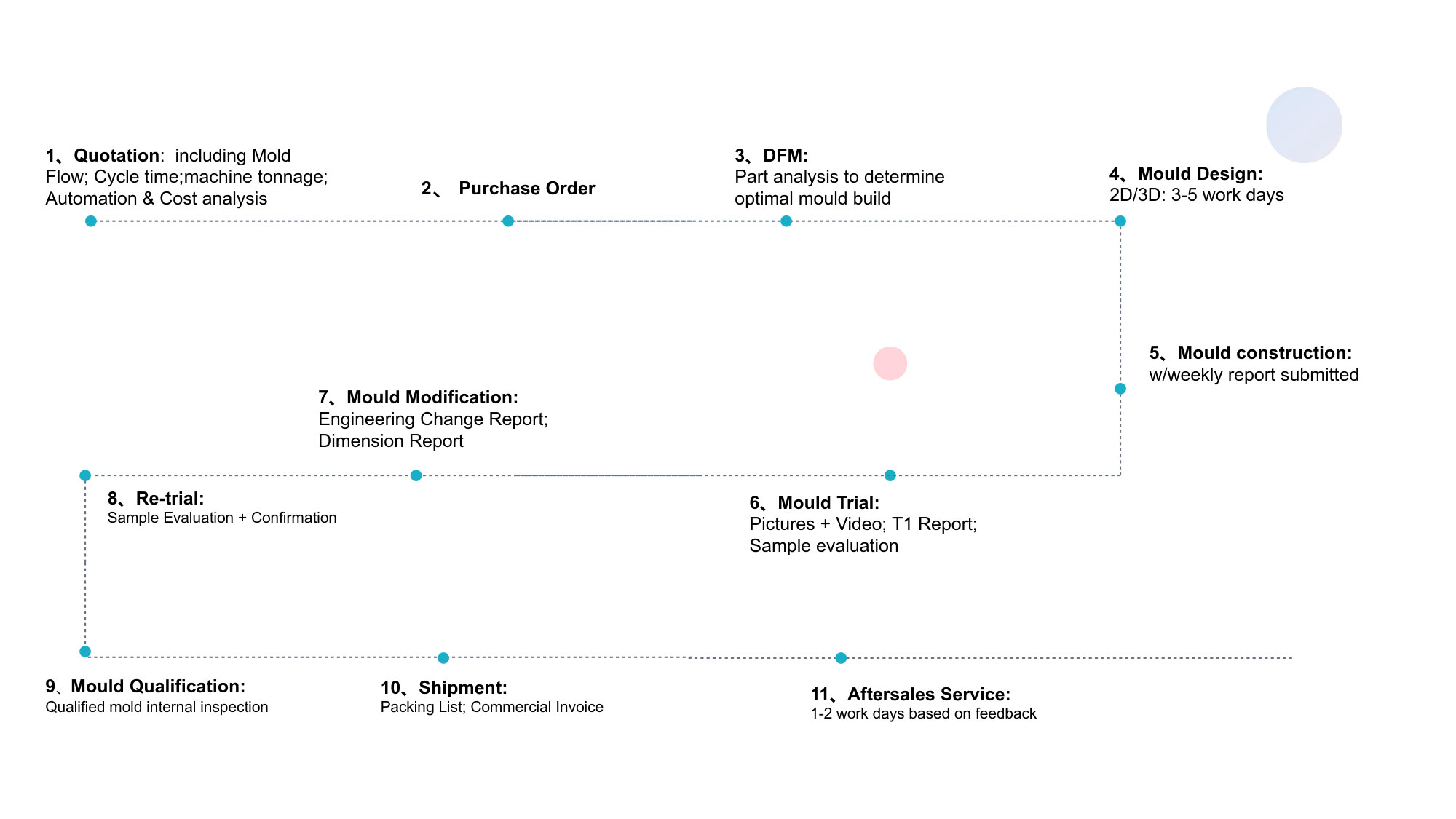
Mold Manufacturing Process Flow
1. Steel Selection and Preparation:
Material certification and traceability
Pre-hardening or heat treatment as required
Ultrasonic inspection for defects
2. Rough Machining:
5-axis high-speed roughing
Stock allowance for finish machining
Stress relief heat treatment if required
3. Finish Machining:
5-axis high-speed finishing (0.002mm accuracy)
EDM for complex cavities and sharp corners
Wire EDM for fine features and narrow slots
4. Fitting and Assembly:
Parting surface grinding (flatness ≤0.003mm)
Guide pin and bushing fitting
Component assembly (hot runner, cooling lines, ejector system)
5. Polishing and Surface Treatment:
Critical surfaces polished to Ra≤0.1μm
Texturing if required
Nitriding or other surface treatments for wear resistance
6. Trial and Validation:
T0-T3 trial sequence
Dimensional inspection on CMM
Full dimensional report
CPK verification for critical dimensions
Manufacturing Challenges and Solutions
Challenge Solution
Thin-wall deformation Wire EDM for 0.03mm features; optimized ejection system
Glass fiber abrasion Wear-resistant steel grades (H13, SKD61); nitrided surfaces
Complex cooling requirements Conformal cooling; zone temperature control
High cosmetic requirements High-gloss steel (S136); precision polishing
Multi-cavity consistency Balanced runner design; MES-controlled parameters
Injection Molding Process Optimization
Efficiency Improvement Strategies
Cycle Time Reduction:
Optimized cooling channel design
High-efficiency servo drives
Automated part handling and degating
Target cycle times: 22.5–32.5 seconds depending on part complexity
Scrap Reduction:
Hot runner systems eliminate runner scrap
Process parameter locked in MES
Real-time quality monitoring reduces rejects
First-off/last-off verification
Multi-Cavity Optimization:
Up to 64 or 128 cavities for high-volume production
Balanced fill across all cavities
Per-part cost reduction of up to 60%
Cost Control Strategies
Material Cost Optimization:
Material selection based on performance requirements (not over-specifying)
Hot runner systems minimize material waste
Regrind programs for non-critical applications
PP-LGF30 as cost-effective metal replacement
Process Efficiency:
Shorter cycle times = more parts per machine-hour
Automated processes reduce labor costs
Reduced scrap = lower material costs
Multi-cavity molds spread tooling investment
Tooling Cost Optimization:
DFM prevents costly late-stage modifications
Modular insert design for flexibility
Standardized components where possible
In-house manufacturing eliminates outsourcing markups
Quality Control and Assurance
In-Process Controls:
MES-locked parameters prevent unauthorized adjustments
Real-time monitoring of key process variables
Automated part inspection systems
Statistical process control (SPC) with CPK tracking
Quality Gates:
Incoming material inspection: Raw material certification verification
First-off inspection: Dimensional verification at start of each run
In-process inspection: Regular sampling per AQL standards
Last-off inspection: Verification that dimensions did not drift
Final inspection: 100% critical dimension check
Certification and Documentation:
Full dimensional reports with each shipment
Material certificates included
CPK data for critical dimensions
First Article Inspection (FAI) reports
PPAP (Production Part Approval Process) documentation for automotive applications
Packaging and Delivery
Packaging Standards:
Custom-designed packaging to prevent damage during transit
ESD-safe packaging for electronic-sensitive components
Cleanroom packaging for contamination-sensitive applications
Labeled and traceable per batch
Delivery Commitments:
On-time delivery guaranteed through capacity planning
Four production bases ensure regional supply chain resilience
Real-time production tracking and status updates
24-hour response to inquiries
Industry Experience and Customer Value
28 Years of Manufacturing Excellence
With over 28 years of precision injection molding heritage and more than 30,000 mold sets delivered since 1998, Ansix Tech brings unmatched depth of experience to every automotive battery component project.
What Ansix Tech Solves for Customers
Customer Pain Point Ansix Tech Solution Quantified Value
Supply chain fragmentation Integrated in-house mold manufacturing and injection molding Eliminates mold transfer delays between separate workshops
Mold reliability issues 2,000-shot aging test; 3-year structure warranty Predictable tooling lifespan; no surprise failures
Inconsistent part quality MES-locked parameters; servo drive ±0.1% repeatability Batch-to-batch consistency; the 10,000th part identical to the first
High scrap rates Process optimization; real-time monitoring Scrap rates typically <2% for mature processes
Long development cycles DFM and Moldflow before tooling Reduced time-to-market; first-time-right tooling
High tooling costs Optimized design; modular inserts; in-house manufacturing Lower total cost of ownership
Cost Reduction Achievements
Material Costs: Strategic material selection; hot runner waste reduction; regrind programs
Labor Costs: Automated processes reduce manual intervention; flash-free parts eliminate deburring
Tooling Costs: DFM prevents rework; in-house manufacturing eliminates markup
Quality Costs: Reduced scrap; fewer customer returns; lower warranty claims
Logistics Costs: Four production bases reduce shipping distances
Conclusion: The Ansix Tech Difference
For the Chery Automobile Battery Mounting Bracket Mold Cell Holder project, Ansix Tech delivers:
World-Class Infrastructure: 260 injection molding machines (30–2,800 tons), 5-axis machining at 0.002mm, comprehensive CMM and optical inspection
Proven Process Excellence: DFM and Moldflow before tooling; MES-locked parameters; CPK ≥1.33 for critical dimensions
Uncompromised Quality: IATF16949 certification; full dimensional reports; material traceability; PPAP documentation
Cost Leadership: Integrated operations eliminate handoff costs; multi-cavity optimization; reduced scrap; lower total cost of ownership
Reliable Delivery: Four production bases; 260 machines; 1,200+ employees; 200+ engineers
Partnership Approach: "A mold is not a block of steel—it is a profit-generating asset for our customers."
Final Invitation: Ansix Tech invites customers to experience a full DFM report walk-through on an existing product—allowing them to see firsthand how weld lines, gas traps, sink marks, and other critical risks are proactively eliminated before tooling even begins.
For inquiries about Chery Automobile Battery Mounting Bracket Mold Cell Holder manufacturing solutions, contact Ansix Tech at info@ansixtech.com. Response within 12–24 hours guaranteed.
Ansix Tech Co Ltd
If you have any plans related to Chery Automobile Battery Mounting Bracket Mold Cell Holder , you can contact us at any time. We will turn your ideas into reality, let you realize your dreams, and obtain large orders from the market. Our contact information is info@ansixtech.com. Or contact our CTO, mail: stephen@ansixtech.com
#www.ansixtech.com #ansixtech.com #Chery Automobile Battery Mounting Bracket Mold Cell Holder #Chery Automobile Battery Mounting Bracket Mold Cell Holder #Chery Automobile Battery Mounting Bracket Mold Cell Holder Canopy Mold injection mold companies #Ansix #Ansix moulds #Ansix china #Ansix tech china #Ansix tech company #Ansix facotry #Chery Automobile Battery Mounting Bracket Mold Cell Holderinjection molding #Chery Automobile Battery Mounting Bracket Mold Cell Holderinjection tools #Chery Automobile Battery Mounting Bracket Mold Cell Holderinjection moulds #Chery Automobile Battery Mounting Bracket Mold Cell Holderplastic mould #Chery Automobile Battery Mounting Bracket Mold Cell Holderplastic tools #Ansix Tech #Ansix molds #Ansix injection molding #Ansix mold factory #injection molding Customized stainless steel float switch for water level, oil level, high liquid level alarm#Ansix mold factory #Chery Automobile Battery Mounting Bracket Mold Cell Holderchina #Chery Automobile Battery Mounting Bracket Mold Cell Holdermolds #injection factory #Chery Automobile Battery Mounting Bracket Mold Cell Holderinjection molding #Chery Automobile Battery Mounting Bracket Mold Cell Holderinjection molding factory #injection molding company #Chery Automobile Battery Mounting Bracket Mold Cell Holderinjection mold companies #Chery Automobile Battery Mounting Bracket Mold Cell HolderTooling #Chery Automobile Battery Mounting Bracket Mold Cell Holdermold limited #Ansix mold china #Ansix companies #Ansix company China #Chery Automobile Battery Mounting Bracket Mold Cell Holderfacotry #Ansix Tech #Ansix Tech mould #Chery Automobile Battery Mounting Bracket Mold Cell Holderinjection moulding #injection moulding company #Ansix Chery Automobile Battery Mounting Bracket Mold Cell Holderparts injection mold companies #medical injection molding companieschina #Chery Automobile Battery Mounting Bracket Mold Cell Holderchina factory #Ansix moulding companies #Ansix molding company #Chery Automobile Battery Mounting Bracket Mold Cell Holderinjection moulding facotry #Ansix Tech mold #Chery Automobile Battery Mounting Bracket Mold Cell Holdermould #Chery Automobile Battery Mounting Bracket Mold Cell Holderplastic injection molding #ansix plastic mold #Mold manufacturing #Chery Automobile Battery Mounting Bracket Mold Cell Holderparts manufacturing #Chery Automobile Battery Mounting Bracket Mold Cell Holderplastic parts factory #Chery Automobile Battery Mounting Bracket Mold Cell Holderinjection parts mold #Chery Automobile Battery Mounting Bracket Mold Cell HolderPRECISION MANUFACTURING #Chery Automobile Battery Mounting Bracket Mold Cell Holder#China mold #Chery Automobile Battery Mounting Bracket Mold Cell Holderinjection moulding china #Chery Automobile Battery Mounting Bracket Mold Cell Holdermould china #china precision mold #mold in china #Chery Automobile Battery Mounting Bracket Mold Cell Holdermold china #Precision molds #High-precision molds #Chery Automobile Battery Mounting Bracket Mold Cell Holder#Injection molds #Chery Automobile Battery Mounting Bracket Mold Cell HolderFactory #Chery Automobile Battery Mounting Bracket Mold Cell HolderCompany #Super Large Injection Mold Factory #Large Tonnage Injection Molding Factory #Chery Automobile Battery Mounting Bracket Mold Cell HolderCompany #Chery Automobile Battery Mounting Bracket Mold Cell HolderFactory #2800T Injection Molding Factory #3000 Ton Injection Molding #4500 Ton Injection Molding Factory #Large Mold Injection Molding #Large Plastic Mold Injection Molding Factory #Large Injection Mold Manufacturer #Plastic Mold Factory #Injection Mold #Plastic Mold