



48-cavity oil bottle preform mold
FEATURES
Manufacturing Hardware & Technical Capabilities (Hard Power)
2.1 Precision Machining Equipment
At Ansix Tech, we believe that great molds start with great machines — but the true value lies not in the machines themselves, but in what they deliver for our customers.
Five-Axis High-Speed Machining Centers: Our facilities are equipped with high-speed five-axis machining centers capable of processing complex curved surfaces with precision down to 0.002mm. For our customers, this means perfectly smooth parting lines with no visible mismatch — a critical aesthetic requirement for transparent oil bottle preforms where even minor marks become visible in the finished container. The elimination of hand-finishing post-processing reduces your labor costs and accelerates your time-to-market.
-
Mold Description
Product Materials:
PET PETG
Mold Material:
S136ESR
Number of Cavities:
1*48
Glue Feeding Method:
Hot runner
Cooling Method:
Water cooling
Molding Cycle
8.5s
- The mold manufacturing process and product material selection
Wire EDM (Slow Wire Cutting): We utilize precision wire EDM capable of achieving tolerances of ±0.001mm to ±0.005mm under controlled conditions. This technology is essential for machining intricate features such as 0.03mm diameter micro-pores and narrow cooling slots in the core and cavity inserts. Why does this matter for you? Because these features directly impact mold cooling efficiency — which in turn determines your cycle time and production cost per part. With ANSIX’s EDM precision, you get thinner walls, faster cycles, and longer mold life, all without compromising dimensional integrity.
The beauty of wire EDM lies in its non-contact nature. Because the cutting wire does not physically contact the workpiece, there are zero cutting forces — eliminating mechanical stress, tool deflection, and friction-induced heat that plague conventional milling. This means we can machine fragile or intricate features that would shatter or distort under traditional cutting methods. For multi-cavity molds, wire EDM allows us to cut near-perfect sharp internal corners and complex splines, ensuring that mold components fit together with seamless precision — which translates directly to zero flash and perfect part release for every shot.
-
Injection Molding Machine Fleet
We maintain a comprehensive fleet of injection molding machines ranging from 30 tons to 4,000 tons clamp force, covering the entire spectrum of preform sizes from small 15g water bottle preforms to heavy 90g+ oil container preforms. Our machines are equipped with all-servo electric drives and precision closed-loop control systems achieving repeatability accuracy of ±0.1% on every cycle.
What does this mean for you? Consistent part quality — not just today or tomorrow, but for every single shot across millions of cycles. When you run a 48-cavity mold at 7.5-second cycles, producing 23,000 preforms per hour, even a 0.5% variation in part weight translates into thousands of dollars in material waste every week. Our servo drive systems eliminate that variation.
2.3 Quality Inspection and Metrology
Every mold that leaves our facility undergoes comprehensive dimensional verification before shipment.
Coordinate Measuring Machines (CMM): Our CMMs perform full dimensional inspection of every critical feature — from core and cavity profiles to ejection pin locations and cooling channel positions. Each mold is accompanied by a full dimensional inspection report showing measured values against drawing tolerances.
Optical Measurement Systems: For features requiring visual verification — gate marks, surface finish quality, parting line condition — we employ high-resolution optical inspection equipment. This ensures that every detail meets or exceeds specification.
Process Capability (CPK) Guarantee: For critical dimensions affecting preform functionality — neck finish dimensions, wall thickness consistency, gate vestige height — we guarantee CPK ≥ 1.33, demonstrating process stability that ensures your production line runs smoothly from day one.
Part III: Mold Manufacturing Core Competencies
3.1 Mold Life Expectancy
The table below translates technical specifications into measurable customer benefits:
Technical Parameter Customer Value Delivered
S136 stainless mold steel (HRC 48-52) for cores and cavities, P20 (HRC 30-36) for mold plates Glass-fiber reinforced materials: 500,000+ shots; Standard PET/PP: 1,000,000+ shots
H13 hot-work tool steel (HRC 45-55) for high-temperature applications Sustained performance under continuous high-temperature molding conditions
8407/2344/2343 improved H13 variants Superior toughness and thermal fatigue resistance, reducing unscheduled downtime
SKD11/SKD61/DC53 for wear-critical components Extended service life in abrasive material applications (e.g., glass-filled PET)
M340/4Cr13/9Cr18 corrosion-resistant stainless Perfect for acidic or chemically aggressive materials
NAK80 pre-hardened P21 type Excellent mirror polish for transparent oil bottle preform applications
Our heat treatment process includes vacuum quenching and multiple tempering cycles, with careful control of preheating stages (400-500°C followed by 800-850°C) before austenitization at 1020-1050°C, followed by precise tempering to achieve target hardness without brittleness. For our customers, this translates to molds that maintain dimensional stability through millions of cycles — which means predictable production schedules and zero costly interruptions.
All mold materials come with full material certification and heat treatment records, providing complete traceability throughout the supply chain.
3.2 Achievable Tolerances
Standard structural components: ±0.05mm
Critical mating surfaces and precision cavities: ±0.005mm
This level of precision eliminates the need for secondary finishing operations — your production line runs with parts that fit perfectly right out of the mold.
3.3 Mold Types and Configurations
Hot Runner Systems: Our 48-cavity preform molds utilize advanced hot runner technology with independently controlled heated manifold systems that deliver molten plastic directly to each cavity, eliminating cold runners and significantly reducing material waste. Each cavity features independent self-locking mechanisms ensuring perfect mold concentricity.
For our customers, hot runner technology means:
Material cost savings: By eliminating runner waste, you reduce material consumption by up to 30-40% per production run.
Energy efficiency: Lower energy consumption per part due to reduced heating requirements.
Color change flexibility: Easy color transitions for producing preforms in different colors, allowing you to respond quickly to changing market demands.
Cold Runner Options: For customers preferring simplicity and lower initial investment, cold runner configurations with runner and sprue systems are also available, with meticulous gate design to minimize waste and maximize packing efficiency.
3.4 Gating Solutions and Flow Optimization
Through advanced mold flow analysis software, we predict and eliminate potential defects before any steel is cut:
Weld Line Prevention: By optimizing gate location and melt flow paths, we minimize knit-line formation — a critical requirement for oil bottles where visual imperfections cannot be tolerated.
Gas Trapping Elimination: Conformal cooling channel design and strategic venting placements ensure trapped air escapes completely during injection, preventing burn marks and incomplete fills.
Cavity Balance: Every one of the 48 cavities receives equal fill pressure, temperature, and material volume — ensuring that preform #1 is identical to preform #48. For our customers, this means scrap rates below 0.5% and perfect parts every cycle. As industry benchmarks show, maximum weight difference across 48 cavities in the same mold can be controlled to ≤0.03g — a fivefold improvement over traditional molds.
3.5 Cooling System Engineering
The cooling system is perhaps the most critical factor in preform mold design. Inefficient cooling leads to prolonged cycle times, warping, incomplete crystallization, and increased scrap rates.
Ansix Tech employs the following cooling technologies:
Conformal Cooling Channels: Strategically positioned cooling channels follow the contour of the preform geometry, ensuring uniform temperature distribution across the entire mold cavity.
Multi-Zone Temperature Control: Our molds feature multiple independently controlled cooling zones, allowing precise temperature management for core, cavity, gate area, and neck finish regions.
Copper Alloy Inserts for Heat Concentration: In areas where heat builds up (such as the gate region), beryllium copper or similar high-thermal-conductivity alloys are employed. With thermal conductivity 3-5 times that of steel, these inserts rapidly draw heat away from critical zones, enabling shorter cycle times without sacrificing part quality.
Temperature Uniformity Guarantee: Through careful cooling channel layout and flow rate optimization, we maintain core-cavity temperature differences within 2°C — a specification that directly translates to warpage-free preforms and dimensional stability across production runs.
3.6 Ejection System Design
Proper ejection is essential for high-cavitation molds. Our ejection systems feature:
Precision-machined ejector pins with tight clearance tolerances (H7/e7 fit) to prevent galling while ensuring smooth operation
Balanced ejection plate design to distribute force evenly across all 48 cavities, preventing part distortion or sticking
Draft angles engineered for material shrinkage (typically 1°-3° for PET), ensuring preforms release cleanly without damage
Self-locking mechanisms per cavity maintaining concentricity and preventing preform deformation during ejection
3.7 Delivery Standards
Mold Type Standard Delivery Rush Option
Simple single-cavity 10-15 working days 7 days (sample approval required)
48-cavity standard configuration 45-50 working days 30 working days
48-cavity with custom features 50-60 working days 40 working days
Our rush delivery options do not compromise quality verification — every mold undergoes complete dimensional inspection, 2,000-cycle aging test, and full CPK validation before shipment, regardless of delivery timeline.
Part IV: Injection Molding Process Control
4.1 Process Standardization
Customer concerns are predictable: sink marks, flash, dimensional inconsistency, batch-to-batch color variation. Ansix Tech addresses each of these systematically.
MES-Integrated Process Control: All injection molding machines are connected to our Manufacturing Execution System (MES). Key process parameters — melt temperature, injection pressure, injection speed, holding pressure, cooling time, back pressure — are locked within the system. Only authorized engineers may modify parameters, and all changes are logged with timestamps and operator identification. Every batch undergoes first-article and last-article inspection.
For our customers, this means complete traceability and zero unauthorized process drift — your product is manufactured the same way, every time, regardless of shift or operator.
4.2 Dimensional Stability Assurance
Ultrasonic Wall Thickness Monitoring: We install ultrasonic sensors in our injection molding machines that continuously monitor preform wall thickness during production. These sensors detect variations in real time and automatically adjust holding pressure to compensate for material viscosity fluctuations — a feature that directly reduces your scrap rate and ensures every preform meets dimensional specifications.
In-Cavity Temperature and Pressure Sensors: For customers requiring the highest level of control, we offer mold instrumentation with in-cavity temperature and pressure sensors integrated into the cooling system. These sensors feed data back to the machine controller, enabling closed-loop process adjustment during the injection cycle. This is closed-loop intelligence that continuously optimizes production quality.
Stability Validation: In production validation testing, we have demonstrated that critical features such as gate-to-end wall thickness and neck finish dimensions remain within ±0.02mm across multiple production batches spanning multiple weeks.
4.3 Surface Finish and Aesthetic Quality
For oil bottles — particularly premium edible oils sold in transparent or tinted containers — surface finish quality is critical. Ansix Tech achieves:
Transparent part quality: Zero bubbles, zero flow marks, zero haze (preform clarity essential for oil visual inspection)
Electroplating-ready surfaces: No gas marks, no surface defects that would affect subsequent coating adhesion
High-gloss finishes: Surface roughness ≤ Ra 0.2μm, achieved through mirror-polished cavity surfaces using S136 and NAK80 steels with proven mirror polishing performance
Compensation for secondary operations: For customers requiring printing or labeling on finished bottles, we build deformation compensation into the preform mold design, ensuring print registration accuracy of ±0.1mm after blow molding
4.4 Special Material Capabilities
Ansix Tech has extensive production experience across a broad spectrum of engineering thermoplastics:
Material Family Examples Key Applications
Polycarbonate alloys PC, PC/ABS, PC/PBT High-impact oil containers
High-temperature resins PEEK, PEI (Ultem), PPSU Specialty chemical/oil packaging
Reinforced materials PA6+GF30, PA66+GF, PBT+GF, PPS+40%GF Structural oil bottle components
Fluoropolymers PTFE, PFA, PVDF Corrosive chemical/oil applications
Commodity resins PET, PP, HDPE, LDPE Standard edible oil bottles
Specialty thermoplastics LCP, PPS High-barrier oil packaging
Liquid silicone rubber LSR (various durometers) Seals and gaskets
Flame-retardant grades UL94 V-0 certified materials Safety-compliant packaging
Weather-resistant grades UV-stabilized compounds (3,000+ hours UV testing) Outdoor/sunlight-exposed oil bottles
FDA/USP Class VI grades Medical-grade materials Pharmaceutical/food-grade oil packaging
4.5 Cycle Time Optimization and Productivity Enhancement
Shorter cycle times translate directly to lower cost per part and higher daily output. At Ansix Tech, we pursue cycle time reduction through four primary levers:
Hot Runner Efficiency: Our advanced hot runner manifold designs, combined with independently controlled needle valve gates, allow for rapid material flow during injection and clean gate break-off without prolonged holding phases — features that cut 10-15% from standard cycle times.
Conformal Cooling Channels: By following the preform contour with cooling passages, we reduce cooling time — typically the longest phase of the injection cycle — by 20-30% compared to conventional straight-drilled channels.
Post-Mold Cooling Integration: For high-volume PET preform production, we integrate post-mold cooling tubes into the mold extraction system. The automated take-out robot transfers preforms to cooling tubes immediately after ejection, allowing the injection machine to begin the next cycle while preforms continue to cool outside the mold. This parallel processing approach yields cycle times as low as 7.5 seconds for preforms under 35g.
OEE Monitoring and Improvement: Overall Equipment Effectiveness (OEE) is a key performance indicator measuring availability, performance, and quality. Studies have shown that systematic OEE improvement — through process optimization, preventive maintenance, operator training, and digital monitoring — can increase OEE from baseline values (e.g., 67.9%) to world-class levels exceeding 76%, representing substantial productivity gains. At Ansix Tech, we help our customers track and improve OEE metrics throughout the production lifecycle.
Part V: Full-Service Quality Assurance
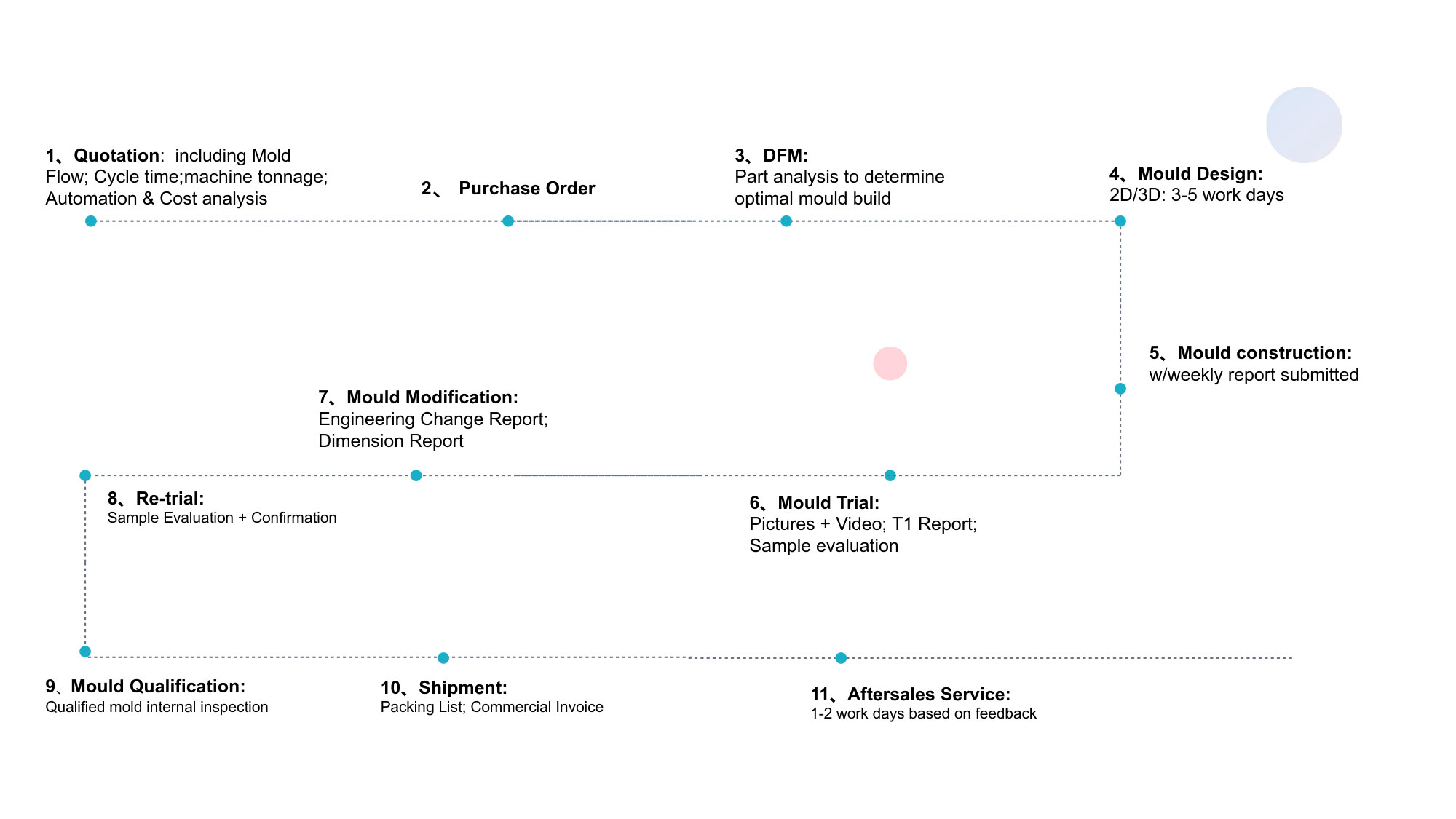
5.1 Early Engagement — Design for Manufacturability (DFM)
We deliver DFM reports before any steel is cut. Each report analyzes the proposed design and provides actionable recommendations:
Gate location optimization: Preventing weld lines in visible areas of the final bottle
Venting placement: Eliminating burn marks or gas traps in difficult-to-fill regions
Draft angle recommendations: Ensuring clean part release without deformation
Wall thickness distribution: Minimizing sink and warp through uniform thickness design
Ejector pin mark placement: Locating witness marks in non-critical areas or secondary surfaces
For our customers, DFM analysis means uncovering potential production problems before they become expensive mold modifications — saving weeks of delay and thousands of dollars in rework costs.
5.2 Trial Shots and Iterative Improvement
Every mold undergoes a structured validation protocol:
T0 sampling: Initial mold trial upon completion of machining, documenting all critical dimensions, part quality observations, and initial cycle time data
T1 improvements: First revision cycle incorporating design changes identified during T0 sampling
T2 validation: Verification that all customer-specified quality criteria are met
T3 sign-off: Final approval confirming mold ready for production
Between each trial, we provide detailed improvement reports documenting all changes made and measurement data confirming compliance.
For complex 48-cavity molds requiring design validation, we offer the capability to quickly exchange mold inserts to test alternative gate designs, cooling configurations, or material options — without requiring complete mold rebuild — dramatically reducing development time and cost.
5.3 Pilot Production Validation
Before releasing a mold for full-scale production, we offer 100 to 500 pre-production cycles:
Yield tracking: Calculating first-pass yield and identifying any quality concerns
CPK analysis: Validating process capability against required tolerances
Cycle time stability: Confirming that the mold achieves consistent cycle times over extended runs
Material consumption verification: Verifying gate weight and scrap rate estimates
Only after pilot production yields meet customer specifications do we declare the mold ready for mass production. This approach eliminates the risk of discovering quality or productivity issues during full production runs.
5.4 Spare Parts and Maintenance Program
Standard Spare Package: Every mold ships with a comprehensive set of spare components — ejector pins, core pins, cavity inserts (where practical), gate inserts, and standard wear components — all certified to meet original mold specifications.
Scheduled Maintenance: We recommend preventive maintenance every 200,000 cycles. Ansix Tech provides detailed maintenance schedules including lubrication points, wear inspection criteria, and recommended replacement intervals for consumable components.
Lifetime Repair Service: Even after the warranty period expires, we provide repair and refurbishment services at cost plus labor — no unexpected charges. Common repairs such as minor welding, insert replacement, or surface refinishing are completed within 24 hours of receipt at our facility.
5.5 Cross-Cavity Consistency Verification
One of the most critical quality requirements for any multi-cavity mold is uniform part quality across all 48 cavities. We implement:
100% inspection of trial parts from every cavity checking for flash, short shots, dimensional accuracy, and weight consistency
Injection parameter optimization across temperature, pressure, and cooling settings to maximize production speed and maintain consistent part quality
Nano-level surface tension balance technology that maintains tight tolerance even when the mold is operating at elevated temperatures (up to 155°C)
The result is maximum weight variation across 48 cavities of ≤0.03g — ensuring perfect part interchangeability regardless of which cavity produced the preform.
Part VI: Cost Advantages and Economic Analysis
6.1 Material Cost Reduction
Hot Runner Material Savings: By eliminating cold runner waste, hot runner technology reduces material consumption by 30-40% compared to conventional cold runner molds — a significant ongoing cost saving that compounds over millions of cycles.
Wall Thickness Optimization: Through mold flow analysis and cooling channel optimization, we reduce wall thickness while maintaining structural integrity. For a typical 30g oil bottle preform, every 0.1mm reduction in wall thickness across 48 cavities translates to material savings of approximately 3-5% — thousands of dollars in annual material cost.
Engineering Support for Lightweighting: For customers exploring weight reduction opportunities, we provide engineering support to redesign preforms with thinner walls while maintaining burst strength and drop impact resistance — lowering your material cost per bottle without compromising quality.
6.2 Cycle Time Reduction — Direct Cost Impact
Shorter cycle times mean more parts per hour — which directly reduces your fixed overhead allocation per part. Consider this calculation:
Baseline:
48 cavities × 12-second cycle = 14,400 preforms per hour
Optimized with Ansix Technology:
48 cavities × 7.5-second cycle = 23,040 preforms per hour
The Difference: 60% more output from the same machine hour — reducing per-part machine cost by 37.5%.
For a production line operating 24 hours/day, 300 days/year, this difference represents hundreds of thousands of dollars in annual cost savings.
6.3 Quality and Scrap Reduction
Lower scrap rates directly improve your bottom line:
Traditional Molds: Weight variation across cavities often exceeds 0.15g — leading to inconsistent preforms and scrap rates of 2-3% or higher
Ansix Molds: Maximum weight variation ≤0.03g — resulting in scrap rates below 0.5%
For a high-volume production line producing millions of preforms annually, this 1.5-2.5% scrap reduction represents tens of thousands of dollars in recovered material value and avoided reprocessing costs.
6.4 Lead Time Reduction — Faster Time-to-Market
Our 45-day standard delivery for 48-cavity preform molds, compared to industry averages of 50-70 days, means your product reaches market sooner.
For customers entering seasonal markets (e.g., holiday oil packaging), faster delivery translates directly to captured revenue — often outweighing the mold investment itself.
6.5 Maintenance and Longevity Cost Savings
Extended Mold Life: With proper maintenance following our guidelines, a 48-cavity Ansix mold running standard PET will exceed 5 million cycles before requiring major refurbishment — amortizing the mold investment over significantly longer production runs.
Low-Cost Repairs: Our in-house electrode machining and EDM facilities mean mold repairs are performed in-house, not outsourced. Standard repairs such as minor welding, insert replacement, and surface refinishing are completed within 24 hours — eliminating costly production downtime.
Predictable Maintenance Costs: Fixed-price maintenance agreements and cost-plus repair pricing eliminate surprise charges, allowing you to budget maintenance costs with confidence.
6.6 Operational Cost Advantages
Energy Efficiency: All-servo electric machines consume 20-30% less energy than traditional hydraulic machines — a meaningful reduction in your carbon footprint and utility costs.
Labor Efficiency: 48-cavity production means 48 parts per cycle without proportionally increasing operator attention. One operator manages production lines, not one operator per machine.
Floor Space Utilization: Higher per-machine throughput means fewer machines required for target output — freeing factory floor space for other operations or future expansion.
Part VII: Ansix Tech Experience and Reliability
7.1 Industry Track Record
Ansix Tech has over 28 years of experience in precision mold manufacturing and injection molding production — serving customers across the packaging, medical, automotive, consumer goods, and industrial sectors. Our company has successfully developed, validated, and brought to full-scale production 48-cavity hot runner mold systems for high-precision applications across multiple industries.
This depth of experience translates directly to customer value: we have solved the design and manufacturing challenges you face — probably multiple times. You benefit from years of accumulated knowledge without paying for the learning curve.
7.2 Applications Track Record
Our 48-cavity preform molds serve diverse applications including:
Edible oil bottles (palm oil, olive oil, vegetable oil, sunflower oil)
Water bottles (still and sparkling)
Carbonated soft drink bottles (CSD applications requiring higher burst strength)
Juice bottles (clear and opaque variants)
Cosmetic and personal care bottles
Household chemical containers (detergents, cleaning products)
Pharmaceutical containers (requiring FDA-compliant materials)
7.3 Engineering Resources
Ansix Tech maintains dedicated engineering teams specializing in:
Mold flow analysis (Moldflow and similar simulation platforms)
Structural FEA (finite element analysis for mold strength and deformation)
Cooling system design (conformal channel optimization)
Hot runner selection (partnering with leading hot runner suppliers)
Material selection (matching mold steel and part material properties)
Process engineering (injection parameter optimization)
7.4 Quality Certifications
Ansix Tech operates under stringent quality management systems:
ISO 9001:2015 certified quality management
Complete material traceability with certification for all mold steels
Full dimensional inspection reporting
CPK capability verification for critical dimensions
Vacuum heat treatment with process monitoring and documentation
7.5 Customer Partnership Approach
We view every mold as the foundation of your production success — not a one-time transaction. Our customer support includes:
Pre-sales consultation: Evaluating your production requirements, volume projections, and quality targets to recommend the optimal mold configuration
DFM collaboration: Working with your design team to optimize the preform geometry for manufacturability before mold fabrication begins
Production launch support: On-site or remote assistance during initial mold installation and process setup
Ongoing technical support: Troubleshooting assistance for process issues, regardless of whether they originate with the mold or other production variables
Refurbishment services: Full mold refurbishment to restore original performance when wear eventually occurs
VIII. Differentiators — How Ansix Tech Solves Customer Pain Points
The following table directly addresses the most common customer complaints about mold suppliers and provides Ansix Tech‘s proven solutions:
Customer Complaint Industry Reality Ansix Tech Solution
Molds requiring frequent repair, disrupting production schedules Poor material selection, insufficient heat treatment, inadequate cooling channel design Pre-delivery 2,000-cycle aging test with full wear report; Three-year structural warranty on mold frames and core/cavity components
Excessive flash requiring costly manual finishing Inadequate parting line accuracy, insufficient locking force ±0.005mm parting line machining precision; Self-locking per cavity design; Flash controlled ≤0.03mm across all cycles — flash-removal operations eliminated
Dimensional inconsistency between batches Poor cooling system design, inadequate process control Ultrasonic wall thickness sensors with automatic pressure compensation; In-cavity temperature and pressure sensors for closed-loop control
Long repair lead times (weeks to months) Outsourced repair services, lack of in-house machining capability In-house electrode machining and EDM facilities; Standard repairs completed within 24 hours
Poor cavity-to-cavity consistency Manufacturing variation in core/cavity fabrication Nano-level surface tension balance; Independent self-locking per cavity; Maximum weight variation ≤0.03g across all 48 cavities
Inadequate DFM causing late-stage modifications Minimal up-front engineering; rushed quoting process Comprehensive DFM report delivered before mold production; Gate, vent, draft, and cooling recommendations documented prior to any steel being cut
We believe a mold is not a block of steel — it is a profit-generating asset. At Ansix Tech, we design each mold with production efficiency, longevity, and ease of maintenance as primary objectives. Our molds arrive at your production facility ready to run — no extended setup, no trial-and-error process tuning, no unexpected quality issues.
How We Reduce Your Costs — A Summary
Cost Category Ansix Tech Approach Typical Savings
Material cost Hot runner technology eliminates runner waste; Wall thickness optimization reduces resin consumption 30-40% material reduction vs. cold runner; 3-5% additional through lightweighting
Energy cost Servo-electric machine drives; Optimized cooling reduces cycle energy 20-30% lower energy consumption per part
Labor cost 48-cavity production; Automated part extraction; Process stability reduces operator intervention One operator manages full production line, not per machine
Scrap cost Weight variation ≤0.03g across cavities; Process stability CPK≥1.33 Scrap rates below 0.5% vs. industry typical 2-3%
Maintenance cost Premium mold materials; In-house rapid repair capability Lower frequency of repair; 24-hour vs. multi-week repair cycles
Time-to-market 45-day standard delivery; DFM prevents late changes Weeks faster to production than industry average
Verification and Validation — What You Can Expect
We invite you to experience our systematic quality verification process firsthand:
Pre-molding engineering review — We analyze your preform design, material specifications, and production targets
Mold flow analysis — Simulation identifies potential weld lines, gas traps, filling imbalances, and shrinkage concerns
DFM report delivery — Written recommendations document every design optimization identified
Mold manufacturing — All equipment calibration records and processing logs maintained for traceability
CMM dimensional inspection — Full dimensional report comparing measured values to drawing tolerances
2000-cycle aging test — Wear inspection report documenting condition of all wear surfaces
CPK validation — Process capability confirmation for critical dimensions
Customer witness trial — We invite you to observe your mold running at full production speed before shipment
For customers requiring independent verification, we support third-party inspections (SGS, Intertek, or other accredited agencies) to validate mold quality, dimensional compliance, and process capability according to international standards.
Your Next Step
At Ansix Tech, we do not believe in selling molds by price alone — we sell production success. When you choose us as your 48-cavity oil bottle preform mold partner, you are not simply buying a tool. You are investing in a manufacturing solution designed for reliability, efficiency, and long-term profitability.
We welcome the opportunity to demonstrate our capabilities. Provide us with your preform drawing and production volume requirements, and we will deliver a comprehensive proposal including:
DFM analysis with actionable recommendations
Mold material selection and specification
Detailed timeline from design through delivery
Quality control plan with verification checkpoints
Spare parts and maintenance program
Complete commercial proposal with transparent pricing
At Ansix Tech, our commitment is simple: design and build molds that perform to specification, produce consistent quality, and deliver measurable cost advantages over the life of the tool. Let us prove it to you.
Ansix Tech Co Ltd
If you have any plans related to 48-cavity oil bottle preform mold , you can contact us at any time. We will turn your ideas into reality, let you realize your dreams, and obtain large orders from the market. Our contact information is info@ansixtech.com. Or contact our CTO, mail: stephen@ansixtech.com
#www.ansixtech.com #ansixtech.com #48-cavity oil bottle preform mold #48-cavity oil bottle preform mold moulds #48-cavity oil bottle preform mold injection molding companies #48-cavity oil bottle preform mold Canopy Mold injection mold companies #Ansix #Ansix moulds #Ansix china #Ansix tech china #Ansix tech company #Ansix facotry #48-cavity oil bottle preform mold injection molding #48-cavity oil bottle preform mold injection tools #48-cavity oil bottle preform mold injection moulds #48-cavity oil bottle preform mold plastic mould #48-cavity oil bottle preform mold plastic tools #Ansix Tech #Ansix molds #Ansix injection molding #Ansix mold factory #injection molding 48-cavity oil bottle preform mold #Ansix mold factory #48-cavity oil bottle preform mold china #48-cavity oil bottle preform mold molds #injection factory #48-cavity oil bottle preform mold injection molding #48-cavity oil bottle preform mold injection molding factory #injection molding company #48-cavity oil bottle preform mold injection mold companies #48-cavity oil bottle preform mold#48-cavity oil bottle preform mold mold limited #Ansix mold china #Ansix companies #Ansix company China #48-cavity oil bottle preform mold facotry #Ansix Tech #Ansix Tech mould #48-cavity oil bottle preform mold injection moulding #injection moulding company #Ansix 48-cavity oil bottle preform mold parts injection mold companies #medical injection molding companieschina #48-cavity oil bottle preform mold china factory #Ansix moulding companies #Ansix molding company #48-cavity oil bottle preform mold injection moulding facotry #Ansix Tech mold #48-cavity oil bottle preform mold mould #48-cavity oil bottle preform mold plastic injection molding #ansix plastic mold #Mold manufacturing #48-cavity oil bottle preform mold parts manufacturing #48-cavity oil bottle preform mold plastic parts factory #48-cavity oil bottle preform mold injection parts mold #48-cavity oil bottle preform mold PRECISION MANUFACTURING #48-cavity oil bottle preform mold #China mold #48-cavity oil bottle preform mold injection moulding china #48-cavity oil bottle preform mold mould china #china precision mold #mold in china #48-cavity oil bottle preform mold mold china #Precision molds #High-precision molds #48-cavity oil bottle preform mold #Injection molds #48-cavity oil bottle preform mold Factory #48-cavity oil bottle preform mold Company #Super Large Injection Mold Factory #Large Tonnage Injection Molding Factory #48-cavity oil bottle preform mold Company #48-cavity oil bottle preform mold Factory #2800T Injection Molding Factory #3000 Ton Injection Molding #4500 Ton Injection Molding Factory #Large Mold Injection Molding #Large Plastic Mold Injection Molding Factory #Large Injection Mold Manufacturer #Plastic Mold Factory #Injection Mold #Plastic Mold