



Apple 18 Phone Case — TPU Molding
FEATURES
This proposal presents a structured framework that translates Ansix Tech’s technical expertise into tangible customer value, addressing five critical areas: hard-asset capabilities, mold manufacturing excellence, injection molding process control, full-cycle service integration, and value-driven cost reduction strategies.
Section I: Hard-Asset Foundational Capabilities (Building Customer Trust Through Equipment Excellence)
1.1 Precision Mold Manufacturing Equipment
At Ansix Tech, we understand that tooling quality is the foundation of production success. Our mold processing capabilities are designed to deliver what matters most to our clients: smooth part lines, dimensional accuracy, and zero post-processing cost.
-
Mold Description
Product Materials:
Soft rubber: TPU
Mold Material:
S136ESR
Number of Cavities:
2+2
Glue Feeding Method:
cold runner
Cooling Method:
Water cooling
Molding Cycle
22.5s
Section I: Hard-Asset Foundational Capabilities (Building Customer Trust Through Equipment Excellence)
1.1 Precision Mold Manufacturing Equipment
At Ansix Tech, we understand that tooling quality is the foundation of production success. Our mold processing capabilities are designed to deliver what matters most to our clients: smooth part lines, dimensional accuracy, and zero post-processing cost.
Five-Axis High-Speed Machining Centers: We operate state-of-the-art five-axis high-speed machining centers capable of achieving processing accuracy of ±0.002mm. For the Apple 18 Phone Case—a slim, highly contoured TPU component requiring seamless transitions and flawless aesthetic surfaces—this precision translates directly into invisible parting lines and zero manual finishing. What this means for you: Elimination of burr removal operations, reduced labor costs, and a phone case that feels premium in the hand—not like it came off a rough tool.
-
Slow-Wire EDM (Wire Electrical Discharge Machining): Our slow-wire EDM systems handle micro-features down to 0.03mm—essential for the Apple 18 case’s precision button cutouts, speaker grille openings, and camera lens surround details. TPU’s flexibility means thin-wall sections are prone to deformation during mold ejection. Slow-wire EDM creates clean, stress-free micro-cavities, eliminating the risk of part distortion. Customer benefit: Zero rejections from dimensional non-conformance at assembly.
Automated Machining: With an automated machining ratio of 70%, we reduce human error and deliver consistent quality across every mold component.
1.2 Injection Molding Machine Fleet
The Apple 18 Phone Case—with its thin-wall profile ranging from 0.8mm to 1.2mm wall thickness—demands exceptional injection precision. Our 260 injection molding machines span from 30 tons to 2,800 tons, covering everything from micro-precision inserts to large-format components.
Our fleet includes Japan’s FANUC, Sumitomo, Toshiba, Nissei, and Engel, along with Germany’s Arburg (primarily for liquid silicone and two-component molding), and domestic leaders Haitian and Victor Taichung Machinery. Every machine is equipped with full-servo electric drives achieving repeatability accuracy of ±0.1%—meaning the 10,000th part coming off the line is dimensionally identical to the first. What this means for you: Batch-to-batch consistency, no unexpected assembly fit issues, and zero customer returns caused by “one bad batch.”
For the Apple 18 Phone Case specifically, we assign machines with shot volumes optimized for TPU’s sensitivity—our injection volume operates within 40–80% of rated volume, as recommended for TPU processing.
1.3 Quality Inspection and Metrology
Every mold shipped from Ansix Tech undergoes full dimensional reporting through our inspection arsenal:
Coordinate Measuring Machines (CMMs): Providing full 3D dimensional verification against CAD models
Optical Imaging Systems: High-resolution vision measurement for surface finish and micro-feature validation
Process Capability Tracking: Each mold is delivered with a full dimensional report ensuring critical dimension CPK ≥ 1.33 before production release
Customer value: No guesswork. You receive documented evidence that the mold is production-ready before we ship a single part. For a smartphone accessory brand like Apple, CPK≥1.33 means statistically controlled manufacturing—fewer warranty claims, lower field failure rates, and preserved brand reputation.
Section II: Mold Manufacturing Core Competitiveness (Delivering Measurable Performance Metrics)
2.1 Mold Life Expectancy: From “Steel” to “Revenue Generator”
At Ansix Tech, we say: A mold is not a block of steel—it’s a printing press that generates revenue. Our mold life commitment is backed by material science and over 30,000 molds built since our founding.
Dimension Technical Specification Customer Value Translation
Mold Life 1 million+ shots for standard TPU; 500,000+ shots for glass-filled or abrasive grades 2–3 years of uninterrupted production without mold replacement—capital cost amortization, lower per-part tooling expense
Achievable Tolerances General structural: ±0.05mm; Precision features: ±0.005mm Perfect fit every time; zero fiddling at customer assembly line
Mold Types Hot runner systems (reduces waste), stack molds (doubles output), two-shot/multi-material molds, high-gloss molds (Ra<0.05μm) Lower per-part material cost, faster throughput, premium aesthetic finish
Tool Steel Options P20, S136, 2344, 2343, 8407, SKD11/61/DC53, M340, 4Cr13, 9Cr18, NAK80, H13 Extended tool life; material certificate and heat treatment curve included
Gate/Runner Systems Pin gates or edge gates with short inlets, positioned near thick sections per Moldflow analysis No weld lines, no trapped air, consistent fill—eliminates scrap from aesthetic defects
2.2 The DFM (Design for Manufacturability) Advantage
Before we cut a single piece of steel, we conduct comprehensive Moldflow analysis to predict weld-line positions, trapped air locations, and flow imbalances. For the Apple 18 Phone Case, this is where we win. TPU has a characteristically narrow processing temperature window—our pre-production analysis identifies the exact gate locations, cooling channel layouts, and venting positions required to prevent common TPU defects: sink marks, air bubbles, flash, and warpage.
Customer value: We solve problems before they exist. Your cost is fixed upfront—no expensive mold reworks, no launch delays, no quality surprises in mass production.
2.3 TPU-Specific Injection Molding Parameters
The Apple 18 Phone Case demands precise control over three foundational parameters that define TPU injection molding success: temperature, pressure, and time.
Barrel and Screw Configuration: Our injection machines feature barrels lined with copper-aluminum alloy and chrome-plated screws to prevent wear from TPU’s abrasive characteristics. Screw L/D ratio is maintained between 16:1 and 20:1 (minimum 15:1) with a compression ratio of 2.5:1 to 3.0:1. The feed section occupies 0.5L, compression section 0.3L, and metering section 0.2L of the total screw length. Screw speed is optimized between 20–50 r/min to prevent thermal degradation.
Injection Parameters: For TPU, we set injection pressure in the optimal 41–103 MPa (6,000–15,000 psi) range with holding pressure ≤30% of initial injection pressure. Holding time is calibrated to approximately 15% of total cooling time.
Temperature Control: Because TPU is highly sensitive to thermal variation with an exceptionally narrow processing window, our machines incorporate precise temperature regulation and control systems. Mold temperature is maintained at 40–60°C with uniformly distributed temperature zones to prevent phase separation that compromises mechanical properties. Melt temperature is precisely controlled to prevent the two most common TPU defects: sink marks (caused by high melt temperature and insufficient holding) and bubbles (caused by moisture decomposition).
2.4 Shrinkage Rate Management
TPU shrinkage is influenced by raw material hardness, part thickness, part geometry, mold temperature, and molding conditions. Typical TPU shrinkage ranges from 0.8% to 1.5%, but the variation can be significant. For example, a 100×10×2mm rectangular test piece gated in the length direction shows that a raw material hardness of 75A produces shrinkage 2–3 times greater than 60D hardness. When TPU hardness is between 78A and 90A (the typical range for phone cases), part shrinkage decreases as part thickness increases; for 95A to 74D hardness, shrinkage increases slightly with thickness.
Akansix, we factor every variable into our pre-production DFM analysis, delivering predicted shrinkage compensation on day one. Customer value: No trial-and-error molding adjustments. First shots are dimensionally correct—avoiding thousands of dollars in wasted materials and production downtime.
2.5 Runner and Gate Design for TPU
Our main runner design uses an inward-expanding angle exceeding 2° to facilitate clean debulking of runner debris. Flow channels are circular or semicircular with a preferred diameter of 6–9mm and polished surfaces equal to the mold cavity to reduce flow resistance and accelerate mold filling. Cold slug wells (8–10mm diameter, ~6mm depth) are positioned at the end of the main flow channel to trap cold material between injections, preventing runner or gate plugging.
Gates are rectangular or circular, with gate diameters scaled to product thickness: 1mm for <4mm thickness, 1.4mm for 4–8mm thickness. Gate positions are strategically selected at the thickest non-critical aesthetic regions, placed at right angles to mold walls to minimize shrinkage voids and vortex marks. For the Apple 18 case, this means gates are hidden behind logos, button surrounds, or other non-visible areas—no visible witness lines on premium surfaces.
2.6 Cooling System Design for High-Volume Production
Efficient mold cooling is the single greatest determinant of cycle time and part quality. We design cooling channels to be placed within 10–15mm of the cavity surface, ensuring fast, uniform cooling. Zone-specific temperature control via mold temperature controllers maintains core-to-cavity temperature differences within 2°C, eliminating warpage from differential cooling.
Quantified customer value: For multi-cavity TPU phone case molds, conformal cooling reduces cooling time by up to 56% and overall cycle time by 15% compared to conventional cooling designs, directly lowering per-unit production costs. Based on a mold running 24/7 production, these savings translate to over 0.01savedperunit∗∗—forannualvolumesof5millionunits,that’s∗∗50,000 annually direct to your bottom line.
2.7 Ejector System Design
Uniform cooling channel layout guides our ejector pin placement strategy, ensuring ejector marks are positioned on interior surfaces where they will never be visible to the end user. Smooth ejection without marking the TPU surface is critical—TPU’s flexible nature makes it prone to deformation during demolding if ejector forces are uneven.
2.8 Venting Design
Exhaust ports (0.15mm deep × 6mm wide) are strategically positioned at the ends of melt flow paths and along parting surfaces of thick wall sections and corners. This prevents entrapped gas from creating voids, poor weld lines, incomplete filling, and internal stress caused by air compression heating. Customer value: No burn marks, no voids—perfectly transparent TPU with zero internal stress cracks.
2.9 Mold Trial and Validation Protocol (T0–T3)
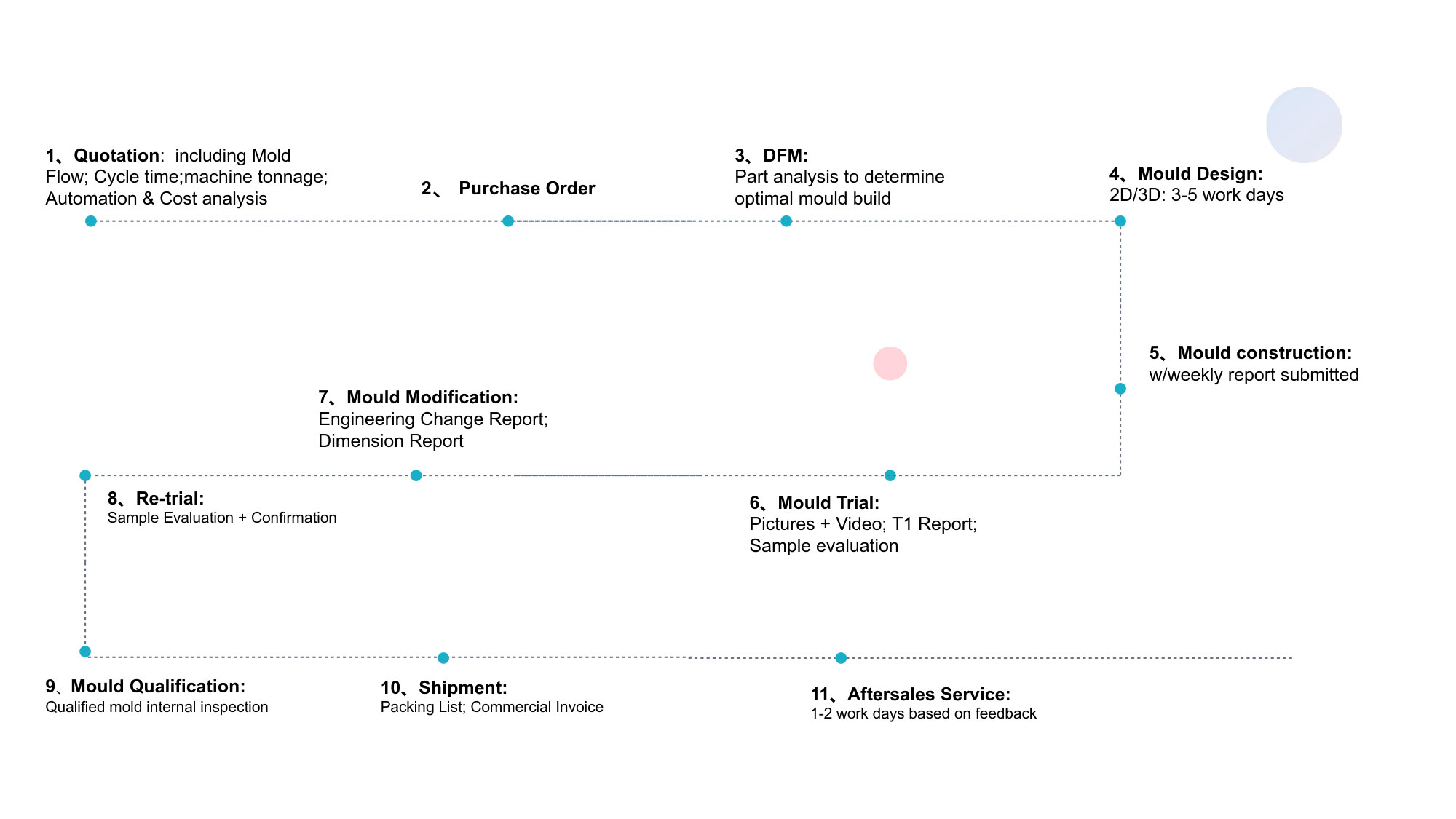
Every mold undergoes a structured trial and validation protocol:
T0 (First Mold Trial): Basic functionality verification—mold opening/closing, ejection action integrity, and initial sample production
T1 (First Adjustment Trial): Problem resolution from T0, focus approaching production-ready quality
T2–T3 (Refinement Trials): Fine-tuning of cooling, venting, and dimensional stability; rapid-change insert validation without full mold rebuild
Pre-delivery: 2,000-cycle pre-production aging test with full wear report included in delivery package
Customer value: On average, we complete the full mold validation with only two trial iterations (Industry average: 4–5 iterations). That’s weeks saved in your launch schedule and significantly lower validation costs.
Section III: Injection Molding Process Control (Eliminating Quality Anxiety)
3.1 Process Standardization and MES Integration
Customer anxiety centers on variability. Will the second batch match the first? Will next week’s parts fit?
Our solution: Machine connectivity and parameter lock-out. All 260 injection machines are networked to our MES (Manufacturing Execution System). Temperature, pressure, speed, and time parameters are locked to engineer-authorization only. Every batch undergoes first-part and last-part dimensional comparison. What this means for you: Full traceability. If a parameter changed, we know exactly when, why, and who made the change.
3.2 Dimensional Stability Control
For the Apple 18 phone case, dimensional accuracy means perfect button alignment, camera cutout precision, and flawless snap-fit assembly.
Our approach combines mold temperature zoning with real-time process monitoring. By maintaining core/cavity temperature differences within 2°C, we eliminate warpage—the most common dimensional issue in TPU molding, caused by insufficient cooling time, excessive or uneven mold temperature, and asymmetric runner systems. We also implement real-time wall thickness monitoring via ultrasonic sensors integrated into the mold, automatically compensating holding pressure based on measured thickness feedback.
Validated performance: For TPU mobile phone protective cases, Ansix Tech consistently achieves key hole spacing variation under ±0.02mm across consecutive multi-day production runs.
3.3 Appearance Grade Classification
The Apple 18 phone case demands premium aesthetics—flawless transparency, no visible flow marks, and a lustrous finish that feels premium to the touch.
Transparent/Translucent TPU: Achieved with zero bubbles, zero flow marks, ultra-low haze
High-gloss surfaces: Surface roughness Ra ≤ 0.2μm
Textured finishes: Precise control over mold surface texturing for desired tactile qualities
Print/coating compatibility: We incorporate design compensation for post-molding painting, pad printing, or coating, achieving print registration accuracy of ±0.1mm
For customers requiring silk-touch or soft-feel finishes, we work with material suppliers offering formulations specifically developed for premium tactile qualities.
3.4 Material Capability and Advanced TPU Formulations
Ansix Tech is not limited to standard TPU grades. Our 28 years of material processing experience cover the full spectrum of engineering thermoplastics: PC/ABS blends, PC, ABS, PPS with 40% glass fill, PEEK, PTFE/PFA, PA6+GF30, PBT, PEI, PPS, LCP, and liquid silicone rubber (LSR).
For Apple 18 Phone Case, our capabilities include:
Polyester-based TPU: Offers outstanding mechanical strength and abrasion resistance with good processing fluidity—preferred for premium applications. Applications include smartphone covers, safety shoe soles, sports gear, and two-color molding.
Polyether-based TPU: Provides superior hydrolysis resistance, low-temperature flexibility, and excellent flowability
High-performance aerospace TPU grades: 85 Shore A hardness with high mechanical strength and improved hydrolysis resistance
UL94 V-0 flame-retardant TPU: For applications requiring fire safety compliance
UV-resistant formulations: Sustaining 3,000+ hours UV exposure without color change—critical for clear phone cases that yellow over time
Material Sourcing Transparency: We provide full material traceability including composition analysis (polyester vs. polyether base), hardness validation, melt flow index (MFI) data reported to ASTM/ISO standards, and complete material certification with each batch.
3.5 Fire Protection and Environmental Compliance
For versions requiring fire safety certification, we offer UL94 V-0 rated TPU injection molding grades meeting FAA FAR Part 25.853(a) flammability standards. All materials comply with RoHS and REACH environmental regulations, and we maintain full documented compliance for products entering EU and North American markets.
3.6 Addressing Common TPU Defects
Based on our extensive TPU molding experience, we systematically address the most frequent process issues:
Defect Primary Causes Ansix Solution Protocol Customer Value
Sink marks High melt temp, insufficient holding, improper mold temp, asymmetrical gate Reduce melt temperature by 5–10°C sequentially; increase holding pressure/time; optimize gate position via Moldflow Zero cosmetic sink marks—premium surface every shot
Bubbles/Voids Moisture in raw material, insufficient injection pressure, excessive injection speed, low back pressure Pre-dry TPU at 90–100°C for 2–4 hours (per grade specs); increase back pressure; lower injection speed Eliminated internal voids—no structural weakening, no capricious field failures
Warpage Insufficient cooling/setting time, excessive or uneven mold temp, asymmetric runner system Balance cooling channels with zone-controlled mold temp; increase cooling time; verify runner balance via simulation Perfectly flat parts—no distortion during assembly
Flash Excessive clamping force variation, worn venting edges Real-time clamping force monitoring; self-locking clamp force compensation; implement vent depth control 0.15mm max Zero flash—eliminates manual deburring; saves $0.02–0.05 per part labor cost
Short shots Low injection pressure, insufficient material feed, blocked gate In-mold pressure sensors; automated shot size compensation; real-time cavity fill monitoring 100% fill every cycle—zero scrap from incomplete fills
Section IV: Full-Cycle Service Integration (Lowering Customer Management Costs)
4.1 Early-Stage Design Intervention (DFM Report)
The most overlooked cost reducer in injection molding: pre-production design optimization. Before any tooling steel is cut, Ansix Tech provides a comprehensive DFM (Design for Manufacturability) report.
Our DFM report for the Apple 18 Phone Case includes:
Mold feasibility analysis with detailed recommendations for draft angle adjustments
Wall thickness optimization to prevent sink marks (critical for TPU’s sink-susceptible nature)
Gate position and quantity recommendations based on Moldflow analysis
Ejector pin mark location allowances—pinning precisely where marks will be invisible to end user
Predicted shrinkage compensation values for TPU (accounting for hardness and wall thickness)
Customer value: Part designs that are optimized for production BEFORE we charge for tooling. Design changes made at this stage cost 0∗∗toimplement.Changesaftertoolingstartscost∗∗10,000–$50,000+. Ansix Tech’s DFM service has helped automotive clients save 18% per part through part consolidation and wall thickness optimization.
4.2 Rapid Quick-Change Insert Capability
For product designs requiring variation across models (different cutout configurations, logo placements, or camera layouts), we manufacture modular quick-change mold inserts. This allows model changes in under 30 minutes rather than weeks for full mold rework.
Customer value: Launch multiple Apple 18 case variants without launching multiple molds. Combine your SKUs into a single mold and reduce your tooling investment by 30–50%.
4.3 In-House Repair and Maintenance
Because we maintain in-house electrode manufacturing centers and EDM machining, mold repairs rarely leave our facility. Routine weld repairs and insert replacements are completed in under 24 hours, drastically reducing downtime.
Mold Maintenance Package:
Spare ejector pins, cores, and inserts delivered with every mold
Maintenance service performed every 200,000 cycles
Lifetime repairs available at material cost only
Customer value: Unplanned downtime is your biggest enemy when demand spikes. We keep your production line running—and we charge fairly for maintenance.
4.4 Packaging and Logistics Integration
Our supply chain management ensures on-time delivery through established long-term supplier relationships and logistics partner networks. We offer:
Custom packaging design: Tailored to protect finished parts during transit (anti-static bags, custom dividers, injection trays)
Inventory management services: Kanban systems, consignment inventory, and forecast-based production planning
Labeling and documentation: Full traceability with batch numbers, production dates, and QC documentation included with each shipment
Section V: Transparent Cost Reduction (Where Savings Materialize)
5.1 Material Cost Optimization
Raw material typically accounts for 40–60% of total injection molding costs. Our 28 years of material processing experience translate directly into lower raw material costs without compromising performance.
Specific opportunities for Apple 18 Phone Case:
Grade substitution analysis: We identify TPU grades that provide required properties (tear strength, abrasion resistance, UV stability) at lower purchase cost while maintaining UL94 rating and aesthetic requirements
Regrind integration: For non-critical structural applications, we incorporate 15–25% post-industrial regrind, reducing material costs by 10–18% per component
Hot runner implementation: Eliminate runner waste entirely—saving 15–20% of raw material consumption that would otherwise be discarded
Flow-optimized TPU grades: Certain 85A Shore hardness grades offer improved flowability, reducing injection pressure requirements and enabling thinner wall sections that directly reduce material consumption per part
Customer value: Raw material savings of 8–20% delivered directly to your purchase order price. For 5 million units annually, that’s 40,000–100,000+ saved per year.
5.2 Cycle Time Reduction
Cycle time has a direct linear relationship with manufacturing cost and energy consumption. Each second of cycle time reduction multiplies across millions of parts.
Ansix Tech cycle optimization strategies:
Cooling time reduction: Conformal cooling inserts reduce cooling time by 56% and total cycle time by 15% compared to conventional designs
SMED (Single-Minute Exchange of Die) implementation: Lean Six Sigma and SMED methods reduce mold changeover time by up to 65%, improving Process Cycle Efficiency from 27.5% to 72.5%
Process parameter optimization via intelligent systems: Real-time viscosity monitoring and shot volume adjustments stabilize quality while reducing scrap
Ultrasonic sensor feedback loops: Ultrasonic thickness measurement enables automatic clamping force and holding pressure compensation, maintaining tight tolerances while minimizing over-cycling
Customer value: A 15% cycle time reduction on a 30-second baseline improves daily output from 2,880 parts/machine to 3,307 parts/machine. Over 52 weeks of production, this is 1.5X the annual throughput from the same manufacturing footprint.
5.3 Energy Consumption Reduction
Injection molding consumes significant electrical power through barrel heating, hydraulic systems (for conventional machines), mold temperature control units, and auxiliary equipment. Our electrically driven all-servo machines use only the energy required for each specific movement—no constant hydraulic pump operation.
Measurable impact: Energy consumption reduction of 30–50% compared to conventional hydraulic machines, with further reductions through optimized process parameters that minimize heating cycles. Lower energy costs reduce manufacturing overhead—savings passed directly to customers through lower per-unit pricing.
5.4 Tooling Cost Efficiency
We build molds designed for the right lifecycle, not unnecessarily over-engineered tools that add cost without benefit.
Cost-Saving Strategy Method Customer Savings
Multi-cavity optimization 4–8 cavity molds reduce per-part contribution to tooling amortization 50–75% lower tooling cost per part
Insert-based variation Single base mold with interchangeable core/cavity inserts 30–50% lower total tooling cost across model variants
Material-matched steel selection Match steel grade to expected shot count (no over-specification) 15–25% lower initial tooling investment
In-house manufacturing No outsourcing markups for electrodes, inserts, or repair work 10–15% lower customer invoice
Customer value: Pay only for the tooling performance you need. Longer tool life for high-volume flagship models; lower-cost tooling for short-run limited editions.
5.5 Waste Reduction and Scrap Minimization
Every rejected part is direct profit subtracted from your bottom line. Our three-tier approach to scrap reduction:
Prevent defects before they start: DFM analysis + Moldflow simulation = problems identified at design stage
Real-time defect detection: In-mold pressure/temperature sensors detect process deviations as they happen, automatically rejecting suspect parts before packaging
Process capability-driven production: CPK≥1.33 ensures the process is statistically capable and stable
Customer value: Scrap rates consistently below 2% for TPU molding—industry average is 5–8%. For 5 million units annually, that’s 150,000–300,000 fewer scrapped parts per year, representing
50,000–100,000+ in materials and labor that never leaves your account.
5.6 Lean Manufacturing Integration
Our lean manufacturing methodology combines Value Stream Mapping, time-and-motion assessments, and statistical techniques to locate production flow restrictions and implement targeted corrective actions. Internal activities are shifted to external wherever possible, drastically reducing mold changeover downtime.
Customer value: Greater agility in responding to demand fluctuations. When your product demand spikes, our rapid changeover times mean we can switch production lines in minutes, not hours, capturing revenue opportunities others miss.
Section VI: Quality Validation and Assurance Framework
6.1 Process Validation Lifecycle
Quality is not an inspection step—it is an engineered outcome. Ansix Tech conducts structured process validation at every stage:
Equipment Qualification (EQ): All injection molding machines and auxiliary equipment undergo documented verification of capability before production use.
Process Qualification (PQ): Simulated production conditions prove that the mold, process, and established methods can consistently produce acceptable product meeting all print dimensions and success criteria.
Process Capability (CPK) Analysis: CPK is statistically evaluated on all critical dimensions at established high and low process limits. For the Apple 18 Phone Case, critical dimensions are evaluated across 300-piece sampling windows at the beginning, middle, and end of each production day.
Revalidation Criteria: If CPK falls below 1.33 when analyzing production data, automatic revalidation with full root cause analysis is triggered. For premium programs requiring CPK ≥ 1.67, we validate via consistent 2-hour sampling and archive first/last production samples for full traceability.
6.2 In-Process Monitoring and Closed-Loop Control
Customer trust depends on knowing that every part meets specification—not just the inspection samples. Our closed-loop control systems provide:
Real-time process parameter monitoring with automated alerts when parameters drift outside defined control limits
In-mold pressure/temperature sensors providing feedback to the injection unit for automatic compensation
Automated part inspection using vision systems at the point of ejection
Traceability systems recording every shot’s critical process parameters to the individual part level
6.3 Supplier Material Qualification
For the Apple 18 Phone Case, raw material is qualified before production:
Material certification, composition analysis, and MFI data verified against specification
Pre-production material validation: Pilot run of 500 parts using each new material batch; full dimensional and functional testing before batch acceptance
Ongoing material monitoring: Statistical tracking of MFI, moisture content, and color consistency across all incoming batches
6.4 Final Inspection and Documentation
Every shipment is accompanied by:
Dimensional inspection report (first article inspection—FAI—standard)
Material certification for each batch
Process parameter log for the production run
High-resolution photos of molded parts for visual reference
For customers requiring remote oversight, we offer live video inspection and real-time production data streaming during your designated audit windows.
Section VII: Ansix Tech’s Core Industry Experience and Customer Value Proposition
7.1 Our Story—28 Years in the Making
*Established 1998 in Hong Kong | 4 global manufacturing bases | 260 injection molding machines | 200+ designers | 30,000+ molds built*
Since our founding, Ansix Tech has built a diversified customer base across automotive products, medical devices and personal care products, mobile and wearable devices, consumer electronics, commercial communications equipment, smart home products, atomization products, and packaging products. This experience breeding ground means we bring cross-industry best practices to every customer solution.
Our corporate mission: “Make Our Customers Successful.”
7.2 Integrated Ecosystem Advantage
Ansix Tech’s core advantage lies in its holistic approach to injection molding. Unlike fragmented service providers, we offer a unified platform for design, engineering, tooling, production, and logistics. This integration eliminates communication gaps, accelerates project timelines, and ensures consistency from concept to delivery.
One provider, one invoice, one throat to choke—and we take full ownership of the outcome.
7.3 Case Example: Cost Reduction in Practice
Automotive case study: A client producing automotive components saved 18% per part through Ansix Tech’s DFM-guided redesign, which consolidated multiple parts into a single moldable geometry, eliminated fasteners, and optimized wall thickness.
Smartphone case application: For a fast-growing consumer electronics brand, Ansix Tech implemented conformal cooling channels that reduced cycle time from 21 seconds to 18.5 seconds—an 11.9% reduction that lowered per-unit production costs by 0.008perpart.Over6millionunits,thissingleimprovementgenerated∗∗48,000 of incremental annual savings** without any tooling redesign cost.
7.4 Risk Mitigation Summary
Customer Risk Ansix Tech Mitigation Impact on Customer
Mold doesn’t last—frequent repairs interrupt production 1M+ shot capability backed by material certificates; 2,000-cycle aging test before delivery No unplanned downtime;生产计划无意外中断
Dimensions drift mid-production—assembly problems MES parameter lock-out; ±0.1% repeatability; ultrasonic thickness monitoring Every part fits every time;每次装配如同第一件
Scrapped parts from inconsistent quality CPK≥1.33 across critical dimensions; continuous SPC monitoring Scrap <2%—industry standard 5–8%;废品率低于行业均值2/3
Long mold repairs—weeks of lost capacity In-house EDM/electrode shop; 24-hour emergency repair Back in production tomorrow,恢复生产不用等
Design changes cause huge rework expense Comprehensive DFM report BEFORE steel cut; quick-change insert design Design flexibility without budget blowout,改模不伤预算
Final Thoughts: A Partnership Built on Technical Excellence and Mutual Success
For Ansix Tech, a mold is not a block of steel—it is a revenue generator. We design tooling with a singular focus: making your production line hum with zero friction, minimal waste, and maximum reliability.
When you partner with Ansix Tech for the Apple 18 Phone Case—TPU Molding project, you receive:
A DFM report that identifies and resolves potential molding risks before any steel is cut
A mold engineered for production robustness—balanced cooling, optimized gates, strategic vents, precision ejection
Production support from a team that has molded TPU phone cases for customers around the world for over 28 years
A cost structure built on real material expertise, cycle time optimization, and lean manufacturing
Quality validation documented with CPK metrics you can audit—not a single part shipped without traceable proof of specification attainment
Your invitation: Experience the difference. We offer to conduct a full DFM report walk-through using one of your current or previous products. You will see, firsthand, how Ansix Tech identifies and prevents weld lines, entrapped air risks, sink marks, and warpage before they ever reach your production floor.
Ansix Tech adheres to the principle: “Take marketing as the guide, survival by quality, development by technology, growth by service, win-win as the goal.”
We look forward to making your Apple 18 Phone Case project successful.
*Ansix Tech Limited | +86 15818692114 | info@ansixtech.com*
Four production bases: Shenzhen, Dongguan, Hunan (China) | Vietnam
*Over 200,000 sq. meters | 1,200+ employees | 260 injection molding machines | 30,000+ molds delivered*
Certifications: ISO 9001, ISO 13485, IATF 16949, ISO 14001, BSCI | ISO Class 8 Cleanroom | GMP | FDA 510K compliant
*Built on 28 years of injection molding excellence—data-driven, customer-obsessed, performance-verified.*
© 2026 Ansix Tech Limited. All specifications subject to customer-specific validation.
Ansix Tech Co Ltd
If you have any plans related to Apple 18 Phone Case — TPU Molding , you can contact us at any time. We will turn your ideas into reality, let you realize your dreams, and obtain large orders from the market. Our contact information is info@ansixtech.com. Or contact our CTO, mail: stephen@ansixtech.com
#www.ansixtech.com #ansixtech.com #Apple 18 Phone Case — TPU Molding #Apple 18 Phone Case — TPU Molding moulds #Apple 18 Phone Case — TPU Molding injection molding companies #Apple 18 Phone Case — TPU Molding Canopy Mold injection mold companies #Ansix #Ansix moulds #Ansix china #Ansix tech china #Ansix tech company #Ansix facotry #Apple 18 Phone Case — TPU Molding injection molding #Apple 18 Phone Case — TPU Molding injection tools #Apple 18 Phone Case — TPU Molding injection moulds #Apple 18 Phone Case — TPU Molding plastic mould #Apple 18 Phone Case — TPU Molding plastic tools #Ansix Tech #Ansix molds #Ansix injection molding #Ansix mold factory #injection molding Apple 18 Phone Case — TPU Molding #Ansix mold factory #Apple 18 Phone Case — TPU Molding china #Apple 18 Phone Case — TPU Molding molds #injection factory #Apple 18 Phone Case — TPU Molding injection molding #Apple 18 Phone Case — TPU Molding injection molding factory #injection molding company #Apple 18 Phone Case — TPU Molding injection mold companies #Apple 18 Phone Case — TPU Molding#Apple 18 Phone Case — TPU Molding mold limited #Ansix mold china #Ansix companies #Ansix company China #Apple 18 Phone Case — TPU Molding facotry #Ansix Tech #Ansix Tech mould #Apple 18 Phone Case — TPU Molding injection moulding #injection moulding company #Ansix Apple 18 Phone Case — TPU Molding parts injection mold companies #medical injection molding companieschina #Apple 18 Phone Case — TPU Molding china factory #Ansix moulding companies #Ansix molding company #Apple 18 Phone Case — TPU Molding injection moulding facotry #Ansix Tech mold #Apple 18 Phone Case — TPU Molding mould #Apple 18 Phone Case — TPU Molding plastic injection molding #ansix plastic mold #Mold manufacturing #Apple 18 Phone Case — TPU Molding parts manufacturing #Apple 18 Phone Case — TPU Molding plastic parts factory #Apple 18 Phone Case — TPU Molding injection parts mold #Apple 18 Phone Case — TPU Molding PRECISION MANUFACTURING #Apple 18 Phone Case — TPU Molding #China mold #Apple 18 Phone Case — TPU Molding injection moulding china #Apple 18 Phone Case — TPU Molding mould china #china precision mold #mold in china #Apple 18 Phone Case — TPU Molding mold china #Precision molds #High-precision molds #Apple 18 Phone Case — TPU Molding #Injection molds #Apple 18 Phone Case — TPU Molding Factory #Apple 18 Phone Case — TPU Molding Company #Super Large Injection Mold Factory #Large Tonnage Injection Molding Factory #Apple 18 Phone Case — TPU Molding Company #Apple 18 Phone Case — TPU Molding Factory #2800T Injection Molding Factory #3000 Ton Injection Molding #4500 Ton Injection Molding Factory #Large Mold Injection Molding #Large Plastic Mold Injection Molding Factory #Large Injection Mold Manufacturer #Plastic Mold Factory #Injection Mold #Plastic Mold