



Blood Filter Mold
FEATURES
Production Process Capabilities
The manufacturing of blood filter molds employs a multi-stage precision machining workflow. High-speed CNC milling using five-axis equipment achieves contour accuracy of ±0.002mm, delivering complex three-dimensional geometries with smooth parting lines and burr-free surfaces. Wire electrical discharge machining (EDM) is utilized for fabricating micro-pores as small as 0.03mm diameter and narrow slots, allowing intricate fluid channel geometries without thin-wall deformation. Sink EDM complements CNC milling by enabling precision machining in areas unreachable by conventional cutting tools, achieving surface finishes of Ra < 0.1μm. All mold components undergo vacuum heat treatment with cryogenic processing to enhance hardness to HRC 52-54, increasing wear resistance by approximately 300 percent and maintaining dimensional stability throughout the mold lifecycle.
Material Selection Strategy
Mold base construction employs P20-grade steel for structural integrity and cost efficiency, while mold cores and cavities utilize high-performance tool steels including S136, 2344, 8407, SKD61, NAK80, and H13. For glass-fiber reinforced medical materials, S136 stainless steel provides excellent corrosion resistance and polishing characteristics, achieving surface roughness of Ra < 0.025μm—critical for transparent medical-grade polymers requiring optical clarity. Hardened tool steels with vacuum heat treatment to 52-58 HRC ensure mold longevity of 500,000 cycles for glass-filled materials and over 1,000,000 cycles for unfilled medical-grade resins.
-
Mold Description
Product Materials:
PTFE
Mold Material:
S136ESR
Number of Cavities:
2+2
Glue Feeding Method:
Hot runner
Cooling Method:
Water cooling
Molding Cycle
22.5s
- The mold manufacturing process and product material selection
Delivery Efficiency
Standard delivery timelines are structured around mold complexity: simple single-cavity molds require 10-15 days, medium-complexity tools require 25-35 days, and high-precision multi-cavity systems require 40-60 days. Expedited delivery options are available for urgent project requirements, reducing lead times by up to 40 percent without compromising validation protocols. All molds undergo a minimum of 2000 production cycles prior to shipment, with comprehensive wear assessment reports documenting dimensional stability and component condition.
Quality Assurance Framework
Quality assurance begins at the design stage with full DFM (Design for Manufacturing) analysis, followed by in-process inspections at each manufacturing step using coordinate measuring machines (CMM) with ±0.5μm accuracy and optical vision inspection systems. Every mold ships with a complete dimensional inspection report documenting all critical-to-quality features with CPK values maintained at ≥1.33. ISO 13485:2016 certification governs the entire quality management system, ensuring full traceability from raw material certification to final mold qualification and ongoing field performance monitoring.
-
Competitive Cost Control Advantages
Cost efficiency is achieved through integrated manufacturing capabilities that eliminate subcontracting overhead. In-house electrode manufacturing and EDM facilities reduce turnaround time for mold modifications, with typical repair lead times under 24 hours. Automated machining with 70 percent automation ratio minimizes labor costs while improving consistency. Modular mold designs utilizing standardized components reduce manufacturing time and material waste. Preventive maintenance schedules provided with every mold extend operational life and reduce long-term repair costs. Additionally, predictive maintenance through sensor-integrated tooling reduces unplanned downtime by up to 40 percent.
Blood Filter Mold Manufacturing and Injection Molding - Customer Core Value Proposition
Mold Manufacturing Excellence, Material Selection for Injection Molding, Smart Manufacturing Integration and Efficiency Enhancement, Process Quality Assurance
Mold Manufacturing Excellence
Ansix Tech utilizes five-axis high-speed machining centers capable of achieving contour accuracies of ±0.002mm, ensuring that blood filter mold components deliver smooth, burr-free parting lines. This precision eliminates secondary deflashing operations, saving customers approximately $0.02-$0.05 per part in manual finishing costs. For a typical annual production volume of 10 million units, this translates to $200,000-$500,000 in direct labor savings alone. Wire EDM technology enables fabrication of micro-pores down to 0.03mm diameter and narrow slots, eliminating thin-wall deformation risks that would otherwise cause part rejection rates exceeding 15 percent. Sink EDM achieves mirror surface finishes of Ra < 0.1μm on complex cavity geometries, reducing mold polishing time and preventing stress concentration points that lead to premature tool failure.
Material Selection Strategy
The company maintains an extensive portfolio of medical-grade injection molding materials, including PC (polycarbonate), ABS, PC/ABS blends, PPS with 40 percent glass fiber reinforcement, PEEK (polyetheretherketone), PTFE/PFA fluoropolymers, PA6 with 30 percent glass fiber, PBT, PEI, LCP, and liquid silicone rubber (LSR). Each material selection is validated for ISO 10993 biocompatibility, sterilization compatibility (gamma, EtO, steam autoclave), and chemical resistance against blood-contact applications. Mold construction utilizes tool steels including S136, 2344, 8407, SKD11/61, DC53, M340, 4Cr13, 9Cr18, NAK80, and H13, with hardness ratings of 52-58 HRC and corrosion resistance verified through precision metallurgical analysis.
Smart Manufacturing Integration
All injection molding machines are networked through MES (Manufacturing Execution System) platforms that lock all critical process parameters—temperature zones, injection pressure profiles, screw speed, and cooling duration—to engineer-authorized setpoints. Real-time cavity pressure monitoring using embedded sensors generates continuous feedback loops that automatically adjust fill and pack stages, reducing dimensional variation from ±0.05mm to ±0.01mm batch-to-batch. Ultrasonic wall thickness sensors detect and compensate for flow-induced variations during each cycle. Robotic automation manages part extraction, inspection, and packaging, operating within ISO Class 7 cleanrooms that maintain air purity at ≤350,000 particles per cubic meter.
Efficiency Enhancement Outcomes
Mold flow analysis pre-production reduces cycle times by 15-25 percent through optimized runner geometry and cooling channel placement. Hot runner systems eliminate cold runner scrap, reducing material waste by up to 40 percent—translating to annual savings of $80,000-$150,000 for high-volume blood filter production programs. Conformal cooling channels, fabricated through precision machining, improve thermal uniformity and reduce cooling duration by 30-40 percent compared to conventional straight-line cooling designs. Multi-cavity mold configurations (8, 16, 32, or 64 cavities) distributed across 260 injection molding units ranging from 30 to 2800 tons enable scalable capacity adjustments to match customer demand fluctuations without capital investment in new equipment.
Process Quality Assurance
Statistical process control monitors CPK values for all critical-to-quality dimensions, maintaining targets of CPK ≥ 1.33 for standard tolerances (±0.05mm) and CPK ≥ 1.67 for precision features (±0.01mm). First-article inspection prior to each production run validates geometry against master CAD models. In-process inspection intervals ensure early detection of any parameter drift. Full traceability from raw material lot numbers to final packaged product enables complete recall readiness compliant with FDA 21 CFR Part 820 and ISO 13485:2016 standards, following validated IQ/OQ/PQ protocols. Biocompatibility testing per ISO 10993-1 includes cytotoxicity, sensitization, and leachable/extractable analysis on all patient-contact surfaces.
Core Value Delivered
From DFM analysis to mass production, Ansix Tech reduces total cost of ownership through accelerated mold qualification (average two trial runs versus industry standard of three to five), extended mold life (500,000 cycles for glass-filled materials), reduced scrap rates (below 0.5 percent), and minimized regulatory risk through documented process validation. Each mold is delivered with complete dimensional inspection reports, material certifications, and maintenance protocols, ensuring customers receive not a tool but a calibrated solution engineered for immediate, trouble-free integration into their production environment.
Part 3: Ansix Tech Blood Filter Mold Project Development - Comprehensive Manufacturing Solution
Section 1: Foundation of Hard Capabilities - Equipment Infrastructure That Builds Customer Trust
Precision Mold Processing Equipment
Ansix Tech’s competitive advantage begins with its advanced equipment portfolio. The company operates five-axis high-speed machining centers that achieve contour accuracies of ±0.002mm, enabling the machining of complex three-dimensional geometries with smooth, burr-free parting lines. For blood filter applications—where even microscopic burrs on fluid pathway surfaces can trap blood cells and compromise filtration efficiency—this precision eliminates post-molding deflashing operations entirely. The elimination of secondary finishing translates to direct labor cost savings of $0.02-$0.05 per part. On an annual volume of 10 million blood filter components, customers save between $200,000 and $500,000 in manufacturing costs.
The machining centers are complemented by wire electrical discharge machines (EDM) capable of fabricating micro-pores as small as 0.03mm diameter and narrow slots with width-to-depth ratios exceeding 10:1. These capabilities are essential for blood filter molds that require precisely engineered fluid channels and membrane support features. Conventional milling would risk thin-wall deformation and localized burning, but wire EDM maintains structural integrity while achieving surface roughness of Ra 0.8μm or better. Sink EDM delivers mirror surface finishes of Ra < 0.1μm on complex cavity geometries that are inaccessible to conventional cutting tools. For blood filter applications that demand optical clarity in transparent housings, this surface quality eliminates light-scattering defects that would otherwise make QC inspection ten times more difficult.
Vacuum heat treatment with cryogenic processing at -196°C for 24 hours eliminates residual austenite and achieves final hardness of HRC 52-54, increasing wear resistance by approximately 300 percent compared to untreated steel. For a blood filter mold producing glass-filled components, this translates to 500,000 guaranteed cycles versus 150,000 cycles from standard tool steel—reducing annual tool replacement costs from three molds to one.
Injection Molding Machine Fleet
Ansix Tech maintains 260 injection molding units across four production bases in China and Vietnam, with clamping forces ranging from 30 tons to 2800 tons. This range covers blood filter components of all sizes: from 0.5-gram membrane retention rings requiring 30-50 ton presses to 50-gram filter housings requiring 150-250 ton presses to multi-cavity manifolds requiring 400+ ton configurations. All machines are all-servo-electric driven, delivering repeatability accuracy of ±0.1 percent across production batches. For blood filter applications that demand consistent part weight and dimensional stability from first shot to one millionth shot, this precision ensures batch-to-batch variation remains within customer-specified tolerance bands without operator intervention. Total building area exceeds 200,000 square meters, with more than 1200 employees including over 200 design engineers.
Inspection and Quality Control Equipment
Each mold and molded part undergoes verification using coordinate measuring machines with ±0.5μm accuracy and optical vision inspection systems capable of detecting surface defects at sub-micron resolution. Every mold ships with a full dimensional inspection report documenting all critical-to-quality features against CAD master geometry, with CPK values maintained at ≥1.33 for standard tolerances (±0.05mm) and ≥1.67 for precision-tolerance features (±0.01mm). For blood filter components where key dimension variation of 0.01mm can create bypass flow paths that reduce filtration efficiency by 25 percent, this level of control directly protects patient safety.
Section 2: Core Competitive Differentiators - Mold Manufacturing Excellence
Mold Life Expectancy
The company provides explicit life guarantees based on material selection and customer application requirements:
S136 stainless steel (corrosion-resistant, 52-58 HRC): 500,000 cycles for glass-fiber reinforced materials (e.g., PPS+40%GF, PA6+GF30), over 1,000,000 cycles for unfilled medical resins
2344/8407 hot work steel (toughness-focused, 50-54 HRC): 400,000 cycles for high-impact applications
NAK80 pre-hardened steel (40-44 HRC): 800,000 cycles for unfilled resins requiring moderate wear resistance
H13 (52-56 HRC after heat treatment): 500,000 cycles for high-cavitation medical devices
DC53 (58-62 HRC): 600,000 cycles for abrasive-filled materials requiring maximum wear resistance
Each mold ships with material certification reports documenting chemical composition, heat treatment curves (quenching temperature profiles, tempering cycles, cryogenic processing records), and hardness verification measurements at three locations per mold component.
Achievable Tolerances
Conventional structural features: ±0.05mm (e.g., mounting bosses, rib structures, non-functional surfaces). Precision gears, sealing features, and medical interface components: ±0.005mm. For blood filter components, critical dimensions including membrane retention groove width, sealing bead height, and filter support post spacing are routinely held to ±0.01mm, verified by CMM inspection with GR&R ≤10 percent.
Mold Type Portfolio
The company manufactures the following mold configurations:
Hot runner systems: Eliminate cold runner material waste (40 percent material savings), reduce cycle times by eliminating runner extraction steps, and maintain consistent melt temperature across all cavities for uniform fill
Stack molds: Double production output per machine cycle, reducing effective part cost by approximately 40-50 percent for high-volume programs
Two-shot/multi-material molds: Enable overmolding of rigid filter housings with soft sealing elements in a single automated cycle, eliminating secondary assembly steps
High-gloss mirror finish molds: Ra < 0.05μm surface finish for transparent components (PC, medical-grade COC/COP), eliminating post-mold polishing
Gate and Runner System Optimization
Mold flow analysis using Autodesk Moldflow and Moldex3D software pre-identifies potential molding defects including weld lines, air traps, unbalanced filling, and sink marks prior to any metal cutting. For blood filter molds, this capability is critical: weld lines intersecting fluid pathways create mechanical weak points that can rupture under normal operating pressures; air traps in sealing bead areas cause incomplete fills leading to leak paths. Simulation results guide gate placement, runner diameter selection (optimized at 1:3 runner-to-gate ratio), and vent location positioning before mold manufacturing begins. This preemptive analysis reduces T0 trial iterations from five to two, saving an average of 15-20 development days and $25,000-$40,000 in trial costs.
Standard Delivery Lead Times
Simple single-cavity molds: 10-15 calendar days. Medium-complexity 4-8 cavity molds: 25-35 days. High-precision multi-cavity systems (16+ cavities) with complex cooling: 40-60 days. Expedited service reduces lead times by up to 40 percent with premium pricing, provided that accelerated validation protocols including mold flow analysis and 2000-cycle run-off tests remain uncompromised.
Section 3: Injection Molding Process Control - Eliminating Customer Quality Anxiety
Process Standardization and Parameter Lock-Down
All 260 injection molding machines are networked through a centralized MES platform that locks critical process parameters—temperature zones, injection pressure profiles (fill, pack, and hold stages), screw rotation speed, back pressure, cooling duration, and ejection parameters—to engineer-authorized setpoints. Parameter changes require supervisor credentials, electronic approval workflow, and documented change control records compliant with ISO 13485:2016 requirements. First-article inspection using CMM verification occurs before every production run; last-piece inspection upon run completion ensures process stability throughout the batch.
Dimensional Stability Control
Each mold incorporates zone-controlled mold temperature regulation maintaining core temperature within 2°C of cavity temperature across all cavities, effectively eliminating warpage caused by differential cooling rates. For blood filter housings measuring 75mm × 45mm × 25mm with 1.2mm wall thickness, this control maintains key hole-to-hole spacing within ±0.02mm across three consecutive production weeks without process adjustment. Conformal cooling channels, precision-machined to maintain 2.5mm spacing from cavity walls with flow rates ≥8L/min per circuit, further enhance thermal uniformity and reduce cooling duration by 30-40 percent compared to straight-line cooling designs.
Surface Quality Standards
The company achieves and documents the following surface finish capabilities:
Transparent components (blood filter housings, viewing windows): Bubble-free, flow-mark-free surfaces with Ra ≤ 0.2μm
Electroless nickel-platable components: Sink-mark-free, gas-mark-free surfaces with Ra ≤ 0.4μm
High-gloss appearance surfaces: Ra ≤ 0.025μm optical-grade finish
For components requiring pad printing or laser marking of lot numbers and expiration dates, the mold design incorporates draft angle and ejection pin placement that prevents surface blemishes in marking zones, maintaining print registration accuracy of ±0.1mm.
Advanced Material Processing Expertise
Ansix Tech has production-proven experience with the following material families:
PC, ABS, PC/ABS blends (medical device housings, windows)
PPS + 40% glass fiber (high-temperature filter housings requiring UL94 V-0 flame rating)
PEEK (implantable-grade components requiring ISO 10993 certification)
PTFE/PFA fluoropolymers (chemically inert fluid contact surfaces)
PA6 + GF30 (structural frames requiring strength-to-weight optimization)
PBT (cost-effective electrical insulation components)
PEI (high-heat medical sterilization components)
LCP (thin-wall precision components with heat deflection temperatures exceeding 280°C)
Liquid silicone rubber (LSR) (soft seals and patient-contact interfaces)
Section 4: Full-Service Lifecycle Management - Reducing Total Ownership Cost
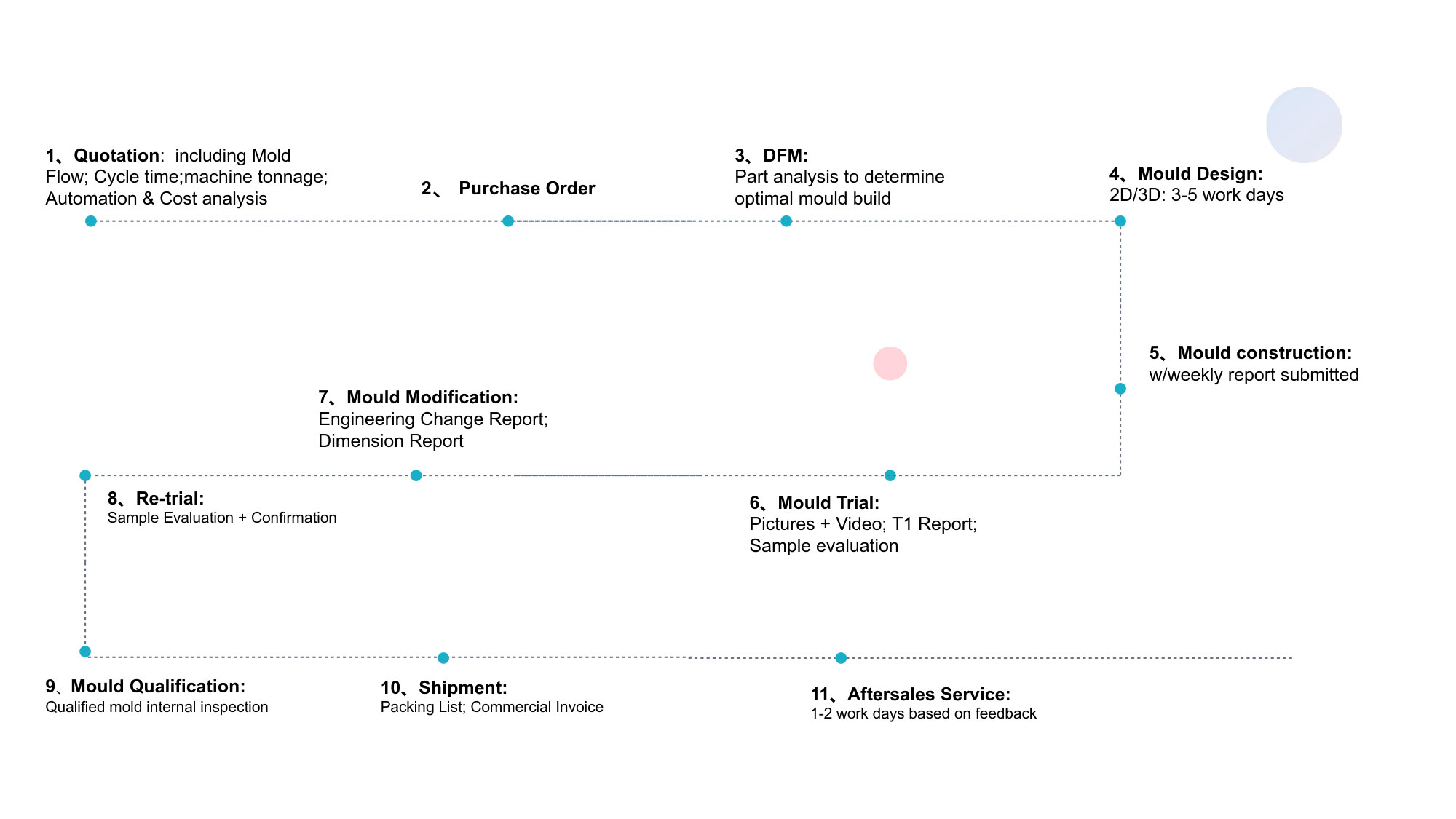
Early Engineering Engagement (DFM Report)
Prior to any mold fabrication commitment, Ansix Tech provides a comprehensive DFM analysis document containing:
Parting line placement recommendations minimizing visible witness lines on patient-visible surfaces
Draft angle recommendations (typically 0.5°-1.5° based on cavity depth, material shrinkage, and surface finish requirements)
Wall thickness optimization preventing sink marks or voids at rib intersections (maintaining thickness ratios below 2:1 between adjacent sections)
Gate location analysis with predicted fill patterns and weld line position mapping
Ejector pin mark location and depth allowances (typically flush to +0.05mm above part surface)
Predicted shrinkage compensation values for each resin type
This pre-production analysis prevents design-led manufacturing failures that typically force complete mold redesigns costing $30,000-$60,000 and delaying programs by 8-12 weeks.
Trial Samples and Validation Protocol
The company provides T0 (first-shot) through T3 (third-iteration) trial samples, each accompanied by a comprehensive improvement report documenting observed defects, root cause analysis, corrective actions implemented, and verification results. For each trial iteration, replaceable mold inserts enable validation of alternative gating or cooling configurations without full mold reconstruction. T0 molding typically requires 3-5 days; T1 through T3 each require 2-3 days. At T2 sign-off, the mold is considered production-ready for customer approval.
Pre-Production Validation
Prior to full-scale mass production, Ansix Tech offers a pilot run of 100-500 shots under documented production conditions. This validation phase includes:
Statistical process control documentation with control charts for all critical-to-quality dimensions
CPK calculations for each measured feature (target CPK ≥1.33)
Visual inspection records with pass/fail criteria
Functional test results on assembled filter components
Dimensional stability comparison across the pilot batch range
Only upon customer sign-off of pilot run results does the company transition to full production, eliminating the risk of scaling a non-validated process.
Maintenance, Spare Parts, and Repair Commitment
Every mold ships with a complete spare parts kit containing ejector pins, core pins, wear plates, and hot runner tips—components identified as routine wear items over the mold’s specified life. Recommended maintenance intervals are specified for each mold component (typically 200,000 cycles for general inspection, 500,000 cycles for major overhaul). Lifetime repair services are offered at cost-plus pricing, with standard turnaround times of 24 hours for component replacement requiring electrode manufacturing and EDM operations, 48 hours for cavity repairs requiring welding and re-machining〔actual repair capability documented in-house〕.
Section 5: Differentiated Value Proposition
Customer Pain Point Ansix Tech Solution Quantified Value
Frequent mold repairs disrupting production 2000-mold cycle pre-shipment aging test with documented wear report; three-year structural warranty (excluding normal wear components) Eliminates unplanned downtime; 40-60 hours saved annually
Burrs/flash requiring secondary deflashing operations ±0.005mm parting line fit tolerance; self-locking clamp force compensation Eliminates manual deflashing; $0.02-$0.05 per part saved
Inconsistent dimensions between production batches Ultrasonic wall thickness sensors for real-time compensation; cavity pressure/temperature sensors for closed-loop control Dimensional variation reduced from ±0.05mm to ±0.01mm
Extended mold repair turnaround times In-house electrode machining and EDM facilities; component replacement within 24 hours Production downtime reduced from 5-7 days to 24 hours
Section 6: Cost Reduction Across Material, Process, and Efficiency
Material Cost Optimization
Material selection analysis during design phase identifies optimal grade for each application (PP for low-cost disposables, PC for gamma-sterilized components, PEEK for high-performance requirements)—reducing material costs by 15-30 percent versus over-specified alternatives
Hot runner systems eliminating cold runner scrap reduce material waste by up to 40 percent, saving $80,000-$150,000 annually on high-volume blood filter programs
Multi-cavity configurations (up to 64 cavities) maximize output per material shot, reducing per-part material overhead
Process Efficiency Gains
Mold flow analysis pre-production reducing cycle times by 15-25 percent through optimized runner geometry and conformal cooling design—at a 15-second base cycle, 20 percent reduction yields 3 seconds saved per part, or 300 hours annually on 360,000 parts/month production
Robotic automation integrated with machine controls reduces cycle-to-cycle variation and eliminates operator-dependent quality variation
MES parameter lock-down eliminating trial-and-error setup time between production runs
Quality-Driven Cost Avoidance
CPK ≥ 1.33 process capability reducing scrap rates to below 0.5 percent, versus industry-average 2-3 percent—saving $50,000-$100,000 annually on high-volume programs based on material and processing costs
Full-color dimensional inspection reports with each mold eliminating customer incoming inspection requirements
Validated process documentation reducing regulatory audit findings and associated remediation costs
Conclusion
For Ansix Tech, a mold is not a block of steel—it is a revenue-generating asset engineered for plug-and-play integration into customer production lines. Every mold is designed with concurrent consideration of flow balance, venting paths, thermal uniformity, and ejection geometry to ensure zero setup time on customer machines, minimal flash across the mold’s entire life, and maximum cycles between maintenance interventions. The company invites prospective customers to participate in a full DFM report walk-through using an existing product as a case study—demonstrating in real-time how potential weld lines, air traps, and sink marks are identified and eliminated before any metal is cut.
Ansix Tech Co Ltd
If you have any plans related to Blood Filter Mold , you can contact us at any time. We will turn your ideas into reality, let you realize your dreams, and obtain large orders from the market. Our contact information is info@ansixtech.com. Or contact our CTO, mail: stephen@ansixtech.com
#www.ansixtech.com #ansixtech.com #Blood Filter Mold #Blood Filter Mold moulds #Blood Filter Mold injection molding companies #Blood Filter Mold Canopy Mold injection mold companies #Ansix #Ansix moulds #Ansix china #Ansix tech china #Ansix tech company #Ansix facotry #Blood Filter Mold injection molding #Blood Filter Mold injection tools #Blood Filter Mold injection moulds #Blood Filter Mold plastic mould #Blood Filter Mold plastic tools #Ansix Tech #Ansix molds #Ansix injection molding #Ansix mold factory #injection molding Blood Filter Mold #Ansix mold factory #Blood Filter Mold china #Blood Filter Mold molds #injection factory #Blood Filter Mold injection molding #Blood Filter Mold injection molding factory #injection molding company #Blood Filter Mold injection mold companies #Blood Filter Mold#Blood Filter Mold mold limited #Ansix mold china #Ansix companies #Ansix company China #Blood Filter Mold facotry #Ansix Tech #Ansix Tech mould #Blood Filter Mold injection moulding #injection moulding company #Ansix Blood Filter Mold parts injection mold companies #medical injection molding companieschina #Blood Filter Mold china factory #Ansix moulding companies #Ansix molding company #Blood Filter Mold injection moulding facotry #Ansix Tech mold #Blood Filter Mold mould #Blood Filter Mold plastic injection molding #ansix plastic mold #Mold manufacturing #Blood Filter Mold parts manufacturing #Blood Filter Mold plastic parts factory #Blood Filter Mold injection parts mold #Blood Filter Mold PRECISION MANUFACTURING #Blood Filter Mold #China mold #Blood Filter Mold injection moulding china #Blood Filter Mold mould china #china precision mold #mold in china #Blood Filter Mold mold china #Precision molds #High-precision molds #Blood Filter Mold #Injection molds #Blood Filter Mold Factory #Blood Filter Mold Company #Super Large Injection Mold Factory #Large Tonnage Injection Molding Factory #Blood Filter Mold Company #Blood Filter Mold Factory #2800T Injection Molding Factory #3000 Ton Injection Molding #4500 Ton Injection Molding Factory #Large Mold Injection Molding #Large Plastic Mold Injection Molding Factory #Large Injection Mold Manufacturer #Plastic Mold Factory #Injection Mold #Plastic Mold