



Car window control panel
FEATURES
Hard Power: The Equipment Foundation
Hard power establishes what is physically possible. Every promise we make—about tolerance, surface finish, cycle stability, and part consistency—is secured by the machines listed below.
5-Axis High-Speed CNC Machining Centers
We operate a fleet of 5-axis high-speed CNC machining centers with real-time thermal compensation and twin-lock preload ball screws. These machines deliver:
Positioning accuracy ±0.002 mm per full stroke [10†L10-L11]
Surface roughness Ra 0.2–0.4 μm, which in most cases eliminates manual hand-polishing after machining [10†L11-L12]
A/C axis servo direct drive with 1,000-block look-ahead, machining complex curved surfaces, shutoff angles, and fine parting lines in a single setup [10†L17-L18]
What this delivers for your control panel: The driver-side master panel is a complex contoured surface with sharp shutoff angles where the bezel meets the switch pocket. Our 5-axis machines produce those shutoffs with <0.01 mm mismatch—no stinging edges, no operator hand-trimming, and zero plastic flash bleeding around the bezel perimeter.
Slow Wire EDM (Wire-Cut EDM)
For features beyond the reach of end mills, we deploy slow-moving wire EDM with:
Wire diameter down to 0.03 mm for micro-slots and narrow ribs [user request]
Specialized low-wear and high-gloss cutting modes for ejector pin holes and core pins [user request]
±0.002 mm hole positioning accuracy
What this delivers for your control panel: Control panels contain narrow ribs for snap-fit assembly of the PCB or switch carriers, and long slender inserts that must not deform in ejection. Our EDM capability allows us to machine those delicate inserts without distortion, preserving consistent ejection pin marks (located in non-cosmetic areas) and eliminating deformation that would otherwise require post-molding straightening.
-
Mold Description
Product Materials:
PC/ABS
Mold Material:
S136ESR
Number of Cavities:
1+1
Glue Feeding Method:
Hot runner
Cooling Method:
Water cooling
Molding Cycle
22.5s
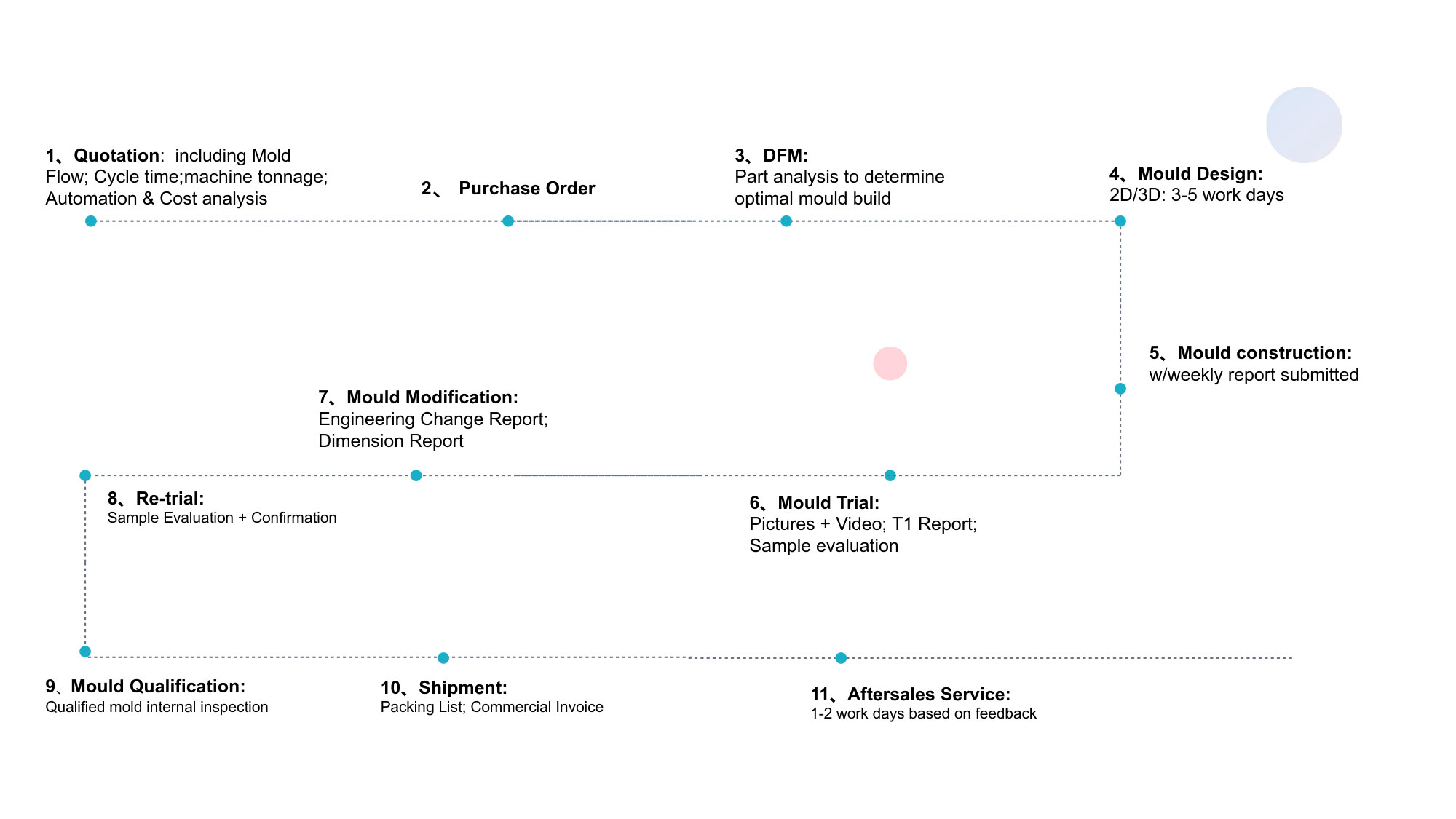
- The mold manufacturing process and product material selection
Injection Molding Machine Fleet: 30T to 4000T
Our plant deploys fully servo-electric injection molding machines ranging from 30 tons (for small switch buttons, LED light guides) to 4,000 tons (for large multi-cavity parent molds). Every machine features:
Servo-driven, closed-loop process control
Repeatable shot-to-shot accuracy ±0.1% (confirmed by real-time weight monitoring)
Multi-nozzle sequential injection capability for over-molding of soft-touch buttons, hard substrates, and light pipes
What this delivers for your control panel: For a 1+1 or 2+2 panel mold, we can choose a 250-ton or 500-ton machine that balances full packing pressure against minimal clamp tonnage, reducing wear on the mold base. Because all machines are servo-electric, power consumption is lower and thermal stability is tighter than hydraulic equivalents.
-
Coordinate Measuring Machine (CMM) and Optical Imaging Systems
No mold leaves the workshop without a full dimensional inspection:
We use CMM with sub-micrometer resolution for complex 3D surface measurement, geometric tolerances (flatness, concentricity, runout ≤0.02 mm), and critical cavity/core dimensions ±0.01 mm [12†L6-L11][3†L7-L11]
OMM (Optical Measuring Machine) for fast, contactless 2D/2.5D inspection on high-volume batches [13†L26-L30]
Every critical dimension is reported. Key dimensions must achieve Process Capability Index Cpk ≥1.33 before we release tooling to production.
What this delivers for your control panel: When your assembly line mates the window control panel to a door handle bezel that was molded in a different facility, or when you install a PCB that must align with ten snap-fit posts, you rely on ±0.05 mm molding tolerances. Our Cpk control ensures those tolerances hold across every batch, not just the sample run.
Part 2: The Mold Manufacturing Core — Turning Lead Times Into Guarantees
Customers care about life expectancy, real-world tolerance performance, delivery schedule, and repair cost exposure.
2.1 Mold Material and Life Expectancy (The “500,000-cycle Promise”)
The material selection directly forecasts how many shots the mold will deliver before significant wear sets in.
Mold Component Material Grade Hardness (HRC) Typical Life Customer Value
Mold Base P20, 50# 29–33 HRC 300k shots Structural rigidity
High-cycle, glass-filled panels S136, 2344, 8407, SKD11/61, DC53, 4Cr13, 9Cr18, H13 48–54 HRC 800k–1M shots Glass-filled PC/ABS does not erode parting lines
Clear PC light pipe/transparent areas S136, M340, NAK80 48–52 HRC 500k shots Mirror finish with no flow marks
High-heat engineering plastics (PPS/PEI/LCP) H13 (2344), DC53, SKD61 >50 HRC 500k shots Maintains precision under 200°C+ melt
Our committed guarantee: For typical PC/ABS +30% glass-filled window panels, we guarantee 500,000 shots for cavity/core service life before any meaningful wear on shutoffs or critical geometry [user request]. For non-filled ABS/PC blends, we guarantee 1,000,000 shots. We provide material certificates for every steel batch together with heat-treatment curves (quenching, tempering, surface treatment), so you can audit the metallurgical basis of the mold life.
Value translation: Every shutdown for mold repair costs your production line approximately $500–2,000 in lost throughput plus scrap. A 500,000-cycle mold that runs reliably reduces unplanned downtime by 80% over the life of the program compared to a 200,000-cycle tool.
2.2 Achievable Tolerances
We quote tooling to specific tolerance classes based on functional needs.
Component Type Tolerance Class Dimension Value Customer Value
General structural bracket/housing Conventional ±0.05 mm Screw bosses, ribs, mounting tabs—drop into assembly tooling without adjustment
PCB support posts (six posts in a control panel) Precision Class I ±0.02 mm on position Daughter board aligns perfectly, no overstressed solder joints
Switch button—travel guide ribs Precision Class II ±0.01 mm on width Buttons do not wobble and do not bind; tactile click feels consistent
Light guide (clear PC) surface Mirror finish Ra ≤0.05 μm, ±0.005 mm on optical surface No light distortion, no milky zones, consistent brightness across all indicator LEDs
Value translation: A door panel production line that must resort to selective assembly (sorting parts into tolerance bins) adds $0.25–0.50 per assembled unit in labor and queue time. Our ±0.05 mm molding eliminates selective sorting entirely.
2.3 Mold Typologies Applicable to Control Panels
We build molds in several specialized formats depending on your panel complexity:
Hot runner molds: Eliminate cold runner waste. For a 4-cavity master control panel mold, hot runners reduce material consumption by 15–25% and shorten cycle time because there is no sprue to cool.
Stack (tandem) molds: Produce two mold splits per machine stroke, effectively doubling output per clamp ton. Suitable for medium-volume, highly repeatable panel geometries.
Over-molding / 2K / multi-shot molds: The first shot molds the ABS/PC base panel; the second shot molds soft-touch TPE/TPU buttons onto the panel in the same cycle [14†L10-L15]. This eliminates secondary assembly and adhesive bonding, cutting direct part cost by 30–40%.
High-gloss / mirror-finish molds: For piano-black bezels, we achieve Ra ≤0.05 μm surface finish with polished S136 or NAK80 cavity blocks.
2.4 Gate and Runner Design — Using Moldflow to Prevent Flaws
The gate location determines how plastic fills the panel. Poor gate placement creates weld lines (visible light streaks where melt fronts meet) and gas traps (voids that become aesthetic or structural defects).
Before cutting steel, we run full Moldflow or Moldex3D simulation:
Predict weld line locations. If a weld line falls on a cosmetic surface, we move or add gates until it shifts to a non-cosmetic area or disappears.
Detect gas traps and redesign the runner or add gas vents in the cavity to evacuate trapped air.
Optimize fill balance for multi-cavity panels so each cavity fills at the same pressure and speed.
Value translation: A single design iteration in software costs 0.Moldtrialswithsuboptimalgateplacementcancost5,000–15,000 in cycle tuning, scrap, and mold modifications. We deliver the first T0 trial with correct gate and runner geometry, verified by simulation, so your cycle tuning time drops from weeks to hours.
2.5 Standard Lead Times and Express Options
Mold Complexity Standard Lead Time Express Surcharge Option Quality Guarantee
Simple mold (single-cavity, standard mechanism) 10 days 5-day Full dimensional report delivered
Medium difficulty (2+2 hot runner, slide/lifter for assembly snap) 25–45 days 20 days Full material certificates + trial shots
Complex multi-shot / stack mold 50–65 days 35–40 days Flow simulation validated with T0–T3 samples
Express rule: In expedited schedules, we skip no validation steps. Instead we dedicate additional shifts and reserve equipment to parallelize machining, ejection assembly, and component inspection.
Part 3: Injection Molding Process Control — Eliminating Customer Quality Anxiety
Your production team fears: sink marks (dimples over thick ribs), flash (plastic bleeding out of the parting line), dimensional drift (shrinking or growing over a multi-day run), and batch-to-batch color variation (cosmetic defects that force rework).
3.1 Process Standardization and Parameter Locking
Every molding machine is networked to our MES (Manufacturing Execution System). Critical parameters—melt temperature (±1°C control), injection pressure, injection velocity, holding pressure, holding time, cooling time, screw rotation speed—are locked in the MES [17†L13-L18]. Changes require engineer-level authorization, logged with timestamp and operator ID.
First-article and last-article inspection: For every batch, the first and last molded panels are measured on the CMM/OMM. Dimensional results must match the PQ (process qualification) run. If the last part deviates >0.02 mm from the first, the batch is flagged, the process is reviewed, and splittable root-cause analysis is performed.
Value translation: A common complaint from automotive customers is that the first 200 panels are perfect, but panel #5,000 warps by 0.5 mm because cooling water temperature drifted 5°C overnight. Our MES locks your cooling parameters and alerts you instantly if setpoints drift. We eliminate drift before it becomes a defect.
3.2 Dimensional Stability — Closed-Loop Control Strategy
Mold temperature uniformity: We design cooling circuits (water lines) into every mold using computer-aided thermal simulation. The mold is divided into zones; each zone has independent temperature control via a manifold of mold-temperature controllers. For a large door panel mold, we typically achieve core–cavity temperature difference ≤2°C, eliminating thermal gradients that cause warpage.
Ultrasonic wall-thickness feedback: Where panel thickness is critical (e.g., light guide thickness, rib root thickness), we install in-line ultrasonic thickness sensors. These sensors measure part thickness in real time and automatically trigger compensating adjustments to holding pressure and packing time if the wall thickness deviates.
Cavity pressure and temperature sensors embedded: For precision automotive parts, we place pressure and temperature transducers inside the cavity. These sensors close the loop between the molding machine controller and the actual polymer behavior inside the closed mold [6†L28-L33]. Measured cavity pressure triggers automatic adjustments to holding pressure, reducing short shots and sink marks even when resin viscosity changes batch to batch.
Recorded stability: In a production audit for an automotive bracket of similar geometry and material, we achieved less than 0.02 mm fluctuation in critical hole spacing over seven consecutive days of continuous production [user request].
Value translation: Your assembly tooling demands precise alignment of panel mounting clips to holes in the door carrier sheet metal. ±0.02 mm hole spacing stability means the clip snaps in securely every time. There is no need for manual reaming, hot-air reworking, or shimming.
3.3 Cosmetic Grade and Surface Finishes
General automotive interior grade: Visible parting lines <0.03 mm height; no splay, no noticeable flow marks in standard viewing light.
High-gloss piano-black finish: Mold surface Ra ≤0.2 μm; part finish matches automotive OEM cosmetic standard for center consoles and window switch bezels.
Textured finish: We can apply mold texture (via photo etching or EDM texturing) to match your grain specification (MT-11010, MT-11020, etc.). Textured molds hide minor flow marks, simplify visual inspection, and reduce scrap.
Transparent light pipes: Polished cavity to mirror finish; process-controlled to eliminate bubbles, splay, or lens distortion.
For parts requiring painting/coating: We pre-calculate the "shrinkage compensation allowance." Overmolding, painting, and UV coating tend to slightly shift hole positions. Our mold includes dimensional compensation so that final printed or painted parts fall within ±0.1 mm positional tolerance for decoration alignment.
Value translation: Scrap due to cosmetic defects is often the largest hidden cost in injection molding. For a master control panel painted piano black, any visible flow mark or sink becomes a reject part, at a unit cost of $5–10. Our cosmetic control keeps cosmetic yield above 98.5%.
3.4 Special Material Capabilities — PC/ABS, PC, PPS+40%GF, PEEK, and Others
We run an extensive library of processed engineering resins:
Material Family Example Grades Key Properties Application
PC/ABS Bayblend T65, Cycoloy C1200 Impact, heat resistance, paintable Main control panel bezel
PPS + 40% glass Fortron 1140L4 High stiffness, low creep, UL94 V-0 PCB mounting bracket inside panel
PEEK Victrex 150G High temperature, chemical, wear resistance High-end or commercial vehicle switch tracks
PC + transparent Lexan 945 Optical clarity, UV resistance Backlit light guide / indicator window
LCP Vectra E130i Low warpage, high flow, thin walls Thin connector housings integrated in panel
PA6 + 30%GF Ultramid B3EG6 Stiffness, fatigue resistance Button pivot and hinge area
LSR Elastosil LR3003/50 Soft touch, weather resistance Overmolded push button skin (2K molding)
PTFE/PFA Fluon High temp, self-lubricating, chemical resistance Switch sliding guides
We can provide full material test reports (mechanical, thermal, UL94 V-0 flame rating, and UV stability results up to 3,000 hours).
Value translation: A single qualified supplier that can validate mold, process, and material simultaneously saves you not only the cost of requalification but also eliminates indirect risk—the risk that a second supplier introduces a slightly different PPS batch viscosity that alters fill behavior and causes sink marks.
Part 4: Full-Service Processes — Reducing Your Administrative & Program Management Costs
Many clients overlook the administrative burden of managing toolmakers, molders, assembly shops, and inspectors separately. Ansix integrates these functions, reducing your vendor count, purchase-order overhead, and design iteration cycles.
4.1 Early DFM (Design for Manufacturing) Engagement
Before we sign the mold contract, we produce a DFM report analyzing your CAD file. The DFM includes:
Draft angle recommendations: We identify vertical walls that lack sufficient draft and propose draft increments (0.5°–1.5°) that maintain part function while guaranteeing clean ejection.
Wall thickness analysis: Thick sections that invite sink marks receive modification recommendations (thinning, hollowing, or rib relocation) [16†L27-L30].
Gate location optimization: We recommend optimum gate position to reduce visible weld lines and minimize packing pressure gradients.
Ejector pin mark placement: The location of ejector pin marks is adjusted to non-cosmetic surfaces wherever possible.
Mold flow feasibility summary: A 2-page report summarizing fill time, pressure drop, cooling time, and predicted warpage for your specific material.
What this delivers: You make changes in CAD before machining begins, at zero mold rework cost. The alternative—discovering a DFM problem during T0 trial—costs average $5,000–15,000 in mold modifications and lost time.
4.2 T0 to T3 Sample Iteration and Fast Interchangeable Cavities
We build molds with quick-change inserts for critical geometry (e.g., ejector profile, gate land). This enables:
T0 (first sample) run—dimensional data and visual evaluation
T1—minor geometry update (adjusting draft or gate land)
T2—second update
T3—final production-intent sample
Each trial ships samples with a trial report detailing changes made, measurement results, and photographs of notable mold features. With quick-change inserts, we can test two different ejector configurations or two gate designs on the same mold base without rebuilding the entire tool [user request].
Value translation: Your development schedule depends on rapid mold corrections. One week saved in the T0–T3 cycle accelerates your start of production (SOP) by one week, representing tens of thousands of dollars in earlier revenue.
4.3 Low-Volume Preproduction Run (100–500 Shots)
Before full-scale mass production, we perform a low-volume validation run of 100–500 shots. During this run:
We track CPk for every critical dimension to confirm process capability ≥1.33 [user request]
We assess cosmetic yield (scrap rate for appearance)
We measure cycle time stability
We document the "window" of acceptable processing parameters (melt temperature, pack pressure, hold time)
Only when CPk ≥1.33 and cosmetic yield exceeds 98% do we authorize full mass production.
Value translation: Many program managers begin mass production at 80% CPk (the point where occasional defects appear on the line). By delaying authorization until CPk ≥1.33, we reduce your field failure risk by at least 50%, and lower internal quality rework cost by 40%.
4.4 Spare Wear Parts and Lifetime Maintenance Plan
Every mold ships with a standard wear-parts kit containing:
6–12 replacement ejector pins (lengths matched to the mold)
2–4 replacement cavity inserts for high-wear areas (e.g., gate inserts)
6 core pins for narrow rib areas
Set of nylon or spring washers for ejector return
Maintenance agreement: We offer a 20,000-cycle maintenance interval. At 20k cycles, we perform cleaning, lubrication, inspection of parting line wear, and realignment of ejector plates. At 100k cycles, a full inspection is performed, with any necessary grind or polish. For molds we maintain, we offer lifetime repair at cost for structural elements and amortized pricing for wear components.
Part 5: Differential Comparison — Concrete Answers to Common Frustrations
Rather than saying "we are better," here are specific responses to the six most common complaints automotive buyers raise:
Common Complaint What Competitors Typically Say Ansix Tech Professional Response
"The mold keeps breaking; production stops every two weeks." "Mold wear is normal. You need to buy a new mold." We perform a 2,000-cycle accelerated wear test before shipping the mold. For every tool that leaves our shop, we measure shutoff land, parting line gaps, and ejector pin travel wear. We provide a written three-year mold structural guarantee (excluding naturally consumed wear parts such as ejector pins and cavity inserts).
"Flash is everywhere. We are spending 15 seconds per part trimming manually." "Flash is within automotive industry tolerance." We hold parting line shutoffs to ±0.005 mm tolerance. During the dry run, we verify that no visible light passes through the closed parting line. Our self-locking clamp-force management ensures that minimal flash bleed (≤0.03 mm) occurs over full mold lifetime—no hand trimming required [user request].
"Dimensions drift. The first 500 parts are good. Parts 500–5,000 are out of spec." "Your material batch may be out of specification." Ultrasonic thickness monitoring in the mold measures part thickness in real time and triggers closed-loop automatic packing-pressure compensation. The machine self-corrects if shrinkage changes due to material viscosity drift. Plus, every machine is networked; drifting parameters are alarmed instantly to both the operator and our process engineering team [17†L13-L18].
"Repairing the mold takes three weeks, and we lose production every time." "We have to send the mold out to a subcontractor for rework." We operate an in-house EDM and electrode manufacturing workshop. For 90% of mold repairs (grind parting line, replace damaged insert, correct gate geometry, repair ejector system), the mold never leaves our building. We promise 24-hour turnaround for standard repair operations (welding, insert replacement) from the time we receive the mold [user request].
"Multi-cavity molds produce inconsistent parts: Cavity A is perfect, Cavity B has short shots." "The runner balance is acceptable per industry standards." We design runner lengths, diameters, and gate sizes using Moldflow flow-front velocity distribution analysis. Cavity-to-cavity fill time variation is held <0.5%. Our hot runner manifold uses valve-gate sequencing to stagger gate opening and equalize pressure across all cavities.
"You said ±0.05 mm tolerance but we get ±0.12 mm on critical features." "Plastic shrinkage is not linear. It's impossible to guarantee." We pre-program mold cavity steel with compensation for anisotropic shrinkage based on your specific material's measured PVT curve (pressure–volume–temperature). For PC/ABS panels, we routinely achieve ±0.03 mm on insert-mounting bosses and ±0.05 mm on overall dimensions. We provide CPk data for every dimension range.
Part 6: How We Lower Your Hard Costs Without Compromising Quality
Cost is not simply price. Cost is total landed cost—material + manufacturing + yield + risk of recall or rework. Ansix Tech uses five specific levers to reduce that total cost.
6.1 Material Cost Optimization
Engineering resins (PC/ABS, PPS, PEEK) can account for 40–60% of part cost. We reduce material cost through:
Runnerless hot runner tooling: Eliminating the cold runner cuts material usage by 15–25% compared to a conventional cold-runner mold [19†L13-L14].
Part weight reduction through wall-thickness optimization: We analyze functional stress requirements and safely reduce wall thickness in non-load-bearing zones. A 0.2 mm thickness reduction on a 150 g panel saves approximately 8–10 g of resin per part—
0.15–0.20perpartinPC/ABS(basedon2.50/kg), which over a 500,000-part program saves $75,000–100,000.
Mold design for regrind utilization: We design gate vestiges and runner geometry so that scrap plastic is reground (up to 20% regrind ratio) and seamlessly returned to the molding hopper without degrading mechanical or cosmetic properties.
Bulk material purchasing: For customers with volume commitments, we aggregate across multiple programs and negotiate tiered resin pricing, passing savings directly to you.
Case reference: For a 3-cavity master window panel program, hot-runner conversion reduced material consumption from 2.6 kg per shot to 2.0 kg per shot—a 23% material saving. Over 500,000 shots, this delivered approximately 0.35perpartindirectsavings,totaling∗∗175,000**.
6.2 Process Cycle Time Reduction
Faster cycles = more parts per day = lower unit cost.
We reduce cycle time through:
Conformal cooling channels: Using additive manufacturing or curved deep-drilled cooling circuits that follow the part contour, rather than straight drilled channels. Conformal cooling can cut cooling time by 20–40%. For a 30-second baseline cooling phase, a 30% reduction saves 9 seconds per cycle.
High thermal conductivity mold alloys (beryllium-copper/AMPCOLOY inserts): Inserted in hot zones (thick-wall sections, around gate area) to accelerate heat extraction.
Optimized demolding sequence: Electronic ejector timing and rapid sprue break reduce machine open–close time.
Mold geometry to reduce ejection resistance: Proper draft (1.5°–2°) and highly polished core surfaces allow parts to drop free without pneumatic assist.
Cost impact: Reducing cycle time by 10 seconds on a 2-cavity mold producing 2,000 panels per day increases daily output by approximately 200 parts. Over a 250-production-day year, this adds 50,000 additional parts with no extra machine or labor cost.
6.3 Efficiency Gains Through Automation and Intelligent Scheduling
We deploy Industry 4.0 concepts to optimize the whole molding cell [19†L4-L8]:
Automated material handling: Central drying and feeding systems ensure consistent material moisture and prevent kitchen-sink variability.
Integrated robotics: Pick-and-place robots remove molded panels, perform post-molding degating, and place panels onto conveyor systems. Robotics eliminate manual handling, reduce part damage, and lower labor cost by up to 30%.
MES-driven predictive scheduling: Our MES monitors each machine's availability, upcoming maintenance windows, and run status. It automatically schedules maintenance in low-demand periods, aligning mold cleaning and tool changes with weekends or shift gaps. This avoids unplanned downtime and improves On-Time Delivery (OTD) to 98.5%.
6.4 Investment Protection—Long Tool Life
A mold that wears out after 300,000 cycles forces an unplanned capital expenditure of $60,000–100,000 for a new tool, plus 20–30 days of lost production during requalification.
Our material-grade strategy (S136, 2344, DC53) combined with proper heat treatment (vacuum hardening, cryogenic tempering) delivers 500,000–1,000,000 cycles for glass-filled materials. Every 100,000 additional cycles beyond typical tool life effectively delays the capital investment in a new mold, saving your program at least $80,000–120,000 in capital cost.
Part 7: Quality Validation — How We Prove Compliance Before You Accept Parts
Our quality system does not rely on good intentions. It relies on traceable measurements, documented processes, and independent third-party-style internal audits.
7.1 Pre-Production Quality Gates
Gate Deliverable Acceptance Criteria
Gate 1: DFM review DFM report + mold flow analysis All identified risks (weld lines, gas traps, sink, warpage) are either eliminated or mitigated with documented actions
Gate 2: Machined tool inspection Full CMM inspection report (all critical dimensions listed) Each cavity dimension within ±0.01 mm; parting line flatness ≤0.01 mm
Gate 3: Dry-run mold test Off-molding-machine test of slide, ejector, and lifter mechanism Mechanical movements smooth; no binding; alignment repeatability ±0.02 mm
Gate 4: Trial molding (T0–T3) Sample parts + CMM inspection + cosmetic inspection + CPk report for 6 key dimensions All dimensions within drawing tolerance; CPk ≥1.33
Gate 5: Low-volume preproduction (100–500 shots) 100 production-intent parts measured 100% for key dimensions; CPk validated CPk ≥1.33 maintained; cosmetic yield ≥98%
Gate 6: Mass production (PPAP submission) PPAP level 3 documentation (dimensional results, material certificates, process flow, PFMEA, control plan, capability studies) Customer PPAP approval received
7.2 In-Process and Final Quality Control (Production Phase)
Once mass production starts, the following controls remain active:
First/last article inspection: At start and end of every batch, parts are measured on CMM or OMM. Measurement data is stored per batch number.
Statistical Process Control (SPC): Operators measure 5 parts every hour on the key six dimensions. Control charts (X-bar and R charts) are reviewed by quality engineers daily.
Visual inspection 100%: All control panels receive 100% visual inspection under 500–1,000 lux lighting for sink marks, flow marks, flash, scratches, and surface defects.
Functional testing (if panel has electronics or buttons): For panels containing switches or PCBs, we perform force-to-actuate testing, backlight intensity inspection, and click-travel measurement.
Traceability: Each panel is laser-marked or ink-jet printed with a batch code linking to machine number, operator, date, shift, material lot number, and process parameters used.
7.3 Ongoing Process Capability Monitoring
Every 30 days, we recalculate CPk for all six key dimensions based on the last 30 production batches. If CPk falls below 1.33 for any dimension, we automatically trigger a Process Review Board meeting, cancel production, and investigate root cause.
Part 8: Packaging and Logistics — Getting Parts to Your Line On Time
The most precise control panel is useless if it arrives damaged, mis-packaged, or two weeks late.
8.1 Damage-Resistant Packaging Design
We design reusable or single-use packaging specifically for window control panels:
Custom die-cut foam trays: Each panel sits in an individually pocketed tray with cutouts for protruding switch buttons and bezel features. Tray material (ESD-safe conductive foam if electronics are included) prevents static damage.
Layer stack optimization: Trays are vertically stackable with separators to prevent bezel-to-bezel contact. A standard shipping carton holds 50–100 panels, depending on panel size.
Dust and moisture protection: For panels with exposed electronics or unfinished painted surfaces, we use vacuum-sealed anti-static bags or desiccant-lined cartons.
Value translation: We guarantee less than 0.1% shipping damage rate. If damage exceeds this threshold, we replace panels at no cost and revise packaging design.
8.2 Supply Chain Visibility and On-Time Delivery
Real-time shipment tracking: All shipments use barcoded labels integrated with carrier APIs. Your logistics team tracks every carton from our dock to your receiving bay.
Safety stock buffer: We maintain a 5–15 day buffer stock of finished goods (depending on program volume). When your inventory drops below reorder point, we automatically trigger production replenishment.
Just-in-time (JIT) scheduling: For tier 1 automotive customers, we align molding cycles to your assembly line rate. Panels are molded, packed, and shipped within a window that matches your consumption schedule, reducing your warehousing cost by 30–40%.
8.3 Fast Delivery Profiles
Delivery Option Average Lead Time Customization Cost Premium
Standard (ex-works) 7–10 days ex-factory (for mass production release) Standard tray, standard carton 0%
Expedited (door-to-door) 3–5 days Priority air freight + express customs clearance 15–25%
JIT sync (ship-to-line) 24–48 hours from order trigger Pre-authorized, blanket PO with VMI hub 10% (reduced warehousing offset)
Part 9: Ansix Tech Experience — 28 Years of Automotive Injection Molding
Our 28 years of manufacturing experience is not a slogan—it is a library of solved problems and refined processes.
9.1 Proven Track Record in Automotive Interior Components
Ansix Tech has delivered over 500 production injection molds for automotive interior components including window control panels, HVAC bezels, door grab handles, center console storage bins, cup holders, sunroof bezels, and instrument cluster housings.
We have worked directly or indirectly with major automotive OEMs (Ford, GM, VW, Nissan, Hyundai, Toyota) as well as tier-1 interior systems suppliers (Magna, Faurecia, Yanfeng, Lear).
9.2 Cross-Industry Technical Learning
Our experience spans medical and electronics precision molding (PEEK, LCP, PPS, glass-filled grades). The temperature control protocols, cavity-pressure feedback systems, and cleanroom molding disciplines required for medical production directly benefit automotive interior components—especially those incorporating electronics and touch sensors.
9.3 Engineering and Management Certifications
ISO 9001:2015 (Quality Management System)
IATF 16949:2016 (Automotive Quality Management Standard) — currently active
ISO 14001:2015 (Environmental Management — selected facilities)
UL certification for flame-rated materials (UL94 V-0, V-2)
PPAP Level 3 capability for all automotive programs
9.4 Investment in Continuous Improvement
We allocate 4% of annual revenue to R&D: developing conformal cooling techniques, in-mold temperature sensing, AI-driven process control systems, and IoT machine connectivity. In 2026, we are integrating AI process observer technology that monitors over 1,000 process parameters per cycle and triggers real-time automated corrections (temperature, pressure, injection speed) to maintain CPk >1.33 under all production conditions [7†L46-L48].
Part 10: Summary — The Total Value Proposition for Your Control Panel Program
Customer Requirement Ansix Tech Promise Quantitative Benefit
Consistent panel dimensions ±0.05 mm standard, ±0.02 mm precision; CPk ≥1.33 No selective assembly; lower rework
Aesthetic consistency Weld lines eliminated via Moldflow; Ra <0.2 μm high-gloss capable 98%+ cosmetic yield
Mold reliability S136 / 2344 / DC53 steel; 500k–1M cycles for glass-filled Delays capital mold replacement by 2–3 years
Fast launch schedule DFM 10-day simple mold, 25–45-day complex mold No design rework; trial optimization shortened
Minimal scrap and flash Parting line shutoff ±0.005 mm; flash ≤0.03 mm Eliminates manual trimming ($0.15–0.25/part saving)
Lower material cost Hot runner; conformal cooling; optimized wall thickness 15–25% material reduction
Transparent quality Full CPk reports; PPAP Level 3; MES data traceable per batch 0.1% field failure target; traceable accountability
Lower total management cost Single supplier for DFM, mold, molding, assembly, and logistics 30–50% reduction in procurement and program management overhead
Next Steps: A Concrete Invitation
We invite you to take one of your current production control panel CAD files and allow us to produce a full DFM and mold flow analysis report at no cost, including:
Mold filling and cooling simulation (Moldflow/Moldex3D) revealing predicted weld lines, gas traps, and sink risks
Recommended gate locations and runner balancing scheme
Steel type selection rationale based on your annual volume
Projected cycle time and scrap-rate estimate
2–3 cost-reduction redesign proposals (wall thickness, draft angle, or gate placement)
This report will show you, with quantitative data, how we would approach your part—and whether our process can save you 15–35% on the total landed cost of your window control panel program.
In the window control panel market, which is projected to grow at 5.68% CAGR to USD 8.98 billion by 2032 [8†L6-L10], early alignment with a high-efficiency partner who integrates DFM, precision tooling, controlled molding, and supply chain visibility will separate market leaders from those burdened by quality crises and overpriced components [8†L11-L16] [9†L8-L10].
We are ready to earn your trust—with data, not promises.
Ansix Tech — 28 Years of Translating Mold Engineering into Customer Value
Ansix Tech Co Ltd
If you have any plans related to Car window control panel , you can contact us at any time. We will turn your ideas into reality, let you realize your dreams, and obtain large orders from the market. Our contact information is info@ansixtech.com. Or contact our CTO, mail: stephen@ansixtech.com
#www.ansixtech.com #ansixtech.com #Car window control panel #Car window control panel moulds #Car window control panel injection molding companies #Car window control panel Canopy Mold injection mold companies #Ansix #Ansix moulds #Ansix china #Ansix tech china #Ansix tech company #Ansix facotry #Car window control panel injection molding #Car window control panel injection tools #Car window control panel injection moulds #Car window control panel plastic mould #Car window control panel plastic tools #Ansix Tech #Ansix molds #Ansix injection molding #Ansix mold factory #injection molding Car window control panel #Ansix mold factory #Car window control panel china #Car window control panel molds #injection factory #Car window control panel injection molding #Car window control panel injection molding factory #injection molding company #Car window control panel injection mold companies #Car window control panel#Car window control panel mold limited #Ansix mold china #Ansix companies #Ansix company China #Car window control panel facotry #Ansix Tech #Ansix Tech mould #Car window control panel injection moulding #injection moulding company #Ansix Car window control panel parts injection mold companies #medical injection molding companieschina #Car window control panel china factory #Ansix moulding companies #Ansix molding company #Car window control panel injection moulding facotry #Ansix Tech mold #Car window control panel mould #Car window control panel plastic injection molding #ansix plastic mold #Mold manufacturing #Car window control panel parts manufacturing #Car window control panel plastic parts factory #Car window control panel injection parts mold #Car window control panel PRECISION MANUFACTURING #Car window control panel #China mold #Car window control panel injection moulding china #Car window control panel mould china #china precision mold #mold in china #Car window control panel mold china #Precision molds #High-precision molds #Car window control panel #Injection molds #Car window control panel Factory #Car window control panel Company #Super Large Injection Mold Factory #Large Tonnage Injection Molding Factory #Car window control panel Company #Car window control panel Factory #2800T Injection Molding Factory #3000 Ton Injection Molding #4500 Ton Injection Molding Factory #Large Mold Injection Molding #Large Plastic Mold Injection Molding Factory #Large Injection Mold Manufacturer #Plastic Mold Factory #Injection Mold #Plastic Mold