



Tesla car battery tray, cell holder mold
FEATURES
Hard Infrastructure – The Foundation of Customer Trust
1.1 Mold Processing Equipment
Ansix Tech's mold manufacturing facility is equipped with five-axis high-speed machining centers capable of achieving positioning accuracy of ±0.002mm on complex three-dimensional contours. This precision ensures that parting lines remain smooth, consistent, and virtually invisible—eliminating the need for post-processing deburring operations on the customer's end and reducing both secondary processing costs and production lead times.
For delicate features such as retractable slide mechanisms, snap-fit tabs, and fine micro-holes, Ansix utilizes precision wire electrical discharge machining (wire EDM) capable of cutting channels as fine as 0.03mm without causing thin-wall deformation. This capability is critical for cell holder molds, which require intricate internal geometries and precise alignment features.
The company has achieved an automated machining ratio of 70% and maintains an average mold trial count of just two times—a testament to the precision of its upfront engineering and manufacturing processes.
Customer Value Translation: These capabilities mean customers receive molds that produce parts ready for assembly straight off the press, eliminating secondary finishing operations that typically add 15-25% to component costs.
-
Mold Description
Product Materials:
PPO+GF40
Mold Material:
S136ESR
Number of Cavities:
1
Glue Feeding Method:
Hot runner
Cooling Method:
Water cooling
Molding Cycle
42.5s
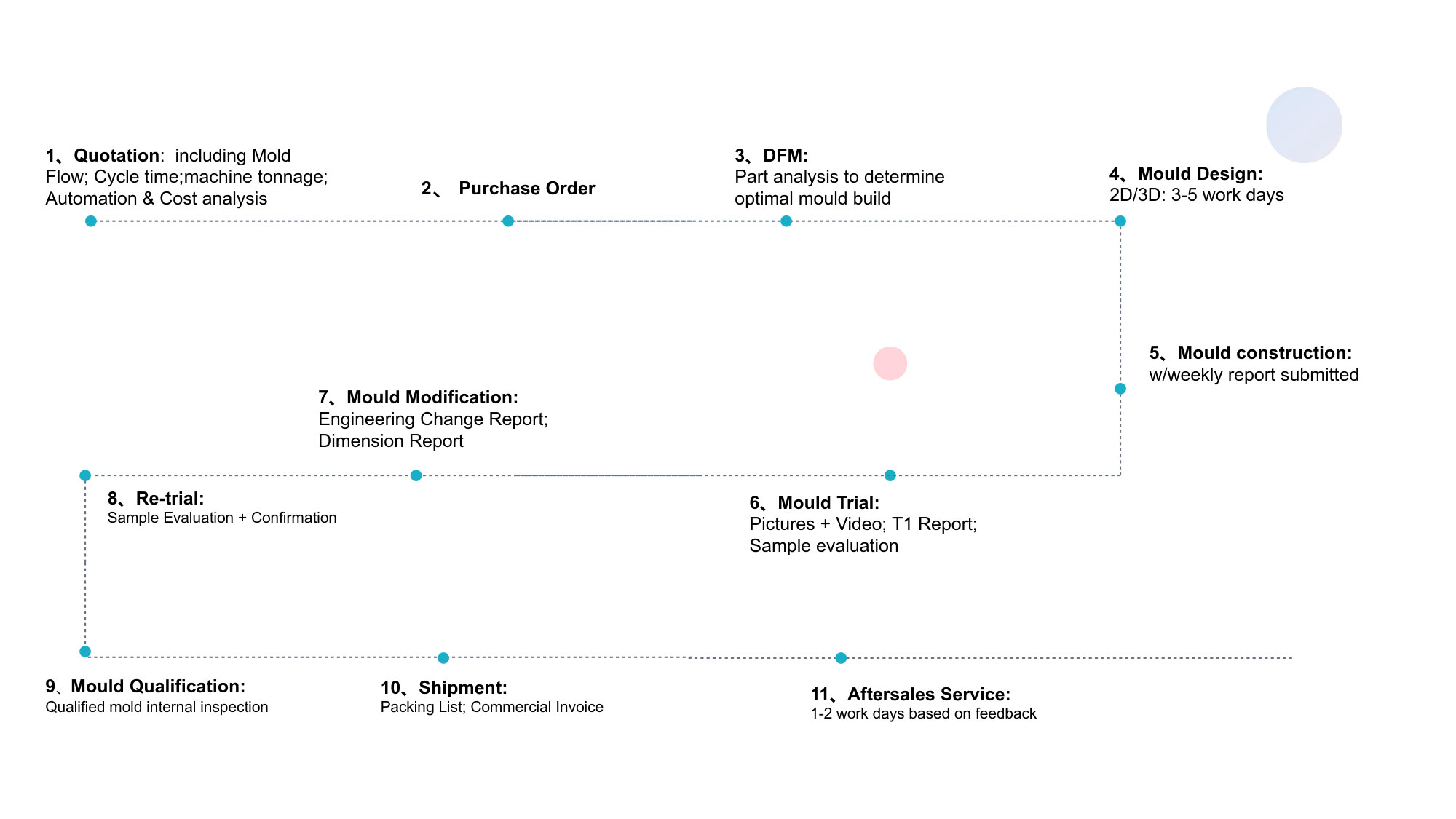
- The mold manufacturing process and product material selection
Injection Molding Machine Fleet
Ansix operates 260 injection molding machines ranging from 30 tons to 2,800 tons of clamping force. This extensive range covers the full spectrum of product sizes—from precision cell holder components to large-format battery trays exceeding one meter in length.
All machines feature fully servo-electric drives with stable repeatability accuracy of ±0.1%, ensuring that every shot is consistent with the last. Industry 4.0 integration through Manufacturing Execution System (MES) software locks critical forming parameters—temperature, pressure, injection speed, and cooling time—preventing unauthorized adjustments. Only qualified engineers can modify these settings, with every change logged and traceable.
Customer Value Translation: Servo-electric drives consume up to 70% less energy than hydraulic equivalents, directly reducing the per-part energy cost passed to customers. The MES-locked parameters ensure that a part produced in month 12 is identical to one produced in month 1—eliminating the quality drift that plagues less disciplined operations.
-
Quality Inspection Equipment
Ansix employs coordinate measuring machines (CMM) and optical inspection systems as standard practice. Every mold undergoes full dimensional reporting before release, with critical dimensions verified to CPK ≥ 1.33—the automotive industry benchmark for process capability. Material certifications and heat treatment curves are provided for every mold steel used, giving customers complete transparency.
Customer Value Translation: CPK ≥ 1.33 means the process produces 99.99% of parts within specification. For a customer producing millions of parts annually, this translates to tens of thousands fewer rejects and the associated scrap costs.
Section 2: Mold Manufacturing – Core Competitiveness Through Measurable Metrics
2.1 Mold Life and Material Selection
Ansix specifies mold steels matched to production demands with clear, enforceable commitments:
Mold Component Material Grade Properties Application
Mold Base P20 pre-hardened steel Structural stability, machinability Foundation of mold assembly
Cores & Cavities S136 stainless steel Corrosion-resistant, HRC 48-52 High-wear areas, glass-filled materials
Cores & Cavities H13 / SKD61 / 2344 / 8407 High thermal stability, HRC 48-55 Hot-work applications
Cores & Cavities DC53 / SKD11 High wear resistance Abrasive material applications
Cores & Cavities M340 / 4Cr13 / 9Cr18 Corrosion resistance Chemically aggressive environments
Cores & Cavities NAK80 Pre-hardened, excellent polishability High-gloss surface requirements
Ansix provides clear life commitments: for glass-fiber-reinforced materials (common in battery trays and cell holders), the mold is guaranteed for 500,000 cycles; for unfilled engineering plastics, 1,000,000 cycles. Each mold is delivered with a complete set of spare wear parts (ejector pins, core inserts) to minimize downtime.
Customer Value Translation: A mold that lasts 500,000 cycles vs. 200,000 cycles means the customer avoids a $200,000-$500,000 capital expenditure every 2-3 years. The included spare parts kit means when wear occurs, replacement takes hours, not weeks.
2.2 Dimensional Tolerances
Part Type Achievable Tolerance Industry Standard
General structural components ±0.05mm ±0.10mm
Precision mating features ±0.005mm ±0.02mm
Battery tray critical mounting points ±0.02mm (batch-to-batch) ±0.05mm
Customer Value Translation: Tighter tolerances mean parts assemble without forcing, shimming, or rework. For a battery tray with 50+ mounting points, ±0.02mm vs. ±0.05mm cumulative error is the difference between a 5-minute assembly and a 30-minute struggle.
2.3 Mold Types and Capabilities
Ansix offers a comprehensive range of mold technologies:
Hot runner systems – Reduce material waste by eliminating runner scrap, saving 15-30% on material costs for high-volume production
Stack molds – Double productivity by producing two layers of parts per cycle without increasing machine size
Two-shot / multi-material molds – Enable overmolding and component integration, eliminating secondary assembly operations
High-gloss / mirror-finish molds – Achieve surface roughness Ra < 0.05μm for transparent or visible-surface applications
Customer Value Translation: A hot runner system on a battery tray mold producing 500,000 parts annually saves approximately 15 tons of plastic waste per year—translating to $30,000-$50,000 in material cost savings annually.
2.4 Gate and Runner System Optimization
Through comprehensive mold flow analysis using Moldflow and UG software, Ansix simulates the injection process before any steel is cut. This predictive approach identifies and eliminates potential defects:
Weld line prediction – Optimize gate location and number to ensure melt fronts converge in non-critical areas or eliminate them entirely
Trapped air identification – Design venting pathways to prevent burn marks and incomplete filling
Fill balance optimization – Ensure all cavities fill simultaneously, preventing overpacking in some areas and short shots in others
Pressure drop analysis – Size runners to minimize pressure loss while maintaining shear heating for proper melt flow
Customer Value Translation: Eliminating weld lines in structural battery tray components means the part maintains full mechanical strength—preventing field failures that could lead to battery damage, safety incidents, and multimillion-dollar recalls.
2.5 Mold Delivery Standards
Mold Complexity Standard Lead Time Expedited Lead Time
Simple molds 10 days N/A
Medium complexity 25-45 days 20 days
High complexity (battery trays) 45-60 days 30-35 days
Customer Value Translation: A 10-day reduction in mold delivery means the customer's vehicle program launches 10 days earlier—representing millions in early revenue for a high-volume EV model.
Section 3: Injection Molding – Process Control That Eliminates Quality Anxiety
3.1 Dimensional Stability Control
Battery trays present unique challenges due to their large size (often exceeding one meter in length) and the precision required for busbar alignment. Ansix addresses these challenges through:
Multi-zone mold temperature control using thermal oil circulators that maintain cavity-to-core temperature differentials within ±2°C, dramatically reducing warpage, distortion, and residual stress
Real-time wall thickness monitoring using ultrasonic sensors that feed back to the injection unit for automatic pressure compensation
In-mold temperature and pressure sensors enabling closed-loop process control
Demonstrated results: For cup holder components, continuous production across three separate batches demonstrates dimensional fluctuation of less than ±0.02mm on critical mounting features. For battery tray components, this same discipline ensures that the 50+ mounting points remain in precise alignment across millions of production cycles.
Customer Value Translation: A battery tray that is 0.02mm out of tolerance on a single mounting point can cause busbar misalignment, leading to high-resistance connections, heat generation, and potential battery failure. Ansix's dimensional stability eliminates this risk category entirely.
3.2 Surface Quality and Appearance
Ansix achieves surface quality that meets the most demanding automotive standards:
Requirement Ansix Capability
Transparent parts No bubbles, no flow lines
Platable surfaces No gas marks, no splay
High-gloss finishes Surface roughness Ra ≤ 0.2μm
Painted surfaces Deformation compensation预留, print registration ±0.1mm
Customer Value Translation: A Class-A surface finish on visible battery components eliminates the need for secondary sanding, priming, or refinishing—saving $2-5 per part in post-processing costs.
3.3 Advanced Material Processing Capabilities
Ansix has extensive production experience with the engineering thermoplastics critical for EV battery applications:
Material Key Properties Battery Application
PPS + 40% GF 800V+ dielectric strength, dimensional stability in humid environments High-voltage connector housings, charging ports, end plates
PA66 + GF30/50 High impact resistance, stiffness Structural brackets, tray reinforcements
PC/ABS Impact strength, heat deflection, aesthetic finish Cell holders, covers
PBT Chemical resistance, electrical insulation Busbar insulators, module housings
PPA High-temperature performance Under-hood components, thermal management parts
LCP Ultra-high flow, thin-wall capability Precision connectors, miniature components
PEI / PPSU High heat resistance (200°C+) High-temperature structural applications
Flame-retardant grades UL94 V-0 compliance Battery enclosures, safety-critical components
PP + talc 35% lighter than metal, -40°C impact resistance Battery tray lower housings
Customer Value Translation: Ansix's material expertise means customers don't need to become polymer scientists—they simply specify the performance requirements, and Ansix recommends the optimal material grade, validated through simulation and testing.
3.4 Process Standardization and Quality Assurance
Ansix addresses the five most common customer concerns systematically:
Customer Concern Ansix Solution
Shrinkage / sink marks Optimized packing pressure and hold time through scientific molding methodology
Flash / burrs 0.005mm parting line fit tolerance; self-locking clamp force compensation; flash controlled to <0.03mm
Dimensional drift MES-locked parameters; batch-to-batch first-article and last-article inspection
Batch color variation Automated material handling; precise colorant dosing; ΔE < 1.0
Long repair cycles In-house electrode manufacturing and EDM; 24-hour repair turnaround
Each production cycle begins with first-article inspection and ends with last-article comparison against certified standards. Before any mold is released for high-volume production, Ansix conducts a thorough accelerated wear test confirming that wear patterns remain acceptable after thousands of cycles under worst-case conditions.
Customer Value Translation: These controls mean the customer receives components that are dimensionally identical, batch after batch, month after month—eliminating the costly surprises that disrupt assembly lines and delay vehicle deliveries.
Section 4: Full-Service Lifecycle – Reducing Customer Management Cost
4.1 Early-Stage Design for Manufacturability (DFM)
Ansix provides comprehensive DFM reports before contract signing, offering detailed feasibility assessments including:
Draft angle recommendations – Ensuring proper part ejection without scoring
Wall thickness optimization – Preventing sink marks, warpage, and short shots
Gate location planning – Optimizing fill patterns and minimizing weld lines
Ejector pin mark location permissions – Defining acceptable locations that don't affect form, fit, or function
Material selection guidance – Recommending optimal grades based on performance requirements and cost targets
Customer Value Translation: Identifying a structural issue during DFM vs. after mold opening saves 4-8 weeks of development time and $50,000-$150,000 in rework costs. Ansix's DFM process ensures the first mold is the right mold.
4.2 Trial Molding and Validation
Ansix follows a structured validation protocol:
T0 to T3 trial samples with improvement reports after each iteration
Quick-change inserts for design verification without remaking the entire mold
100-500 shot pilot production runs to validate yield rates and process capability (Cpk) before mass production
Full dimensional reporting at each trial stage
Customer Value Translation: The T0-T3 process means customers see physical parts and can validate form, fit, and function before committing to full production—reducing the risk of discovering issues after 100,000 parts have been produced.
4.3 Pilot Production Validation
Before committing to full-scale production, Ansix offers 100-500 mold pilot runs that statistically validate:
Production yield rates
Process capability indices (Cpk ≥ 1.33)
Cycle time stability
Material consumption efficiency
Customer Value Translation: Pilot production validation means the customer doesn't gamble on production readiness. If issues arise, they're discovered on 500 parts, not 50,000 parts.
4.4 Maintenance and Spare Parts
Ansix delivers every mold with:
Complete set of spare wear parts (ejector pins, core inserts) included with mold delivery
Maintenance schedule recommendation (every 200,000 cycles)
Lifetime repair service at cost price
24-hour emergency repair response capability
Customer Value Translation: A mold that goes down costs the customer $10,000-$50,000 per day in lost production. Ansix's spare parts kit and rapid repair capability mean that downtime is measured in hours, not days or weeks.
4.5 Integrated One-Stop Solution
Unlike fragmented service providers that require customers to manage separate vendors for design, tooling, production, and assembly, Ansix provides a unified platform integrating:
Product design
Prototyping
Mold manufacturing
High-volume production
Secondary processing
Assembly
This integration eliminates communication gaps, accelerates timelines, and ensures design intent is preserved from concept through to finished product.
Customer Value Translation: Managing one supplier instead of four reduces procurement overhead by 60-70% and eliminates the finger-pointing that occurs when quality issues arise across multiple vendors.
Section 5: Competitive Differentiation – Addressing Industry Pain Points
5.1 Direct Comparison: Common Industry Complaints vs. Ansix Solutions
Industry Complaint Ansix's Commitment Customer Value
"Molds require constant repair, disrupting orders" 2000-cycle accelerated wear test before delivery; wear report provided; 3-year mold structure warranty (excluding normal consumable wear) Predictable tooling costs; no surprise maintenance expenses
"Flash is excessive, post-processing costs are high" 0.005mm parting line fit tolerance; self-locking clamp force compensation; flash controlled to <0.03mm Eliminates manual deburring; saves $0.50-2.00 per part
"Dimensions vary from batch to batch" MES-locked parameters; in-mold sensors for closed-loop control; batch-to-batch dimensional fluctuation < ±0.02mm Assembly-line compatibility; no rework or scrapping
"Mold repair takes weeks" In-house electrode machining and EDM; repairs stay within facility; standard repair: 24-hour turnaround Production downtime minimized; lost revenue avoided
"Material costs are eating margins" Hot runner systems reduce waste 15-30%; multi-cavity molds spread tooling cost 15-30% material savings; lower per-part amortized tooling cost
5.2 Cost Leadership Strategy
Ansix achieves cost leadership through multiple optimization vectors:
Material Cost Optimization:
Hot runner systems eliminate runner scrap (15-30% material savings)
Scientific molding optimizes packing pressure to minimize overfill waste
Multi-cavity molds (up to 96 cavities) spread material waste across more parts
Process Efficiency Optimization:
70% automated machining reduces labor costs and human error
MES-optimized cycle times minimize per-part energy consumption
Vietnam production base offers competitive labor rates without quality compromise
Tooling Cost Optimization:
Average mold trial count of just 2 times vs. industry average of 5-8
Right-first-time DFM eliminates costly mold reworks
Standardized mold bases and components reduce manufacturing time
Customer Value Translation: A 15% material saving on a part using $5 of plastic per unit, produced at 1 million units annually, saves $750,000 per year. A 10% cycle time reduction on a 60-second cycle adds 10% capacity without additional capital investment.
Section 6: Ansix's Philosophy – Molds as Profit-Generating Assets
Ansix views molds not as mere blocks of steel, but as profit-generating assets for customers. Every design decision is made with the customer's total cost of ownership in mind:
Mold design considers injection moldability – Ensuring the part runs on standard machines without special fixturing
Exhaust paths are engineered for reliability – Preventing gas traps that cause burn marks and tool fouling
Temperature balance is optimized – Reducing cycle time and improving dimensional stability
The result: A mold that arrives on the customer's production floor ready for zero-trial startup, minimal flash, and maximum tool life
Customer Value Translation: A mold that runs "out of the box" without trial-and-error setup saves 2-5 days of production ramp time—representing 5,000-15,000 parts of early production and the associated revenue.
Section 7: Project Lifecycle Summary – From Concept to Production
7.1 Project Initiation
Customer performance requirements defined
Material selection based on mechanical, thermal, and electrical property requirements
DFM analysis conducted; feasibility report delivered
Mold flow analysis simulates filling, packing, and cooling phases
7.2 Mold Design and Manufacturing
3D CAD design using UG software
Five-axis high-speed machining (accuracy: ±0.002mm)
Wire EDM for fine features (0.03mm capability)
Heat treatment with documented curves
Full dimensional inspection (CMM, optical)
7.3 Trial Molding and Validation
T0-T3 trial samples with improvement reports
Quick-change insert verification
100-500 shot pilot production
CPK verification (target: ≥1.33)
7.4 Mass Production
MES-locked process parameters
Multi-zone temperature control (cavity-core differential ≤2°C)
First-article and last-article inspection
Continuous improvement through data analysis
7.5 Delivery and After-Sales
Full dimensional report with mold delivery
Spare wear parts included
200,000-cycle maintenance schedule
Lifetime repair service at cost
24-hour emergency response
Conclusion: The Ansix Difference
Ansix Tech transforms technical competencies into measurable customer value through:
Risk Reduction – DFM analysis identifies and eliminates production risks before tooling begins; 2000-cycle wear testing validates tool life before delivery; CPK ≥ 1.33 ensures process capability
Cost Savings – 15-30% material savings through hot runner systems; 70% automated machining reduces labor costs; right-first-time engineering eliminates rework; multi-cavity molds spread tooling investment
Quality Assurance – ±0.002mm machining precision; ±2°C temperature control; batch-to-batch dimensional stability < ±0.02mm; IATF 16949-certified quality systems
Delivery Reliability – 260 machines from 30-2800 tons; four production bases across China and Vietnam; 200,000+ m² production capacity; capacity to scale from prototyping to millions of units per month without re-tooling
Partnership Approach – One-stop integrated solution eliminates vendor fragmentation; spare parts and lifetime support reduce total cost of ownership; 28 years of experience across 30,000+ mold projects
For Tesla car battery tray and cell holder mold projects, Ansix Tech delivers the precision, reliability, and cost-effectiveness that the world's most demanding automotive OEM requires. The company's vertically integrated model—from material selection and mold design through validation and mass production—ensures that every component meets the exacting standards of electric vehicle battery systems, where failure is not an option and cost pressure is relentless.
"For us, a mold is not a block of steel—it is a printing press. We design every mold with injection moldability, exhaust paths, and temperature balance engineered in, so that when it reaches your production line, it runs with zero trial, minimal flash, and maximum life."
Contact Ansix Tech for a comprehensive DFM report walkthrough on your specific battery tray or cell holder application. Experience firsthand how Ansix identifies and eliminates weld lines, trapped air, and shrinkage risks before a single piece of steel is cut.
Ansix Tech Co Ltd
If you have any plans related to Tesla car battery tray, cell holder mold , you can contact us at any time. We will turn your ideas into reality, let you realize your dreams, and obtain large orders from the market. Our contact information is info@ansixtech.com. Or contact our CTO, mail: stephen@ansixtech.com
#www.ansixtech.com #ansixtech.com #Tesla car battery tray, cell holder mold #Tesla car battery tray, cell holder mold #Tesla car battery tray, cell holder mold Canopy Mold injection mold companies #Ansix #Ansix moulds #Ansix china #Ansix tech china #Ansix tech company #Ansix facotry #Tesla car battery tray, cell holder moldinjection molding #Tesla car battery tray, cell holder moldinjection tools #Tesla car battery tray, cell holder moldinjection moulds #Tesla car battery tray, cell holder moldplastic mould #Tesla car battery tray, cell holder moldplastic tools #Ansix Tech #Ansix molds #Ansix injection molding #Ansix mold factory #injection molding Customized stainless steel float switch for water level, oil level, high liquid level alarm#Ansix mold factory #Tesla car battery tray, cell holder moldchina #Tesla car battery tray, cell holder moldmolds #injection factory #Tesla car battery tray, cell holder moldinjection molding #Tesla car battery tray, cell holder moldinjection molding factory #injection molding company #Tesla car battery tray, cell holder moldinjection mold companies #Tesla car battery tray, cell holder moldTooling #Tesla car battery tray, cell holder moldmold limited #Ansix mold china #Ansix companies #Ansix company China #Tesla car battery tray, cell holder moldfacotry #Ansix Tech #Ansix Tech mould #Tesla car battery tray, cell holder moldinjection moulding #injection moulding company #Ansix Tesla car battery tray, cell holder moldparts injection mold companies #medical injection molding companieschina #Tesla car battery tray, cell holder moldchina factory #Ansix moulding companies #Ansix molding company #Tesla car battery tray, cell holder moldinjection moulding facotry #Ansix Tech mold #Tesla car battery tray, cell holder moldmould #Tesla car battery tray, cell holder moldplastic injection molding #ansix plastic mold #Mold manufacturing #Tesla car battery tray, cell holder moldparts manufacturing #Tesla car battery tray, cell holder moldplastic parts factory #Tesla car battery tray, cell holder moldinjection parts mold #Tesla car battery tray, cell holder moldPRECISION MANUFACTURING #Tesla car battery tray, cell holder mold#China mold #Tesla car battery tray, cell holder moldinjection moulding china #Tesla car battery tray, cell holder moldmould china #china precision mold #mold in china #Tesla car battery tray, cell holder moldmold china #Precision molds #High-precision molds #Tesla car battery tray, cell holder mold#Injection molds #Tesla car battery tray, cell holder moldFactory #Tesla car battery tray, cell holder moldCompany #Super Large Injection Mold Factory #Large Tonnage Injection Molding Factory #Tesla car battery tray, cell holder moldCompany #Tesla car battery tray, cell holder moldFactory #2800T Injection Molding Factory #3000 Ton Injection Molding #4500 Ton Injection Molding Factory #Large Mold Injection Molding #Large Plastic Mold Injection Molding Factory #Large Injection Mold Manufacturer #Plastic Mold Factory #Injection Mold #Plastic Mold