



Disposable Trocars Tooling
FEATURES
Beyond the Blueprint: How Ansix Tech Is Reinventing Disposable Trocars Tooling from the Ground Up
In the high-stakes world of modern laparoscopic surgery, the disposable trocar is far more than a simple access port—it is the gateway through which nearly every minimally invasive procedure passes. As global surgical volumes continue to rise and healthcare systems increasingly prioritize infection control and operational efficiency, the demand for high-quality, cost-effective disposable trocars has never been greater. According to market research, the global trocar market was valued at approximately USD 887.54 million in 2025 and is projected to reach USD 1,645.43 million by 2032, growing at a compound annual growth rate of 9.21%. Within this expanding landscape, disposable trocars represent a rapidly growing segment, with the market expected to reach USD 686.62 million by 2030 at a CAGR of 5.00%.
-
Mold Description
Product Materials:
PC PA12
Mold Material:
S136ESR
Number of Cavities:
1*1
Glue Feeding Method:
COLD runner
Cooling Method:
Water cooling
Molding Cycle
22.5s
Yet behind every reliable, single-use trocar that reaches the operating room lies an extraordinarily complex manufacturing journey—one that demands precision engineering, rigorous quality control, and an intimate understanding of both polymer science and surgical ergonomics. For medical device OEMs seeking to bring new trocar products to market, the path is fraught with challenges: protracted design cycles, costly mold reworks, material inconsistencies, production bottlenecks, and the ever-present pressure to reduce per-unit costs without compromising patient safety.
This is where Ansix Tech enters the picture. With over 28 years of experience in high-precision injection molding, more than 30,000 mold sets delivered, and a track record as a leader in medical device component manufacturing, the company is launching a dedicated disposable trocars tooling initiative that promises to fundamentally reshape how these critical surgical instruments are designed, validated, and mass-produced. This feature explores how Ansix Tech’s integrated approach—from material selection and mold design through to high-volume production and just-in-time delivery—creates tangible value for OEM partners while solving the industry’s most persistent manufacturing challenges.
-
The Client Challenge: Why Disposable Trocars Are So Difficult to Manufacture
Before understanding Ansix Tech’s solution framework, it is essential to grasp the inherent complexity of the disposable trocar as a manufactured product. A single trocar assembly comprises multiple components with divergent functional requirements: the sharp obturator (often incorporating sophisticated safety mechanisms), the cannula or outer sleeve, the sealing cap (sometimes featuring multiple duckbill or flap valves), the insufflation port, and various housing components. Each part demands specific material properties—rigidity, flexibility, transparency, biocompatibility, and sterilizability—yet all must function together as a seamless, reliable surgical instrument.
For OEMs, the development process has traditionally been both expensive and unpredictable. A design change late in the tooling phase can trigger months of delay and six-figure rework costs. Material inconsistencies can lead to field failures. Assembly misalignments can compromise sealing integrity. And for many manufacturers, the fundamental tension between achieving medical-grade quality and maintaining commercially viable per-unit pricing remains unresolved.
Ansix Tech’s core value proposition addresses these challenges directly. Rather than operating as a conventional contract manufacturer that simply builds molds to customer-provided specifications, Ansix Tech positions itself as an integrated engineering partner that embeds manufacturability into the product’s DNA from the very first concept. The company manages the entire value chain—from initial design and material formulation through precision mold manufacturing, high-volume production, packaging, and logistics—under one unified technical philosophy.
Project Initiation: From Customer Challenge to Technical Roadmap
The launch of Ansix Tech’s disposable trocars tooling initiative begins with what the company calls “parallel engineering”—a collaborative process that brings together design engineers, material scientists, mold makers, and process technicians at the earliest possible stage. Unlike traditional suppliers that receive finalized CAD files and quote tooling without substantive input, Ansix Tech engages proactively with OEM clients to optimize product geometry for performance, manufacturability, and cost.
This approach starts with a comprehensive design review that examines every aspect of the trocar’s geometry: wall thickness uniformity, draft angles for proper ejection, undercut handling strategies, gate placement, and the interaction between rigid and elastomeric components. The company’s team of more than 200 designers and engineers works from a position of deep domain knowledge, drawing on decades of experience in medical injection molding to identify potential failure modes before any steel is cut.
Within 24 hours of order confirmation, Ansix Tech provides a Design for Manufacturability (DFM) report that documents all proposed optimizations. This rapid turnaround accelerates the front-end engineering phase, reducing the time between concept and production readiness by weeks or even months compared to conventional development timelines.
Material Selection: The Chemistry of Clinical Performance
The material science foundation of any trocar is arguably its most critical success factor. Ansix Tech’s material scientists work alongside clients to navigate the complex landscape of medical-grade polymers, selecting formulations that balance clinical function, regulatory compliance, processability, and cost.
For the rigid structural components—the cannula, obturator body, and housing—polycarbonate (PC) and PC/ABS blends are the predominant choices. Polycarbonate offers exceptional impact resistance, clarity for visualization purposes, and proven biocompatibility when sterilized via ethylene oxide or gamma irradiation. PC/ABS alloys combine polycarbonate’s strength and heat resistance with ABS’s flexibility and improved flow characteristics during injection molding, offering enhanced toughness and dimensional stability. The materials are typically specified to standards such as EN ISO 7391-1:2006 for PC and EN ISO 19062-1:2015 for ABS.
For applications requiring additional stiffness—such as the obturator shaft where column strength during insertion is critical—glass fiber-reinforced polymers (e.g., glass-filled PP or nylon) may be specified to enhance rigidity while maintaining dimensional stability under load.
The sealing components—duckbill valves, flap seals, and gaskets—demand an entirely different set of material properties: flexibility, tear resistance, low surface friction, and the ability to reseal repeatedly after instrument passes. Thermoplastic elastomers (TPEs) are the material of choice for these applications. Medical-grade TPEs such as Mediprene or Versalloy HC series offer USP Class VI biocompatibility, excellent adhesion to rigid substrates for overmolding applications, and the flexibility profiles required for consistent sealing performance across the device’s functional life. Many such materials are ISO 10993 tested for cytotoxicity, sensitization, and irritation, ensuring compliance with global medical device regulations.
Ansix Tech’s material consulting extends to sterilization compatibility as well. Different sterilization modalities—ethylene oxide (EtO), gamma irradiation, electron beam, and steam autoclaving—impose distinct demands on polymer formulations. Polycarbonate is generally compatible with EtO and gamma, while certain TPE formulations may be optimized for specific sterilization methods. By matching material selection to the client’s intended sterilization pathway early in development, Ansix Tech eliminates costly downstream material substitutions.
DFM and Mold Flow Analysis: Solving Problems Before Steel Is Cut
Once the product design is optimized and materials selected, the tooling development phase begins—and here, Ansix Tech’s digital engineering capabilities come to the fore. The company utilizes advanced CAE simulation software, including Moldflow and other industry-standard platforms, to simulate the injection molding process before any physical tooling is manufactured.
Mold flow analysis serves multiple critical functions. First, it predicts how molten polymer will flow into the mold cavity, identifying potential defects such as weld lines (where two flow fronts meet and may create weak seams), air traps (where gas becomes entrapped and causes voids or burn marks), and sink marks (where uneven cooling creates depressions on the part surface). Second, it optimizes gate placement and runner system design to achieve balanced filling across multi-cavity tools. Third, it simulates pressure distribution during the packing phase, ensuring that the melt reaches the most distant features of the geometry before freezing occurs.
For thin-walled trocar components—where wall thicknesses may be as low as 1–2 millimeters—mold flow analysis is particularly critical. Inadequate fill can result in short shots (incomplete part formation), while overly rapid fill rates can create excessive shear and degrade polymer properties. Ansix Tech uses simulation outputs to fine-tune injection parameters, gate locations, and runner dimensions iteratively—all in the virtual environment, where changes cost nothing but time in front of a workstation. This predictive capability dramatically reduces the risk of costly mold rework and shortens the development cycle from months to weeks.
Precision Mold Design: Engineering for High-Volume Production
With DFM analysis complete and flow simulations validated, Ansix Tech proceeds to mold design—a discipline where the company’s 28 years of experience manifest most tangibly. The tooling for disposable trocars must balance several competing requirements: extreme dimensional precision (tolerances as tight as ±0.002mm in critical features), robust construction for multi-million-shot production runs, efficient cooling to minimize cycle times, and cost-effective maintainability.
Mold Steel Selection
The choice of mold steel is foundational to tooling longevity and part quality. For trocar components, Ansix Tech typically selects high-performance tool steels capable of withstanding the rigors of high-volume medical molding. Industry-standard grades include German 2738HH and 718HH steels for core and cavity inserts, which offer excellent polishability for optical-grade surface finishes, uniform hardness in the HRC 33–40 range, and superior machinability for complex geometries. For processing highly abrasive glass-filled materials, harder grades such as H13 or 420 stainless steel may be specified to maintain dimensional accuracy over extended production runs.
Where rapid tooling is required for prototyping or low-volume production runs, Ansix Tech employs cost-effective materials such as pre-hardened P20 steel, which offers durability, corrosion resistance, and a superior glossy finish while allowing tooling costs to be reduced by 30–50% compared to conventional production tooling.
Cooling System Engineering
Cooling accounts for the largest portion of the injection molding cycle—sometimes 50–80% of total cycle time. Ansix Tech engineers cooling systems with the intensity that high-volume production demands, strategically placing conformal cooling channels that follow the contours of the part geometry. Where conventional drilled channels are constrained to straight-line paths, conformal cooling (enabled by advanced manufacturing techniques) allows cooling circuits to wrap around complex features, ensuring uniform heat extraction across the entire cavity.
The impact of optimized cooling design on productivity cannot be overstated. Efficient cooling systems can reduce overall cycle time, improve plastic product quality (by minimizing residual stresses and warpage), and directly reduce the unit molded part cost. In many high-cavity trocar tools, every second shaved from the cooling phase translates into thousands of additional parts per shift and meaningful reductions in per-unit manufacturing cost.
Runner, Gate, and Ejection Systems
The runner system—the network of channels that delivers molten plastic from the injection nozzle to the cavities—is designed for both efficiency and material conservation. Hot runner systems, where the runner remains molten between cycles, eliminate the need to eject and regrind cold runner waste, reducing material usage and improving process stability. Ansix Tech balances hot runner adoption against tooling cost considerations, recommending systems that optimize total cost of ownership rather than upfront expenditure alone.
Gate placement is determined through mold flow analysis, with Ansix Tech selecting from a range of gate types (edge gates, submarine gates, fan gates) based on part geometry and aesthetic requirements. For transparent trocar cannulas where gate vestige must be minimized, pinpoint or valve gates may be specified to achieve clean break-off with minimal witness marks.
The ejection system—comprising ejector pins, sleeves, and air-blast mechanisms—must be engineered to remove parts cleanly without deformation, stick marks, or damage to sealing surfaces. This is particularly challenging for thin-walled cannulas and delicate TPE seals. Ansix Tech designs ejection layouts with sufficient surface area to distribute ejection forces evenly, often incorporating stripper plate systems for parts with deep-draw geometries.
Mold Manufacturing: The Art of Precision Machining
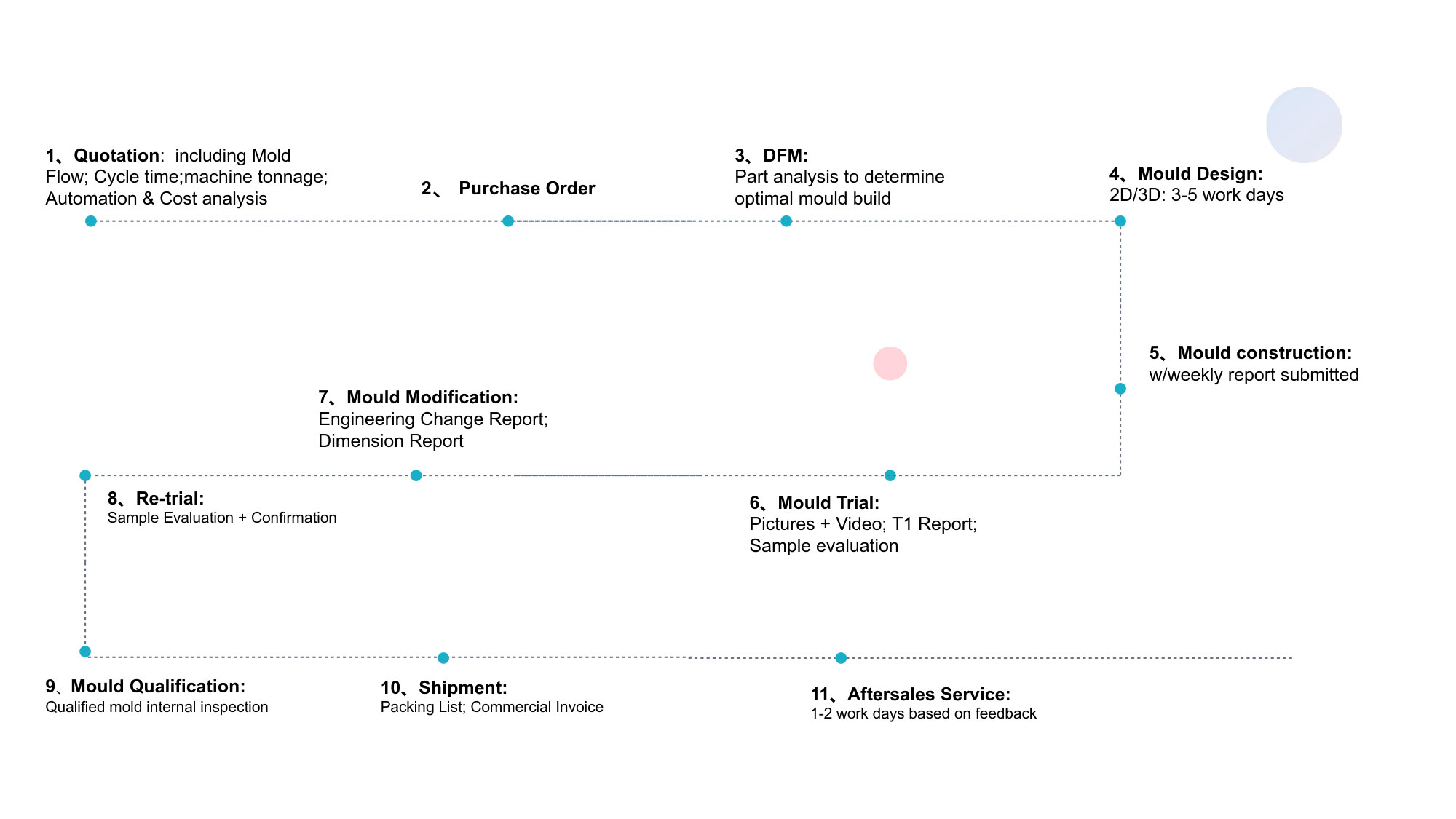
Mold manufacturing at Ansix Tech is a multi-stage process that combines high-speed CNC machining, electrical discharge machining (EDM), wire EDM, and surface finishing technologies. The company’s four production bases across China and Vietnam house advanced machining centers capable of delivering the tolerances required for Class II medical device tooling.
The typical manufacturing sequence proceeds as follows: after DFM approval, tooling design and main steel cutting proceed in parallel. CNC machining produces the core and cavity inserts to near-net shape, at which point EDM may be employed for features with high aspect ratios or sharp internal corners that cannot be accessed by cutting tools. Following machining, the tooling components undergo fitting and bench work, including hand polishing of critical surfaces to achieve the required surface finish—typically as fine as SPI A2 or A3 for optical surfaces and sealing interfaces.
Final assembly is followed by mold inspection by master technicians, after which the tool is transferred to the injection molding workshop for trial runs. Initial samples are subjected to full dimensional inspection before being forwarded to the client for functional evaluation.
Machining Challenges Unique to Trocar Tooling
Trocar tooling presents several distinct machining challenges. The lumen of the cannula may require core pins with length-to-diameter ratios exceeding 10:1, demanding specialized deep-hole drilling or EDM strategies. The valve seat geometries in the sealing cap often feature complex undercuts and thin-wall sections that challenge conventional machining. And the sharp edge geometries of bladed obturators demand extreme precision to ensure consistent insertion force profiles across production runs.
Ansix Tech’s machining teams are experienced in overcoming these challenges through a combination of advanced equipment, process knowledge, and iterative refinement. Where necessary, surface coatings—including diamond-like carbon (DLC) coatings—may be applied to improve wear resistance and prevent polymer sticking to mold surfaces during processing. DLC coatings are chemically inert and exceptionally hard, preventing plastics from adhering to mold surfaces and ensuring smooth part release over extended production runs.
Validation: Proving the Process, Not Just the Product
In medical device manufacturing, validation is not a one-time event—it is an ongoing commitment. Ansix Tech operates under a suite of quality management certifications, including ISO 13485:2016 for medical devices, as well as IATF 16949, ISO 9001, and ISO 14001. These frameworks ensure that every aspect of production—from raw material receiving to final packaging—is documented, controlled, and continuously improved.
The company’s validation approach for trocar tooling projects encompasses multiple levels:
IQ, OQ, PQ Protocol
Installation Qualification (IQ) verifies that the injection molding machine, tooling, and auxiliary equipment are installed according to specifications. Operational Qualification (OQ) tests the molding process across its intended operating ranges—varying injection pressure, temperature, and cooling parameters—to establish the process window within which parts consistently meet specifications. Performance Qualification (PQ) confirms that the process produces acceptable parts under normal production conditions over an extended run.
This scientific molding approach generates data that defines the validated process parameters, enabling consistent manufacturing even when molds are transferred between different injection molding machines across Ansix Tech’s global production network.
Component-Level Quality Testing
For trocar components, quality verification includes dimensional inspection to engineering drawings (typically with CMM or optical measurement systems for critical features), visual inspection for cosmetic defects, and functional testing specific to each component type. For obturators and cannulas, this may include insertion force testing, column strength verification, and optical clarity assessment. For TPE seals, functional testing typically includes leak testing under pressure—a 4 kPa leak test is common for ensuring the assembled trocar maintains pneumoperitoneum during surgery.
First Article Inspection (FAI)
On every new tool, Ansix Tech performs a comprehensive First Article Inspection, measuring every dimension called out on the part drawing and documenting compliance against specifications. The FAI report provides the client with tangible evidence that the molding process is producing parts that conform to requirements before any commitment to volume production is made.
Injection Molding Challenges and Process Optimization
Even the finest tooling cannot overcome an uncontrolled injection molding process. Ansix Tech’s molding floor houses over 260 injection molding machines with clamping forces ranging from 30 to 2800 tons, giving the company the flexibility to match machine capability to part geometry and production volume.
The most significant challenges in trocar molding revolve around dimensional consistency and aesthetic quality:
Warpage arises from non-uniform cooling or residual stresses in the molded part. Ansix Tech addresses warpage through optimized cooling system design, balanced flow from the gate, and careful control of packing pressure timing.
Weld lines occur where two melt fronts meet, potentially creating visible lines or mechanical weak points. Simulation-based gate placement and mold temperature optimization minimize weld line prominence.
Sink marks appear as depressions opposite thick sections of the part where insufficient packing material can compensate for shrinkage. Rib and boss designs are optimized during DFM to maintain uniform wall thickness.
Flash (excess material escaping between mating mold surfaces) requires precise tool fitting and balanced clamp force distribution.
The company’s process optimization strategy focuses on cycle time reduction without sacrificing quality. Automated process control systems—employing real-time pressure sensors and viscosity monitoring—adjust injection parameters dynamically to compensate for material variability, stabilizing part quality and reducing scrap generation.
Efficiency Gains Through Scientific Molding
Scientific molding principles are embedded into Ansix Tech’s manufacturing culture. By using mold flow simulations to establish optimal processing windows, the company reduces trial-and-error during mold startup. Defect rates are systematically analyzed using data from process monitoring systems, enabling rapid identification of root causes and corrective actions. In a typical optimization cycle, Ansix Tech achieves cycle time reductions of 20–30% through improvements in cooling system design, automation of part handling, and fine-tuning of injection and packing parameters.
Cost Reduction: The Ansix Tech Advantage
Perhaps the most compelling value proposition Ansix Tech offers its OEM partners is the ability to drive down total product cost without compromising quality or reliability. The company’s approach to cost reduction operates along multiple dimensions simultaneously:
Material Cost Optimization
Material typically accounts for 40–60% of the variable cost of a molded trocar component. Ansix Tech works with clients to select cost-effective medical-grade polymers that meet performance specifications without premium pricing. Where glass-filled resins are required, the company qualifies alternative fill levels or supplier sources to maintain properties at lower cost. For high-volume TPE seals, formulations are selected to minimize cycle time while maintaining required flexibility and tear strength.
Cycle Time Reduction
As noted above, Ansix Tech’s optimized cooling system designs cut cycle times by as much as 20–30% compared to conventional tooling, directly increasing output per shift and reducing per-unit manufacturing cost. Industry research shows that high-efficiency molds with advanced cooling capabilities can reduce unit part costs by $0.01 per part or more, with break-even points for the additional tooling investment reached within 29 days of runtime.
Shared Mold Base and Rapid Tooling
For clients needing cost-effective tooling for new product introductions or low-to-medium volume production, Ansix Tech offers shared mold base systems that reduce tooling costs by 30–50% compared to conventional production tooling. This approach uses standardized mold frames with custom cavity inserts, eliminating the expense of unique mold plates and cooling system fabrication for each project.
Automation and Scrap Reduction
Ansix Tech integrates automation into its molding cells wherever volume justifies investment. Automated part handling reduces labor costs and eliminates variability in manual trimming. Process monitoring systems detect non-conforming parts in real time, preventing scrap propagation across multiple cavities. Servo-driven injection units and auxiliary equipment cut energy consumption by 30–60% compared to conventional hydraulic systems, reducing operating cost and environmental footprint.
The result of these combined strategies is a total cost of ownership for molded trocar components that is significantly lower than what competing suppliers can achieve. The company’s track record includes standard medical syringe cost reductions of over 30% through advanced mold engineering and intelligent process control.
Capacity and Delivery: Scaling for Global Demand
As the disposable trocar market expands—projected to reach nearly USD 1.65 billion by 2032—manufacturing capacity becomes a strategic differentiator. Ansix Tech’s four production bases across China and Vietnam, together comprising over 260 injection molding machines, provide the company with the scale to absorb large-volume programs while maintaining the flexibility to accommodate urgent orders.
The company’s global footprint also serves as a supply chain hedge, allowing production to be shifted between locations in response to regional demand fluctuations or geopolitical events. This geographic diversification is structured to serve more than 50 countries worldwide, with a shipping network that ensures parts reach customers on any continent within compressed lead times.
For clients launching new trocar products, the company’s fast delivery capability extends to the development phase as well. With hundreds of shared mold bases and a large inventory of precision tooling components on hand, Ansix Tech can deliver rapid tooling for prototypes and functional verification runs in a fraction of the time required by conventional toolmakers. Where standard delivery lead times for production tooling may stretch to 60 days, the company’s rapid tooling service compresses that timeline significantly.
Quality Control and Packaging: The Final Mile
The quality of a molded trocar component is ultimately defined by its performance in the field. Ansix Tech’s quality control system extends from incoming raw material verification through in-process inspection to final product acceptance.
In-Process Controls
During molding, statistical process control (SPC) charts track key process parameters and part dimensions, alerting operators to trends that may indicate deterioration in tooling condition or material inconsistency. Pressure sensors within the mold cavity monitor fill, pack, and cooling phases, providing real-time data that feeds closed-loop process control systems.
Final Inspection
Finished components undergo final dimensional inspection using automated vision systems and CMM verification for critical-to-function features. For TPE seals, dedicated leak testers verify seal integrity before assembly. For transparent cannulas and obturator housings, optical inspection stations detect bubbles, flow lines, or contamination.
Sterilization and Packaging
Depending on the client’s specification, Ansix Tech may perform sterilization validation services, assisting with qualification of ethylene oxide, gamma irradiation, or e-beam sterilization processes. The company’s packaging solutions range from bulk cartons for non-sterile components to individually sealed sterile pouches and thermoform trays. Packaging configurations are validated for seal integrity, sterility maintenance over shelf life, and compatibility with the chosen sterilization modality.
All packaging operations are performed in controlled environments with documented procedures for traceability. Finished goods are labeled with batch numbers and manufacturing dates, enabling full traceability back to the specific molding machine, tool cavity, and raw material lot that produced each part.
Delivering Reliability and Value: The Ansix Tech Difference
With 28 years of operational history, more than 30,000 mold sets produced, and a global workforce exceeding 1,200 employees, Ansix Tech has established itself as a trusted partner for medical device OEMs requiring injection-molded components for the world’s most demanding applications.
The company’s disposable trocars tooling initiative represents the culmination of decades of incremental improvement in design methodologies, process science, and manufacturing technology. By integrating tooling design, mold manufacturing, injection molding, and quality validation under a single management philosophy, Ansix Tech eliminates the friction that typically besets multi-vendor supply chains. Every decision from material selection to cavity layout to gate placement is made with the full context of the client’s cost, quality, and delivery requirements.
For medical device OEMs, the value of this integrated approach is measurable: shorter development timelines, lower total cost, higher production yields, and the peace of mind that comes from partnering with a supplier that understands the clinical consequences of manufacturing variability. In a market where a few micrometers of dimensional error can render a trocar unusable in the operating room, that reliability is not just a business advantage—it is a patient safety imperative.
As the disposable trocar market continues its rapid growth trajectory, Ansix Tech stands ready to serve as the manufacturing backbone for the next generation of minimally invasive surgical instruments—not merely molding parts to specification, but engineering solutions that enable OEMs to succeed in the competitive, quality-driven landscape of modern medical device manufacturing.
Ansix Tech Co Ltd
If you have any plans related to Disposable Trocars Tooling , you can contact us at any time. We will turn your ideas into reality, let you realize your dreams, and obtain large orders from the market. Our contact information is info@ansixtech.com. Or contact our CTO, mail: stephen@ansixtech.com
#www.ansixtech.com #ansixtech.com #Disposable Trocars Tooling #Syringe mold moulds #Syringe mold molds #Syringe mold injection molding companies #Disposable Trocars Tooling Canopy Mold injection mold companies #Ansix #Ansix moulds #Ansix china #Ansix tech china #Ansix tech company #Ansix facotry #Syringe mold injection molding #Syringe mold injection tools #Syringe mold injection moulds #Syringe mold plastic mould #Syringe mold plastic tools #Ansix Tech #Ansix molds #Ansix injection molding #Ansix mold factory #injection molding Syringe mold #Ansix mold factory #Syringe mold china #Syringe mold molds #injection factory #Syringe mold injection molding #Syringe mold injection molding factory #injection molding company #Syringe mold injection mold companies #Syringe mold#Syringe mold mold limited #Ansix mold china #Ansix companies #Ansix company China #Syringe mold facotry #Ansix Tech #Ansix Tech mould #Syringe mold injection moulding #injection moulding company #Ansix Syringe mold parts injection mold companies #medical injection molding companieschina #Syringe mold china factory #Ansix moulding companies #Ansix molding company #Syringe mold injection moulding facotry #Ansix Tech mold #Syringe mold mould #Syringe mold plastic injection molding #ansix plastic mold #Mold manufacturing #Syringe mold parts manufacturing #Syringe mold plastic parts factory #Syringe mold injection parts mold #Syringe mold PRECISION MANUFACTURING #Syringe mold #China mold #Syringe mold injection moulding china #Syringe mold mould china #china precision mold #mold in china #Syringe mold mold china #Precision molds #High-precision molds #Syringe mold #Injection molds #Syringe mold Factory #Syringe mold Company #Super Large Injection Mold Factory #Large Tonnage Injection Molding Factory #Syringe mold Company #Syringe mold Factory #2800T Injection Molding Factory #3000 Ton Injection Molding #4500 Ton Injection Molding Factory #Large Mold Injection Molding #Large Plastic Mold Injection Molding Factory #Large Injection Mold Manufacturer #Plastic Mold Factory #Injection Mold #Plastic Mold