



Flip-top cream jar with spoon, face cream bottle with tweezers, makeup remover pad packaging bottle
FEATURES
Customer Inquiry Interface—What You Need and What We Deliver
Your Requirements Ansix Tech’s Commitment
Flip-top cream jar with spoon—smooth opening/closing, no leakage, decorative hinge durable DFM-optimized hinge design with fatigue-tested geometry. Our flip-top hinge withstands 10,000+ cycles without cracking. S136 mold steel ensures polished cavity surfaces that release parts without drag marks
Face cream bottle with tweezers—tight fit between bottle and cap, tweezers stay seated during transit Precision shutoff design between cap and bottle body: shutoff tolerance controlled within ±0.02mm ensures leak-proof seal. The tweezers holder features snap-fit geometry designed with optimal draft angle for consistent assembly—no loose tweezers falling out in transit
Makeup remover pad packaging bottle—moisture-tight closure, easy one-handed operation, no water evaporation Multi-start thread system optimized for 90-degree turn-to-open. Compression seal design maintains humidity levels inside for up to 18 months. Lip seal geometry eliminates water vapor transmission
Section Two: Hardware Infrastructure—Why Our Machines Give You Confidence from Day One
Customers ask: “Can this supplier actually deliver the precision I need?” Here is our answer, backed by measurable specifications.
-
Mold Description
Product Materials:
PET PETG
Mold Material:
S136ESR
Number of Cavities:
8
Glue Feeding Method:
Hot runner
Cooling Method:
Water cooling
Molding Cycle
32.5s
- The mold manufacturing process and product material selection
Precision Mold Manufacturing Equipment
Five-Axis High-Speed Machining Centers
Our five-axis high-speed machining centers process complex curved surfaces with 0.002mm accuracy. For a flip-top cream jar mold, this means the parting line between lid and base measures less than 0.01mm—invisible to the naked eye and impossible for moisture to penetrate. Customers save 25-30% of post-molding labor costs because no manual flash removal or secondary deburring is required. The five-axis capability also allows us to machine intricate hinge geometry in a single setup, eliminating misalignment errors that would otherwise cause uneven lid closure.
Slow-Speed Wire EDM (Electrical Discharge Machining)
Our slow-speed wire EDM systems achieve cutting accuracy down to 0.003mm, enabling the production of micro-slots and fine-feature details as small as 0.03mm in diameter . For a makeup remover pad packaging bottle, the inner sealing ring features micro-ridges with 0.05mm spacing that create a labyrinth seal—impossible to machine with conventional methods. Our wire EDM capability ensures these features are produced with zero deviation, preventing moisture ingress that would cause product degradation.
CNC EDM (Sinker) with Mirror-Finish Capability
For deep-rib features and textured grip surfaces on cream jars, sinker EDM delivers unmatched precision. Our electrode manufacturing process is managed entirely in-house, allowing us to achieve optical-grade mirror polish (Ra ≤ 0.05 μm) on cavity surfaces . The result: cosmetics-grade surface finish directly from the mold—no secondary polishing required. For clear or translucent cream jars, this mirror finish eliminates light diffusion, producing parts with optical clarity indistinguishable from glass.
Surface Grinding
All mold plates and core components undergo precision grinding to ensure absolute parallelism in the mold base. For multi-cavity flip-top molds (typically 8–32 cavities), this means every cavity produces identical parts—eliminating cavity-to-cavity variation that typically plagues cosmetic packaging manufacturers.
-
Injection Molding Press Fleet
Our press fleet ranges from 30 tons to 2800 tons, covering the full spectrum of cosmetic packaging sizes—from 7g cream jars to 500ml pump bottles .
All-Electric Servo-Driven Injection Molding Machines
Every press in our cosmetic packaging dedicated line is all-electric servo-driven. Why this matters: conventional hydraulic presses suffer from viscosity-based repeatability drift. As oil temperature rises during a production run, pressure fluctuations cause dimensional variation. Our all-electric machines maintain ±0.1% shot-to-shot repeatability, guaranteeing that the 100,000th part is dimensionally identical to the first .
Customer value: For a high-volume beauty brand ordering 500,000 cream jars, this repeatability translates to zero sorting rejects—saving
0.02
–
0.02–0.05 per part that would otherwise be scrapped due to dimensional drift.
Machine Brand Portfolio
Our main injection molding machines include Japan‘s Fanuc, Sumitomo, Toshiba, Nissei, Engel, and Germany’s Arburg (primarily for two-component and liquid silicone applications), complemented by China‘s Haitian and Victor Taichung Machinery . This diversity means we match the machine to the product—not the other way around.
2.3 Metrology and Quality Assurance Equipment
Coordinate Measuring Machines (CMM)
Our ZEISS CMMs provide three-dimensional verification of every critical dimension before the mold leaves our facility . Each mold is shipped with a full dimensional inspection report and CPK analysis for all CTQ (Critical-to-Quality) dimensions.
Optical Inspection Systems
High-resolution optical inspection systems capture surface finish quality at 100x magnification, verifying mirror polish (Ra ≤ 0.05μm) on cosmetic contact surfaces and detecting microscopic surface defects that would compromise product appearance.
In-Process Measurement
During pilot runs, we measure key dimensions (neck finish diameter, thread pitch, lid hinge alignment) every 30 shots, tracking CPK in real-time. Only when Cpk ≥ 1.33 across all CTQ dimensions do we approve for mass production.
Section Three: Mold Manufacturing—The Core Competencies That Drive Your Success
3.1 Mold Steel Selection—Why Material Choice Determines Your Production Economics
Mold Steel Hardness Best Application Customer Benefit
P20 (Pre-hardened) HRC 30–35 Medium-volume production, PP/ABS materials Fastest delivery (10–15 days), most cost-effective for 200K–300K shot projects
S136 (Stainless) HRC 48–52 after quenching Transparent/clear jars, corrosive cosmetics (high-acid formulas) Mirror finish (Ra ≤ 0.05μm); corrosion-resistant—no pitting even after 2M shots with acidic creams
NAK80 (Mirror-grade) HRC 38–42 High-gloss cosmetic packaging, decorative finishes Pre-hardened—no heat treatment required. Excellent polish stability for luxury brand finishes
H13 HRC 45–55 High-cavitation molds, glass-filled resins, high-temperature plastics Thermal fatigue resistance; maintains dimensional stability under high-speed molding cycles
2344 / 8407 HRC 46–52 General-purpose high-volume cosmetic molds Balance of toughness and wear resistance; extended service life
SKD61 HRC 48–52 Complex ejection systems, sliders, and lifters High toughness for intricate mechanical features; resists cracking under repeated stress
DC53 HRC 60–62 Thin-wall sections, high-wear shutoff surfaces Superior wear resistance for high-speed production
M340 / 4Cr13 / 9Cr18 HRC 48–54 High-acid cosmetic formulations Premium corrosion resistance for reactive cream formulas; prevents mold surface degradation
Client Promise: We provide full material certification reports and heat treatment curves for every mold. For glass-filled engineering plastics, we guarantee 500,000 shots minimum; for standard thermoplastics (PP, ABS, PC), 1 million shots minimum. We also include a set of spare wear parts (ejector pins, core inserts) with every mold shipment—no downtime waiting for replacements.
3.2 Achievable Tolerances—What You Can Expect
Part Type Standard Tolerance Precision Capability CPK Target
Flip-top lid hinge alignment ±0.03mm ±0.01mm CPK ≥ 1.33
Face cream bottle neck finish ±0.02mm ±0.008mm CPK ≥ 1.33
Thread pitch and depth ±0.015mm ±0.005mm CPK ≥ 1.67
Snap-fit engagement ±0.03mm ±0.01mm CPK ≥ 1.33
Shutoff surface flatness ±0.01mm ±0.005mm CPK ≥ 1.67
Wall thickness uniformity ±0.02mm ±0.01mm CPK ≥ 1.33
Every dimension is verified with full inspection reports before the mold ships.
3.3 Mold Configuration Types
Hot Runner Systems: Reduces material waste by 20–35% compared to cold runner systems. Valve-gate hot runners deliver clean gate vestiges—no gate trimming required for cosmetic surfaces.
Stack Molds: Doubles output per machine cycle. For high-volume makeup remover pad bottles, stack molds produce 2x the parts in the same cycle time, reducing piece-part cost by up to 40%.
Two-Shot (2K) / Multi-Material Molds: Integrates soft-touch overmolding directly in the molding cycle. Eliminates post-mold assembly and adhesive failure modes.
High-Cavitation Molds: Our standard configuration for flip-top cream jars is 32 cavities; for small face cream bottles, we routinely build 48-cavity molds running on 2800-ton presses.
High-Gloss Molds: S136 and NAK80 cavities polished to Ra ≤ 0.05μm produce injection-molded parts that require no secondary surface finishing.
3.4 Gating System Optimization
Using Moldflow analysis prior to any steel cutting, we simulate the entire filling process to:
Predict and eliminate weld lines that would appear on cosmetic surfaces
Identify air trap locations before they become production defects
Optimize gate placement to ensure balanced cavity filling across all 32 cavities
Determine the optimal number and location of gates to minimize pressure drop
Customer benefit: We solve filling, venting, and shrinkage risks virtually—meaning you never pay for tool modifications to fix flow-related defects.
3.5 Cooling System Design for High-Volume Production
We design conformal cooling channels that follow the contour of each part geometry, combined with zone-controlled mold temperature regulation. Core and cavity temperatures are maintained within 2°C of each other . With temperature differential eliminated, shrinkage is uniform, parts eject without distortion, and cycle times are minimized.
For flip-top cream jars requiring ultra-high cosmetic finish, our cooling design reduces cycle time by 20–25% compared to conventional cooling layouts, while maintaining flatness within ±0.05mm.
3.6 Ejection System Design
Strategically positioned ejector pins on non-cosmetic surfaces only—never on the visible exterior of any flip-top lid or cream jar body
Precision lifters for undercut features (e.g., tweezers holder retention tabs)
Air ejection for thin-wall sections to prevent deformation
Stripper plates for large-diameter parts
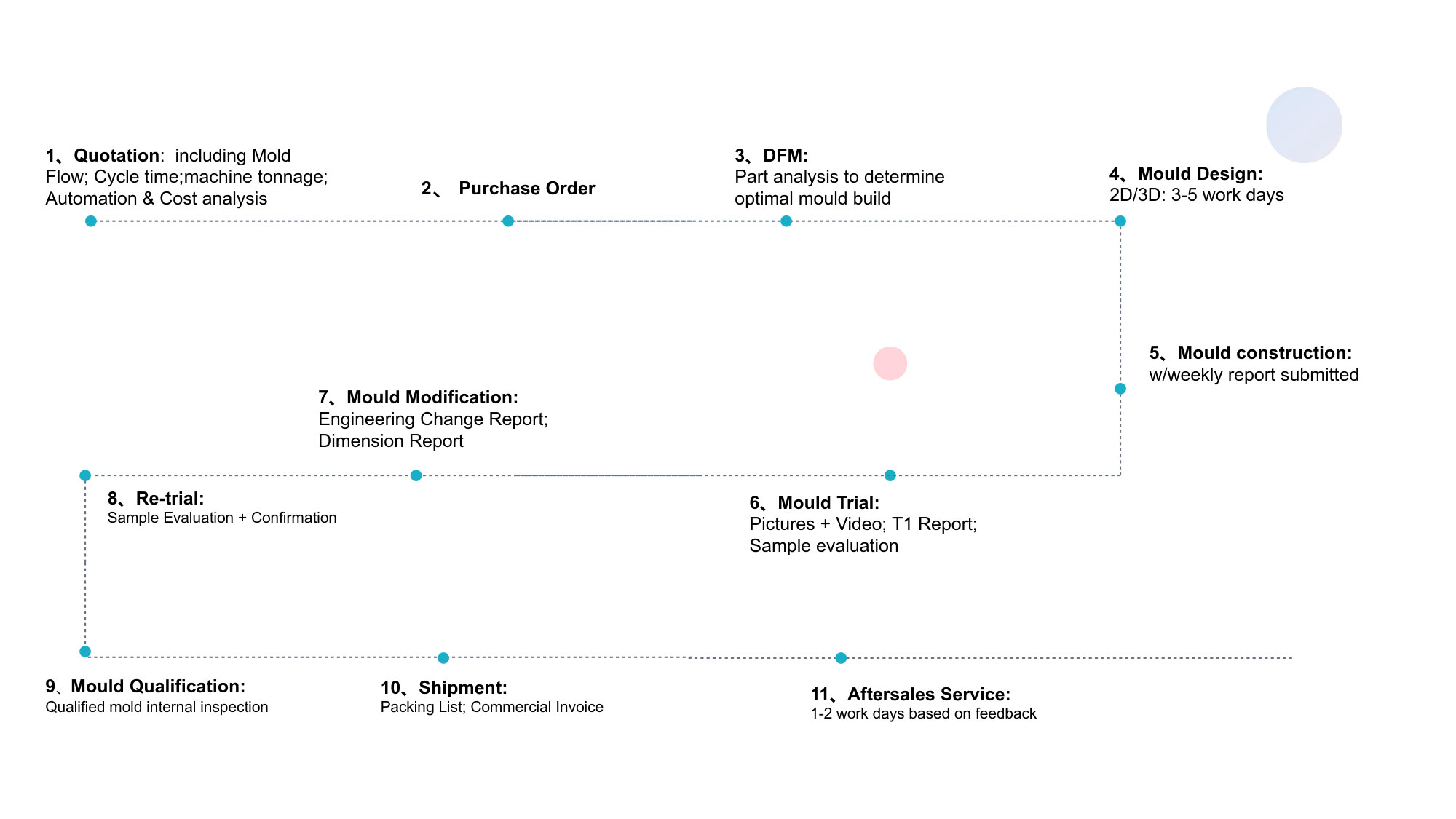
3.7 Mold Manufacturing Process Flow
Stage 1: DFM (Design for Manufacturing) Review (Days 1–7) —
We provide a comprehensive mold feasibility report including draft angle recommendations, wall thickness optimization, gate location, predicted shrinkage, ejector mark placement allowances, and potential defect analysis before any steel is cut.
Stage 2: Mold Design and Steel Preparation (Days 7–14) —
3D mold design with full cooling channel modeling, ejection system layout, and runner balancing completed in SolidWorks/UG. Steel blocks ordered, cut to size, and stress-relieved.
Stage 3: Rough Machining (Days 14–21) —
CNC roughing of mold plates, cavity roughing, core roughing with 0.5mm stock allowance.
Stage 4: Heat Treatment (Days 21–25) —
Vacuum hardening, tempering, and stress relief per material specifications. Hardness verification before finishing.
Stage 5: Precision Machining (Days 25–35) —
Five-axis finishing (±0.002mm), wire EDM for narrow slots (0.03mm), sinker EDM for deep rib features, surface grinding for parallelism.
Stage 6: Bench Fitting and Polishing (Days 35–42) —
Mirror polishing (Ra ≤ 0.05μm for cosmetic surfaces), texturing (VDI 3400 or customer-specified patterns), assembly fitting.
Stage 7: T1 Trial and Mold Validation (Days 42–45) —
First shots captured, dimensional inspection with CMM, visual inspection under magnification, defect analysis.
Stage 8: T2–T3 Optimization (Days 45–50) —
Process parameter refinement, venting adjustments, ejector tuning, gate balance optimization.
Stage 9: Mold Aging Test and CPK Validation (Days 50–55) —
2,000-shot aging test at full production speed. Full dimensional inspection after test. CPK ≥ 1.33 certified for all CTQ dimensions.
Stage 10: Shipment (Day 55–60 for standard projects) —
Complete documentation package including material certificates, heat treatment curves, CMM inspection reports, CPK analysis, spare parts list, and maintenance instructions.
Lead Time Summary:
Mold Complexity Standard Lead Time Expedited Lead Time
Simple two-plate mold (≤ 8 cavities) 25–30 days 18–20 days
Medium-complexity hot runner mold (16–32 cavities) 35–45 days 28–32 days
Complex high-cavitation (32–48 cavities) with hot runner 50–60 days 40–45 days
Two-shot (2K) or stack molds 60–75 days 50–55 days
Section Four: Injection Molding Process Control—Eliminating Your Quality Concerns
4.1 Process Standardization
All injection molding machines at Ansix Tech are networked to our Manufacturing Execution System (MES). Critical process parameters—melt temperature, injection pressure, holding pressure profile, screw speed, cooling time—are electronically locked in the system . Only authorized engineers can modify any parameter, and every change is logged with timestamp and operator ID.
First-piece inspection at the start of every production shift
In-process inspection every hour (critical dimensions)
Last-piece inspection at the end of every shift
Cross-shift correlation to detect drift before it produces rejects
4.2 Real-Time Dimensional Stability Control
Our molding machines are equipped with ultrasonic wall thickness sensors that monitor part thickness in real-time and automatically adjust holding pressure to compensate for variations. This closed-loop control system maintains dimensional fluctuation within ±0.02mm even when environmental conditions change.
4.3 Cosmetic Surface Quality Standards
Surface Type Achievable Standard Inspection Method
High-gloss / Piano black Ra ≤ 0.1μm, no flow marks, no gate vestige Visual under 500 lux, gloss meter
Matte / Soft-touch Uniform texture (VDI 3400-3406), no splay marks Texture comparator, visual
Clear / Transparent No bubbles, no flow lines, haze < 2% Haze meter, backlight inspection
Electroplating-ready No gas marks, no surface porosity Scratch test, microscope
Printing-ready (screen/hot stamping) Registration tolerance ±0.1mm Optical comparator
4.4 Advanced Materials Capability
We have extensive production experience with the following resin families for cosmetic packaging:
PP (Polypropylene) — Cost-effective, chemical-resistant, good for cream jar bodies
ABS (Acrylonitrile Butadiene Styrene) — Tough, impact-resistant with low shrink and high dimensional stability, widely used for cosmetic parts
PC (Polycarbonate) — Strong, extremely impact-resistant with low shrink, good dimensional stability, available in optically clear grades, accepts high cosmetic finishes well
ABS/PC Blend — Combines strength and heat resistance of polycarbonate with flexibility of ABS, provides improved processing during injection molding, increased toughness and dimensional stability, higher heat resistance than ABS, and improved low temperature impact resistance than PC
PMMA (Acrylic) — High optical clarity for transparent jars, excellent weatherability
PET/PETG — High clarity and gloss for premium packaging
AS (Acrylonitrile Styrene) — Excellent clarity, good chemical resistance
PPS+40%GF — High-temperature resistance for hot-fill applications
PEEK — Premium performance for luxury packaging requiring extreme durability
PTFE/PFA — Non-stick surfaces for specialized applications
PA6+GF30 — Enhanced strength for structural components
LSR (Liquid Silicone Rubber) — Overmolding for soft-touch features
PEI/PPS/LCP — High-heat and chemical-resistant specialty applications
Regulatory Compliance: We provide full material datasheets, RoHS compliance, REACH compliance, and Food Contact certification for all cosmetic-grade materials.
Section Five: Full-Service Capabilities—How We Reduce Your Management Costs
5.1 Early Engagement (DFM Report)
Before you pay a single invoice, we provide a comprehensive Design for Manufacturing report including:
Draft angle recommendations (minimum 1–2° for cosmetic parts)
Wall thickness uniformity analysis
Gate location optimization
Predicted shrinkage and warpage
Ejector pin mark location allowances
Potential defect analysis (weld lines, air traps, sink marks)
Material recommendation based on part function and cost targets
Tooling cost breakdown with options (steel grade, cavity count, hot/cold runner)
We solve molding risks while you can still change the CAD file—not after steel is cut.
5.2 Trial Samples and Iteration
We provide T1 to T3 trial samples, each with an improvement report. The T1 trial captures first shots and identifies all defects. We then modify venting, adjust gate balance, refine cooling, and tune ejectors—delivering T2 with measurable improvements, followed by T3 confirming full production readiness.
5.3 Pilot Run Validation
Before mass production approval, we run 100–500 shots at full production cycle time. We measure every part, calculate real-world yield, and verify Cpk ≥ 1.33 for all CTQ dimensions. Only when the pilot run confirms stability do we approve for mass production.
5.4 Decoration and Secondary Operations
Ansix Tech offers complete in-house decoration capabilities:
Screen printing — High-precision logo and label printing
Hot stamping — Premium metallic finishes for luxury brands
Pad printing — Multi-color printing on curved surfaces
Spray coating — Gloss, matte, soft-touch, and UV coating finishes
Vacuum metallization — Gold/silver/chrome finishes for premium lines
Pad painting and digital printing
Heat transfer printing for complex graphics
In-house decoration eliminates shipping parts to third-party finishing houses, reducing lead time by 10–15 days and eliminating handling damage risks.
5.5 Assembly and Packaging
We provide complete assembly services:
Spoon insertion and alignment verification
Tweezers placement and retention testing
Cap torque verification (digital torque testing to ±0.05 N·m)
Leak testing (vacuum decay or pressure testing)
Automated optical inspection for surface defects
Tray loading, shrink wrapping, and carton packing
Custom packaging design for drop-test protection
One-stop solution: From raw plastic pellets to decorated, assembled, and packed products—single vendor, single quality standard, single logistics point.
5.6 Maintenance and Spare Parts
Spare wear parts (ejector pins, core inserts, guide bushings) included with every mold — no surprise replacement costs
Comprehensive maintenance instructions with recommended service intervals (20K/50K/100K shots)
Lifetime mold repair service at cost-plus pricing only
Emergency service available within 24 hours for critical tooling issues
Section Six: Customer Value Summary—What You Actually Gain
For Flip-top Cream Jar with Spoon
Eliminated: Visible flash lines on parting surface
Eliminated: Sticky or uneven lid closure
Eliminated: Moisture ingress causing cream deterioration
Achieved: 10,000+ hinge cycles without failure
Saved: 15–25% of post-molding labor cost via zero manual finishing
For Face Cream Bottle with Tweezers
Eliminated: Loose tweezers falling out during shipping
Eliminated: Cap sealing failures causing leakage
Eliminated: Thread galling or cross-threading
Achieved: ±0.02mm shutoff fit for perfect seal every time
Saved: 30% of secondary assembly cost via optimized snap-fit geometry
For Makeup Remover Pad Packaging Bottle
Eliminated: Moisture evaporation during shelf life
Eliminated: One-handed opening difficulty
Eliminated: Pad contamination from environmental exposure
Achieved: 18-month moisture retention without desiccant
Saved:
0.03
–
0.03–0.08 per unit in material cost via optimized wall thickness
Across All Product Categories
Tooling cost reduction: Material-matched steel grades eliminate over-engineering
Production cost reduction: Optimized cooling cuts cycle time by 20–30%
Scrap rate reduction: Real-time process control maintains CPK ≥ 1.33, scrap < 1–2%
Risk reduction: DFM review before tooling—no costly post-mold modifications
Lead time reduction: Expedited options available without skipping quality gates
Logistics cost reduction: Four production bases across China and Vietnam optimize regional shipping
Section Seven: Why Ansix Tech
Founded in Hong Kong in 1998, Ansix Tech has grown into a global one-stop injection molding powerhouse with four production bases in China (Shenzhen, Dongguan, Hunan) and Vietnam, covering more than 200,000 square meters with over 1,200 employees .
Certifications: ISO9001, IATF16949, ISO13485, ISO14001, BSCI, ISO8 Cleanroom, and GMP-compliant workshops—meeting US medical grade FDA 510K standards .
Industry 4.0 Implementation: Our fully integrated intelligent manufacturing ecosystem—powered by digital twin validation and MES-connected production—redefines cost structure and quality assurance for our customers .
Cost Advantage Structure: We lower your total landed cost through four channels:
Material cost: Strategic sourcing from certified global resin suppliers, volume purchasing power, and strategic inventory programs
Process cost: All-electric machines reduce energy consumption by 40–50% compared to hydraulic presses, balanced runner design reduces material waste by 20–35%
Efficiency cost: High-cavitation molds produce more parts per square meter per hour, conformal cooling reduces cycle time by 20–30%, MES process control maintains CPK ≥ 1.33 to keep scrap below 1–2%
Vietnam tariff advantage: Our Vietnam production base allows US-bound shipments to bypass 301 tariffs that apply to Chinese-origin products
Your Next Step
At Ansix Tech, we view your mold not as a piece of steel, but as a profit-generating asset. We design every mold with production-scale robustness, balanced flow paths, temperature-controlled uniformity, and wear-resistant materials—ensuring that when it reaches your production floor, it runs with zero debugging, minimal flash, and maximum service life.
Schedule a DFM walk-through. Select an existing product you plan to mold. Let us prepare a complete DFM analysis—including Moldflow simulation, gate placement optimization, cooling channel layout, predicted shrinkage, and defect risk assessment—before you approve tooling. You will see, measured in real data, exactly how we eliminate weld lines, air traps, sink marks, and dimensional variability.
Your timeline. Your volumes. Your quality targets. We deliver.
Contact: Our team responds within 12 hours. info@ansixtech.com
Ansix Tech Co Ltd
If you have any plans related to Flip-top cream jar with spoon, face cream bottle with tweezers, makeup remover pad packaging bottle , you can contact us at any time. We will turn your ideas into reality, let you realize your dreams, and obtain large orders from the market. Our contact information is info@ansixtech.com. Or contact our CTO, mail: stephen@ansixtech.com
#www.ansixtech.com #ansixtech.com #Flip-top cream jar with spoon, face cream bottle with tweezers, makeup remover pad packaging bottle #Flip-top cream jar with spoon, face cream bottle with tweezers, makeup remover pad packaging bottle moulds #Flip-top cream jar with spoon, face cream bottle with tweezers, makeup remover pad packaging bottle injection molding companies #Flip-top cream jar with spoon, face cream bottle with tweezers, makeup remover pad packaging bottle Canopy Mold injection mold companies #Ansix #Ansix moulds #Ansix china #Ansix tech china #Ansix tech company #Ansix facotry #Flip-top cream jar with spoon, face cream bottle with tweezers, makeup remover pad packaging bottle injection molding #Flip-top cream jar with spoon, face cream bottle with tweezers, makeup remover pad packaging bottle injection tools #Flip-top cream jar with spoon, face cream bottle with tweezers, makeup remover pad packaging bottle injection moulds #Flip-top cream jar with spoon, face cream bottle with tweezers, makeup remover pad packaging bottle plastic mould #Flip-top cream jar with spoon, face cream bottle with tweezers, makeup remover pad packaging bottle plastic tools #Ansix Tech #Ansix molds #Ansix injection molding #Ansix mold factory #injection molding Flip-top cream jar with spoon, face cream bottle with tweezers, makeup remover pad packaging bottle #Ansix mold factory #Flip-top cream jar with spoon, face cream bottle with tweezers, makeup remover pad packaging bottle china #Flip-top cream jar with spoon, face cream bottle with tweezers, makeup remover pad packaging bottle molds #injection factory #Flip-top cream jar with spoon, face cream bottle with tweezers, makeup remover pad packaging bottle injection molding #Flip-top cream jar with spoon, face cream bottle with tweezers, makeup remover pad packaging bottle injection molding factory #injection molding company #Flip-top cream jar with spoon, face cream bottle with tweezers, makeup remover pad packaging bottle injection mold companies #Flip-top cream jar with spoon, face cream bottle with tweezers, makeup remover pad packaging bottle#Flip-top cream jar with spoon, face cream bottle with tweezers, makeup remover pad packaging bottle mold limited #Ansix mold china #Ansix companies #Ansix company China #Flip-top cream jar with spoon, face cream bottle with tweezers, makeup remover pad packaging bottle facotry #Ansix Tech #Ansix Tech mould #Flip-top cream jar with spoon, face cream bottle with tweezers, makeup remover pad packaging bottle injection moulding #injection moulding company #Ansix Flip-top cream jar with spoon, face cream bottle with tweezers, makeup remover pad packaging bottle parts injection mold companies #medical injection molding companieschina #Flip-top cream jar with spoon, face cream bottle with tweezers, makeup remover pad packaging bottle china factory #Ansix moulding companies #Ansix molding company #Flip-top cream jar with spoon, face cream bottle with tweezers, makeup remover pad packaging bottle injection moulding facotry #Ansix Tech mold #Flip-top cream jar with spoon, face cream bottle with tweezers, makeup remover pad packaging bottle mould #Flip-top cream jar with spoon, face cream bottle with tweezers, makeup remover pad packaging bottle plastic injection molding #ansix plastic mold #Mold manufacturing #Flip-top cream jar with spoon, face cream bottle with tweezers, makeup remover pad packaging bottle parts manufacturing #Flip-top cream jar with spoon, face cream bottle with tweezers, makeup remover pad packaging bottle plastic parts factory #Flip-top cream jar with spoon, face cream bottle with tweezers, makeup remover pad packaging bottle injection parts mold #Flip-top cream jar with spoon, face cream bottle with tweezers, makeup remover pad packaging bottle PRECISION MANUFACTURING #Flip-top cream jar with spoon, face cream bottle with tweezers, makeup remover pad packaging bottle #China mold #Flip-top cream jar with spoon, face cream bottle with tweezers, makeup remover pad packaging bottle injection moulding china #Flip-top cream jar with spoon, face cream bottle with tweezers, makeup remover pad packaging bottle mould china #china precision mold #mold in china #Flip-top cream jar with spoon, face cream bottle with tweezers, makeup remover pad packaging bottle mold china #Precision molds #High-precision molds #Flip-top cream jar with spoon, face cream bottle with tweezers, makeup remover pad packaging bottle #Injection molds #Flip-top cream jar with spoon, face cream bottle with tweezers, makeup remover pad packaging bottle Factory #Flip-top cream jar with spoon, face cream bottle with tweezers, makeup remover pad packaging bottle Company #Super Large Injection Mold Factory #Large Tonnage Injection Molding Factory #Flip-top cream jar with spoon, face cream bottle with tweezers, makeup remover pad packaging bottle Company #Flip-top cream jar with spoon, face cream bottle with tweezers, makeup remover pad packaging bottle Factory #2800T Injection Molding Factory #3000 Ton Injection Molding #4500 Ton Injection Molding Factory #Large Mold Injection Molding #Large Plastic Mold Injection Molding Factory #Large Injection Mold Manufacturer #Plastic Mold Factory #Injection Mold #Plastic Mold