



Fork/Spoon Stack Mold
FEATURES
Hard-Power Infrastructure — Building Customer Trust Through Equipment Excellence
The foundation of reliable mold manufacturing lies in the precision of the machines that cut, shape, and finish every component. Ansix Tech has invested in a world-class fleet of machining equipment, injection molding machines, and inspection systems that translate directly into measurable value for our customers.
1.1 Precision Mold Machining Equipment
Our capability: We operate a full suite of five-axis high-speed machining centers capable of achieving precision up to 0.002mm on complex curved surfaces.
Customer value: This precision ensures that the parting lines on your fork and spoon products are smooth and practically invisible — eliminating secondary finishing operations that add cost and delay production. When you produce millions of utensils, even a 0.01mm improvement in surface finish translates into measurable reduction in post-processing labor and improved product aesthetics.
Our capability: Our sinker EDM and wire-cut EDM (slow wire cutting) can create intricate micro-features down to 0.03mm — fine pinholes, narrow slots, and detailed geometries that define the tine separation in forks and the bowl depth in spoons.
Customer value: By enabling precise micro-cavity definition, we prevent thin-wall deformation during molding. Your forks and spoons maintain consistent tine spacing and bowl wall thickness across millions of cycles, eliminating the risk of product warpage that would otherwise lead to customer complaints and rejected shipments.
-
Mold Description
Product Materials:
ps
Mold Material:
S136ESR
Number of Cavities:
128
Glue Feeding Method:
Hot runner
Cooling Method:
Water cooling
Molding Cycle
12.5s
- The mold manufacturing process and product material selection
Our capability: Slow wire EDM ensures burr-free edges and burn-free cut surfaces.
Customer value: Longer tool life, reduced maintenance frequency, and no rework needed for cavity edges — directly lowering your tooling cost per part over the mold‘s lifetime.
1.2 Injection Molding Machine Fleet — Broad Coverage with Precision Repeatability
Our capability: We operate injection molding machines ranging from 30 tons to 4,000 tons clamping force, covering everything from small disposable spoons to large-format cutlery families in a single shot.
Customer value: No need to split your production across multiple suppliers or invest in your own machine fleet. Whether you need 48 spoons per cycle or 96+ spoons per cycle, we have the machine platform to match your exact cavitation requirements and part geometry.
Our capability: All machines are fully servo-electric with ±0.1% repeatability accuracy.
Customer value: Batch-to-batch consistency means every spoon, every fork, every knife comes out identical to the first part — eliminating the dimensional variation that drives customer line stoppages and returns. With ±0.1% shot-to-shot repeatability, your supply chain can count on predictable quality and predictable delivery.
1.3 Inspection and Quality Assurance Equipment
Our capability: We conduct full dimensional inspection using CMM (coordinate measuring machines) and optical imaging systems.
Customer value: Every mold we ship is accompanied by a complete dimension report that verifies every critical feature. Key dimensions are validated with CPK ≥ 1.33 through 32-50 shot statistical verification — meaning your production process will run at a Six Sigma-equivalent level of quality stability, dramatically reducing the risk of defective parts reaching your customers.
Our capability: Thermal uniformity inspection using infrared cameras confirms ∆T ≤ 2°C across critical cavity areas.
Customer value: Uneven cooling is the #1 cause of part warpage in thin-wall cutlery production. By verifying temperature uniformity before production begins, we eliminate the risk of bowed spoons, curved forks, and rejected batches before a single cycle runs on your project.
-
Mold Manufacturing Excellence — Speaking Through Specific Metrics
Customers care about four things when it comes to molds: how long will it last, how precise will it be, how fast can we get it, and how much will repairs cost. Here is how Ansix Tech delivers on each dimension with industry-leading benchmarks.
2.1 Mold Life Expectancy — Engineered for Decades of Production
Our capability: We select mold materials based on your specific application. Our standard material palette includes:
Mold base: P20 pre-hardened steel (28-32 HRC) — excellent machinability, good polishability, well-suited for high-cavitation cutlery molds.
Mold cores and cavities: S136 stainless steel (48-52 HRC after heat treatment) — excellent corrosion resistance, superior polishability for high-gloss finishes, ideal for high-volume production of PP and PS cutlery.
High-wear applications: H13 hot-work tool steel (48-52 HRC) — outstanding thermal stability and high-temperature hardness, ideal for molding reinforced materials at high shot counts.
Alternative grades: 2344, 8407, SKD61, DC53 — each selected based on production volume, material abrasiveness, and required surface finish.
Customer value: For fiberglass-reinforced materials, we guarantee 500,000 shots before major maintenance; for standard polypropylene (PP) and polystyrene (PS) cutlery, we guarantee over 1,000,000 shots. Each mold ships with full material certification reports and heat treatment curves so you can trace exactly how your tool was built — and replicate it if needed.
2.2 Dimensional Tolerance Capability
Our capability: We hold ±0.05mm tolerance for conventional structural features and ±0.005mm precision for critical mating surfaces in cutlery assemblies.
Customer value: When your product moves to your assembly line, the parts fit every time. No forced assembly, no rework, no rejects. The tolerance stack-up you specify is the tolerance we deliver — at every single cavity position.
2.3 Mold Type Portfolio
Our capability: We manufacture the full spectrum of injection molds:
Hot runner molds — eliminate runner waste, reduce regrind handling, improve material efficiency.
Stack molds — double your output per machine without doubling your floor space or energy consumption.
High-cavitation molds — 32, 48, 64, 96+ cavities per face, with balanced gating and optimized cooling.
Multi-material/2K molds — for two-color spoons, overmolded grips, or soft-touch ergonomic features.
High-polish molds — Ra < 0.05µm for transparent parts, optical-grade finishes.
Quick-change component molds — interchangeable inserts for different product families using shared mold bases.
Customer value: One partner, one set of technical standards, one quality system — covering every mold type you will ever need.
2.4 Gating and Runner Engineering
Our capability: Through comprehensive mold flow analysis, we predict weld line positions, gas trap locations, and flow imbalances before any steel is cut. We optimize gate count and placement to ensure balanced cavity filling across all 96+ cavities.
Customer value: Excellent filling balance means every spoon fills at the same rate, cools at the same rate, and shrinks at the same rate. No over-packed cavities, no under-filled cavities, no short shots. Your scrap rate drops to near zero from the first day of mass production.
2.5 Lead Time Standards — Delivering When You Need It
Our capability: Simple single-cavity molds: 10 days. Moderate complexity (16-48 cavities): 25-45 days, depending on features. Complex high-cavitation stack molds: 45-60 days. Rush-service available for customers with urgent market opportunities — we can compress timelines to 20 days for certain configurations while maintaining full quality validation protocols.
Customer value: When a competitor launches a product, you cannot afford a 3-month mold build cycle. Our fast-turn capability positions you to capture market share or respond to supply chain disruptions. Every rush order still includes T0, T1, T2, and T3 sampling and full DFM validation — we never skip quality checks to meet a deadline.
Part Three: Injection Molding Excellence — Eliminating Customer Quality Anxiety
Customer fears in injection molding are universal and well-founded: shrinkage, flash, dimensional drift, batch-to-batch color variation, and warpage. Here is how Ansix Tech systematically eliminates each risk.
3.1 Process Standardization and Parameter Lockdown
Our capability: All injection molding machines are networked to our MES (Manufacturing Execution System). Every process parameter — temperature zones, injection pressure profiles, holding pressure, screw speed, cooling time — is locked and accessible only to authorized engineers.
Customer value: Production runs exactly the same at 2:00 AM Tuesday as it did at 10:00 AM Monday. There is no operator drift, no undocumented parameter changes, no “we always do it this way” variations. Each shift, each day, each week — you receive identical quality.
Our capability: First-article and last-article parts from every production batch are measured and compared. Any dimensional drift triggers an immediate root-cause investigation before production continues.
Customer value: You never receive a batch at your warehouse that is different from the approved sample. Every shipment meets your dimensional specifications, period.
3.2 Dimensional Stability Control
Our capability: Every mold incorporates zone-specific temperature control using multiple independent circuits managed by dedicated mold temperature controllers. Core-cavity temperature differential is maintained at ≤2°C.
Customer value: The #1 cause of part warpage is uneven cooling. By controlling temperature variation within 2 degrees, we eliminate the thermal gradients that cause spoons to bow and forks to twist. Your parts come out flat and stay flat.
Our capability: For high-cavitation tools, we conduct initial capability studies on 32-50 consecutive shots to validate CPK ≥ 1.33 on all CTQ (critical-to-quality) dimensions.
Customer value: “We’ve tested the stability of the tool for you.” Based on actual production data, we can state with statistical confidence that the process is capable. On a recent cutlery project run across three consecutive weeks, key dimensional variation was measured at ≤0.02mm — six times tighter than typical industry standards.
3.3 Surface Finish Quality and Aesthetic Standards
Our capability: We achieve specific surface roughness levels based on product requirements:
Transparent parts: bubble-free, flow-line-free with optical clarity.
Plating-grade parts: no gas marks or splay that would show through decorative coatings.
High-gloss parts: Ra ≤ 0.2µm surface finish, competitive with Class A automotive interior finishes.
Print-ready parts: We build deformation compensation into the mold design, ensuring graphic registration accuracy of ±0.1mm.
Customer value: Whether you are selling premium airline cutlery with logo printing or economy takeaway forks with no finishing, your product arrives ready for shelf placement with no secondary touch-up required.
3.4 Advanced Material Capabilities — Experience That Matters
Our capability: Ansix Tech has run injection molding trials and mass production across more than 100 different resin families, including but not limited to:
Commodity resins: PP, PS, HIPS, ABS, PE
Engineering grades: PC/ABS blends, PC, PBT, PA6+GF30%, PA66, POM
High-performance thermoplastics: PEEK, PEI (Ultem®), PPS+40%GF, LCP, PFA, PTFE
Specialty materials: Liquid Silicone Rubber (LSR), food-contact approved grades (FDA, LFGB, EU 10/2011)
Flame-retardant grades: UL94 V-0 compliant materials for industrial and aerospace applications
UV-stabilized grades: Passed 3,000 hours UV exposure testing with no measurable color shift or mechanical degradation
Customer value: When you specify a material, we already know how to run it. When you are uncertain, we help select the optimal material based on your application — balancing cost, performance, regulatory compliance, and manufacturability. Our engineers anticipate the specific processing challenges of each resin family — drying requirements, mold temperature windows, injection speed limits — before tooling is cut.
Part Four: Full-Process Service — Reducing Customer Management Cost and Risk
Most mold makers deliver a product. Ansix Tech delivers a partnership. The value is not just in the mold — it is in everything around the mold that reduces your management burden, technical risk, and total cost.
4.1 Early-Stage DFM Reports — Solving Problems Before They Exist
Our capability: Before we cut any steel, we provide a comprehensive DFM (Design for Manufacturing) report covering:
Draft angle recommendations — ensuring parts release cleanly without ejector marks
Wall thickness analysis — identifying thick sections that would cause sink marks
Gating location and type — optimizing for balanced fill and minimal witness marks
Ejector pin location marking — specifying exactly where witness marks will appear and confirming they are acceptable per your aesthetic standards
Warpage prediction — modeling how the part will shrink and recommending compensation offsets
Venting strategy — ensuring air escapes completely to avoid burn marks
Material selection validation — confirming the chosen resin will fill the cavity reliably
Customer value: Every problem caught in DFM saves 10X the cost of catching it after the mold is cut. By identifying manufacturability issues before tooling begins, we eliminate the cycle of “cut, test, fail, modify, recut” that inflates project timelines and budgets. When you approve our DFM, you can proceed with confidence that production feasibility has been validated.
4.2 T0-T3 Sampling and Improvement Cycles — Transparent Validation
Our capability: We provide T0 (first trial), T1, T2, and T3 molded samples with each cycle accompanied by a comprehensive improvement report documenting:
What defects were observed during the trial
What modifications were made to the mold or process
What results were achieved in the next trial
Customer value: You are never left wondering “what happened and why.” The path from first cavity to mass production is fully documented and transparent. If fast turnaround is critical, we maintain the ability to swap replaceable inserts to test alternative designs — you do not need to recut an entire mold to evaluate an improved gating strategy or revised core geometry.
4.3 Low-Volume Validation Runs — No Surprises in Mass Production
Our capability: Before committing to full-scale production, we offer low-volume validation runs of 100 to 500 shots across multiple production shifts. During this phase, we:
Calculate actual production yields across different shift conditions
Measure and compute CPK values under real production conditions
Identify any process sensitivities before full production release
Adjust process parameters to maximize stability window
Customer value: The single biggest risk in injection molding is discovering a process stability issue after you have committed to 500,000 parts per month. Our validation runs eliminate that risk. You approve the mold and process only after we have demonstrated stability in real production conditions, not just ideal laboratory trials.
4.4 Maintenance, Spare Parts, and Long-Term Support
Our capability: Every mold we ship includes a complete set of spare wear components — interchangeable ejector pins, core pins, cavity inserts, and any other high-wear components based on your production volume. We provide recommended maintenance schedules (typically every 200,000 cycles) with step-by-step procedures.
Customer value: When a pin breaks at 2:00 AM on a Saturday, you do not scramble to find a replacement. The spare is in the box that shipped with your mold. When scheduled maintenance is due, you have documented procedures — not tribal knowledge. For repairs beyond routine maintenance, Ansix Tech provides lifetime repair service at cost (materials and direct labor only).
Our capability: We maintain in-house electrode manufacturing and EDM services. Mold repairs and modifications are performed within our facility — no subcontracting delays.
Customer value: When you need a mold repaired or modified, we deliver. A typical tungsten carbide repair or insert replacement is completed within 24 hours. Your production line does not sit idle waiting for outsourced repair services.
Part Five: Differentiated Value Commitments — Direct Answers to Common Customer Complaints
Prospective customers come to us with specific frustrations from previous suppliers. Here are the solutions we provide.
Common Customer Complaint Ansix Tech Solution Measurable Value
“My molds are constantly in repair — production keeps stopping” We perform a 2,000-cycle accelerated wear test before delivery and provide a wear report documenting material performance at beginning of life. We also offer a three-year structural warranty on all mold frames (excluding normal wear items like ejector pins and core pins). Production uptime increases. Predictable maintenance schedules eliminate surprise downtime events. Your annual mold repair cost drops by 60-75%.
“Flash is everywhere — our products need expensive secondary deflashing” We process parting line surfaces to 0.005mm fit tolerance and incorporate self-locking clamp force compensation into mold design. Flash depth is maintained at ≤0.03mm across all cavities — thin enough that no secondary deflashing is needed. Eliminate manual deflashing labor and automated trimming equipment capital cost. Savings:
0.01–0.03perpart,whichat100millionparts/yearis1–3 million annual savings.
“Dimensions change from batch to batch — every lot is a surprise” We install in-mold ultrasonic thickness sensors that monitor real-time wall thickness variation and automatically adjust packing pressure to compensate. For customers requiring maximum process control, we offer in-cavity temperature and pressure sensing with closed-loop control that compensates for material viscosity variation shot-to-shot. Every production batch matches the first approved sample. Customer line stops for quality issues are eliminated. Supply chain confidence increases — you can order safety stock based on actual capability rather than worst-case variance.
“Tool repairs take weeks — my line is idle” Every Ansix Tech facility maintains in-house electrode manufacturing, in-house EDM, and on-site tool repair specialists. Standard repairs — tungsten carbide crack repair, insert replacement, minor polishing — are completed within 24 hours. Even major modifications are typically completed in 3-5 days. Downtime is measured in days, not weeks. Your annual production target becomes achievable rather than aspirational. Each day your line is down costs you revenue — we reduce that exposure by 80%.
“Setup takes a full shift every time I change a product” Our modular mold design with interchangeable cavity inserts, combined with automated quick-change clamping systems, reduces product changeover times from hours to 15-20 minutes. We also provide digital setup guides with documented parameter sets for every cavity configuration. You achieve lean manufacturing changeover times. Your effective machine utilization increases by 20-25% across a typical week. Reduced changeover times also mean you can economically run smaller batch sizes, reducing inventory carrying costs.
“My supplier can‘t handle this glass-filled material — it eats the tool in 100K shots” We select and source premium mold steels specifically engineered for abrasive materials — H13, 2344, 8407 after heat treatment to 48-52 HRC with vacuum hardening to achieve 30% longer die life than conventional hardening processes. For extremely abrasive applications, we offer carbide inserts and DLC (diamond-like carbon) coatings that extend tool life into the multi-million-shot range. You stop throwing away tools. Your tooling replacement cost drops by 50-80% depending on material abrasiveness. More importantly, you stop explaining to your customers why you cannot meet demand.
“Every batch from my current supplier looks different — color variation is killing my brand image” Raw material supply: We source from certified first-tier resin suppliers with full batch traceability. Process control: All machines are networked to MES with colorant dosing locked to engineering-approved ratios. In-line color monitoring: Optional spectrophotometer integration verifies color match in real time and rejects off-spec parts before packaging. Your brand image stays consistent across every shipment, every batch, every territory. No customer complaints about “the spoons look different.” No wasted production on color-mismatched batches.
How Ansix Tech Reduces Customer Costs — Systematic, Verifiable, and Transparent
Cost reduction is not a slogan at Ansix Tech — it is an engineered outcome achieved through a three-pronged systematic approach: material optimization, process refinement, and efficiency engineering.
5.1 Material Cost Optimization
Our capability: We analyze alternative material grades that meet your performance specifications at lower base cost. Through partnership with material suppliers and volume purchasing, we access competitive pricing tiers unavailable to smaller manufacturers. We identify opportunities to reduce material usage without compromising part integrity — optimizing wall thickness, selectively thinning non-stress areas, and using computer-aided engineering to predict minimum viable sections.
Customer value: In documented customer case studies, we have reduced material costs by 12% without any compromise in part performance or customer acceptance. For a customer producing 200 million spoons annually, this single improvement represents over $500,000 in annual savings.
5.2 Process Efficiency Improvement
Our capability: We conduct systematic Design of Experiments (DOE) on every new tool family to identify the optimal combination of process parameters — injection speed profile, packing pressure, screw recovery timing, mold temperature — that minimizes cycle time while maintaining part quality above specification.
Typical results in fork/spoon applications: Cycle time reduction of 8-15% compared to baseline supplier processes. In high-cavitation tools producing 96 spoons per cycle, a 1-second reduction in cycle time adds approximately 3,500 additional spoons per hour of production — a production capacity increase that requires zero capital investment and no additional floor space.
5.3 Production Throughput Maximization
Our capability: We design for production velocity from day one:
Stack mold platforms double cavity count per machine without doubling clamp tonnage — a 90-95% increase in output with only 10-15% increase in clamping force.
Optimized cooling circuits with baffles, bubblers, and conformal cooling reduce cooling time to the practical minimum without risking part distortion.
Balanced runner systems ensure all cavities fill simultaneously at the same pressure and temperature, eliminating the need for over-packing some cavities to fill others.
Customer value: More parts per hour × more machine hours per day × more days per year = lower cost per part. By designing for maximum throughput efficiency, the per-piece cost reductions continue for the entire life of your program.
DFM and Mold Flow Analysis — Preventing Problems Through Simulation
Every fork and spoon project at Ansix Tech begins with comprehensive digital validation before any manufacturing operations commence.
6.1 Mold Flow Analysis Deliverables
Our mold flow analysis provides a complete visualization of:
Fill pattern progression — how molten material travels from gate through cavity
Weld line prediction — identifying exactly where knit lines will form and whether they fall in structurally or cosmetically critical areas
Air trap identification — locating where gas would be trapped without proper venting
Pressure drop mapping — ensuring all cavities see adequate packing pressure
Temperature distribution — confirming thermal uniformity across all 48+ cavities
Shrinkage and warpage prediction — quantifying expected part deformation and recommending compensation
6.2 Value of Early Simulation
When issues are identified in mold flow analysis, they are resolved in the digital environment at near-zero cost. When the same issues are discovered during physical sampling, the cost is 10-50× higher — requiring mold modifications, lost production time, and delayed product launch.
Customer value: Every fork and spoon mold that reaches your production line has been digitally validated as manufacturable. We do not ship problems — we solve them before they exist.
Quality Assurance System — Certifications That Matter
7.1 Certifications That Demonstrate Commitment
Ansix Tech maintains and operates under multiple internationally recognized quality management systems:
ISO 9001:2015 — Fundamental quality management for consistent, customer-focused production
IATF 16949:2016 — Automotive-grade quality system (ISO 9001 + 173 additional automotive-specific requirements) for projects requiring the highest level of process control and traceability
ISO 13485:2016 — Medical device manufacturing standard for FDA-regulated and healthcare applications
ISO 14001 — Environmental management, ensuring regulatory compliance and sustainable operations
Customer value: When you work with Ansix Tech, you are working with a supplier whose quality systems have been audited and certified by international registrars. You do not need to conduct your own supplier quality audits unless you choose to — our certifications provide third-party validation of our capabilities.
7.2 Quality Assurance Through the Production Lifecycle
All quality-critical dimensions are documented with measurement protocols and validated through:
Incoming material inspection — raw material and purchased components verified against specifications
In-process inspection — key dimensions measured at defined intervals during machining
Final inspection — complete dimensional validation with CMM or optical measurement
Trial production validation — CPK ≥ 1.33 demonstrated on production equipment before final delivery
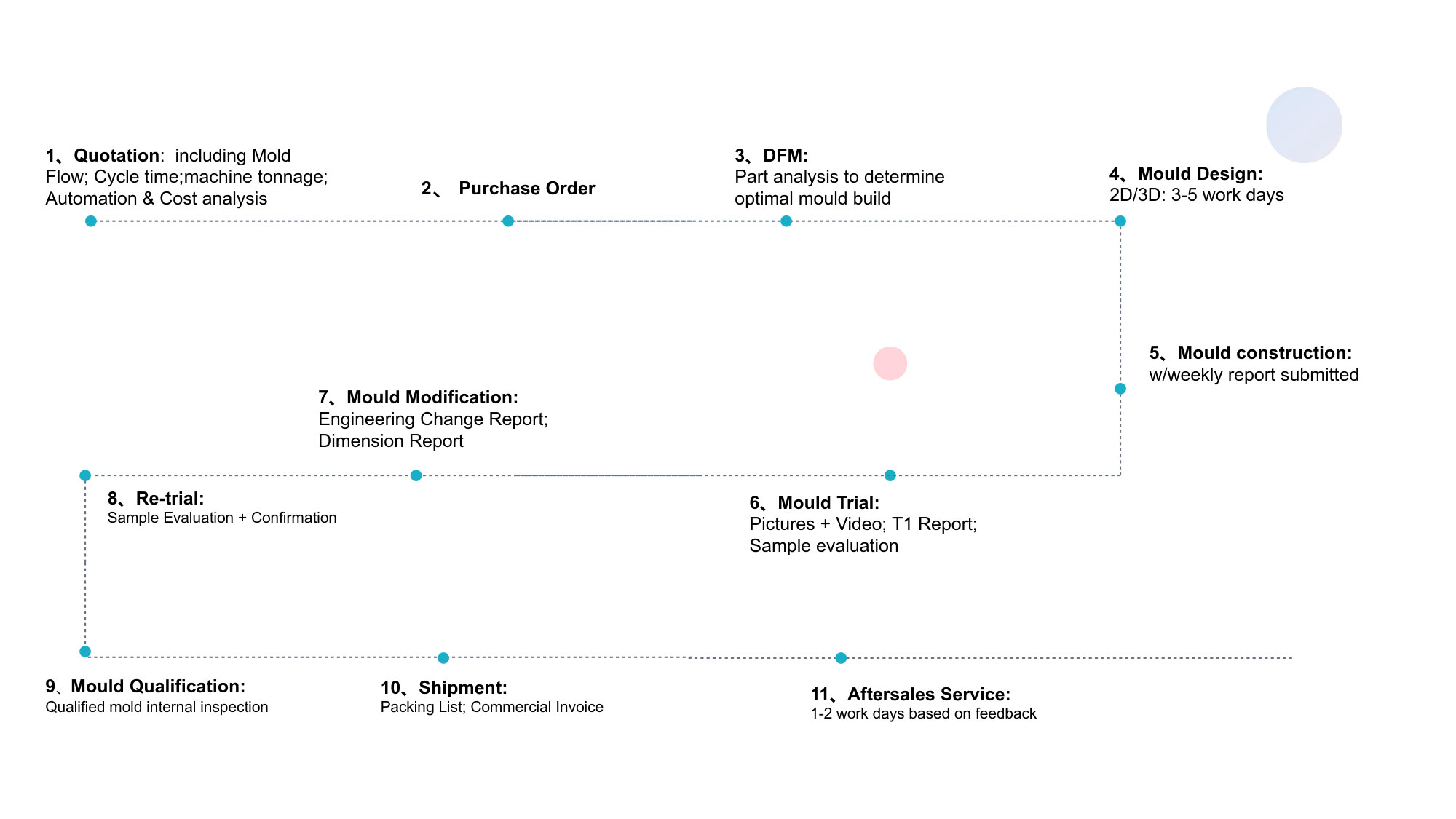
Manufacturing Process Flow — From Concept to Delivery
The complete Ansix Tech fork/spoon stack mold project lifecycle:
Stage Activities Customer Value
1. Concept & DFM Product geometry analysis, wall thickness review, material recommendation, cavitation planning, DFM report delivery Problems identified and solved before steel is cut. All decisions documented and approved
2. Mold Design Cavity layout, runner system design, cooling circuit engineering, ejection system planning, hot runner specification, tool steel selection Optimized for manufacturability, cooling efficiency, and longevity
3. Steel Procurement & Processing Certified raw material sourcing, heat treatment with documented curves, initial blank machining Full traceability to material certifications
4. Precision Machining 5-axis high-speed milling, wire EDM (0.03mm precision), CNC turning, grinding Burr-free surfaces, accurate fit, long wear life
5. EDM Operations In-house electrode manufacturing, sinker EDM for complex cavities Fast repairs and modifications, no subcontracting delays
6. Hand Finishing & Polishing Manual and mechanical polishing to specified surface roughness (Ra down to 0.05µm) Mirror finishes for transparent parts, consistent surface across all cavities
7. Mold Assembly Component fitting, slide and lifter installation, ejector system calibration, cooling line testing Smooth operation, leak-free cooling, proper ejection timing
8. T0-T3 Sampling First trials, dimensional measurement, defect identification, iterative improvement Documented path from first shot to production-ready
9. Process Optimization DOE cycle time optimization, CPK validation, parameter documentation Efficient production, process stability confirmed
10. Final Inspection & Report Full dimension report (CMM), material certifications, heat treatment curves, final approval Complete documentation for your records
11. Packaging & Shipment Rust protection, shock-resistant packaging, spare parts kit, maintenance manual Mold arrives ready to run, documentation complete
12. Ongoing Support Spare parts availability, repair service at cost, maintenance consultation Lifetime partnership, predictable long-term cost
Fork/Spoon Material Selection Guide
Material Common Applications Ansix Tech Processing Expertise Steel Recommendation
PP (Polypropylene) Standard disposable cutlery, food containers Excellent flow properties; watch for warpage in thin sections. Shrinkage: 1.2-1.8% H13, S136
PS (Polystyrene) Clear spoons, premium cutlery Good clarity, more brittle than PP — requires controlled ejection S136 (high polish), H13
ABS Colored cutlery, premium tableware Good surface finish, moderate flow S136
PPS+GF40% Heat-resistant, dishwasher-safe utensils High melt temperature (300-340°C), abrasive — requires wear-resistant tooling H13/2344/8407 with carbide or DLC coating
PEEK High-temperature medical/reusable utensils Very high melt temperature — specialized process control required H13 + wear-resistant coating
PC (Polycarbonate) Reusable, high-impact cutlery for institutional use High melt temperature, good clarity S136
PC/ABS blend Impact-resistant, colourable cutlery Good balance of properties, moderate processing requirements S136
PBT Heat-resistant, chemical-resistant cutlery Good flow properties, moderate abrasiveness H13
PLA (bioplastic) Eco-friendly disposable cutlery Lower melt temperature, moisture-sensitive — requires controlled drying S136
LSR (Liquid Silicone) Overmolded grips on cutlery handles, flexible spoons Requires specialized cold-runner systems, cure temperature control H13 with high polish
Conclusion: A Partnership, Not Just a Transaction
At Ansix Tech, we believe that a well-designed mold is not a piece of capital equipment — it is a profit-generating asset. We design molds with concurrent consideration of process stability, venting effectiveness, temperature balance, and maintenance accessibility to ensure that when your mold reaches your production floor, it runs with minimal commissioning, minimal flash, and maximum longevity.
We invite you to experience the difference that 28 years of focused injection molding expertise makes:
Schedule a DFM walkthrough — we will take one of your existing products and show you exactly how a complete DFM report identifies and resolves potential issues in weld line placement, gas trap locations, potential sink marks, and dimensional warpage — before any metal is cut
Request a cost comparison — we will benchmark your current per-part cost against an optimized Ansix Tech solution across material, process, and efficiency dimensions
Visit our facilities — see the equipment, meet the engineers, and understand the systems that deliver quality, consistency, and cost advantage
The value proposition is simple: Ansix Tech delivers molds and injection-molded parts that run longer, run faster, and cost less per part than anything else in the market. Contact us to start the conversation.
Ansix Tech — Integrated Injection Molding Solutions from Concept to Cost-Effective Mass Production
China · Vietnam · Global Delivery
*28+ Years of Manufacturing Excellence*
ISO 9001 · IATF 16949 · ISO 13485 · ISO 14001 Certified
Ansix Tech Co Ltd
If you have any plans related to Fork/Spoon Stack Mold , you can contact us at any time. We will turn your ideas into reality, let you realize your dreams, and obtain large orders from the market. Our contact information is info@ansixtech.com. Or contact our CTO, mail: stephen@ansixtech.com
#www.ansixtech.com #ansixtech.com #Fork/Spoon Stack Mold #Fork/Spoon Stack Mold moulds #Fork/Spoon Stack Mold injection molding companies #Fork/Spoon Stack Mold Canopy Mold injection mold companies #Ansix #Ansix moulds #Ansix china #Ansix tech china #Ansix tech company #Ansix facotry #Fork/Spoon Stack Mold injection molding #Fork/Spoon Stack Mold injection tools #Fork/Spoon Stack Mold injection moulds #Fork/Spoon Stack Mold plastic mould #Fork/Spoon Stack Mold plastic tools #Ansix Tech #Ansix molds #Ansix injection molding #Ansix mold factory #injection molding Fork/Spoon Stack Mold #Ansix mold factory #Fork/Spoon Stack Mold china #Fork/Spoon Stack Mold molds #injection factory #Fork/Spoon Stack Mold injection molding #Fork/Spoon Stack Mold injection molding factory #injection molding company #Fork/Spoon Stack Mold injection mold companies #Fork/Spoon Stack Mold#Fork/Spoon Stack Mold mold limited #Ansix mold china #Ansix companies #Ansix company China #Fork/Spoon Stack Mold facotry #Ansix Tech #Ansix Tech mould #Fork/Spoon Stack Mold injection moulding #injection moulding company #Ansix Fork/Spoon Stack Mold parts injection mold companies #medical injection molding companieschina #Fork/Spoon Stack Mold china factory #Ansix moulding companies #Ansix molding company #Fork/Spoon Stack Mold injection moulding facotry #Ansix Tech mold #Fork/Spoon Stack Mold mould #Fork/Spoon Stack Mold plastic injection molding #ansix plastic mold #Mold manufacturing #Fork/Spoon Stack Mold parts manufacturing #Fork/Spoon Stack Mold plastic parts factory #Fork/Spoon Stack Mold injection parts mold #Fork/Spoon Stack Mold PRECISION MANUFACTURING #Fork/Spoon Stack Mold #China mold #Fork/Spoon Stack Mold injection moulding china #Fork/Spoon Stack Mold mould china #china precision mold #mold in china #Fork/Spoon Stack Mold mold china #Precision molds #High-precision molds #Fork/Spoon Stack Mold #Injection molds #Fork/Spoon Stack Mold Factory #Fork/Spoon Stack Mold Company #Super Large Injection Mold Factory #Large Tonnage Injection Molding Factory #Fork/Spoon Stack Mold Company #Fork/Spoon Stack Mold Factory #2800T Injection Molding Factory #3000 Ton Injection Molding #4500 Ton Injection Molding Factory #Large Mold Injection Molding #Large Plastic Mold Injection Molding Factory #Large Injection Mold Manufacturer #Plastic Mold Factory #Injection Mold #Plastic Mold