



Fully automatic honey bottle cap filling machine
FEATURES
Competitive Advantages
Production Efficiency: Multi-nozzle configurations with 6 to 24 cavities in a single mold achieve production speeds of 1800-3200 bottles per hour, reducing per-unit cycle time by leveraging parallel processing.
Quality Assurance: Each machine undergoes full-dimension inspection using CMM and optical imaging systems. Key dimensional tolerances are maintained within ±0.01mm, and sealing integrity is verified through automated torque testing and pressure decay testing.
Cost Control Leadership: By optimizing cavity count, implementing conformal cooling channels, and leveraging in-house mold manufacturing capabilities, Ansix reduces tooling amortization costs by up to 30-40% compared to fragmented supply chain models.
After-Sales Service: Ansix provides 24/7 technical support, spare parts inventory for key components (ejector pins, threaded core assemblies), on-site maintenance within 72 hours for domestic clients, and remote diagnostics via IoT-enabled machine connectivity.
-
Mold Description
Product Materials:
PP
Mold Material:
S136ESR
Number of Cavities:
32
Glue Feeding Method:
Hot runner
Cooling Method:
Water cooling
Molding Cycle
12.5s
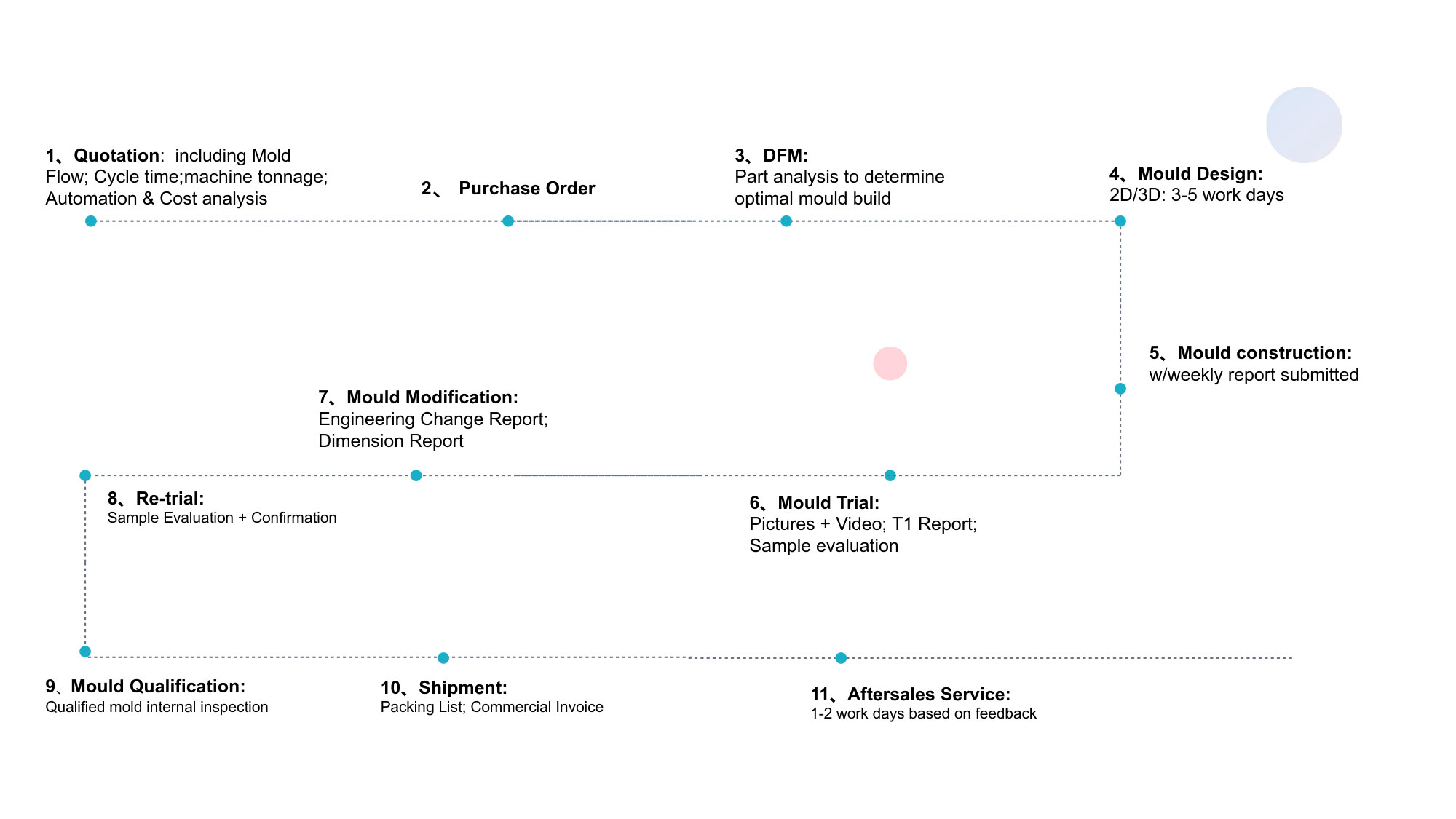
- The mold manufacturing process and product material selection
Part Two: Ansix’s Path to Industry Leadership and Customer Satisfaction
2.1 Customer Satisfaction Framework: From Technical Metrics to Business Value
Ansix’s philosophy is simple but profound: “A mold is not a block of steel — it is a revenue-generating asset.” This mindset drives every decision, from initial design validation through post-delivery support.
Technical Capability Translated Customer Value
0.002mm machining accuracy via 5-axis high-speed machining centers Seamless parting lines with zero burrs — eliminates secondary finishing costs
70% automated machining ratio Consistent repeatability across batches — no surprise variations
Two-trial average mold validation (industry standard: 5-7 trials) Faster time-to-market — 30-40 days saved in development cycle
ISO 13485:2016 cleanroom (ISO Class 8) + FDA 510(k) compliant Regulatory-ready — no additional compliance costs
In-house mold repair with 24-hour turnaround Minimized production downtime — $5,000–$15,000 saved per incident
CPK ≥1.33 for critical dimensions Statistical confidence in every shipment — 99.73% of parts within spec
-
How Ansix Achieved Industry Leadership
1. Vertical Integration Without Fragmentation — Most manufacturers require customers to manage separate vendors for design, tooling, production, and assembly. Ansix unifies the entire value chain under one platform: 200+ dedicated engineers, 260 injection molding machines (30–2800 tons), four production bases across China and Vietnam, and 200,000 m² of manufacturing space.
2. 28-Year Cumulative Knowledge Base — Since 1998, Ansix has delivered over 30,000 mold sets across medical, automotive, consumer electronics, and packaging sectors. This cross-industry learning directly benefits honey cap projects through proven best practices in thermal management, material selection, and cycle optimization.
3. Data-Driven Continuous Improvement — All injection molding machines are networked via MES (Manufacturing Execution System). Parameters (temperature, pressure, injection speed, holding time) are locked to engineer-authorized settings only. Historical data from each production run is archived, enabling root-cause analysis and ongoing cycle time reduction of 5–8% annually.
Part Three: End-to-End Service — Design, Development, Validation, Production, Quality, Delivery, After-Sales
3.1 Product Design Development
Phase 1 — DFM (Design for Manufacturing) Report — Before any tooling begins, Ansix conducts a comprehensive DFM analysis covering: draft angle recommendations (0.5°–2° depending on feature depth), wall thickness optimization (±0.05mm uniformity), gate placement strategy, and ejector pin location allowances.
Phase 2 — Mold Flow Analysis (MFA) — Using advanced simulation software (e.g., Moldflow), Ansix predicts weld line positions, air trap locations, and fill imbalance across multi-cavity configurations. For a 24-cavity honey cap mold, MFA typically identifies 3-5 optimization opportunities before steel cutting begins, reducing T0 trial iterations by 60%.
Phase 3 — CAD/CAM Integration — All designs are parametric, ensuring that any late-stage engineering change propagates automatically through mold design, CNC programming, and inspection documentation.
3.2 Product Validation
T0–T3 Sampling Protocol — Ansix follows a four-tier validation ladder:
Trial Purpose Deliverable
T0 (First trial) Verify basic mold functionality First-off samples + defect log
T1 Optimize gate balance, cooling, venting Full dimensional report (CMM + optical)
T2 Validate full-cycle performance (8-hour run) CPK analysis (target ≥1.33)
T3 (Pre-production) 100–500 part run with final process settings Customer-approved sample lot + process book
2000-Mold Wear Test — Every production mold undergoes a 2000-cycle accelerated aging test with the intended material (e.g., PP, HDPE, or PET). A wear report documents dimensional drift, surface finish degradation, and component wear patterns — providing customers with predictable maintenance schedules.
3.3 Mass Production
Multi-Cavity Economics — Ansix deploys cavity counts from 6 up to 24 for bottle cap applications. A 24-cavity mold produces 24 caps per injection cycle — typically 2.5–3.5 seconds per cycle — resulting in 24,000–34,000 caps per hour per machine. Compared to single-cavity tooling, per-unit cost is reduced by approximately 70%.
Automatic Unscrew Mechanism — For screw caps (internal threads), Ansix employs servo-driven gear-rack unscrewing systems where the oil cylinder drives a rack, the rack rotates the main gear G1, and G1 sequentially drives larger gears to retract threaded cores. This mechanism completes unscrewing in 1–1.5 seconds without damaging threads.
Cooling Optimization — Conformal cooling channels are designed using CFD analysis to ensure uniform temperature distribution across all cavities. Type I/II temperature difference is controlled within 2°C, reducing warpage by 40% and shortening cooling time by 15–25%.
3.4 Quality Assurance
Incoming Material Control — Each resin lot (PP, HDPE, PET, etc.) is tested for melt flow index (MFI), moisture content (<0.02% for hygroscopic materials), and ash content. Material certificates are archived for full traceability.
In-Process Quality Control (IPQC) — Key inspection checkpoints include:
Station Inspection Method Acceptance Criterion
First-off every shift CMM + thread gauge All dims within spec
Every 500 parts Optical vision system Cap height ±0.05mm, diameter ±0.03mm
Every 2000 parts Torque tester Opening torque: 0.8–1.5 N·m
Continuous (inline) Leak test (vacuum decay) Zero leakage at -0.08MPa
Final Audit (OQC) — AQL sampling per ANSI/ASQ Z1.4 (Level II, 0.65). Full-size measurement report and material test report accompany each shipment.
3.5 Delivery & Logistics
Standard Lead Times — Simple molds: 10–15 calendar days; medium-complexity molds (16–32 cavities): 25–35 days; high-complexity molds (48+ cavities or unscrew mechanisms): 45–55 days.
Accelerated Option — For urgent projects, T1 samples can be delivered in 14 days (with DFM completed within 5 days). Accelerated programs require 24/7 machining shift arrangements but maintain all validation steps — no shortcuts on quality.
Packaging — Molds are shipped in wooden export crates with VCI anti-corrosion treatment, desiccant packs, and full documentation (drawing package, BOM, spare parts list, maintenance manual).
3.6 After-Sales Service
Spare Parts Kit — Each mold ships with replacement ejector pins, core pins, wear plates, and hot runner nozzles — sufficient for 500,000 cycles of normal operation.
Maintenance Interval — Preventative maintenance recommended every 200,000 cycles (cleaning, lubrication, wear inspection). Ansix provides free technical consultation and cost-priced repair services.
Remote Support — Machines equipped with IoT gateways allow Ansix engineers to monitor real-time production data (cycle time, shot weight, temperature stability) and provide proactive alerts before quality deviations occur.
Warranty — 3-year structural warranty on mold base and core components (excluding normal wear items). T1 sample approval includes a signed acceptance protocol, creating clear accountability boundaries.
Part Four: Mold Manufacturing and Injection Molding — Core Value Drivers
4.1 Mold Materials and Selection Criteria
Hot Runner System Components — For high-volume honey cap production, hot runner molds are essential to eliminate runner waste and achieve faster cycle times. Ansix implements heated manifolds and valve-gate nozzles that keep polymer molten between cycles, reducing material waste by 15–20% and cutting cooling time by eliminating thick runner cross-sections.
Mold Base Steel — P20 with nitriding — P20 pre-hardened steel (28–32 HRC) provides excellent machinability for mold base plates and support pillars. Nitriding treatment (60–64 HRC surface hardness) enhances wear resistance at guide pin interfaces without compromising core toughness.
Core/Cavity Steel — S136 (Stavax ESR) / 2344 / 8407 / 2343 / NAK80 — S136 stainless mold steel (48–52 HRC after vacuum heat treatment) is the default for honey caps due to its corrosion resistance against honey’s acidic nature (pH 3.5–5.5) and its ability to achieve mirror finishes (Ra ≤0.05μm) required for clean-label food packaging. For glass-fiber reinforced materials (e.g., PP+30%GF), 2344 (H13 equivalent) or 8407 hot-work tool steel (52–54 HRC) with PVD coating extends mold life by 2–3×.
Wear-Enhanced Materials — For unscrew thread mechanisms where relative rotation causes friction, DC53 (62–64 HRC) or SKD61 with DLC (diamond-like carbon) coating reduces coefficient of friction to 0.1, extending component life to 2 million+ cycles.
4.2 Manufacturing Processes
1. Steel Receiving & Ultrasonic Inspection — Incoming tool steel blocks are scanned for internal voids or inclusions — a hidden defect that would cause premature cracking in high-cavity molds.
2. CNC Rough Machining — 3-axis milling removes 70–80% of material stock, leaving 0.3–0.5mm finishing allowance.
3. Heat Treatment (Vacuum Quench + Triple Temper) — Critical components (core pins, thread inserts, cavity blocks) undergo vacuum heat treatment (1030–1080°C for S136) followed by triple tempering (520–560°C) to achieve target hardness while relieving residual stresses.
4. 5-Axis High-Speed Finishing — Makino or GF Machining Solutions 5-axis machining centers achieve ±0.002mm positioning accuracy and surface finishes of Ra 0.2μm directly from milling. This eliminates bench hand-finishing on 85% of mold surfaces.
5. EDM (Electrical Discharge Machining) — For deep ribs, narrow slots (<0.5mm width), and complex 3D contours inaccessible to milling, Ansix uses Charmilles or Sodick EDM systems with 0.05mm electrode undersizing and ±0.003mm spark gap control.
6. Wire EDM (Slow-Wire Cut) — For parting line inserts, core pin holes, and ejector pin guide bores, slow-moving wire EDM achieves 0.03mm diameter capacity and Ra 0.4μm surface finish.
7. Fitting & Assembly — Component matching tolerances: slide-to-gib clearance 0.01–0.02mm; ejector pin-to-bore clearance 0.008–0.012mm; core/cavity shut-off clearance ≤0.005mm for zero-flash molding.
8. Texturing (Mold-Tech / Yick Sang) — If specified, texture levels from MT-10 (fine matte) to MT-110 (deep leather grain) are applied via chemical etching with masking.
4.3 Cooling System Design for High-Volume Production
Honey caps require rapid, uniform cooling to prevent warpage (which compromises seal integrity) and minimize cycle time. Ansix implements:
Conformal Cooling Channels — 3D-printed or gun-drilled curved channels that follow part geometry contour, maintaining 8–12mm distance from cavity surface. Temperature variation across Type I/Type II surfaces is ≤2°C.
Baffled & Bubbler Cooling — For deep core features (e.g., unscrew threaded inserts), spiral baffles or jet impingement bubblers achieve Reynolds numbers >10,000, achieving heat transfer coefficients 3–4× higher than straight-drilled channels.
Independent Zone Control — Core, cavity, and hot runner nozzle zones each have independent thermolator units with ±1°C regulation.
Water Flow Verification — Every cooling circuit is tested for flow rate (target: ≥1.5 m/s) and pressure drop (<0.5 bar) before mold release.
4.4 Process Quality Assurance
MES Parameter Lockdown — All molding parameters (melt temperature ±2°C, injection velocity ±3%, holding pressure ±1%, cooling time ±0.2 sec) are locked in MES with role-based access control. Any unapproved adjustment triggers an alert.
In-Mold Sensors (Optional) — Cavity pressure sensors and thermocouples provide real-time feedback. A proprietary closed-loop algorithm adjusts holding pressure on a shot-by-shot basis to compensate for viscosity variations — a key capability for maintaining CPK across PP/HDPE batches with different MFI values.
Automated Vision Inspection — Inline cameras inspect cap height, diameter, thread integrity, and gate vestige height at 30 parts per second. Rejection rates for typical honey cap production runs are maintained below 0.3% after process stabilization.
Traceability — Each batch receives a unique production ID linking material certificate, process parameters, QC records, and final inspection results — full backward traceability to resin lot.
Part Five: Cost Reduction and Risk Mitigation
5.1 Hard Cost Reductions (Direct Savings)
Cost Category Traditional Approach Ansix Approach Estimated Savings
Tooling investment Separate design + tooling + sampling vendors Single-source integrated solution 20–30%
Runner waste Cold runner with 20–30% waste Hot runner with ≤5% waste 15–20% material cost
Labor — mold repair Outsource to mold repair shop In-house 24-hour turnaround $500–2000 per incident
Secondary finishing Manual flash removal (0.1–0.2mm) Zero-flash molding (≤0.03mm flash) 0.2–0.5 cents/part
Energy consumption Hydraulic machines (variable efficiency) All-electric servo drives (repeatability ±0.1%) 30–50% energy reduction
Inventory Separate mold storage + multiple vendors Just-in-time production from unified source 15–25 days working capital
5.2 Risk Mitigation
Customer Concern Ansix Solution Risk Reduction
Mold fails before expected life 2000-cycle wear test + material certification + 3-year structural warranty Zero unplanned retooling costs
Dimension instability MES-locked parameters + in-mold sensors + CPK ≥1.33 Zero customer line stoppages
Long repair cycles In-house EDM and machining — 24-hour typical repair $5k–$15k saved per downtime incident
Regulatory non-compliance ISO 13485:2016 + ISO Class 8 cleanroom + FDA-compliant documentation Zero import refusal or recall
Supply chain disruption Two-shift operation + Vietnam backup capacity + 30-day safety stock Zero line starvation
5.3 DFM Risk Elimination (Prevention)
Before cutting steel, Ansix identifies and resolves:
Weld lines — predicted via Moldflow and mitigated through gate relocation or increased melt temperature (by 10–20°C for PP)
Air traps — eliminated by adding venting (depth 0.02–0.05mm, width 5–8mm) at predicted locations
Sink marks — addressed by rib-to-wall thickness ratio (recommended ≤0.6) or gas assist
Ejector pin marks — placed on non-critical surfaces (cap underside) with surface finish and customer pre-approval
Conclusion: Integrated Excellence
Ansix Tech’s comprehensive solution for the Fully Automatic Honey Bottle Cap Filling Machine delivers value across the entire product lifecycle — from DFM-assisted design through validated production and responsive after-sales support. By treating every technical specification as a translation point toward customer ROI, Ansix has built a foundation of trust across 30,000+ mold deliveries and 28 years of continuous operation.
Core differentiator: Not simply “making molds” — but engineering manufacturing assets that maximize output quality while minimizing total cost of ownership.
Ansix Tech Co Ltd
If you have any plans related to Fully automatic honey bottle cap filling machine , you can contact us at any time. We will turn your ideas into reality, let you realize your dreams, and obtain large orders from the market. Our contact information is info@ansixtech.com. Or contact our CTO, mail: stephen@ansixtech.com
#www.ansixtech.com #ansixtech.com #honey bottle caps #Fully automatic honey bottle cap filling machine #honey bottle caps Canopy Mold injection mold companies #Ansix #Ansix moulds #Ansix china #Ansix tech china #Ansix tech company #Ansix facotry #honey bottle caps injection molding #honey bottle caps injection tools #honey bottle caps injection moulds #honey bottle caps plastic mould #honey bottle caps plastic tools #Ansix Tech #Ansix molds #Ansix injection molding #Ansix mold factory #injection molding honey bottle caps#Ansix mold factory #honey bottle caps china #honey bottle caps molds #injection factory #honey bottle caps injection molding #honey bottle caps injection molding factory #injection molding company #honey bottle caps injection mold companies #honey bottle caps Tooling #honey bottle caps mold limited #Ansix mold china #Ansix companies #Ansix company China #honey bottle caps facotry #Ansix Tech #Ansix Tech mould #honey bottle caps injection moulding #injection moulding company #Ansix honey bottle caps parts injection mold companies #medical injection molding companieschina #honey bottle caps china factory #Ansix moulding companies #Ansix molding company #honey bottle caps injection moulding facotry #Ansix Tech mold #honey bottle caps mould #honey bottle caps plastic injection molding #ansix plastic mold #Mold manufacturing #honey bottle caps parts manufacturing #honey bottle caps plastic parts factory #honey bottle caps injection parts mold #honey bottle caps PRECISION MANUFACTURING #honey bottle caps #China mold #honey bottle caps injection moulding china #honey bottle caps mould china #china precision mold #mold in china #honey bottle caps mold china #Precision molds #High-precision molds #honey bottle caps #Injection molds #honey bottle caps Factory #honey bottle caps Company #Super Large Injection Mold Factory #Large Tonnage Injection Molding Factory #honey bottle caps Company #honey bottle caps Factory #2800T Injection Molding Factory #3000 Ton Injection Molding #4500 Ton Injection Molding Factory #Large Mold Injection Molding #Large Plastic Mold Injection Molding Factory #Large Injection Mold Manufacturer #Plastic Mold Factory #Injection Mold #Plastic Mold