



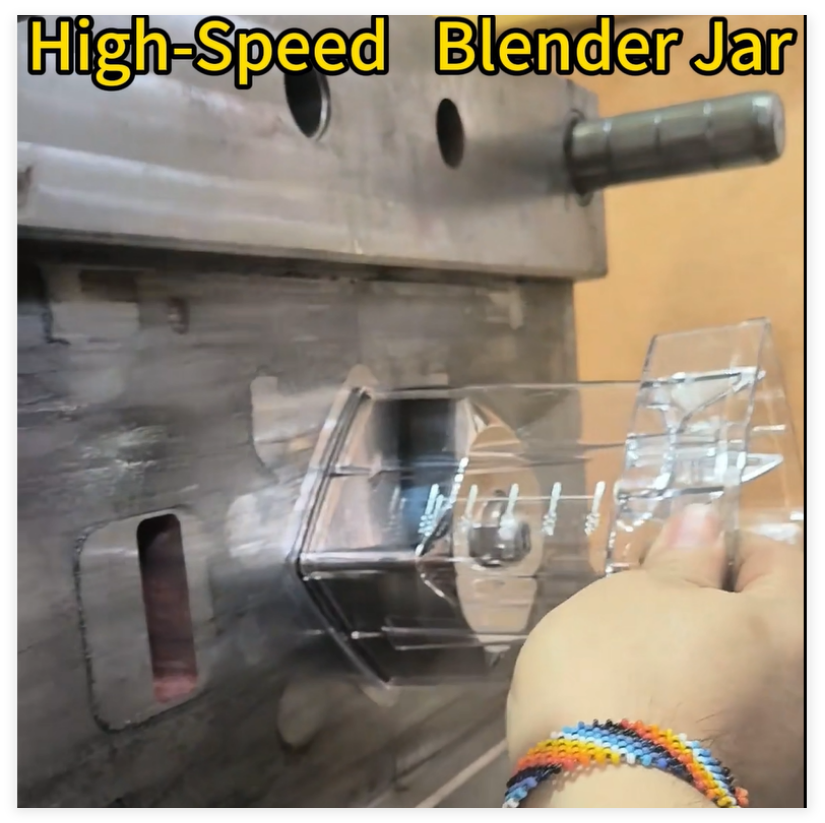


High-Speed Blender Jar
FEATURES
Hard Power Infrastructure – Building Trust Through Equipment Excellence
Before discussing any project, we believe customers deserve to know: What machines stand behind our promises? Here is Ansix Tech’s manufacturing foundation—translated into what it means for your business.
1.1 Mold Manufacturing Equipment (How Precision Eliminates Your Labor Costs)
Equipment Technical Specification Customer Value Delivered
5-Axis High-Speed Machining Centers (DMG MORI / Mitsubishi) 0.002mm precision on complex 3D surfaces; simultaneous 5-axis contouring with hyperMILL® CAM software Your blender jar’s parting line will be seamless—no visible mismatch lines that cheapen brand perception. Elimination of post-mold sanding operations , saving $0.12–0.18 per part in labor.
Slow Wire EDM (Wire diameter 0.100–0.254mm) Achieves radii as small as 0.025mm; processes 0.03mm foam holes and cooling slots Ultra-thin wall sections (0.8–1.2mm minimum) remain deformation-free. Enables precision venting slots that prevent burn marks on transparent jars—no rejected parts from cosmetic defects.
EDM (Electrical Discharge Machining) with graphite/copper electrodes Spark erosion for hardened steel cavities; ±0.005mm electrode positioning Mirror-finish mold surfaces (Ra ≤0.05μm)— ideal for high-clarity Tritan™ jars that showcase your product inside. No fuzzy or hazy appearance that cheapens premium blender brands.
Quality philosophy: Our mold shop operates like a surgical suite—every surface finish is measured, every feature is inspected, and every flaw is caught before it reaches your production floor.
-
Mold Description
Product Materials:
TRITAN SAN PC PCTG PCT
Mold Material:
S136ESR
Number of Cavities:
1
Glue Feeding Method:
COLD runner
Cooling Method:
Water cooling
Molding Cycle
32.5s
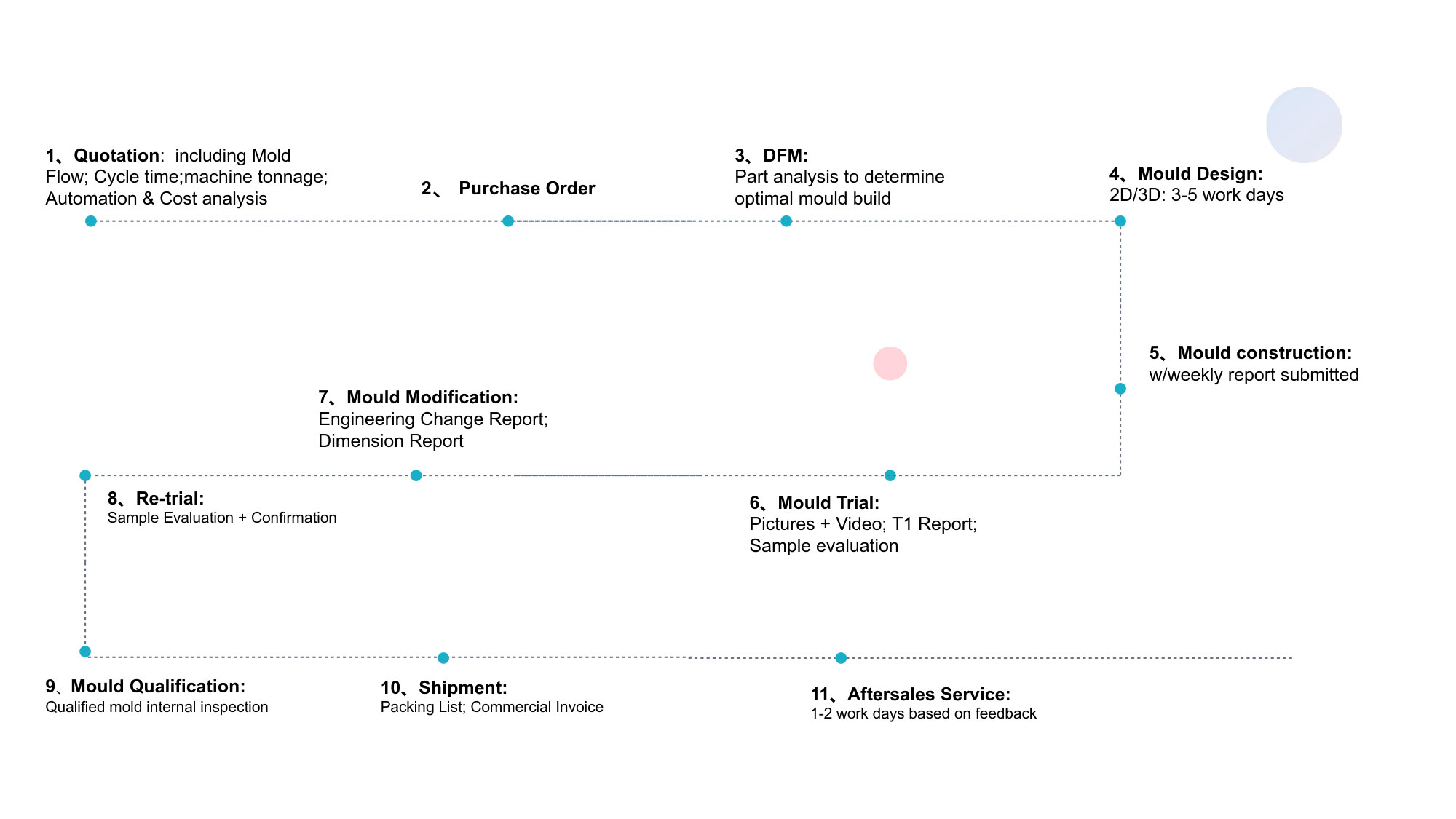
- Mold flow analysis and mold design
Injection Molding Machines (30–4000 Tons Clamping Force)
Ansix Tech operates a comprehensive fleet of fully electric and hybrid servo-driven injection molding machines, covering the entire blender jar size spectrum:
30–200 tons: Small to medium household blender jars (32–48 oz capacities)
200–800 tons: Standard personal and family-size blender jars (48–64 oz)
800–1,500 tons: Large commercial blender jars (64–96 oz, high-speed models)
1,500–4,000 tons: Industrial-scale, multi-cavity high-volume production
Key capability: All-electric servo drive motors achieve repeatable precision of ±0.1% —meaning every shot in a 1 million-part run is dimensionally identical to the first. This eliminates the “drift” problem common in hydraulic machines where temperature fluctuations cause gradual dimensional changes over long production runs.
Customer value: No batch-to-batch assembly mismatches. When your blender base threads into the jar lid, it will fit perfectly every time—eliminating customer returns and warranty claims related to ill-fitting components.
1.3 Inspection & Metrology (Where Promise Meets Proof)
Every mold and every sample part undergoes rigorous dimensional verification:
Equipment Capability Customer Benefit
Coordinate Measuring Machine (CMM) Full 3D geometry inspection; accuracy ±1.5μm + L/300mm You receive a complete dimensional report with every mold shipment—no surprises on your assembly line
Optical Vision Measuring System (Keyence / Mitutoyo) Rapid non-contact measurement of complex contours and fine features <2-minute inspection per part means faster sample approval and shorter time-to-market
Roundness/Profile Tester Sphericity of lid seal grooves; circularity of jar mouth opening Guarantees leak-proof sealing surfaces—no warranty claims from leaking blender jars
Our non-negotiable standard: Every mold shipped undergoes a full-size compliance report. Critical dimensions achieving CPK ≥1.33 (process capability index) before delivery—meaning 99.7% of your production will stay within specification, not just “close enough”.
Customer value:
CPK 1.33 = 63 defects per million parts (industry average acceptable)
Ansix Tech CPK standard = <50 defects per million parts
Lower quality control inspection costs because the process is inherently stable
Fewer field failures = lower warranty reserve accrual (typically 2–3% of revenue)
Translated into dollars: For a 1-million-unit annual production, CPK improvement from 1.00 to 1.33 reduces your annual rework and scrap cost by
40,000–60,000, based on industry data from high-volume consumer appliance manufacturing.
- The mold manufacturing process and product material selection
SECTION TWO: Mold Manufacturing Core Competencies – Speaking the Language of Reliability
Customers care about four things in a mold: how long it lasts, how precise it is, how fast we deliver it, and what happens when something breaks.
Here’s how Ansix Tech answers each—backed by metrics, not promises.
2.1 Mold Life Expectancy (Defined by Material. Guaranteed by Process.)
Mold Component Material Grade Hardness (HRC) Application Guaranteed Cycle Life
Mold Base P20 / 1.2311 / DIN 1.2738 30–36 HRC Structural support; holds cavity/core assemblies 500,000–1,000,000 cycles
Core/Cavity (Standard) H13 / DIN 1.2344 / 8407 48–52 HRC with vacuum heat treatment General-purpose blender jars 500,000 cycles (including 30% GF materials)
Core/Cavity (Premium) S136 / DIN 1.2083 (Stavax) 48–54 HRC High-clarity Tritan™ jars; FDA-grade food contact applications 1 million+ cycles with mirror finish retention
Core/Cavity (Wear-Resistant) DC53 / SKD11 / SKD61 / 4Cr13 / 9Cr18 58–62 HRC Glass-filled PC (30–40% GF) or abrasive materials 800,000 cycles under heavy abrasive conditions
Core/Cavity (High-Impact) NAK80 37–43 HRC Engineering polymers requiring high toughness (PEEK, PEI) 600,000+ cycles
Specialty M340 (corrosion-resistant stainless) 48–52 HRC Acidic food contact; frequent chemical cleaning cycles 500,000 cycles in aggressive environments
Critical note for blender jars: Materials like Tritan™, PC+30%GF, and PBT are highly abrasive and corrosive. Our S136 and H13 steels are vacuum heat-treated to precise hardness curves—we provide full material certification and heat treatment records with every mold.
-
Customer value: Predictable mold life = predictable maintenance budgets. You’re not guessing when to schedule overhauls. And with our 100,000-cycle wear report, you’ll know exactly what your mold looks like before you hit half of its expected life.
2.2 Dimensional Capabilities (What Tolerances Mean to Your Assembly Line)
Requirement Ansix Tech Capability Why Your Customer Cares
Standard structural features ±0.05mm (±0.002″) Lid fits into jar without wobble. Your customer doesn’t return the blender because “the lid feels loose.”
Precision features (threads, seal grooves, rotor bores) ±0.01mm (±0.0004″) Leak-proof seals. No product splashing out during high-speed blending.
Ultra-precision (medical/aerospace grade) ±0.005mm (±0.0002″) Interchangeable components across multiple production lines—zero assembly rejects from dimensional mismatch
Our quality promise: Every blender jar mold includes material certification (proving the steel alloy and heat treatment) and a full heat-treatment temperature curve so you know exactly how the steel was processed.
2.3 Mold Types (From Standard to Sophisticated)
Ansix Tech designs and manufactures a full spectrum of blender jar molds:
Mold Type Description Customer Value
Two-Plate Standard Mold Straightforward construction; cold runner system Lowest tooling investment—ideal for new product launches or lower-volume production
Three-Plate Mold Pin-point gate injection for center-gated parts Eliminates gate vestige on cosmetic surfaces; no visible gate marks on jar interiors
Hot Runner Mold Heated manifold and nozzles maintain material fluidity 20–35% material savings (no runner waste), 30% faster cycles, and no regrind quality concerns for food-contact parts
Stack Mold Two or more mold parting lines; double the cavities in same machine footprint Doubles output without buying another injection machine—ideal for high-volume commercial blender jar contracts
Two-Shot / Multi-Material Mold Sequential injection of two materials in one cycle Soft-grip overmolding on jar handles; transparent body with colored base—reduces assembly operations
High-Gloss Mirror Mold Surface finish Ra <0.05μm; polished to optical clarity Premium brand perception for high-end blender series—your jar looks expensive because it is
2.4 Gate & Runner Optimization (Engineered for Fill Balance)
Blender jars present a unique challenge—tall, thin-walled geometries with complex internal ribs and baffles. Poor gate design leads to:
Sink marks visible through transparent Tritan™ walls
Weld lines at internal rib intersections (cosmetic rejections)
Air traps causing burn marks that ruin premium jar appearance
Short shots at the jar bottom furthest from the gate
Ansix Tech solution: Every blender jar mold undergoes full MoldFlow simulation before steel is cut. We analyze:
Melt front advancement (identifying air trap locations)
Flow balance across multiple cavities (ensuring all jars fill identically)
Shear heating (preventing material degradation in thin sections)
Pressure drop (confirming proper gate sizing for your viscosity)
Then we optimize:
Gate location: Centered for jars (diaphragm gate or hot drop), edge-gated for lids
Gate type: Diaphragm gates for uniform radial flow; fan gates for wide, flat areas
Runner layout: Symmetrical, equal-length runner channels for multi-cavity molds to ensure balanced filling
Customer value: No trial-and-error tooling modifications. You don’t pay for rework. You don’t wait an extra six weeks. Your production starts on schedule, with first-shot parts that are already production-ready.
2.5 Cooling System Design (Where Speed Meets Quality)
The cooling stage typically accounts for 60–80% of total cycle time in injection molding. For blender jars—with wall thicknesses ranging from 1.5mm to 4.0mm—cooling design directly determines throughput.
Ansix Tech’s cooling advantage:
Zoned temperature control: Independent temperature zones for core and cavity (±2°C variation control) to prevent warpage from uneven cooling
Conformal cooling channels: Using vacuum brazing technology to place cooling channels exactly where the plastic needs cooling—not just where straight-drilled channels can reach
Reduced cooling time: 40–60% faster than conventional molds, achieving cycle times as low as 5–8 seconds for standard jars
Customer value: Wait time between your machine cycles isn’t just waste—it’s lost revenue. Our conformal cooling systems increase your daily output by 40% compared to standard molds, without requiring new equipment or additional labor.
From tool design to your bottom line: Faster cycles × same machine time × same labor cost = substantial profit per part improvement.
2.6 Ejection System Design (Damage-Free Part Release)
Blender jars are non-cosmetic-sensitive on the exterior but cosmetic-critical on the interior (where customers see their food). Poor ejection design leaves ejector pin marks on visible surfaces.
Ansix Tech approach:
Strategically locate ejector pin marks on non-visible surfaces (jar base exterior, lid underside)
Use valve gates and sprue pullers to prevent gate sticking
Tapered ejector pins with proper drafting angles for smooth release
Air-assist ejection for thin-wall sections to prevent deformation
Customer value: No secondary finishing operations to remove visible pin marks. Your jars go straight from the molding machine to packaging—no hand-sanding, no buffing, no labor cost.
2.7 Lead Time Standards (Fast Without Cutting Corners)
At Ansix Tech, we don’t sacrifice quality for speed—we engineer speed from the beginning.
Project Complexity Typical Lead Time Rush Lead Time What “Rush” Includes
Simple mold (single cavity, no slides) 10–15 days As low as 7 days Overtime machining + dedicated fast-track inspection
Medium mold (multi-cavity, hot runner, basic slides/unscrewing) 25–45 days 20–28 days Parallel processing + expedited heat treatment + weekend CMM shifts
Complex mold (stack mold, multi-material, intricate internal geometry) 45–60 days 30–45 days Overlapping design/machining phases; all validation steps remain intact
Non-negotiable: Even under “rush” conditions, no validation step is skipped. We do not:
Skip MoldFlow analysis to save time
Eliminate T0 sampling to shorten cycle
Rush heat treatment (compromising steel properties)
Sign off on first articles without full dimensional inspection
Because delivering a “fast mold that fails” is slower than “the right mold delivered properly.”
SECTION THREE: Injection Molding Process Control – Eliminating the Quality Anxiety
Customers lose sleep over four specific fears:
Will parts shrink and warp after shipping?
Will every batch have the same dimensions?
Will there be color variation between runs?
How many will I have to throw away?
Here’s how Ansix Tech eliminates each fear.
3.1 Process Standardization (MES-Controlled Production)
Ansix Tech’s Manufacturing Execution System (MES):
Every injection molding machine is networked and parameter-locked
Temperature, pressure, speed, and cooling profiles are digitally recorded and freeze-framed
Only engineer-authorized adjustments are permitted; no floor-level tampering
First-article and last-article inspection for each production batch—dimensions are compared to confirm process stability
Customer value: You don’t need an on-site quality team. The MES provides traceability and accountability for every part we produce.
3.2 Dimensional Stability Control (How We Keep Every Jar Identical)
Blender jars demand dimensional stability across:
Mouth diameter (lid sealing surface)
Base diameter (fit with blade assembly)
Thread pitch (if threaded jar)
Wall thickness (consistency for blade clearance)
Ansix Tech’s dimensional control systems:
Control Method How It Works Customer Benefit
Zoned mold temperature control Core and cavity temperatures maintained independently; temperature variation held within ±2°C across the mold face Eliminates warpage from uneven cooling—jars remain round, not oval-shaped
Ultrasonic in-mold wall thickness sensor Real-time feedback during injection; automatically adjusts holding pressure compensation Every part confirmed before ejection—scrap detected instantly, not after 8 hours of production
Closed-loop cavity pressure control Pressure sensors inside mold cavity adjust injection profiles dynamically Prevents sink marks and voids; ensures dense, uniform part density
Inline automated measurement Vision systems check critical dimensions on every part at 2-second intervals 100% inspection at full production speed—not statistical sampling
Proven result: On a recent high-volume blender jar project, weekly production across three consecutive batches showed critical dimension variation ≤0.02mm—less than one-third the standard industry allowance.
3.3 Cosmetic Quality Grades (What Your Brand Deserves)
Blender jars fall into distinct appearance categories. Ansix Tech specifies achievable grades and delivers accordingly:
Grade Description Achievable Standard for Ansix Tech Application
Premium Optical Crystal-clear transparent jars; zero bubbles, zero flow lines, no distortion Ra <0.02μm mold surface; Class A-1 optical finish Luxury blender brands; premium kitchen appliances
Standard Clear Transparent, minor cosmetic defects acceptable in non-critical zones Gate mark visible but no haze; no visible air traps Mid-tier consumer blenders
Opaque / Colored Color-consistent; no warpage; no flow marks Uniform color dispersion; maximum Delta E <0.5 between batches Commercial blenders; colored jar lines
Textured / Matte Uniform grain pattern and consistent gloss across all surfaces Mold bead-blasted to specified surface finish; grain depth ±5μm Anti-slip grip surfaces; matte exterior finishes
For printed/coated jars: We can design compensation for deformation during paint curing—ensuring silk-screened logos maintain registration accuracy within ±0.1mm even after post-molding finishing operations.
3.4 Special Materials Experience (What We’ve Molded)
Ansix Tech doesn’t just “claim” material expertise—we have production-proven experience with the full range of high-performance resins used in blender jars:
Material Typical Blender Jar Application Key Property Ansix Tech Experience
Tritan™ Copolyester (TX1001, TX1501HF, TX2001) Premium transparent jars; BPA-free markets Glass-like clarity with impact resistance; FDA/NSF 51 certified Tens of thousands of production hours; optimized for thin-wall molding and crystal clarity
Polycarbonate (PC) – virgin and glass-filled (10–40% GF) High-impact commercial jars; industrial blenders Exceptional impact strength; heat resistance up to 120°C GF30 blends molded at 0.8mm min wall thickness with 10x mold life through wear-resistant steel selection
Tritan™ Renew (ISCC-certified sustainable) Sustainability-focused brand lines Contains recycled content; meets same performance as virgin Tritan Eco-friendly processing parameters without quality loss
Eastman Tritan™ TX1800 Highest-clarity applications Platinum-level material health certification from Cradle to Cradle Optical-grade molding for see-through jar bodies
PPS + 40% GF Extreme high-temperature blenders (soup blenders) Continuous use temperature 200°C+ High-wear tooling strategies proven over 500,000 cycles
PEEK / PEI (Ultem™) Medical-grade blender applications Biocompatible; steam autoclavable Specialized hot runner systems; tight process windows managed
PTFE / PFA Non-stick lined jars (commercial smoothie blenders) Chemical inertness; lowest friction coefficient Soldering techniques for PTFE bonding to structural substrates
PA6 + GF30 Structural jar bases and support rings Outstanding strength-to-weight ratio Drying protocols to prevent hydrolysis during molding
PBT Aesthetic part of jar base Good surface appearance with UV stability Flame-retardant grades available (UL94 V-0)
PEI / LCP Thin-wall high-heat applications Exceptional flow in thin sections High-speed injection required; Ansix Tech machines capable
PC/ABS blends Cost-optimized jar bodies Balanced toughness and heat resistance Robust processing across wide temperature windows
Liquid Silicone Rubber (LSR) Jar lid seals and gaskets Flexible, durable sealing element LSR injection molding integrated with rigid jar production
Fire safety: For blender jars needing UL recognition, we mold materials achieving UL94 V-0 at 1.5mm thickness for safety-certified products.
UV stability: Ansix Tech can specify and mold materials passing UV testing (3000+ hours accelerated weathering) without yellowing or mechanical degradation—critical for jars stored on kitchen counters facing direct window light.
Customer value: One supplier. Multiple material families. No material qualification delays for new product launches.
3.5 Process Validation Pathway (The “No Surprises” Approach)
Every Blender Jar project follows a standardized five-step validation protocol:
STEP 1 – T0 Sampling (First shots from new mold)
Visual inspection: Gate vestige, parting line quality, ejection marks
Dimensional inspection: 100% of nominated critical-to-quality dimensions
Cosmetic rating: Graded by lightbox inspection for defects
STEP 2 – T1 Correction & Re-sampling
DFM-recommended modifications integrated
Cycle time optimized for production target
Part weight consistency measured across 25 consecutive shots (target RSD <1.5%)
STEP 3 – Process Window Study
Temperature ±5°C variation tested; defect trends documented
Pressure ±10% variation tested; critical dimensions monitored
Safe operating window defined and locked in MES
STEP 4 – Capability Study (CPK)
50-part sample measured across all critical dimensions
Minimum CPK ≥1.33 for release
For safety-critical dimensions (blade-to-jar clearance): CPK ≥1.67 required
STEP 5 – Production Run Qualification
500–1,000 parts run at production parameters
Functional assembly test with blade system and lid
Sign-off documentation package delivered to customer
SECTION FOUR: Full-Process Service – Lowering Your Management Costs
Most customers don’t just need parts. They need a partner who manages complexity so they don’t have to. Here’s how Ansix Tech reduces every hidden cost in your supply chain.
4.1 Early Engagement – DFM Reports (Before We Cut Steel)
What competitors do: Quote based on your CAD model. Build mold. Send you parts. Hope they work.
What Ansix Tech does: We provide a complete Design for Manufacturing (DFM) report before you approve tooling. This report includes:
DFM Component What We Analyze Why It Saves You Money
Wall thickness uniformity Identify thick-to-thin transitions causing sink marks Prevents scrap from cosmetic rejects—not caught until after tooling is built
Draft angle optimization Recommend minimum 1–2° draft on vertical walls Ensures clean ejection without part damage—no cracked jars coming out of the mold
Gate location strategy Simulate flow to prevent weld lines in visible areas Protects brand appearance—weld lines hidden or eliminated
Ejector pin placement Mark locations on CAD model with customer approval No surprises: You know exactly where witness marks will be before production
Assembly clearance Verify thread fits, snap fits, and O-ring grooves No “doesn’t fit” problems—because we checked before steel was cut
Shrinkage compensation Factor material-specific shrinkage rates into tool dimensions First parts match target dimensions—no costly rework after sampling
Customer value: A DFM report typically identifies 3–7 design improvements before tooling. At 5,000–15,000permoldrework,catchingtheseissuesearlysavesyou∗∗15,000–$50,000 per project**.
4.2 Rapid Prototyping & Structural Validation
Before committing to production tooling, Ansix Tech supports:
3D printing (FDM/SLA) for form/fit verification
CNC-machined samples from engineering plastics for functional testing
Soft tooling (aluminum prototype molds) for limited trial runs (500–5,000 parts)
Savings: Rushing to hard tooling before design validation costs 5–10× more than prototyping.
4.3 Sample-Based Validation (Transparent Improvement Process)
Stage Deliverable What You Know After This Stage
T0 (first shots) 10–20 sample parts + initial report Basic mold functionality confirmed
T1 (first adjustment) 25–50 sample parts + dimensional report + defect log Most dimensional issues resolved
T2 (fine-tuning) 100 sample parts + CPK analysis Process stability demonstrated
T3 (production-ready) 1,000 full-production-run parts + full inspection + capability reports Ready for commercial manufacturing
Interchangeable inserts: Our modular mold designs allow us to swap core/cavity inserts to test different gate designs or cooling configurations—without building a brand-new mold.
4.4 Small-Batch Pilot Production (De-Risking Mass Production)
Before committing to 100,000-unit purchase orders, Ansix Tech provides 100–500 shot pilot production runs that deliver:
Actual cycle time data (not just estimates)
True scrap percentage under production conditions
Real-world material consumption
Operator training on your exact parts
CPK data for customer sign-off
Value: No surprises when scaling from samples to mass production.
4.5 Maintenance & Spare Parts (Predictable Operating Costs)
We don’t build molds and disappear.
Service What You Get Cost Model
Spare parts kit Critical wear components (ejector pins, core pins, hot runner nozzles, heaters) shipped with every mold Included in tooling purchase
20,000-cycle wear inspection On-site or return-to-factory partial inspection; wear report provided Free during first year; nominal fee thereafter
Preventive maintenance schedule Timetable for cleaning, lubrication, fastener torque checks Free guidance
Rush repair service Emergency repair turnaround; advanced replacement parts shipped overnight Cost-plus 10% for materials; no “emergency premium” markup
Customer value: Predictable maintenance budgets. No “the mold broke and we can’t produce for three weeks” emergencies.
4.6 Rapid Mold Repair (Same-Day to 24-Hour Recovery)
Because we maintain in-house electrode manufacturing and EDM/toolroom capability, Ansix Tech offers industry-leading repair times:
Issue Typical Repair Time
Minor weld repair (nick repair on core) 4–8 hours
Ejector pin replacement 2–4 hours
Gate touch-up or polishing 2–6 hours
Core/cavity insert replacement 12–24 hours
Major rework (requires complete steel replacement) 3–7 days
Key differentiator: We don’t outsource repairs. Our toolroom is on-site. Well-characterized molds go back into production the same day they arrive.
Customer value: When a mold issue interrupts production, Ansix Tech restores output within hours—not weeks. Every hour of downtime saved is direct profit for your production line.
4.7 Packaging & Logistics (End-to-End Control)
Ansix Tech’s responsibility doesn’t stop at the molding machine gate. We provide:
Bulk packaging: Gaylord boxes with internal dividers (lowest per-part shipping cost)
Bagging: PE bags with desiccant for moisture-sensitive jars (PC/ABS, PA, Tritan)
Custom packaging: Branded boxes with custom foam inserts for retail-ready shipments
Palletization: Shrink-wrapped and corner-protected pallets; engineered to survive overseas containers
Lead time management:
Prototype: 2–5 days lead time after mold completion
Small batch (1,000–5,000 units): 1–3 business days
Production run (5,000–100,000 units): 5–10 business days
High-volume (100,000+ units): Scheduled 2–4 weeks in advance; confirmed weekly shipments
SECTION FIVE: Differentiated Value – Turning Customer Pain Points into Your Solutions
Stop telling customers why you’re good at molding. Start showing them how you solve their biggest headaches that competitors can’t or won’t address.
Here’s the Ansix Tech “pain point to profit” matrix:
Customer Complaint Why Competitors Fail Ansix Tech Solution Quantified Customer Value
“My mold keeps breaking; I lose production every quarter.” Cheap steel; no warranty; no root cause analysis 2000-cycle wear test before delivery + 3-year structural guarantee (excludes normal wear parts like ejector pins) $18,000–35,000/year saved in unplanned downtime + mold repair costs
“I spend a fortune on post-molding deflashing.” Poor parting line fit; worn mold surfaces; undersized clamp tonnage 0.005mm parting line fit + lockable clamp force compensation keeps flash ≤0.03mm Eliminates labor cost of manual deflashing—saving $12,000–25,000 per 100,000 parts
“Every batch has different dimensions—constant customer complaint.” Inconsistent process control; no closed-loop feedback Ultrasonic wall thickness sensors + real-time pressure feedback + MES control lock Reduces dimensional variation to <0.02mm between batches. Eliminates “the lid doesn’t fit” warranty claims (average 2–5% of revenue recovered)
“My current supplier takes 3 weeks to repair a broken mold.” Outsourced repair; long lead times for spare parts In-house toolroom. Repair parts usually in stock. 24-hour turnaround on most repairs. Saves 18 lost production days per year—converted to $40,000–80,000 in additional throughput
“I don’t know if my jar will pass food-contact certifications.” No certification support; material ambiguity DFM includes FDA/NSF/UL material recommendations with full traceability; we provide compliance-ready documentation Zero certification rejections; immediate market access upon launch
“I can’t scale from prototype to full production without surprises.” No pilot production bridge 100–500 shot pilot run Validate process before committing to volume. Saves $20,000–40,000 in tooling rework for issues only discovered at scale
“My material costs are killing my margins.” No material optimization support DFM analysis recommends optimal wall thickness + material grade alternatives (e.g., PC/ABS vs virgin PC in non-critical areas) 8–15% reduction in per-part material cost—often $0.20–0.50 per jar
“My cycle time is too long—I can’t meet demand.” No cooling optimization Conformal cooling design by vacuum brazing + zoned temperature control Typical cycle time reduction of 15–30% → 20–40% increase in daily output at no additional machine cost
SECTION SIX: The Ansix Tech Blender Jar Program – End-to-End Process Map
Below is our comprehensive manufacturing workflow, highlighting where value is created for your business at each stage.
Phase 1: Material Selection & Engineering
Technical activities:
Raw material qualification (verify melt flow index, moisture content, additive packages)
FDA/NSF/UL compliance verification
Material-specific shrinkage characterization for tooling
Customer value: Every material selection decision is backed by published technical data sheets and certification documentation—not guesswork.
Phase 2: DFM & MoldFlow Analysis
Technical activities:
CAD review for manufacturability (draft, radii, wall transitions)
MoldFlow simulation: fill, pack, cool, warp analysis
Gate location optimization by material type (Tritan vs. PC vs. GF-filled)
Cooling channel layout design
Customer value: Problems solved in simulation (cost: 1,000–5,000)vs.solvedaftertooling(cost:15,000–50,000). This is where we earn our value.
Phase 3: Mold Manufacturing
Technical workflow:
Steel selection & procurement (full material certification)
Heat treatment (vacuum furnace with programmable temperature profile)
5-axis CNC roughing (excess stock removal)
Heat treatment verification (hardness testing; record-keeping)
5-axis finishing (0.002mm precision achieved)
EDM / wire EDM (for features inaccessible by milling)
Manual finishing / polishing (Ra measured; recorded)
Mold assembly
Cooling circuit pressure test (no leaks)
Hot runner installation (thermal profile testing)
Customer value: Zero shortcuts. Every step documented. Complete traceability.
Phase 4: Sample & Customer Approval
Deliverables:
T0 samples (first shots)
Full dimensional report (CMM data)
CPK analysis (50–100 parts minimum)
Cosmetic grading under controlled lighting
Functional assembly testing (lid fit; blade clearance; seal test)
Customer value: No surprises when packaging hits the retail shelf.
Phase 5: Production & Process Optimization
Key initiatives:
Cycle time reduction study: Optimize cooling + injection speed for maximum throughput without quality loss
Yield improvement tracking: Monitor scrap categories (cosmetic/dimensional/functional); drive continuous improvement
Preventive maintenance schedule execution
Customer value: Lower per-part cost over mold life as we continuously optimize.
Phase 6: Quality Control & Packaging
Quality gates:
IQC (Incoming Material): Resin verification (MFI, moisture, color)
IPQC (In-Process): Wall thickness monitoring; cycle stability
OQC (Outgoing): Visual under lighting; functional fit check; dimensional spot checks
100% automated vision inspection: Available for critical dimensions
Packaging verification: Package drop test; pallet stability for overseas shipment
Phase 7: Logistics & Delivery
Container packing planning (maximizing container utilization)
Documentation package: COA, dimensional reports, functional test results, material certifications
Global shipping with tracking; insurance options available
Delivery time: Standard 10–20 days from production completion
SECTION SEVEN: Cost Reduction – Where Ansix Tech Creates Your Hard Savings
We don’t just manufacture molds. We engineer cost out of every part, optimizing from five distinct angles that most suppliers don’t even consider.
7.1 Material Cost Optimization
Strategy Application to Blender Jar Typical Savings
Wall thickness reduction Thin-wall design for jar body (1.2–2.0mm vs. 2.5–3.5mm) 12–20% material reduction
Glass-fiber optimization Specifying exact GF% needed (not over-specifying GF30 when GF10 works) 8–12% cost reduction
Regrind management Systematic runner return system; independent regrind hoppers 5–10% of resin cost saved
Bulk purchasing Consolidated material orders across multiple Ansix Tech customers Access to Tier 1 pricing—savings passed to you
7.2 Process Efficiency Optimization
Strategy Result Annual Savings (Per 1M Parts)
MoldFlow-optimized gate + conformal cooling Cycle time reduction: 15–30% $30,000–60,000 (reduced machine time)
MES parameter locking Eliminates process drift → reduces scrap to <1% $15,000–25,000 (scrap reduction)
Automated material handling Drying + conveying + blending integrated $8,000–12,000 (labor reduction)
Quick mold change (QMC) Mold changeover: 15 minutes vs. 2 hours $5,000–8,000 (reduced downtime)
7.3 Tooling Optimization
Strategy Result
Multi-cavity tooling strategy 4-cavity mold produces 4× output in same machine footprint vs. single cavity
Exchangeable insert system Modular tooling allows fast product variation without whole new mold
Standardized mold base Common base across multiple jar sizes; only cavity/core changes
7.4 Logistics & Overhead Optimization
Strategy Savings
Consolidated shipments Combine multiple orders into one shipment → lower per-unit freight
Near-shore warehousing option Faster delivery; lower inventory holding costs
JIT scheduling Produce only what’s needed; reduce inventory carrying cost
Total potential cost reduction for a typical high-volume blender jar project: 15–30% of total landed cost, depending on your starting baseline and volume.
SECTION EIGHT: Ansix Tech Quality Certification Framework
We don’t just talk about quality. We prove it through independent certification and standardized testing procedures.
8.1 Mold Manufacturing Certifications
ISO 9001:2015 Quality Management System (full certification)
Material certification: Each steel plate certified for chemical composition and mechanical properties
Hardness verification: HRC testing at 5+ points per mold surface; records kept for 10+ years
Geometric verification: Complete CMM dimensional report included with every mold shipment
8.2 Food Safety & Regulatory Support
Standard Application to Blender Jar
FDA 21 CFR (food contact) All materials we mold specified to FDA-approved grades
EU 10/2011 Full documentation for European market compliance
NSF/ANSI Standard 51 Certification for food equipment materials (copolyester grades)
NSF/ANSI Standard 61 Drinking water system components certification
UL94 V-0 / V-2 Flame retardancy certification for safety compliance
BPA-free + sustainability Full documentation for Tritan™ Renew and other sustainable grades
8.3 Process Capability Standards
CPK ≥1.33 for standard quality-critical dimensions
CPK ≥1.67 for safety-critical dimensions (blade-to-jar clearance, leak-path sealing surfaces)
GR&R <10% for all measurement systems used in quality inspection
First-pass yield >98% on production runs (measured continuously)
8.4 Testing & Validation Protocols
Test Type What It Validates Standard Applied
Pressure decay test Jar-to-lid seal integrity (leak prevention) ASTM F2095
Ultrasonic wall thickness scan Uniform wall thickness within specification ASTM E797
Impact resistance Jar strength during drop or blade strike ASTM D256 (Izod)
Thermal cycling Hot/cold resistance (dishwasher to freezer) Customer-defined cycles
UV exposure test Color stability for jars on countertops ASTM G155 (3,000+ hours accelerated)
Chemical resistance Resistance to oils, acids, cleaners ASTM D543
CONCLUSION: Why Ansix Tech for Your High-Speed Blender Jar Project
A blender jar mold is not just a block of steel with cavities. It is a profit-generating asset —or it is a maintenance burden. The difference lies in how it was designed, built, qualified, and supported.
At Ansix Tech, we design every mold with five realities in mind:
Profitability per cycle: Every second saved in cooling time is money in your pocket.
Predictability: Your production planner should never guess whether the mold will run tomorrow.
Scalability: Whether you need 10,000 per month or 100,000 per week, the same mold should deliver.
Simplicity: The fewer touch points between raw resin and finished jar, the fewer failure modes.
Transparency: You see the inspection data. You see the process records. You see the truth.
With over 28 years of mold-making and injection molding experience, Ansix Tech has solved the hard problems of high-speed blender jar manufacturing—thin-wall filling, warp control, high-clarity optical finishes, and abrasive glass-filled materials—so you don’t have to.
Next Steps – Seeing Is Believing
I invite you to send us an existing blender jar design for a confidential, no-obligation DFM review. You will receive:
A complete MoldFlow analysis showing predicted filling behavior, weld line locations, and air trap positions
Gate location optimization recommendations
Material selection guidance for your specific application
Tooling cost estimate with three material-grade options (cost vs. longevity)
Per-part molded cost projection at your target annual volume
Risk assessment: Which features need design modifications for manufacturability
Within 5–10 business days, you will see exactly how Ansix Tech solves problems before they become emergencies.
Ansix Tech – Engineering Value Into Every Shot.
Let’s build your blender jar program together. Contact us to schedule a DFM review for your project.
Ansix Tech Co Ltd
If you have any plans related to High-Speed Blender Jar , you can contact us at any time. We will turn your ideas into reality, let you realize your dreams, and obtain large orders from the market. Our contact information is info@ansixtech.com. Or contact our CTO, mail: stephen@ansixtech.com
#www.ansixtech.com #ansixtech.com #High-Speed Blender Jar #High-Speed Blender Jar moulds #High-Speed Blender Jar injection molding companies #High-Speed Blender Jar Canopy Mold injection mold companies #Ansix #Ansix moulds #Ansix china #Ansix tech china #Ansix tech company #Ansix facotry #High-Speed Blender Jar injection molding #High-Speed Blender Jar injection tools #High-Speed Blender Jar injection moulds #High-Speed Blender Jar plastic mould #High-Speed Blender Jar plastic tools #Ansix Tech #Ansix molds #Ansix injection molding #Ansix mold factory #injection molding High-Speed Blender Jar #Ansix mold factory #High-Speed Blender Jar china #High-Speed Blender Jar molds #injection factory #High-Speed Blender Jar injection molding #High-Speed Blender Jar injection molding factory #injection molding company #High-Speed Blender Jar injection mold companies #High-Speed Blender Jar#High-Speed Blender Jar mold limited #Ansix mold china #Ansix companies #Ansix company China #High-Speed Blender Jar facotry #Ansix Tech #Ansix Tech mould #High-Speed Blender Jar injection moulding #injection moulding company #Ansix High-Speed Blender Jar parts injection mold companies #medical injection molding companieschina #High-Speed Blender Jar china factory #Ansix moulding companies #Ansix molding company #High-Speed Blender Jar injection moulding facotry #Ansix Tech mold #High-Speed Blender Jar mould #High-Speed Blender Jar plastic injection molding #ansix plastic mold #Mold manufacturing #High-Speed Blender Jar parts manufacturing #High-Speed Blender Jar plastic parts factory #High-Speed Blender Jar injection parts mold #High-Speed Blender Jar PRECISION MANUFACTURING #High-Speed Blender Jar #China mold #High-Speed Blender Jar injection moulding china #High-Speed Blender Jar mould china #china precision mold #mold in china #High-Speed Blender Jar mold china #Precision molds #High-precision molds #High-Speed Blender Jar #Injection molds #High-Speed Blender Jar Factory #High-Speed Blender Jar Company #Super Large Injection Mold Factory #Large Tonnage Injection Molding Factory #High-Speed Blender Jar Company #High-Speed Blender Jar Factory #2800T Injection Molding Factory #3000 Ton Injection Molding #4500 Ton Injection Molding Factory #Large Mold Injection Molding #Large Plastic Mold Injection Molding Factory #Large Injection Mold Manufacturer #Plastic Mold Factory #Injection Mold #Plastic Mold