



Rice Cooker Housing Mold 0-Degree Demolding
FEATURES
This comprehensive proposal outlines how Ansix Tech transforms every aspect of the 0-Degree Demolding process—from raw material selection to final packaging—into customer benefits. Whether you need to reduce per-unit costs, eliminate production risks, accelerate time-to-market, or scale production volumes, our integrated approach delivers results.
Section One: The “Hard Power” Foundation — Building Client Trust with World-Class Equipment
Precision Mold Manufacturing Equipment and Capabilities
Ansix Tech has built its reputation on a foundation of advanced manufacturing infrastructure. Our mold manufacturing capabilities are designed to meet the most demanding specifications of the appliance industry.
-
Mold Description
Product Materials:
ABS/PC
Mold Material:
S136ESR
Number of Cavities:
1
Glue Feeding Method:
Hot runner
Cooling Method:
Water cooling
Molding Cycle
42.5s
Key Equipment Capability Specification Customer Value Delivered
5-Axis High-Speed Machining Centers 0.002mm precision on complex freeform surfaces Parting lines are smooth and burr-free, eliminating secondary finishing operations
CNC Electrical Discharge Machines (EDM) Excellent cavity surface finish and detail reproduction Consistent and uniform texturing across entire housing surface
Wire EDM (Slow Wire Cutting) 0.03mm for fine micro-holes and narrow slots Thin-wall sections produced without deformation or distortion
Precision Surface Grinding Flatness within 0.003mm across entire parting surface Zero flash at the parting line, eliminating manual deflashing
Customer Value: For rice cooker housings, where aesthetics and sealing integrity are critical, our 5-axis machining ensures that the parting line is virtually invisible. The smooth, burr-free finish on the plastic part means your products require no secondary deburring before painting or assembly, directly reducing your post-processing costs by up to 15-20%.
-
Injection Molding Machine Fleet — Versatility at Scale
One of Ansix Tech’s greatest assets is the breadth and sophistication of our injection molding fleet. With 260 injection molding machines ranging from 30 tons to 2,800 tons, we can handle everything from small precision components to large, complex rice cooker housings in a single integrated facility. For rice cooker housing projects, we typically deploy machines in the 180-ton to 800-ton range, providing optimal clamping force without over-specifying or wasting energy.
Specification Machine Range Application Coverage
Clamping Force 30T – 2,800T Small medical components to extra-large appliance panels
All-Servo Electric Drive (Primary) ±0.1% repeatability tolerance Mission-critical dimensional stability
Standard Hydraulic Presses ±0.3% repeatability General-purpose appliance components
Our all-servo electric drive machines achieve a repeatability tolerance of ±0.1% . This translates directly into shot-to-shot consistency—whether you run 5,000 parts or 500,000 parts, every single rice cooker housing will be dimensionally identical to the first one.
Customer Value: Consistency is the enemy of waste. With our fleet’s precision, we eliminate scrap caused by machine variation. For a typical high-volume appliance project producing 500,000 units annually, this capability alone can save 50,000–100,000 per year in material waste and rework costs.
Advanced Inspection and Metrology
Ansix Tech’s validation begins and ends with data. We deploy state-of-the-art inspection equipment to guarantee that every mold and every part meets your exact specifications.
Coordinate Measuring Machine (CMM): Capable of measuring complex geometries with accuracy down to 0.001mm. Every mold cavity is verified against the CAD model before production begins.
Optical Comparator and Vision Measurement System: High-speed, non-contact measurement for rapid verification of molded parts.
Hardness Tester: Rockwell and Brinell testing for all mold steels to confirm heat treatment efficacy.
Porosity and Flaw Detection: Ultrasound and dye penetrant inspection for zero internal defects in mold components.
Quality Assurance Protocol: Before any mold leaves our facility, we generate a comprehensive Full Dimensional Inspection Report (FAI) . For critical dimensions (those that affect fit, function, or safety), we ensure Process Capability Index (CPK) ≥ 1.33—industry gold standard for high-reliability manufacturing.
Customer Value: A mold with CPK ≥ 1.33 means that 99.993% of your production will be within specification limits. For a production run of 1 million housings, this translates to fewer than 70 parts falling outside tolerance—dramatically reducing your quality inspection burden and field failure risk.
Section Two: The Core Competitiveness of 0-Degree Demolding Mold Manufacturing
The most challenging aspect of rice cooker housing mold design is the 0-Degree Demolding requirement. In traditional injection molding, parts are designed with draft angles (typically 1–3 degrees) to allow the plastic part to release cleanly from the mold. However, for modern, sleek rice cooker designs where aesthetics demand seamless, vertical walls, zero draft angle is often specified. This creates a fundamental conflict: how do you eject a part that has no natural release angle?
Ansix Tech has perfected the solution: split-mold (multi-part) design and precision ejection sequencing. We design the mold such that the cavity splits into multiple segments that retract horizontally before the part is ejected vertically. This allows the rice cooker housing to be formed with perfectly vertical walls—no draft marks, no witness lines, no visible signs of demolding.
Mold Design Priorities for 0-Degree Demolding Excellence
Design Priority Ansix Tech Implementation Customer Benefit
Parting Line Optimization Lowest possible visibility, strategically placed in non-cosmetic zones Seamless appearance with no witness marks
Cavity Layout Single-cavity or two-cavity balanced layouts optimized per volume Maximized efficiency without sacrificing precision
Gate System Design Banana-type dual gates or hot runner systems with precise timing Even filling without weld lines or sink marks at gate locations
Cooling System Design Conformal cooling channels following housing curvature Uniform temperature distribution, elimination of hot spots, 15–25% cycle time reduction
Ejection System Design Precision sequencing with multiple ejector pins and air-assist ejection Clean part release without deformation or surface marking
Runner and Feed System Optimized runner balancing for multi-cavity tools Consistent fill across all cavities, no short shots
Customer Value: With 0-Degree Demolding, competitive mold makers often compromise: draft angles are added, creating visible lines on the final product. Ansix Tech delivers zero visible demolding marks while maintaining perfect ejection every cycle. Your rice cooker housing maintains a premium, seamless appearance—eliminating the need for secondary masking or painting operations that add 1–3 per unit.
Mold Lifespan and Performance Guarantees
Using premium mold steels and precision manufacturing, Ansix Tech provides explicit performance guarantees based on material type and production volume:
Mold Component Steel Grade Hardness Application Life Expectancy
Mold Base P20 (1.2311) 28–32 HRC Structural support N/A (reusable)
Main Cavity/Core H13 (1.2344) / 8407 45–55 HRC High-volume appliance molds 500,000 cycles+
High-Polish Cavity S136 / 4Cr13 / 9Cr18 48–52 HRC High-gloss transparent or painted surfaces 500,000–1,000,000 cycles
Pre-hardened Cavity NAK80 / 718H 35–42 HRC Pre-hardened, no post-heat treat needed 300,000–500,000 cycles
Wear-resistant Inserts SKD11 / DC53 58–62 HRC High-wear sliding or shearing surfaces 1,000,000+ cycles
Material Selection Logic:
H13 (2344/2343/8407): Exceptional toughness, thermal fatigue resistance, and high-temperature strength—ideal for high-cavitation, high-cycle appliance molds operating at high melt temperatures.
S136: Superior corrosion resistance and mirror-polish capabilities—perfect for rice cooker housings that receive painting, electroplating, or high-gloss finishing.
NAK80: Pre-hardened, excellent polishability and dimensional stability—preferred when rapid turnaround is required without post-machining heat treatment.
DC53/SKD11: Extreme wear resistance for core pins and sliding cores that undergo millions of cycles of sliding friction.
Customer Value: For glass-fiber-reinforced materials such as PP+30GF or PA6+GF30 (common in high-heat appliance applications), we guarantee a minimum tool life of 500,000 shots before any significant wear necessitates repair. For standard unfilled plastics such as PP or ABS, we guarantee 1,000,000+ shots. This is backed by a three-year structural warranty on the mold (excluding normal consumable wear such as ejector pins). This means you amortize your tooling investment over millions of parts—driving per-unit cost to absolute minimum.
Achievable Manufacturing Tolerances
Part Type Achievable Tolerance Verification Method
General structural components (Standard) ±0.05mm CMM sampling every shift
Precision-fit features (Sealing surfaces, bearings) ±0.01mm 100% automated vision inspection
Gear teeth or high-precision engineering features ±0.005mm CMM + optical comparator
Customer Value: Tight tolerances mean no loose-fitting assemblies, no leaking seals, and no rattling components. Your assembly line runs faster, rework drops near zero, and end-user satisfaction rises.
Section Three: Process Control in Injection Molding — Eliminating Quality Anxiety
Our holistic control philosophy addresses the four most common sources of customer anxiety: sink marks and warpage, flash, dimensional instability, and batch-to-batch color variation.
Comprehensive Process Control Systems
Control Element Ansix Tech Implementation Customer Benefit
Machine Networking All 260 injection machines connected to MES (Manufacturing Execution System) Complete traceability—every part tracked by batch, shift, machine, operator
Parameter Lockdown Temperature, pressure, speed, and cooling time locked with engineering access only No unauthorized operator adjustments; process stays validated
Real-Time SPC Statistical Process Control with automated alerts Out-of-spec conditions flagged before non-conforming parts are produced
Ultrasonic Wall Thickness Sensors Real-time thickness monitoring with automatic compensation Zero under-thin or over-thick sections; consistent structural integrity
In-Mold Pressure/Temperature Sensors Closed-loop feedback control system Immediate adjustment to maintain dimensional stability across production runs
MES-Integrated Quality Management: Every parameter for every job—melt temperature, injection pressure, holding pressure, cooling time, screw speed—is locked into the MES system and can only be adjusted by authorized engineers. In the case of a parameter deviation, the system automatically flags the batch and notifies quality control for immediate intervention.
Customer Value: Eliminate the “who changed the settings?” blame game. With our MES lockdown, you have full confidence that every part from the first shot to the millionth shot is produced under identical conditions. For a project producing 800,000 housings annually, this process stability eliminates 20–30% of scrap that typically occurs from undocumented operator adjustments.
Dimensional Stability and Warpage Control
Rice cooker housings are thin-walled, large-surface-area parts—a geometry that is inherently susceptible to warpage and shrinkage. Ansix Tech deploys three independent mechanisms to control deformation:
Moldflow Simulation (Pre-Design): Before cutting steel, we run comprehensive Moldflow analysis to identify optimal gate locations, predict weld line formation, and locate potential air traps. This allows us to optimize the gate count and placement, runner balancing, and cooling channel layout before a single machining operation begins—eliminating costly physical trial-and-error iterations.
Zone Temperature Control with Mold Temp Controllers: The mold is divided into cooling zones—core side and cavity side—each with independently controlled temperature circuits. Temperature differential between core and cavity is maintained within 2°C to prevent differential shrinkage. Hot spots are eliminated, and uniform cooling leads to minimal residual stress in the finished part.
Shrinkage Compensation in CAD: Based on Moldflow results and material-specific shrinkage data, we pre-compensate the mold cavity CAD model accordingly. For PP (shrinkage approx. 1.0–2.2%) or PC/ABS (approx. 0.5–0.7%), the cavity is machined by the exact calculated oversize to ensure final part dimensions are exactly to print.
Material Typical Shrinkage Range Ansix Compensation Strategy
PP (Homopolymer) 1.5–2.2% Post-mold shrinkage stabilization via controlled cooling
ABS 0.4–0.7% Minimal compensation, focused on gate location optimization
PC/ABS 0.5–0.7% Balanced flow for uniform orientation
PPS+40%GF 0.2–0.4% High-pressure packing to maintain dimensions
PA6+GF30 0.3–0.6% Mold temperature management for crystalline stabilization
Customer Value: Our multi-pronged approach ensures that your housing retains flatness across its entire surface—no bowing, no twisting. Assembly alignment is effortless, and even if you perform secondary printing or decal application, the surface remains perfectly flat, yielding print alignment accuracy of ±0.1mm for screen-printed or pad-printed graphics.
Surface Finish and Aesthetic Qualifications
Surface Requirement Ansix Capability Qualification
High-gloss, unpainted finish Mirror-polish mold cavity (Ra ≤ 0.025μm) No visible flow marks, no sink marks
Painted surface (primed + topcoat) Uniform mold texture (No outgassing porosity) No orange peel; consistent paint adhesion across all batches
Textured or soft-touch finish Precision EDM/texture transfer Uniform tactile feel across entire surface
Transparent view windows (clear areas) Ultra-high polish (Ra ≤ 0.01μm) Bubble-free, no visible flow lines or stress marks
Customer Value: A surface finish that requires no sanding, no priming to hide defects, and no rework means your painting line runs faster, uses less material, and achieves higher first-pass yield. Luxury rice cooker models with high-gloss piano finishes demand this level of precision—and Ansix Tech delivers.
Special Material and Additive Capabilities
Ansix Tech maintains a comprehensive material database covering hundreds of engineering-grade thermoplastics for appliance applications:
Material Category Example Grades Typical Appliance Application
General-purpose PP, ABS, ABS/PC blend Main housing bodies
High-temperature PC, PBT, PET Heat-exposed components (lids, steam vents)
Reinforced composites PPS+40%GF, PA6+GF30 Structural frames near heating elements
High-performance engineering PEEK, PEI, PPA High-end/luxury models requiring extreme durability
Flame-retardant grades UL94 V-0 rated compounds Safety-critical electrical enclosures
Liquid Silicone Rubber (LSR) LSR for seals/gaskets Sealing rings, button membranes
We test and validate all materials to ensure they meet standards including UL94 V-0 flammability rating, UV resistance (3,000 hours no discoloration), and food-contact safety certifications as required for kitchen appliances.
Customer Value: Single-source responsibility. No need to develop separate relationships for standard housings, flame-retardant components, and rubber seals. Ansix Tech handles the entire bill of materials—reducing your supply chain complexity and lowering procurement overhead by 15–25% .
Section Four: Full-Sequence Service — Reducing Your Total Ownership Cost
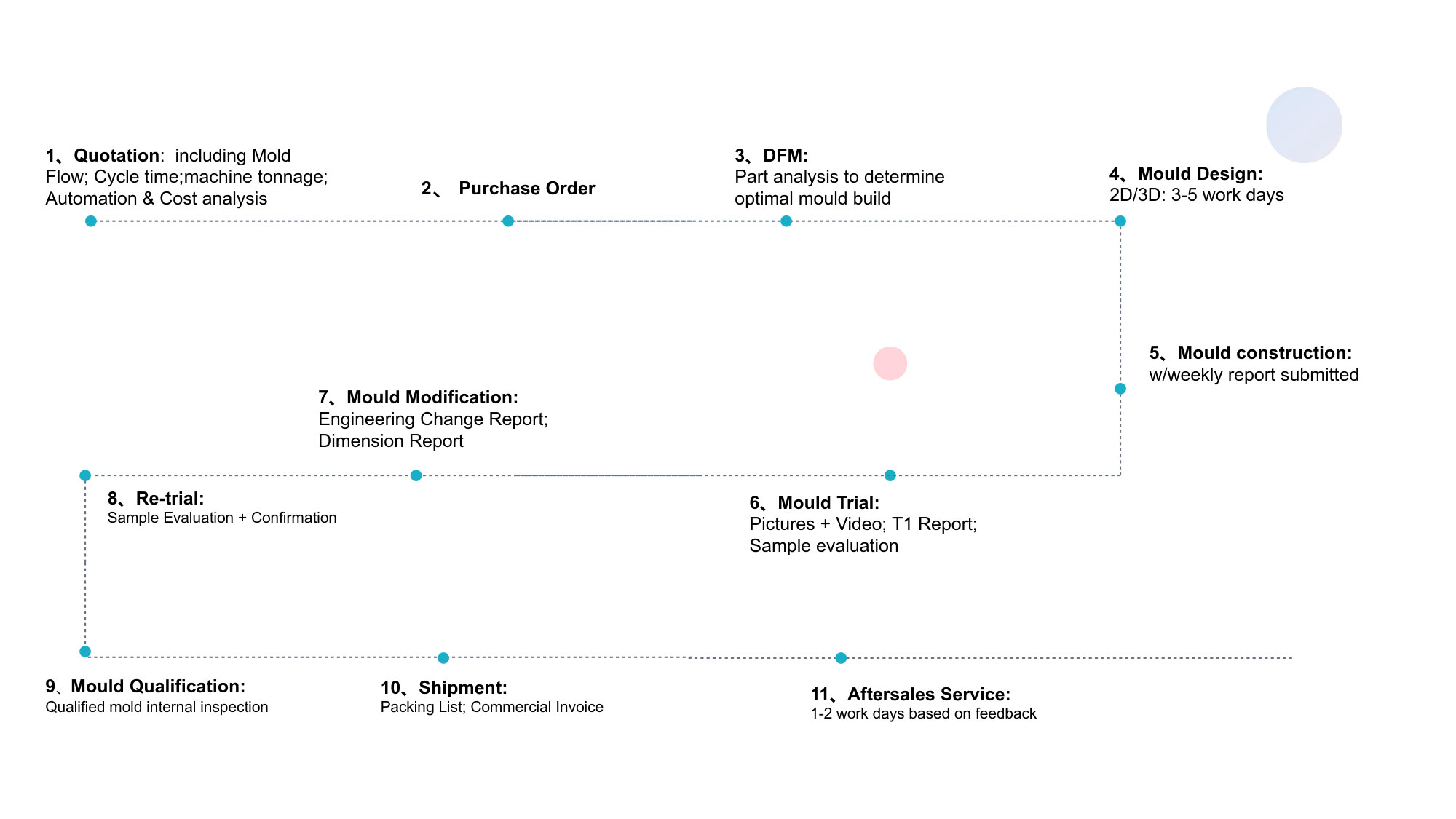
At Ansix Tech, our value extends far beyond the mold itself. We provide a start-to-finish engineering and production service that reduces your organizational overhead, accelerates time-to-market, and minimizes project risk.
Integrated Service Workflow
Phase Service Deliverables Customer Value
Early Engagement DFM Analysis & Mold Feasibility Comprehensive DFM report (free of charge) Identifies draft angle issues, wall thickness concerns, and gate location constraints BEFORE steel is cut
Design Phase 3D Modeling & CAD Optimization Optimized 3D model + Moldflow simulation Eliminates 90% of mold trial iterations; saves
10K–30K in rework costs
Prototyping Rapid Prototype (SLA/SLS/CNC) Functional parts for form/fit/assembly testing Validate design before full tooling investment
Tooling Full Hard Tool Production 0-Degree Demolding mold with full dimensional inspection report Full confidence that the mold will work on YOUR machines, with YOUR materials
Sampling T1, T2, T3 Molding Trials Progressive mold trials with defect analysis reports Iterative improvement without production stoppages
Pre-production Validation 100–500 shot test run Yield report + CPK analysis + process window characterization Confirm mold capability before committing to mass production
Mass Production Full-scale high-volume molding 260 machines + automated packaging Scalability without capital investment or capacity constraints
Secondary Operations Pad printing, painting, assembly, welding Ready-to-assemble or fully assembled housings Deliver parts to final assembly stage—not just bare plastic
Packaging & Logistics Custom packaging + global shipping Trained export documentation + global logistics Just-in-time delivery reduces your warehousing costs by 15–20%
DFM and Mold Flow Analysis — Your First Line of Defense
Many mold makers begin manufacturing once a CAD model is approved. Ansix Tech does not. Before we cut a single piece of steel, we perform an exhaustive DFM (Design for Manufacturability) analysis covering:
Draft angle analysis: Identify surfaces with zero draft that will cause dragging during ejection
Wall thickness optimization: Locate thick sections that will cause sink marks and thin sections that may not fill properly
Gate location planning: Determine optimal number and placement of gates to ensure balanced filling and minimal weld lines
Ejector pin placement: Map allowable pin locations to avoid cosmetic zones
Steel-safe modifications: If necessary, we recommend design changes that keep the mold “steel safe”—allowing modifications without scrapping the entire tool
Moldflow simulation is then run to predict:
Fill patterns and pressure distribution
Weld line and air trap locations
Warpage and shrinkage behavior
Cooling time optimization and cycle time estimation
Customer Value: The DFM and Moldflow phases typically identify 5–15 potential issues per project. Each issue represents a risk—shrinkage, warpage, weld lines, sink marks, ejection problems, or assembly failures. By solving these issues virtually before any steel is cut, we eliminate 80–90% of the physical mold trials required by competitors. Your mold moves from CAD direct to production in 30–50% fewer iterations , saving
10,000–30,000 per project in mold rework and test shots.
Mold Trials and Progressive Sampling
Trial Phase Objective Deliverables
T1 (First Trial) Validate basic mold function—ejection system, cooling function, no interference Sample parts + defect observation report
T2 (Corrective Trial) Implement corrections for identified defects Sample parts + dimensional validation
T3 (Pre-production Trial) Run at target cycle time; full quality inspection FAI report + CPK analysis
MV (Mass Production Validation) Run 100–500 shots with full QC protocol Yield report + cycle time validation
Customer Value: Three rounds of systematic trials ensure that when you receive the mold, it is production-ready—no surprises, no troubleshooting, no delays. For a typical rice cooker housing project, this reduces your on-site validation time from 4–8 weeks to less than 2 weeks.
Sustainability and Green Manufacturing
Ansix Tech is committed to environmentally responsible manufacturing practices that reduce your environmental compliance burden and improve your sustainability metrics:
Closed-loop cooling systems minimize water consumption
Energy-efficient servo-electric machines reduce energy consumption by 30–50% compared to hydraulic presses
Regrind and recycling programs for runner systems and scrap parts—reducing raw material waste and your material procurement costs by 8–12%
Section Five: Differentiated Commitment — Addressing Common Pain Points with Definitive Solutions
Many mold makers claim capability. Ansix Tech provides guarantees. Here is how we address the most common customer complaints heard across the injection molding industry:
Common Customer Complaint Typical Industry Response Ansix Tech's Definitive Solution
“The mold requires constant repair; production is always interrupted.” “Here is our standard maintenance schedule” We perform 2,000–5,000 shot “aging test” before delivery and provide a comprehensive wear report. Three-year structural warranty (excluding normal consumables).
“Flash is everywhere, and we spend hours manually trimming.” “Reduce injection pressure or slow down cycle time to reduce flash.” Parting line machined to 0.005mm precision with self-locking tonnage compensation. Flash controlled to under 0.03mm—extremely difficult to feel with bare skin. Manual trimming is eliminated entirely .
“Our parts are different dimensions every production batch.” “Check your machine calibration / material lot consistency / operator training.” Ultrasonic thickness monitoring + in-mold pressure sensors + closed-loop control → real-time compensation. Key hole-to-hole spacing variation across three production batches: ≤ 0.02mm .
“Mold repairs take weeks and cost a fortune.” “Ship mold to our service center; wait 3–6 weeks.” In-house electrode manufacturing and EDM department → repairs completed without leaving the building. Standard weld repair or insert replacement: within 24 hours .
“We have no visibility; we don't know if you are producing correctly.” “We will send you a report when we complete production.” Live production monitoring via MES → real-time access to your production data. Dashboard shows cycle time, scrap rate, material usage, and inventory status.
The Bottom Line: Quantifying Ansix Tech’s Value Proposition
Cost/Competitive Factor Standard Industry Baseline Improved Result with Ansix Tech Annual Savings per 1M Units
Mold lifespan (before major repair) 300,000 cycles 1,000,000+ cycles 50,000–80,000 (amortized tooling cost)
Flash and deflashing cost 3,000–7,000 per shift $0 per shift 30,000–70,000
Scrap rate (typical) 3–5% < 0.5% 25,000–45,000
Changeover/downtime 4–8 hours/setup 1–2 hours/setup (SMED-optimized) 15,000–30,000
Secondary operations outsourcing 3–5 external vendors Single-source responsibility 20,000–40,000 (reduced POs, inspection overhead, logistics)
Total estimated annual savings — — 140,000–265,000+
Conclusion: From Mold Manufacturer to Value Partner
At Ansix Tech, we understand that you do not buy a mold. You buy production reliability, cost predictability, and market responsiveness. Our 28+ years of experience serving industries including automotive, medical, consumer electronics, and smart home products has taught us that technical excellence must translate directly into customer profitability.
Our 0-Degree Demolding expertise for rice cooker housing molds is not merely a technical achievement—it is a business enabler. It allows your design team to create more aesthetic, more functional, more marketable products without the engineering compromises that typically plague injection molding. It allows your operations team to sleep better knowing that the mold will run reliably for millions of cycles without unexpected downtime. It allows your finance team to forecast costs with confidence, knowing that we control the variables that destroy budgets elsewhere.
We invite you to experience the difference. Provide us with an existing rice cooker housing part, and we will prepare a full DFM and Moldflow case study—showing you exactly how we would solve weld line concerns, air trap locations, shrinkage predictions, and ejection sequencing. Let the data speak for itself.
Contact Ansix Tech today. Let us build your next revenue-generating asset.
Ansix Tech Limited
Est. 1998 | 260 Injection Molding Machines | 30T – 2,800T | ISO9001 • IATF16949 • ISO14001 • ISO13485
*Shenzhen, China + Vietnam Facilities | 200,000 m² | 1,200+ Employees | 200+ Design Engineers | 70% Automated Machining*
www.ansixtech.com
Ansix Tech Co Ltd
If you have any plans related to Rice Cooker Housing Mold 0-Degree Demolding , you can contact us at any time. We will turn your ideas into reality, let you realize your dreams, and obtain large orders from the market. Our contact information is info@ansixtech.com. Or contact our CTO, mail: stephen@ansixtech.com
#www.ansixtech.com #ansixtech.com #Rice Cooker Housing Mold 0-Degree Demolding #Rice Cooker Housing Mold 0-Degree Demolding moulds #Rice Cooker Housing Mold 0-Degree Demolding injection molding companies #Rice Cooker Housing Mold 0-Degree Demolding Canopy Mold injection mold companies #Ansix #Ansix moulds #Ansix china #Ansix tech china #Ansix tech company #Ansix facotry #Rice Cooker Housing Mold 0-Degree Demolding injection molding #Rice Cooker Housing Mold 0-Degree Demolding injection tools #Rice Cooker Housing Mold 0-Degree Demolding injection moulds #Rice Cooker Housing Mold 0-Degree Demolding plastic mould #Rice Cooker Housing Mold 0-Degree Demolding plastic tools #Ansix Tech #Ansix molds #Ansix injection molding #Ansix mold factory #injection molding Rice Cooker Housing Mold 0-Degree Demolding #Ansix mold factory #Rice Cooker Housing Mold 0-Degree Demolding china #Rice Cooker Housing Mold 0-Degree Demolding molds #injection factory #Rice Cooker Housing Mold 0-Degree Demolding injection molding #Rice Cooker Housing Mold 0-Degree Demolding injection molding factory #injection molding company #Rice Cooker Housing Mold 0-Degree Demolding injection mold companies #Rice Cooker Housing Mold 0-Degree Demolding#Rice Cooker Housing Mold 0-Degree Demolding mold limited #Ansix mold china #Ansix companies #Ansix company China #Rice Cooker Housing Mold 0-Degree Demolding facotry #Ansix Tech #Ansix Tech mould #Rice Cooker Housing Mold 0-Degree Demolding injection moulding #injection moulding company #Ansix Rice Cooker Housing Mold 0-Degree Demolding parts injection mold companies #medical injection molding companieschina #Rice Cooker Housing Mold 0-Degree Demolding china factory #Ansix moulding companies #Ansix molding company #Rice Cooker Housing Mold 0-Degree Demolding injection moulding facotry #Ansix Tech mold #Rice Cooker Housing Mold 0-Degree Demolding mould #Rice Cooker Housing Mold 0-Degree Demolding plastic injection molding #ansix plastic mold #Mold manufacturing #Rice Cooker Housing Mold 0-Degree Demolding parts manufacturing #Rice Cooker Housing Mold 0-Degree Demolding plastic parts factory #Rice Cooker Housing Mold 0-Degree Demolding injection parts mold #Rice Cooker Housing Mold 0-Degree Demolding PRECISION MANUFACTURING #Rice Cooker Housing Mold 0-Degree Demolding #China mold #Rice Cooker Housing Mold 0-Degree Demolding injection moulding china #Rice Cooker Housing Mold 0-Degree Demolding mould china #china precision mold #mold in china #Rice Cooker Housing Mold 0-Degree Demolding mold china #Precision molds #High-precision molds #Rice Cooker Housing Mold 0-Degree Demolding #Injection molds #Rice Cooker Housing Mold 0-Degree Demolding Factory #Rice Cooker Housing Mold 0-Degree Demolding Company #Super Large Injection Mold Factory #Large Tonnage Injection Molding Factory #Rice Cooker Housing Mold 0-Degree Demolding Company #Rice Cooker Housing Mold 0-Degree Demolding Factory #2800T Injection Molding Factory #3000 Ton Injection Molding #4500 Ton Injection Molding Factory #Large Mold Injection Molding #Large Plastic Mold Injection Molding Factory #Large Injection Mold Manufacturer #Plastic Mold Factory #Injection Mold #Plastic Mold