



Hot-plate welding process for PPS+GF40 electronic water pumps
FEATURES
Product Introduction — Hot-Plate Welding Process for PPS+GF40 Cell Holders
1.1 What is Hot-Plate Welding?
Hot-plate welding is a thermoplastic joining process that uses heat and pressure to form strong, reliable welds in parts. The process can be broken down into three basic steps: Melt, Open, and Seal. During the melt stage, upper and lower heating plates melt the components that must be joined, with temperature controlled to ensure uniform heating across the entire surface area. Once melted, the parts are removed from the heated tooling, which retracts so the melted surfaces can be brought together. The final step is sealing — the welder pushes the parts together using pressure to create a molecular-level bond at the joint.
Hot-plate welding produces welds that reach 80 to 95 percent of the parent material's tensile strength, making it one of the strongest plastic joining methods available. It is fast, efficient, and cost-effective, making it ideal for mass production.
-
Mold Description
Product Materials:
PPS+GF40
Mold Material:
S136ESR
Number of Cavities:
1+1
Glue Feeding Method:
Hot runner
Cooling Method:
Water cooling
Molding Cycle
32.5s
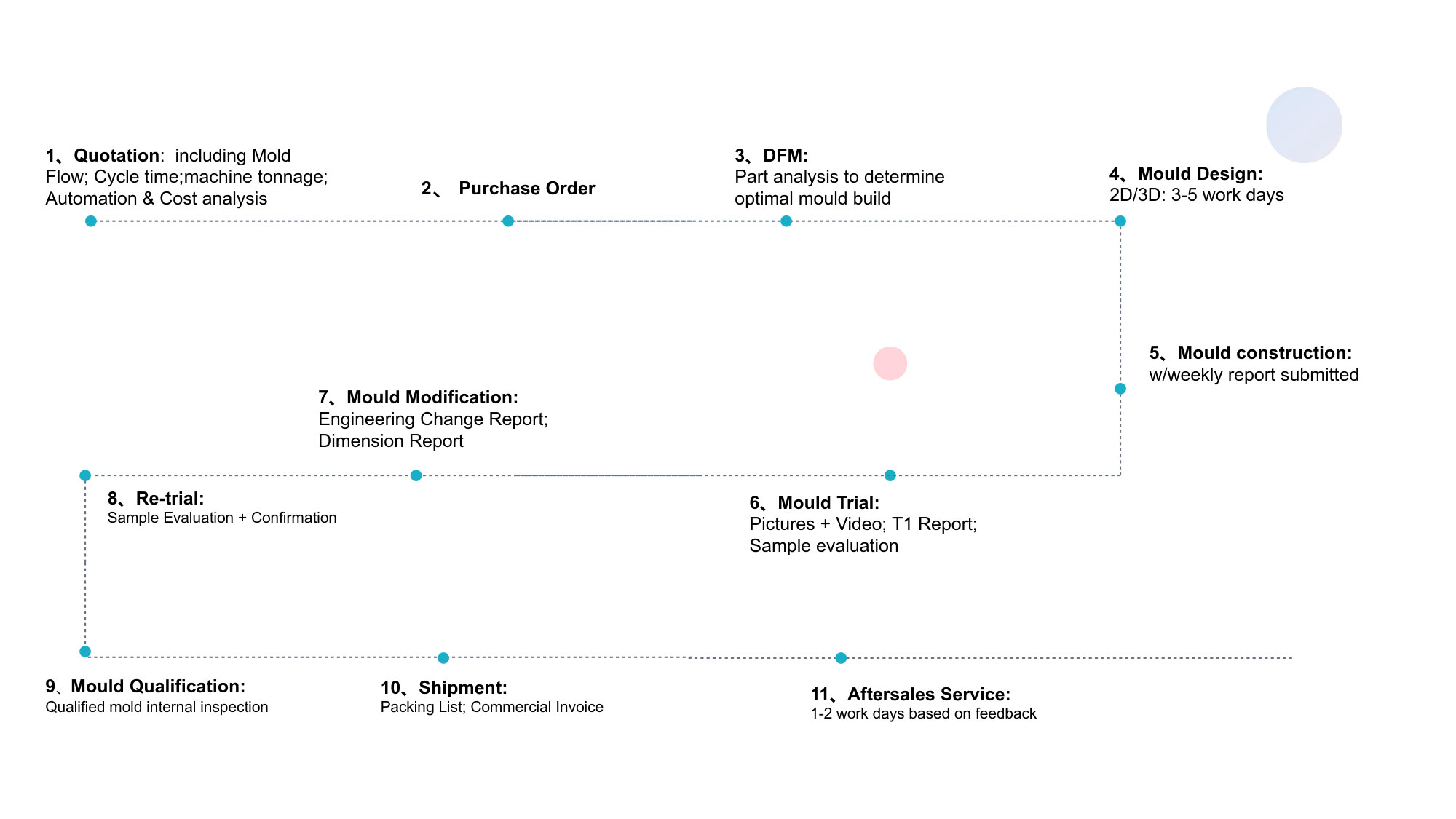
- The mold manufacturing process and product material selection
PPS+GF40 Material Properties
PPS-GF40 is a polyphenylene sulfide material modified with 40% chopped glass fiber. This material offers:
Property Value Standard
Density 1.66 g/cm³ ISO 1183-1
Tensile Yield Strength ≥80 MPa ISO 527-2
Tensile Modulus ≥5.0 GPa ISO 527-2
Flexural Strength ≥135 MPa ISO 178
Flexural Modulus ≥7.0 GPa ISO 178
Heat Deflection Temperature (1.8MPa) ≥230°C ISO 75-1/2
Long-term Service Temperature 200–220°C UL 746B
Flammability Rating V-0 (3mm) UL 94
Water Absorption (24h) ≤0.05% ISO 62
Compared to unreinforced PPS, PPS-GF40 offers significantly improved heat deflection temperature, enhanced material strength and modulus, better wear resistance, and a lower coefficient of thermal expansion. The material exhibits outstanding dimensional stability, chemical resistance, and flame retardance, making it ideal for high-temperature electrical components and automotive applications requiring reliability under thermal cycling. PPS can be processed at temperatures in the range of 300 to 350°C, with mold temperatures of 120–150°C required to develop full crystallinity.
-
Cell Holder Application Context
Cell holders manufactured via hot-plate welding of PPS+GF40 are critical components in battery systems, requiring:
Hermetic sealing to prevent electrolyte leakage
Thermal stability to withstand operating temperatures up to 200°C
Dimensional precision for consistent cell alignment and contact pressure
Dielectric strength for electrical insulation
Chemical resistance to electrolytes and aggressive fluids
Hot-plate welding creates air-tight and hermetic bonds essential for battery safety and longevity.
Part II: The "Hard Power" Foundation — Equipment Infrastructure That Builds Customer Trust
Trust in precision manufacturing begins with the machines and metrology tools that produce every shot. Ansix Tech's manufacturing floor is engineered for exactly this purpose.
2.1 Mold Machining Equipment
Five-Axis High-Speed Machining Centers: Ansix Tech operates advanced five-axis high-speed CNC machining centers capable of achieving ±0.002 mm machining accuracy on complex three-dimensional surfaces. This directly translates to smooth, burr-free parting lines with no visible witness marks — eliminating secondary finishing operations that add time and cost. The five-axis capability allows machining of complex cavities and cores in a single setup, maintaining perfect geometric alignment between mating mold halves.
Customer Value: When your product leaves our mold, the parting line is visually seamless and functionally precise. No manual deburring — saving $0.02–0.05 per part.
Slow-Wire EDM (Electrical Discharge Machining): Ansix Tech's slow-wire EDM systems cut features with exceptional precision — micro-holes and narrow grooves down to 0.03 mm — without inducing mechanical stress or deformation in thin-wall sections. Traditional machining risks warping or cracking thin features; EDM creates them cleanly, consistently, and without post-processing.
Customer Value: For cell holders requiring fine ribs, narrow slots, and small-diameter holes, EDM ensures dimensional integrity without thin-wall deformation — eliminating scrap and rework.
CNC EDM (Sinker EDM): Ansix Tech operates a self-built electrode machining center enabling in-house mold repairs. Mold rework stays within the shop — no outsourcing delays. Routine weld repair and insert replacement are restored within 24 hours.
Customer Value: When your mold needs maintenance, production downtime is measured in hours, not weeks.
High-Precision Surface Grinding: Dedicated surface grinding stations achieve flatness within 0.002 mm across the entire mold base. Perfectly flat parting surfaces eliminate flash and ensure consistent clamp force distribution across the cavity — reducing scrap rates and extending mold service life.
2.2 Injection Molding Machine Fleet
Scale: Ansix Tech operates 260 injection molding machines across four production bases, with clamping forces ranging from 30 tons to 2,800 tons. This covers everything from miniature electronic connectors to large automotive structural housings. Major brands include Japan's Fanuc, Sumitomo, Toshiba, Nissei, Engel, and Germany's Arburg.
Customer Value: We match the machine to your part — neither over-sizing (wasting energy and cost) nor under-sizing (risking flash or short shots).
All-Servo Electric Drive Systems: Every machine is equipped with all-servo electric drives, delivering repeatable shot-to-shot precision of ±0.1%. For cell holder production, this means every molded part in a production run of 100,000 pieces is dimensionally identical to the first shot.
Customer Value: No drift, no operator intervention required, no surprise deviations in critical dimensions that affect assembly fit or sealing performance.
Real-Time MES Integration: All machines are connected to a centralized Manufacturing Execution System (MES) where every molding parameter — melt temperature profile, injection pressure, injection velocity, hold pressure profile, and cooling time — is locked, monitored, and recorded. Only authorized engineering personnel can modify these settings, creating a fully traceable process history.
Customer Value: For customers subject to ISO or IATF 16949 quality audits, this provides complete, auditable documentation of every production batch.
2.3 Quality Inspection and Metrology Equipment
CMM (Coordinate Measuring Machine): Every mold undergoes full dimensional inspection on CMM equipment before shipment, with comprehensive inspection reports comparing all critical dimensions against CAD specifications.
Optical Vision Measurement System: High-precision 2D/3D optical measurement for visual validation of complex contours and surface features.
Process Capability Validation: CPK measurement for critical-to-quality (CTQ) features — CPK ≥ 1.33 for key dimensions, providing statistical proof of production stability.
Customer Value: You don't just get parts — you get data proving every part meets specifications.
Part III: Mold Manufacturing Core Competitiveness — Speaking with Specific Metrics
Customers care about four fundamental questions: How long will the mold last? What accuracy can I expect? How fast can I get it? What will it cost to maintain? Ansix Tech answers each with concrete, verifiable metrics.
3.1 Mold Material Selection
Ansix Tech selects mold steels based on a rigorous three-factor framework: durability, thermal conductivity, and machinability:
Component Material Options Application
Mold Base P20, H13 Structural integrity for full service life
Cavity/Core (Standard) S136 (420 stainless), NAK80, 4Cr13/9Cr18 High mirror polish for transparent/high-gloss parts
Cavity/Core (Abrasive) H13 (2344/8407), 2343, SKD11/61, DC53 Superior wear resistance for glass-filled plastics
Wear-Intensive Features Powder metallurgy steels (M340), coated inserts (TiAlN/CrN) Extended life for micro-ribs and narrow slots
For PPS+GF40 specifically: Core hardness at 48–52 HRC, cavity hardness at 52–56 HRC. Each material comes with a certified heat-treatment curve and hardness report.
Customer Value: For glass-filled PPS, we guarantee 1-million-shot mold life. You amortize tooling costs over a million parts — not 100,000.
3.2 Achievable Tolerances
Feature Type Achievable Tolerance
Standard structural features ±0.05 mm
Precision features (gears, medical) ±0.005 mm
Parting line fit 0.005 mm
Flash control ≤0.03 mm
Hole-to-hole spacing stability ≤0.02 mm across weeks
Customer Value: We provide mold steel material certificates and heat-treatment curves with every mold. You have full traceability of what went into your tool.
3.3 Cooling System Design
Cooling time can account for more than half of the production cycle. Ansix Tech employs advanced conformal cooling channel designs where waterways follow the part contour for uniform heat dissipation. Mold temperature is zoned by independent water manifolds with ΔT ≤ 2°C between core and cavity.
Customer Value: Conformal cooling cuts molding cycles by 22% compared to conventional designs. Faster cycles = more parts per hour = lower piece price.
3.4 Gating System and Feed Design
Ansix Tech engineers utilize advanced Mold Flow Analysis software to simulate the injection molding process virtually. Mold flow analysis helps pinpoint the ideal gate location that ensures balanced filling. For PPS+GF40 cell holders, the company employs:
Hot runner systems for reduced material waste and consistent melt delivery
Cascade runner systems that reduce scrap by up to 18%
Optimized gate placement to minimize weld lines and ensure balanced cavity filling
Customer Value: We predict and eliminate weld lines, gas traps, and sink marks before tooling even begins. No surprises, no costly mold rework.
3.5 Mold Delivery Standards
Mold Complexity Standard Lead Time Expedited Option
Simple molds 10 days —
Medium complexity 25–45 days 20 days
High complexity 45–60 days 30–35 days
Customer Value: Even under expedited schedules, we never skip validation steps. Fast delivery without quality compromise.
Part IV: Injection Molding Process Control — Eliminating Customer Quality Anxiety
Customers fear: sink marks, flash, dimensional drift, and batch-to-batch color variation. Ansix Tech's process control system is designed to eliminate each of these concerns.
4.1 Process Standardization
Every machine is networked to MES with all molding parameters locked:
Temperature profiles
Injection pressure
Injection velocity
Hold pressure profiles
Cooling time
Only authorized engineers can modify process recipes. First-article and last-article inspections are conducted for every batch.
Customer Value: Your parts are produced the same way, every time, on every shift. No operator variability.
4.2 Real-Time Closed-Loop Control
Real-time sensors (intra-cavity pressure, nozzle melt temperature) feed data to a cloud SPC dashboard. If any deviation exceeds ±1%, the system automatically adjusts holding pressure or rejects the shot.
Customer Value: This reduces human error and boosts Overall Equipment Effectiveness (OEE) to 88%. You get fewer rejects and more good parts.
4.3 Dimensional Stability Control
For PPS+GF40 cell holders:
Mold temperature zoned with ΔT ≤ 2°C between core and cavity
Critical hole-to-hole spacing fluctuation ≤ 0.02 mm across three consecutive production weeks
Parting line machined to 0.005 mm fit tolerance
Customer Value: Parts fit in assembly every time. No rework, no forced assembly, no field failures.
4.4 Flash Control
Self-locking clamp force compensation limits flash to ≤0.03 mm.
Customer Value: Eliminates manual deburring — saving $0.02–0.05 per part. On a million-part run, that's $20,000–50,000 in savings.
4.5 Visual Quality Grades
For opaque PPS (black or natural), Ansix Tech achieves Class A surface (Ra ≤ 0.2 μm) with no flow marks.
Customer Value: Your cell holders look professional and perform reliably. No surface defects that could affect sealing or aesthetics.
4.6 Special Material Capabilities
Ansix Tech has extensive experience with engineering thermoplastics including:
PC, ABS, PC/ABS
PPS, PPS+40% GF
PEEK, PEI (Ultem)
PPSU
LCP
PA6+GF30
Liquid Silicone Rubber (LSR)
Customer Value: We know how to run difficult materials. You don't pay for our learning curve.
Part V: Full-Spectrum Service — Reducing Customer Total Cost of Ownership
5.1 Early Engagement — DFM (Design for Manufacturability)
Before contract signing, Ansix provides comprehensive mold flow analysis (DFM reports) including:
Draft angle recommendations
Wall thickness optimization
Gate location planning
Permissible ejector pin mark locations
Weld line and gas trap prediction
Customer Value: We prevent you from discovering structural production issues after mold opening. No costly redesigns, no project delays.
5.2 Prototyping and Trial Molds
T0 to T3 trial samples with improvement reports after each round. Rapid prototyping creates functional models for physical validation of assembly, form, and function.
Customer Value: We validate fit and function before committing to production tooling. You don't pay for mistakes.
5.3 Small-Batch Validation
100–500 shot trial production before full-scale mass production, with yield rate and CPK statistics to confirm stability.
Customer Value: We prove the process is capable before we run your million parts. No surprises in mass production.
5.4 Automation Integration
Robotic take-out systems
Conveyor integration
In-mold labeling
Customer Value: Eliminates secondary labor, reduces piece price by 15–30% while maintaining tight tolerances.
5.5 Maintenance and Spare Parts
Spare wear parts (ejector pins, core inserts) delivered with every mold. Maintenance at every 200,000 shots. Lifetime repair at cost.
Customer Value: Your mold doesn't stop production waiting for parts. You plan maintenance, you don't react to breakdowns.
Part VI: Differentiated Value Proposition — Addressing Common Industry Pain Points
Customer Complaint Ansix Tech's Solution Customer Value
"Molds need frequent repairs, disrupting orders" 2,000-shot wear test before delivery; three-year structural warranty (excluding normal wear parts) Predictable tool life — you can plan production schedules with confidence
"Flash is excessive, post-processing costs are high" Parting line machined to 0.005mm fit tolerance; self-locking clamp force compensation; flash ≤0.03mm No manual deburring — $20,000–50,000 savings per million parts
"Dimensions vary batch to batch" Real-time ultrasonic wall thickness sensors; automatic pressure compensation; in-cavity pressure/temperature sensors with closed-loop control Every part is identical to the first — assembly fits every time
"Mold repairs take too long" In-house EDM and electrode machining center; repairs stay in-house; 24-hour turnaround for weld repair/insert replacement Production downtime measured in hours, not weeks
Part VII: Cost Optimization Strategy
Ansix Tech lowers total cost through three integrated strategies:
7.1 Material Optimization
Regrind management systems
Cascade runner systems reducing scrap by up to 18%
Supply chain partnerships with certified resin suppliers for competitive pricing
Customer Value: Less material waste = lower material cost per part.
7.2 Cycle Time Reduction
High-efficiency conformal cooling channels cutting cycles by 22%
Optimized process parameters for PPS+GF40
High-speed all-servo electric machines with ±0.1% repeatability
Customer Value: More parts per hour = lower piece price.
7.3 Automation
Robotic take-out eliminates secondary labor
Conveyor integration streamlines material flow
MES integration reduces human error and rejects
Customer Value: Piece price reduction of 15–30% while maintaining tight tolerances (±0.02mm typical).
Part VIII: Delivery Efficiency and Supply Chain
8.1 Production Footprint
Ansix Tech operates four production bases across China and Vietnam, with facilities spanning over 200,000 square meters. This geographic diversification provides:
Supply chain redundancy
Proximity to customer markets
Labor and cost optimization
8.2 Delivery Commitment
Service Level Commitment
Standard delivery Per mold complexity schedule (10–60 days)
Expedited delivery Up to 40% faster (conditions apply)
Small-batch trial 100–500 shots before mass production
Mass production 260 machines, 24/7 capability
Customer Value: We scale with your demand. From prototype to millions of parts, we deliver on time.
Part IX: Quality Assurance and After-Sales Service
9.1 Certification Framework
Ansix Tech holds multiple international certifications:
ISO9001 — Quality Management
IATF16949 — Automotive Quality Management
ISO13485 — Medical Device Quality Management
ISO14001 — Environmental Management
9.2 Quality Control System
Incoming Material Inspection:
IV (incoming verification) testing
Moisture content < 0.04%
In-Process Monitoring:
Real-time parameter monitoring (temperature, pressure, velocity)
Automatic rejection of out-of-spec shots
Final Inspection:
Full dimensional CMM reports
Visual inspection (Class A surface standard)
Weld strength verification
9.3 After-Sales Service Framework
Service Element Description
Spare parts kit Ejector pins, core inserts delivered with mold
Scheduled maintenance Every 200,000 shots
Emergency repair 24-hour turnaround for weld repair/insert replacement
Lifetime support Repair at cost for mold life
Documentation Full material certificates, heat-treatment curves, dimensional reports
Part X: Summary — Translating Technical Capability into Customer Value
For Ansix Tech, a mold is not a piece of steel — it's a money-printing machine. Every technical decision in mold design and manufacturing is evaluated through one lens: does this create value for the customer?
Technical Capability Customer Value Delivered
0.002mm 5-axis machining Burr-free parts, no secondary finishing
0.03mm EDM micro-features Thin-wall integrity, no deformation
1-million-shot mold life Tooling cost amortized over a million parts
±0.1% shot-to-shot repeatability Every part identical to the first
MES-locked parameters Full traceability, audit-ready documentation
CPK ≥ 1.33 Statistical proof of process capability
22% cycle time reduction Lower piece price, higher throughput
18% scrap reduction Lower material cost
15–30% piece price reduction Direct cost savings
24-hour mold repair Minimal production downtime
DFM before contract No costly redesigns, no project delays
Ansix Tech's core philosophy: Every technical capability is translated into measurable customer value. When you engage Ansix Tech for hot-plate welding of PPS+GF40 cell holders, you receive not just components — you receive a partner ecosystem that delivers reliability, cost-effectiveness, and peace of mind at scale.
For a full DFM report walk-through on your specific cell holder application, Ansix Tech invites you to experience firsthand how we proactively eliminate weld lines, gas traps, sink marks, and other critical risks before tooling even begins.
Ansix Tech Co Ltd
If you have any plans related to Hot-plate welding process for PPS+GF40 electronic water pumps, you can contact us at any time. We will turn your ideas into reality, let you realize your dreams, and obtain large orders from the market. Our contact information is info@ansixtech.com. Or contact our CTO, mail: stephen@ansixtech.com
#www.ansixtech.com #ansixtech.com #Hot-plate welding process for PPS+GF40 electronic water pumps #Hot-plate welding process for PPS+GF40 electronic water pumps #Hot-plate welding process for PPS+GF40 electronic water pumps Canopy Mold injection mold companies #Ansix #Ansix moulds #Ansix china #Ansix tech china #Ansix tech company #Ansix facotry #Hot-plate welding process for PPS+GF40 electronic water pumpsinjection molding #Hot-plate welding process for PPS+GF40 electronic water pumpsinjection tools #Hot-plate welding process for PPS+GF40 electronic water pumpsinjection moulds #Hot-plate welding process for PPS+GF40 electronic water pumpsplastic mould #Hot-plate welding process for PPS+GF40 electronic water pumpsplastic tools #Ansix Tech #Ansix molds #Ansix injection molding #Ansix mold factory #injection molding Customized stainless steel float switch for water level, oil level, high liquid level alarm#Ansix mold factory #Hot-plate welding process for PPS+GF40 electronic water pumpschina #Hot-plate welding process for PPS+GF40 electronic water pumpsmolds #injection factory #Hot-plate welding process for PPS+GF40 electronic water pumpsinjection molding #Hot-plate welding process for PPS+GF40 electronic water pumpsinjection molding factory #injection molding company #Hot-plate welding process for PPS+GF40 electronic water pumpsinjection mold companies #Hot-plate welding process for PPS+GF40 electronic water pumpsTooling #Hot-plate welding process for PPS+GF40 electronic water pumpsmold limited #Ansix mold china #Ansix companies #Ansix company China #Hot-plate welding process for PPS+GF40 electronic water pumpsfacotry #Ansix Tech #Ansix Tech mould #Hot-plate welding process for PPS+GF40 electronic water pumpsinjection moulding #injection moulding company #Ansix Hot-plate welding process for PPS+GF40 electronic water pumpsparts injection mold companies #medical injection molding companieschina #Hot-plate welding process for PPS+GF40 electronic water pumpschina factory #Ansix moulding companies #Ansix molding company #Hot-plate welding process for PPS+GF40 electronic water pumpsinjection moulding facotry #Ansix Tech mold #Hot-plate welding process for PPS+GF40 electronic water pumpsmould #Hot-plate welding process for PPS+GF40 electronic water pumpsplastic injection molding #ansix plastic mold #Mold manufacturing #Hot-plate welding process for PPS+GF40 electronic water pumpsparts manufacturing #Hot-plate welding process for PPS+GF40 electronic water pumpsplastic parts factory #Hot-plate welding process for PPS+GF40 electronic water pumpsinjection parts mold #Hot-plate welding process for PPS+GF40 electronic water pumpsPRECISION MANUFACTURING #Hot-plate welding process for PPS+GF40 electronic water pumps#China mold #Hot-plate welding process for PPS+GF40 electronic water pumpsinjection moulding china #Hot-plate welding process for PPS+GF40 electronic water pumpsmould china #china precision mold #mold in china #Hot-plate welding process for PPS+GF40 electronic water pumpsmold china #Precision molds #High-precision molds #Hot-plate welding process for PPS+GF40 electronic water pumps#Injection molds #Hot-plate welding process for PPS+GF40 electronic water pumpsFactory #Hot-plate welding process for PPS+GF40 electronic water pumpsCompany #Super Large Injection Mold Factory #Large Tonnage Injection Molding Factory #Hot-plate welding process for PPS+GF40 electronic water pumpsCompany #Hot-plate welding process for PPS+GF40 electronic water pumpsFactory #2800T Injection Molding Factory #3000 Ton Injection Molding #4500 Ton Injection Molding Factory #Large Mold Injection Molding #Large Plastic Mold Injection Molding Factory #Large Injection Mold Manufacturer #Plastic Mold Factory #Injection Mold #Plastic Mold