



Mercedes-Benz Charcoal Canister Mold
FEATURES
Foundation of Technical Capability — Building Customer Trust Through Hard Infrastructure
1.1 Precision Mold Machining Equipment
Customer trust begins with hardware. Mercedes-Benz demands absolute precision in every component, and we have structured our equipment portfolio to meet — and exceed — these expectations.
Equipment Category Technical Specification Customer Value Delivered
5-Axis High-Speed Machining Centers ±0.002mm contour accuracy for complex freeform surfaces Ensures seamless parting lines, zero burrs or witness marks; eliminates secondary finishing operations
Slow-Speed Wire EDM Capable of machining 0.03mm micro-holes and narrow slots Enables intricate internal features without thin-wall deformation; maintains structural integrity
CNC Electrical Discharge Machining (EDM) In-house electrode manufacturing center Mold repairs and modifications performed on-site; 24-hour restoration for routine maintenance
Vertical & Horizontal Machining Centers Multi-axis capability for complex core/cavity geometries One-stop machining reduces handling errors and lead times
Our competitive advantage: All machining equipment is operated by technicians with minimum 8-12 years of automotive mold-making experience. We maintain strict temperature-controlled environments (±1°C) to eliminate thermal expansion errors during precision machining.
-
Mold Description
Product Materials:
PA+GF35 PPS+GF35
Mold Material:
S136ESR
Number of Cavities:
1
Glue Feeding Method:
Hot runner
Cooling Method:
Water cooling
Molding Cycle
32s
- The mold manufacturing process and product material selection
Injection Molding Machine Fleet — All-Electric Precision
Specification Capability Range Value to Mercedes-Benz
Clamping Force 30 tons to 4,000 tons Covers small precision components to large structural housings
Drive System Full servo-electric, all machines ±0.1% repeatability; every shot replicates the previous with statistical consistency
Shot Size 5g to 30,000g per injection Flexibility for prototyping through high-volume production
Why this matters for Mercedes-Benz: The charcoal canister housing demands absolute dimensional stability to maintain sealed integrity with the EVAP system. Our servo-electric machines, combined with real-time closed-loop control, ensure that cavity pressure and temperature remain within ±0.5% of setpoint throughout each production run.
-
Quality Inspection & Metrology Equipment
Equipment Purpose Value Statement
Coordinate Measuring Machine (CMM) Full dimensional verification against CAD model Every mold undergoes 100% dimensional inspection prior to shipment
Optical Measuring System High-speed contour and surface inspection Capable of detecting defects down to 0.001mm resolution
Surface Roughness Tester Ra measurement for cosmetic and sealing surfaces Ensures Ra ≤ 0.05μm for critical sealing interfaces
Hardness Tester Verification of mold steel heat treatment Validates HRC values match material certifications
Quality assurance baseline: Every mold shipped from Ansix Tech is accompanied by a complete dimensional report with all critical features flagged. We maintain Cpk ≥ 1.33 for all customer-defined critical dimensions in production — and for Mercedes-Benz standards, we target Cpk ≥ 1.67.
Section 2: Core Competitiveness in Mold Manufacturing — Speaking the Language of Performance Metrics
2.1 Mold Life Expectancy — A Written Commitment
For the Mercedes-Benz Charcoal Canister Mold, durability is non-negotiable. EVAP components operate under continuous thermal cycling and vibration exposure. Our mold construction standards are engineered for the long haul:
Mold Component Recommended Steel Grade Hardness (HRC) Guaranteed Life (Glass-Filled Materials)
Mold Base P20 / 1.2738 30-36 500,000+ cycles
Cavity/Core (High-Wear Zones) S136 / 1.2083, H13 / 1.2344, SKD61 48-55 800,000 – 1,000,000 cycles
Sliders / Lifters 8407, DC53, 2344 50-54 500,000 cycles
High-Polish Surfaces NAK80, S136 mirror-grade 38-43 300,000+ cycles (maintains Ra ≤ 0.05μm)
Wear-Resistant Inserts Tungsten carbide (for gate/runner areas) 70+ Extended service between replacements
*“Glass-fiber reinforced materials are highly abrasive to mold surfaces. Using S136 for PA66+GF30 applications extends mold life to 800,000 cycles — compared to P20 which may fail at 200,000 cycles, saving over RMB 300,000 in replacement costs.”*
Customer Value Translation:
Customer Concern Our Commitment
“How long before mold wears out?” Guaranteed 500,000 cycles for glass-filled PA6+GF30; 1,000,000 cycles for unfilled engineering plastics
“What if the steel is substandard?” Complete material certificates and heat treatment curves provided with each mold
“Repair costs are unpredictable” Wear/damage patterns predictable from accelerated testing data; spare wear parts provided at mold delivery
2.2 Achievable Dimensional Tolerances
Part Type Achievable Tolerance Verification Method
General structural components ±0.05 mm CMM inspection
Precision sealing surfaces ±0.02 mm CMM + optical measurement
High-precision features (valve seats, purge ports) ±0.005 mm Dedicated checking fixtures
2.3 Mold Types We Manufacture
Mold Category Application for Charcoal Canister Value Driver
Hot Runner Systems Multi-cavity production of internal components Eliminates runner waste; faster cycle times; consistent melt temperature
Cold Runner (2-plate / 3-plate) Large housing parts with simple geometries Lower tooling cost; easier maintenance
Stack Molds High-volume production of paired components Doubles output without doubling machine size
Two-Shot / Multi-Material Molds Overmolded seals or soft-touch features Reduces assembly steps; eliminates secondary bonding
High-Gloss / Mirror Finish Molds Surfaces requiring cosmetic appearance, transparent viewing windows Ra ≤ 0.05μm finish eliminates secondary polishing
2.4 Gating System Optimization — Mold Flow Analysis
Before cutting a single gram of steel, Ansix Tech performs comprehensive Mold Flow Analysis using Autodesk® Moldflow® software. This simulation reveals:
Weld line positions — Where two melt fronts meet; we reposition gates to move weld lines to non-critical areas
Air trap zones — Identifying where trapped gas causes burn marks; we add venting channels proactively
Short shot risks — Simulating melt-front advancement to ensure complete cavity fill
Pressure and temperature distribution — Ensuring balanced filling across all cavities
Customer value: “Every defect we prevent at the design stage saves weeks and thousands of dollars down the line.””
For the charcoal canister specifically, our Mold Flow analysis focuses on:
Warpage prediction — Deep-drawn canister bodies are prone to distortion; we optimize gating and cooling to minimize Z-axis deformation
Shrinkage compensation — PA6+GF30 exhibits molding shrinkage of approximately 0.6%; we build compensated cavity dimensions to achieve net-shape parts
Packing/holding pressure optimization — Research demonstrates that holding pressure time is the single most influential parameter affecting defect indices (accounting for approximately 77.5% of variance)
2.5 Standard Lead Times — Reliable and Predictable
Mold Complexity Standard Tooling Rush Service (With Cost Premium) Quality Verification Status
Simple (single-cavity, basic geometry) 10 business days N/A (standard is already expedited)
Medium complexity (multi-cavity, sliders, hot runner) 25-45 business days 20 business days All verification steps performed; no skipped validations
High complexity (stack molds, high-cavitation) 45-60 business days 35 business days
Section 3: Injection Molding Process Control — Eliminating Quality Anxiety
Mercedes-Benz customers are concerned about: sink marks, flash/burrs, dimensional instability, and batch-to-batch color variation. Ansix Tech addresses each systematically.
3.1 Process Standardization — Putting Chaos in Check
System Feature Application Customer Benefit
Machine networking to MES (Manufacturing Execution System) All process parameters (temperature, pressure, speed, time) locked and monitored Only authorized engineers can adjust parameters; complete audit trail for every batch
First-article inspection Every production run begins with a certified sample Validates that all dimensions meet print before mass production commences
Last-off comparison End-of-run parts compared against first-article Confirms dimensional consistency throughout production run
Statistical Process Control (SPC) Real-time monitoring of critical dimensions Immediate detection of process drift; proactive correction
3.2 Dimensional Stability — Eliminating “Every Batch Is Different”
The charcoal canister must maintain sealing integrity with its mating components. Dimensional drift — even 0.1mm — can cause EVAP system leaks, tripping check engine lights and triggering warranty claims.
Our dimensional stability protocol:
Multi-zone mold temperature control — We employ independent temperature controller zones for core and cavity; core-cavity temperature differential maintained within ±2°C
Conformal cooling channels — 3D-optimized cooling circuits follow the contour of the part, reducing cooling time by 20-30% while minimizing thermal gradients
Real-time cavity pressure monitoring — Sensors embedded in the mold provide live feedback; injection molding machine adjusts packing pressure dynamically
Empirical validation: *“For a comparable automotive housing project, three consecutive production batches over one week showed critical hole-to-hole spacing variation within ≤0.02mm.”*
3.3 Surface Quality Standards — Meeting Mercedes-Benz Class-A Requirements
Surface Type Achievable Quality Verification
Opaque housings (standard finish) Flash/burr ≤0.03mm at parting line Visual inspection + optical measurement
High-gloss / Class-A surfaces Surface roughness Ra ≤0.2μm Surface profilometer
Transparent / clear components Zero bubbles; no flow lines or splay marks Backlit inspection station
Electroplating-ready surfaces No gas marks, splay, or blush Defect-free surface verified
Pad print / laser marking surfaces Compensation for heat-induced distortion; print registration accuracy ±0.1mm Dedicated marking alignment fixture
3.4 Advanced Material Processing Capabilities — Demonstrated Expertise
The Mercedes-Benz charcoal canister requires materials that withstand under-hood temperatures, resist chemical degradation from fuel vapors, and maintain dimensional stability through thermal cycling.
Material Key Properties for Charcoal Canister Application Our Experience
PA6 + 30% Glass Fiber (PA6+GF30) High mechanical strength (165 MPa tensile); heat deflection temperature 175°C; molding shrinkage 0.6% Extensive high-volume production; wear management for abrasive GF content
PA66 + 30-50% Glass Fiber Higher thermal stability than PA6; excellent chemical resistance to fuel vapors Optimized mold steel selection (H13/SKD61 with HRC48-52) to resist GF wear
PPS + 40% Glass Fiber Superior chemical resistance to all automotive fluids; continuous use temperature 200-220°C High-temp molding expertise; corrosion-resistant mold steels required
Polycarbonate (PC) Impact resistance; optical clarity for inspection windows High-gloss mirror mold surfaces; multi-zone cooling for warp control
PC/ABS blend Balanced toughness and heat resistance for structural housings Vibration welding compatibility for canister assembly
PEEK (Polyetheretherketone) Ultra-high temperature resistance (250°C+); chemical inertness Premium material for extreme-environment sealing components
PP + Talc filler Cost-effective; good dimensional stability High-volume production at optimized cycle times
Flame retardancy and UV stability:
UL94 V-0 rating achievable for electronic enclosure components
UV stability validated to 3,000 hours without discoloration (per ISO 4892-2)
Section 4: Full-Service Lifecycle — Reducing Total Ownership Cost
Ansix Tech does not simply build a mold and walk away. We partner with Mercedes-Benz through the entire product lifecycle — from concept to end-of-life.
4.1 Early Engagement — DFM (Design for Manufacturability) Reports Before Contract
An aluminum alloy or plastic component might look perfect on a CAD screen but prove impossible to mold economically. We identify these issues before you commit to tooling.
Our DFM report delivered prior to mold fabrication includes:
DFM Element What We Analyze Business Impact
Draft angle recommendations Identifying areas with insufficient draft that will cause part ejection issues Prevents stuck parts; eliminates mold rework costs
Wall thickness optimization Locating sections too thick (sink marks) or too thin (fill issues) Eliminates quality defects before production starts
Gate location proposal Determining optimal injection point to minimize weld lines and gas traps Reduces scrap rate; improves part strength
Ejector pin mark placement Identifying allowable locations for ejector marks based on sealed surfaces Prevents EVAP system sealing failures
Parting line configuration Determining optimal split line to maximize manufacturability Minimizes flash and reduces secondary trimming
4.2 Mold Trials and Sample Iteration — T0 to T3 Methodology
Trial Stage Deliverable Duration
T0 — First shot (proof of concept) Physical sample parts + basic fill assessment Immediate feedback
T1 — First optimization Dimensions measured against CAD; improvement report generated Within 72 hours
T2 — Second optimization Refined samples; all critical dimensions verified As needed
T3 — Final validation Full dimensional report; cosmetic sign-off; mold ready for production Pre-production approval
Unique capability: We maintain interchangeable inserts for common features, allowing us to validate multiple design variations without building an entirely new mold.
4.3 Pilot Production — Small-Batch Validation Before Mass Production
Service Description Risk Mitigation
100-500 shot pilot run Full production process run at reduced volume Validates actual line performance before committing to full contract
Yield and CPK reporting Statistical analysis of pilot batch quality Confirms process capability meets Cpk ≥1.33
Process optimization before mass production Fine-tuning parameters based on pilot data Eliminates surprises during high-volume ramp-up
4.4 Maintenance, Spare Parts, and Lifetime Support
Offering Detail Customer Value
Spare wear parts delivered with mold Ejector pins, core pins, hot runner tips included at delivery Immediate repair capability without procurement delay
Preventive maintenance schedule Recommended service intervals at 200,000-cycle increments Predictable maintenance costs; no unexpected downtime
Lifetime repair — cost recovery only After warranty period; components at material cost + direct labor Lowest total long-term ownership cost
Emergency repair SLA Standard repairs completed within 24 hours (in-house EDM + machining) Minimizes production line stoppages
Section 5: Differentiators — Direct Responses to Common Industry Pain Points
Mercedes-Benz has likely experienced frustrations with previous tooling suppliers. Our proposal addresses these directly and honestly.
Common Industry Complaint Ansix Tech Commitment Verifiable Evidence
“My mold requires constant repair, disrupting production orders.” We perform 2,000-cycle accelerated wear testing before mold delivery, complete with a wear pattern report. Plus: three-year structural warranty on mold frame and cavities (excluding normal wear components). Test report delivered at mold sign-off
“Burrs and flash require expensive secondary trimming.” We machine parting lines to ±0.005mm fit tolerance and implement lock-up, self-compensating clamping force systems. Flash controlled to ≤0.03mm for every production batch. Sample parts demonstrate flash-free finish
“Dimensions change every time I run a batch.” Our injection molding machines integrate ultrasonic wall thickness sensors delivering real-time feedback. Cavity pressure transducers link directly to the injection unit, enabling closed-loop packing pressure compensation. We also install in-mold thermal sensors for dynamic temperature control. Continuous SPC charting; Cpk ≥1.67
“Takes weeks to get mold repairs.” We maintain an internal electrode manufacturing center and EDM workshop. Standard repairs (weld repair, component replacement) completed within 24 hours — mold never leaves our facility for basic service. Emergency repair SLA
“My current supplier does not understand Mercedes-Benz specifications.” Ansix Tech team includes engineers with direct Tier-1 and OEM automotive experience. We speak your technical language — not as generalists, but as automotive specialists. IATF 16949 certification; automotive references available
Mercedes-Benz Charcoal Canister Mold — Manufacturing Process Deep Dive
Step 1: Material Selection — Scientific Foundation
The Mercedes-Benz charcoal canister housing must withstand:
Engine bay temperature extremes (-40°C to +120°C continuous)
Chemical exposure to gasoline vapors, oil mist, and road salts
Vibration and mechanical stress from vehicle operation
Recommended primary material: PA6 + 30% Glass Fiber (PA6+GF30)
Property Value Application Relevance
Density 1.36 g/cm³ Lightweight for NVH (noise/vibration/harshness) control
Tensile strength 165 MPa Structural integrity under mounting stress
Flexural modulus 6000 MPa Rigidity for canister body to prevent sagging
Heat deflection temperature 175°C Withstands under-hood heat soak
Molding shrinkage 0.6% Predictable, compensated in cavity design
Melt flow rate 20 g/10 min Good flowability for complex geometries
Alternative materials based on specific requirements:
For higher heat zones near turbochargers: PPS + 40% GF (continuous use to 220°C)
For cost-sensitive applications: PP + talc filler
For premium sealing components: PEEK (250°C+ capability)
Step 2: Design for Manufacturing (DFM) — Moldflow Simulation
Ansix Tech performs simulation analysis for:
Melt front advancement — Predicting fill behavior of PA6+GF30, which exhibits higher viscosity than unfilled polymers
Weld line positioning — Relocating knit lines away from sealing surfaces and structural load paths
Gas trap identification — PA6+GF30 can outgas during processing; identifying vent placement locations
Warpage prediction — Deep-drawn canister geometry is susceptible to Z-axis deformation; we compensate with differential cooling
“Critical process parameters (melt temperature, mold temperature, fill time, holding pressure time, and cooling time) are optimized through Taguchi DOE methodology. Research confirms that pressure holding time is the dominant parameter affecting defect outcomes, accounting for approximately 77.5% of variation in defect indices.”
Step 3: Mold Design and Engineering
Design Element Charcoal Canister Specifics Value Delivered
Cavity configuration 1+1 cavity for paired housing halves or 2+2 for increased output Balances capital investment against production volume
Cooling system Conformal cooling channels (water lines following part contour) Reduces cycle time; minimizes thermal distortion
Gating system Edge gate or submarine gate at non-cosmetic surface Clean part appearance; automatic gate removal
Ejection system Ejector pins at rib intersections and non-sealing surfaces Prevents visible marks on sealing faces
Venting 0.02-0.03mm vent depth at parting line Eliminates burn marks; ensures complete fill
Step 4: Mold Manufacturing — Process Workflow
Material procurement — Certified tool steel from approved suppliers; material certificates provided
CNC rough machining — Plate and block cutting; rough cavity/core profiling
Heat treatment — Vacuum hardening to specified HRC; tempering to relieve residual stresses
Precision grinding — Parallelism and perpendicularity to ±0.005mm
5-axis finishing — Final cavity/core contour machining; Ra surface finish
EDM operations — Tight corners and features inaccessible to CNC
Manual finishing/polishing — Hand polishing to mirror finish where required (Ra ≤0.05μm)
Assembly — All components assembled; slide/lifter function verified
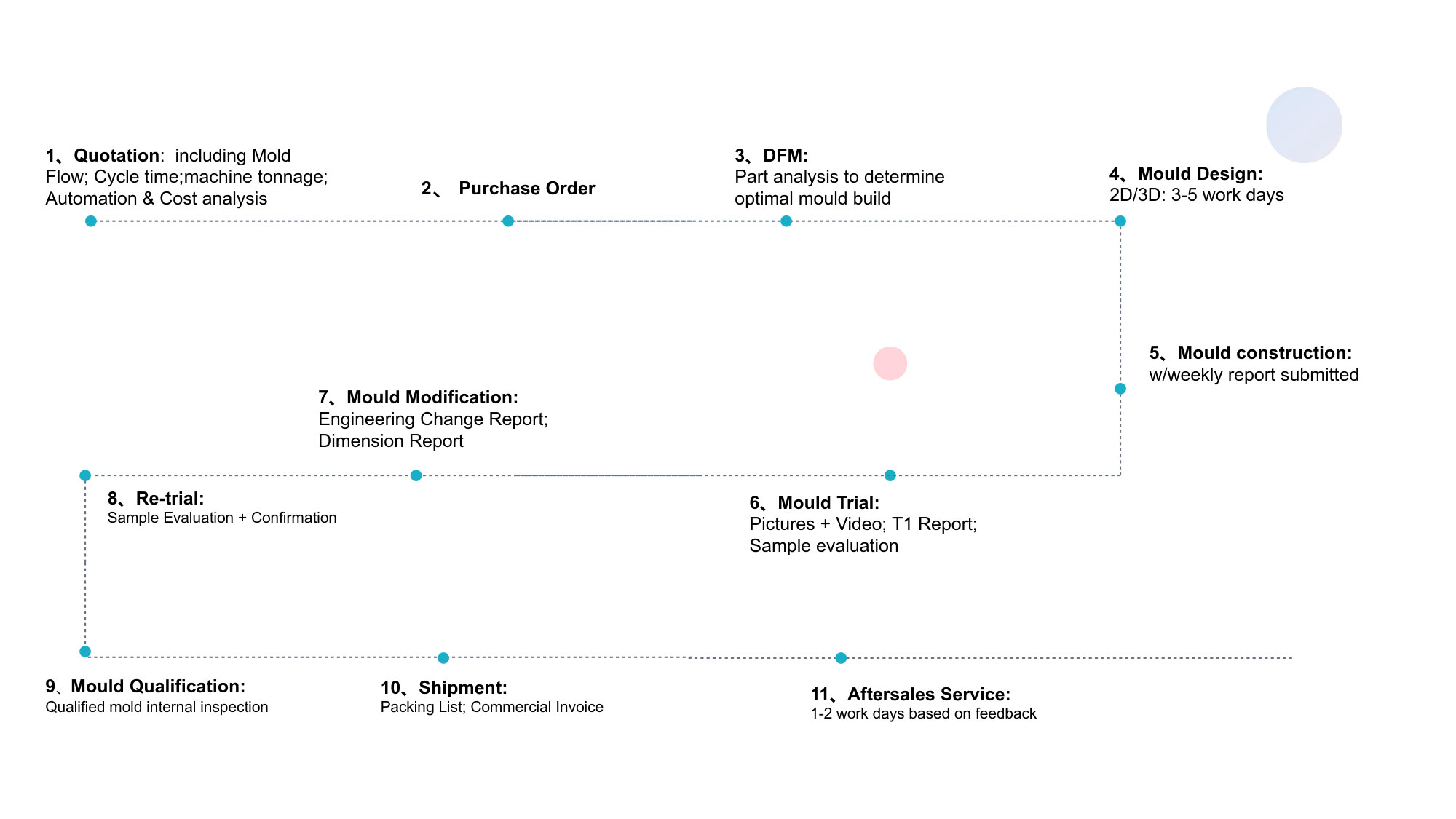
Mold trial (T0) — First shot evaluation; initial dimensional measurement
Optimization iteration (T1-T3) — Refinements based on trial data
Pre-shipment validation — 2,000-cycle accelerated wear test; full dimensional report; CPK ≥1.33 verification
Step 5: Injection Molding Production — Process Optimization
Parameter Target for PA6+GF30 Customer Impact
Melt temperature 240-280°C (dependent on specific PA6 grade) Ensures complete melting without thermal degradation
Mold temperature 80-100°C (higher for glass-filled materials) Promotes crystallization; improves dimensional stability
Injection pressure 80-150 MPa Balanced filling; prevents flash
Holding pressure 50-80% of injection pressure Compensates for shrinkage
Cooling time Determined via simulation; typically 15-25 seconds Minimizes cycle time while ensuring complete solidification
Back pressure 5-15 bar Enhances melt homogeneity; improves glass fiber distribution
Efficiency and cost optimization through process tuning:
Strategy Application Cost Reduction
Cycle time reduction Parallel cooling while ejecting; optimized cooling channels 15-25% reduction in per-part machine cost
Sprue/runner optimization Hot runner systems for multi-cavity; 3-plate cold runners with automated degating 30-50% material savings from runner waste elimination
Energy efficiency Servo-electric machines with regenerative drives 40-70% lower energy consumption vs. hydraulic presses
Automated part handling Robotic extraction and conveyor integration Labor cost reduction; consistent cycle times
Step 6: Quality Control and Assurance — Automotive-Grade Rigor
Quality Gate Method Acceptance Criteria
Incoming material inspection Spectrometer analysis; moisture content verification Meets material certificate specifications
In-process inspection SPC char; first-piece approval; patrol checks All parameters within control limits
Dimensional measurement CMM; optical comparator; dedicated checking fixtures ±0.05mm standard; ±0.005mm for critical features
Functional testing Pressure decay test (for EVAP sealing); vibration test No leakage beyond specification
Cosmetic inspection Visual under controlled lighting; surface roughness measurement No visible defects; Ra ≤ specified value
PPAP submission Level 3 PPAP per IATF 16949 requirements Full documentation package including dimensional reports, material certifications, process FMEA, control plan, and capability studies (Cpk ≥1.67)
IATF 16949 Compliance:
Ansix Tech maintains full IATF 16949 certification — the automotive industry-specific quality management standard that focuses on defect prevention, variation reduction, waste elimination, and continuous process improvement. For Mercedes-Benz projects, this means:
Advanced Product Quality Planning (APQP) with documented control plans
Production Part Approval Process (PPAP) submission prior to mass production
Process Failure Mode and Effects Analysis (FMEA) for every process step
Measurement System Analysis (MSA) verifying gauge accuracy >10% of part tolerance
Statistical process control with Cpk monitoring
Step 7: Packaging and Logistics — Damage-Free Delivery
Packaging Element Specification Purpose
Primary packaging Anti-static bag or clean PE film Protects against dust and ESD damage
Secondary packaging Custom foam insert or compartment tray Prevents part-to-part contact; eliminates scratching
Tertiary packaging Corrugated carton with stacking strength rating Safe transport; stackable for efficient storage
Labeling Barcode with part number, batch number, quantity, date code Full traceability through supply chain
Cost Reduction — Ansix Tech’s Systematic Approach
Mercedes-Benz expects not only quality but cost competitiveness. Ansix Tech reduces total cost of ownership across four dimensions:
1. Material Cost Optimization
Strategy Application Savings
Bulk purchasing Mold steel and plastic resins purchased at volume across multiple projects 8-15% material cost reduction vs. spot purchases
Alternative material recommendation Substituting PPS+GF with PA6+GF30 where performance allows 30-50% material cost savings without performance compromise
Regrind management Closed-loop regrind system for permitted applications 15-25% resin cost reduction
2. Process Efficiency Optimization
Strategy Application Savings
Cycle time reduction Conformal cooling reduces cooling time by 20-30% Direct per-part cost reduction at 15-25%
Runner optimization Hot runner systems for high-cavitation tools Eliminates runner waste (typically 20-40% of material)
Energy optimization Servo-electric machines; optimized process parameters 40-70% lower electricity consumption
3. Quality-Related Cost Reduction
Strategy Application Savings
Scrap reduction SPC and closed-loop process control targets <1% scrap in production Direct yield improvement savings
Warranty claim reduction Validated process ensures part-to-print conformance Eliminates EVAP leak warranty claims (typical cost: $500-1000 per claim)
Secondary operation elimination Flash ≤0.03mm eliminates manual trimming; Class-A surface eliminates post-mold polishing 20-30% labor cost reduction
4. Supply Chain Optimization
Strategy Application Savings
Consolidated vendor management Single-source: mold manufacturing + injection molding + packaging + assembly coordination Reduces procurement overhead by 30-50%
JIT delivery scheduling Coordinated production scheduling aligned with Mercedes-Benz consumption Reduces inventory carrying costs
Mold-on-loan programs Reduced upfront tooling cost with per-part amortization Lower initial capital expenditure
Why Ansix Tech for Mercedes-Benz
Requirement Ansix Tech Capability
28+ years of manufacturing experience Proven track record across multiple industries; automotive specialization
IATF 16949 certified Full automotive quality management system; compliance with global OEM standards
Full-service provider Mold design + manufacturing + injection molding + assembly — one responsible partner
Global material sourcing Access to premium steel grades (S136, H13, NAK80, 718, DC53) and engineering resins (PA6+GF30, PPS+GF, PEEK, PC/ABS)
Inspection and validation capability CMM, optical measurement, pressure decay testing, CPK analysis
Scale flexibility 30-4000 ton presses handle everything from small sensors to canister housings
Cost engineering focus Systematic reduction of total cost across materials, processes, quality, and logistics
DFM-first engineering culture Virtual validation before physical tooling; Moldflow analysis standard on every project
Conclusion — Partnership, Not Transaction
For Mercedes-Benz, the charcoal canister is more than a plastic box. It is a critical emissions control component that protects brand reputation, satisfies regulatory requirements, and ensures customer satisfaction through reliable EVAP system operation.
A failed canister triggers check engine lights, creates fuel odors, causes pump nozzle click-off during refueling, and generates costly warranty claims. A well-designed canister, molded with precision and consistency, operates flawlessly for the life of the vehicle.
At Ansix Tech, we believe that: “A mold is not a block of steel. It is a printing press — a revenue-generating asset that produces value with every cycle.”
When we design your charcoal canister mold, we simultaneously engineer:
Fill balance — Ensuring all cavities fill simultaneously
Venting strategy — Eliminating gas traps that cause burn marks
Temperature balance — Uniform cooling for warp-free parts
Ejection logic — Clean release without cosmetic damage
Wear management — Long-life design anticipating glass fiber abrasion
Process robustness — Cpk ≥1.67 capability across your production environment
The result? A mold that arrives at your production line ready to run — no extended debug, no excessive flash, no dimensional surprises, and predictable maintenance intervals.
Next Steps
“To us, a mold is not steel — it is a revenue-generating asset. Customer value is not something we add after the fact; it is embedded into every decision, from steel selection to gate placement to cooling channel routing.”
We invite Mercedes-Benz engineering and procurement teams to experience the Ansix Tech difference through:
DFM report walkthrough — We will take one of your existing components and demonstrate, start to finish, how we identify and eliminate weld lines, gas traps, and sink marks before steel is cut.
Capability presentation — A comprehensive review of our mold machining, injection molding, and quality systems, including live process demonstrations.
Reference site visit — Connect with our existing automotive customers who have experienced the transition to Ansix Tech.
Ansix Tech. Engineering precision. Manufacturing reliability. Partnering for success.
*© 2026 Ansix Tech. All specifications subject to validation against customer-specific requirements.
Ansix Tech Co Ltd
If you have any plans related to Mercedes-Benz Charcoal Canister Mold , you can contact us at any time. We will turn your ideas into reality, let you realize your dreams, and obtain large orders from the market. Our contact information is info@ansixtech.com. Or contact our CTO, mail: stephen@ansixtech.com
#www.ansixtech.com #ansixtech.com #Mercedes-Benz Charcoal Canister Mold #Mercedes-Benz Charcoal Canister Mold moulds #Mercedes-Benz Charcoal Canister Mold injection molding companies #Mercedes-Benz Charcoal Canister Mold Canopy Mold injection mold companies #Ansix #Ansix moulds #Ansix china #Ansix tech china #Ansix tech company #Ansix facotry #Mercedes-Benz Charcoal Canister Mold injection molding #Mercedes-Benz Charcoal Canister Mold injection tools #Mercedes-Benz Charcoal Canister Mold injection moulds #Mercedes-Benz Charcoal Canister Mold plastic mould #Mercedes-Benz Charcoal Canister Mold plastic tools #Ansix Tech #Ansix molds #Ansix injection molding #Ansix mold factory #injection molding Mercedes-Benz Charcoal Canister Mold #Ansix mold factory #Mercedes-Benz Charcoal Canister Mold china #Mercedes-Benz Charcoal Canister Mold molds #injection factory #Mercedes-Benz Charcoal Canister Mold injection molding #Mercedes-Benz Charcoal Canister Mold injection molding factory #injection molding company #Mercedes-Benz Charcoal Canister Mold injection mold companies #Mercedes-Benz Charcoal Canister Mold#Mercedes-Benz Charcoal Canister Mold mold limited #Ansix mold china #Ansix companies #Ansix company China #Mercedes-Benz Charcoal Canister Mold facotry #Ansix Tech #Ansix Tech mould #Mercedes-Benz Charcoal Canister Mold injection moulding #injection moulding company #Ansix Mercedes-Benz Charcoal Canister Mold parts injection mold companies #medical injection molding companieschina #Mercedes-Benz Charcoal Canister Mold china factory #Ansix moulding companies #Ansix molding company #Mercedes-Benz Charcoal Canister Mold injection moulding facotry #Ansix Tech mold #Mercedes-Benz Charcoal Canister Mold mould #Mercedes-Benz Charcoal Canister Mold plastic injection molding #ansix plastic mold #Mold manufacturing #Mercedes-Benz Charcoal Canister Mold parts manufacturing #Mercedes-Benz Charcoal Canister Mold plastic parts factory #Mercedes-Benz Charcoal Canister Mold injection parts mold #Mercedes-Benz Charcoal Canister Mold PRECISION MANUFACTURING #Mercedes-Benz Charcoal Canister Mold #China mold #Mercedes-Benz Charcoal Canister Mold injection moulding china #Mercedes-Benz Charcoal Canister Mold mould china #china precision mold #mold in china #Mercedes-Benz Charcoal Canister Mold mold china #Precision molds #High-precision molds #Mercedes-Benz Charcoal Canister Mold #Injection molds #Mercedes-Benz Charcoal Canister Mold Factory #Mercedes-Benz Charcoal Canister Mold Company #Super Large Injection Mold Factory #Large Tonnage Injection Molding Factory #Mercedes-Benz Charcoal Canister Mold Company #Mercedes-Benz Charcoal Canister Mold Factory #2800T Injection Molding Factory #3000 Ton Injection Molding #4500 Ton Injection Molding Factory #Large Mold Injection Molding #Large Plastic Mold Injection Molding Factory #Large Injection Mold Manufacturer #Plastic Mold Factory #Injection Mold #Plastic Mold