



NBR Floats – NBR Foam Molding Manufacturer
FEATURES
Hard Infrastructure — Building Customer Confidence Through Equipment Excellence
Mold Processing Equipment
Ansix Tech's mold processing capabilities form the foundation of precision manufacturing. The company operates 5-Axis High-Speed Machining Centers capable of achieving ±0.002mm machining accuracy [11†L9-L11】. For NBR foam float molds, this precision translates directly into customer value:
Seamless parting lines eliminate flash and secondary deburring operations
Complex curved surfaces are machined with extreme fidelity, ensuring proper float geometry for consistent buoyancy
Surface finish quality reduces post-molding finishing requirements, lowering labor costs by eliminating manual trimming
Slow-Wire EDM (Electrical Discharge Machining) technology enables the processing of 0.03mm micro-holes and narrow slots. For NBR foam floats, this capability is essential for:
Producing precision venting holes required for the foaming process
Creating fine features that prevent thin-wall deformation
Maintaining dimensional accuracy across complex geometries
Injection Molding Machine Fleet
Ansix Tech operates 260 injection molding machines with clamping forces ranging from 30 tons to 2,800 tons. This breadth covers the entire spectrum of NBR float production:
Machine Range Application Customer Value
30–90 tons Prototyping, single-cavity validation Rapid iteration, low-risk development
160–500 tons High-volume multi-cavity production Consistent repeatability across cavities
500+ tons Large-format components, high-cavity-count production Scalability without re-tooling
-
Mold Description
Product Materials:
NBR FOAM
Mold Material:
S136ESR
Number of Cavities:
16
Glue Feeding Method:
Hot runner
Cooling Method:
Water cooling
Molding Cycle
22.5s
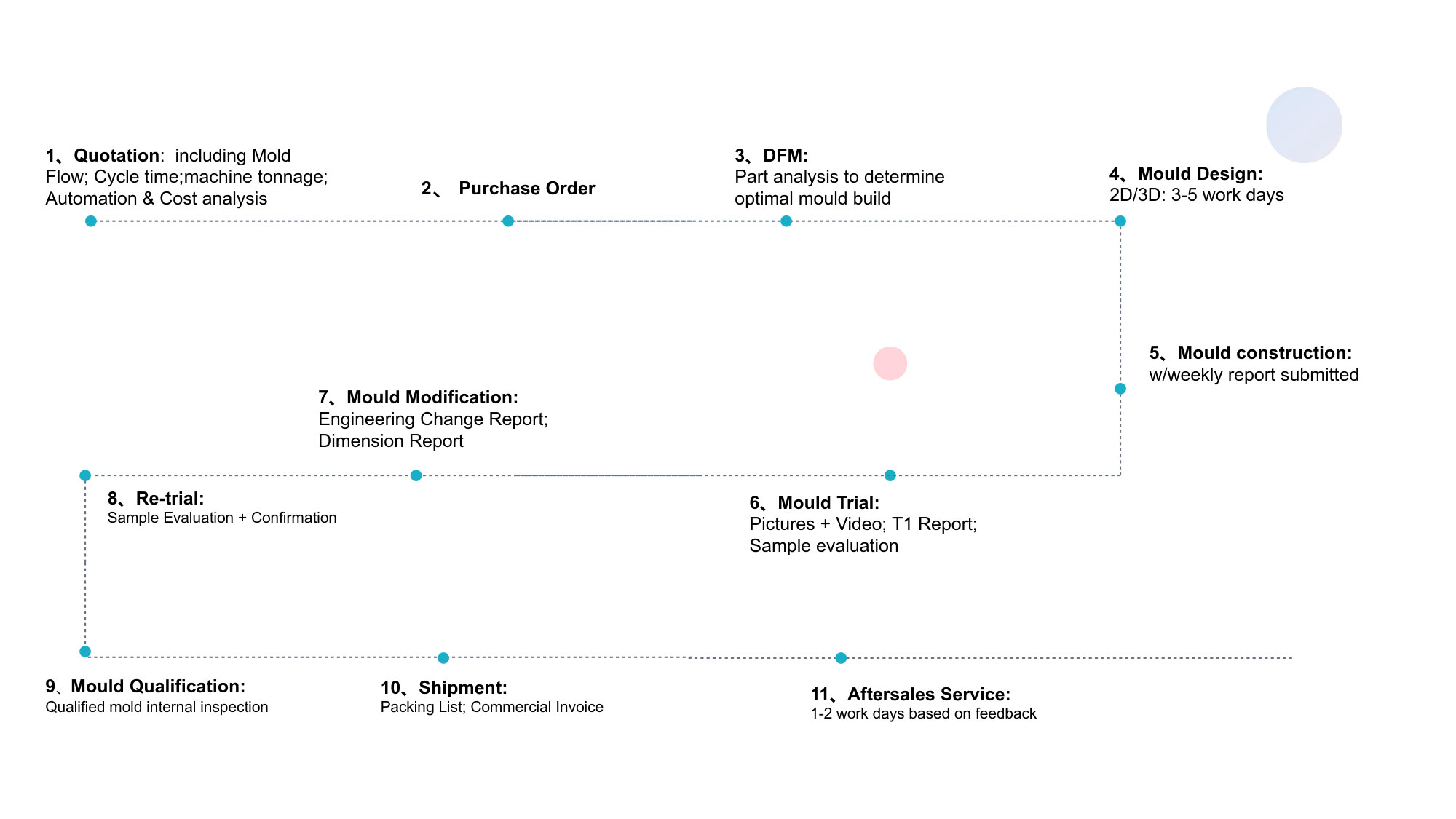
- The mold manufacturing process and product material selection
All machines are equipped with All-Servo Electric Drives, delivering repeatable process accuracy of ±0.1%. For the customer, this means:
Batch-to-batch consistency: The 10,000th part is identical to the first
Reduced scrap rates: Process stability minimizes dimensional variation
Lower validation costs: Once validated, the process runs predictably
Key machine brands include Japan's Fanuc, Sumitomo, Toshiba, Nissei, Engel, and Germany's Arburg (primarily for liquid silicone injection molding with two-component capability). Domestic machines include Haitian and Victor Taichung Machinery.
Quality Inspection Equipment
Ansix Tech's quality laboratory is equipped with Coordinate Measuring Machines (CMMs) and Optical Imaging Systems capable of sub-micron resolution. Every mold undergoes:
Full dimensional reporting before shipment
Critical-to-Quality (CTQ) dimension CPK ≥ 1.33
First-article inspection with complete documentation
Certifications and Compliance
-
Ansix Tech holds multiple international certifications that validate its quality management systems:
Certification Scope Customer Value
ISO9001 Quality management systems Consistent quality across all operations
ISO13485 Medical device quality management Compliance for medical-grade applications
IATF16949 Automotive quality management Automotive industry acceptance
ISO14001 Environmental management Sustainable manufacturing practices
BSCI Social compliance Ethical supply chain assurance
ISO Class 8 Cleanroom Controlled environment manufacturing Contamination control for critical applications
GMP Good Manufacturing Practice Regulatory compliance for medical products
Part Two: Mold Manufacturing — The Core of Longevity and Precision
Steel Selection and Material Science
NBR foam float molds must withstand the chemical and thermal demands of rubber foaming processes. Ansix Tech maintains strategic inventory of premium tool steels, selected to match material properties to exact service conditions:
Steel Grade Hardness (HRC) Key Properties Best Fit Application
S136 / S136H Pre-hard: 35 / Quench: 48–54 Superior corrosion resistance, ultra-high mirror polishability (Ra < 0.05μm), excellent wear resistance Transparent PC/ABS parts, optical-grade surfaces, corrosive plastic materials
2344 / 8407 / H13 48–52 High hot hardness at 550–600°C, excellent toughness, superior thermal fatigue resistance High-temperature engineering plastics, high-thermal-load injection molds
NAK80 37–43 Super mirror polish (up to #15000), excellent EDM machinability High-gloss surfaces, cosmetic-grade appearances
SKD11 / DC53 58–62 High wear resistance, high compression strength Wear inserts, sliders, shear edges for abrasive materials
2343 48–52 Impact resistance superior to H13, good thermal conductivity Complex geometries with extreme mechanical shock loads
M340 / 4Cr13 / 9Cr18 48–53 Stainless martensitic, excellent corrosion resistance FDA-grade applications, acidic plastic compounds
P20 28–32 Good machinability, cost-effective Mold bases, support plates, non-critical cavities
Each mold undergoes strict heat treatment protocols with documented time-temperature curves. For S136, this involves a precise quench at 1000–1050°C, oil-cooled to 50–100°C, then tempered at 200+°C to achieve 48–54HRC while preventing cracking.
Mold Life Commitments
Ansix Tech provides explicit mold life guarantees based on material selection:
Glass fiber-reinforced materials: Guaranteed 500,000 cycles
Standard plastics: Guaranteed 1,000,000 cycles
Material certification reports and heat treatment curves provided with every mold
Mold Types and Capabilities
Ansix Tech manufactures a comprehensive range of mold types for NBR foam float applications:
Hot Runner Systems: Reduce material waste and cycle time, improve part quality through precise gate control
Stack Molds: Double production efficiency with the same machine footprint
Two-Shot / Multi-Material Molds: Enable overmolding of magnets or metal inserts in NBR floats
High-Gloss Molds: Achieve surface roughness Ra < 0.05μm for transparent or cosmetic applications
Gate and Runner System Design
Through Moldflow simulation, Ansix Tech engineers create digital twins of the mold and material flow process. This enables:
Prediction of weld-line formation and air-trap locations
Optimization of gate location and quantity for balanced filling
Identification of pressure distribution issues before steel is cut
For NBR materials specifically, which have higher viscosity than thermoplastics, runner diameters are designed larger to reduce flow resistance.
Delivery Standards
Ansix Tech offers structured delivery timelines:
Mold Complexity Standard Delivery Expedited Delivery
Simple molds 10 days —
Medium-complexity 25–45 days 20 days
High-complexity 45–60 days 35 days
Expedited delivery maintains full validation protocols, ensuring quality is never compromised for speed.
Part Three: Injection Molding Process Control — Eliminating Quality Anxiety
Process Standardization and MES Integration
All injection molding machines are connected via MES (Manufacturing Execution System). Process parameters—temperature, pressure, speed, and time—are locked within the system. Only authorized engineers can adjust parameters, and every adjustment is tracked and documented.
Customer value: Complete process traceability, elimination of unauthorized adjustments, and consistent part quality across shifts and production runs.
Dimensional Stability Control
For NBR foam floats, dimensional stability is critical to buoyancy performance. Ansix Tech employs:
Zone temperature control with mold temperature controllers, maintaining core and cavity temperature differences within ±2°C to reduce warpage
Ultrasonic wall thickness sensors providing real-time feedback, automatically compensating holding pressure
In-mold temperature and pressure sensors enabling closed-loop process control
Performance data: For similar components, key hole spacing variation across three consecutive production batches is ≤ 0.02mm.
Surface Quality Standards
Ansix Tech achieves defined surface quality levels:
Requirement Achievable Standard Customer Value
Transparent parts No bubbles, no flow marks Optical clarity for visual inspection applications
Plated parts No gas marks Adhesion quality for secondary coatings
High-gloss parts Surface roughness Ra ≤ 0.2μm Premium appearance, reduced finishing costs
Printed parts Print registration accuracy ±0.1mm Consistent branding and labeling
Special Material Processing Capabilities
Ansix Tech has extensive experience processing a wide range of engineering materials, including:
PC/ABS, PC, PPS+40%GF, PEEK, PTFE/PFA
PA6+GF30, PBT, PEI/PPS/LCP
Liquid Silicone Rubber (LSR) with two-component capability
NBR with chemical foaming agents for closed-cell foam structures
Flame retardancy: UL94 V-0 compliance for automotive and electrical applications
Weathering: UV testing up to 3,000 hours without discoloration
NBR Material Characteristics and Foaming Process
NBR (Nitrile Butadiene Rubber) is a synthetic rubber with exceptional properties for float applications:
Property Typical Range Relevance to Floats
Density (solid) 1.04–1.35 g/cm³ Baseline for foam density calculation
Foam density 0.30–0.90 g/cm³ Determines buoyancy performance
Hardness (Shore A) 40–90 Affects durability and sealing
Tensile strength 10–25 MPa Structural integrity
Temperature range -30°C to +110°C Operational environment compatibility
Oil/fuel resistance Excellent Critical for automotive fuel tank applications
NBR foam is produced through a closed-cell foaming process where chemical blowing agents (such as Azodicarbonamide/ADC) decompose at controlled temperatures (200–205°C) to create a uniform cellular structure. The closed-cell structure provides:
Complete liquid impermeability
Consistent buoyancy over the product lifetime
Resistance to fuel and chemical attack
Process Parameter Control for NBR Foaming
NBR foam molding requires precise control of multiple parameters:
Parameter Control Range Impact on Quality
Injection temperature 80–120°C (compound mixing) Prevents premature crosslinking
Mold temperature Controlled ±2°C Ensures uniform curing and cell formation
Injection speed Optimized per geometry Prevents flow marks and uneven density
Curing time Process-specific Complete vulcanization for mechanical properties
Blowing agent content 5–15% Controls foam density and cell morphology
Critical insight: NBR is considered one of the easier rubber materials to process due to its moderate shrinkage rate, good mold flow properties, and relatively stable curing behavior. However, foam density must be carefully controlled—lower density foams (0.51 g/cm³) show different energy absorption characteristics compared to higher density foams (0.79 g/cm³).
First-Article and In-Process Inspection
Every production batch undergoes rigorous inspection:
First-article inspection: Complete dimensional verification against specifications
In-process inspection: Regular sampling with statistical process control
Last-article inspection: Verification that quality has been maintained throughout the run
Part Four: Full-Process Service — Reducing Customer Management Costs
Early Design Intervention (DFM Reports)
Before any steel is cut, Ansix Tech provides comprehensive Design for Manufacturability (DFM) reports that include:
Draft angle recommendations for optimal mold release
Wall thickness optimization to prevent sink marks and shrinkage
Gate location recommendations for balanced filling
Ejector pin mark location allowances to avoid functional surfaces
Shrinkage compensation calculations for NBR materials
Customer value: Problems are solved in the design phase, not after mold construction. This eliminates costly rework and project delays.
Sample Development (T0 to T3)
Ansix Tech provides structured sample development with full documentation:
Stage Deliverable Customer Value
T0 First sample parts Initial verification of mold function
T1 Improved samples with modification report Iterative improvement based on real data
T2 Validated samples Confirmation of all critical dimensions
T3 Production-ready samples Final approval before mass production
Quick-change insert capability: Different design variations can be validated without building entirely new molds.
Small-Batch Validation
Before full production release, Ansix Tech provides 100–500 shot trial production runs:
Statistical yield analysis
CPK calculation for critical dimensions
Process capability verification
Confirmation of stability before mass production
Maintenance and Spare Parts
Every mold ships with:
Spare wear parts (ejector pins, core inserts)
Maintenance schedule (recommended service every 200,000 cycles)
Lifetime repair service at cost price
Three-year structural warranty (excluding normal wear components)
One-Stop Turnkey Solutions
Ansix Tech offers integrated solutions covering every stage of the product lifecycle:
Product design and prototyping
Mold manufacturing
High-volume production
Secondary processing (assembly, printing, ultrasonic welding)
Packaging and logistics
Integration value: Eliminates communication gaps, accelerates project timelines, and ensures consistency from concept to delivery.
Part Five: Differentiated Value Proposition — Solving Industry Pain Points
Comparison of Common Industry Problems vs. Ansix Tech Solutions
Common Customer Complaint Ansix Tech's Professional Response Technical Justification
"Molds require frequent repairs, disrupting orders" "We perform 2,000-cycle aging tests before delivery and provide wear reports. We offer a three-year structural warranty." Systematic validation before shipment ensures mold reliability
"Excessive flash leads to high post-processing costs" "We machine parting surfaces to 0.005mm fit precision and use self-locking clamp force compensation. Flash is controlled to <0.03mm, eliminating manual deburring." 5-axis machining at ±0.002mm accuracy ensures perfect parting line fit
"Dimensions vary between batches" "Our machines feature ultrasonic wall thickness sensors that provide real-time feedback and automatic holding pressure compensation. In-mold temperature and pressure sensors enable closed-loop control." Servo electric drives deliver ±0.1% repeatability
"Mold repair cycles are too long" "We maintain in-house EDM and electrode machining centers. Mold repairs rarely leave the workshop. Standard welding/insert replacement restores production within 24 hours." Complete in-house capability eliminates outsourcing delays
The "Money Printer" Philosophy
At Ansix Tech, molds are viewed not as pieces of steel but as revenue-generating assets. Every mold is designed with simultaneous consideration of:
Mold retention for long-term stability
Exhaust paths to prevent trapped air
Temperature balance for consistent cycles
The promise: Molds arrive at the customer's production line ready-to-run—no tuning, minimal flash, and extended service life.
Cost Engineering: Systematic Reduction of Total Cost of Ownership
Ansix Tech's approach to cost reduction operates across multiple dimensions:
Material Cost Optimization
NBR foam density optimization: By precisely controlling foam density (ranging from 0.05 to 0.90 g/cm³ depending on application), material usage is minimized while maintaining required buoyancy
Closed-cell structure efficiency: Uniform pore structure reduces material consumption without compromising liquid impermeability
Supply chain management: Long-term relationships with reliable suppliers ensure raw material quality and supply stability
Process Efficiency Optimization
Cycle time reduction: Optimized cooling system design and hot runner systems reduce per-part cycle times
Multi-cavity molds: Increased cavity count (up to 96 cavities) dramatically reduces per-part cost
Automated production: 70% automated machining ratio with automatic feeding, injection, and demolding
Waste Reduction
Flash elimination: ±0.005mm fit precision eliminates flash-related waste
Scrap reduction: Process stability and CPK ≥ 1.33 minimize rejected parts
Material recovery: Hot runner systems reduce sprue and runner waste
Quality Cost Reduction
Zero-defect orientation: First-shot quality eliminates rework costs
Reduced validation burden: Process stability means fewer re-validations
Extended mold life: Premium steel selection and proper heat treatment extend mold life to 1,000,000 cycles
Total Cost Impact
Ansix Tech has demonstrated component cost reductions of up to 30% through innovative process optimization in comparable projects. This is achieved through:
Strategic material selection
Process parameter optimization
Efficient cooling system design
High-cavity-count tooling
Automated production systems
Quality Verification and Assurance
Validation Methodology
Ansix Tech employs a systematic validation approach for NBR foam float projects:
Material Verification
Material certification and traceability
Foaming agent content verification (5–15% ADC content range)
Compound homogeneity testing
Mold Validation
Full dimensional inspection with CMM
Steel hardness verification with heat treatment documentation
Cooling system flow rate and temperature uniformity testing
2,000-cycle aging test with wear report
Process Validation
First-article inspection
Process capability studies (CPK ≥ 1.33 for critical dimensions)
Statistical process control during production runs
Product Validation
Density measurement for foam consistency
Cell morphology analysis via SEM
Buoyancy testing (critical for float applications)
Fuel/oil resistance testing
Temperature cycling (-40°C to +160°C)
Continuous Improvement
Data tracking and analysis: Production data is collected and analyzed to identify and resolve potential issues
Customer feedback integration: Active incorporation of client feedback to improve quality and satisfaction
Industry engagement: Active participation in industry seminars and exhibitions to stay current with best practices
Capacity and Delivery Assurance
Production Capacity
260 injection molding machines ranging from 30 to 2,800 tons
200,000+ square meters of production space across four facilities
1,200+ employees including 200+ designers
30,000+ mold sets delivered since 1998
Scale capability: From prototyping to millions of units per month without re-tooling
Delivery Excellence
Agile production enabling rapid response to customer orders
Quick mold change capability reducing changeover time and production downtime
Emergency delivery plans for urgent customer requirements
Optimized logistics with reliable logistics partners
Fastest delivery: 3–4 weeks for complete mold solutions
Supply Chain Management
Long-term supplier relationships ensuring raw material availability
Demand forecasting for proactive material procurement
Precision inventory management avoiding stockouts or excess inventory
Conclusion: The Ansix Tech Advantage for NBR Foam Floats
Ansix Tech's comprehensive capabilities in NBR foam float manufacturing translate technical expertise into measurable customer value across five key dimensions:
Hard Infrastructure: 5-axis machining at ±0.002mm, 260 servo-driven injection molding machines, and CMM-based quality verification provide the foundation for zero-defect production.
Mold Manufacturing Excellence: Premium steel selection, documented heat treatment, and explicit mold life guarantees (up to 1,000,000 cycles) ensure long-term production reliability.
Process Control: MES-integrated process parameter control, ±0.1% repeatability, and closed-loop monitoring deliver batch-to-batch consistency that eliminates quality anxiety.
Full-Service Integration: DFM reports, structured sample development, small-batch validation, and lifetime maintenance support reduce customer management costs and project risk.
Cost Engineering: Systematic optimization across materials, processes, and quality systems achieves up to 30% component cost reduction while maintaining uncompromised quality.
For customers seeking a manufacturing partner for NBR foam floats, Ansix Tech offers a proven track record of translating technical capability into business value—transforming what could be a commodity component into a competitive advantage.
For a detailed DFM report walkthrough on a specific NBR float application, Ansix Tech's engineering team is available to demonstrate how weld-line prevention, air-trap elimination, and shrinkage control are addressed before any steel is cut—ensuring your mold arrives production-ready from day one.
Ansix Tech Co Ltd
If you have any plans related to NBR Floats – NBR Foam Molding Manufacturer , you can contact us at any time. We will turn your ideas into reality, let you realize your dreams, and obtain large orders from the market. Our contact information is info@ansixtech.com. Or contact our CTO, mail: stephen@ansixtech.com
#www.ansixtech.com #ansixtech.com #NBR Floats – NBR Foam Molding Manufacturer #NBR Floats – NBR Foam Molding Manufacturer #NBR Floats – NBR Foam Molding Manufacturer Canopy Mold injection mold companies #Ansix #Ansix moulds #Ansix china #Ansix tech china #Ansix tech company #Ansix facotry #NBR Floats – NBR Foam Molding Manufacturer injection molding #NBR Floats – NBR Foam Molding Manufacturer injection tools #NBR Floats – NBR Foam Molding Manufacturer injection moulds #NBR Floats – NBR Foam Molding Manufacturer plastic mould #NBR Floats – NBR Foam Molding Manufacturer plastic tools #Ansix Tech #Ansix molds #Ansix injection molding #Ansix mold factory #injection molding NBR Floats – NBR Foam Molding Manufacturer#Ansix mold factory #NBR Floats – NBR Foam Molding Manufacturer china #NBR Floats – NBR Foam Molding Manufacturer molds #injection factory #NBR Floats – NBR Foam Molding Manufacturer injection molding #NBR Floats – NBR Foam Molding Manufacturer injection molding factory #injection molding company #NBR Floats – NBR Foam Molding Manufacturer injection mold companies #NBR Floats – NBR Foam Molding Manufacturer Tooling #NBR Floats – NBR Foam Molding Manufacturer mold limited #Ansix mold china #Ansix companies #Ansix company China #NBR Floats – NBR Foam Molding Manufacturer facotry #Ansix Tech #Ansix Tech mould #NBR Floats – NBR Foam Molding Manufacturer injection moulding #injection moulding company #Ansix NBR Floats – NBR Foam Molding Manufacturer parts injection mold companies #medical injection molding companieschina #NBR Floats – NBR Foam Molding Manufacturer china factory #Ansix moulding companies #Ansix molding company #NBR Floats – NBR Foam Molding Manufacturer injection moulding facotry #Ansix Tech mold #NBR Floats – NBR Foam Molding Manufacturer mould #NBR Floats – NBR Foam Molding Manufacturer plastic injection molding #ansix plastic mold #Mold manufacturing #NBR Floats – NBR Foam Molding Manufacturer parts manufacturing #NBR Floats – NBR Foam Molding Manufacturer plastic parts factory #NBR Floats – NBR Foam Molding Manufacturer injection parts mold #NBR Floats – NBR Foam Molding Manufacturer PRECISION MANUFACTURING #NBR Floats – NBR Foam Molding Manufacturer #China mold #NBR Floats – NBR Foam Molding Manufacturer injection moulding china #NBR Floats – NBR Foam Molding Manufacturer mould china #china precision mold #mold in china #NBR Floats – NBR Foam Molding Manufacturer mold china #Precision molds #High-precision molds #NBR Floats – NBR Foam Molding Manufacturer #Injection molds #NBR Floats – NBR Foam Molding Manufacturer Factory #NBR Floats – NBR Foam Molding Manufacturer Company #Super Large Injection Mold Factory #Large Tonnage Injection Molding Factory #NBR Floats – NBR Foam Molding Manufacturer Company #NBR Floats – NBR Foam Molding Manufacturer Factory #2800T Injection Molding Factory #3000 Ton Injection Molding #4500 Ton Injection Molding Factory #Large Mold Injection Molding #Large Plastic Mold Injection Molding Factory #Large Injection Mold Manufacturer #Plastic Mold Factory #Injection Mold #Plastic Mold