



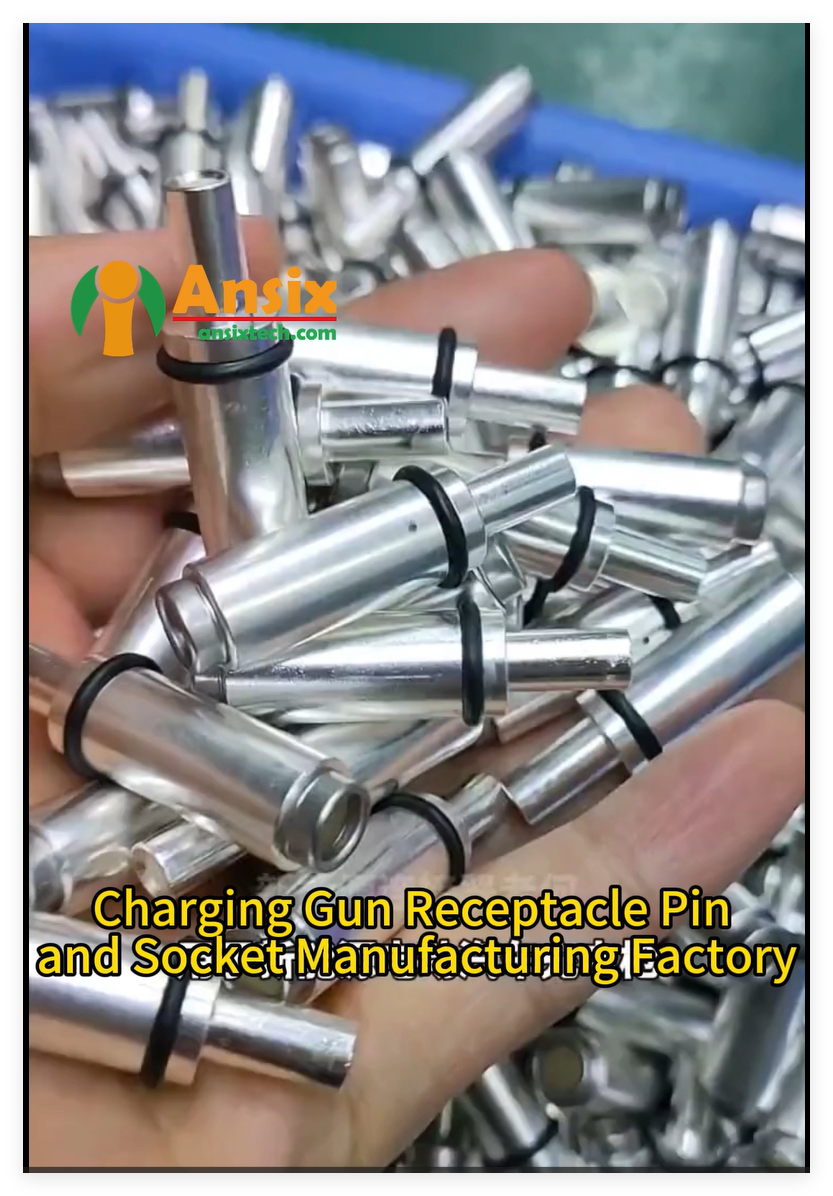
Charging Gun Receptacle Pin and Socket Manufacturing Factory
Charging Gun Receptacle Pin and Socket Manufacturing Factory

Beyond the Contact: How Ansix Tech is Redefining Precision, Reliability, and Cost Efficiency in Charging Gun Receptacle Manufacturing
In the rapidly evolving landscape of electric vehicle (EV) infrastructure, the difference between a reliable charging session and a catastrophic failure often comes down to a component measuring mere millimeters: the receptacle pin and socket. As the global EV market surges toward projected figures of over 100 million units sold annually by the end of the decade, the demand for high-cycle, thermally stable, and corrosion-resistant charging interfaces has never been more critical.
Amidst this backdrop of technical urgency, Ansix Tech has emerged not merely as a supplier, but as a strategic engineering partner. Specializing exclusively in the design and manufacturing of charging gun receptacle pins and sockets, the company leverages over 28 years of manufacturing experience to address the most pressing challenges facing the EV infrastructure supply chain. This article delves into Ansix Tech’s comprehensive capabilities—from the initial spark of a project concept through to the logistics of mass production—exploring how the company reduces hard costs, validates quality, and ensures the reliability of the components that power the future of mobility.
The Genesis of a Project: Engineering Precision from the Start
For Ansix Tech, a project does not begin with the press of a button on an injection molding machine; it begins with a deep dive into the client’s specific application requirements. The charging gun receptacle is a unique component in the automotive world. Unlike standard automotive connectors, these components must withstand thousands of mating cycles, exposure to harsh environmental elements (water, dust, salt), extreme temperature fluctuations, and the persistent risk of electrical arcing.
When a client approaches Ansix Tech, the process initiates with a collaborative design review. The company’s engineering team evaluates the client’s specifications against the physical realities of the manufacturing process. This phase is critical because the geometry of a receptacle pin—often involving complex undercuts, precise plating requirements, and specific creepage and clearance distances—directly dictates the Mold Design and material selection.
Ansix Tech’s value proposition at this stage is rooted in its ability to de-risk the project before any steel is cut. By leveraging decades of experience, the team identifies potential failure points related to shrinkage, warpage, or insert alignment early in the design phase. This proactive approach saves clients months of development time and hundreds of thousands of dollars in potential mold rework costs.
The Science of Raw Material Selection: Composition and Grades
The foundation of any high-performance receptacle pin or socket lies in the raw materials. Ansix Tech distinguishes itself through a rigorous, data-driven approach to material selection, understanding that the "hard costs" and functional lifespan of a component are dictated by the polymer matrix and metal substrates used.
- Polymer Insulators (The Socket Body)
For the socket housing and insulating structures, Ansix Tech primarily utilizes high-performance engineering thermoplastics. The selection is not arbitrary; it is based on the specific comparative tracking index (CTI), relative thermal index (RTI), and flame resistance (UL 94) required for EV charging applications (typically up to 1000V DC).
PA66 (Polyamide 66): For standard AC charging applications (Level 1 and 2), Ansix Tech employs PA66 GF25/GF33 (Polyamide 66 with 25% to 33% glass fiber reinforcement). The specific grade often utilized is heat-stabilized, such as PA66 A3X2G7 or equivalents, which offer high mechanical strength, good electrical insulation, and thermal stability up to 220°C for short periods. The addition of glass fiber is critical to maintaining dimensional stability under the mechanical stress of repeated plug-ins.
PBT (Polybutylene Terephthalate): For components requiring superior dimensional stability and lower moisture absorption than PA66, Ansix Tech leverages PBT GF30 (e.g., PBT 4130 or PBT 3030). PBT exhibits excellent creep resistance and dielectric strength, making it ideal for high-precision terminal position assurance (TPA) components within the receptacle.
PPS (Polyphenylene Sulfide): For high-power DC fast-charging applications (350kW+), where operating temperatures can exceed 150°C, Ansix Tech utilizes PPS GF40 (e.g., PPS 1140A6). PPS offers inherent flame retardancy (V-0), exceptional chemical resistance (crucial for withstanding road salts and fluids), and maintains its rigidity at temperatures where PA66 would soften.
- Metal Conductive Elements (Pins and Sockets)
The conductive path is the heart of the charging system. Ansix Tech specifies raw copper alloys based on a balance of conductivity, spring property (fatigue resistance), and corrosion resistance.
C15100 (Zirconium Copper): For the primary power pins (DC+ and DC-), Ansix Tech frequently specifies C15100 (Copper-Zirconium). This alloy is selected for its ability to retain high conductivity (≥95% IACS) while offering superior stress relaxation resistance at elevated temperatures compared to pure copper. This ensures that the receptacle maintains clamping force on the gun pins even after years of thermal cycling.
C70250 (Copper-Nickel-Silicon): For signal pins and smaller gauge sockets requiring high yield strength, C70250 is the material of choice. It provides an excellent balance of formability and spring properties, ensuring that the delicate signal pins responsible for proximity and control pilot circuits do not deform over thousands of cycles.
Plating Strategy: Recognizing that raw copper alloys oxidize, Ansix Tech employs a multi-layer plating process. The standard protocol involves a base layer of Nickel (Ni) —typically Semi-Bright Sulfamate Nickel—to act as a diffusion barrier, followed by a top layer of Silver (Ag) or Tin (Sn) . For high-power applications, silver is preferred for its superior conductivity and low contact resistance, while tin is utilized for lower-cost, moderate-power applications. In extreme corrosion environments (e.g., regions with heavy road salting), the company applies a flash of gold (Au) over the nickel for signal pins to ensure signal integrity.
Manufacturing Capabilities: The Art of Mold Engineering
With materials selected, Ansix Tech’s focus shifts to the tooling—the critical interface where design intent meets mass production. The company’s in-house mold fabrication facility is a hub of precision engineering, capable of producing complex, high-cavitation molds designed for 24/7 operation.
- Mold Flow Analysis (Design for Manufacturability)
Before machining begins, every mold undergoes comprehensive Mold Flow Analysis (MFA) using advanced simulation software. This step is non-negotiable for Ansix Tech. For charging gun components, which often feature thin walls (to reduce weight and material cost) alongside thick boss sections (for terminal retention), MFA predicts:
Weld Line Placement: Engineers simulate the flow front to ensure weld lines occur in non-critical structural or aesthetic areas. In a high-voltage receptacle, a weld line across a creepage path could lead to electrical failure; Ansix Tech uses MFA to reposition gates to eliminate this risk.
Air Traps and Voids: The simulation identifies potential air traps that could cause "dieseling" (burn marks) in the plastic, which is unacceptable for high-voltage insulation.
Shrinkage and Warpage: By predicting volumetric shrinkage, the team adjusts cooling channel layouts and holding pressure profiles to ensure that the finished part meets the tight tolerances required for terminal alignment (±0.02mm).
- Mold Design: Cooling, Gating, and Ejection
The architecture of the mold is designed specifically for high-volume production (HPV). Ansix Tech’s mold designs focus on three critical subsystems:
Cooling System Design (Water Channels): Cycle time is the primary driver of cost in injection molding. Ansix Tech engineers implement conformal cooling strategies where possible, using baffles and bubblers to route water channels within 8-10mm of the cavity surface. For complex geometries, the company utilizes copper-beryllium (BeCu) inserts in high-heat areas. BeCu, such as C17200, is used for core pins and inserts because it transfers heat 5-10 times faster than standard tool steel, drastically reducing cooling time and preventing hot spots that cause warpage in glass-filled nylons.
Runner and Gating Systems: To minimize material waste (a key factor in reducing "hard costs"), Ansix Tech employs hot runner systems with valve gates. This eliminates the cold runner sprue, reducing scrap rates by up to 30% compared to cold runner systems. For cosmetic surfaces or high-voltage insulation areas, submarine gates (tunnel gates) are used to automatically de-gate the part during ejection, ensuring a clean break that does not require secondary trimming operations. The gate location is strategically placed to ensure laminar flow into the pin retention features, avoiding stress concentrations that could lead to cracking under thermal shock.
Ejection Mechanisms: Given the delicate nature of receptacle housings—which often contain small ribs to guide terminal insertion—ejection must be perfectly balanced. Ansix Tech utilizes a combination of precision ground ejector pins and stripper plates. Stripper plates are preferred for large, flat surfaces or components with complex geometries to ensure even ejection force, preventing part deformation. The ejection system is designed to provide a safety factor of 1.5x the expected cycle count, ensuring longevity and minimizing downtime for maintenance.
- Technical Challenges in Mold Fabrication
Fabricating molds for these components involves micro-machining tolerances. The pins and sockets must align perfectly with the charging gun’s terminals; a misalignment of 0.1mm can result in high mating forces or, worse, fretting corrosion.
Ansix Tech’s toolroom utilizes 5-axis CNC machining centers and Sinker EDM (Electrical Discharge Machining) to create the complex geometries required for:
Terminal Locking Features: Undercuts and ramps that retain the metal terminals within the plastic housing.
High-Aspect-Ratio Cores: Deep, thin steel cores that form the cavities for the pin receptacles, requiring surface finishes of SPI A-1 (mirror finish) to allow the plastic to release easily without drag marks.
The steel selected for the mold base and cavities is typically S136 (Stavax ESR) or H13 hardened to 48-52 HRC. For high-volume production exceeding 1 million cycles, Ansix Tech applies PVD (Physical Vapor Deposition) coatings like TiAlN (Titanium Aluminum Nitride) to core pins to protect against abrasion from the glass fibers in the PA66 or PPS materials.
The Injection Molding Process: Optimization for Efficiency and Cost Control
Once the mold is qualified, the focus shifts to the injection molding process. Ansix Tech operates a fleet of fully electric injection molding machines ranging from 50 to 500 tons. The shift to electric machines (as opposed to hydraulic) is a deliberate strategy that yields benefits in precision, energy efficiency, and cycle time consistency.
Process Optimization:
The company utilizes Scientific Molding principles. For every mold, a Design of Experiments (DOE) is conducted to determine the ideal "process window." Key parameters controlled include:
Melt Temperature: For PPS GF40, melt temperatures are precisely controlled between 310°C and 330°C. If the temperature drifts by even 10°C, the polymer can degrade, releasing corrosive gases that damage the mold and compromise the dielectric strength of the part.
Pack and Hold Pressure: To combat the shrinkage associated with semi-crystalline materials like PA66, Ansix Tech employs dynamic pressure profiles. By using a high initial pack pressure followed by a staged reduction, the company achieves a consistent weight and dimensional stability across all cavities, ensuring that every receptacle socket meets the same insertion force specification.
Automation and Insert Molding:
A significant portion of Ansix Tech’s efficiency comes from automation. For charging gun receptacles, insert molding (molding plastic over the metal pins) is often required to create a hermetic seal. Ansix Tech has developed automated systems where robotic arms pick metal terminals from a tray, insert them into the mold cavity with micron-level precision, and remove the finished over-molded assembly. This eliminates manual handling errors, reduces cycle time, and ensures that the metal-to-plastic interface is free of flash, which is critical for preventing arc tracking.
Quality Validation: Ensuring Zero-Defect Reliability
In the EV industry, a single defective receptacle can result in a vehicle fire or a stranding event, leading to massive recalls and reputational damage. Ansix Tech’s validation process is designed to simulate the worst-case scenarios of a charging component’s life.
The quality protocol is divided into three stages:
- First Article Inspection (FAI):
Before mass production begins, the initial batch undergoes a rigorous FAI. This includes:
CMM (Coordinate Measuring Machine) Inspection: 100% of critical dimensions are verified against CAD data. For terminal positions, CMM tolerances are held to ±0.03mm.
Microsection Analysis: Molded parts are cut, mounted in resin, and polished to inspect the internal structure. This verifies that no voids exist in the plastic and that the metal inserts are fully encapsulated without exposure.
- In-Process Validation (IPV):
During mass production, Ansix Tech employs Statistical Process Control (SPC). Sensors on the injection molding machines monitor cavity pressure in real-time. If a cavity pressure deviates from the established baseline (indicating a potential issue like a blocked gate or material degradation), the system automatically rejects that specific part and logs the event for engineering review.
- Environmental and Mechanical Testing:
Ansix Tech maintains an in-house testing laboratory capable of simulating the entire lifecycle of the charging component:
Thermal Cycling: Components are subjected to cycling from -40°C to 85°C for 500+ cycles to verify that the Coefficient of Thermal Expansion (CTE) mismatch between the metal pins (17 ppm/°C) and plastic housing (25-35 ppm/°C) does not cause seal failure.
Durability Testing: Automated test stands perform 10,000+ mating/unmating cycles to measure the degradation of insertion force and contact resistance.
Hi-Pot Testing: Every receptacle undergoes a dielectric withstand test (e.g., 3000V AC for 60 seconds) to ensure insulation integrity. Ansix Tech uses Partial Discharge (PD) testing for high-voltage DC components, a more sensitive test that detects microscopic voids in the plastic that could lead to long-term failure.
Strategies for Cost Reduction and Capacity Expansion
Ansix Tech’s ability to reduce "hard costs" is a primary differentiator. In an industry where margins are squeezed by the commoditization of charging infrastructure, the company delivers value through:
Material Optimization: By using MFA to optimize wall thicknesses, Ansix Tech reduces the weight (and thus material cost) of each housing by an average of 8-12% without compromising structural integrity. Switching clients from virgin PA66 to a precisely controlled PA66 with optimized glass fiber content can save hundreds of thousands of dollars annually in high-volume programs.
High-Cavitation Molds: To boost production capacity without proportional labor increases, Ansix Tech invests in 32-cavity and 64-cavity molds for high-volume terminal housings. This increases output per square foot of manufacturing space and reduces the energy cost per part.
Vertical Integration: By maintaining mold fabrication, injection molding, and assembly under one roof, the company eliminates the markups associated with outsourcing tooling. This vertical integration also shortens the feedback loop; if a mold requires a repair to boost cycle time, the toolroom can address it overnight without waiting for a third-party vendor.
Boosting Production Capacity:
Ansix Tech employs a modular manufacturing layout. As client volumes scale, the company deploys additional injection molding cells that are "cloned" to the original validated process. This ensures that production can be scaled from 10,000 units per month to 500,000 units per month without process drift. The company also maintains a buffer stock of critical molds and spare components (core pins, ejector pins) to ensure that maintenance does not interrupt delivery schedules.
Ensuring On-Time Delivery: Logistics and Packaging
In the just-in-time (JIT) environment of automotive and EV infrastructure manufacturing, on-time delivery is as critical as product quality. Ansix Tech employs a sophisticated Enterprise Resource Planning (ERP) system that integrates customer forecasts with raw material procurement and production scheduling.
Packaging Workflow:
Recognizing that receptacle pins and sockets are often subject to automated assembly lines at the client’s facility, packaging is considered an extension of the manufacturing process.
Tape and Reel: For SMT (Surface Mount) or press-fit terminals, components are packaged on tape and reel using ESD-safe materials, ensuring they are ready for pick-and-place machines.
Trays: For larger receptacle housings, custom anti-static trays are designed to prevent part-on-part contact during shipping. These trays are designed to be stackable and to allow for robotic de-nesting at the client’s factory.
Cleanliness: Given the risk of contamination affecting electrical contact, all components undergo ultrasonic cleaning or plasma treatment post-molding to remove any mold release or particulate matter before packaging.
Rapid Delivery Workflow:
Ansix Tech’s rapid delivery capability is a result of its Rapid Tooling division. For clients needing to validate designs for new vehicle platforms (NPI—New Product Introduction), the company can produce prototype-quality molds using aluminum or pre-hardened steel in as little as 2-4 weeks. This allows clients to perform vehicle-level testing and regulatory certification (such as UL 2251 or IEC 62196) while the production-grade, hardened steel molds are being fabricated. This parallel processing reduces time-to-market by up to 40% compared to traditional tooling timelines.
The Ansix Tech Value Proposition: Experience and Reliability
With over 28 years of manufacturing experience, Ansix Tech has witnessed the evolution of connector technology from simple automotive wiring harnesses to the high-power, data-intensive interfaces required for modern EVs. This longevity has endowed the company with a deep institutional knowledge of injection molding challenges.
The company’s reliability is not merely a claim; it is demonstrated through its performance metrics. Ansix Tech operates with a PPM (Parts Per Million) defect rate that consistently ranks in the single digits for its charging gun components. This is achieved through the rigorous application of ISO 9001:2015 and IATF 16949 quality management systems, specifically tailored for the automotive supply chain.
Furthermore, Ansix Tech’s engineering team brings a consultative approach to client relationships. When a client faces a problem—such as a terminal fretting issue caused by micro-vibration in a high-power DC receptacle—Ansix Tech does not simply produce the part to print. The engineering team analyzes the root cause, often proposing adjustments to the material selection (e.g., switching to a higher spring-rate copper alloy) or altering the plating thickness to solve the problem at the material interface level.
Conclusion: Powering the Future with Precision
As the electric vehicle industry continues to mature, the spotlight is increasingly shifting toward the infrastructure that supports it. The charging gun receptacle is no longer a simple accessory; it is a safety-critical component that demands the highest levels of engineering rigor.
Ansix Tech stands at the forefront of this sector, transforming the way charging gun receptacle pins and sockets are designed, validated, and manufactured. By integrating advanced mold flow analysis, selecting precise raw material grades (from PA66 GF33 to PPS GF40 and C15100 alloys), engineering sophisticated cooling and ejection systems for high-cavitation molds, and employing scientific injection molding principles, the company delivers components that meet the exacting standards of global EV manufacturers.
The company’s strategic focus on reducing hard costs—through material optimization, high-cavitation tooling, and vertical integration—provides clients with a competitive advantage in a cost-sensitive market. Simultaneously, its unwavering commitment to quality validation and on-time delivery ensures that clients can scale production with confidence.
For companies seeking a manufacturing partner capable of navigating the technical complexities of EV charging components, Ansix Tech offers a compelling combination of deep-rooted experience, technological sophistication, and a demonstrable track record of reliability. In the high-stakes world of electric mobility, where the integrity of every connection matters, Ansix Tech ensures that the link between the grid and the vehicle is not just functional, but flawless.


Ansix Tech Co Ltd
If you have any plans related to Charging Gun Receptacle Pin and Socket Manufacturing Factory , you can contact us at any time. We will turn your ideas into reality, let you realize your dreams, and obtain large orders from the market. Our contact information is info@ansixtech.com. Or contact our CTO, mail: stephen@ansixtech.com
#www.ansixtech.com #ansixtech.com #Charging Gun Receptacle Pin and Socket Manufacturing Factory #Charging Gun Receptacle Pin and Socket Manufacturing Factory #Charging Gun Receptacle Pin and Socket Manufacturing Factory injection molding company #Charging Gun Receptacle Pin and Socket Manufacturing Factory injection mold companies #Ansix #Ansix moulds #Ansix china #Ansix tech china #Ansix tech company #Ansix facotry #Ansix Tech #Ansix molds #Ansix injection molding #Ansix mold factory #injection molding Charging Gun Receptacle Pin and Socket Manufacturing Factory #Ansix mold factory #Charging Gun Receptacle Pin and Socket Manufacturing Factory china #Charging Gun Receptacle Pin and Socket Manufacturing Factory molds #injection factory #Charging Gun Receptacle Pin and Socket Manufacturing Factory injection molding #Charging Gun Receptacle Pin and Socket Manufacturing Factory injection molding factory #injection molding company #Charging Gun Receptacle Pin and Socket Manufacturing Factory injection mold companies #Charging Gun Receptacle Pin and Socket Manufacturing Factory#Charging Gun Receptacle Pin and Socket Manufacturing Factory mold limited #Ansix mold china #Ansix companies #Ansix company China #Charging Gun Receptacle Pin and Socket Manufacturing Factory facotry #Ansix Tech #Ansix Tech mould #Charging Gun Receptacle Pin and Socket Manufacturing Factory injection moulding #injection moulding company #Ansix Charging Gun Receptacle Pin and Socket Manufacturing Factory parts injection mold companies #Charging Gun Receptacle Pin and Socket Manufacturing Factory #Charging Gun Receptacle Pin and Socket Manufacturing Factory china #Charging Gun Receptacle Pin and Socket Manufacturing Factory china factory #Ansix moulding companies #Ansix molding company #Charging Gun Receptacle Pin and Socket Manufacturing Factory injection moulding facotry #Ansix Tech mold #Charging Gun Receptacle Pin and Socket Manufacturing Factory mould #Charging Gun Receptacle Pin and Socket Manufacturing Factory plastic injection molding #ansix plastic mold #Mold manufacturing #Charging Gun Receptacle Pin and Socket Manufacturing Factory parts manufacturing #Charging Gun Receptacle Pin and Socket Manufacturing Factory plastic parts factory #Charging Gun Receptacle Pin and Socket Manufacturing Factory injection parts mold #Charging Gun Receptacle Pin and Socket Manufacturing Factory PRECISION MANUFACTURING #Charging Gun Receptacle Pin and Socket Manufacturing Factory #China mold #Charging Gun Receptacle Pin and Socket Manufacturing Factory injection moulding china #Charging Gun Receptacle Pin and Socket Manufacturing Factory mould china #china precision mold #mold in china #Charging Gun Receptacle Pin and Socket Manufacturing Factory mold china #Precision molds #High-precision molds #Charging Gun Receptacle Pin and Socket Manufacturing Factory #Injection molds #Charging Gun Receptacle Pin and Socket Manufacturing Factory Factory #Charging Gun Receptacle Pin and Socket Manufacturing Factory Company #Super Large Injection Mold Factory #Large Tonnage Injection Molding Factory #Charging Gun Receptacle Pin and Socket Manufacturing Factory Company #Charging Gun Receptacle Pin and Socket Manufacturing Factory Factory #2800T Injection Molding Factory #3000 Ton Injection Molding #4500 Ton Injection Molding Factory #Large Mold Injection Molding #Large Plastic Mold Injection Molding Factory #Large Injection Mold Manufacturer #Plastic Mold Factory #Injection Mold #Plastic Mold