



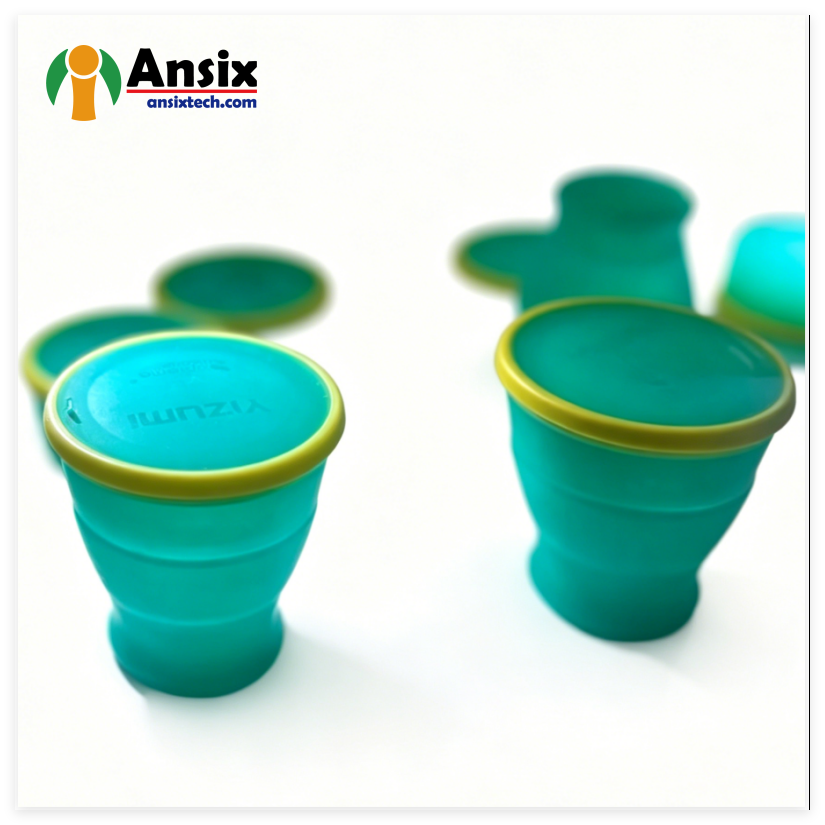
Foldable liquid silicone cup
Foldable liquid silicone cup

Core Value to Customers: Mold Tooling, Injection Material Selection, Smart Manufacturing, Process Efficiency, and In-Process Quality Assurance
Mold Tooling — Precision That Delivers Downtime-Free Production
A foldable silicone cUp Mold is the single most important asset for a long-running project. At Ansix Tech, we design and machine molds with five-axis high-speed CNC centers capable of holding geometric accuracy to ±0.002 mm, ensuring that the parting line between upper and lower mold halves seals perfectly over millions of cycles. For narrow slots, thin-wall sections, and tiny venting grooves, we rely on AgieCharmilles slow-wire EDM equipment to cut features as fine as 0.03 mm without inducing stress or burr formation. The mold core and cavity are constructed from hardened tool steels selected for LSR compression resistance and wear life: for standard production runs (up to 500,000 shots), we use pre-hardened P20-grade steel in the mold base combined with S136 or 2344 inserts; for high-volume contracts (over 1,000,000 shots) where glass-fiber-filled LSR or other abrasive additives might be used, we upgrade to premium 8407, H13, or DC53 inserts, which are vacuum heat-treated to 48–52 HRC and undergo triple-tempering to relieve internal stresses. Each mold shipment includes a full CMM (coordinate measuring machine) inspection report, material certificates for all steel components, and a documented heat-treatment profile, allowing you to verify every element before the mold ever touches an injection press.
Injection Material Selection — Science-Based Choices, Zero Guesswork
Not every liquid silicone rubber is suited for folding applications. Ansix Tech maintains a curated materials library specifically for foldable products. For general-purpose, non-food-contact folding cups, we recommend high-tear-strength LSR compounds with a Shore A hardness of 40–60, which balance flexibility and shape retention. For cups that will repeatedly fold more than 5000 times, we select self-lubricating, low-friction LSR grades that resist surface abrasion. For food-contact or medical-grade applications, we source platinum-cured, fully cured (post-cured) liquid silicone that complies with FDA, LFGB, or USP Class VI standards. We provide a complete materials dossier for every project: chemical composition (specific raw material supplier name and grade), curing curve, tensile strength, tear strength, elongation at break, compression set at elevated temperature, and any relevant certification statements. This level of material transparency ensures that the cup you design with computer-aided engineering (CAE) actually performs identically in mass production.
Smart Manufacturing and Efficiency Improvements
Ansix Tech has fully digitized our injection molding floor. All all-electric injection molding machines are connected to a central Manufacturing Execution System (MES) that locks processing parameters—injection speed, hold pressure, melt temperature, mold temperature, and cooling time—as soon as a process is qualified. Only engineers with authorization can modify these parameters, and any deviation triggers an immediate alarm and automatic notification. For a foldable silicone cup project, this means that the cycle time, shot weight, and curing profile that achieve first-pass yield on a Monday morning will be exactly duplicated on a Wednesday night or across any of the five parallel machines running the same job. Our smart automation also includes real-time part-weight and cavity-pressure monitoring: if any individual cavity deviates beyond the defined limits, the affected parts are automatically rejected into a separate bin without stopping the entire press. This closed-loop control not only maintains quality but also drives efficiency—production can run lights-out overnight or through weekends, increasing machine utilization by 25%–35%.
In-Process Quality Assurance — Risk Removed Before the Part Is Ejected
Customers worry about dimensional drift, flash, surface blemishes, and hidden internal voids. Ansix Tech eliminates these risks through layered in-process controls. First, every batch of raw LSR material is tested for viscosity and cure response before it is released to the production floor; any lot falling outside the specification is rejected at the loading dock. Second, at machine startup, we run a complete first-article inspection (FAI) using a vision measurement system, verifying all critical dimensions against the CAD model and customer-approved drawing. Third, during ongoing production, we sample parts at prescribed intervals and perform real-time inspection of wall thickness, rim circularity, and fold-line thickness using laser micrometers and automated optical inspection (AOI). Fourth, we track long-term process capability: for every key dimensional characteristic, we calculate Cpk on a rolling basis; if Cpk falls below 1.33, our process engineers intervene before nonconforming parts can be produced. All inspection records, including statistical process control (SPC) charts, are maintained for full traceability and can be provided to your quality team on demand. The result: zero hidden defects, zero surprises at incoming inspection, and zero production interruptions caused by out-of-spec parts.
The Bottom Line: Lower Total Cost, Less Risk, Faster Time-to-Market
When you work with Ansix Tech on a foldable liquid silicone cup project, you gain more than a supplier—you gain a manufacturing partner that has already de-risked your program. Our tooling precision and material expertise mean you will not experience premature mold wear, flash, dimensional drift, or reject lots. Our smart MES-enabled production floor ensures consistent quality across millions of cups. And our integrated quality controls allow you to skip or reduce expensive incoming inspections. The cumulative financial effect: tooling amortization cost per part drops, scrap and rework costs approach zero, and inventory risk (from defective batches) disappears. That is the core value Ansix Tech delivers: predictable, high-quality, low-cost manufacturing of foldable silicone cups, backed by 28 years of injection molding experience.
Part 3 – Complete Production Manufacturing Solution for Foldable Liquid Silicone Cup
(Full-length article, 2000+ words)
Executive Summary: Why a Foldable Silicone Cup Is More Than a Simple Product
A foldable liquid silicone cup embodies a unique engineering paradox: it must be simultaneously soft enough to be repeatedly compressed into a flat, pocket-sized shape, yet rigid enough to maintain its open, upright form when filled with liquid. It requires high tear strength to resist cracking along the fold line after thousands of cycles, and it must be manufactured with absolute consistency because the geometry—specifically the thin-walled flexible section where folding occurs—has very little tolerance for variation. At Ansix Tech, we have spent 28 years mastering the interplay between precision tooling, liquid silicone rubber material science, and high-efficiency injection molding. This document outlines a complete end-to-end manufacturing solution for the foldable liquid silicone cup, from the initial project kick-off and DFM analysis through mass production, quality validation, and rapid global delivery. For the client, the outcome is not simply a molded silicone part; it is a production program that delivers lower per-unit cost, shorter lead times, and zero quality surprises.
Section 1: Project Initiation – Turning Customer Needs into Manufacturing Reality
1.1 From Concept to Feasibility (Day 0 to Week 1)
When a customer approaches Ansix Tech with a foldable silicone cup concept—whether expressed as a 3D CAD model, a physical sample, or even a rough sketch—our first action is to initiate the "Design for Manufacturing" (DFM) process. Within five business days of receiving the geometry, we deliver a complete DFM report that covers four critical areas:
Draft angles and wall thickness optimization: The foldable section of the cup requires very thin walls to enable folding, but too thin will induce tearing or incomplete fill during injection. Using Moldflow simulation, we determine the minimum manufacturable wall thickness for the selected LSR material, advise on draft-angle adjustments for ejection without part distortion, and identify any sharp internal corners that could become stress-risers during folding.
Gate location and runner layout: Liquid silicone rubber is a shear-thinning material that cures rapidly once the mold reaches temperature. Incorrect gate placement can cause premature cure, short shots, weld lines, or air traps. Our simulation identifies the ideal gate location(s) to ensure balanced cavity filling, and we compare the trade-offs between cold-runner and hot-runner systems specifically for the foldable cup geometry. For most high-volume projects, we recommend a multi-cavity cold-runner mold (up to 64 cavities) because it eliminates runner waste and reduces material cost per part by approximately 20% compared to conventional sprued molds.
Ejection system planning: Because silicone is highly flexible and tends to stick to steel surfaces, conventional ejector pins can leave visible marks or even puncture thin-walled sections. Our DFM specifies a combination of large-area stripper plates, air-assist ejection, or textured cavity surfaces that allow the cup to release cleanly without sticking, without needing pin marks on cosmetic surfaces.
Shrinkage and post-cure compensation: Liquid silicone shrinks at a different rate than thermoplastics, and full curing continues after the part leaves the mold. Based on the specific LSR grade selected, we calculate the shrinkage factor (typically 2%–4% linear) and compensate the steel cavity dimensions accordingly. If the cup is to be post-cured in an oven to stabilize properties, we also advise on the dimensional change that occurs during post-cure and adjust the "as-molded" dimensions accordingly.
1.2 Material Selection – Documented, Data-Driven, and Customer-Approved
Ansix Tech maintains a database of over 50 liquid silicone rubber compounds from ISO-certified manufacturers such as Dow Corning, Momentive, Shin-Etsu, Wacker, and Elkem. For a foldable cup project, material selection is based on three quantifiable performance metrics:
Tear strength and elongation: Minimum requirement for a silicone cup that will be folded more than 1000 times is tear strength >25 N/mm and elongation at break >500%. We recommend specific grades that have been validated in flex testing.
Food-contact or medical compliance: For food/drink applications, we supply platinum-cured silicone that complies with FDA 21 CFR 177.2600, LFGB (German food safety), or EU Regulation 1935/2004. For medical-grade cups, we offer USP Class VI-certified LSR.
Post-cure stability: Some grades require a 4–8 hour post-cure at 200°C to remove volatiles and stabilize compression set; others are formulated for "no-post-cure" processing, reducing energy cost and cycle time.
For every project, Ansix Tech provides a material datasheet that includes:
Supplier name and complete grade designation.
Chemical composition: the percentage of polydimethylsiloxane polymer, reinforcing silica filler, crosslinker, and platinum catalyst.
Physical properties: Shore A hardness, tensile strength, tear strength (Die B or Die C), elongation at break, compression set at 150°C, and specific gravity.
Cure characteristics: recommended curing temperature, injection temperature, and typical cycle time for a given wall thickness.
Certification documentation: RoHS, REACH, FDA, LFGB, or USP Class VI as applicable.
The customer approves the material selection before any steel is cut for the mold, ensuring that the final product exactly matches regulatory and performance requirements.
Section 2: Mold Engineering – Where Precision Meets Volume Production
2.1 Mold Flow Analysis (MFA) – Simulating Before Cutting Steel
Before CAM programming begins, our mold engineers perform a comprehensive Moldflow analysis specific to liquid silicone rubber. Unlike thermoplastics, LSR exhibits a unique curing profile: viscosity initially decreases with shear, then increases rapidly as crosslinking begins. Our simulation accounts for this non-Newtonian, reactive behavior. Key output from the simulation includes:
Fill time and pressure distribution: We verify that the mold fills completely within the allowable injection window (typically 2–5 seconds) without exceeding the clamping force limit. Uneven pressure distribution is corrected by adjusting gate location, runner diameter, or cavity layout.
Air trap and weld line prediction: The simulation identifies locations where converging flow fronts could trap air, causing blisters or voids. We add venting grooves (typically 0.01–0.02 mm depth, 2–3 mm width) at those locations to allow air escape without silicone bleed-out.
Temperature distribution during cure: The mold must maintain a uniform temperature across all cavities to ensure consistent cure speed. Our analysis checks for hot spots and cold spots; if variation exceeds ±5°C, we adjust the conformal cooling channel layout until temperature uniformity is achieved. For foldable cups with thin walls, uniform temperature is especially critical because uneven cure causes differential shrinkage, leading to a cup that sits crooked on a table or deforms when filled with hot liquid.
2.2 Mold Design and Construction – Built for 50,000 to 1,000,000 Shots
Mold Type and Cavity Count: For a foldable silicone cup with a typical volume of 200–350 ml, we design molds with 16, 32, or 64 cavities, depending on the customer’s annual volume forecast. A 32-cavity cold-runner mold represents the optimal balance between initial tooling investment (approx.
8
,
000
–
8,000–15,000) and per-part manufacturing cost (reaching break-even at approximately 200,000 parts).
Mold Steel Selection:
Mold base (non-forming surfaces): We use P20 pre-hardened steel (28–32 HRC), a standard, economical, and dimensionally stable material for the frame, clamping plates, and support pillars. The use of LKM, HASCO, or DME-standard mold bases ensures rapid availability of replacement components.
Cavity and core inserts (forming surfaces): For the cup's primary geometry (inner surface and outer surface), we use S136 (a martensitic stainless steel with excellent corrosion resistance and polishability) or 2344/8407 (hot-work tool steels with high toughness and wear resistance). These materials are vacuum heat-treated to 48–52 HRC and triple-tempered to eliminate retained austenite.
For extremely high-volume programs (over 500,000 shots per year): We upgrade the cavity inserts to H13 (air-hardening hot-work steel, 50–55 HRC) or DC53 (high-strength cold-work steel, 58–60 HRC) to maximize wear life against abrasive silica filler in the silicone compound.
Sliders, lifters, and moving components: These high-wear parts are machined from SKD11 or SKD61 (Japanese equivalents of D2 and H13) with hardness 55–60 HRC, then nickel-plated or DLC-coated to reduce friction against the silicone.
For each mold, Ansix Tech provides a "steel certificate" documenting the manufacturer, heat-treatment temperature profile, hardness verification (Rockwell C or equivalent), and any surface coatings applied. This documentation is critical for the customer's own supplier quality file.
Cooling System: Uniform cooling is the single most important factor for fast cycle time and dimensional consistency. Our 3D conformal cooling channels (additive-manufactured or EDM-drilled) follow the contour of the cup geometry, rather than straight-drilled lines. Key design criteria:
Coolant flow channels within 8–12 mm of the cavity surface.
Water connections arranged so that each cavity receives coolant at the same flow rate and temperature.
Insulation plates between the hot mold and the injection machine platen to minimize heat loss to the press.
Integrated mold temperature sensors (thermocouples embedded within 5 mm of the cavity surface) feed real-time data to the machine controller; any temperature drift triggers automatic adjustment of the mold temperature controller unit (water chiller or oil heater).
Runner and Gate System: The cold runner system (for LSR) uses a manifold maintained below 40°C, keeping the silicone liquid until the exact moment of injection. The needle valve gate (electrically or pneumatically actuated) opens for approximately 0.2–0.4 seconds per injection cycle, allowing a precise shot weight of 0.5–2.5 grams per cavity (depending on cup size). Benefits of the cold runner: no waste; no need for regrind (which is impossible with cured silicone); and minimal gate vestige, eliminating a post-mold trimming operation. For extremely large foldable cups (over 500 ml capacity), we may use a hot runner system (heated manifold, 150°C–200°C) to reduce runner length and injection pressure drop; however, hot runner gate marks require trimming, so the cost trade-off is analyzed per project.
Ejection System: The 32-cavity mold uses a combination of a stripper plate (a movable plate that pushes uniformly over the entire part surface) and retractable air-assist nozzles that blow a puff of compressed air between the part and the core to break vacuum adhesion. The stripper plate is guided by four hardened bushings and runs on two kick bars mounted to the moving platen. This system ejects all 32 cups cleanly within 0.5 seconds after mold opening, without leaving ejection-pin marks on the cup interior or exterior.
2.3 Mold Processing – Five-Axis Machining and Wire EDM for Flawless Geometry
The manufacturing of the mold itself uses five-axis high-speed CNC machining (Mori Seiki, Makino, or GF Machining Solutions) to cut hardened steel inserts with a machine accuracy of ±0.002 mm. For complex 3D surfaces—the curved inner wall of the cup, the radiused fold line, and the rim—five-axis machining eliminates the step lines and tool marks that would otherwise require manual polishing. Surface finish is held to Ra < 0.15 μm on all cosmetic surfaces and Ra < 0.05 μm on the cavity shutoff surfaces that form the parting line.
For narrow grooves (vent channels, O-ring grooves in the parting line), we use slow-wire EDM (AgieCharmilles, Sodick) to achieve ±0.002 mm tolerance and sharp internal corners down to a 0.03 mm radius. Wire EDM is also used for ejector pin holes (0.5–3.0 mm diameter) and through-holes for cooling water connections. Because wire EDM is a non-contact process, there is no burr or mechanical stress, ensuring that small features are not distorted.
All mold components are inspected on a Zeiss or Mitutoyo CMM after machining, with 100% of critical dimensions measured. For a foldable cup mold, critical dimensions include:
Cavity diameter and roundness (affects fit of lids and sealing performance).
Wall thickness of the foldable section (affects foldability and tear resistance).
Parting line flatness (affects flash formation).
Location of gates and ejection components (affects filling consistency).
Each dimension is compared to the CAD model, and the CMM report is included in the mold delivery package.
Mold Validation (Pre-FAT): Before the mold leaves our facility, it undergoes a 2000-shot trial on an injection machine identical to the one that will run in mass production. The trial confirms:
Complete cavity filling with no short shots.
Flash dimension <0.02 mm (measured by optical microscope).
Uniform cure across all cavities (identical durometer reading on parts from each cavity).
Clean, consistent ejection.
Stabilized cycle time.
If any defect is observed, we perform an iterative adjustment (modify venting, adjust gate, tweak temperature) and re-run the trial. Only when the mold runs defect-free for 100 consecutive cycles do we schedule it for shipment.
Section 3: Injection Molding Process – Efficiency, Consistency, and Cost
3.1 Equipment Selection and Machine Configuration
Ansix Tech's injection molding floor includes all-electric servo-driven machines from Fanuc, Sumitomo, Toshiba, and Arburg, ranging in clamping force from 30 tons (for small single-cavity prototype molds) to 4000 tons (for heavy multi-cavity or large-insert jobs). For a 32-cavity foldable cup mold, we select a machine with:
Clamping force: 250–300 tons (to reliably hold the mold closed against injection pressure).
Shot size (LSR capacity): Minimum 100 grams (LSR is measured as A+B combined weight).
Injection unit: LSR-dedicated screw and barrel (hardened to resist wear, with a check ring to prevent backflow).
Metering pump: Precision gear pump (volumetric accuracy ±0.5%) that mixes A and B components in a 1:1 ratio and delivers the mixture to the injection barrel.
Cold runner controller: Multi-zone temperature control, holding the runner manifold within ±1°C of set point.
3.2 Process Parameter Optimization – Efficiency and Cost Control
The injection process for LSR is governed by four sets of parameters, each optimized for the foldable cup geometry:
Injection parameters:
Injection speed: Fast enough to fill before premature cure (typically 50–150 mm/s), but not so fast as to cause jetting or air entrapment.
Injection pressure: 50–150 bar (limited by the material viscosity and runner length).
Injection volume: Exactly matching the shot weight of the 32 cavities plus a small cushion (5%–10% extra to ensure full packing).
Temperature parameters:
Barrel temperature (feed zone): 15°C–25°C (liquid silicone is chilled to prevent premature crosslinking before entering the mold).
Mold cavity temperature: 150°C–200°C, depending on the LSR grade. For typical foldable cup LSR, 175°C is optimal.
Temperature uniformity requirement: Cavity-to-cavity variation ≤ ±2°C; any larger variation causes non-uniform cure and rejects.
Cure time (hold time) : Typically 20–35 seconds, determined by the part's thickest cross-section. Our Moldflow simulation gives the initial estimate; we then run a "cure curve" experiment (varying hold time and measuring compression set) to identify the minimum hold time that achieves full crosslinking—shorter hold time means faster cycle and lower cost, but under-cured parts will lack strength and may feel tacky.
Ejection and cooling:
Mold opens after hold time is complete.
Stripper plate advances, ejecting all cups.
Robot (or free-fall onto conveyor) moves parts away from the mold area.
Cooling outside the mold: Parts are transferred to a fan-cooled conveyor belt for cooling from 175°C to below 60°C before packaging.
Standard cycle time for 32-cavity foldable cup:
Injection & hold: 25 seconds.
Mold open/eject/close: 3 seconds.
Robot pick-and-place: 2 seconds.
Total cycle: 30 seconds → 3,840 parts per hour → over 92,000 parts per day from one machine (running 24 hours).
By optimizing the cooling channel design in the mold and using a conformal cooling approach, we can reduce the required hold time from 28 seconds down to 22 seconds, increasing output to 113,000 parts per day.
3.3 Process Control and Repeatability – MES-Locked, SPC-Monitored
All process parameters are locked in the MES system; any deviation from the set point (e.g., temperature drift >2°C, injection pressure fluctuation >5 bar) triggers an immediate alert and, if unresolved within three consecutive shots, pauses the machine. This ensures that the "golden batch" condition (the exact settings that produced the customer-approved sample) is maintained for the entire production run, regardless of shift changes or operator skill.
Real-time monitoring includes:
Cavity pressure sensors (mounted behind each cavity): If the peak pressure in a particular cavity falls outside the defined range (indicating a partially blocked gate or incomplete fill), parts from that cavity are automatically diverted to a rejection bin.
Ultrasonic wall thickness sensor (mounted after demolding, scanning each cup): Measures wall thickness at the critical fold line with ±0.01 mm accuracy; any cup with wall thickness outside tolerance (target ±0.03 mm) is rejected.
Vision system (in-line, after cooling): Checks for surface defects (black specks, bubbles, tears) using high-resolution cameras and image recognition software.
Statistical Process Control: For each production batch, we calculate Cpk for three critical characteristics:
Wall thickness at fold line.
Cup rim diameter.
Shore A hardness.
The target Cpk is ≥1.33; if Cpk falls below 1.33 for any characteristic, production is halted, the process is reviewed, and corrective action is taken before resuming.
Section 4: Quality Validation – From First Article to Life-of-Tool Assurance
4.1 First Article Inspection (FAI) and PPAP
The first 100 cups produced from any new mold or any new material batch are subjected to a complete First Article Inspection:
Dimensional inspection: All critical and major dimensions are measured using a CMM or optical comparator and compared to the customer's engineering drawing. The FAI report lists each dimension, measured value, deviation, and pass/fail determination.
Mechanical testing: Five samples are tested for tear strength (ASTM D624), elongation at break (ASTM D412), Shore A hardness (ASTM D2240), and compression set (ASTM D395, Method B). Results are compared to the material datasheet specifications.
Visual inspection: All 100 parts are examined under 2x–5x magnification for sink marks, flow lines, flash, bubbles, and gate vestige quality. Any defect is documented and root-caused to the mold or process.
If any dimension or property fails to meet the requirement, Ansix Tech produces a corrective action plan, adjusts the mold or process accordingly, and re-runs the FAI. No mass production begins until the customer has signed off on the FAI report.
For customers requiring Production Part Approval Process (PPAP) Level 3 or higher (common in automotive, medical, or high-reliability consumer goods), we can provide:
Design Record (drawing and CAD model).
Engineering Change Notice (if any changes were made).
Dimensional Results (FAI report).
Material Certificates (steel for mold + LSR for parts).
Performance Test Results (mechanical properties, flex testing).
Process Flow Diagram.
Process FMEA (Failure Mode and Effects Analysis).
Control Plan.
Measurement System Analysis (MSA) for critical gauges.
Statistical Process Control (SPC) data for first production run.
Sample Part (signed off by customer).
4.2 Ongoing Production Quality Assurance
Once mass production commences, quality control moves from 100% to statistical sampling, but with a robust plan:
In-process sampling : Every 2 hours, 5 parts are taken from each cavity (or from a representative set of cavities) and measured for critical dimensions and hardness. At every shift change, a more extensive set of 20 parts is subjected to visual and dimensional checks.
In-line automated inspection : 100% of parts pass through an in-line vision system that checks for dimensional completeness and surface defects; rejects are automatically counted and separated.
Lot traceability: Every batch of raw LSR is logged, and each production lot of finished cups is marked with a date code and material batch number. If a quality issue is discovered after shipment, traceability allows targeted recall of only the affected lots, not the entire production history.
4.3 Long-Term Mold Maintenance and Warranty
Molds are not consumables; they are capital equipment that, with proper maintenance, can produce millions of parts. Ansix Tech provides a mold care package:
Spare parts kit: Delivered with the mold, including extra ejector pins, core inserts (if multiple variants are anticipated), O-rings, and cold-runner needle valves.
Maintenance schedule: Every 200,000 cycles, the mold returns to Ansix Tech (or is serviced at your facility if you prefer) for cleaning, lubrication, and inspection. Worn components (gate needles, ejector pins) are replaced.
Warranty: We provide a 3-year structural warranty on the mold (against cracking, deformation, or failure of the mold base and cavity inserts), excluding normal wear components (ejector pins, gate needles, O-rings). For the first 12 months, we also offer free repair of any manufacturing defects discovered during normal use.
Section 5: Cost Management – Driving Down Per-Part Cost Through Engineering
The per-part cost of a foldable silicone cup has five components: raw material cost, machine time cost, labor cost, tooling amortization, and overhead/quality cost. Ansix Tech systematically attacks each component:
Raw material cost reduction:
By using a cold-runner mold, we eliminate runner waste that typically represents 15%–25% of raw LSR weight. For a 10-gram cup, a conventional mold might waste 2–3 grams per shot; the cold runner wastes essentially zero. Over 1,000,000 cups, this saves 2000–3000 kg of LSR—worth
8
,
000
–
8,000–12,000 at typical LSR market prices.
We maintain direct relationships with LSR raw material manufacturers (Dow, Momentive, Shin-Etsu, Wacker), bypassing distributors. The volume commitment for a large cup project (millions of parts) allows us to negotiate material pricing that is 10%–15% below spot market rates.
For non-food-contact applications, we can recommend alternative LSR formulations that use less expensive filler systems while still meeting performance requirements.
Machine time cost reduction:
All-electric servo-driven machines consume 40%–60% less electrical energy than equivalent hydraulic machines, directly lowering the hourly machine operating cost.
Faster cycles: Our optimized cooling channels and fast-acting cold-runner gates reduce cycle time by 10%–15% compared to standard LSR tooling. At a machine rate of $50/hour, saving 3 seconds per cycle on a 32-cavity mold producing 3,840 parts per hour yields an effective cost reduction of approximately 2 cents per part.
Lights-out automated production: With automated part handling, in-line quality control, and self-correcting process monitoring, our molding cells can run unattended for 16 hours per day (two shifts of direct labor, plus overnight unmanned). This reduces labor cost per part by 30%–40% compared to fully staffed, manual operation.
Tooling cost amortization:
We design molds with 1,000,000-shot capability, meaning that the tooling investment is amortized over a very large production volume, resulting in a modest per-part tooling cost (typically $0.01–0.02 per part for a million-part program).
For customers who are uncertain about long-term volume, we offer the option to start with a lower-cavity mold (e.g., 8 cavities, lower initial cost) and then upgrade to a higher-cavity mold after volume increases, using the same core geometry and machine platform.
Labor cost reduction:
By eliminating secondary operations (gate trimming, flash removal, manual inspection), we reduce direct labor to essentially zero. The machine operator simply monitors the process, loads empty boxes, and removes full ones. For a typical 32-cavity mold running 24/7, one operator can manage two or three molding cells simultaneously.
For fully automated packaging (adding a bagging or cartoning unit after the molding cell), the labor cost per part approaches zero.
The cumulative effect: For a typical foldable silicone cup project of 500,000 units per year, Ansix Tech's optimized manufacturing solution reduces the landed per-part cost by 20%–30% compared to a conventional LSR molder using standard equipment and tooling. This saving is delivered not through inferior quality, but through superior engineering, better tooling design, and more efficient production processes.
Section 6: Delivery – Fast, Reliable, and Globally Scalable
Prototype to pre-production timeline (assuming customer provides final 3D CAD model):
Week 1: DFM review, material selection, mold design (CAD).
Week 2–3: Mold machining (five-axis CNC + EDM).
Week 4: Mold assembly, trial (T0), and first sample parts shipped for customer approval.
Week 5: Process optimization (T1, T2, T3 trials) based on customer feedback, initial FAI.
Week 6: Pilot production (1000 parts) for final PPAP approval.
Week 7: Start mass production ramp-up.
Total lead time from project kickoff to mass production: 7–8 weeks for a new mold. For an existing, qualified mold design (e.g., a "standard" cup size that we have already tooled), production can begin in 10–15 days after order confirmation.
Mass production capacity :
One 32-cavity mold on one machine: 90,000–110,000 cups/day.
Running two shifts (16 hours) with lights-out overnight: 75,000 cups/day.
Running three shifts with full staffing: 110,000 cups/day.
Scaling to multiple molds and multiple machines: unlimited capacity. For a customer needing 5 million cups per month, we can commit 6–8 molding cells simultaneously.
Logistics and shipping:
Parts are packed in food-grade poly bags, then into corrugated cartons, with palletization and stretch-wrapping for container shipping.
Standard export packaging meets ISPM-15 (heat-treated wood pallets) and customs regulations.
We ship worldwide via air freight (for urgent ramp-ups: 3–5 days to US/EU) or ocean freight (for routine orders: 25–35 days to West Coast USA, 30–40 days to Europe). For ongoing programs, we maintain a safety stock of finished goods (2 weeks' supply) to buffer against shipping delays.
Conclusion: Trust Ansix Tech with Your Foldable Silicone Cup Program
A foldable silicone cup is not a commodity. It is an engineered product that demands deep expertise in LSR material science, precision mold building, automated injection molding, and rigorous quality control. Ansix Tech brings all of these disciplines together under one roof, supported by 28 years of manufacturing experience, a world-class equipment fleet, and a relentless focus on reducing your total cost of ownership.
When you partner with Ansix Tech, you receive:
A detailed DFM analysis that eliminates risk before tooling is cut.
A precision-built mold that delivers 1,000,000+ defect-free shots.
An optimized injection process that lowers per-part cost through faster cycles, less waste, and automated operations.
Full quality validation (FAI, PPAP, SPC, in-line inspection) that protects your brand reputation.
Fast delivery and global scalability, so you never face a shortage.
We do not just sell molds or molded parts. We sell a complete, reliable, low-cost manufacturing solution for your foldable silicone cup product. Contact Ansix Tech to begin your project today.




Ansix Tech Co Ltd
If you have any plans related to Foldable liquid silicone cup , you can contact us at any time. We will turn your ideas into reality, let you realize your dreams, and obtain large orders from the market. Our contact information is info@ansixtech.com. Or contact our CTO, mail: stephen@ansixtech.com
#www.ansixtech.com #ansixtech.com #Foldable liquid silicone cup #Foldable liquid silicone cup moulds #Foldable liquid silicone cup injection molding companies #Foldable liquid silicone cup Canopy Mold injection mold companies #Ansix #Ansix moulds #Ansix china #Ansix tech china #Ansix tech company #Ansix facotry #Foldable liquid silicone cup injection molding #Foldable liquid silicone cup injection tools #Foldable liquid silicone cup injection moulds #Foldable liquid silicone cup plastic mould #Foldable liquid silicone cup plastic tools #Ansix Tech #Ansix molds #Ansix injection molding #Ansix mold factory #injection molding Foldable liquid silicone cup #Ansix mold factory #Foldable liquid silicone cup china #Foldable liquid silicone cup molds #injection factory #Foldable liquid silicone cup injection molding #Foldable liquid silicone cup injection molding factory #injection molding company #Foldable liquid silicone cup injection mold companies #Foldable liquid silicone cup#Foldable liquid silicone cup mold limited #Ansix mold china #Ansix companies #Ansix company China #Foldable liquid silicone cup facotry #Ansix Tech #Ansix Tech mould #Foldable liquid silicone cup injection moulding #injection moulding company #Ansix Foldable liquid silicone cup parts injection mold companies #medical injection molding companieschina #Foldable liquid silicone cup china factory #Ansix moulding companies #Ansix molding company #Foldable liquid silicone cup injection moulding facotry #Ansix Tech mold #Foldable liquid silicone cup mould #Foldable liquid silicone cup plastic injection molding #ansix plastic mold #Mold manufacturing #Foldable liquid silicone cup parts manufacturing #Foldable liquid silicone cup plastic parts factory #Foldable liquid silicone cup injection parts mold #Foldable liquid silicone cup PRECISION MANUFACTURING #Foldable liquid silicone cup #China mold #Foldable liquid silicone cup injection moulding china #Foldable liquid silicone cup mould china #china precision mold #mold in china #Foldable liquid silicone cup mold china #Precision molds #High-precision molds #Foldable liquid silicone cup #Injection molds #Foldable liquid silicone cup Factory #Foldable liquid silicone cup Company #Super Large Injection Mold Factory #Large Tonnage Injection Molding Factory #Foldable liquid silicone cup Company #Foldable liquid silicone cup Factory #2800T Injection Molding Factory #3000 Ton Injection Molding #4500 Ton Injection Molding Factory #Large Mold Injection Molding #Large Plastic Mold Injection Molding Factory #Large Injection Mold Manufacturer #Plastic Mold Factory #Injection Mold #Plastic Mold