



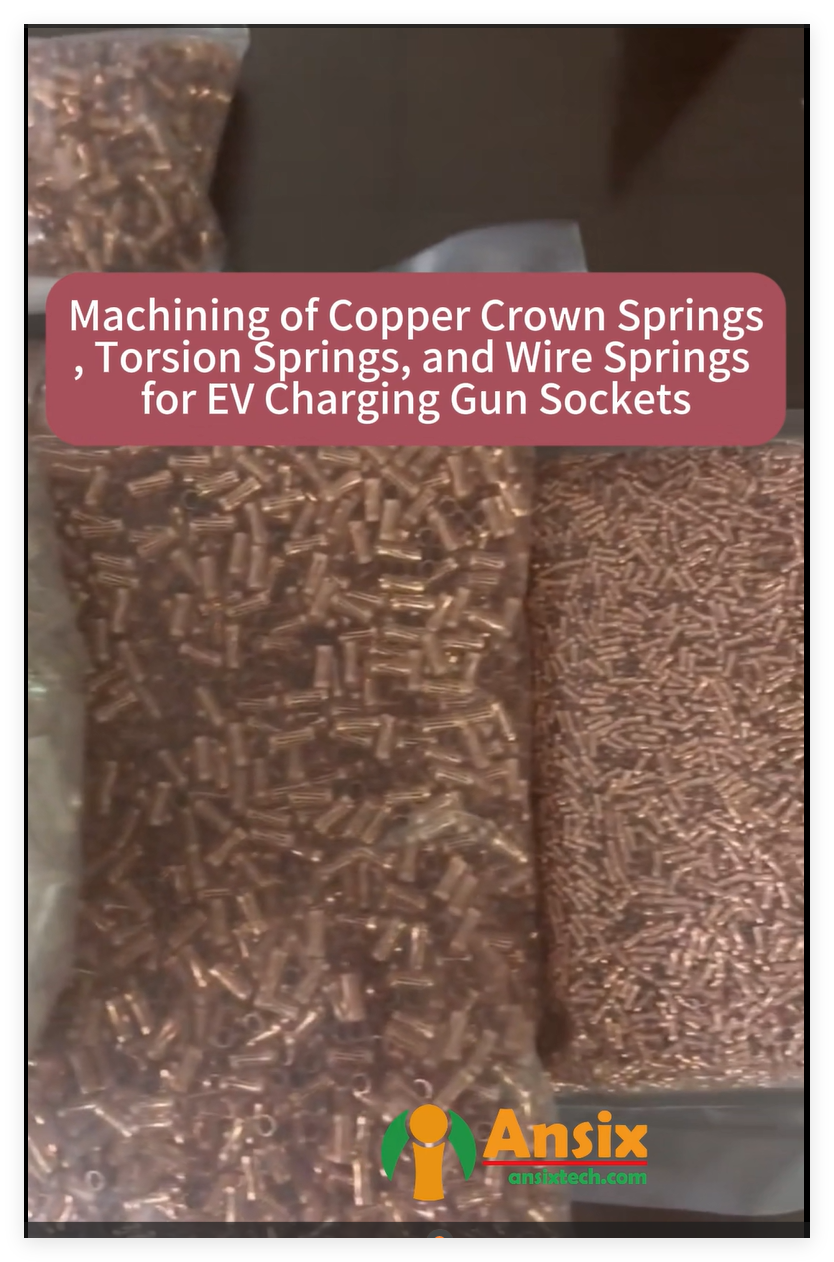
Machining of Copper Crown Springs, Torsion Springs, and Wire Springs for EV Charging Gun Sockets
Machining of Copper Crown Springs, Torsion Springs, and Wire Springs for EV Charging Gun Sockets

Precision Under Pressure: How Ansix Tech is Mastering the Machining of Copper Crown Springs, Torsion Springs, and Wire Springs for Next-Generation EV Charging Gun Sockets
In the high-stakes arena of electric vehicle (EV) infrastructure, reliability is measured in milliseconds, and safety is non-negotiable. While the world’s attention focuses on battery range and charging speed, a quieter revolution is taking place deep inside the EV charging gun socket—where precision-engineered metal springs form the critical interface between vehicle and power source.
Copper crown springs, torsion springs, and wire springs may be small in stature, but they carry an outsized responsibility. These components ensure consistent electrical contact, maintain mechanical engagement through thousands of mating cycles, and provide the tactile feedback that signals a secure connection. As charging power levels surge toward 600 amps and beyond, the demands on these springs have intensified dramatically—requiring manufacturing precision measured in microns and material science expertise that few contract manufacturers possess.
For Ansix Tech, a precision injection molding and metal component specialist with over 28 years of manufacturing experience, these components represent both a formidable engineering challenge and a strategic opportunity. Through integrated design, advanced material selection, and rigorous process optimization, the company has developed a comprehensive approach to producing these critical components that delivers measurable value to EV charging manufacturers worldwide.
The Market Imperative: Why Spring Components Matter More Than Ever
The global EV charging gun market is experiencing explosive growth. Industry analysts project that the market for DC charging guns alone will reach $1.187 billion by 2031, representing a compound annual growth rate of nearly 13% . Within this expanding ecosystem, the internal spring components that ensure electrical continuity and mechanical reliability have become performance-critical elements.
Copper crown springs, typically employed as conductive contacts within the charging socket, must maintain consistent pressure against the charging pin across thousands of mating cycles. Torsion springs provide the return mechanism for locking latches and safety interlocks, while wire springs serve various functions from contact pressure to cable strain relief. The failure of any of these components can result in intermittent charging, overheating, or complete system failure—scenarios that EV manufacturers cannot tolerate.
“The charging interface is arguably the most critical touchpoint in the entire EV ownership experience,” explains Stephen, CTO of Ansix Tech. “If a battery management system glitches, the car might not start. If a charging gun socket fails, the driver is stranded with a dead vehicle. Our spring components are engineered to ensure that never happens.”
Project Initiation: From Concept to Collaborative Engineering
The journey of every spring component at Ansix Tech begins not with metal forming, but with collaborative engineering. The company’s project initiation phase follows a structured approach that integrates client requirements with manufacturing reality before any tooling is cut.
Design for Manufacturability (DFM) as Foundation
Ansix Tech’s engineers conduct comprehensive DFM analyses at the project outset, evaluating component geometry against the constraints of mass production . For spring components, this analysis examines critical parameters:
Material flow characteristics during forming processes
Stress distribution under cyclic loading conditions
Geometric tolerances required for consistent electrical contact
Surface finish requirements that affect corrosion resistance and wear
The DFM process identifies potential manufacturing pitfalls before they become costly problems. For copper crown springs, this might involve evaluating the feasibility of achieving specific contact geometries with high-speed stamping equipment. For torsion springs, it means analyzing coil geometry to ensure consistent torque characteristics across millions of cycles.
Virtual Prototyping and Simulation
Following DFM analysis, Ansix Tech employs advanced simulation tools to create digital twins of both the component and its manufacturing process. Mold flow analysis software, typically associated with plastic injection molding, is adapted to simulate metal forming processes—predicting material behavior under forming pressures, identifying potential defect locations, and optimizing tool geometry .
This virtual validation phase is particularly critical for spring components, where material grain structure and work hardening directly impact performance. By simulating the forming process digitally, engineers can predict how copper alloys or spring steels will behave during manufacturing and, more importantly, how they will perform over thousands of service cycles.
“We treat simulation as our first line of defense against quality issues,” notes a senior design engineer at Ansix Tech. “By the time we cut steel for production tooling, we’ve already validated the design virtually. This approach reduces development time by up to 30% and virtually eliminates costly mold rework” .
Material Selection: The Foundation of Spring Performance
The selection of raw materials for spring components represents one of the most critical decisions in the entire manufacturing process. Ansix Tech maintains extensive databases on metal alloys and their specific properties, enabling engineers to match material characteristics precisely to application requirements.
Copper Crown Springs: Balancing Conductivity and Spring Force
Copper crown springs face a unique challenge: they must simultaneously provide excellent electrical conductivity while maintaining consistent spring force across thousands of mating cycles. Ansix Tech typically specifies high-performance copper alloys for these applications:
Beryllium Copper (C17200, C17300) remains the gold standard for conductive spring applications. With electrical conductivity ranging from 15-30% IACS (International Annealed Copper Standard) and exceptional fatigue resistance, beryllium copper maintains spring force even after extended cycling. The alloy’s yield strength can exceed 1,000 MPa after appropriate heat treatment, enabling designers to achieve required contact forces with minimal material volume.
Phosphor Bronze (C51000, C52100) offers a more cost-effective alternative for less demanding applications. While electrical conductivity (10-20% IACS) and strength are somewhat lower than beryllium copper, phosphor bronze provides excellent formability and corrosion resistance. Ansix Tech’s engineers evaluate application requirements to determine whether the premium properties of beryllium copper justify its higher material cost.
Torsion and Wire Springs: Strength and Fatigue Resistance
For torsion springs and wire springs, where electrical conductivity is secondary to mechanical performance, Ansix Tech specifies high-carbon spring steels and stainless alloys:
Music Wire (ASTM A228) provides exceptional tensile strength (up to 2,500 MPa) and fatigue resistance at moderate cost. The material’s high carbon content enables consistent spring characteristics across millions of cycles, making it ideal for locking mechanisms and latch return springs.
Stainless Steel (Type 302, 316) offers corrosion resistance essential for outdoor charging environments. While slightly lower in strength than music wire, stainless springs maintain their properties in challenging environmental conditions—a critical consideration for charging equipment exposed to moisture, road salt, and temperature extremes.
Precision Manufacturing: The Art of Spring Production
With validated designs and selected materials, Ansix Tech’s manufacturing process brings components to life through precision metal forming techniques.
Copper Crown Spring Manufacturing
Copper crown springs typically follow a stamping and forming process that demands exceptional precision. The manufacturing workflow begins with high-speed stamping operations that blank the spring from copper alloy strip stock. Progressive dies—where the material moves through multiple stations, each performing an operation—enable production rates exceeding 200 strokes per minute while maintaining tolerances within ±0.025mm.
Following stamping, copper crown springs undergo forming operations that create the characteristic crown geometry. This step is critical: the crown height and profile directly determine contact force and electrical performance. Ansix Tech’s forming equipment incorporates real-time monitoring systems that verify crown dimensions at production speeds, immediately flagging any deviation from specifications.
Heat treatment follows forming for beryllium copper components, typically performed in controlled atmosphere furnaces that prevent surface oxidation. The precipitation hardening process transforms the material from its soft, formable state to its final high-strength condition, with precisely controlled time-temperature cycles ensuring consistent properties across production batches.
Torsion and Wire Spring Manufacturing
The production of torsion and wire springs follows established coiling processes, executed on Precision Cnc spring coiling machines. These sophisticated systems control wire feed rate, coiling pitch, and mandrel rotation to create springs with consistent geometry and mechanical properties.
For torsion springs, where leg orientation and coil diameter directly impact torque characteristics, Ansix Tech employs machines capable of producing complex geometries with multiple bends and configurations. Each spring is automatically measured after coiling, with dimensions verified against CAD specifications before proceeding to subsequent operations.
Stress relief heat treatment follows coiling, reducing residual stresses introduced during forming. This step is critical for fatigue life: properly stress-relieved springs can withstand millions of cycles without failure, while springs processed incorrectly may fail prematurely.
Quality Validation: Ensuring Reliability Through Rigorous Testing
Ansix Tech’s commitment to quality extends far beyond dimensional inspection. The company’s validation protocols are designed to ensure that every spring component will perform reliably throughout its service life.
Dimensional Verification
Coordinate measuring machines (CMMs) and optical measurement systems verify critical dimensions with micron-level accuracy. For copper crown springs, this includes crown height, contact geometry, and overall dimensions. For torsion springs, coil diameter, free length, and leg orientation are verified against specifications .
Mechanical Testing
Spring force testing validates that each component meets its specified load-deflection characteristics. Ansix Tech utilizes automated test systems capable of cycling springs through their full range of motion while measuring force output. For copper crown springs, this testing verifies contact pressure across the intended operating range—critical for ensuring consistent electrical performance.
Fatigue testing, performed on representative samples from production batches, validates that springs maintain their properties across thousands of cycles. Ansix Tech’s accelerated life testing protocols compress years of service into days, providing confidence that components will perform reliably in the field.
Electrical Testing
For copper crown springs, electrical performance validation is essential. Contact resistance measurements verify that the spring’s conductive path meets specifications, typically in the milliohm range. High-voltage testing ensures that insulation requirements are satisfied when springs are integrated into charging socket assemblies.
Cost Reduction: Engineering Value Through Process Optimization
Perhaps Ansix Tech’s most distinctive capability lies in its systematic approach to cost reduction. Rather than viewing cost as a simple negotiation point, the company approaches cost optimization as an engineering discipline—identifying opportunities for savings throughout the manufacturing lifecycle .
Material Optimization
Material costs typically represent the largest component of spring manufacturing expense. Ansix Tech’s material optimization strategy focuses on selecting the most cost-effective material that meets performance requirements, rather than defaulting to premium specifications.
For copper crown springs, this might involve substituting phosphor bronze for beryllium copper when electrical conductivity requirements permit. For torsion springs, it might mean selecting a lower-cost spring steel with slightly reduced tensile strength when design margins allow. Ansix Tech’s engineers work closely with clients to understand actual performance requirements, eliminating unnecessary specification margins that drive up cost without adding value.
Process Efficiency
Cycle time reduction represents another significant opportunity for cost savings. Ansix Tech’s process optimization initiatives have achieved substantial improvements:
High-speed stamping operations optimized through tool geometry refinement and lubrication improvements
Heat treatment cycles shortened through improved furnace loading and temperature control
Automated inspection integrated directly into production lines, eliminating separate inspection operations
These efficiency gains translate directly to lower per-part costs. A 15% reduction in cycle time, for example, increases annual output by a corresponding percentage without additional capital investment .
Tooling Innovation
Ansix Tech’s approach to Tooling Design emphasizes long-term value over initial cost. While high-performance tooling may require greater upfront investment, it delivers lower per-part costs through extended tool life and reduced maintenance requirements.
For copper crown spring stamping, carbide tooling—while more expensive than steel alternatives—maintains dimensional precision over millions of strokes, reducing scrap and extending production runs between tool maintenance. For wire spring coiling, precision-ground coiling points and mandrels reduce wear and ensure consistent geometry over extended production periods.
Production Capacity and Delivery: Meeting Market Demands
With over 260 injection molding machines across facilities in China and Vietnam, Ansix Tech has built substantial production capacity for plastic components. The company’s metal spring manufacturing operations, while smaller in scale, benefit from the same focus on efficiency and quality .
Scalable Production Infrastructure
Ansix Tech’s manufacturing footprint—totaling approximately 200,000 square meters—provides flexibility to scale production as client demands grow. For spring components, this scalability enables the company to support clients from prototype development through high-volume production, with capacity to accommodate demand fluctuations without compromising quality or delivery.
Rapid Delivery Capability
In the fast-moving EV market, speed matters. Ansix Tech has structured its operations to compress development and delivery timelines without sacrificing quality:
Concurrent engineering reduces development time by enabling design and tooling activities to proceed in parallel rather than sequentially
Digital validation eliminates physical trial iterations that typically consume weeks or months
Integrated manufacturing under one roof reduces logistics overhead and eliminates delays associated with multiple suppliers
For urgent requirements, the company’s dedicated project management teams coordinate expedited workflows that can deliver certified parts within days of order confirmation—a capability essential for clients managing production line disruptions or sudden demand increases.
The Ansix Tech Advantage: Experience That Delivers Value
With nearly three decades of manufacturing experience, Ansix Tech has developed institutional knowledge that benefits every client engagement. The company’s work with major EV manufacturers—including components for Tesla charging guns—has created a knowledge foundation that translates across applications .
Automotive-Grade Quality Systems
Ansix Tech’s IATF 16949 certification reflects the company’s commitment to automotive-quality standards. This certification requires rigorous documentation, process control, and continuous improvement—disciplines that directly benefit spring component manufacturing .
Integrated Solutions Capability
Unlike manufacturers focused exclusively on springs or metal components, Ansix Tech offers integrated solutions that combine metal springs with plastic housings and assemblies. This integration reduces client supply chain complexity and eliminates interface issues that can arise when components from multiple suppliers are assembled.
Co-Engineering Partnership
Perhaps most significantly, Ansix Tech positions itself as a co-engineering partner rather than a simple supplier. The company’s engineers engage early in the design process, providing feedback on manufacturability, cost optimization, and material selection. This collaborative approach ensures that components are designed not just to function, but to be manufactured efficiently and cost-effectively.
The Road Ahead: Meeting Future Demands
As EV charging technology continues its rapid evolution toward higher power levels and more demanding operating conditions, the requirements for spring components will intensify. Ansix Tech’s ongoing investments in material science, process automation, and quality systems position the company to meet these future challenges.
Emerging trends that will shape future spring component requirements include:
Higher power levels demanding improved thermal management and contact reliability
More compact designs requiring spring components with higher force density
Extended service life expectations demanding improved fatigue resistance
Sustainability requirements favoring recyclable materials and efficient manufacturing processes
For Ansix Tech, these trends represent opportunities to leverage the company’s core competencies in precision manufacturing and process optimization. The same engineering discipline that delivers cost-effective components today will enable even more sophisticated solutions tomorrow.
Conclusion: Precision as Competitive Advantage
In the complex ecosystem of EV charging infrastructure, the smallest components often carry the greatest responsibility. Copper crown springs, torsion springs, and wire springs may represent a fraction of the total component count in a charging gun socket, but their performance determines whether that socket will function reliably for thousands of cycles or fail prematurely.
Ansix Tech’s approach to manufacturing these critical components—integrating design, material science, precision manufacturing, and rigorous quality validation—demonstrates that excellence in the details translates to competitive advantage in the marketplace. By reducing clients’ hard costs through material optimization, process efficiency, and tooling innovation, the company delivers value that extends far beyond component price.
For EV charging manufacturers navigating the complex transition to electric mobility, partnering with a manufacturer that understands both the technical demands and cost pressures of the industry is essential. Ansix Tech’s 28 years of manufacturing experience, combined with its focus on engineering value into every component, positions the company as a trusted partner in building the charging infrastructure that will power the future of transportation.
About Ansix Tech
Ansix Tech is a precision injection molding and metal component manufacturer with over 28 years of experience serving automotive, medical, consumer electronics, and industrial clients. The company operates four production facilities in China and Vietnam, employing over 1,200 people including more than 200 design engineers. Ansix Tech holds ISO 9001, ISO 14001, IATF 16949, and ISO 13485 certifications, reflecting its commitment to quality management across diverse industries.
For more information about Ansix Tech’s spring component manufacturing capabilities, contact info@ansixtech.com.



Ansix Tech Co Ltd
If you have any plans related to Machining of Copper Crown Springs, Torsion Springs, and Wire Springs for EV Charging Gun Sockets , you can contact us at any time. We will turn your ideas into reality, let you realize your dreams, and obtain large orders from the market. Our contact information is info@ansixtech.com. Or contact our CTO, mail: stephen@ansixtech.com
#www.ansixtech.com #ansixtech.com #Machining of Copper Crown Springs, Torsion Springs, and Wire Springs for EV Charging Gun Sockets #Machining of Copper Crown Springs, Torsion Springs, and Wire Springs for EV Charging Gun Sockets #Machining of Copper Crown Springs, Torsion Springs, and Wire Springs for EV Charging Gun Sockets injection molding company #Machining of Copper Crown Springs, Torsion Springs, and Wire Springs for EV Charging Gun Sockets injection mold companies #Ansix #Ansix moulds #Ansix china #Ansix tech china #Ansix tech company #Ansix facotry #Ansix Tech #Ansix molds #Ansix injection molding #Ansix mold factory #injection molding Machining of Copper Crown Springs, Torsion Springs, and Wire Springs for EV Charging Gun Sockets #Ansix mold factory #Machining of Copper Crown Springs, Torsion Springs, and Wire Springs for EV Charging Gun Sockets china #Machining of Copper Crown Springs, Torsion Springs, and Wire Springs for EV Charging Gun Sockets molds #injection factory #Machining of Copper Crown Springs, Torsion Springs, and Wire Springs for EV Charging Gun Sockets injection molding #Machining of Copper Crown Springs, Torsion Springs, and Wire Springs for EV Charging Gun Sockets injection molding factory #injection molding company #Machining of Copper Crown Springs, Torsion Springs, and Wire Springs for EV Charging Gun Sockets injection mold companies #Machining of Copper Crown Springs, Torsion Springs, and Wire Springs for EV Charging Gun Sockets#Machining of Copper Crown Springs, Torsion Springs, and Wire Springs for EV Charging Gun Sockets mold limited #Ansix mold china #Ansix companies #Ansix company China #Machining of Copper Crown Springs, Torsion Springs, and Wire Springs for EV Charging Gun Sockets facotry #Ansix Tech #Ansix Tech mould #Machining of Copper Crown Springs, Torsion Springs, and Wire Springs for EV Charging Gun Sockets injection moulding #injection moulding company #Ansix Machining of Copper Crown Springs, Torsion Springs, and Wire Springs for EV Charging Gun Sockets parts injection mold companies #Machining of Copper Crown Springs, Torsion Springs, and Wire Springs for EV Charging Gun Sockets #Machining of Copper Crown Springs, Torsion Springs, and Wire Springs for EV Charging Gun Sockets china #Machining of Copper Crown Springs, Torsion Springs, and Wire Springs for EV Charging Gun Sockets china factory #Ansix moulding companies #Ansix molding company #Machining of Copper Crown Springs, Torsion Springs, and Wire Springs for EV Charging Gun Sockets injection moulding facotry #Ansix Tech mold #Machining of Copper Crown Springs, Torsion Springs, and Wire Springs for EV Charging Gun Sockets mould #Machining of Copper Crown Springs, Torsion Springs, and Wire Springs for EV Charging Gun Sockets plastic injection molding #ansix plastic mold #Mold manufacturing #Machining of Copper Crown Springs, Torsion Springs, and Wire Springs for EV Charging Gun Sockets parts manufacturing #Machining of Copper Crown Springs, Torsion Springs, and Wire Springs for EV Charging Gun Sockets plastic parts factory #Machining of Copper Crown Springs, Torsion Springs, and Wire Springs for EV Charging Gun Sockets injection parts mold #Machining of Copper Crown Springs, Torsion Springs, and Wire Springs for EV Charging Gun Sockets PRECISION MANUFACTURING #Machining of Copper Crown Springs, Torsion Springs, and Wire Springs for EV Charging Gun Sockets #China mold #Machining of Copper Crown Springs, Torsion Springs, and Wire Springs for EV Charging Gun Sockets injection moulding china #Machining of Copper Crown Springs, Torsion Springs, and Wire Springs for EV Charging Gun Sockets mould china #china precision mold #mold in china #Machining of Copper Crown Springs, Torsion Springs, and Wire Springs for EV Charging Gun Sockets mold china #Precision molds #High-precision molds #Machining of Copper Crown Springs, Torsion Springs, and Wire Springs for EV Charging Gun Sockets #Injection molds #Machining of Copper Crown Springs, Torsion Springs, and Wire Springs for EV Charging Gun Sockets Factory #Machining of Copper Crown Springs, Torsion Springs, and Wire Springs for EV Charging Gun Sockets Company #Super Large Injection Mold Factory #Large Tonnage Injection Molding Factory #Machining of Copper Crown Springs, Torsion Springs, and Wire Springs for EV Charging Gun Sockets Company #Machining of Copper Crown Springs, Torsion Springs, and Wire Springs for EV Charging Gun Sockets Factory #2800T Injection Molding Factory #3000 Ton Injection Molding #4500 Ton Injection Molding Factory #Large Mold Injection Molding #Large Plastic Mold Injection Molding Factory #Large Injection Mold Manufacturer #Plastic Mold Factory #Injection Mold #Plastic Mold