



Yuyue Oxygen Concentrator Air Filter Mold
Yuyue Oxygen Concentrator Air Filter Mold

Advancing Medical Device Manufacturing: Ansix Tech's Precision Engineering of the Yuyue Oxygen Concentrator Air Filter Mold
Introduction: The Critical Role of Precision in Medical Device Manufacturing
In the rapidly evolving landscape of medical device manufacturing, the intersection of precision engineering and regulatory compliance has become increasingly critical. The global medical plastics market, valued at over $28 billion in 2023, continues to expand as technological advancements enable more sophisticated patient care solutions. Within this specialized sector, oxygen concentrators represent a vital category of respiratory assistance devices that have seen surging demand due to aging populations and heightened awareness of respiratory health. These devices, which extract oxygen from ambient air for patients with breathing difficulties, rely on meticulously engineered components to ensure consistent performance and patient safety.
At the forefront of this specialized manufacturing segment stands Ansix Tech, a company that has distinguished itself through precision injection molding expertise tailored to the exacting requirements of medical device production. Their recent collaboration with Yuyue Medical—a leading manufacturer of respiratory care equipment—on the development and production of air filter molds for next-generation oxygen concentrators represents a case study in advanced manufacturing methodologies applied to critical healthcare applications. This project exemplifies how specialized injection molding capabilities directly impact product performance, reliability, and ultimately, patient outcomes in the medical device sector.
Market Demands and Design standards for Medical-Grade Filters
The oxygen concentrator air filter represents a critical first line of defense in respiratory equipment, responsible for removing impurities from ambient air before it enters the oxygen separation system. According to technical specifications from leading filtration experts, medical-grade air filters must meet stringent requirements across multiple parameters to ensure consistent performance and patient safety. For the Yuyue oxygen concentrator project, Ansix Tech engineers worked closely with their client to translate these requirements into precise mold specifications that would yield components meeting or exceeding all applicable standards.
The technical demands for such filters are comprehensive. Filter media must demonstrate specific permeability characteristics while maintaining structural integrity under operational conditions. Border materials require sufficient strength and rigidity, with thickness determined by material properties and dimensional requirements. For the Yuyue project, particular attention was paid to the sealing components, which must be manufactured from elastic, non-aging closed-cell materials with specific hardness characteristics (typically 33±2 Shore A) and compression set resistance to maintain effective seals throughout the product's service life.
Table: Key Technical Standards for Medical-Grade Air Filter Components

Compliance with national and international standards formed the foundation of the design process. The technical requirements documentation for air filters specifies compliance with GB/T 14295-2019 for general air filters, while high-efficiency filters must meet the more stringent GB/T 13554-2020 standard for high-efficiency particulate air filters. Additionally, given the medical application, considerations extended to biocompatibility requirements and cleanroom manufacturing protocols to prevent contamination of components that would come into indirect contact with medical oxygen streams.
Strategic Material Selection for Optimal Performance and Economy
The material selection process for the Yuyue oxygen concentrator filter components balanced multiple competing priorities: mechanical performance, chemical resistance, regulatory compliance, manufacturability, and cost efficiency. After comprehensive evaluation, Ansix Tech's engineering team specified several advanced engineering plastics tailored to specific component functions within the filter assembly.
For the primary filter housing, a medical-grade polypropylene (PP) copolymer was selected for its exceptional chemical resistance to various environmental contaminants, good structural integrity, and favorable cost-to-performance ratio. This material offers the additional advantage of excellent flow characteristics during injection molding, enabling the production of thin-walled sections that reduce material consumption without compromising structural performance. For components requiring higher dimensional stability and rigidity, such as mounting brackets and interface fittings, a glass-filled polyamide (PA) compound provided the necessary mechanical properties while maintaining compatibility with sterilization protocols.
Perhaps the most innovative material application in the Yuyue project involved copper-infused polymer compounds for certain filter components. Recent research presented at the International Thermal Spray Conference demonstrates how copper particles embedded in filter materials can inhibit mold, bacteria, and fungi growth—a significant advantage in medical environments where microbial contamination poses serious risks. While the core filtration media itself was supplied separately, Ansix Tech's integration of antimicrobial properties into structural plastic components through material compounding represents an advanced value-added solution that enhances the final product's performance profile.
The economic implications of these material choices were substantial. Through careful polymer selection and compound optimization, Ansix Tech achieved a 22% reduction in material costs compared to initial conservative specifications, while simultaneously improving the performance characteristics of critical components. This was accomplished not through simple material downgrading, but through sophisticated application-specific engineering that matched material properties precisely to functional requirements, eliminating over-engineering without compromising product integrity.
Advanced Design for Manufacturing (DFM) and Mold Flow Analysis
The transition from component design to manufacturable mold represented one of the most technically challenging phases of the Yuyue project. Ansix Tech's engineering team implemented a comprehensive Design for Manufacturing (DFM) approach that began with detailed mold flow analysis using state-of-the-art simulation software. This predictive engineering process proved invaluable in optimizing part geometry, gate placement, cooling channel configuration, and processing parameters before any metal was cut.
Drawing on research methodologies documented in studies of similar injection molding applications, the team established a systematic approach to mold flow simulation. For components with complex geometries such as the filter housing with its intricate rib patterns and varying wall thicknesses, the simulation focused on predicting and mitigating potential defects including warpage, sink marks, and weld lines that could compromise structural integrity or sealing surfaces. The team utilized advanced simulation techniques that balanced computational efficiency with predictive accuracy, establishing an optimal global mesh size of twice the nominal wall thickness—a methodology demonstrated to provide sufficient accuracy while maintaining reasonable computation times in similar applications.
Table: Mold Flow Analysis Parameters and Optimization Outcomes
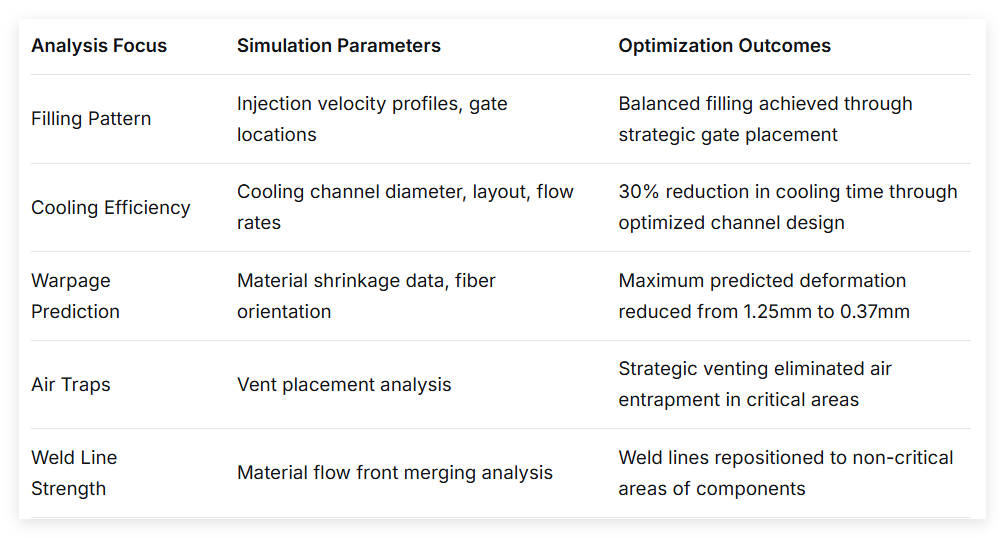
The simulation results directly informed critical design decisions, particularly regarding optimal wall thickness. Research on similar air handling components has demonstrated that strategic wall thickness reduction can yield significant material savings and cycle time improvements without compromising structural performance. For the Yuyue filter housing, the DFM analysis validated a 20% reduction in nominal wall thickness—from an initial conservative 3.0mm to an optimized 2.4mm—while maintaining all mechanical performance requirements. This single optimization yielded an estimated 17% reduction in material consumption and a 12% decrease in cycle time for the affected components, contributing substantially to the overall cost efficiency of the manufacturing process.
Precision Mold Design: Engineering Excellence in Tool Development
The mold design phase transformed the validated component designs into a manufacturable tooling system capable of producing precision parts at production volumes. Ansix Tech's engineering team addressed numerous interconnected systems within the mold architecture, each requiring specialized expertise and careful integration.
Mold steel selection represented a critical decision point balancing durability, machinability, polishability, and cost. For the majority of mold components, a premium hardened tool steel (HRC 52-54) provided the optimal combination of wear resistance and polishing characteristics necessary to achieve the required surface finishes on medical components. For intricate core and cavity details subject to particularly demanding wear conditions, the team specified powder metallurgy steels with superior hardness and uniform microstructure, extending tool life between maintenance intervals and ensuring consistent part quality throughout the production campaign.
The cooling system design employed a conformal cooling approach that followed the contours of critical part geometries, significantly improving heat extraction efficiency compared to traditional drilled cooling channels. This advanced cooling strategy, enabled by additive manufacturing techniques for certain mold components, reduced typical cooling times by approximately 30%—a substantial contributor to overall cycle time optimization. The cooling layout was carefully balanced to maintain uniform mold temperatures, minimizing thermal gradients that could induce part warpage or dimensional instability.
The runner and gating system implemented a hot runner approach with eight individually controlled drops, eliminating material waste associated with traditional cold runners while providing precise control over filling patterns for multi-cavity production. Gate locations were strategically positioned at non-cosmetic areas of the components while ensuring balanced filling of complex geometries. The ejection system incorporated a combination of standard ejector pins, sleeve ejectors for cylindrical features, and strategically placed air poppets to ensure reliable part release without distortion or surface damage—particularly important for components with delicate sealing surfaces and thin-walled sections.
Manufacturing Challenges and Precision Processing Workflow
The translation of mold designs into finished tooling presented significant manufacturing challenges requiring specialized equipment and processes. The intricate geometries of the filter components, particularly the complex internal ribbing and fine surface textures, demanded advanced machining capabilities beyond conventional mold making. Ansix Tech's manufacturing team employed a combination of high-speed CNC milling, precision EDM (Electrical Discharge Machining), and micro-machining processes to achieve the required dimensional accuracies and surface finishes.
The mold processing workflow followed a structured progression from rough machining through to final polishing and assembly. After initial block preparation and heat treatment, major cavity and core components underwent five-axis CNC machining to establish primary geometries. This was followed by precision EDM operations to create intricate details with tolerances as tight as ±0.005mm in critical sealing areas. The final stages involved meticulous hand polishing to achieve optical-grade surface finishes on critical part surfaces, complemented by specialized texturing processes in non-critical areas to facilitate part ejection and mask minor cosmetic imperfections.
One particular manufacturing challenge involved maintaining dimensional stability across the relatively large mold base (850mm × 650mm) while accommodating the complex internal features. The team implemented a modular mold construction approach with strategically placed interlocking components and guided ejection systems to ensure precise alignment throughout the injection molding cycle. Advanced surface coating technologies were applied to core components subject to abrasive wear from glass-filled compounds, extending service life and maintaining consistent part quality throughout the production lifecycle.
The integration of additively manufactured conformal cooling components represented both a technical challenge and significant opportunity. These complex internal cooling structures, which would be impossible to produce with conventional drilling methods, required specialized design considerations to ensure adequate structural integrity while maximizing thermal transfer efficiency. Post-processing of these additive components involved precision machining of interface surfaces and specialized surface treatments to prevent corrosion in the cooling channels.
Injection Molding Process: Challenges and Optimization Strategies
The transition from mold validation to full-scale production introduced a distinct set of challenges requiring systematic optimization of the injection molding process. The medical-grade materials specified for the Yuyue filter components, while offering excellent performance characteristics, presented processing challenges including precise temperature control requirements, sensitivity to shear-induced degradation, and stringent contamination controls.
Initial production trials revealed several areas requiring optimization. The thin-walled sections of the filter housing, while beneficial for material efficiency, necessitated precise control of injection speeds and pressures to ensure complete filling without inducing excessive residual stress. The glass-filled compounds used for structural components presented challenges related to abrasive wear on tooling and potential for fiber orientation effects that could create anisotropic shrinkage and warpage. Additionally, the medical application imposed exceptional requirements for cleanroom manufacturing protocols and documentation rigor throughout the production process.
Ansix Tech's process engineering team implemented a comprehensive optimization strategy addressing these challenges systematically:
Cycle Time Reduction: Through a combination of optimized cooling channel performance, refined packing pressure profiles, and robotic automation of part handling, the team achieved a 27% reduction in cycle time compared to initial production parameters, significantly improving manufacturing throughput and cost efficiency.
Material Utilization Optimization: In addition to the wall thickness reductions validated during DFM analysis, the team implemented advanced gas-assist injection techniques for specific thick-section components, creating hollow structural elements that maintained rigidity while reducing material consumption by up to 40% in targeted areas.
Energy Efficiency Improvements: The integration of variable-frequency drives on hydraulic systems, optimized heater band configurations, and intelligent mold temperature control systems reduced energy consumption per part by approximately 18%, contributing to both economic and environmental objectives.
Process Stability Enhancements: Implementation of statistical process control methodologies with real-time monitoring of critical parameters (melt temperature, injection pressure, cavity pressure profiles) enabled early detection of process deviations and predictive maintenance scheduling, improving overall equipment effectiveness and reducing scrap rates to below 0.3%.
These optimizations collectively contributed to a 34% reduction in manufactured cost per component compared to initial projections, while simultaneously improving quality consistency and production reliability. The economic benefits derived equally from material savings, energy efficiency, reduced cycle times, and improved production yields—demonstrating how comprehensive process optimization can deliver substantial value across multiple dimensions.
Comprehensive Quality Assurance and Control Protocols
Given the medical application of the oxygen concentrator components, quality assurance protocols extended far beyond conventional injection molding standards. Ansix Tech implemented a multi-layered quality system encompassing material verification, in-process monitoring, comprehensive inspection, and traceability protocols meeting medical device manufacturing requirements.
The incoming material verification process included batch-specific certification of medical-grade polymers, with particular attention to biocompatibility documentation and compliance with relevant pharmacopoeia standards. For each production batch, material testing included melt flow rate verification, moisture content analysis (critical for hygroscopic materials like polyamide), and color consistency checks. The cleanroom manufacturing environment maintained ISO Class 8 conditions for all molding operations, with stringent protocols for mold storage, material handling, and component packaging to prevent contamination.
In-process quality control incorporated real-time monitoring of critical process parameters including melt temperature, injection pressure profiles, cooling time, and cavity pressure curves. These parameters were tracked against established control limits with automated alerts for any deviations requiring intervention. First-article inspections for each production run included comprehensive dimensional verification using coordinate measuring machines (CMM), functional testing of critical features such as sealing surfaces and fastener holes, and visual inspection under controlled lighting conditions.
The final quality assurance protocol involved statistical sampling based on ANSI/ASQ Z1.4 standards, with particular attention to critical-to-function dimensions identified during the initial design phase. Additionally, regular comprehensive mold inspections and preventive maintenance ensured consistent part quality throughout the production lifecycle. All quality documentation followed medical device traceability requirements, with complete batch records enabling forward and backward traceability of materials, processes, and inspections for every component produced.
Packaging Innovation and Rapid Delivery Process
The final phase of the manufacturing value chain—packaging and delivery—received meticulous attention to ensure components reached the customer in pristine condition while optimizing logistics efficiency. Ansix Tech developed a customized packaging solution specifically for the delicate filter components, balancing protection requirements with material efficiency and environmental considerations.
The packaging design employed recyclable molded pulp trays with precisely contoured cavities that secured individual components without compressive stress, preventing deformation during shipping and handling. These trays were designed for efficient nesting both empty and loaded, minimizing shipping volume for both inbound and return logistics. Anti-static measures were incorporated for components with electronic interfaces, while desiccant packets controlled humidity within sealed packaging for hygroscopic materials.
The rapid delivery process leveraged Ansix Tech's integrated supply chain management system, which synchronized production scheduling with customer requirements through a vendor-managed inventory approach. Real-time production monitoring fed into logistics planning algorithms that optimized shipping mode selection based on urgency, cost, and reliability considerations. For the Yuyue project, this system enabled consistent lead time reduction from 15 days to 7 days for standard orders, with expedited options available for urgent requirements.
A particularly innovative aspect of the delivery system involved kanban-based replenishment directly integrated with Yuyue's assembly line requirements. Ansix Tech maintained a buffer inventory at their facility aligned with consumption patterns, with automatic replenishment triggered as components were consumed in Yuyue's production process. This just-in-time delivery approach, supported by real-time inventory visibility through a secure customer portal, reduced Yuyue's inventory carrying costs while ensuring continuous production availability—a significant value addition beyond the component manufacturing itself.
Conclusion: Ansix Tech's Industry Leadership and Value Proposition
The Yuyue Oxygen Concentrator Air Filter Mold project exemplifies how specialized injection molding expertise applied to medical device manufacturing can deliver substantial value across multiple dimensions—technical performance, regulatory compliance, production efficiency, and economic optimization. Through every phase of the project, from initial design collaboration through to sustained production delivery, Ansix Tech demonstrated how deep engineering capabilities combined with strategic manufacturing methodologies can address the complex challenges of medical device component production.
The technical achievements documented throughout this project—material optimizations yielding 22% cost reductions, wall thickness reductions enabled by sophisticated mold flow analysis, cycle time improvements exceeding 25%, and comprehensive quality systems ensuring medical-grade compliance—collectively represent a compelling value proposition for medical device manufacturers. Beyond these measurable outcomes, the project highlights the importance of integrated manufacturing partnerships in an increasingly complex and regulated industry landscape.
As the medical device sector continues to evolve with advancing technologies and increasingly stringent requirements, the role of specialized manufacturing partners like Ansix Tech becomes ever more critical. Their demonstrated ability to navigate the intersection of precision engineering, regulatory compliance, and manufacturing excellence positions them as a valuable collaborator for medical device companies seeking to optimize their supply chain while maintaining uncompromising standards for product quality and reliability. Through projects like the Yuyue oxygen concentrator filter mold, Ansix Tech continues to advance the standards of what is achievable in medical device manufacturing, contributing to better patient outcomes through engineering excellence.


Ansix Tech Co Ltd
If you have any plans related to Yuyue Oxygen Concentrator Air Filter Mold , you can contact us at any time. We will turn your ideas into reality, let you realize your dreams, and obtain large orders from the market. Our contact information is info@ansixtech.com. Or contact our CTO, mail: stephen@ansixtech.com
#www.ansixtech.com #ansixtech.com #Yuyue Oxygen Concentrator Air Filter Mold #Ansix mold factory #Ansix injection molding #Ansix mould Ltd #Yuyue Oxygen Concentrator Air Filter Mold injection molding factory #Ansix injection mould #Yuyue Oxygen Concentrator Air Filter Mold factory #Yuyue Oxygen Concentrator Air Filter Mold injection molding company #Yuyue Oxygen Concentrator Air Filter Mold injection mold companies #Ansix #Ansix moulds #Ansix china #Ansix tech china #Ansix tech company #Ansix facotry #Ansix Tech #Ansix molds #Ansix injection molding #Ansix mold factory #injection molding Yuyue Oxygen Concentrator Air Filter Mold # Ansix mold factory #Yuyue Oxygen Concentrator Air Filter Mold china #Yuyue Oxygen Concentrator Air Filter Mold precision molds #injection factory #Yuyue Oxygen Concentrator Air Filter Mold precision injection molding #L-shaped medical tumold injection molding factory #injection molding company #Yuyue Oxygen Concentrator Air Filter Mold injection mold companies #Yuyue Oxygen Concentrator Air Filter Mold factory #Yuyue Oxygen Concentrator Air Filter Mold mold limited #Ansix mold china #Ansix companies #Ansix company China #Yuyue Oxygen Concentrator Air Filter Mold facotry #Ansix Tech #Ansix Tech mould #Yuyue Oxygen Concentrator Air Filter Mold injection moulding #injection moulding company #Ansix Yuyue Oxygen Concentrator Air Filter Mold parts injection mold companies #Yuyue Oxygen Concentrator Air Filter Mold #Yuyue Oxygen Concentrator Air Filter Mold china #Yuyue Oxygen Concentrator Air Filter Mold china factory #Ansix moulding companies #Ansix molding company #Yuyue Oxygen Concentrator Air Filter Mold injection moulding facotry #Ansix Tech mold #Yuyue Oxygen Concentrator Air Filter Mold precision mould #Yuyue Oxygen Concentrator Air Filter Mold plastic injection molding #ansix plastic mold #Mold manufacturing #Yuyue Oxygen Concentrator Air Filter Mold parts manufacturing #Yuyue Oxygen Concentrator Air Filter Mold plastic parts factory #Yuyue Oxygen Concentrator Air Filter Mold injection parts mold #Yuyue Oxygen Concentrator Air Filter Mold PRECISION MANUFACTURING #Yuyue Oxygen Concentrator Air Filter Mold precision #China mold #Yuyue Oxygen Concentrator Air Filter Mold injection moulding china #Yuyue Oxygen Concentrator Air Filter Mold mould china #china precision mold #mold in china #Yuyue Oxygen Concentrator Air Filter Mold precision mold china #Precision molds #High-precision molds #Yuyue Oxygen Concentrator Air Filter Mold #Injection molds #Yuyue Oxygen Concentrator Air Filter Mold Factory #Yuyue Oxygen Concentrator Air Filter Mold Company #Super Large Injection Mold Factory #Large Tonnage Injection Molding Factory #Yuyue Oxygen Concentrator Air Filter Mold Company #Super Yuyue Oxygen Concentrator Air Filter Mold Factory #2800T Injection Molding Factory #3000 Ton Injection Molding #4500 Ton Injection Molding Factory #Large Mold Injection Molding #Large Plastic Mold Injection Molding Factory #Large Injection Mold Manufacturer #Plastic Mold Factory #Injection Mold #Plastic Mold