



Oil level sensor for water tank, universal oil float, stainless steel water level sensor for travel, sprinkler, fire truck, and oil level gauge
FEATURES
Product Portfolio and Technical Specifications
1.1 Product Overview
Ansix Tech manufactures a comprehensive range of liquid level sensing components designed for demanding environments:
Oil Level Sensors for Water Tanks – Precision-engineered sensing devices that monitor fluid levels in industrial and residential water storage systems. These sensors must withstand continuous immersion, temperature fluctuations, and potential chemical exposure while maintaining measurement accuracy.
Universal Oil Floats – Float mechanisms that operate in oil-based environments, requiring exceptional chemical resistance and stable buoyancy characteristics. Ansix employs specialized micro-foaming processes to achieve precise density control for reliable flotation.
Stainless Steel Water Level Sensors – Hybrid designs combining stainless steel sensing elements with engineered polymer housings, offering superior durability for travel, sprinkler, and fire truck applications where vibration, temperature extremes, and environmental exposure are constant challenges.
Oil Level Gauges – Comprehensive measurement systems integrating sensor elements with visual or electronic readout capabilities, requiring dimensional precision and long-term stability.
-
Mold Description
Product Materials:
SUS304+NBR FOAM
Mold Material:
S136ESR
Number of Cavities:
32
Glue Feeding Method:
Hot runner
Cooling Method:
Water cooling
Molding Cycle
42.5s
- The mold manufacturing process and product material selection
Application Environments
These components operate in extraordinarily harsh conditions:
Temperature Range: -40°C to over 150°C
Chemical Exposure: Coolants, oils, acids, alkalis, and solvents
Mechanical Stress: Continuous vibration, pressure cycling, and thermal shock
Environmental: High humidity, pressure washing, and UV exposure
Any component failure can result in system downtime, equipment damage, environmental leakage, or significant safety hazards.
Part II: Material Science – The Foundation of Performance
2.1 Strategic Material Selection Methodology
Ansix Tech approaches material selection as a foundational engineering discipline, recognizing that polymer choice determines sensor performance, longevity, and cost. The company maintains an extensive material database and collaborates with global leaders including Covestro and SABIC to select or customize the most cost-effective grades that meet all functional requirements.
-
Primary Materials and Applications
Polypropylene (PP) – Exhibits excellent chemical resistance, low density, and good processability. Ansix employs specialized micro-foaming processes using physical or chemical foaming agents to create closed-cell foam structures with precise density control, resulting in waterproof, durable floats with reliable buoyancy. Standard foam floats are suitable for water and mild chemical environments.
Polyvinylidene Fluoride (PVDF) – Delivers exceptional resistance to strong acids, alkalis, and solvents, with continuous operating temperatures up to 105°C. The material exhibits high purity and low moisture absorption, making it ideal for corrosive chemical environments in semiconductor and pharmaceutical applications.
Polyphenylene Sulfide (PPS) – Offers outstanding heat resistance exceeding 200°C, excellent dimensional stability, and superior chemical resistance. PPS with 30-40% glass fiber reinforcement withstands under-hood temperatures and is specified where high heat, fire safety (UL94 V-0), and chemical resistance are critical.
Polyamide (Nylon/PA6 and PA66) – Provides toughness, heat resistance, and excellent mechanical properties. Glass-filled grades (PA6-GF30, PA66-GF30) offer enhanced strength and dimensional stability for sensor housings and structural components.
Polycarbonate (PC) – Delivers high impact strength, dimensional stability, and optical clarity for sensors requiring signal transparency. Special grades such as Covestro's Makrolon Ai ST series are designed specifically for LiDAR sensor components to prevent signal interference.
Polybutylene Terephthalate (PBT) – Provides dimensional stability and chemical resistance, commonly specified for sensor housings and connectors.
Polyether Ether Ketone (PEEK) – Used for high-voltage insulation in EV power electronics, offering UL94 V-0 flame retardancy and exceptional thermal stability.
2.3 Custom Material Formulation
When off-the-shelf materials cannot meet specific requirements, Ansix engineers adjust compound properties—optimizing glass fiber content in PEI materials to enhance rigidity in thin-wall housings, or adding specific additives to improve fluid resistance. This scientific approach ensures housings perform flawlessly in their specific environments while avoiding unnecessary costs from over-specification.
Part III: Digital Engineering – Predictive Design and Virtual Validation
3.1 Design for Manufacturability (DFM) Analysis
Ansix Tech's journey toward reliable liquid level sensors begins not on the factory floor, but in the digital realm. The company operates on the principle that up to 70% of a component's final manufacturing cost is determined during the initial design phase.
The DFM process is a collaborative, rigorous analysis conducted before any steel is cut. Engineers examine the 3D CAD model to identify potential manufacturing challenges:
Difficult undercuts
Excessive wall thickness variations
Stress concentration areas
Suboptimal draft angles
Critical sealing surface requirements
This collaborative phase often yields design improvements that make parts easier, faster, and less expensive to produce without compromising functionality.
3.2 Advanced Mold Flow Analysis (MFA)
Using sophisticated software such as Autodesk Moldflow and Moldex3D, Ansix engineers create a digital twin of the entire injection molding process. This virtual prototyping approach predicts potential defects long before metal is cut:
Weld Lines – Identifies where molten plastic fronts meet, potentially creating weak points in critical sealing areas.
Air Traps – Predicts gas entrapment that can cause burn marks or voids.
Sink Marks – Detects shrinkage issues at ribs and thick sections.
Warpage – The most critical concern for sensors, predicting dimensional deformation. Research demonstrates that for PA66 sensor housings with 30% glass fiber reinforcement, warpage is primarily influenced by melt temperature, followed by packing pressure and injection time.
Fill Balance – Optimizes gate locations and runner systems to ensure balanced filling, minimizing stress and warpage.
Cooling Channel Layout – Simulates heat dissipation design to achieve uniform cooling.
Shrinkage Prediction – Anticipates dimensional changes to ensure final parts meet stringent tolerance requirements.
In a recent floating component analysis, simulation predicted a fill time of 2.8 seconds with a peak injection pressure of 56.34 MPa, validating design feasibility and avoiding costly mold rework.
3.3 Virtual Prototyping and Validation
Through simulation, Ansix tests multiple "virtual prototypes" evaluating different gate positions, runner systems, and cooling channel layouts. The objective is to identify optimal gate locations—typically at the geometric center of the part for balanced filling—and establish a robust process window.
This digital validation reduces physical prototyping costs and time by over 50%, ensuring physical molds achieve "first-time-right" success. After digital validation, functional prototypes are produced using rapid technologies for physical verification, de-risking the project before high-cost production tooling is committed.
Part IV: Mold Manufacturing – The Core Competency
4.1 Precision Mold Making Equipment
Ansix Tech's mold manufacturing capabilities are built on a foundation of world-class equipment:
Five-Axis High-Speed Machining Centers – Capable of machining complex surfaces with 0.002mm precision, ensuring smooth, burr-free parting lines.
Slow Wire EDM (Electrical Discharge Machining) – Enables the production of 0.03mm fine micro-holes and narrow slots while preventing thin-wall deformation.
EDM Spark Erosion Machines – Self-built electrode processing centers and EDM workshops ensure mold repairs rarely leave the facility, with conventional weld repairs and insert replacements restored to production within 24 hours.
4.2 Mold Steel Selection
Ansix typically manufactures molds using DIN 1.2343 (X38CrMoV5-1) or DIN 1.2344 (X40CrMoV5-1) hot-work tool steels. These chromium-molybdenum-vanadium alloys offer:
Exceptional toughness
High wear resistance
Hardness maintenance (typically 48-52 HRC) under extreme thermal cycling of high-speed injection molding
For abrasive materials such as glass fiber-reinforced nylon or PP-GF40, enhanced wear-resistant grades are specified.
4.3 Mold Life and Precision Commitments
Mold Life Assurance – With mold bases using P20 steel and mold cores in S136, 2344, 2343, 8407, SKD11/61, DC53, M340, 4Cr13, 9Cr18, NAK80, or H13, Ansix guarantees:
500,000 shots for glass fiber-reinforced materials
1,000,000 shots for standard plastics
Achievable Tolerances – Conventional structural parts achieve ±0.05mm; precision gears and medical components achieve ±0.005mm. Full material certification reports and heat treatment curves are provided with every mold.
Mold Types – Ansix manufactures a comprehensive range including hot runner molds (reducing material waste), stack molds (doubling efficiency), two-shot/multi-material molds, and high-gloss molds (Ra<0.05μm for transparent components).
Gate System Optimization – Through mold flow analysis, weld lines and air trap positions are predicted and optimized before production, ensuring fill balance.
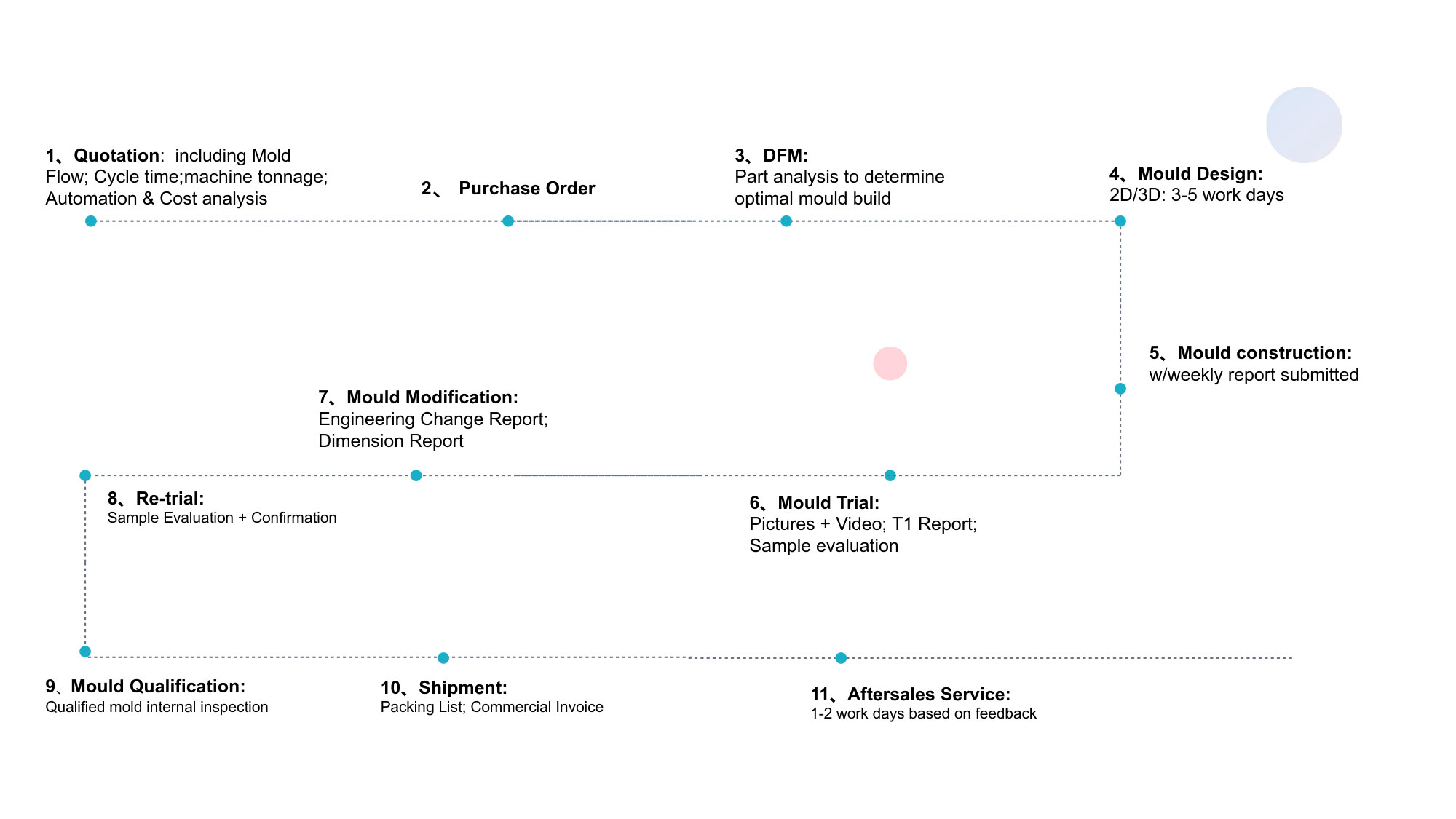
Standard Lead Times – Simple molds in 10 days, medium-complexity in 25-45 days, with expedited options available to 20 days (with all validation steps maintained).
4.4 Cooling System Design
For high-volume production requirements, Ansix designs sophisticated cooling systems:
Conformal cooling channels follow part contours for uniform heat extraction
Zone temperature control maintains core and cavity temperature differentials within 2°C
Reduced cycle times through optimized cooling efficiency
Minimized warpage through balanced thermal management
4.5 Ejection System Design
Ejection systems are engineered for reliability in high-volume production:
Optimized ejector pin placement to minimize visible marks
Balanced ejection forces to prevent part deformation
Wear-resistant components with extended service life
Spare wear parts (ejector pins, core inserts) delivered with every mold
Part V: Injection Molding – Process Excellence
5.1 Injection Molding Machine Fleet
Ansix operates a fleet of 260 injection molding machines with clamping forces ranging from 30 tons to 4,000 tons, covering the full spectrum of component sizes. All machines feature:
All-Servo Electric Drives – Delivering stable repeatability of ±0.1%, ensuring every shot is consistent across millions of cycles.
Closed-Loop Process Control – Machine parameters (temperature, pressure, speed, time) are locked within the MES system, accessible only to authorized engineers for adjustments.
Ultrasonic Wall Thickness Sensors – Real-time feedback on wall thickness fluctuations enables automatic compensation of packing pressure.
In-Mold Temperature and Pressure Sensors – Enable true closed-loop control for critical dimensions.
5.2 Process Standardization and Control
Scientific Molding and Decoupled Molding® Technology – Ansix applies scientific molding principles to establish a stable, repeatable process window based on data rather than guesswork.
Networked Machine Integration – All machines are connected, with molding parameters locked into the MES system.
First-Article and Last-Article Inspection – Every batch undergoes first-piece and last-piece dimensional verification.
Dimensional Stability Control – Through mold temperature zone control maintaining core-cavity temperature differentials within 2°C, warpage is minimized. For同类 bracket products, three consecutive production batches over one week showed critical hole spacing variation ≤0.02mm.
5.3 Appearance Quality Standards
Ansix achieves industry-leading surface quality:
Transparent Parts: No bubbles, no flow marks
Plating-Ready Parts: No gas marks
High-Gloss Parts: Surface roughness Ra ≤0.2μm
Printing/Coating Applications: Pre-compensation for deformation, print registration accuracy ±0.1mm
5.4 Special Material Processing Capabilities
Ansix has extensive production experience with a wide range of engineering plastics:
PC/ABS, PC
PPS + 40% GF
PEEK, PTFE/PFA
PA6 + GF30, PBT
PEI, PPS, LCP
Liquid Silicone Rubber (LSR)
Flame Retardancy – UL94 V-0 rated components for high-voltage applications.
Weather Resistance – UV testing verified at 3,000 hours with no discoloration.
5.5 Injection Molding Process Optimization
Cycle Time Reduction – Documented case studies demonstrate cycle time reductions of 28%, increasing daily production from 1,300 to 1,670 units on identical equipment.
Material Waste Reduction – Hot runner systems minimize sprue and runner waste.
Energy Efficiency – All-servo electric drives reduce energy consumption by 30-70% compared to hydraulic machines.
Automation Integration – Robotic part removal, automated inspection, and packaging systems minimize labor costs and human error.
Part VI: Quality Assurance – From Material to Delivery
6.1 Incoming Material Quality Control
All raw materials are verified against material certifications and performance specifications. Material traceability is maintained throughout the production process.
6.2 In-Process Quality Control
First-Article Inspection (FAI) – Comprehensive dimensional verification of first production shots against CAD models.
Statistical Process Control (SPC) – Real-time monitoring of critical dimensions with CPK tracking.
Critical Dimension CPK ≥1.33 – Every mold undergoes full dimension reporting before delivery, with critical dimensions maintained at CPK ≥1.33.
Batch-to-Batch Consistency – Through locked process parameters and closed-loop control, dimensional variation between batches is minimized.
Appearance Inspection – 100% visual inspection for surface defects, flow marks, sink marks, and flash.
6.3 Final Quality Verification
Coordinate Measuring Machine (CMM) – Full dimensional verification of critical features.
Optical Inspection Systems – High-resolution imaging for surface quality and dimensional verification.
Functional Testing – Where applicable, sensors undergo functional verification including:
Float buoyancy testing
Seal integrity testing
Temperature cycling
Chemical exposure validation
Full Dimension Reporting – Every mold delivery includes a complete dimension report with CPK values for all critical dimensions.
6.4 2000-Shot Aging Test
Before mold delivery, Ansix performs a 2,000-shot aging test, providing a wear report and guaranteeing mold structural integrity for three years (excluding normal wear on consumable components).
6.5 Mold Maintenance and Support
Spare Parts Package – Wear parts (ejector pins, core inserts) delivered with every mold.
Scheduled Maintenance – Mold maintenance recommended every 200,000 shots.
Lifetime Repair – Repairs provided at cost throughout the mold's service life.
Rapid Repair – Self-contained electrode processing and EDM workshops enable mold repairs without leaving the facility; conventional weld repairs and insert replacements restored within 24 hours.
Part VII: Cost Control – Systematic Value Engineering
7.1 Design-Phase Cost Optimization
Up to 70% of final manufacturing costs are determined during initial design. Ansix's DFM analysis identifies cost-saving opportunities before tooling is committed:
Material grade optimization to avoid over-specification
Wall thickness optimization for material savings
Gate location optimization for fill efficiency
Part consolidation to reduce assembly costs
7.2 Material Cost Optimization
Value Engineering – Ansix guides customers toward the most cost-effective material that meets all performance criteria, avoiding over-design.
Bulk Material Sourcing – Strategic partnerships with material suppliers (Covestro, SABIC) ensure competitive pricing.
Waste Reduction – Hot runner systems and optimized runner designs minimize material waste.
Regrind Utilization – Where specifications permit, regrind material is incorporated to reduce raw material costs.
7.3 Process Efficiency Optimization
Cycle Time Reduction – Documented 28% cycle time reduction through process optimization.
Energy Cost Reduction – All-servo electric drives reduce energy consumption.
Automation – Robotic systems reduce labor costs and increase throughput.
Multi-Cavity Molds – Where volume justifies, multi-cavity molds increase output per machine hour.
7.4 Quality Cost Reduction
First-Time-Right – Digital validation and scientific molding eliminate costly trial-and-error.
Reduced Scrap – Process control maintains scrap rates below industry averages.
Minimal Rework – Precision molding eliminates secondary operations like deburring.
Lower Inspection Costs – Process capability (CPK≥1.33) enables reduced inspection frequency.
Part VIII: Delivery and Supply Chain Excellence
8.1 Prototype and Validation Phase
T0 to T3 Samples – Progressive sample iterations with improvement reports at each stage.
Rapid Insert Changes – Quick-change inserts enable validation of different design variations without complete mold rebuild.
Small-Batch Validation – 100-500 shot trial production before full-scale manufacturing, with yield and CPK statistics confirming stability.
8.2 Production Phase
Scalable Production – From prototype quantities to millions of units annually.
Flexible Capacity – 260 machines with clamping forces from 30 to 4,000 tons.
Dedicated Production Lines – Where volume justifies, dedicated machine cells for specific products.
Inventory Management – Just-in-time delivery supported by strategic safety stock.
8.3 Packaging and Logistics
Customized Packaging – Designed to protect components during transit and facilitate automated assembly lines.
Damage Prevention – Anti-static, moisture-barrier, and ESD-protective packaging as required.
Global Logistics – Efficient shipping to customers worldwide.
Documentation – Complete certification packages including material certificates, dimension reports, and Cpk data.
Part IX: Customer Value Proposition – Transforming Technical Capabilities into Business Benefits
9.1 Problem-Solution Mapping
Customer Concern Ansix Solution Customer Value
Mold failures disrupt orders 2,000-shot aging test + 3-year structural warranty Production reliability, reduced downtime
Flash requires costly secondary operations 0.005mm parting line precision + self-locking clamp force compensation Flash controlled to ≤0.03mm, eliminating manual deburring
Inconsistent dimensions between batches Ultrasonic wall thickness sensors + closed-loop pressure control Batch-to-batch variation ≤0.02mm
Long mold repair cycles In-house EDM and electrode processing 24-hour restoration for conventional repairs
High material costs Value engineering + strategic sourcing Optimized material selection, reduced per-unit cost
Long time-to-market Digital validation + rapid prototyping First-time-right tooling, faster market entry
9.2 Documented Cost Savings
Per-Unit Cost Reduction – Documented cases show up to 16% reduction in per-sensor housing costs.
Cycle Time Reduction – 28% cycle time reduction documented, increasing daily output from 1,300 to 1,670 units.
Prototyping Cost Reduction – Virtual validation reduces physical prototyping costs by over 50%.
Maintenance Cost Reduction – PPS替代316L stainless steel can extend service life from 3 years to 10 years, reducing maintenance costs by 75%.
9.3 Risk Reduction
Design Risk – DFM analysis identifies and eliminates production issues before tooling is committed.
Quality Risk – CPK≥1.33 ensures process capability and predictable quality.
Supply Risk – 260 machines across four facilities provide production redundancy.
Obsolescence Risk – Mold designs accommodate future modifications through insert technology.
Part X: After-Sales Service and Long-Term Partnership
10.1 Mold Warranty and Maintenance
Three-Year Structural Warranty – Ansix guarantees mold structural integrity for three years (excluding normal consumable wear).
Spare Parts Package – Critical wear parts delivered with every mold.
Scheduled Maintenance – Recommended maintenance intervals at 200,000-shot increments.
Lifetime Repair Support – Repairs provided at cost throughout the mold's service life.
10.2 Technical Support
Process Optimization – Ongoing support for injection molding process optimization.
Troubleshooting – Rapid response to production issues.
Design Updates – Support for product design changes and mold modifications.
10.3 Continuous Improvement
Data-Driven Optimization – Production data analysis identifies ongoing improvement opportunities.
Material Innovation – Access to new material developments and formulations.
Process Innovation – Continuous investment in new technologies and methodologies.
Conclusion: The Ansix Difference
Ansix Tech has transformed the manufacturing of oil level sensors and related components from an art into a predictable, optimized science. Through the integration of advanced material science, predictive digital engineering, precision mold manufacturing, scientific injection molding, and systematic quality assurance, Ansix delivers:
Reliability – Components that perform flawlessly in the harshest environments, from -40°C to 150°C, immersed in corrosive chemicals, subjected to continuous vibration.
Cost Efficiency – Systematic cost reduction through design optimization, material selection, process efficiency, and quality control—documented savings of up to 16% per unit.
Speed – Accelerated time-to-market through digital validation, rapid prototyping, and first-time-right tooling.
Partnership – A single point of accountability throughout the product lifecycle, from initial concept through production and after-sales support.
As Ansix's engineering leadership states: "Our value proposition is clear—we sell efficiency and reliability. By integrating materials science, cutting-edge mold design, and intelligent process optimization, we systematically reduce our customers' total cost of ownership".
For customers seeking a manufacturing partner that understands that "a mold is not just a piece of steel—it's a money-printing machine," Ansix Tech offers the expertise, infrastructure, and commitment to deliver exceptional value, every time, on every project.
Ansix Tech Co Ltd
If you have any plans related to Oil level sensor for water tank, universal oil float, stainless steel water level sensor for travel, sprinkler, fire truck, and oil level gauge , you can contact us at any time. We will turn your ideas into reality, let you realize your dreams, and obtain large orders from the market. Our contact information is info@ansixtech.com. Or contact our CTO, mail: stephen@ansixtech.com
#www.ansixtech.com #ansixtech.com #Oil level sensor for water tank, universal oil float, stainless steel #Oil level sensor for water tank, universal oil float, stainless steel #Oil level sensor for water tank, universal oil float, stainless steel Canopy Mold injection mold companies #Ansix #Ansix moulds #Ansix china #Ansix tech china #Ansix tech company #Ansix facotry #Oil level sensor for water tank, universal oil float, stainless steel injection molding #Oil level sensor for water tank, universal oil float, stainless steel injection tools #Oil level sensor for water tank, universal oil float, stainless steel injection moulds #Oil level sensor for water tank, universal oil float, stainless steel plastic mould #Oil level sensor for water tank, universal oil float, stainless steel plastic tools #Ansix Tech #Ansix molds #Ansix injection molding #Ansix mold factory #injection molding Oil level sensor for water tank, universal oil float, stainless steel#Ansix mold factory #Oil level sensor for water tank, universal oil float, stainless steel china #Oil level sensor for water tank, universal oil float, stainless steel molds #injection factory #Oil level sensor for water tank, universal oil float, stainless steel injection molding #Oil level sensor for water tank, universal oil float, stainless steel injection molding factory #injection molding company #Oil level sensor for water tank, universal oil float, stainless steel injection mold companies #Oil level sensor for water tank, universal oil float, stainless steel Tooling #Oil level sensor for water tank, universal oil float, stainless steel mold limited #Ansix mold china #Ansix companies #Ansix company China #Oil level sensor for water tank, universal oil float, stainless steel facotry #Ansix Tech #Ansix Tech mould #Oil level sensor for water tank, universal oil float, stainless steel injection moulding #injection moulding company #Ansix Oil level sensor for water tank, universal oil float, stainless steel parts injection mold companies #medical injection molding companieschina #Oil level sensor for water tank, universal oil float, stainless steel china factory #Ansix moulding companies #Ansix molding company #Oil level sensor for water tank, universal oil float, stainless steel injection moulding facotry #Ansix Tech mold #Oil level sensor for water tank, universal oil float, stainless steel mould #Oil level sensor for water tank, universal oil float, stainless steel plastic injection molding #ansix plastic mold #Mold manufacturing #Oil level sensor for water tank, universal oil float, stainless steel parts manufacturing #Oil level sensor for water tank, universal oil float, stainless steel plastic parts factory #Oil level sensor for water tank, universal oil float, stainless steel injection parts mold #Oil level sensor for water tank, universal oil float, stainless steel PRECISION MANUFACTURING #Oil level sensor for water tank, universal oil float, stainless steel #China mold #Oil level sensor for water tank, universal oil float, stainless steel injection moulding china #Oil level sensor for water tank, universal oil float, stainless steel mould china #china precision mold #mold in china #Oil level sensor for water tank, universal oil float, stainless steel mold china #Precision molds #High-precision molds #Oil level sensor for water tank, universal oil float, stainless steel #Injection molds #Oil level sensor for water tank, universal oil float, stainless steel Factory #Oil level sensor for water tank, universal oil float, stainless steel Company #Super Large Injection Mold Factory #Large Tonnage Injection Molding Factory #Oil level sensor for water tank, universal oil float, stainless steel Company #Oil level sensor for water tank, universal oil float, stainless steel Factory #2800T Injection Molding Factory #3000 Ton Injection Molding #4500 Ton Injection Molding Factory #Large Mold Injection Molding #Large Plastic Mold Injection Molding Factory #Large Injection Mold Manufacturer #Plastic Mold Factory #Injection Mold #Plastic Mold