



PET transparent plastic bottle preform, 24 threads, 38g hand sanitizer tube preform, thickened
FEATURES
Product Introduction – 24-Thread, 38g Thick-Walled Lotion Tube Preform
1.1 Product Overview and Technical Specifications
PET bottle preforms are injection-molded intermediate products, primarily used to produce final containers via stretch blow molding for beverage, food, personal care, and household chemical packaging applications. The 24-thread, 38g preform described here is specifically designed for lotion, hand wash, and other viscous liquid packaging applications requiring a thick-walled tube structure.
A preform consists of three main components: the neck finish (complete with thread design for secure closure), the preform body, and the closed bottom. For thick-walled applications, the preform’s critical parameters—dimensions, neck finish specifications, and weight—directly determine the final bottle’s performance, including structural strength, top-load resistance, and dispensing compatibility.
-
Mold Description
Product Materials:
PET PETG
Mold Material:
S136ESR
Number of Cavities:
1*24
Glue Feeding Method:
Hot runner
Cooling Method:
Water cooling
Molding Cycle
12.5s
- The mold manufacturing process and product material selection
Key specifications for Ansix’s 24-Thread, 38g Thick-Walled Lotion Tube Preform:
Parameter Specification
Neck Finish 24-thread (24mm standard PCO or custom lotion finish)
Preform Weight 38g (± tolerance)
Wall Thickness Thick-walled design for enhanced structural integrity
Material 100% Virgin PET (or rPET upon request, up to 100% content)
Intrinsic Viscosity (IV) 0.80–0.87 dL/g (optimized for thick-wall applications)
Acetaldehyde (AA) ≤15 μg/g (meeting food-grade standards)
Blow Ratio Compatibility Preform length and diameter optimized for target bottle volume
1.2 Why “Thick-Walled” Requires Specialized Expertise
Thick-walled preform production is fundamentally different from lightweight bottle preform manufacturing. While lightweight preforms (such as 5.89g water bottle preforms) prioritize ultra-fast cycle times of 4.5 seconds, thick-walled 38g preforms demand:
Higher material volume per cavity, requiring longer injection and cooling phases
More precise thermal management to prevent internal stresses and crystallization in thick sections
Enhanced mold cooling design to achieve uniform solidification across the thicker wall
Higher intrinsic viscosity (IV) material (0.80–0.87 dL/g range) to maintain mechanical strength and stress crack resistance
-
The Value Translation: Ansix does not simply “make preforms thicker.” We design the entire production ecosystem—material selection, mold cooling, process parameters, and quality verification—around the specific demands of thick-walled geometries. The result is a preform that blows consistently, seals reliably, and delivers the structural strength your lotion container requires.
1.3 Material Selection for Thick-Walled Applications
The quality of a PET preform depends critically on the quality of the PET material. For 38g thick-walled preforms, Ansix selects bottle-grade PET resin with optimized intrinsic viscosity (IV) values typically ranging from 0.80 to 0.87 dL/g. Higher IV PET provides better stress crack resistance and mechanical strength—critical for thick-walled applications that undergo significant orientation during blow molding.
Material handling and pretreatment requirements:
Drying: PET resin is hygroscopic. Ansix uses dedicated drying systems with temperature control at 165–175°C, residence time of 4–6 hours, and dew point below –30°C to achieve moisture content of 10–40 ppm before injection.
AA value control: Acetaldehyde content is maintained at ≤15 μg/g, meeting both national and international food contact safety standards.
Recycled PET (rPET) capability: Ansix can process up to 100% rPET content while maintaining IV stability through optimized process controls, supporting customer sustainability goals without compromising product quality.
Part II: Thick-Walled Mold Design & Manufacturing – The Engineering Foundation
Mold quality and condition directly affect how preforms are formed. For the 24-thread, 38g thick-walled preform, Ansix’s mold design and manufacturing capabilities are the foundation of product excellence.
2.1 DFM (Design for Manufacturing) – Early Customer Collaboration
Before any metal is cut, Ansix provides a comprehensive DFM (Design for Manufacturing) report to customers. This proactive approach—often called “smart prototyping” in the industry—enables design validation before costly tooling decisions are made, significantly reducing the likelihood of expensive late-stage modifications.
What the DFM includes for the 24-thread, 38g preform:
Mold flow analysis predicting melt front progression, weld line locations, and air trap areas
Draft angle recommendations for reliable ejection
Wall thickness optimization for uniform cooling
Gate location and injection point optimization to ensure balanced filling
Ejector pin mark position allowances and limitations
Shrinkage compensation calculations based on material grade
Customer Problem Solved: Most quality issues—warped threads, inconsistent wall thickness, visible flow lines—are designed into the mold before the first shot is ever made. By delivering a DFM report before mold manufacturing begins, Ansix eliminates surprises, reduces design iterations, and ensures the mold produces acceptable parts from the very first production run.
2.2 Mold Structure for 24-Thread, 38g Thick-Walled Preforms
Modern PET preform molds are high-precision, multi-cavity injection molds that inject molten PET at 270–290°C into cooled mold cavities (8–14°C). For the 24-thread, 38g thick-walled preform, cavity counts typically range from 24 to 72 cavities, balancing production efficiency with mold stability.
Key mold components and material selection:
Component Material Options Application Notes
Mold Frame/Base P20, 718H Standard structural material for long-term stability
Cavity Inserts S136, 420SS stainless steel, M340 Corrosion-resistant, polished to mirror finish for transparency
Core Pins S136, H13, 8407, NAK80 High thermal conductivity, wear-resistant
Neck Rings (Thread Splits) S136, 420SS, DLC-coated Diamond-like carbon coating for wear resistance and thread precision
Hot Runner Manifold 2344, 2343, SKD61 Thermal stability for melt distribution
For the 38g thick-walled application, cavity and core inserts require enhanced cooling channel design to manage the increased thermal load from the thicker material section. Ansix uses conformal cooling designs—cooling channels that follow the preform contour—to ensure uniform temperature distribution across all cavities.
2.3 Hot Runner System Design for Thick-Walled Preforms
All modern PET preform molds use hot runner systems with valve gates. Cold runner systems are no longer economically viable for PET production. For the 24-cavity mold configuration, the hot runner system is the lifeline of production stability.
Critical design elements for thick-walled preforms:
Multi-point valve pin system with simultaneous opening: Ensures melt fills all cavities simultaneously with consistent pressure and temperature profiles, fundamentally reducing variability caused by different filling sequences.
Multi-zone independent temperature control: The hot runner manifold is divided into independent temperature control zones, providing temperature compensation for runners farther from the main inlet, ensuring consistent melt state at each nozzle tip.
Balanced melt distribution: Advanced manifold design ensures uniform melt flow to all cavities, reducing the weight variation between cavities to ≤0.03g—significantly tighter than the industry standard of >0.15g.
Customer Problem Solved: Inconsistent preform weights across cavities cause downstream blow-molding problems—blow-ups, thin spots, and rejected bottles. Ansix’s hot runner design with multi-zone independent control ensures that every cavity produces an identical preform, eliminating the “good cavity vs. bad cavity” variability that plagues multi-cavity molds.
2.4 Cooling System Design – The Key to Thick-Walled Success
For thick-walled preforms, cooling is the rate-limiting step in the production cycle and the primary determinant of product quality. Uneven cooling directly leads to differences in preform shrinkage and crystallinity.
Ansix’s cooling optimization for 38g thick-walled preforms:
Dynamic variable-diameter water channels: Water channel diameters are differentiated based on the mold cavity thermal map, reducing mold cavity temperature difference from ±8°C to ±0.5°C.
Spiral turbulent cooling channels inside core pins ensure each preform is cooled quickly and uniformly.
Individual cavity temperature monitoring: AI temperature control compensation provides real-time monitoring and automatic cooling flow adjustment, keeping crystallinity fluctuation ≤3% (industry average is 15%).
Post-cooling integration: Multiple post-cooling stations integrated into the removal system ensure preforms exit the mold fully stabilized, preventing post-mold shrinkage and distortion.
Customer Problem Solved: Thick-walled preforms that exit the mold too hot or unevenly cooled will warp, crack, or develop unacceptable crystallinity (visible as haze or fogging). Ansix’s precision cooling system ensures every 38g preform emerges dimensionally stable, crystal-clear, and ready for blow molding.
2.5 Mold Manufacturing Precision
Ansix’s mold manufacturing facility is equipped with:
Five-axis high-speed machining centers: Capable of machining complex curved surfaces to 0.002mm accuracy, ensuring thread surfaces and parting lines are smooth and burr-free
CNC electrical discharge machining (EDM): For precision cavity features requiring fine detail
In-house mold repair and modification capabilities: Repair turnaround measured in hours, not weeks—enabling rapid response to customer requests
Temperature-controlled machining environment: All critical components are precision-machined in controlled conditions, maintaining ±0.1μm environmental stability
Mold life guarantee: Ansix molds are designed and built for the long haul. For standard PET (non-filled) applications, mold life exceeds 1,000,000 cycles. For glass-filled or reinforced materials, molds maintain precision through 500,000 cycles.
Part III: Injection Molding Process – Intelligent Manufacturing for Consistency
At Ansix, we view the injection molding process not as a machine operation but as an integrated manufacturing ecosystem. Our approach combines advanced injection molding equipment, real-time process monitoring, and data-driven optimization to deliver exceptional product consistency.
3.1 Equipment Capabilities
Ansix operates a fleet of PET-dedicated injection molding machines with clamping forces ranging from 300 tons to 4,000 tons, covering the full spectrum of preform sizes from lightweight beverage preforms to large thick-walled preforms exceeding 200g.
Key equipment specifications for 38g thick-walled production:
Parameter Specification
Clamping Force Range 300–4,000 tons (matched to cavity count)
Injection Speed High-speed servo-electric drives with up to 1,600 kg/hour output capacity
Shot Size Customized for preform weight and cavity configuration
Repeatability ±0.1% injection stroke repeatability, cavity-to-cavity weight difference ≤0.03g
3.2 Cycle Time Optimization for Thick-Walled Preforms
For standard PET preforms, typical cycle times range from 5 to 14 seconds, depending on wall thickness and weight. The 38g thick-walled preform operates at the higher end of this range due to increased cooling requirements.
Cycle time breakdown for 38g preform (48-cavity configuration):
Phase Duration
Injection 1.5–2.0 seconds
Packing/Holding 1.0–1.5 seconds
Cooling (mold + post-cooling) 8–12 seconds
Mold open/ejection 1.0–1.5 seconds
Total Cycle Time 11–17 seconds
Hourly Output (48 cavities) 10,000–15,000 preforms
Customer Value: Ansix optimizes cycle time not by sacrificing quality, but by investing in superior mold cooling, efficient hot runner design, and high-response injection units. Our customers get the fastest possible throughput without compromising preform clarity, dimensional accuracy, or blow-molding performance.
3.3 Process Control – The “Parameter is the Instruction”
Pet preforms require high-precision injection molding equipment with high-speed clamping and injection capability. Ansix’s manufacturing execution system (MES) creates an unbroken chain from parameter setting to product quality.
Injection parameters for 38g thick-walled preforms:
Parameter Target Range
Melt Temperature 275–285°C
Mold Temperature (cooling) 8–14°C
Injection Pressure 800–1,500 bar (cavity-specific)
Injection Speed Profile Multi-stage: fast initial fill, controlled second-stage
Holding Pressure 300–600 bar
Back Pressure 10–30 bar
Screw Speed 40–80 rpm
Critical aspect for thick-walled preforms: The thicker wall cross-section requires more precise control of the cooling phase. Premature mold opening leads to preform deformation; insufficient cooling leads to crystallization haze. Ansix’s process controls maintain cooling phase consistency within ±0.5°C across all cavities.
Customer Problem Solved: A 1-second variation in cooling time across 24 cavities might produce acceptable preforms individually, but when blown into bottles, some will be perfectly round while others will develop ovality or thin spots. Ansix’s cavity-specific temperature monitoring and real-time adjustments ensure every preform—from cavity 1 to cavity 48—receives identical thermal treatment.
3.4 MES – Manufacturing Execution System for Complete Traceability
Ansix has implemented a comprehensive Manufacturing Execution System (MES) across all production lines. In injection molding, MES bridges the gap between planning and shop floor execution, enabling digital and transparent production management.
MES capabilities at Ansix for 24-thread, 38g preform production:
Real-time process monitoring: All injection molding machines are connected via IoT sensors, collecting temperature, pressure, speed, and cycle time data in real time.
Parameter access control: Only authorized engineers can modify process parameters. Every change is logged with timestamp and operator identification.
Full traceability: Each production batch is recorded with raw material source, injection parameters, quality inspection results, and operator identification. Defective products can be traced back to specific cavities and production conditions within 30 seconds.
OEE (Overall Equipment Effectiveness) monitoring: Real-time tracking of equipment utilization, performance rate, and quality rate identifies efficiency improvement opportunities.
Mold life management: MES precisely records mold opening/closing cycles and automatically alerts maintenance teams when service thresholds are approaching, ensuring quality stability and extended mold life.
Customer Problem Solved: When quality issues arise, traditional production records require hours or days to identify the root cause. Ansix’s MES provides complete visibility from raw material receipt to finished preform delivery. Whether the issue is material-related, process-related, or mold-related, we pinpoint the cause and implement corrective action—fast.
Part IV: Quality Control and Assurance
Quality testing at Ansix occurs before, during, and after production to ensure every finished preform meets customer specifications.
4.1 Incoming Material Quality Control
Raw material verification: Every batch of PET resin undergoes IV testing per ASTM D4603 standard, moisture content analysis, and visual inspection for contamination.
Certification requirements: Ansix holds ISO 9001 quality management system certification and CE certification, with quality management systems audited and certified by TÜV Rheinland.
Supplier qualification: Only pre-approved PET resin suppliers meeting food-grade safety standards (FDA, EU 10/2011) are utilized.
4.2 In-Process Quality Control
Visual inspection:
Immediate post-mold visual inspection for surface defects: bubbles, flow lines, splay marks, contamination
Thread finish inspection for completeness and surface quality
Gate vestige inspection for acceptable protrusion height
Color and transparency verification against standard samples
Dimensional inspection:
Thread major/minor diameter measurement using optical comparators and CMM (coordinate measuring machines)
Preform length and body diameter measurement
Wall thickness distribution measurement (key for thick-walled preforms—variation directly affects blow-molding performance)
Neck finish concentricity and perpendicularity checks
Critical dimensions maintained with CPK ≥ 1.33 (process capability index)
Performance testing:
Top-load testing for structural integrity
Impact resistance testing
Blow-molding trials to verify processability
Torque and pull force testing for closure compatibility
Equipment-based inspection:
Automated vision inspection systems for 100% online quality screening
Weight monitoring: Every cavity monitored continuously; weight variation between cavities maintained at ≤0.03g
Statistical process control (SPC): Real-time SPC charts monitor key dimensions; automatic alerts trigger when trends indicate process drift
4.3 Finished Product Quality Assurance
Lot sampling plan: ANSI/ASQ Z1.4 (MIL-STD-105E) sampling with AQL levels appropriate for cosmetic/household chemical packaging
Comprehensive quality report: Every shipment is accompanied by a certificate of analysis (COA) detailing:
Dimensional inspection results (critical threads, length, body diameter)
Wall thickness distribution profile
Material IV value
Blow-molding test results
Visual inspection pass/fail data
Cavity-by-cavity performance data (when required)
Blow-molding verification: Sample preforms from each production run are blown into final containers to verify blow ratio, wall distribution, and bottle performance before shipment release
Customer Problem Solved: Receiving a shipment of preforms that blow inconsistently disrupts your entire filling line. Ansix’s blow-molding verification protocol—testing actual preforms from each production run under blow-molding conditions—ensures that what we ship is exactly what you need to run on your production line.
Part V: Production Efficiency and Cost Control
5.1 Smart Manufacturing for Efficiency Improvement
In the injection molding industry, digital transformation is not just about upgrading machines—it is about reconstructing production logic. Through MES implementation, Ansix has achieved efficiency improvements of 30–150%, building a core competitive advantage for the future.
Key efficiency metrics for 38g thick-walled preform production:
Metric Industry Average Ansix Performance
OEE (Overall Equipment Effectiveness) 65–75% 85–90%
Cycle-to-cycle repeatability ±0.5% ±0.1%
Cavity-to-cavity weight variation >0.15g ≤0.03g
First-pass yield rate 92–95% 97–98%
Changeover time (mold swap) 4–8 hours 2–3 hours
5.2 Cost Control Strategy
PET resin raw material costs represent approximately 70% of total production costs for PET preforms. Ansix’s cost control approach addresses all four major cost drivers: raw materials, mold investment, production efficiency, and logistics.
Raw Material Cost Optimization:
Competitive PET resin sourcing: Strategic relationships with multiple PET resin suppliers ensure competitive pricing and supply stability
Lightweighting engineering: For customers seeking cost reduction, Ansix provides lightweighting feasibility analysis—balancing material reduction against structural performance requirements
rPET integration: Ability to process rPET content up to 100% reduces raw material costs while supporting sustainability goals
Scrap reduction: First-pass yield rates of 97–98% minimize material waste and rework costs
Mold Investment Optimization:
Multi-cavity molds (up to 72 cavities): Higher cavity counts reduce unit cost through volume efficiency
Standardized tooling platforms: Where customer specifications permit, Ansix offers standardized mold platforms to reduce initial investment
Modular mold design: Core/cavity sets interchangeable on same mold base, reducing per-product mold costs for customers with multiple products
Production Efficiency Optimization:
Optimized cooling systems: Reduced cooling time increases effective production capacity without additional capital investment
Automated downstream handling: Robotic stacking and packaging reduce manual labor requirements
Predictive maintenance: MES-based maintenance alerts reduce unplanned downtime and emergency repair costs
Logistics Optimization:
Packaging density optimization: Preform nesting and palletization designed for maximum container utilization
Multiple shipping options: Air freight for urgent orders, sea freight for cost-sensitive bulk shipments
Consolidated shipments: Full container loading reduces per-unit shipping cost
Customer Value: For a typical 38g preform customer producing 10 million units per year, every 1g reduction in preform weight saves approximately 10 metric tons of PET resin annually. Ansix’s lightweighting engineering helps customers reduce material consumption without compromising bottle performance—translating technical expertise directly into your bottom line.
5.3 Fast Delivery – Responsive to Customer Needs
Ansix understands that packaging lead times directly impact your product launch schedules and inventory carrying costs.
Standard delivery times:
Order Type Lead Time (from PO confirmation)
Sample / Trial Run 3–5 days
First Article Inspection Report (FAIR) 10–14 days
Standard Production (mold exists) 15–20 days
Custom Mold Development 30–45 days (depending on cavity count and complexity)
Expedited Mold Development 20–25 days (rush service available)
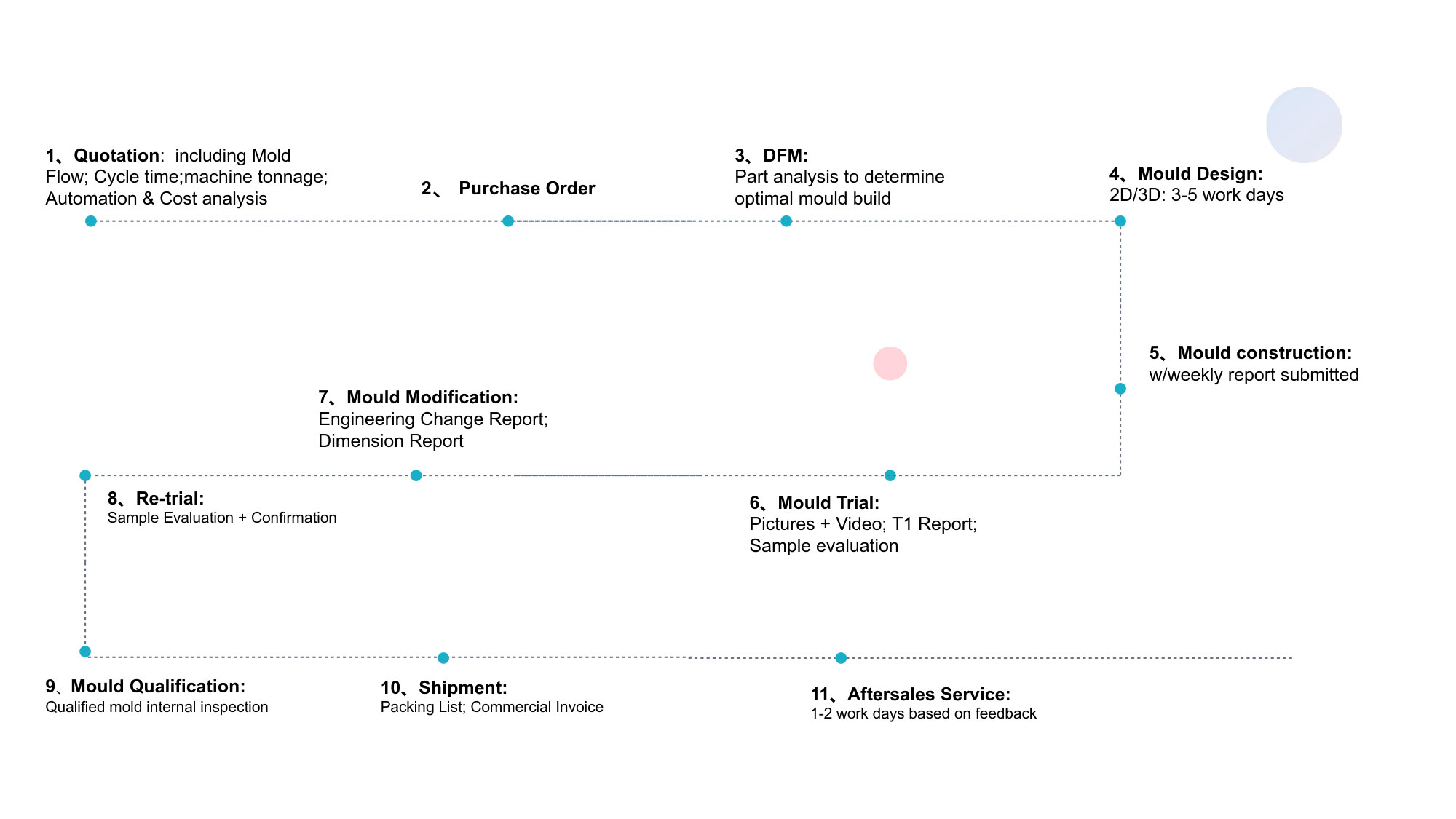
Mold development timeline breakdown (standard, 24–48 cavity):
Phase Duration
DFM report and customer approval 3–5 days
Mold design completion 7–10 days
Mold manufacturing 14–21 days
Heat treatment and surface finishing 3–5 days
Assembly and bench testing 3–5 days
Mold trial (T0, T1, T2) and process optimization 3–5 days
PPAP/first article approval sample shipment 2–3 days
Total 35–54 days
Customer Value: Ansix’s in-house mold manufacturing capability eliminates the sub-supplier delays that plague many mold makers. When urgent modifications are required, our repair turnaround is measured in hours—not weeks.
Part VI: Customer Value Summary – “What Does Ansix Do for You?”
6.1 Customer Pain Point: Inconsistent Preform Quality Across Production Batches
Ansix Solution: MES-controlled process with real-time SPC monitoring. Every preform is produced under the same process parameters recorded and approved during initial production qualification. Batch-to-batch variation is eliminated.
The Result: Your blow-molding process runs consistently, shift after shift, month after month. No “tuning for each batch.” No unexpected rejects.
6.2 Customer Pain Point: Mold Downtime and Maintenance Costs
Ansix Solution: High-quality mold materials (S136, 8407, H13, SKD61) and precision manufacturing (0.002mm accuracy) deliver 1,000,000+ cycle mold life for standard materials. MES-based maintenance alerts prevent unexpected breakdowns.
The Result: Lower total cost of mold ownership. Predictable maintenance schedules. Minimal unplanned production stops.
6.3 Customer Pain Point: Long Lead Times for Mold Repairs
Ansix Solution: In-house mold manufacturing, EDM, and repair capabilities. Spare parts (ejector pins, core pins) shipped with initial mold delivery. Repair turnaround: hours for minor issues, days for major rework.
The Result: When something breaks, you are back in production—fast. Not waiting weeks for a sub-supplier to schedule repair work.
6.4 Customer Pain Point: Unable to Verify Preform Quality Before Shipment
Ansix Solution: Blow-molding verification protocol. Sample preforms from each production run are blown into final containers and tested before shipment release. Comprehensive COA accompanies every shipment.
The Result: No surprises. You receive preforms that are guaranteed to blow successfully on your equipment.
6.5 Customer Pain Point: Material Cost Increases Eating into Margins
Ansix Solution: Lightweighting engineering analysis. rPET processing capability (up to 100% content). Competitive PET resin sourcing. High first-pass yield (97–98%) minimizing scrap.
The Result: Lower per-unit material cost. Reduced waste. Competitive total landed cost.
Part VII: Ansix Tech – Company Overview
Ansix Tech is a specialized manufacturer of PET transparent plastic bottle preforms, 24-thread, 38g thick-walled lotion tube preforms, with over 28 years of production experience. Our facility integrates mold design and manufacturing, injection molding production, quality testing, and logistics under one roof—ensuring seamless coordination and single-source accountability.
Quality certifications:
ISO 9001 quality management system
CE certification
Food-grade safety compliance (FDA, EU 10/2011 as applicable)
Production capacity:
Injection molding machines: 300–4,000 tons clamping force range
Annual preform production capacity: Multi-million units (contact for current specific capacity)
Mold manufacturing: Custom molds up to 72 cavities
rPET processing: Up to 100% recycled content capability
Commitment to customers:
Ansix does not view molds as “pieces of steel.” We view molds as printing presses—precision devices that convert raw material into finished product, hour after hour, shift after shift, without variation. Every mold we design simultaneously addresses plasticizing capacity, melt flow balance, venting path optimization, and thermal balance—ensuring production lines run with minimal adjustment, low flash, and long mold life.
Part VIII: Conclusion
The 24-thread, 38g thick-walled lotion tube preform represents a demanding application where generic manufacturing approaches fail. Success requires:
Material expertise – Selecting and handling PET resin for thick-wall performance
Mold engineering excellence – Optimized hot runner, conformal cooling, and precision machining for 0.002mm accuracy
Process control maturity – MES-enabled parameter management, real-time SPC, and complete traceability
Quality verification rigor – Blow-molding validation before shipment, not after arrival
Responsive partnership – In-house mold repair, fast delivery, and proactive DFM collaboration
Ansix Tech delivers all five.
We invite you to contact us to discuss your specific 24-thread, 38g thick-walled lotion tube preform requirements—whether you are developing a new product, seeking cost reduction on an existing product, or looking for a manufacturing partner who treats your success as their own success.
Contact Ansix Tech:
Contact information available upon request
Document prepared for customer distribution. Specifications subject to change with customer agreement. All quality claims supported by documented process capability data and third-party certifications.
Ansix Tech Co Ltd
If you have any plans related to PET transparent plastic bottle preform, 24 threads, 38g hand sanitizer tube preform, thickened. , you can contact us at any time. We will turn your ideas into reality, let you realize your dreams, and obtain large orders from the market. Our contact information is info@ansixtech.com. Or contact our CTO, mail: stephen@ansixtech.com
#www.ansixtech.com #ansixtech.com #PET transparent plastic bottle preform, 24 threads, 38g hand sanitizer tube preform, thickened #PET transparent plastic bottle preform, 24 threads, 38g hand sanitizer tube preform, thickened #PET transparent plastic bottle preform, 24 threads, 38g hand sanitizer tube preform, thickened injection molding companies #PET transparent plastic bottle preform, 24 threads, 38g hand sanitizer tube preform, thickened Canopy Mold injection mold companies #Ansix #Ansix moulds #Ansix china #Ansix tech china #Ansix tech company #Ansix facotry #PET transparent plastic bottle preform, 24 threads, 38g hand sanitizer tube preform, thickened injection molding #PET transparent plastic bottle preform, 24 threads, 38g hand sanitizer tube preform, thickened injection tools #PET transparent plastic bottle preform, 24 threads, 38g hand sanitizer tube preform, thickened injection moulds #PET transparent plastic bottle preform, 24 threads, 38g hand sanitizer tube preform, thickened plastic mould #PET transparent plastic bottle preform, 24 threads, 38g hand sanitizer tube preform, thickened plastic tools #Ansix Tech #Ansix molds #Ansix injection molding #Ansix mold factory #injection molding PET transparent plastic bottle preform, 24 threads, 38g hand sanitizer tube preform, thickened #Ansix mold factory #PET transparent plastic bottle preform, 24 threads, 38g hand sanitizer tube preform, thickened china #PET transparent plastic bottle preform, 24 threads, 38g hand sanitizer tube preform, thickened molds #injection factory #PET transparent plastic bottle preform, 24 threads, 38g hand sanitizer tube preform, thickened injection molding #PET transparent plastic bottle preform, 24 threads, 38g hand sanitizer tube preform, thickened injection molding factory #injection molding company #PET transparent plastic bottle preform, 24 threads, 38g hand sanitizer tube preform, thickened injection mold companies #PET transparent plastic bottle preform, 24 threads, 38g hand sanitizer tube preform, thickened#PET transparent plastic bottle preform, 24 threads, 38g hand sanitizer tube preform, thickened mold limited #Ansix mold china #Ansix companies #Ansix company China #PET transparent plastic bottle preform, 24 threads, 38g hand sanitizer tube preform, thickened facotry #Ansix Tech #Ansix Tech mould #PET transparent plastic bottle preform, 24 threads, 38g hand sanitizer tube preform, thickened injection moulding #injection moulding company #Ansix PET transparent plastic bottle preform, 24 threads, 38g hand sanitizer tube preform, thickened parts injection mold companies #medical injection molding companieschina #PET transparent plastic bottle preform, 24 threads, 38g hand sanitizer tube preform, thickened china factory #Ansix moulding companies #Ansix molding company #PET transparent plastic bottle preform, 24 threads, 38g hand sanitizer tube preform, thickened injection moulding facotry #Ansix Tech mold #PET transparent plastic bottle preform, 24 threads, 38g hand sanitizer tube preform, thickened mould #PET transparent plastic bottle preform, 24 threads, 38g hand sanitizer tube preform, thickened plastic injection molding #ansix plastic mold #Mold manufacturing #PET transparent plastic bottle preform, 24 threads, 38g hand sanitizer tube preform, thickened parts manufacturing #PET transparent plastic bottle preform, 24 threads, 38g hand sanitizer tube preform, thickened plastic parts factory #PET transparent plastic bottle preform, 24 threads, 38g hand sanitizer tube preform, thickened injection parts mold #PET transparent plastic bottle preform, 24 threads, 38g hand sanitizer tube preform, thickened PRECISION MANUFACTURING #PET transparent plastic bottle preform, 24 threads, 38g hand sanitizer tube preform, thickened #China mold #PET transparent plastic bottle preform, 24 threads, 38g hand sanitizer tube preform, thickened injection moulding china #PET transparent plastic bottle preform, 24 threads, 38g hand sanitizer tube preform, thickened mould china #china precision mold #mold in china #PET transparent plastic bottle preform, 24 threads, 38g hand sanitizer tube preform, thickened mold china #Precision molds #High-precision molds #PET transparent plastic bottle preform, 24 threads, 38g hand sanitizer tube preform, thickened #Injection molds #PET transparent plastic bottle preform, 24 threads, 38g hand sanitizer tube preform, thickened Factory #PET transparent plastic bottle preform, 24 threads, 38g hand sanitizer tube preform, thickened Company #Super Large Injection Mold Factory #Large Tonnage Injection Molding Factory #PET transparent plastic bottle preform, 24 threads, 38g hand sanitizer tube preform, thickened Company #PET transparent plastic bottle preform, 24 threads, 38g hand sanitizer tube preform, thickened Factory #2800T Injection Molding Factory #3000 Ton Injection Molding #4500 Ton Injection Molding Factory #Large Mold Injection Molding #Large Plastic Mold Injection Molding Factory #Large Injection Mold Manufacturer #Plastic Mold Factory #Injection Mold #Plastic Mold