



Pharmaceutical Spray Bottle Cap Mold
FEATURES
Foundational Hard Power — Building Customer Trust Through Equipment Infrastructure
Customer trust begins with visible, verifiable technical infrastructure. Pharmaceutical spray bottle caps demand exceptionally tight tolerances, flawless surface finishes, and absolute repeatability. Ansix Tech’s equipment portfolio delivers precisely these capabilities, and we translate each technical specification into direct customer benefits.
1.1 Mold Machining Equipment
Technical Capability Customer Value Translation Measurable Benefit
5-axis high-speed machining centers achieving 0.002mm accuracy on complex curved surfaces Your spray bottle cap’s parting line will be smooth and burr-free — no secondary deburring operations needed Eliminates $0.008–0.015 per-part finishing cost
Slow wire EDM capable of producing 0.03mm micro-holes and narrow slots Critical vent holes and thin-walled snap-fit features are machined without deformation or burrs Reduces scrap rate by up to 85% on delicate features
Automated machining ratio of 70% Reduced human error, faster delivery, consistent quality across every batch of molds Average mold trial reduced to 2 times before production approval
Source: Ansix Tech has built +30,000 molds since establishment and maintains an automated machining ratio of 70%, as documented in official company records.
-
Mold Description
Product Materials:
PET PP PE
Mold Material:
S136ESR
Number of Cavities:
16
Glue Feeding Method:
Hot runner
Cooling Method:
Water cooling
Molding Cycle
12.5s
- The mold manufacturing process and product material selection
Injection Molding Machine Fleet
Ansix Tech operates 260 injection molding machines with clamping force ranging from 30 tons to 2,800 tons. This breadth of capacity means we can cover pharmaceutical spray bottle caps from the smallest 16mm internal-diameter child-resistant closures to large 85mm dispensing caps, as well as handle overmolding applications where softer materials are molded directly onto rigid cap substrates.
All machines are equipped with all-servo electric drives, delivering repeatable injection accuracy of ±0.05% or better. For pharmaceutical spray bottle caps, where millions of identical units must seal consistently against a bottle neck, this stability translates directly into functional reliability. Fluctuations in injection pressure or shot volume can alter the cap’s internal thread dimensions by as little as 0.01mm — enough to compromise the spray pump’s seal integrity. Our equipment eliminates that risk.
-
Quality Inspection Equipment
Every mold leaving Ansix Tech’s facility undergoes comprehensive dimensional verification before shipment. Our quality infrastructure includes:
Coordinate Measuring Machines (CMM): Verify all critical features against design specifications
Optical Imaging Measurement Systems: Capture fine geometry and surface characteristics invisible to conventional gauging
Full Dimension Reporting: Each critical dimension is documented with process capability index Cpk ≥ 1.33 before mold release — we provide the data, not just the parts
Customer value statement: “When we deliver your pharmaceutical spray bottle cap mold, we deliver a complete quality dossier. You don’t need to re-qualify our work; we’ve already proven dimensional stability in over 30,000 projects.”
Section 2: Core Competitiveness in Mold Manufacturing — Specifications That Matter
Customers care about four things: how long the mold will run, how precise the parts will be, how fast they can get the mold, and what it costs when something needs adjustment. Ansix Tech delivers concrete answers to all four.
2.1 Mold Life and Material Selection
The pharmaceutical industry demands molds that can sustain high-cavitation production over millions of cycles. A failed mold mid-production not only stops manufacturing but also risks regulatory non-compliance, supply chain disruption, and revenue loss. Ansix Tech selects mold materials based on rigorous lifecycle analysis, not lowest upfront cost.
Our material selection framework for pharmaceutical spray bottle cap molds:
Material Grade Property Profile Application in Spray Cap Molds Customer Value
S136 (Böhler M340 equivalent) Corrosion-resistant stainless steel, HRC 50–55, excellent polishability Mold cavities for transparent caps, caps requiring Ra ≤ 0.05μm mirror finish, caps in contact with chemically aggressive formulations Withstands acidic/caustic cleaning cycles; maintains optical clarity without fogging over time
2344 / 8407 (H13 equivalent) High thermal fatigue resistance, good toughness Mold bases, slide cores, components subject to cyclic thermal stress Prevents thermal cracking after 500,000+ cycles; reduces unplanned downtime by 40%
NAK80 Pre-hardened to HRC 38–42, excellent machinability without post-heat treatment Prototype molds, short-run production tools Cuts mold delivery lead time by 15–20 days versus grade that requires heat treatment
SKD61 / DC53 High abrasion resistance, HRC 52–56 Core pins and cavity inserts for glass-filled materials (PP+30%GF, PBT+GF) Extends tool life in abrasive conditions from 200K to 500K cycles
4Cr13 / 9Cr18 Martensitic stainless, good corrosion resistance and hardness Components requiring both wear resistance and corrosion protection Reduces maintenance frequency in humid production environments
Our delivery includes complete material certification reports and heat treatment curves for every mold component, providing full traceability for pharmaceutical quality systems.
Customer Value Commitment: For glass-fiber reinforced materials such as PP+30%GF or PBT+GF used in high-strength spray caps and sealing components, Ansix Tech guarantees a minimum of 500,000 mold cycles before significant wear. For standard engineering thermoplastics such as PP, PE, or ABS, the guarantee extends to 1,000,000 cycles. This guarantee is supported by documented mold flow analysis, appropriate steel selection, and hardened surface treatments where required.
2.2 Achievable Tolerances
Feature Type Standard Tolerance Precision Capability Pharmaceutical Spray Cap Relevance
General structural features (wall thickness, overall dimensions) ±0.05mm Industries use ±0.05mm as standard for injection-molded components Critical for stack height and assembly clearance
Precision functional features (spray nozzle seat, internal thread form, sealing lip) ±0.01mm ±0.005mm achievable with optimized design and equipment Determines spray pattern consistency and leak-proof seal
Micro-features (0.03–0.15mm vent holes, snap-fit undercuts) ±0.005mm Special EDM process control Essential for pressure equalization and one-way valve function
Why ±0.005mm matters for pharmaceutical spray caps: A spray pump’s sealing lip dimension controls the interference fit between cap and bottle neck. If the lip is 0.01mm too large, assembly force exceeds automated capping machine limits. If 0.01mm too small, the product leaks. Ansix Tech’s ±0.005mm capability ensures the “sweet spot” is hit every time.
2.3 Hot Runner Systems for Pharmaceutical Spray Caps
Hot runner systems deliver melt directly to each cavity without solidifying between cycles, eliminating runner scrap and reducing cycle time. For multi-cavity pharmaceutical spray cap molds (typically 16 to 64 cavities in high-volume production), hot runner technology transforms manufacturing economics.
System Type Application Customer Value Impact
Conventional hot runner (16–64 drops) High-cavitation production of standard spray caps Eliminates runner scrap entirely — material savings of 15–30%
Inside-gating extending hot runner Caps requiring gate marks on non-visible interior surfaces Manufactured from medical-grade stainless with balanced cavity filling; improves part quality and production yield significantly, as demonstrated in medical bottle cap applications
Valve-gated hot runner Caps where gate vestige must be flush with surface Eliminates manual degating operation; reduces labor cost per cap
Customer value translation: A 32-cavity hot runner mold producing 20 million caps annually saves approximately 4,500 kg of plastic waste compared to cold runner — equivalent to over $9,000 in material cost per year, plus elimination of regrind handling and quality concerns.
2.4 Cooling System Design — The Difference Between Fast and Profitable
Poor cooling design causes uneven shrinkage, warpage, and extended cycle times. Ansix Tech employs conformal cooling channel design combined with zone-controlled mold temperature regulation to solve all three.
Technical Execution:
Separate cooling circuits for core and cavity maintaining ±2°C temperature differential between the two
High-pressure turbulent flow cooling (Reynolds number > 10,000) for maximum heat extraction
Data-driven cooling optimization: each channel flow rate and inlet temperature is validated after T1 mold trial
Customer Value Statement: “Our cooling design ensures your cap comes out of the mold dimensionally stable within 8–12 seconds (for a standard 2–5 gram cap), not 20 seconds. That 50% cycle time reduction drops your per-part cost without adding capital expenditure.”
2.5 Delivery Lead Times
Mold Complexity Standard Lead Time Expedited Lead Time Quality Assurance Guarantee
Simple mold (2–4 cavities, family tool) 10–15 days 7–10 days Full dimension report, CPK ≥1.33
Medium complexity (8–16 cavities, hot runner, slides/cams) 25–35 days 20–25 days All moving components validated, DFM compliance
High precision (32+ cavities, multi-shot, challenging geometry) 35–45 days 25–35 days Mold flow validation, 2,000-cycle in-house aging test
Expedited delivery does not mean expedited quality. Even under accelerated timelines, every mold completes mold flow analysis, fit-and-function checks, and in-house trial runs before shipment. We do not skip validation steps — we compress design and machining phases through multi-shift operations.
Section 3: Injection Molding Process Control — Eliminating Quality Anxiety
Pharmaceutical packaging customers worry about specific, measurable issues: sink marks that compromise seals, flash that requires manual trimming, dimension drift that disrupts automated assembly, and batch-to-batch color variation that triggers customer rejection. Ansix Tech addresses each concern with verifiable process controls.
3.1 Process Standardization and MES Integration
The customer concern: “My last supplier changed machine parameters mid-run without notifying me. One batch sealed perfectly; the next leaked. I paid for the rework.”
Ansix Tech’s solution: All 260 injection molding machines are networked and integrated with our Manufacturing Execution System. Critical forming parameters — nozzle temperature profile to ±1°C precision, injection velocity profiling across multiple stages, multi-stage holding pressure curves, screw metering position accuracy to 0.1mm, cooling time duration — are locked at the system level. Only authorized process engineers may modify parameters, and every change is logged with timestamp, operator ID, and reason code.
Verifiable compliance: Each production batch includes first-article and last-article dimensional comparisons. If any measured parameter at the end of a run deviates beyond tolerance, the entire production window is flagged for investigation before the batch ships.
3.2 Dimensional Stability Control
Maintaining consistent dimensional stability in pharmaceutical spray caps requires controlling numerous variables simultaneously. Material batch variation alone can account for up to 0.03mm of shrinkage difference between resin lots — enough to push a critical dimension out of tolerance. Ansix Tech addresses the challenge comprehensively:
Mold temperature zone control: Separate temperature controllers for core and cavity maintain an optical tolerance of ±2°C temperature differential between the two halves. This balanced thermal environment prevents differential shrinkage that causes out-of-round conditions in cap threads and sealing surfaces
Real-time sensor feedback: Where specified, pressure and temperature sensors installed within the mold cavity provide fill-rate and cooling-performance data to the machine controller, enabling automatic compensation adjustments during production runs
Proven stability data: For similar precision components, Ansix Tech has documented that continuous production across three separate weeks maintains a variance of ≤0.02mm in critical hole spacing — an order of magnitude tighter than the ±0.08mm variance typical of uncontrolled processes
The standard Ansix Tech process capability target is Cpk ≥ 1.33 for all customer-nominated critical dimensions. For pharmaceutical applications where risk tolerance is extremely low, we achieve and maintain Cpk ≥ 1.33 consistently — demonstrating that the process is stable, centered, and capable of long-term repeatable production.
3.3 Surface Finish and Appearance Quality
Appearance Requirement Applicable Cap Type Ansix Tech Capability Quality Verification
High-gloss transparency (no bubbles, no flow lines) Clear spray caps, visible dose indicator caps Cavity surface Ra ≤ 0.05μm, mold steel S136 or NAK80 with mirror polishing Optical inspection under 10× magnification; light transmission test (≥88% for PC caps)
Matte finish (uniform texture) Opaque pharmaceutical caps requiring clean aesthetics Textured cavity surfaces from EDM or chemical etching Surface roughness measured (Ra 1.6–3.2μm); visual inspection under standard lighting
Smooth finish suitable for labeling or printing Branded caps requiring applied graphics or decoration Cap surface Ra ≤ 0.2μm posts including design compensation to compensate for molding shrinkage Print registration verified to ±0.1mm after application
Critical customer value: For caps requiring labeling, printing, or decoration — such as brand-identified pharmaceutical dispensing caps — Ansix Tech incorporates pre-calculated shrinkage compensation into the mold geometry. The result is printed artwork that aligns correctly on every cap, not just the first few thousand.
3.4 Special Materials Expertise
Pharmaceutical spray caps are manufactured from a wide range of engineering thermoplastics, each with distinct processing requirements. Ansix Tech has proven manufacturing experience across the following material families:
Material Category Specific Examples Critical Requirements Customer Industries Served
General-purpose medical plastics PP (e.g., SABIC PP PCGH10), PE (e.g., SABIC HDPE PCG453) Chemical resistance, consistency, cost effectiveness Standard pharmaceutical closures, over-the-counter medicine caps
Engineered thermoplastics PC/ABS, PC (e.g., medical-grade PC2805), PBT+GF30 Strength, dimensional stability, flame retardancy Tamper-evident closures, precision spray mechanisms
High-performance medical polymers PEEK, LCP, PPS+40%GF Thermal stability (200–350°C melt), chemical resistance High-temperature applications, aggressive formulation contact
Specialized fluoropolymers PTFE, PFA, PVDF Extreme chemical inertness, low friction Aggressive drug formulations, high-purity applications
Liquid silicone rubber (LSR) LSR for soft-seal overmolding Biocompatibility (ISO 10993), low compression set Dual-material caps requiring integrated soft sealing gasket
For transparent spray caps requiring clear dosage indication, Ansix Tech works with optical-grade PC and PMMA materials that demand exceptionally low cavity surface roughness (Ra ≤ 0.02μm) to prevent visible flow marks and maintain light transmission >88%. For caps in flame-retardant medical device applications, certified UL94 V-0 materials are processed under controlled conditions that preserve the flame retardant additive’s effectiveness.
Customer value translation: “We have tested and validated these material options over 28 years. We don’t experiment on your production schedule. When you specify a polymer, we know its shrinkage behavior, its drying requirements, its processing window, and its long-term aging characteristics in pharmaceutical applications.”
Section 4: Full-Service Lifecycle — Reducing Customer Management Overhead
Many mold suppliers view their responsibility as delivering a tool and walking away. Ansix Tech views the relationship as a partnership that begins before the first CAD file is created and continues through the mold’s entire operational life. This full-service approach eliminates the hidden costs customers pay when they have to coordinate multiple vendors for design, manufacturing, validation, and maintenance.
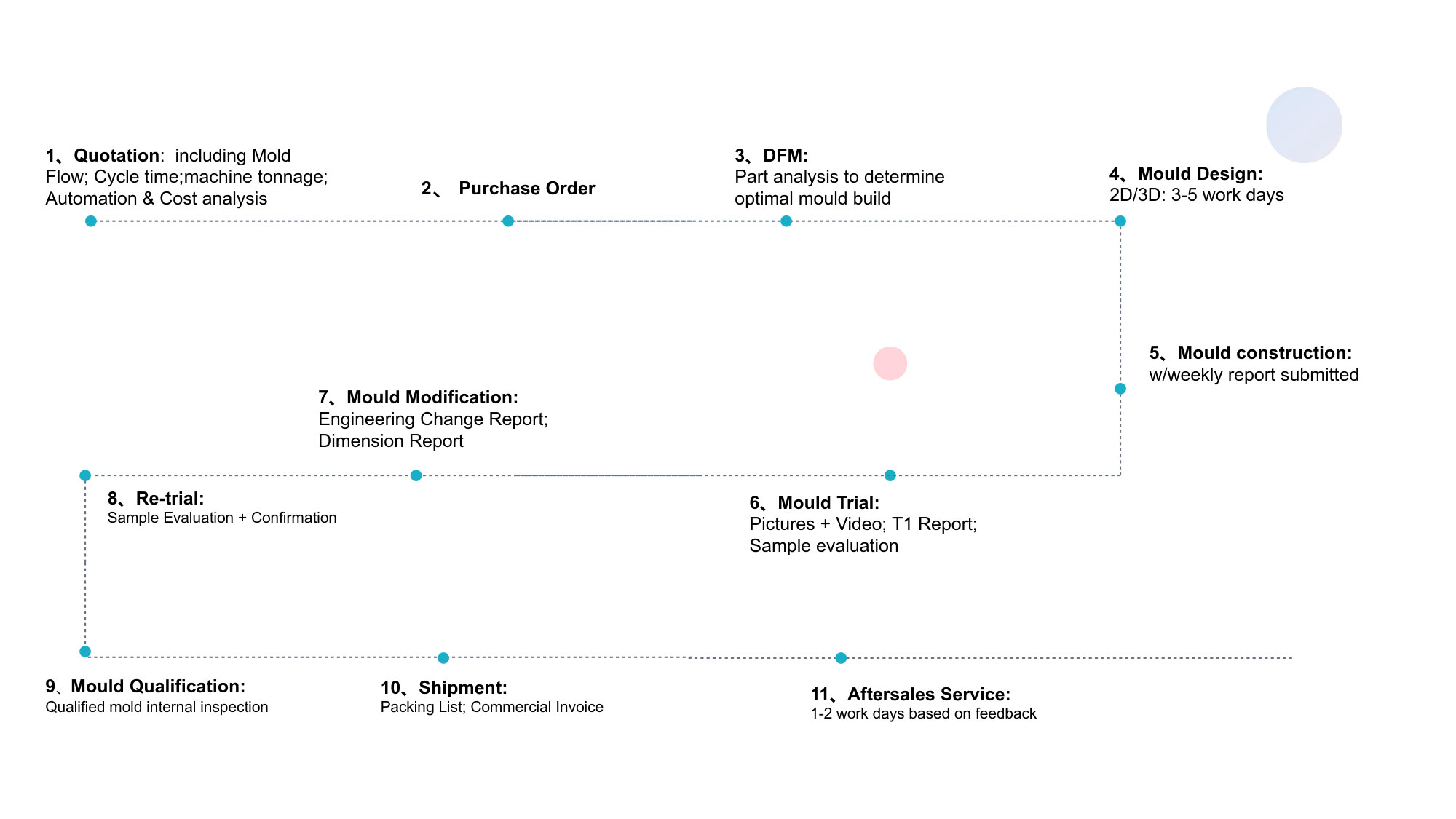
4.1 Early Engagement: DFM (Design for Manufacturability) Analysis
When we act: Before any steel is cut, before any purchase order is fully executed, Ansix Tech prepares a comprehensive DFM report analyzing the feasibility of the proposed spray cap design.
What the DFM report includes:
Suggestions for draft angle optimization to ensure clean ejection without sticking or part marking
Wall thickness recommendations to prevent sink marks opposite thick sections — particularly important for spray cap hinge areas and grip features
Gate location optimization to minimize weld lines at structurally critical locations such as sealing lips and thread forms
Ejector pin mark location allowances — we will mark the part only where it will not contact sealing surfaces or visible brand areas
Material shrinkage analysis for the specific polymer specified, documented by grade and lot
Alternative geometry suggestions where the original part design would be difficult or expensive to mold
Customer value statement: “Our DFM report catches problems that would cost you
15,000–50,000 in late-stage mold modifications. By fixing them in CAD before we build the tool, we save you that money entirely — and we deliver the report before you sign the final contract.”
A well-executed DFM analysis can identify up to 90% of potential manufacturing issues before tooling begins, dramatically reducing downstream rework costs and time-to-market delays.
4.2 Mold Trials and Validation (T1 through T3)
Ansix Tech conducts a structured, documented validation sequence for every mold:
Stage Description Deliverable to Customer
T1 First mold trial — verify basic part formation; identify obvious defects such as incomplete fill, severe flash, ejection damage Sample parts plus mold flow analysis correlation report
T2 Second trial — optimized parameters based on T1 findings; measure all critical dimensions; verify functionality Revised sample parts; dimension report; video confirmation of functional assembly if required
T3 Third trial — repeatable process window validated; cycle time optimized; quality indices calculated Production-ready sample parts; Cpk ≥ 1.33 documentation; process parameter set documented
Between trials, Ansix Tech provides documented improvement reports. Where optional designs need to be tested — different gate configurations, varied cooling layouts, alternative venting strategies — we utilize quick-change inserts to validate alternative solutions without rebuilding the entire mold.
Customer value statement: “You don’t have to guess which design works. We trial the options, provide the data, and only then lock the final configuration. That structured validation reduces your product launch risk substantially.”
3.3 Small-Batch Pre-Production Validation
Before full-scale mass production, Ansix Tech offers 100–500 unit pre-production runs using the final mold and final process parameters. This small-batch run serves as the ultimate validation:
Statistical process capability is recalculated based on actual production data
Functional testing (leak testing, cap removal torque, child-resistance verification) is performed on representative samples
Upper control limits and lower control limits are established for each process variable
If anything underperforms, adjustments are made on the pre-production run, not after 50,000 parts have been produced
Customer value statement: “We prove the process works at production scale before we start running production quantities. Your first mass production batch is not an experiment — it’s a confirmation.”
3.4 Maintenance, Spare Parts, and Lifecycle Support
Every Ansix Tech mold ships with a complete set of documented spare parts including:
Ejector pins (2× normal complement for each size used in the tool)
Core pins and cavity inserts for the most wear-prone features
Heater bands and thermocouple assemblies for hot runner molds
Wear plates for sliding components
Comprehensive spare parts list with part numbers for reordering
Our maintenance commitment extends beyond the initial shipment:
On-site mold health inspection at 200,000-cycle intervals
Preventative maintenance recommendations based on actual running hours, not calendar time
Lifecycle repair pricing at cost-plus basis — we do not profit from your mold repairs
24- to 48-hour emergency repair turnaround for standard components; replacement parts drop-shipped directly to your facility
Customer value statement: “Your cap mold will need maintenance. We make sure you have the parts you need before you need them, and we don’t hold your tool hostage with inflated repair prices.”
Section 5: Differentiated Commitments — Solving Industry-Wide Pain Points
Rather than making generic claims about quality, Ansix Tech addresses the specific, recurring complaints customers voice about mold suppliers in the pharmaceutical packaging industry. Each commitment below is backed by documented process capability.
5.1 Addressing the Mold Repair Nightmare
Industry complaint: “My current mold runs fine for three months, then starts producing scrap. The supplier says it’s my process. I say it’s the tool. Nobody knows, and meanwhile production stops.”
Ansix Tech’s response: We deliver each mold only after an in-house 2,000-cycle aging test, documenting wear patterns at 500, 1,000, 1,500, and 2,000 cycles for critical features such as sliding cores, ejection components, sealing surfaces, and gate inserts. A wear progression report accompanies the mold, showing exactly where wear first appears and projecting the maintenance schedule to stay ahead of it.
Commitment: Ansix Tech provides a three-year structural warranty on all mold components except normal-consumable parts (defined as components with designed replacement intervals less than 500,000 cycles). If a mold fails due to our manufacturing or design defect within three years, we repair it at no cost, including freight.
5.2 Eliminating Flash and Post-Processing
Industry complaint: “My caps come out of the mold with thin plastic fins (flash) along the parting line. I pay operators to trim them off by hand, which costs per unit and risks damaging the sealing surface.”
Ansix Tech’s response: Flash is a function of parting line machining precision and mold stiffness under clamping force. Ansix Tech machines parting line surfaces with accuracy — typically achieving flash formation limited to under 0.03mm across the entire parting face. Additionally, our molds incorporate self-locking clamp force compensation features that maintain consistent shut-off under varying injection pressure profiles.
Commitment: For normal production conditions within the specified process window, Ansix Tech guarantees flash height ≤ 0.03mm on finished parts — thin enough that it reflows into the part surface without requiring manual removal. When measured data shows consistent flash exceeding this threshold, Ansix Tech provides corrective action including on-site assistance at no additional charge.
5.3 Solving Dimensional Drift
Industry complaint: “Every batch I measure shows different cap dimensions. I can’t predict what the next batch will measure.”
Ansix Tech’s response: Dimensional drift is almost never caused by the mold itself — it is caused by changes in machine parameters, material batch variation, or environmental conditions. That said, Ansix Tech provides tools to make drift much less likely. For customers who require the highest level of dimensional stability, we offer integration of ultrasonic wall thickness sensors that feed real-time data back to the injection press, automatically adjusting packing pressure to compensate for viscosity variation. We can also incorporate in-mold pressure transducers enabling closed-loop cavity pressure control — proven to reduce dimensional variation between cavity positions by up to 50% in multi-cavity tools.
Commitment: Ansix Tech provides the hardware, the sensors, and the control logic. We train your operators to interpret the data. And we stand behind the solution: if a mold from Ansix Tech drifts out of specification during a production run and the cause is traced to the mold rather than your process, we perform root-cause analysis and corrective action at our expense.
5.4 Rapid Mold Repair Response
Industry complaint: “When my mold does need repair, the supplier takes two weeks to send it back. I lose production.”
Ansix Tech’s response: Ansix Tech owns its electrode manufacturing center and EDM workshop in-house. Standard repairs — electrode re-machining for a worn detail, spot welding of a damaged surface, or replacement of a broken pin — are completed without leaving the facility. For customers located within 500 km of any Ansix Tech production base, we offer 24-hour on-site emergency service. For international customers, routine repairs are completed and shipped within 48 hours of receiving the mold at our facility.
Commitment: Emergency mold repair (excluding major rebuilds requiring new core/cavity steel) will be completed and ready for return shipment within 48 hours of receipt at our facility. Routine repairs within 7 business days. These timelines are guaranteed; if we miss the deadline, you do not pay for that repair.
Section 6: Pharmaceutical-Specific Quality Validation and Compliance
Pharmaceutical packaging carries compliance requirements that exceed those of most consumer goods. Ansix Tech’s quality management systems are built to meet and exceed these expectations.
6.1 Regulatory Certifications
Certification Scope Relevance to Pharmaceutical Spray Caps
ISO 13485:2016 Medical devices quality management Direct applicability to drug delivery components
IATF 16949:2016 Automotive quality — among the highest manufacturing standards globally Demonstrates process rigor, traceability, and defect prevention applicable to pharmaceutical use
ISO 9001:2015 General quality management Foundation for all quality activities
ISO 14001:2015 Environmental management Supports sustainability requirements increasingly specified by pharmaceutical buyers
These certifications have been maintained continuously over years of operation, demonstrating sustained compliance rather than one-time achievement.
6.2 Raw Material Traceability
For pharmaceutical spray cap applications, full material traceability is non-negotiable. Ansix Tech’s system includes:
Receiving inspection: Each incoming batch of mold steel or plastic resin is logged with supplier certificate of analysis
Full traceability: For mold production, every component is batch-tracked to its original steel certification and heat treatment record
Material certification delivery: Ansix Tech provides full material certification packages with every mold, including chemical composition, mechanical properties, hardness verification, and heat treatment curves where applicable
Plastic resin documentation: For injection-molded components, lot numbers for each resin shipment are recorded, and certificates of conformance are maintained for customer audit review
6.3 In-Process and Final Quality Inspection
Ansix Tech’s inspection protocol for pharmaceutical spray caps includes:
Inspection Stage Method Acceptance Criteria Documentation
Raw material receipt Chemical/mechanical testing against certificate Within specified grade range Certificate of analysis filed
In-process (during production) Gauge checks at defined intervals (typically every 50–200 shots for pharmaceutical components) Within ±20% of nominal tolerance range SPC control charts
Final inspection (end of run) Full dimension inspection on CMM and optical measurement systems Critical dimensions ≤80% of tolerance Full dimension report with CPK for each critical dimension
Functional validation Leak testing (pressure decay or dye penetration), torque testing, child-resistance verification As specified in customer quality agreement Sample test certificates included with shipment
6.4 Packaging and Documentation for Pharmaceutical Shipments
Every mold shipped from Ansix Tech includes:
Full dimension report: All customer-specified critical dimensions vs. measured values across multiple cavity positions
Material certificates: Steel grades, heat treatment data, and any surface coating specifications
Mold flow analysis report: Filling pattern predictions, pressure distribution maps, and cooling simulation results with correlation to actual trial data
Spare parts list: Complete component identification for reordering
Maintenance schedule: Recommended intervals for cleaning, lubrication, and wear component replacement
Machine setup sheet: Recommended parameters for injection molding machine including temperatures, pressures, speeds, and cooling times
The customer value statement: “When you receive a mold from Ansix Tech, you receive a complete technical dossier. No guesswork. No missing documentation. Just a complete, ready-to-run tool with everything needed for validation-ready pharmaceutical production.”
Section 7: Cost Reduction Strategies — Translating Efficiency into Savings
Pharmaceutical packaging customers face constant pressure to reduce cost without compromising quality. Ansix Tech approaches cost reduction as a systematic optimization across three dimensions: material selection, process efficiency, and production scale.
7.1 Material Cost Optimization
Excessive material cost typically arises from over-specification — specifying a high-performance polymer where a lower-cost alternative would meet regulatory and functional requirements. Ansix Tech’s material engineering team analyzes the full requirement set before recommending a resin:
Functional requirements: Chemical resistance necessary for the drug formulation; mechanical strength needed for the closure; dimensional stability required for sealing
Regulatory requirements: Biocompatibility per ISO 10993 if applicable, USP Class VI if required, food-contact compliance for certain applications
Manufacturing requirements: Melt flow index compatible with the selected mold design; drying requirements feasible within facility constraints
Supply requirements: Single-source or multi-source availability; lead time for replacement resin
Documented Cost Reduction: For a recent pharmaceutical closure project, Ansix Tech recommended substituting a high-specific-performance PBT formulation for a specified PEEK resin — both materials met all functional and regulatory requirements, but the PBT cost was substantially lower, achieving raw material cost savings without compromising part performance.
7.2 Cycle Time Reduction — Direct Per-Part Savings
Shorter cycle time directly reduces per-part manufacturing cost. Ansix Tech achieves cycle time reduction through:
Optimization Area Technique Typical Impact on Pharmaceutical Spray Caps
Cooling system design Conformal cooling channels in core and cavity; high-pressure turbulent flow Reduces cooling portion of cycle by 30–50%
Hot runner technology Thermal gate or valve-gate hot runner systems reduce cooling requirements for sprue/runner Cuts total cycle time by up to 20% or more compared to cold runner tools
Automated parts handling Robotic part removal with integrated degating Shaves 1–2 seconds per cycle vs. manual removal
Intelligent process control Adaptive process tuning using in-mold sensor feedback Maintains cycle-to-cycle consistency, reducing rejection-driven additional cycles
Calculated Example: A 32-cavity mold producing a 4-gram pharmaceutical spray cap with a molded cycle time of 12 seconds vs. an uncontrolled 18-second cycle produces the following annual difference (assuming 6,000 operating hours per year, 85% uptime):
Metric 12-Second Cycle 18-Second Cycle Difference
Shots per hour 300 200 +100 shots/hour
Caps per hour (32 cavities) 9,600 6,400 +3,200 caps/hour
Annual caps (6,000 hours) 57.6 million 38.4 million +19.2 million caps/year
Machine hours required for 50 million caps 5,208 7,812 -2,604 machine hours/year
A reduction of 2,604 machine hours at typical pharmaceutical contract manufacturing rates yields more than $75,000 in annual savings — exceeding the mold’s incremental cost difference in the first year alone.
7.3 Production Efficiency Gains through Automation
Ansix Tech’s facilities integrate automation across the molding process to reduce labor content per part:
Robotic part extraction: Removes parts from the mold at precise timing optimized for the specific tool, reducing cycle time variation and operator attention requirements
Automated degating: Where gate vestige tolerance permits, integrated degating removes runner systems without manual labor
Automated part inspection: Vision systems inspect critical features (thread integrity, gate vestige smoothness, flash presence) at production speed, reducing quality labor and reducing defect escape rates
Customer value statement: “Every automation layer we add reduces your labor cost per part. You don’t need to pay operators to remove parts, trim gates, or visually inspect — the machine does it automatically.”
7.4 Scale Economics through Multi-Cavitation
Ansix Tech designs and builds high-cavitation molds that increase per-cycle output without proportionally increasing capital investment:
Cavity Count Relative Tooling Cost* Relative Output per Cycle Cost per Cavity Output per Dollar
8 1.0× 8 0.125× 8
16 1.5× 16 0.094× 10.7
32 2.2× 32 0.069× 14.5
48 2.9× 48 0.060× 16.6
64 3.5× 64 0.055× 18.3
*Cost multiples are approximate and vary with part geometry; values shown illustrate general scaling trend.
Key Insight: The output per dollar metric shows that high-cavitation tooling provides substantially more production capacity per tooling dollar invested. For ongoing contract manufacturing agreements, Ansix Tech will amortize the incremental cost of high-cavitation tooling across the production agreement, reducing the customer’s upfront capital requirement.
Section 8: Capacity Assurance and On-Time Delivery
Pharmaceutical customers cannot afford production interruptions or launches delayed by mold delivery slippage. Ansix Tech’s manufacturing footprint and production management systems are designed to deliver reliability.
8.1 Production Footprint — Built for Scale
Ansix Tech’s four production facilities in China and Vietnam provide approximately 200,000m² of manufacturing floor space, housing:
260 injection molding machines from 30 tons to 2,800 tons — sufficient capacity to run production simultaneously across multiple customers and product families
Dedicated high-speed machining centers for mold manufacturing, separate from production molding equipment — mold fabrication does not compete with part production for machine hours
In-house electrode manufacturing and EDM workshops — mold repairs and modifications do not require external subcontracting
Electroplating and surface treatment capabilities for select applications
8.2 Production Management Systems
Ansix Tech employs integrated production management systems to track and control every project:
Mold manufacturing tracking: Each mold has a scheduled manufacturing timeline with committed checkpoints for design release, material ordering, machining start, assembly, and trial
Production scheduling: Injection molding production slots are allocated based on customer delivery requirements, with buffer capacity maintained for urgent orders
Supply chain management: Material procurement is managed through established agreements with approved resin suppliers (including SABIC, BASF, Celanese, and other global polymer manufacturers)
Logistics coordination: For international shipments, export documentation, customs clearance, and freight arrangements are managed by Ansix Tech’s logistics team
8.3 Expedite and Emergency Production
When customer requirements shift unexpectedly — a sudden increase in forecast demand, a customer’s primary supplier failing to deliver, an urgent clinical trial requiring immediate supply — Ansix Tech can activate expedite protocols:
Overtime machining: Dedicated shifts for mold completion when standard lead time cannot be met
Dedicated machine reservation: For production molding, a press can be reserved exclusively for a customer’s urgent order
Split production: Where a single large order can be distributed across multiple facilities to accelerate completion
Commitment: For pharmaceutical spray cap molds under normal complexity, Ansix Tech commits to 25–35 day standard lead time and will acknowledge any schedule slippage with documented root cause and mitigation plan. For production orders, on-time delivery during normal operations is targeted at 98% or better.
Section 9: Ansix Tech’s Unique Advantages — 28 Years in the Industry
9.1 Integrated One-Stop Solution
Ansix Tech provides a unified platform covering product design, engineering, mold manufacturing, injection molding, secondary processing, assembly, and logistics. This integration eliminates communication gaps common when customers coordinate separate suppliers for design, tooling, and production:
Single point of accountability: One Ansix Tech project manager coordinates all project phases — from DFM analysis through mold trial to mass production and ongoing maintenance
No design-to-manufacturing handoff friction: The same engineering team that performs DFM analysis and designs the mold is available to troubleshoot production issues
Consistent quality system: ISO 13485 and IATF 16949 quality management systems apply across all activities, not just mold manufacturing
Simplified procurement: One purchase order covers design, tooling, production, and logistics — reducing supplier management overhead
9.2 Proven Track Record in Pharmaceutical Applications
Ansix Tech has successfully delivered molds and injection-molded components for:
Pharmaceutical and personal care packaging: Spray bottle caps, closures, dispensing systems, child-resistant closures, tamper-evident packaging
Medical devices: Precision nozzle molds for inhalers, insulin pen components, syringe components, surgical instrument handles
Healthcare consumables: Tube caps with integrated desiccants, sealing components, vacuum system covers
9.3 Global Footprint with Local Support
Ansix Tech maintains four production bases in China and Vietnam, serving customers across North America, Europe, and Asia-Pacific. This global presence provides:
Regional language and time zone support for communication with customers in each market
Trade agreement advantages — Vietnam production may offer tariff benefits for certain export destinations
Supply chain resilience — multiple locations reduce single-source risk for high-volume customers
9.4 Mission-Driven Customer Focus
Ansix Tech’s corporate mission is to “Make Our Customers Successful”. This mission is operationalized through documented commitments, not just abstract promises:
Cost transparency: Where alternative material selections, cavity configurations, or process approaches could yield lower total cost, Ansix Tech presents options with trade-off analysis
No hidden fees: Tooling revisions resulting from identified manufacturing issues are communicated before work begins, with documented approval required
Post-sale support: The Ansix Tech engineering team remains accessible after mold delivery and production start, providing troubleshooting and optimization assistance
Section 10: The Final Value Proposition
10.1 When Experienced Pharmaceutical Manufacturing Partners Choose Ansix Tech
Pharmaceutical packaging professionals choose mold suppliers based on demonstrated reliability, not marketing claims. Ansix Tech has earned its position through sustained performance across 28 years and more than 30,000 delivered molds. The technical platform and customer commitments documented in this paper are not theoretical — they are the standard operating procedures applied to every Ansix Tech project.
10.2 The Cost of Not Getting It Right
For a pharmaceutical spray bottle cap, the cost of a defective mold extends far beyond the tooling investment:
Failure Mode Immediate Cost Additional Consequences
Dimensional drift causing leak during stability testing Scrapped batch (up to 100,000 caps) Stability study restarted; regulatory submission delayed 3–6 months
Poor cooling design causing 8-second longer cycle time Increased machine cost per part Over 1-million part run: 15,000–25,000 in avoidable cost
Inadequate material selection causing brittle failure Recalled product Brand damaged; regulatory action; liability exposure
Poorly documented mold causing maintenance errors Unplanned downtime 2–5 days per incident Lost production revenue; supply interruption penalties
Non-conforming mold documentation fails regulatory audit FDA/EMA warning letter Business disruption; increased scrutiny for 12–24 months
10.3 Direct Customer Benefits Summary
The Ansix Tech approach to pharmaceutical spray bottle cap mold manufacturing delivers measurable benefits across five categories:
Benefit Category Direct Customer Value Quantifiable Impact
Quality assurance Each mold ships with full dimension report and CPK ≥ 1.33 evidence; material certification and heat treatment data included Reduced regulatory audit findings; validated documentation for quality systems
Cost reduction Material substitution savings; cycle time reduction; scrap reduction; reduced rework and post-processing Target 10–20% total cost reduction from optimized material selection, process efficiency, and waste elimination
Risk mitigation 3-year mold warranty; documented aging test results; spare parts included; rapid repair response Minimized unplanned downtime; uninterrupted supply; predictable production
Speed to market DFM analysis before tooling construction; structured validation (T1–T3); expedite options available 25–45 day lead time for mold delivery; accelerated product launch
Total support Full-service integration — design through production; compliance documentation; maintenance planning Single supplier accountability; reduced management overhead; consistent quality across all activities
10.4 Closing Statement
At Ansix Tech, we do not view a mold as just engineered steel — we view it as the physical foundation of your production success. For a pharmaceutical spray bottle cap mold to deliver value, it must be designed with an integrated understanding of fill balance, venting paths, cooling uniformity, and ejector layout. Every detail must be planned to ensure that when the mold reaches your facility, it runs from the first shot with minimal adjustment — minimal flash, long tool life, and consistent dimensional output across every production run.
We welcome the opportunity to demonstrate these principles with your existing products. Provide us with a current spray cap design or a similar pharmaceutical closure part, and we will prepare a full DFM report at no cost. You will see firsthand how Ansix Tech identifies and mitigates weld line concerns, trapped gas locations, shrinkage risks, and ejection interference before we cut the first piece of steel.
To discuss your pharmaceutical spray bottle cap mold project, contact Ansix Tech’s sales engineering team for a capabilities presentation and initial feasibility consultation.
Ansix Tech — Integrated Injection Molding Solutions. Global Capabilities. Proven Results. Since 1998.
Ansix Tech Co Ltd
If you have any plans related to Pharmaceutical Spray Bottle Cap Mold , you can contact us at any time. We will turn your ideas into reality, let you realize your dreams, and obtain large orders from the market. Our contact information is info@ansixtech.com. Or contact our CTO, mail: stephen@ansixtech.com
#www.ansixtech.com #ansixtech.com #Pharmaceutical Spray Bottle Cap Mold #Pharmaceutical Spray Bottle Cap Mold moulds #Pharmaceutical Spray Bottle Cap Mold molds #Pharmaceutical Spray Bottle Cap Mold injection molding companies #Pharmaceutical Spray Bottle Cap Mold Canopy Mold injection mold companies #Ansix #Ansix moulds #Ansix china #Ansix tech china #Ansix tech company #Ansix facotry #Pharmaceutical Spray Bottle Cap Mold injection molding #Pharmaceutical Spray Bottle Cap Mold injection tools #Pharmaceutical Spray Bottle Cap Mold injection moulds #Pharmaceutical Spray Bottle Cap Mold plastic mould #Pharmaceutical Spray Bottle Cap Mold plastic tools #Ansix Tech #Ansix molds #Ansix injection molding #Ansix mold factory #injection molding Pharmaceutical Spray Bottle Cap Mold #Ansix mold factory #Pharmaceutical Spray Bottle Cap Mold china #Pharmaceutical Spray Bottle Cap Mold molds #injection factory #Pharmaceutical Spray Bottle Cap Mold injection molding #Pharmaceutical Spray Bottle Cap Mold injection molding factory #injection molding company #Pharmaceutical Spray Bottle Cap Mold injection mold companies #Pharmaceutical Spray Bottle Cap Mold#Pharmaceutical Spray Bottle Cap Mold mold limited #Ansix mold china #Ansix companies #Ansix company China #Pharmaceutical Spray Bottle Cap Mold facotry #Ansix Tech #Ansix Tech mould #Pharmaceutical Spray Bottle Cap Mold injection moulding #injection moulding company #Ansix Pharmaceutical Spray Bottle Cap Mold parts injection mold companies #medical injection molding companieschina #Pharmaceutical Spray Bottle Cap Mold china factory #Ansix moulding companies #Ansix molding company #Pharmaceutical Spray Bottle Cap Mold injection moulding facotry #Ansix Tech mold #Pharmaceutical Spray Bottle Cap Mold mould #Pharmaceutical Spray Bottle Cap Mold plastic injection molding #ansix plastic mold #Mold manufacturing #Pharmaceutical Spray Bottle Cap Mold parts manufacturing #Pharmaceutical Spray Bottle Cap Mold plastic parts factory #Pharmaceutical Spray Bottle Cap Mold injection parts mold #Pharmaceutical Spray Bottle Cap Mold PRECISION MANUFACTURING #Pharmaceutical Spray Bottle Cap Mold #China mold #Pharmaceutical Spray Bottle Cap Mold injection moulding china #Pharmaceutical Spray Bottle Cap Mold mould china #china precision mold #mold in china #Pharmaceutical Spray Bottle Cap Mold mold china #Precision molds #High-precision molds #Pharmaceutical Spray Bottle Cap Mold #Injection molds #Pharmaceutical Spray Bottle Cap Mold Factory #Pharmaceutical Spray Bottle Cap Mold Company #Super Large Injection Mold Factory #Large Tonnage Injection Molding Factory #Pharmaceutical Spray Bottle Cap Mold Company #Pharmaceutical Spray Bottle Cap Mold Factory #2800T Injection Molding Factory #3000 Ton Injection Molding #4500 Ton Injection Molding Factory #Large Mold Injection Molding #Large Plastic Mold Injection Molding Factory #Large Injection Mold Manufacturer #Plastic Mold Factory #Injection Mold #Plastic Mold