



Portable Medical Instrument Enclosure
FEATURES
- ontrols=false&loop=false&playsinline=true&muted=false"> ontrols=false&loop=false&playsinline=true&muted=false">
Hard Power Foundation — Building Customer Confidence Through Technical Capabilities
Mold Manufacturing Equipment — Precision That Delivers Flawless Parts
Ansix Tech’s mold manufacturing facility is equipped with advanced five-axis high-speed machining centers capable of achieving positioning accuracy of ±0.002mm, with repeatability precision better than ±0.0005mm. The company maintains an automated machining ratio of 70%, ensuring consistency across every tool produced.
Customer Value Translation: This ultra-precision machining capability directly translates into smooth, nearly invisible parting lines on portable medical instrument enclosures. No manual polishing or post-processing burr removal is required, eliminating labor costs and reducing the risk of surface defects that could compromise device cleanliness or aesthetics. The ±0.002mm dimensional accuracy ensures that snap-fits and sealing interfaces maintain consistent closure force over the device's lifetime.
The facility incorporates slow wire EDM (electrical discharge machining) systems capable of producing micro-features down to 0.03mm, including narrow slots, fine venting channels, and thin-walled sections. For portable medical instruments requiring complex geometries—such as battery compartment seals, LED indicator windows, or sensor ports—this capability is critical.
Customer Value Translation: By enabling the machining of intricate features directly into the mold, Ansix Tech eliminates secondary machining operations on finished parts, reducing per-part cost by up to 15-20% while eliminating potential contamination points that could arise from post-molding processing.
-
Mold Description
Product Materials:
ABS/PC
Mold Material:
S136ESR
Number of Cavities:
2
Glue Feeding Method:
Hot runner
Cooling Method:
Water cooling
Molding Cycle
42.5s
- The mold manufacturing process and product material selection
Injection Molding Machine Fleet — Process Stability That Guarantees Part-to-Part Consistency
Ansix Tech operates 260 injection molding machines with clamping forces ranging from 30 tons for micro-sized components to 2,800 tons for larger instrument housings. All machines utilize all-electric servo-drive systems, achieving repeatable shot-to-shot precision of ±0.1% across critical process parameters.
Customer Value Translation: This extensive machine range means Ansix Tech can accommodate portable medical instrument enclosures of virtually any size—from handheld diagnostic devices to larger point-of-care systems—without compromising precision. The all-electric drives deliver energy savings of 30-50% compared to hydraulic machines, reducing both operating costs and the environmental footprint of production.
Machine networking and data acquisition systems connect every press to a centralized MES (Manufacturing Execution System). Process parameters including temperature, pressure, injection speed, and cooling time are locked and accessible only to authorized engineering personnel. Every production batch undergoes first-article and end-of-batch part verification.
Customer Value Translation: When a medical device manufacturer needs 100,000 identical instrument housings delivered over 12 months, they require assurance that part #100,000 is dimensionally identical to part #1. Ansix Tech’s locked-parameter control system guarantees this repeatability, eliminating the risk of assembly line interruptions caused by inconsistent part dimensions.
-
Inspection and Metrology Equipment — Data-Driven Quality Assurance
Every mold manufactured at Ansix Tech undergoes comprehensive dimensional inspection using coordinate measuring machines (CMMs) combined with laser interferometer systems capable of real-time error correction to the 0.001mm level. Optical inspection systems provide automated verification of surface finish, gate vestige, and cosmetic quality.
Customer Value Translation: Each mold is delivered with a full dimensional inspection report and a capability study demonstrating that all critical dimensions maintain Cpk (process capability index) ≥ 1.33—often achieving Cpk ≥ 1.67 for CTQ dimensions. This documentation directly supports FDA and ISO 13485 regulatory submissions, providing auditable traceability from tooling through production.
Equipment Capability Summary Table
Equipment Category Specification Customer Value
5-Axis Machining Centers ±0.002mm accuracy No burrs, no manual finishing, lower labor cost
Slow Wire EDM 0.03mm micro-feature capability Complex geometries in single mold, reduced assembly
All-Electric Presses ±0.1% shot repeatability Identical parts across millions of cycles
Section II: Mold Manufacturing Core Competencies — Measurable Performance Guarantees
Mold Life Expectancy — Predictable Tooling Investment
The longevity of a portable medical instrument enclosure mold directly impacts the OEM's cost-per-part calculation. Ansix Tech selects mold materials based on production volume requirements and material characteristics:
Steel Grade Typical Application Guaranteed Mold Life
P20 / 1.2311 Prototype and low-volume production 100,000+ shots
S136 / 1.2083 Medium-volume, corrosion-resistant medical enclosures 500,000+ shots
2344 / 1.2344 High-volume, abrasive-filled materials 800,000+ shots
H13 / SKD61 Maximum durability, high-cycle applications 1,000,000+ shots
DC53 Wear-resistant, glass-filled materials 1,000,000+ shots
NAK80 High-polish, cosmetic-grade surfaces 500,000+ shots
M340 / 4Cr13 / 9Cr18 Sterilization-resistant, surgical-grade enclosures 500,000+ shots
Customer Value Translation: Instead of vague promises about mold durability, Ansix Tech provides a binding commitment: for glass-fiber reinforced materials, the mold is guaranteed for 500,000 cycles; for standard engineering thermoplastics, 1,000,000 cycles. Each mold is delivered with material certification reports and detailed heat treatment curves, ensuring the customer knows exactly what production volume their tooling investment will support.
Achievable Tolerances — Precision That Eliminates Secondary Operations
Portable medical instrument enclosures demand tight tolerances to ensure proper sealing, button operation, and screen alignment. Ansix Tech’s capabilities are categorized by criticality:
Component Type Achievable Tolerance Customer Value
General structural features ±0.05mm Snap-fits and assembly guides function correctly without forcing
Mating surfaces and seals ±0.02mm No leakage paths, no need for additional gaskets
Precision gear housings ±0.008mm Reduced wear, longer mechanism life
Optical/medical precision components ±0.005mm Lens alignment and sensor placement within spec
Micro-molded medical parts ±0.003mm Implantable-grade precision for critical features
Customer Value Translation: When a portable medical instrument's enclosure must seal against moisture ingress or its buttons must actuate reliably for 100,000 presses, ±0.02mm tolerances on mating surfaces eliminate the need for separate gaskets or post-molding hand-fitting—directly reducing bill-of-materials cost and assembly labor.
Mold Type Capabilities — Design Flexibility for Every Application
Ansix Tech’s mold engineering portfolio covers the full spectrum of injection mold configurations:
Hot Runner Systems: Precision valve-gate control eliminates runner waste, reduces material consumption, and improves gate aesthetics for visible cosmetic surfaces. Cycle time reduction of 15-30% compared to cold runner systems.
Stack Molds (Two-Level / Tandem): Doubles output per machine cycle without increasing clamp tonnage requirements. Annual output can increase from approximately 8.5 million to over 12.8 million parts, with unit costs decreasing by up to 23%.
Two-Shot / Multi-Material Molds: Enables overmolding of soft-touch grippable surfaces onto rigid ABS or PC structural enclosures in a single automated cycle, eliminating secondary assembly and adhesive bonding.
High-Polish / Optical Molds: Achieves surface finish Ra < 0.05μm for transparent instrument windows, display covers, and light-guide components.
Customer Value Translation: A portable medical instrument requiring both a rigid structural frame and soft-touch ergonomic grips would traditionally require two separate molding operations plus assembly. Ansix Tech’s two-shot mold capability produces the complete assembly in one cycle, eliminating adhesive costs, assembly labor, and the risk of bond-line failures.
Gate and Runner Design Optimization — Eliminating Defects Before They Occur
Through comprehensive mold flow analysis (MFA) using Autodesk Moldflow and Moldex3D platforms, Ansix Tech simulates the complete injection process before any metal is cut. The analysis identifies and resolves:
Weld line locations — repositioned to non-critical cosmetic or structural zones
Air trap locations — addressed through strategic venting channel placement
Fill imbalance across multi-cavity molds — balanced runner designs target <5% variation
Shrinkage and warpage prediction — compensated through CAD model adjustments
Gate freeze timing — optimized for uniform packing across all cavities
Customer Value Translation: By simulating the entire molding process digitally before committing tooling, Ansix Tech eliminates the traditional "cut-and-try" mold development cycle. The customer receives a DFM (Design for Manufacturability) report within 72 hours of design submission, identifying potential manufacturing issues before they become costly tooling revisions. This proactive approach reduces tooling costs by 15-30% while accelerating time-to-market by eliminating multiple mold iterations.
Cooling System Design — Reducing Cycle Time Through Conformal Cooling
Uniform mold temperature control is critical for dimensional stability and cycle time reduction. Ansix Tech employs conformal cooling channel design—cooling paths that precisely follow the product contour through topological optimization algorithms, maintaining mold surface temperature differentials within ±1°C to eliminate thermal stress-induced warpage.
Customer Value Translation: Conformal cooling reduces cooling time by 25-40% compared to traditional straight-line cooling channels. For a portable medical instrument enclosure, this directly translates to more parts per hour, lower per-part manufacturing cost, and faster order fulfillment lead times. The uniform temperature distribution also eliminates hotspots that can cause sink marks or residual stress cracking—critical factors for load-bearing and sealing surfaces.
Ejection System Design — Protecting Precision Surfaces
Ejection pin placement is strategically planned to avoid cosmetic surfaces, sealing faces, and critical dimensional datums. Ansix Tech’s mold designs incorporate:
Pre-hardened ejector pins with nitrided surfaces for wear resistance
Stripper plate ejection for thin-walled or large-surface-area enclosures
Air-assist ejection for delicate features
Customer Value Translation: No unsightly ejector pin marks on the visible exterior of the medical instrument. No deformation of snap-fit beams during ejection. Consistent part geometry from first shot to millionth shot.
Mold Performance Commitment Table
Parameter Commitment Validation Method
Mold life (engineering plastics) 1,000,000+ shots Pre-delivery 2,000-shot wear test
Mold life (glass-filled) 500,000+ shots Material-specific wear test
Critical dimension tolerance ±0.005mm or better CMM inspection, CPK ≥1.33
Parting line flash ≤0.03mm First-article and periodic verification
Delivery (simple mold) 10 days Project schedule tracking
Delivery (medium complexity) 25-45 days Project schedule tracking
Delivery (expedited) 20 days With full validation documentation
Section III: Injection Molding Process Control — Eliminating Quality Anxiety
Process Standardization and Parameter Locking
All injection molding machines at Ansix Tech are connected to a centralized MES (Manufacturing Execution System) that locks all critical process parameters:
Melt temperature (±1°C control)
Injection pressure and velocity profiles
Packing and holding pressure timing
Cooling time
Back pressure and screw speed
Mold temperature — closed-loop control with PID intelligent algorithm maintaining ±0.5°C accuracy
Customer Value Translation: Every portable medical instrument enclosure produced in the same production batch is manufactured under identical conditions. No operator adjustments, no unrecorded parameter drift. First-article and end-of-batch part inspection confirms dimensional consistency. This traceability directly supports regulatory compliance and provides auditable records for FDA and ISO inspections.
Dimensional Stability Control — Eliminating Run-to-Run Variation
Injection molding machine pressure fluctuations are controlled within ±0.5% through closed-loop servo control systems, with temperature control accuracy reaching ±0.5°C. For portable medical instrument enclosures requiring tight dimensional control, Ansix Tech implements:
Ultrasonic in-mold wall thickness sensors providing real-time feedback to adjust packing pressure
Closed-loop cavity pressure/temperature sensors enabling adaptive process control
Mold temperature zoning — core and cavity temperatures maintained within 2°C differential to minimize warpage
Customer Value Translation: On a portable medical instrument enclosure with critical mounting bosses or sealing surfaces, run-to-run dimensional variation is reduced to ±0.02mm across consecutive production batches. Assembly line interruptions caused by inconsistent fit are eliminated. Scrap rates from dimensional non-conformance drop to <1%.
Surface Finish Classification — Cosmetic Quality Guarantees
Ansix Tech achieves and guarantees specific surface finish levels based on customer requirements:
Surface Grade Finish Level (Ra) Application Customer Benefit
SPI A-1 (Super High Polish) <0.012μm Optical lenses, display covers Crystal-clear transparency, no light diffusion
SPI A-2 (High Polish) <0.025μm Transparent windows, medical-grade components No flow marks or haze
SPI A-3 (Normal Polish) <0.050μm Cosmetic housings Mirror-like finish, premium appearance
SPI B-1 (Fine Grit Stone) 0.05-0.10μm Soft-touch surfaces, grippable areas Consistent texture, no sink marks
SPI C-1 (800-1000 grit paper) 0.10-0.25μm Standard enclosures Functional texture, hides minor flow lines
VDI 12-21 (EDM texture) 0.20-1.00μm Matte finishes Scratch-resistant, uniform appearance
VDI 24-45 (Coarse EDM) 1.00-4.00μm Heavy textures Industrial-grade durability
Customer Value Translation: Whether a customer requires a crystal-clear lens window for an instrument display or a textured, scratch-resistant housing for a field-deployed diagnostic device, Ansix Tech guarantees the specified surface finish without bubbles, flow lines, or visible weld marks. For enclosures requiring painting or printing, positional accuracy for pad printing and screen printing is maintained at ±0.1mm.
Special Materials Processing Capability — Expanding Design Possibilities
Ansix Tech has extensive production experience with the full spectrum of medical-grade thermoplastics:
Material Capability Overview
Material Category Specific Grades Key Properties for Medical Enclosures
PC (Polycarbonate) General-purpose, medical-grade High impact strength, optical clarity, dimensional stability, autoclavable grades available
ABS Standard, flame-retardant Toughness, excellent surface finish, cost-effective, easy to mold
PC/ABS Blends Cycoloy, Bayblend, medical grades Balances PC strength with ABS moldability, ideal for portable device housings
PEEK Victrex, Solvay medical grades Exceptional strength, heat resistance, chemical resistance, biocompatible
PPS+40%GF Fortron, Ryton high-fill grades Ultra-stiff, high-temperature stability, UL94 V-0 flame rating
LCP (Liquid Crystal Polymer) Vectra, Zenite Thin-wall molding capability, high flow, excellent dimensional stability
PEI (Polyetherimide) Ultem High heat deflection, flame resistance, medical compatibility
PPSU (Polyphenylsulfone) Radel Autoclavable, excellent sterilization resistance, tough
PA6+GF30 / PA66 Standard and reinforced nylon High strength-to-weight ratio, good fatigue resistance
PTFE / PFA Fluoropolymer grades Low friction, chemical inertness, extreme temperature performance
LSR (Liquid Silicone Rubber) Medical-grade Soft-touch seals, biocompatibility for skin contact
TPE / TPU Santoprene, Desmopan, medical-flex Overmolded soft grips, flexible seals, chemical bonding to PC/ABS
Customer Value Translation: Material expertise means Ansix Tech guides customers toward the optimal resin for their application rather than simply molding whatever material is specified. When a portable medical instrument requires UL94 V-0 flame rating for the housing, Ansix Tech recommends material candidates with associated fire testing documentation. When the device requires gamma sterilization, Ansix Tech validates material compatibility to prevent discoloration or embrittlement before production begins.
Section IV: Full-Process Service — Reducing Customer Management Costs
Early Engineering Intervention — DFM Reports Before Tooling Commitment
Ansix Tech’s Design for Manufacturability (DFM) process begins before any tooling investment is made. Within 72 hours of receiving a customer’s CAD model, Ansix Tech delivers a comprehensive DFM analysis report that evaluates:
Draft angle requirements — ensuring proper part ejection without scratching cosmetic surfaces
Wall thickness consistency — uniform thickness prevents sink marks and warpage
Rib and boss placement — structural reinforcement without creating thick sections
Gate location optimization — hiding gate vestiges in non-critical areas
Parting line placement — avoiding cosmetic faces and sealing surfaces
Ejector pin mark locations — obtaining customer approval for visible witness marks
Undercut analysis — determining slide or lifter requirements for side-actions
Customer Value Translation: Changes made to a CAD model before tooling starts cost virtually nothing. Changes made after tooling is complete can cost thousands or tens of thousands of dollars. An Ansix Tech DFM report identifies and resolves manufacturability issues upstream, eliminating tooling rework, reducing scrap rates, and accelerating the path to production. The customer receives a design-for-manufacturability assessment that includes wall thickness optimization, draft angle recommendations, material compatibility confirmation, and assembly simplification opportunities.
Mold Flow Analysis Report — Virtual Validation Before Metal Cutting
Using advanced simulation software, Ansix Tech performs mold flow analysis (MFA) to predict and optimize:
Analysis Output Customer Value
Fill time visualization Identifies flow imbalance, enabling runner balancing
Weld line prediction Relocates weld lines to non-critical areas or eliminates through gate repositioning
Air trap identification Guides vent placement, eliminating burn marks
Pressure drop analysis Optimizes gate size and location, reducing required clamp force
Temperature distribution Validates cooling system effectiveness before machining
Shrinkage and warpage compensation CAD model adjusted to produce correct finished dimensions
Fiber orientation (filled materials) Predicts part strength and anisotropy
Customer Value Translation: The mold flow report serves as a risk assessment document that predicts how the medical enclosure will perform in production before a single part is molded. Weld lines that could compromise structural integrity are identified and relocated. Potential sink marks from thick sections are flagged for design modification. This virtual validation eliminates the trial-and-error mold rework cycle, reducing tooling costs by 15-25% and compressing development timelines by weeks.
Sample Molding and Iterative Improvement — T0 through T3 Validation
Ansix Tech follows a disciplined sample validation protocol:
T0 (First Trial): Mold is mounted and initial parts produced. Dimensional inspection report provided. Customer receives first-off samples with full measurement data.
T1 (First Optimization): Based on T0 findings, mold adjustments implemented. Cosmetic improvement and dimensional fine-tuning.
T2 (Second Optimization): Final adjustments before production release. Process window defined.
T3 (Production Release): Mold qualified for serial production. All critical dimensions meet specification. CPK ≥1.33 demonstrated.
Customer Value Translation: The customer is never left wondering when their mold will be ready. Each trial stage has defined deliverables and acceptance criteria. The customer receives physical samples at every stage plus digital dimensional reports. Quick-change inserts allow design alternatives to be tested without building entirely new tooling, reducing evaluation costs by 40-60%.
Pilot Production Validation — Statistical Confirmation Before Full-Scale Run
Before committing to full mass production, Ansix Tech offers a pilot production phase of 100 to 500 mold cycles. During this phase:
Dimensional inspection of every part from each cavity
CPK calculation for all critical-to-quality dimensions
Scrap rate and process yield calculation
Operator instruction development
Packaging and handling validation
Customer Value Translation: The pilot production stage validates that the molding process delivers statistical capability before the customer commits to large-volume orders. Medical device manufacturers receive CPK data confirming that the process meets their quality standards. The validation data directly supports FDA and ISO 13485 process validation requirements (IQ/OQ/PQ documentation).
Tooling Maintenance and Spare Parts — Protecting Production Continuity
Ansix Tech delivers each mold with a complete set of spare wear components:
Spare ejector pins (standard and extended lengths)
Spare core pins and inserts for features subject to wear
Spare guide pins and bushings
Cooling system O-rings and seals
Spare sprue bushings and locating rings
Customer Value Translation: When a production line requires replacement of a worn core pin, waiting weeks for a new one to be manufactured means lost production and delayed customer orders. Ansix Tech ships spare components with every mold, enabling 24-hour turnaround on common replacement parts. Scheduled mold maintenance is recommended every 200,000 cycles, with cost-plus pricing for any repairs required beyond the wear-and-tear coverage period.
Section V: Competitive Differentiation — Direct Answers to Common Pain Points
Addressing Industry-Wide Customer Complaints
Ansix Tech’s value proposition is not built on marketing claims but on measurable responses to the challenges medical device manufacturers consistently encounter:
Common Customer Complaint Ansix Tech’s Professional Response
"Our molds need frequent repair work, disrupting production schedules." Every mold undergoes a 2,000-cycle accelerated wear test before delivery. Ansix Tech provides a written mold structure warranty for three years (excluding normal wear components). The wear test report documents component degradation over simulated production cycles.
"Flash requires extensive manual deflashing, adding labor cost." Ansix Tech holds parting line fit to 0.005mm machining accuracy. Autolocking clamp force compensation ensures flash is consistently ≤0.03mm per cycle. No manual deburring required for properly designed enclosures.
"Dimensional consistency varies from batch to batch." Closed-loop process control with in-mold pressure sensors provides real-time quality feedback. Machine parameters are locked and accessible only to engineering personnel. Three consecutive weekly production batches demonstrate critical dimension variation ≤0.02mm.
"Tooling modifications take weeks, causing line downtime." Ansix Tech maintains in-house electrode machining centers and EDM capabilities. Mold repairs and component replacements do not require outsourcing. Standard repairs—including patch welding and insert replacement—restore production within 24 hours.
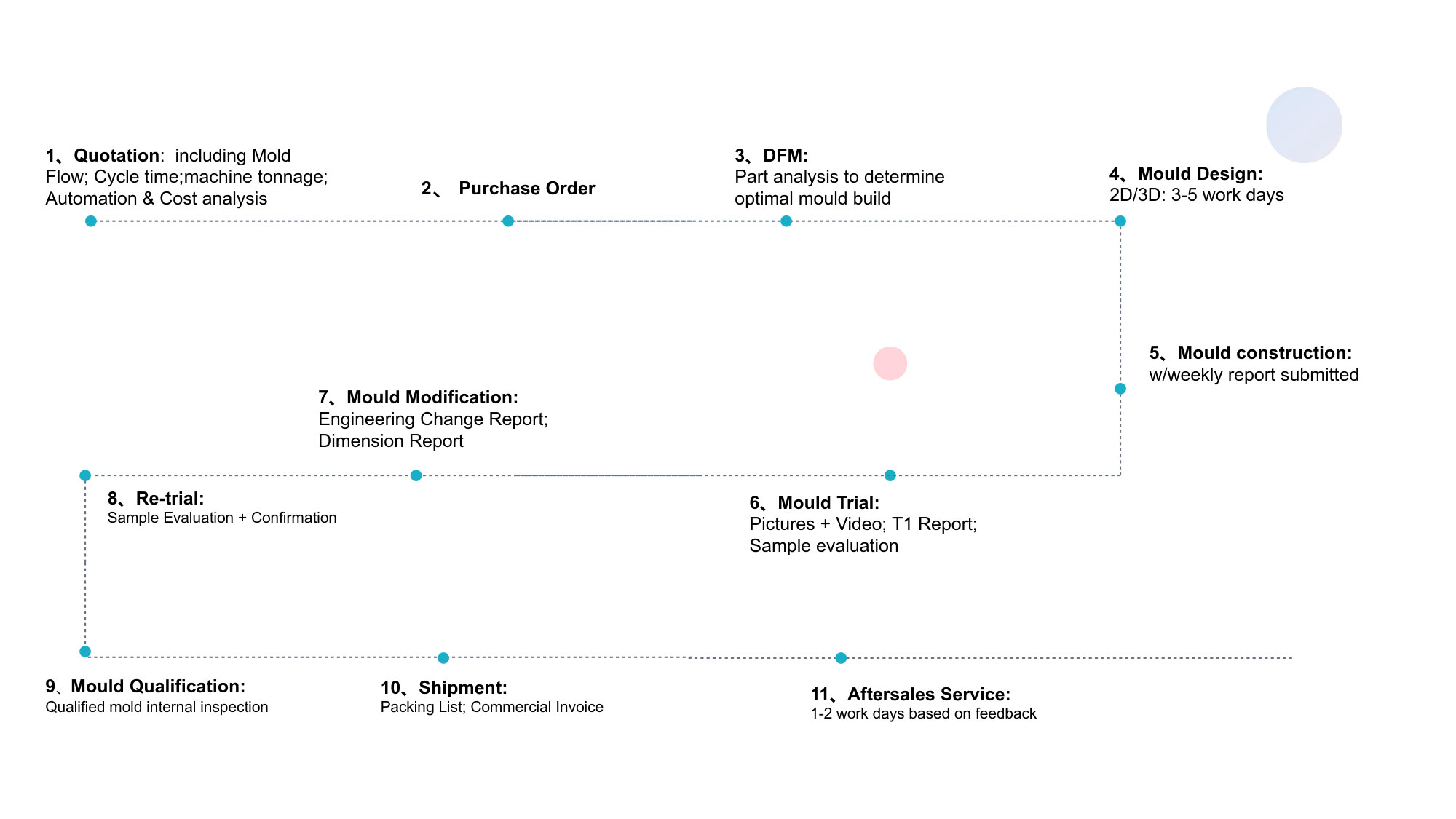
"Material selection guidance has been inconsistent across vendors." Ansix Tech provides material recommendations based on full property analysis including shrinkage rate, melt flow index, heat deflection temperature, sterilization compatibility (autoclave, gamma, EtO), biocompatibility certification, and regulatory compliance data
Quality Validation Framework — IQ/OQ/PQ Documentation
Ansix Tech’s quality validation system follows the FDA-mandated three-stage validation structure:
Installation Qualification (IQ)
Machine and auxiliary equipment installation verification
Calibration records for all measurement devices
Utility verification (power, water, compressed air)
Software version and configuration documentation
Operational Qualification (OQ)
Process parameter window definition
Design of Experiments (DOE) to establish operating limits
Verification of alarms and safety interlocks
Operator training documentation
Performance Qualification (PQ)
Production-scale trial with batch size agreed with customer
CPK calculation for all CTQ dimensions (Cpk ≥1.33 minimum, Cpk ≥1.67 preferred for critical dimensions)
First Article Inspection Report (FAIR)
Production Part Approval Process (PPAP) documentation when required
Customer Value Translation: FDA and ISO 13485 audits demand documented evidence that manufacturing processes are validated. Ansix Tech delivers complete IQ/OQ/PQ documentation packages that stand up to regulatory scrutiny. Medical device manufacturers integrating Ansix Tech-molded components into their devices receive fully compliant validation data that supports their own Device Master File (DMF) submissions.
Cost Reduction Strategy — Lowering Total Product Cost Through Engineering
Ansix Tech’s cost reduction approach addresses the three primary drivers of per-part cost: material expense, cycle time, and scrap rate.
Material Cost Optimization
Strategy Implementation Cost Impact
Multi-cavity tooling 4/8/16/32 cavity configurations reduce per-part material distribution overhead 15-30% reduction in unit cost
Hot runner deployment Eliminates runner waste, reduces regrind handling 10-25% material savings
Wall thickness reduction Structural analysis removes excess material without compromising strength 15-20% weight reduction
Alternative material recommendation Down-selection from high-cost specialty resin to equivalent medical-grade standard 20-40% material cost savings
Cycle Time Reduction
Strategy Cycle Time Impact
Conformal cooling channels 25-40% reduction compared to conventional cooling
High-flow material selection 15-25% reduction through faster cavity filling
Automated part removal (pick-and-place robots) 10-15% reduction through elimination of manual operations
Optimized cooling circuit layout 20-35% reduction through uniform temperature management
Customer Value Translation: On a typical portable medical instrument enclosure with a 30-second cycle time, implementing conformal cooling reduces cooling from 18 seconds to 12 seconds, dropping overall cycle time to 24 seconds. Annual production capacity increases by 20% without adding capital equipment. Per-part manufacturing cost decreases proportionally.
Energy Consumption Reduction
All-electric servo-driven injection molding machines consume 30-50% less energy than equivalent hydraulic machines. Reduced cooling water requirements and lower auxiliary equipment power draw further reduce operating costs. In cleanroom environments where every square foot carries premium cost, Ansix Tech’s compact cell designs reduce required floor space by up to 40%.
Capacity Scaling and Delivery Assurance
Capability Metric Ansix Tech Performance
Total injection molding machines 260 units
Clamping force range 30 tons to 2,800 tons
Annual mold output 30,000+ sets since establishment
Average mold trials to qualification 2 trials
Tooling modification response 24 hours for standard repairs
DFM analysis 72 hours from CAD receipt
Simple mold delivery 10 days
Medium complexity mold 25-45 days
Rapid prototype sample 7-15 days
Customer Value Translation: When a portable medical instrument OEM experiences unexpected demand growth, Ansix Tech scales production by allocating additional machine capacity from its fleet of 260 presses. When tooling modification is required during production, in-house repair capabilities restore production within 24 hours—not weeks. The integrated ecosystem from mold design through production eliminates the communication gaps and handoff delays that fragment service providers impose.
Packaging and Logistics
All finished parts are packaged according to customer specifications, with options including:
Anti-static bags for electronics-sensitive components
Cleanroom-packaged enclosures meeting ISO Class 8 or ISO Class 7 standards
Tray packing with individual cavity traceability
Bulk packaging with dust protection
Certification and Compliance
Certification Scope
ISO 13485:2016 Quality management for medical devices
ISO 9001 General quality management
IATF 16949 Automotive-grade quality (applicable to medical with equivalent rigor)
ISO 14001 Environmental management
Customer Value Translation: Ansix Tech has already passed the audits and maintains the quality systems that medical device manufacturers require. No need for customers to conduct their own quality system audit of the supplier.
Summary: What Portable Medical Device OEMs Gain from Ansix Tech
When a portable medical instrument OEM chooses Ansix Tech as their injection molding partner, they receive:
A single integrated source from design through production to final packaging—no fragmented supply chain, no communication gaps.
Predictable quality backed by documented CPK data, full dimensional reporting, and complete validation documentation packages for regulatory compliance.
Measurably lower costs achieved through material optimization, cycle time reduction, multi-cavity tooling, and vertical integration.
Guaranteed mold performance with 1,000,000-cycle capability for standard engineering plastics, backed by pre-delivery wear testing and three-year structural warranty.
Fast response—DFM analysis in 72 hours, standard repairs in 24 hours, simple mold delivery in 10 days.
The portable medical instrument enclosure is not merely a protective housing—it is the interface between sophisticated electronics and the medical professional who depends on that instrument for accurate diagnosis and effective treatment. Every dimension, every surface finish, every snap-fit contributes to device reliability and user confidence.
Ansix Tech is prepared to conduct a full DFM review of your existing enclosure design, demonstrating—with your actual CAD model—how weld lines can be relocated, cooling optimized, and cost engineered. Contact Ansix Tech to schedule this analysis and receive a detailed quotation for your portable medical instrument enclosure program.
Ansix Tech Co Ltd
If you have any plans related to Portable Medical Instrument Enclosure , you can contact us at any time. We will turn your ideas into reality, let you realize your dreams, and obtain large orders from the market. Our contact information is info@ansixtech.com. Or contact our CTO, mail: stephen@ansixtech.com
#www.ansixtech.com #ansixtech.com #Portable Medical Instrument Enclosure #Portable Medical Instrument Enclosure moulds #Portable Medical Instrument Enclosure molds #Portable Medical Instrument Enclosure injection molding companies #Portable Medical Instrument Enclosure Canopy Mold injection mold companies #Ansix #Ansix moulds #Ansix china #Ansix tech china #Ansix tech company #Ansix facotry #Portable Medical Instrument Enclosure injection molding #Portable Medical Instrument Enclosure injection tools #Portable Medical Instrument Enclosure injection moulds #Portable Medical Instrument Enclosure plastic mould #Portable Medical Instrument Enclosure plastic tools #Ansix Tech #Ansix molds #Ansix injection molding #Ansix mold factory #injection molding Portable Medical Instrument Enclosure #Ansix mold factory #Portable Medical Instrument Enclosure china #Portable Medical Instrument Enclosure molds #injection factory #Portable Medical Instrument Enclosure injection molding #Portable Medical Instrument Enclosure injection molding factory #injection molding company #Portable Medical Instrument Enclosure injection mold companies #Portable Medical Instrument Enclosure#Portable Medical Instrument Enclosure mold limited #Ansix mold china #Ansix companies #Ansix company China #Portable Medical Instrument Enclosure facotry #Ansix Tech #Ansix Tech mould #Portable Medical Instrument Enclosure injection moulding #injection moulding company #Ansix Portable Medical Instrument Enclosure parts injection mold companies #medical injection molding companieschina #Portable Medical Instrument Enclosure china factory #Ansix moulding companies #Ansix molding company #Portable Medical Instrument Enclosure injection moulding facotry #Ansix Tech mold #Portable Medical Instrument Enclosure mould #Portable Medical Instrument Enclosure plastic injection molding #ansix plastic mold #Mold manufacturing #Portable Medical Instrument Enclosure parts manufacturing #Portable Medical Instrument Enclosure plastic parts factory #Portable Medical Instrument Enclosure injection parts mold #Portable Medical Instrument Enclosure PRECISION MANUFACTURING #Portable Medical Instrument Enclosure #China mold #Portable Medical Instrument Enclosure injection moulding china #Portable Medical Instrument Enclosure mould china #china precision mold #mold in china #Portable Medical Instrument Enclosure mold china #Precision molds #High-precision molds #Portable Medical Instrument Enclosure #Injection molds #Portable Medical Instrument Enclosure Factory #Portable Medical Instrument Enclosure Company #Super Large Injection Mold Factory #Large Tonnage Injection Molding Factory #Portable Medical Instrument Enclosure Company #Portable Medical Instrument Enclosure Factory #2800T Injection Molding Factory #3000 Ton Injection Molding #4500 Ton Injection Molding Factory #Large Mold Injection Molding #Large Plastic Mold Injection Molding Factory #Large Injection Mold Manufacturer #Plastic Mold Factory #Injection Mold #Plastic Mold