



Luer Lock Connector
FEATURES
Hard Infrastructure Capabilities — Building Customer Confidence Through Equipment Excellence
Precision Mold Manufacturing Equipment
Ansix Tech’s mold shop is equipped with state-of-the-art five-axis high-speed machining centers capable of achieving 0.002mm positioning accuracy for complex contour surfaces. For Luer Lock connectors—where split-line quality directly impacts leak performance and patient safety—this capability ensures parting lines are flawlessly smooth, eliminating the need for post-molding de-burring operations.
Slow wire-cut EDM machines with micron-level precision enable the machining of 0.03mm micro-holes and narrow slots commonly found in multi-lumen and anti-backflow Luer Lock configurations. This technology prevents thin-wall deformation—a critical concern when connector walls approach minimum thickness specifications under ISO 80369-7 dimensional requirements.
-
Mold Description
Product Materials:
PC
Mold Material:
S136ESR
Number of Cavities:
64
Glue Feeding Method:
Hot runner
Cooling Method:
Water cooling
Molding Cycle
25s
- The mold manufacturing process and product material selection
Customer Value Delivered: Flawless parting lines eliminate secondary finishing. Precise micro-hole machining preserves structural integrity of ultra-thin wall sections. Customers receive parts ready for assembly without costly rework.
Injection Molding Machine Fleet
Ansix Tech’s all-servo-electric injection molding machines range from 30 tons to 400 tons, covering the full spectrum of Luer Lock connector sizes—from micro-volume single-use connectors to high-flow multi-port manifolds. The all-servo drive ensures repeatable precision of ±0.1% shot-to-shot consistency, delivering identical connector geometry across millions of cycles.
Servo-electric drives also optimize energy consumption, reducing per-part energy costs by 15–25% compared to hydraulic machines—a direct saving passed to customers.
Customer Value Delivered: ±0.1% shot-to-shot reliability eliminates batch-to-batch variation. Lower energy consumption translates directly to lower part pricing.
Inspection and Metrology Equipment
Every mold leaving Ansix Tech undergoes full dimensional inspection using CMM (Coordinate Measuring Machine) and optical imaging systems. Complete full-dimensional reports are provided with each mold shipment before customer acceptance. Critical-to-quality (CTQ) dimensions are statistically validated with CPK ≥ 1.33, meaning less than 63 parts per million are expected to fall outside specification.
-
Customer Value Delivered: Medical device OEMs receive validated manufacturing assets ready for regulatory submission. CPK ≥ 1.33 means predictable, stable production—reducing audit burdens and compliance risks.
Part Two: Mold Manufacturing Excellence — Customer-Centric Metrics for Performance and Longevity
Quantifiable Mold Life Commitments
Ansix Tech structures mold material selection based on specific production volume and material requirements. For Luer Lock connectors produced with glass-fiber-reinforced medical resins such as PPS+40%GF or PA6+GF30, the mold is guaranteed for 500,000 cycles. For standard unfilled medical grades (PC, PC/ABS, MABS, PE), mold life extends to 1,000,000 cycles.
Core Mold Steel Options:
S136 / 4Cr13 / 9Cr18 — Stainless tool steels offering excellent corrosion resistance and polishability to Ra < 0.05μm, ideal for transparent medical connectors requiring visual inspection capabilities.
2344 / 8407 / H13 — Hot-work tool steels for high-temperature engineering resins (PEEK, PEI) with HRC 48–52 hardness.
NAK80 — Pre-hardened steel (HRC 37–43) for shorter-run production, excellent polishability and dimensional stability.
DC53 / SKD11 — High-wear-resistance steels for glass-fiber-filled materials.
Customer Value Delivered: Guaranteed mold life eliminates unplanned downtime and tooling replacement costs. Transparent material selection justifies root-cause analysis capabilities during regulatory audits.
Dimensional Tolerance Commitment
Standard structural features: ±0.05mm — meets most medical assembly requirements
Precision medical Luer Lock critical dimensions: ±0.005mm — ensures ISO 80369-7 taper angle and thread fit requirements are met consistently
Full mold steel material certifications and heat treatment curve documentation are provided with every mold delivery, supporting customers’ ISO 13485 quality management system documentation needs.
Customer Value Delivered: ±0.005mm precision on CTQ dimensions ensures ISO 80369-7 taper fit compliance, eliminating leak failures during customer device assembly.
Comprehensive Mold Types
Ansix Tech delivers:
Hot runner systems — Reduce material waste by eliminating cold runner scrap, achieving 15–30% material savings per part, with gate vestige marks minimized or eliminated for aesthetic-critical applications.
Multi-cavity configurations — 8, 16, 24, or 32 cavities per mold, dramatically reducing per-part cycle times and cost.
Two-shot / over-molding capabilities — For soft-touch grip features or multi-material fluid path constructions requiring different durometer materials in a single part.
High-gloss finishes — Ra ≤ 0.05μm for transparent Luer Lock components requiring bubble-free clarity meeting USP Class VI and ISO 10993 biocompatibility requirements for fluid contact.
Customer Value Delivered: Hot runner systems reduce material costs by 15–30%. Multi-cavity molds reduce per-part machining cost allocation. Over-molded features eliminate secondary assembly operations and their associated labor costs and failure points.
Gate System Optimization
Through comprehensive mold flow analysis performed prior to mold design commencement, Ansix Tech identifies and eliminates potential melt line locations, gas trap concentrations, and fill imbalance conditions. Gate quantity and placement are optimized before any steel is cut, ensuring balanced cavity filling across all impressions.
Standard Mold Delivery Lead Times
Simple molds (≤8 cavities, basic geometry): 10 working days
Medium-complexity molds (16 cavities, hot runner, precision taper features): 25–45 working days
Rush delivery (maximum 20 days, with validation steps fully compressed but not omitted)
Customer Value Delivered: Predictable lead times enable accurate project scheduling. Expedited options support urgent market launch demands without sacrificing quality verification.
Part Three: Injection Molding Process Control — Eliminating Customer Quality Anxiety
What Customers Fear
Concern Customer Impact
Sink marks Aesthetic rejection, functional fluid path obstruction
Flash Manual post-processing costs, assembly interference
Dimensional instability Scrap, assembly failures
Batch-to-batch color variation Regulatory deviation notice, product recall risk
Ansix Tech’s Solutions
Process Standardization via MES: All injection molding machines are networked to a centralized MES (Manufacturing Execution System). All processing parameters—temperature zones, injection pressure, holding pressure profiles, screw speed, cooling time, and cycle timing—are locked within the system. Parameter adjustments require engineer-level authorization with full audit trail logging. First-article and last-article inspections are performed for every production batch, with dimensional comparisons documented.
Customer Value Delivered: Complete process traceability for ISO 13485 audits. Parameter lock eliminates operator-induced variation. First/last inspection ensures shipment quality before product leaves the facility.
Dimensional Stability Control: Ansix Tech equips molds with conformal cooling channels designed via thermal FEA analysis, with mold temperature controllers (thermolators) providing zoned temperature regulation. Core and cavity temperature differentials are maintained below 2°C, minimizing warpage and distortion in thin-wall Luer Lock components.
Production validation shows that over three consecutive weeks of continuous manufacturing on connector bodies, critical hole-to-hole center distance specifications exhibit variation ≤ 0.02mm, with CPK ≥ 1.33 on all CTQ dimensions.
Customer Value Delivered: ≤ 2°C core-cavity temperature differential eliminates warpage—no twisted connectors, no assembly alignment issues. ±0.02mm stability ensures reliable device assembly every shift, every day.
Surface Finish Standards:
Transparent components: Bubble-free, flow-free clarity achieved via optimized injection profiles and mold surface finishes
Plated surface-ready components: Gas-trap-free injection strategies
High-gloss components: Surface roughness Ra ≤ 0.2μm achievable without secondary polishing
For components requiring printing or coating, Ansix Tech’s molds are designed with warp compensation allowances pre-calculated, enabling printed feature registration accuracy of ±0.1mm.
Customer Value Delivered: Ra ≤ 0.2μm eliminates secondary polishing operations. ±0.1mm print registration reduces decoration reject rates by up to 50%.
Special Material Processing Capabilities
Ansix Tech maintains extensive practical experience processing the full range of medical-grade thermoplastics:
PC (Polycarbonate) — Excellent clarity and impact strength for transparent Luer Lock bodies. USP Class VI and ISO 10993 biocompatible. Requires thorough drying (120°C/4h) and controlled melt temperature (280–320°C).
PC/ABS blends (e.g., SABIC CYCOLOY HC1204HF, HCX1640) — Balanced flow and impact strength with biocompatibility certifications (ISO 10993 / USP Class VI). Superior dimensional stability. Preferred for high-flow thin-wall Luer Lock applications.
PPS (Polyphenylene Sulfide) +40%GF — For applications requiring superior chemical resistance and dimensional stability under autoclave sterilization cycles.
PEEK (Polyetheretherketone) — For reusable medical devices requiring 260°C thermal stability, chemical resistance, and biocompatibility (ISO 10993-5).
PPSU (Polyphenylsulfone) — For steam-sterilizable Luer Lock components requiring repeated autoclave cycles without significant property degradation.
PEI (Polyetherimide) / LCP (Liquid Crystal Polymer) — High-temperature dimensional stability requiring specialized processing conditions.
PA6 + GF30 (Nylon 6 with 30% glass fiber) — For high-strength Luer Lock connectors in reusable contexts.
LSR (Liquid Silicone Rubber) — For gaskets, seals, and flexible connector features requiring soft-touch sealing surfaces.
PTFE/PFA — For chemically inert fluid path applications requiring non-stick, low-friction surfaces.
Regulatory Compliance: Parts meet UL94 V-0 flame rating for electrical medical device applications and pass UV exposure testing (3000 hours without color change or surface degradation).
Customer Value Delivered: Single-source supply for all medical-grade material needs eliminates multiple supplier qualification costs and risks. ISO 10993 and USP Class VI compliance documentation supports regulatory submissions globally. 3000-hour UV stability ensures product integrity in field use throughout product lifecycle.
Part Four: End-to-End Service — Reducing Customer Management Costs Through Full Integration
Early DFM Engagement (Design for Manufacturing)
Before mold construction begins, Ansix Tech provides a comprehensive Mold Flow Analysis and DFM (Design for Manufacturing) report. This document includes:
Draft angle recommendations optimized for ejection reliability
Wall thickness optimization ensuring fill without sink
Gate location selection for balanced fill and reduced residual stress
Ejector pin location mapping with visibility of allowable witness mark locations
Predicted melt line and gas trap locations with mitigation strategies
Customer Value Delivered: DFM reports identify manufacturing problems before steel is cut, eliminating late-stage design changes that cost 10× more to fix when discovered after molding begins. Sink, gas trap, and flow mark risks are eliminated before tooling begins.
Trial Molding and Iterative Validation
Ansix Tech provides T0 through T3 trial samples, with each iteration accompanied by a detailed improvement report. Strategically placed interchangeable mold inserts enable rapid design iteration without requiring complete mold reconstruction—permitting verification of multiple gate/runner configurations at minimal additional cost.
Customer Value Delivered: Rapid design iteration without expensive mold rework. Multiple gating options tested simultaneously. Faster validation cycle reduces time-to-market.
Pre-Production Pilot Validation
Prior to full production release, Ansix Tech executes 100- to 500-shot pilot production runs, documenting:
Process stability statistics through production runs
Capability indices (CP/CPK) for all CTQ dimensions
Visual acceptance criteria sign-off
Cycle time validation
High-volume production proceeds only when pilot validation demonstrates stable, capable processes capable of meeting all customer specifications.
Customer Value Delivered: Pilot validation eliminates launch risks. CPK ≥ 1.33 confirmation before volume production—no surprises at scale.
Mold Maintenance and Spare Parts Program
Full set of common wear parts (ejector pins, core inserts, slide components) delivered with each mold—enabling users to perform on-site maintenance without ordering delays
Preventive maintenance service performed at 200,000-cycle intervals
Lifetime maintenance at cost-plus pricing, with returns limited to replacement material costs
Customer Value Delivered: Spare part kits eliminate mold downtime from common wear issues. Preventive maintenance extensions mold life beyond guarantee period. Lifetime cost-plus maintenance protects customers from post-warranty pricing.
Part Five: Differentiated Value Commitments — Direct Responses to Common Industry Complaints
Common Industry Pain Point Ansix Tech’s Committed Response
“Molds need constant repairs, disrupting my production schedule.” Every mold undergoes a 2,000-cycle accelerated wear trial before shipment, accompanied by documented wear reports. Three-year structural warranty on mold base and core/cavity components (excluding normal wear parts such as ejector pins, slides, and adjustable inserts).
“Flash requires costly manual de-burring after molding.” Ansix Tech finishes mold parting surfaces to 0.005mm fit precision, combined with active locking force compensation systems. Flash is consistently held below 0.03mm at the parting line, eliminating all manual de-burring operations between cavities.
“Batch-to-batch dimensions are inconsistent.” Machines incorporate ultrasonic wall thickness sensors providing real-time feedback, automatically compensating holding pressure profiles based on actual molded wall thickness measurements. On critical applications, in-cavity pressure and temperature sensors provide closed-loop process control.
“Mold repair means weeks of downtime.” Ansix Tech maintains in-house electrode manufacturing and EDM facilities—complete mold repair capabilities without outsourcing. Routine weld repairs and insert replacements are completed within 24 hours.
Comprehensive Manufacturing Flow for Luer Lock Connectors at Ansix Tech
Phase 1: Raw Material Selection and Characterization
Ansix Tech begins each project with rigorous raw material selection based on:
Biocompatibility requirements (ISO 10993 series and USP Class VI compliance)
Material composition specifications and batch traceability requirements
Mechanical property validation against device functional requirements
Sterilization compatibility (EtO, gamma irradiation, autoclave considerations)
Processing stability across multiple production lots
Customer Value Delivered: Material recommendations backed by regulatory compliance data. No “surprise” failures during your sterilization validation tests. We certify materials before you commit to tooling.
Phase 2: Mold Flow Analysis and DFM
Comprehensive mold flow analysis identifies:
Predicted melt front advancement timing and fill imbalance across multi-cavity arrangements
Gas trap locations requiring venting strategies
Melt line locations and severity ratings
Pressure distribution mapping across fill, pack, and hold phases
Warpage and shrinkage predictions enabling mold offset compensation
The DFM report captures all analysis findings before any steel is processed, establishing the foundation for mold design approval gate.
Customer Value Delivered: Mold flow analysis eliminates guesswork. We show you exactly where flow issues will occur and how we’ve already eliminated them—before tooling starts.
Phase 3: Mold Design Focus Areas
Ansix Tech’s mold design addresses critical functional features specific to Luer Lock connectors:
Taper accuracy: ISO 80369-7 taper surfaces manufactured from hardened insert materials to withstand millions of cycles without wear-induced taper deviation.
Locking thread precision: Thread profiles machined via precision EDM to ensure consistent locking torque across full mold life.
Gate location: Strategically placed at non-critical visual zones while maintaining balanced fill.
Ejection system design: Multi-point ejection with balanced force distribution prevents distortion during ejection.
Cooling system integration: Conformal cooling channels precisely positioned to maintain uniform temperature distribution across all cavities, minimizing cycle time while eliminating hot spots that cause warpage.
Customer Value Delivered: Hardened inserts for ISO 80369-7 taper surfaces ensure your molds pass regulatory inspection. Balanced multi-point ejection eliminates connector distortion—every part ejects straight, every cycle.
Phase 4: Mold Manufacturing Processes and Challenges
Key Challenges Addressed:
Taper surface machining: Maintaining 2.5mm to 10mm taper depth with 6% slope (±3.44°) across millions of cycles. Ansix Tech achieves taper geometry via precision ground hardened insert steels—never “as-machined” unhardened surfaces.
Thread form precision: Locking threads requiring ±0.02mm pitch accuracy and 0.05mm root radius consistency for 1.5–3 thread engagement depth.
Multi-cavity flow balance: Maintaining fill time differences across 16 or 32 cavities below 5%, ensuring uniform part quality across all impressions.
Manufacturing Workflow:
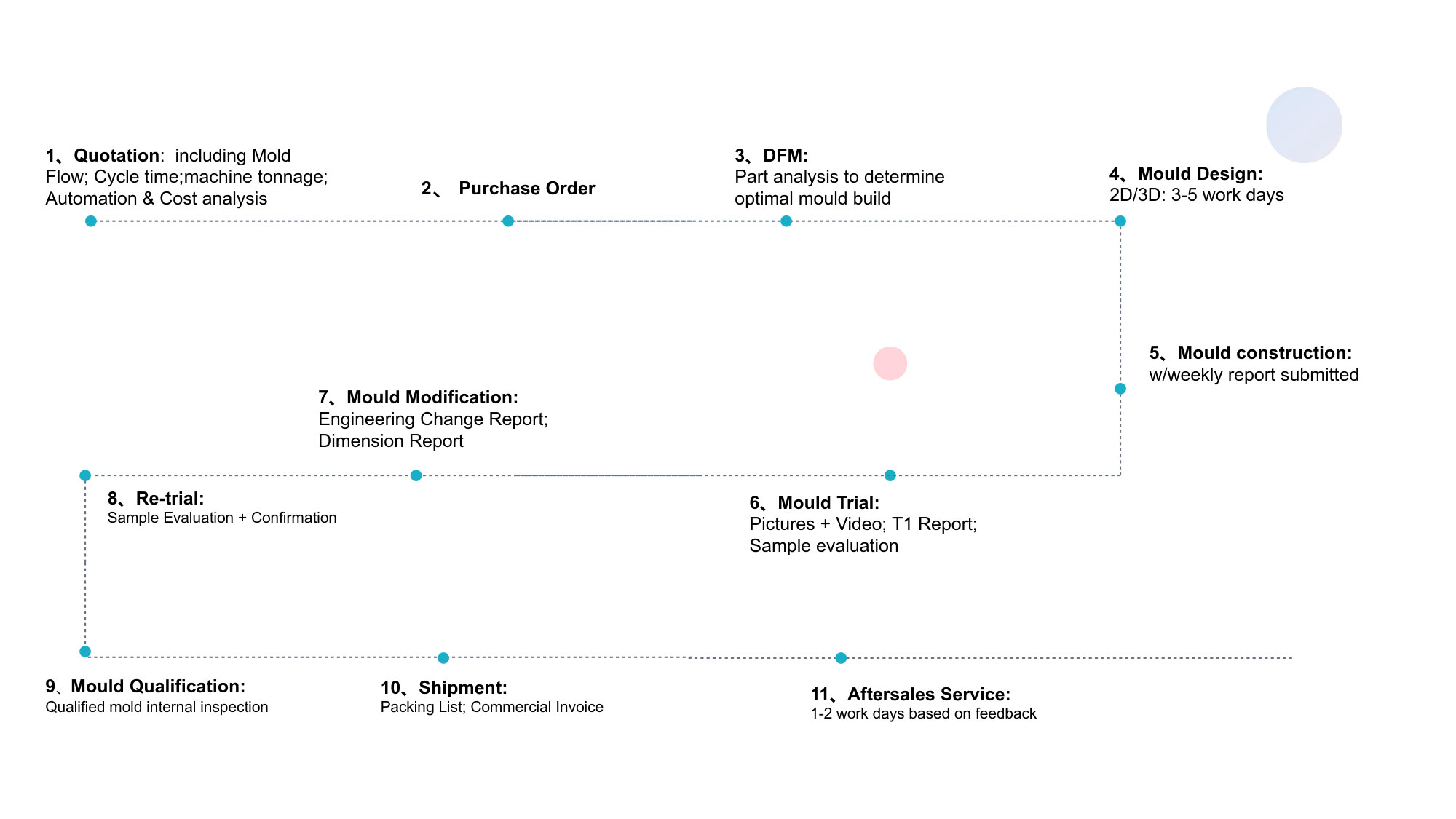
CNC roughing → heat treatment → CNC finishing → EDM multi-axis precision machining → wire EDM for fine features → surface finishing (polishing/texturing) → fitting and assembly → mold trial → dimensional validation
Customer Value Delivered: Every difficulty anticipated and engineered out before production. Thread pitch accuracy ±0.02mm ensures consistent locking torque across every connector over millions of cycles—no “tight” or “loose” complaints from your assembly line.
Phase 5: Injection Molding Process Optimization
Efficiency and Cost Control Approaches:
Reduced cooling time via conformal cooling channel geometry, cutting per-part cycle time by 15–35%
Hot runner gate optimization eliminating cold runner scrap—ensures 100% of consumed resin becomes saleable part material
Real-time cavity pressure monitoring adjusting packing profiles dynamically, maintaining consistent dimensions across day/night production shifts
Customer Value Delivered: Shorter cycle times = higher daily output = lower per-part cost. Hot runner systems pay for themselves within production life. Real-time adaptive process control eliminates rejects regardless of ambient plant conditions.
Phase 6: Quality Control and Assurance Program
Incoming inspection: Raw material certification verification, resin batch validation against COA (Certificate of Analysis)
In-process inspection: First-article verification, hourly dimensional sampling, visual inspection per AQL (Acceptable Quality Limit) plans
Final outgoing inspection: 100% critical dimension check on CTQ stations, visual inspection for surface defects, packaging integrity confirmation
Statistical process control: CPK tracking for all CTQ dimensions, trend monitoring enabling preventive intervention before out-of-spec conditions develop
Phase 7: Packaging and Rapid Delivery
Custom packaging configurations matching customers’ assembly line input specifications (bags, trays, bulk containers, sterile pouches)
IPC (Inter-Process Control) lot traceability from raw material to finished part
Cleanroom packaging options for medical device customers requiring reduced bioburden prior to sterilization
Delivery lead times reduced via in-region warehousing and demand-pull inventory programs
Customer Value Delivered: Parts arrive in your assembly-ready packaging—no repackaging labor, no packaging material waste. Full material traceability supports your ISO 13485 audit requirements.
Case Study Summary: Material and Cost Savings Through Partnering with Ansix Tech
Raw Material Cost Reduction Strategy
Hot runner conversion eliminated runner scrap entirely for high-volume medical-grade resin applications—saving 8–12% of total material consumed on cold runner molds
High-cavitation mold configurations (16–32 cavities) reduced per-part material allocation across progressive tooling investments
Multi-cavity flow balance improvements minimized reject rates from 3-5% to 0.5-1% for thin-wall Luer Lock configurations
Process Efficiency Improvements
Conformal cooling reduced mold cycle times by 20%, increasing theoretical daily capacity by 20% without additional capital expenditure
Automated part handling and degating eliminated secondary labor costs for runner separation
MES parameter locking eliminated operator error, reducing first-article failure rates by 60%
Quality Cost Reductions
Flash control below 0.03mm eliminated manual trimming operations—saving $0.02–0.04 per part in direct labor
CPK ≥ 1.33 on all CTQ dimensions reduced customer incoming inspection sampling requirements, cutting receiving inspection costs by 25–40%
Conclusion: Ansix Tech — Your Strategic Partner for Luer Lock Connector Success
For Ansix Tech, a mold is not simply a block of steel. It is your revenue-generating asset—your “money-printing machine.” Every Ansix Tech mold is designed with planned processing robustness, engineered venting pathways, and optimized thermal balance to ensure your production line receives “plug-and-play” tooling with minimal flash, long service life, and consistent output.
We invite customers to experience Ansix Tech’s DFM approach firsthand—choose any existing plastic component from your portfolio, and we will conduct a comprehensive design for manufacturing analysis showing precisely how we would eliminate melt line formation, gas trap accumulation, sink mark generation, and dimensional instability risks before any mold steel is processed.
Summary: What Ansix Tech Delivers
Customer Concern Ansix Tech Solution
Save material costs Hot runner systems eliminating runner scrap, material savings 15–30% vs cold runner alternatives
Reduce cycle times Conformal cooling reducing cooling time by 20%, increasing daily capacity without additional machines
Lower quality costs Flash below 0.03mm eliminates manual de-burring, CPK ≥ 1.33 reduces inspection burden
Reduce supply chain risk Single-source responsibility for mold, molding, assembly, and packaging
Speed time-to-market DFM reports identifying risks pre-tooling, eliminating validation surprises
Eliminate mold downtime Spare part kits shipped with every mold, preventive maintenance schedule, 24-hour repair SLA
Lower total ownership cost 1,000,000 cycle mold life for unfilled resins, lifetime cost-plus maintenance pricing
Ansix Tech brings over 28 years of specialized mold manufacturing and injection molding experience to every Luer Lock connector project, delivering reliability, value, and absolute quality assurance—from prototype validation through full-scale production and assembly.
For a detailed DFM review on any medical plastic component, contact Ansix Tech to see how we transform manufacturing challenges into competitive advantages.
Ansix Tech Co Ltd
If you have any plans related to Luer Lock Connector , you can contact us at any time. We will turn your ideas into reality, let you realize your dreams, and obtain large orders from the market. Our contact information is info@ansixtech.com. Or contact our CTO, mail: stephen@ansixtech.com
#www.ansixtech.com #ansixtech.com #Luer Lock Connector #Luer Lock Connector moulds #Luer Lock Connector injection molding companies #Luer Lock Connector Canopy Mold injection mold companies #Ansix #Ansix moulds #Ansix china #Ansix tech china #Ansix tech company #Ansix facotry #Luer Lock Connector injection molding #Luer Lock Connector injection tools #Luer Lock Connector injection moulds #Luer Lock Connector plastic mould #Luer Lock Connector plastic tools #Ansix Tech #Ansix molds #Ansix injection molding #Ansix mold factory #injection molding Luer Lock Connector #Ansix mold factory #Luer Lock Connector china #Luer Lock Connector molds #injection factory #Luer Lock Connector injection molding #Luer Lock Connector injection molding factory #injection molding company #Luer Lock Connector injection mold companies #Luer Lock Connector#Luer Lock Connector mold limited #Ansix mold china #Ansix companies #Ansix company China #Luer Lock Connector facotry #Ansix Tech #Ansix Tech mould #Luer Lock Connector injection moulding #injection moulding company #Ansix Luer Lock Connector parts injection mold companies #medical injection molding companieschina #Luer Lock Connector china factory #Ansix moulding companies #Ansix molding company #Luer Lock Connector injection moulding facotry #Ansix Tech mold #Luer Lock Connector mould #Luer Lock Connector plastic injection molding #ansix plastic mold #Mold manufacturing #Luer Lock Connector parts manufacturing #Luer Lock Connector plastic parts factory #Luer Lock Connector injection parts mold #Luer Lock Connector PRECISION MANUFACTURING #Luer Lock Connector #China mold #Luer Lock Connector injection moulding china #Luer Lock Connector mould china #china precision mold #mold in china #Luer Lock Connector mold china #Precision molds #High-precision molds #Luer Lock Connector #Injection molds #Luer Lock Connector Factory #Luer Lock Connector Company #Super Large Injection Mold Factory #Large Tonnage Injection Molding Factory #Luer Lock Connector Company #Luer Lock Connector Factory #2800T Injection Molding Factory #3000 Ton Injection Molding #4500 Ton Injection Molding Factory #Large Mold Injection Molding #Large Plastic Mold Injection Molding Factory #Large Injection Mold Manufacturer #Plastic Mold Factory #Injection Mold #Plastic Mold