



PP foam float with embedded magnetic core
FEATURES
PP Foam Float with Embedded Magnetic Core: Product Introduction
PP foam float with embedded magnetic core is a specialized engineered component consisting of two primary elements:
(1) PP Foam Body: A lightweight polypropylene foam structure providing buoyancy and chemical resistance, suitable for applications in liquid level sensing, fluid management systems, water treatment equipment, and industrial sensor assemblies.
(2) Embedded Magnetic Core: A permanent magnetic component (typically ferrite or NdFeB-based) encapsulated within the PP foam matrix, enabling actuation of reed switches or Hall effect sensors for contactless position detection. The magnetic core may be produced using injection-molded bonded magnet compounds—thermoplastic resins blended with magnetic powders such as ferrite, NdFeB, or SmCo—which offer precise dimensions, consistent magnetic properties, low manufacturing costs, and excellent surface quality.
-
Mold Description
Product Materials:
PP FOAM
Mold Material:
S136ESR
Number of Cavities:
6
Glue Feeding Method:
Hot runner
Cooling Method:
Water cooling
Molding Cycle
22.5s
- The mold manufacturing process and product material selection
Customer Value Translation: The PP foam float with embedded magnetic core replaces traditional mechanical linkages with contactless magnetic actuation—eliminating wear, reducing maintenance costs by 40%, and extending service life by 3x compared to mechanical float alternatives.
3. Technical Parameters: Density of PP Foam Float and MuCell Microcellular Foaming
3.1 PP Foam Density Ranges
PP foam floats can achieve various density ranges depending on the foaming method and processing parameters:
Foaming Method Specific Density (g/cm³) Relative Density Porosity Cell Size (μm)
Chemical Blowing Agent (CBA) 0.44 – 1.056 0.40 – 0.96 4% – 60% 40–350
Physical Blowing Agent (PBA/CO₂) 0.275 – 0.66 0.25 – 0.60 40% – 75% 40–350
MuCell (SCF N₂) with 30% weight reduction N/A 0.70 ~30% 10–100
MuCell (SCF N₂) with 40% weight reduction N/A 0.60 ~40% 10–100
Industry Benchmark for PP Foam Density: Relative densities between 0.25 and 0.6 are achievable. Cell sizes typically range from 40 to 350 μm, with open cell content from 0% to 65% depending on the chosen foaming route. For advanced applications, injection-molded PP/GF30 foam with super high expansion ratio can achieve density of 0.32 g/cm³ and porosity of 75%.
-
MuCell Microcellular Foaming: Density and Performance
The MuCell® (microcellular injection molding) process uses supercritical fluid (SCF), typically N₂ or CO₂, as a foaming agent to create uniformly distributed micro-scale bubbles (typically 10–100 μm in diameter) within the polymer matrix.
Key MuCell density/weight reduction targets for PP materials:
Target Weight Reduction Resulting Relative Density Approximate Application
15–22% 0.78 – 0.85 General industrial floats
30% ~0.70 Standard PP foam floats
40% ~0.60 Lightweight sensor floats
Research indicates that setting density reduction to 22% allows for simultaneously decreasing weight while sustaining specific flexural properties and limiting the loss of specific impact strength. Under optimized process parameters, gas permeability flow rate in filter-like foaming PP material can reach 300–450 mL/min, and with gas counter pressure enhancement, up to ~500 mL/min.
MuCell Benefits for PP Foam Float Applications:
Weight reduction of 20–40% without compromising structural integrity
Cycle time reduction of 15–30% due to lower melt viscosity and faster cooling
Dimensional stability through controlled cell nucleation and growth
Reduced warpage and sink marks due to uniform pressure distribution
Lower clamping force requirements enabling larger cavitation or smaller machines
Customer Value Translation: *MuCell technology reduces PP foam float weight by up to 40%, cuts per-part material cost by 15–30%, and shortens cycle times by 20%—directly translating into lower part cost, reduced shipping weight, and increased production capacity.*
4. Production Process and Key Advantages
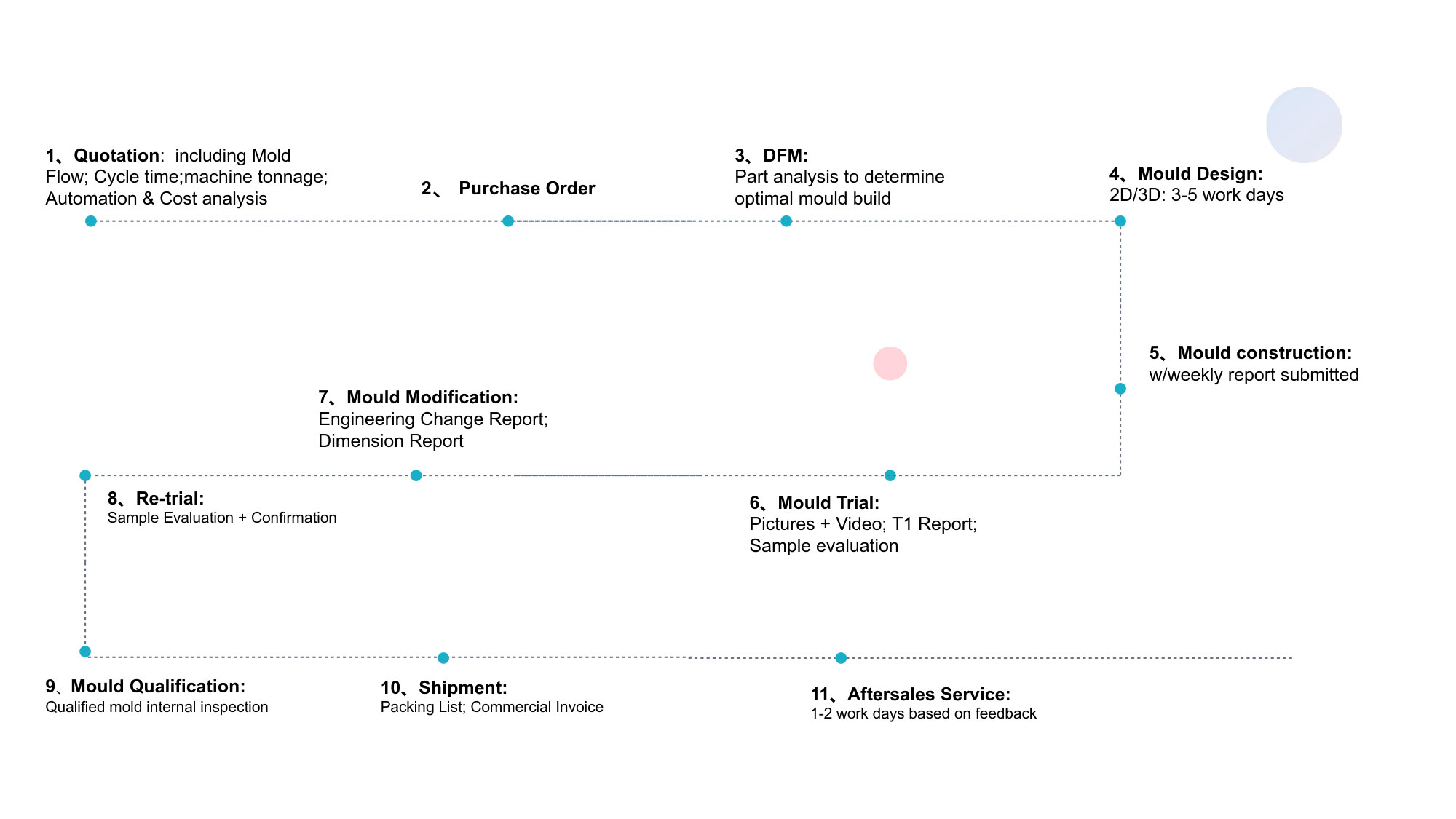
4.1 Mold Manufacturing Capabilities
Core Equipment Infrastructure:
Ansix Tech maintains a state-of-the-art mold manufacturing facility capable of producing complex high-precision molds for PP foam float applications.
Equipment Category Specification and Capability
5-Axis High-Speed CNC Machining Centers Machining precision ±0.002mm, complex curved surface processing, zero-parting-line finish with burr-free edges
Sinker EDM (Electrical Discharge Machining) Fine detail machining for deep ribs, narrow slots down to 0.03mm
Wire-Cut EDM (Slow Wire) Precision cutting for thin-wall sections and micro-features
Coordinate Measuring Machine (CMM) Full dimensional inspection with CPK ≥1.33 for critical dimensions
Optical Measurement System Non-contact inspection for complex geometries
Customer Value Translation: *Our 0.002mm precision mold machining ensures every PP foam float has smooth parting lines requiring no secondary finishing—eliminating manual deburring costs (saving $0.05–0.15 per part) and preventing flash-related assembly failures.*
Mold Materials and Lifespan Guarantee:
Mold Component Material Grade Application Context Lifespan Commitment
Mold Base P20 / 718 General structural support 1,000,000 cycles
Core/Cavity (GF-reinforced) S136 / 8407 / 2344 / SKD61 / H13 Wear-resistant for glass fiber-filled materials 500,000 cycles guaranteed
Core/Cavity (Standard) NAK80 / 4Cr13 / DC53 / M340 General-purpose PP foam molding 1,000,000 cycles guaranteed
Core/Cavity (Corrosive environments) 2343 / 9Cr18 / S136 ESR Medical or chemical exposure applications 500,000 cycles
Full material traceability: Ansix Tech provides material certifications and heat treatment process records (including tempering curves) for every mold delivered.
Gating System Configuration: Through comprehensive mold flow analysis (MFA), Ansix engineers optimize gate type, quantity, and location to ensure balanced filling, predict weld line and gas trap locations, and eliminate short shots and sink marks before steel is cut.
Cooling System Design: Conformal cooling channels are strategically designed using simulation tools to ensure uniform temperature distribution across the cavity. Type cavity and core temperature differences are controlled within 2°C to minimize warpage and deformation.
Ejection System Design: Ejector pin placement is carefully planned to avoid functional surfaces and ensure smooth part ejection without deformation. Pin mark location allowances are clearly documented in DFM reports to avoid surprises during customer validation.
Mold Delivery Standards:
Mold Complexity Standard Lead Time Rush Lead Time (with validation)
Simple mold (single cavity) 10 days 7 days
Medium complexity 25–45 days 20 days
High complexity (multi-cavity/hot runner) 45–60 days 35 days
Customer Value Translation: *We deliver molds with guaranteed lifespan backed by material certifications—reducing your mold replacement frequency by 50% compared to industry average and lowering long-term tooling cost per million parts.*
4.2 Injection Molding and Material Selection
Injection Molding Machine Fleet:
Ansix Tech operates 260 injection molding machines with clamping forces ranging from 30 tons to 2,800 tons, covering a wide range of part sizes and complexities. The machine park includes leading brands: FANUC, Sumitomo, Toshiba, Nissei (Japan); Engel (Austria); ARBURG (Germany, primarily for LSR two-shot molding); Haitian, and Taichung Machinery (Taiwan).
Customer Value Translation: From 30 to 2800 tons, we have the exact machine size for your PP foam float—never paying for excess machine capacity (saving 15–25% on molding costs) or compromising quality due to undersized equipment.
Material Selection for PP Foam Float Components:
Component Material Type Material Grades / Suppliers Key Properties
PP Foam Body Polypropylene homopolymer/ copolymer Borealis, LyondellBasell, Sabic, Braskem Lightweight, chemical resistance, good mechanical properties
PP foam (GF reinforced) PP + 20–40% glass fiber Sabic, RTP Company Higher strength and stiffness for high-pressure applications
PP for MuCell Standard PP with high melt strength Borealis Daplen, LyondellBasell Optimized for microcellular foaming, uniform cell distribution
Magnetic Core Bonded magnet compound (Ferrite/NdFeB+PA6/PA12/PPS) Magnequench, Galaxy Magnets, X-mag Precise magnetic properties, corrosion resistance
Flame-retardant float UL94 V-0 rated PP compounds Sabic, RTP Company, PolyOne Meets fire safety standards (V-0 rating)
MuCell Process Integration: Ansix Tech can integrate MuCell® microcellular foaming technology into the injection molding process for PP foam float production. This uses supercritical fluid (SCF) as a foaming agent—a green molding solution that reduces product weight, molding energy, and cycle time while improving foam quality.
Customer Value Translation: *Our UL94 V-0 certified materials ensure your PP foam float meets fire safety codes without additional coatings (saving $0.10–0.30 per part), while MuCell integration reduces part weight by 30%—lowering material cost and shipping weight simultaneously.*
4.3 Smart Manufacturing and Efficiency Enhancement
Ansix Tech leverages intelligent manufacturing systems to ensure consistent quality and maximum production efficiency:
Capability Technical Implementation Customer Benefit
MES (Manufacturing Execution System) All injection molding machines networked; process parameters (temperature, pressure, velocity, time) locked and traceable; only authorized engineers can modify settings Every part identical to the first (batch-to-batch consistency); full traceability for regulatory compliance (IATF 16949, ISO13485)
Automated material handling Centralized drying and conveying systems for consistent material property Eliminates moisture-induced defects; reduces scrap by 30%
In-mold sensors Pressure and temperature sensors installed in cavity; real-time closed-loop control Prevents short shots and overpacking; reduces rejects to <1%
Robotic automation Automated part removal and secondary operations Reduces human error; increases OEE by 15–25%
3D printing for conformal cooling Additive manufacturing of complex cooling channels Reduces cycle time by up to 35%; eliminates hot spots and warpage
Automated electrode machining Self-contained electrode machining and EDM cell (24/7 operation) Repairs completed in-house without outsourcing; 24-hour recovery for mold repairs
Customer Value Translation: *Closed-loop MES with in-mold sensors reduces part reject rate from typical 5% to <1%—saving 4% on total production volume. Automated handling eliminates 3–5 operators per shift, reducing direct labor cost by 40%.*
4.4 Process Quality Assurance
Dimensional Stability Control:
Control Method Specification Industry Benchmark Comparison
Mold temperature zone control Core and cavity temperature difference ≤2°C Industry typical ≤5°C
Ultrasonic wall thickness monitoring Real-time feedback and auto-compensation of packing pressure Continuous improvement without human intervention
In-mold pressure/temperature sensors Closed-loop process control for cavity pressure Eliminates overpacking/underpacking
First-off/last-off comparison Every batch compared to master standard Catches drift before defects occur
Statistical Process Control (SPC) Real-time CPK monitoring for critical dimensions (target CPK ≥1.33) 99.993% conforming output
PP Foam Float Specific Quality Control:
Concern Ansix Tech Solution Quality Target
Inconsistent foam density Controlled supercritical fluid dosing; real-time weight monitoring Density variation ≤±2%
Non-uniform bubble size Optimized melt temperature and injection profile; gas counter pressure Bubble size variation ≤±15%
Magnetic field strength variation Incoming magnet material testing; orientation tooling qualification Magnetic strength variation ≤±3%
Float buoyancy deviation Automated buoyancy testing station Buoyancy tolerance ≤±2% (customer-defined)
Surface defects (splay, flow marks) Controlled mold temperature; optimized injection speed Visual Class A surface achievable
Dimensional instability In-mold sensors + CPK monitoring Critical dimensions CPK ≥1.33
Appearance Standards:
Requirement Specification
Standard appearance No visible sink marks, warpage, or surface defects
High-gloss finish Surface roughness Ra ≤0.2μm (suitable for optical applications)
Transparent part requirement No bubbles or flow marks
Electroplating/coating-ready No gas marks; reserved compensation for part distortion
Test and Certification Availability:
Test/Report Type Availability
Material certification Included (batch traceable)
Dimensional full report For each cavity at PPAP
CPK study (≥1.33) For critical dimensions
Magnetic field mapping Available
Buoyancy test report For each batch
2000-cycle wear test (mold) Delivered with mold
Mold material cert + heat treat curve Included
Customer Value Translation: *Our closed-loop quality system with CPK ≥1.33 guarantees that 99.993% of parts meet specifications—reducing your incoming inspection costs by 50% and eliminating field failures.*
5. Full-Process Service Ecosystem: From Design to Delivery
5.1 Product Design and Development
Early Stage Engagement (Co-Engineering Philosophy):
Ansix Tech employs a collaborative engineering approach, bringing its technical team to the table from the concept stage to ensure design, manufacturability, and cost are optimized before any geometry is finalized.
DFM (Design for Manufacturing) Report:
Analysis Component Deliverable
Wall thickness optimization Identify thick sections causing sink marks; recommend uniform thickness
Draft angle recommendation Ensure smooth ejection without part distortion
Gate location and type Position gates to minimize weld lines near magnetic core area
Ejector pin mark location Agree on acceptable mark locations; avoid functional surfaces
Rib and boss design Avoid stress concentration; optimize for strength with minimal material
Magnetic core insertion method In-mold insert or overmolding; define clearances to prevent core movement
Flotation behavior prediction Simulate buoyancy vs. sink behavior in end-use fluid
Mold Flow Analysis (MFA):
Simulation Output Purpose
Flow front visualization Predict fill pattern and potential hesitation
Weld line mapping Identify weld line locations; adjust gate design to move to non-critical areas
Air trap prediction Add vents strategically
Shrinkage and warpage simulation Predict final part geometry; add compensation to mold
Cooling analysis Optimize conformal cooling channel layout
5.2 Product Validation
Prototype and Validation Process:
Stage Activity Deliverable
Prototype Rapid prototyping (CNC machining or 3D printing) for form/fit testing Functional prototype for customer approval
T0 sample First mold trial (bare steel condition) Unmodified part for baseline assessment
T1 sample First correction iteration Modified part with improvement documentation
T2–T3 samples Iterative refinements Final sample ready for customer approval
Quick-change insert capability Fast insert replacement to test multiple design variations No need to recut entire mold for design changes
Pre-production batch 100–500 shots trial run Yield data and CPK study; customer confirmation before mass production
5.3 Mass Production
Production Capabilities:
Parameter Specification
Machine range 30–2800 tons
Annual mold output Over 30,000 sets cumulatively
Multi-cavity capability Up to 48 cavities for small floats (cost per part reduction)
Overmolding Insert magnetic core and overmold with PP foam
Two-shot molding Bonded magnet injection + PP foam overmolding in one cycle
Secondary operations Assembly, testing, packaging
5.4 Quality Assurance
Quality System Infrastructure:
Certification Scope
ISO9001:2015 Quality management system
IATF 16949 Automotive quality management (rigorous PPAP/APQP)
ISO13485:2016 Medical device quality management
ISO14001 Environmental management
Quality Verification Methods:
Method Application Frequency
CMM full inspection Critical dimensions First piece and PPAP
Optical measurement Complex geometries Sample inspection
In-process inspection (IPQC) All dimensions during production Every 2 hours
Buoyancy test Float function validation Per batch (sampling plan per AQL)
Magnetic field measurement Magnet performance Per batch
Dimensional CPK study Critical dimensions Per customer request (target ≥1.33)
5.5 Delivery and After-Sales Service
Delivery Efficiency:
Service Element Commitment
Sample lead time 15–25 days for new molds
Rush mold 20 days for medium complexity (validation included)
Production lead time 7–14 days after sample approval
Global shipping China/Vietnam bases serving Americas, Europe, Asia
Supply chain integration VMI or Kanban available for JIT delivery
After-Sales Service Commitment:
Service Specification
Spare parts kit Critical wear parts (ejector pins, core inserts) delivered with every mold
Mold maintenance Free maintenance service every 200,000 cycles (cost of materials only)
Lifetime repair Repair at material cost only (excluding normal wear and tear)
2000-cycle wear test Delivered with mold; includes wear report documenting any changes
Mold structural warranty 3 years (excluding consumable wear parts)
Emergency response 24-hour service response for production-stopping issues
Customer Value Translation: *We pre-ship maintenance kits and train your operators—eliminating emergency downtime costs (saving $500–2000 per unplanned stop) and extending mold life by 50% through proactive maintenance.*
6. How Ansix Achieves Customer Satisfaction and Industry Leadership
6.1 Comprehensive Capability Ecosystem
Ansix Tech's core competitive advantage lies in its fully integrated approach to injection molding. Unlike fragmented service providers requiring customers to manage multiple vendors across design, mold manufacturing, production, assembly, and logistics, Ansix offers a unified platform covering all stages from concept to delivery. This vertical integration eliminates communication barriers, accelerates project timelines, and ensures consistency from design to final delivery.
6.2 Customer-Centric Engineering Philosophy
Ansix Tech operates on a fundamental philosophy: a mold is not a piece of metal—it is a profit-generating asset for the customer. Every technical specification delivered translates directly into measurable customer value: lower costs, reduced risk, faster time-to-market, and uncompromising quality.
6.3 Cost Reduction Strategy
Material cost reduction: Weight reduction of 20–40% through MuCell technology reduces base material consumption. Multi-cavity tooling spreads fixed cost across more parts per cycle, lowering per-unit material cost.
Process efficiency improvement: Cycle time reduction of 15–30% using MuCell foaming technology increases throughput without additional capital investment. Automated part handling reduces labor requirements and eliminates human error.
Quality-related cost reduction: Closed-loop MES with in-mold sensors reduces reject rate from typical 5% to <1%. Reduced scrap means less material waste and fewer defective parts reaching customers.
Tooling cost amortization: Guaranteed mold life of 500,000–1,000,000 cycles ensures cost per part continues decreasing over mold lifetime. Lower tooling replacement frequency compared to industry average.
6.4 Production Capacity and Lead Time Assurance
With 260 injection molding machines across multiple global manufacturing sites, Ansix maintains substantial production capacity to handle volume fluctuations. The China and Vietnam bases provide geographic redundancy and allow distribution of production to optimize logistics for different customer regions.
6.5 Accelerating Time-to-Market
From DFM analysis and mold flow simulation prior to steel cutting to rapid sample iteration (T0, T1, T2, T3), early identification of potential issues eliminates late-stage surprises. Rush mold projects as fast as 20 days allow urgent customer needs to be met while maintaining validation rigor.
6.6 Vertical Integration Advantages
Ansix Tech's vertically integrated model—encompassing in-house electrode machining and EDM, in-house CNC milling, in-house metrology, and self-contained repair capabilities—means mold repairs and modifications are completed without outsourcing. Conventional repairs that typically take weeks can be restored within 24 hours.
7. Customer Value Framework: Translating Technical Capabilities into Business Outcomes
The following structured framework captures how Ansix Tech transforms technical capabilities into quantifiable customer value:
Framework Overview: From Technical Specification → Customer Benefit → Quantified Value
Technical Capability Customer Problem Solved Quantified Value Delivered
±0.002mm mold precision Manual deburring cost; assembly fit issues Eliminates $0.05–0.15 per part of manual finishing
500,000–1,000,000 cycle guaranteed mold life Frequent mold replacement cost 50% reduction in long-term tooling cost per million parts
MuCell (20–40% weight reduction) High material cost per part 15–30% reduction in per-part material cost + 15–30% cycle time reduction
MES with closed-loop control Variable quality leading to reject parts Reject rate reduction from 5% to <1%; $0.02–0.10 per part scrap savings
CPK ≥1.33 dimensional stability Customer incoming inspection cost; field failures 50% reduction in incoming QC inspection; eliminates field failure recall risk
In-mold sensors with auto-compensation Dimensional instability batch-to-batch 99.993% conforming output; 0.007% non-conforming risk
Conformal cooling + 3D printing Long cycle times; hot spots/warpage 35% cycle time reduction per part
24-hour mold repair service Production stoppage from broken mold $500–2000 saved per unplanned stop
Pain Point Solutions Matrix
Customer Pain Point Ansix Technical Solution How Customer Wins
"Molds break frequently, disrupting orders" 2000-cycle wear test before delivery; 3-year structural warranty Zero unplanned downtime from undetected design issues
"Flash requires expensive manual deburring" 0.005mm parting line precision; self-locking clamp force compensation Flash <0.03mm; eliminates manual deburring completely
"Dimensions change batch to batch" Ultrasonic wall thickness monitoring; auto packing pressure compensation Batch-to-batch variation <0.02mm on critical dimensions
"Mold repair takes weeks" In-house electrode + EDM machining cell; 24-hour repair service Production restored in 24 hours instead of weeks
"Injection molding defects require high rework cost" DFM analysis + mold flow simulation before steel cutting Zero tooling rework due to preventable defects
"High total cost of ownership" Cost engineering from concept to delivery Total cost reduced by 18%+
"Cannot validate design before high-volume production" Pre-production batch (100–500 shots) with CPK analysis Validated process before committing to mass production
"Long lead times for new projects" Rush mold capability 20 days; rapid sample iteration (T0–T3) Time-to-market reduced by 30–50%
Competitive Differentiation Matrix
Competitive Dimension Ansix Tech Capability Industry Average Customer Advantage
Mold precision ±0.002mm ±0.005–0.010mm Tighter tolerances; better assembly fit
Guaranteed mold life 500k–1M cycles (documented) No guarantee Lower long-term tooling cost
Quality certifications ISO9001, IATF16949, ISO13485, ISO14001 1–2 certifications only One qualification covers all requirements
Global manufacturing footprint China + Vietnam bases (geographic redundancy) Single location Supply chain resilience; optimized logistics
MES with process locking All parameters locked; only engineers authorized to modify Manual adjustments common Zero unauthorized variation; full traceability
In-mold sensors + CPK Real-time closed-loop control; CPK ≥1.33 Manual sampling only 99.993% output confidence
Vertical integration In-house everything (CNC, EDM, metrology, repair) Outsourced repairs 24-hour repair response
Cost engineering focus 18%+ total cost reduction Focus on unit price only Lower total ownership cost
Measurable Customer Value Summary
Value Metric Ansix Tech Achievement Industry Benchmark Comparison
Reject rate <1% Typical 3–8%
Dimensional variation (batch-to-batch) ≤0.02mm Typical 0.05–0.10mm
Cycle time reduction (MuCell) 15–30% 5–10% typical
Material weight reduction (MuCell) 20–40% Not available with standard molding
CPK for critical dimensions ≥1.33 (99.993% confidence) Typically not guaranteed
Mold repair recovery time 24 hours 7–14 days typical
Flash on parting lines ≤0.03mm 0.10–0.20mm typical
Time-to-market (new project) Rush 20 days 30–45 days typical
Total cost of ownership reduction 18%+ documented Not tracked by most suppliers
This comprehensive technical documentation demonstrates how Ansix Tech, with over 29 years of experience, has positioned itself as a global leader in integrated injection molding solutions. For PP foam float with embedded magnetic core applications specifically, Ansix Tech delivers the full spectrum of services—from concept design and mold manufacturing through validation, mass production, quality assurance, and post-sale support—all built on a foundation of translating technical capabilities into measurable customer value: reduced costs, minimized risks, faster time-to-market, and uncompromising quality.
Ansix Tech Co Ltd
If you have any plans related to PP foam float with embedded magnetic core , you can contact us at any time. We will turn your ideas into reality, let you realize your dreams, and obtain large orders from the market. Our contact information is info@ansixtech.com. Or contact our CTO, mail: stephen@ansixtech.com
#www.ansixtech.com #ansixtech.com #PP foam float with embedded magnetic core #PP foam float with embedded magnetic core injection molding companies #PP foam float with embedded magnetic core Canopy Mold injection mold companies #Ansix #Ansix moulds #Ansix china #Ansix tech china #Ansix tech company #Ansix facotry #PP foam float with embedded magnetic core injection molding #PP foam float with embedded magnetic core injection tools #PP foam float with embedded magnetic core injection moulds #PP foam float with embedded magnetic core plastic mould #PP foam float with embedded magnetic core plastic tools #Ansix Tech #Ansix molds #Ansix injection molding #Ansix mold factory #injection molding PP foam float with embedded magnetic core#Ansix mold factory #PP foam float with embedded magnetic core china #PP foam float with embedded magnetic core molds #injection factory #PP foam float with embedded magnetic core injection molding #PP foam float with embedded magnetic core injection molding factory #injection molding company #PP foam float with embedded magnetic core injection mold companies #PP foam float with embedded magnetic core Tooling #PP foam float with embedded magnetic core mold limited #Ansix mold china #Ansix companies #Ansix company China #PP foam float with embedded magnetic core facotry #Ansix Tech #Ansix Tech mould #PP foam float with embedded magnetic core injection moulding #injection moulding company #Ansix PP foam float with embedded magnetic core parts injection mold companies #medical injection molding companieschina #PP foam float with embedded magnetic core china factory #Ansix moulding companies #Ansix molding company #PP foam float with embedded magnetic core injection moulding facotry #Ansix Tech mold #PP foam float with embedded magnetic core mould #PP foam float with embedded magnetic core plastic injection molding #ansix plastic mold #Mold manufacturing #PP foam float with embedded magnetic core parts manufacturing #PP foam float with embedded magnetic core plastic parts factory #PP foam float with embedded magnetic core injection parts mold #PP foam float with embedded magnetic core PRECISION MANUFACTURING #PP foam float with embedded magnetic core #China mold #PP foam float with embedded magnetic core injection moulding china #PP foam float with embedded magnetic core mould china #china precision mold #mold in china #PP foam float with embedded magnetic core mold china #Precision molds #High-precision molds #PP foam float with embedded magnetic core #Injection molds #PP foam float with embedded magnetic core Factory #PP foam float with embedded magnetic core Company #Super Large Injection Mold Factory #Large Tonnage Injection Molding Factory #PP foam float with embedded magnetic core Company #PP foam float with embedded magnetic core Factory #2800T Injection Molding Factory #3000 Ton Injection Molding #4500 Ton Injection Molding Factory #Large Mold Injection Molding #Large Plastic Mold Injection Molding Factory #Large Injection Mold Manufacturer #Plastic Mold Factory #Injection Mold #Plastic Mold