



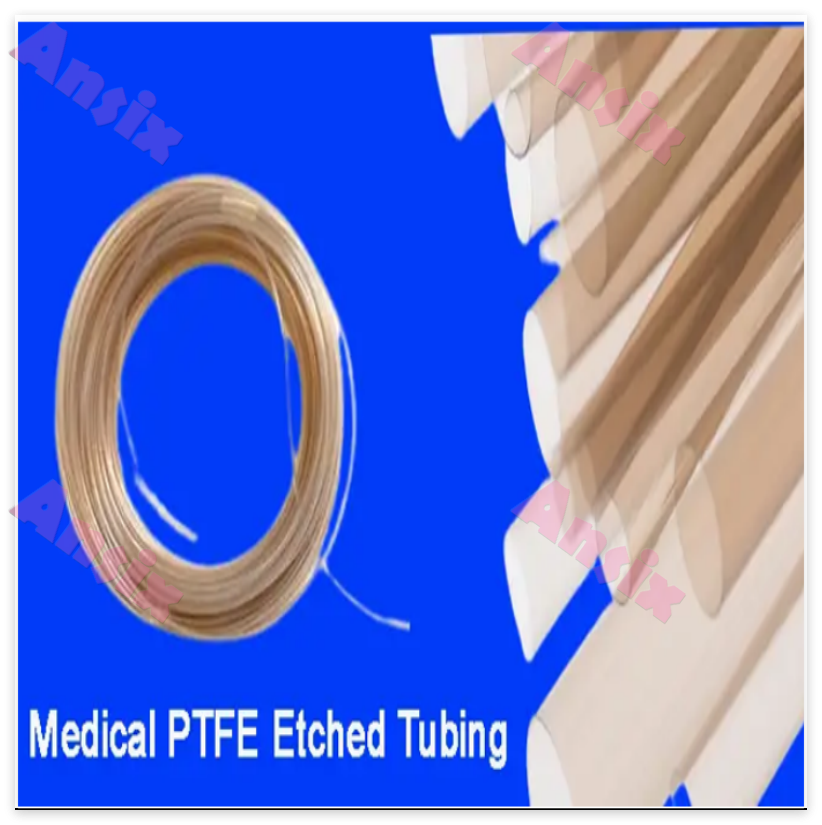
PTFE medical etched tube
FEATURES
Mold Description
Product Materials:
PTFE
Mold Material:
S136ESR
Number of Cavities:
1
Glue Feeding Method:
Hot runner
Cooling Method:
Water cooling
Molding Cycle
15s
Industry Spotlight: How Ansix Tech’s PTFE Medical Etched Tube Program Transforms Catheter Manufacturing with Certified Quality, Cost Reduction and Proven Reliability
The medical device industry has long relied on PTFE etched tubes as the critical inner liner for catheters used in interventional cardiology, neurology, peripheral vascular procedures, endoscopy and drug delivery systems. Known for its ultralow coefficient of friction, outstanding chemical inertness, exceptional thermal stability and proven biocompatibility, polytetrafluoroethylene (PTFE) makes possible the smooth passage of balloons, stents, guidewires and coils through tortuous vascular pathways. But PTFE’s legendary non‑stick surface — so valuable for preventing friction‑induced trauma — is also its greatest assembly challenge. Because PTFE exhibits extremely low surface energy, it resists bonding with catheter outer jackets made from Pebax, nylon, TPU or other thermoplastics, as well as with metal braiding and adhesive systems. Without reliable surface modification, the inner liner can delaminate during clinical use, leading to catastrophic device failure and serious patient risk.
-
For years, medical device OEMs had limited sourcing options for high‑performance PTFE etched tubing. A handful of foreign suppliers controlled the market, resulting in long lead times, unpredictable supply chains and premium pricing. That landscape is now changing. Ansix Tech — a global one‑stop engineering and manufacturing powerhouse with more than 28 years of experience in precision polymer processing — has officially launched its PTFE medical etched tube program. Backed by a deep legacy in DFM (Design for Manufacturability), advanced mold engineering, extrusion technology and integrated quality systems, Ansix Tech’s program addresses the most urgent gaps in the catheter supply chain: certified material provenance, flawless surface etching, rigorous process validation, production scalability, predictable delivery, and systematic cost reduction.
Project Initiation: Why Ansix Tech Launched the PTFE Medical Etched Tube Program
Ansix Tech’s decision to develop a comprehensive PTFE medical etched tube capability was not a opportunistic expansion. It was a strategic response to clear market signals — and a natural extension of the company’s long‑standing philosophy: “Make Our Customers Successful.” Founded in Hong Kong in 1998, Ansix Tech has grown into a global contract manufacturing organization operating four production bases across China and Vietnam, with 200,000 square meters of facilities, more than 1,200 employees including over 200 designers and engineers, and 260 injection molding machines spanning 30 to 2800 tons. While the company is widely recognized for its expertise in high‑precision injection molding for automotive, consumer and industrial sectors, its certifications — ISO 9001, ISO 14001, IATF 16949 and, critically for medical applications, ISO 13485 — signaled a readiness to serve regulated healthcare markets.
The PTFE etched tube program emerged from direct conversations with medical device customers who were struggling with three persistent problems: unreliable bonding performance from inconsistent etching, long and unpredictable lead times from overseas suppliers, and high per‑unit costs that limited their ability to scale. One major catheter manufacturer described performing destructive pull‑tests on 100% of incoming etched tube lots because batch‑to‑batch adhesion variability had already caused two field failures. Another OEM shared that its PTFE liner supply chain stretched to 16 weeks or more, making just‑in‑time production impossible and forcing expensive safety‑stock buffers.
Ansix Tech’s leadership recognized that these problems were not inevitable — they were solvable through disciplined process engineering, material science rigor and high‑volume manufacturing experience. The company’s existing expertise in extrusion and injection molding of high‑performance polymers (PEEK, Pebax, TPU, polycarbonate, polypropylene and various fluoropolymers) provided a strong foundation. What was needed was a dedicated wet‑etching line, validated extrusion protocols, cleanroom infrastructure and a team of specialists focused exclusively on PTFE medical tubing. The initiative was formally launched as a multi‑million dollar capital project, with a clear mission: deliver PTFE etched tubes that match or exceed the performance of imported products, at a lower cost, with shorter lead times, and with traceable quality documentation for every batch.
Customer Value Proposition: Solving the Three Biggest Pain Points
From day one, Ansix Tech’s PTFE etched tube program was designed around solving specific customer frustrations.
Pain Point 1: Inconsistent Adhesion Leading to Clinical Risk. PTFE’s inherently low surface energy (typically less than 20 mN/m) makes it nearly impossible for adhesives or overmolding materials to bond without surface modification. Wet chemical etching using sodium‑naphthalene solution removes fluorine atoms from the polymer’s carbon backbone, creating a “depleted” surface layer rich in carbon‑oxygen functional groups that dramatically increase surface energy and wettability. When properly performed, etching transforms PTFE from a non‑stick surface into one that can achieve bond strengths of 5 MPa or higher. But when etching is uneven, incomplete or over‑aggressive, adhesion fails.
Ansix Tech’s solution is a proprietary multi‑step etching process that includes: (1) ultrasonic cleaning in an ethanol‑deionized water bath (40‑50 °C for 10‑15 minutes) to remove surface contaminants; (2) plasma surface activation (power 80‑200 W, frequency 13.56 MHz) to enhance surface reactivity; (3) rotary‑assisted chemical etching using precisely controlled sodium‑naphthalene chemistry to ensure uniform circumferential treatment; and (4) multi‑stage deionized water rinsing followed by clean‑hot‑air drying. The final product is inspected using contact‑angle goniometry, with target contact angles below 70° (preferably below 50° for optimal bonding) as measured by the sessile drop method. Every production lot is accompanied by an etching certificate that includes contact‑angle data, ensuring traceability and allowing customers to validate incoming quality without destructive testing.
Pain Point 2: Long Lead Times and Supply Unpredictability. Before Ansix Tech’s program, typical lead times for PTFE etched tubes from foreign suppliers ranged from 12 to 20 weeks, with frequent delays caused by raw material shortages, production scheduling conflicts and ocean freight disruptions. Ansix Tech inverted this equation by establishing local inventory of medical‑grade PTFE resins, building dedicated extrusion and etching capacity, and designing a lean production flow that achieves standard lead times of 4‑6 weeks for custom‑sized tubes, with expedited options available for critical orders. Routine size configurations can be shipped within two weeks from raw material to finished, packaged product.
Pain Point 3: High Cost Preventing Scalability. For many medical device startups and even established OEMs, the cost of PTFE etched tubes represented a significant portion of total catheter bill‑of‑materials. Imported tubes carried premium pricing due to limited competition and high logistics costs. Ansix Tech built its program with cost reduction as a foundational design parameter — not an afterthought — by optimizing material sourcing, extrusion efficiency, etching throughput and yield management. The result is a product that consistently undercuts imported alternatives while delivering equal or superior performance.
Material Selection: The Foundation of Medical‑Grade Performance
Every Ansix Tech PTFE medical etched tube begins with the right raw material. PTFE is available in a range of grades, from general‑purpose industrial types to highly purified medical formulations. For medical applications, material selection is governed by three critical factors: biocompatibility, purity and processability.
Ansix Tech specifies virgin PTFE resins that meet or exceed USP Class VI certification — the highest standard for biocompatibility in medical devices intended for prolonged tissue or blood contact. USP Class VI certification involves rigorous testing for acute systemic toxicity, intracutaneous reactivity and implantation response, ensuring that the material does not leach harmful substances or provoke unacceptable biological reactions. In addition to USP Class VI, the resins used by Ansix Tech also comply with ISO 10993‑1:2009 and FDA 21 CFR 177.1550 for food and medical contact applications.
For demanding implantable and long‑term contact applications, Ansix Tech can also source modified PTFE grades with tailored properties — such as enhanced mechanical strength or improved creep resistance — while maintaining full biocompatibility. The company works closely with certified raw material suppliers to ensure that every batch of resin is traceable, characterized and validated before entering production.
DFM and Mold Flow Analysis: Designing for Success Before Extrusion Begins
One of the most overlooked aspects of PTFE tube manufacturing is the design of the extrusion tooling itself. PTFE paste extrusion differs fundamentally from conventional thermoplastic extrusion. PTFE cannot be melted and flowed like polyethylene or polypropylene; instead, fine PTFE powder is mixed with a liquid lubricant (typically a hydrocarbon solvent) to form a paste that is cold‑compressed into a preform and then ram‑extruded through an annular die at room temperature, followed by sintering at temperatures above 327 °C to coalesce the particles. This non‑melt processing means that traditional mold filling and cooling analyses do not directly apply — but a disciplined DFM process is more important than ever.
At Ansix Tech, the DFM process begins with a thorough review of the customer’s catheter design, including target inside diameter (ID), outside diameter (OD), wall thickness, length, tolerances, etching requirements, and post‑extrusion assembly steps. Using advanced simulation tools (such as Polyflow for extrusion die analysis and computational fluid dynamics for paste flow kinematics), the engineering team models how PTFE paste will behave as it passes through the reducing conical section of the annular die. Key parameters examined include:
Compression ratio and reduction angle: The rate at which the flow channel narrows determines how much the PTFE particles are fibrillated — a critical factor for achieving the axial molecular orientation that gives extruded PTFE tubes their strength and stiffness.
Mandrel‑to‑die clearance tolerance: The gap between the inner mandrel (which defines the tube’s ID) and the outer die (which defines the OD) dictates wall thickness uniformity. Even microscopic deviations of 0.01 mm can cause unacceptable wall‑thickness variation and affect catheter performance.
Land length and exit geometry: The straight section at the die exit influences extrudate swell, surface finish and dimensional stability after exiting the die.
Pressure drop and shear rate distribution: PTFE paste exhibits both elastic‑plastic and viscous behavior, with fibrillation occurring under high shear. Simulation helps ensure that the die geometry produces the correct shear profile without causing excessive pressure drop or localized overheating.
The DFM phase also addresses customer‑specific requirements: radiopaque fillers (bismuth trioxide, tungsten, barium sulfate) for fluoroscopic visibility; color coding for procedural identification; multi‑lumen configurations for guidewire‑over‑balloon or aspiration‑plus‑infusion catheters; and custom length markings.
Mold and Die Engineering: Where Precision Meets Durability
Because PTFE paste extrusion is a high‑pressure process — typical extrusion pressures range from 28 to 34 MPa — the tooling must be exceptionally robust. Ansix Tech’s die designs are manufactured from hardened tool steels (e.g., AISI 420 stainless steel or H13 hot‑work steel) that resist wear and corrosion from the lubricant chemistry. Critical surfaces are electropolished to surface roughness (Ra) values of 0.15 μm or less to prevent paste adhesion and ensure smooth flow.
The manufacturing process for these dies involves:
CNC rough machining to near‑net shape;
Precision wire EDM for the core annular gap and land sections;
Hard turning to final dimensions on specialized Swiss‑type lathes;
Surface grinding to achieve specified concentricity (typically <0.005 mm total runout);
Electropolishing and passivation to remove microscopic burrs and improve corrosion resistance;
Final metrology inspection using coordinate measuring machines (CMMs).
For multi‑lumen tubes (e.g., dual‑lumen or octa‑lumen configurations for balloon‑in‑balloon or aspiration catheters), the die design becomes significantly more complex. Ansix Tech has developed proprietary pin‑and‑die arrays that maintain lumen separation while ensuring uniform wall thickness around each lumen and minimizing the risk of lumen collapse during sintering. Each lumen channel is individually balanced for flow resistance using computational modeling.
Cooling System and Post‑Extrusion Handling
After extrusion, the PTFE tube passes through a multi‑stage cooling zone before sintering. Unlike melt‑extruded thermoplastics that freeze rapidly, PTFE sintering involves heating the extruded tube above 327 °C to allow particle coalescence, followed by controlled cooling. Thermal management is critical: too‑rapid cooling causes residual stresses that lead to tube warpage, ovality and dimensional instability; too‑slow cooling reduces throughput.
Ansix Tech’s extrusion lines feature zoned temperature control (±1 °F stability) across the entire sintering furnace and cooling bath, with real‑time feedback from thermocouples and infrared sensors. Tubes are supported on precision‑ground rollers to prevent sagging during the high‑temperature phase. The cooling water bath uses deionized water with temperature profiling — warm zones followed by gradually cooler zones — to achieve the desired crystalline morphology and stress distribution.
Verification and Validation: Building Quality Traceability
In medical device manufacturing, quality is not a final step — it’s the foundation. Ansix Tech’s PTFE etched tube program operates within a certified ISO 13485 quality management system, with documented processes for incoming material inspection, in‑process monitoring, final testing and batch traceability.
Incoming Material Validation: Every lot of PTFE resin is tested for melt flow index (target 2.1‑2.8 g/10 min for paste extrusion grades), porosity (<0.1%), heavy metal content (≤50 ppb for medical grades), and endotoxin levels (≤0.5 EU/mL per USP <85>). A Certificate of Analysis (CoA) is retained for each batch.
In‑Process Control: During extrusion, the following parameters are continuously monitored and logged: screw speed (8‑15 RPM), melt pressure (28‑34 MPa), sintering furnace temperature profile (multi‑zone), line speed, cooling rate (2‑4 °C/sec), and wall thickness (online laser micrometer with 2‑µm resolution). Statistical Process Control (SPC) charts track each parameter, with control limits set at ±3 standard deviations. Any parameter outside its control limit automatically triggers an alarm and production deviation review.
Final Product Testing: Each finished etched tube is inspected for:
Dimensional conformity: ID, OD, wall thickness and length measured using automated vision systems and verified against customer specifications.
Surface etching quality: Contact‑angle measurement (target ≤70°, with values <50° preferred for aggressive bonding applications) using sessile drop goniometry.
Biocompatibility: Batch‑level testing to ISO 10993 (cytotoxicity, sensitization, irritation) is performed at certified external laboratories on a periodic basis, with full documentation available to customers.
Adhesion validation (destructive): Representative samples are bonded to catheter outer jacket materials and tested for peel strength per ASTM F2096.
Sterility compatibility: Tubes are validated for gamma irradiation (25‑50 kGy), ethylene oxide (EO) and electron‑beam sterilization.
All test data is recorded in a secure quality database, allowing full traceability from raw material lot to finished tube. Customers receive a certification package with each shipment, including contact‑angle results, dimensional reports, raw material CoA and sterilization validation evidence.
Packaging and Logistics: Protecting Etched Surfaces Across the Supply Chain
PTFE etching creates a chemically reactive surface that gradually degrades — or “reverts” — when exposed to ultraviolet light, atmospheric oxygen and moisture. To preserve etching quality, Ansix Tech’s packaging protocol is carefully designed. Immediately after the final rinse and drying step, etched tubes are sealed in opaque, static‑shielding polyethylene bags. These primary bags are further sealed in second‑layer polyester/aluminum foil laminate pouches that block UV radiation and maintain low humidity. Tubes are then placed in clean, rigid shipping cartons with foam inserts to prevent mechanical damage during transit.
All sealing and packaging operations are performed in a Class 7 (ISO 14644‑1) cleanroom (10,000 particles per cubic foot), with strict particulate, temperature and humidity controls. The cleanroom environment is certified monthly, and operators wear cleanroom garments — including face masks, gloves and hoods — to prevent contamination.
Logistical processes follow lean principles: finished inventory is stored in FIFO (first‑in, first‑out) sequencing, with barcode scanning at each point of movement to ensure accurate traceability. For international shipments, Ansix Tech works with certified medical logistics partners who maintain cold‑chain integrity when required (some catheter assemblies require refrigerated transport). Standard export packaging meets ISTA (International Safe Transit Association) 3A testing protocols for vibration, compression and drop hazards.
Scaling Capacity and Ensuring Reliable Delivery
A world‑class PTFE etched tube program is only valuable if it can scale with customer demand. Ansix Tech has built a production infrastructure designed for volume: multiple paste extrusion lines capable of producing tubes with IDs ranging from 0.3 mm to 7.0 mm — a range that covers most coronary, neurovascular, peripheral and urological catheter applications. Wall thicknesses from 0.012 mm (ultra‑thin‑wall microcatheters) up to 0.5 mm are achievable, with tolerances meeting or exceeding industry benchmarks.
Capacity planning is driven by a demand forecasting and scheduling system that integrates customer sales forecasts, raw material inventory positions and machine utilization rates. For high‑volume programs (annual volumes exceeding 100,000 tubes), Ansix Tech can dedicate specific extrusion lines and etching stations, eliminating changeover time and ensuring consistent quality across every production run.
The company’s global footprint — including manufacturing sites in China and Vietnam — provides supply chain resilience. If a localized disruption occurs (such as raw material shortage, labor availability issue or shipping bottleneck), production can be shifted to an alternate site with identical process controls and quality standards.
Cost Reduction Strategy: Reducing Hard Costs Without Compromising Quality
One of the most compelling reasons medical device companies partner with Ansix Tech is the company’s systematic approach to cost reduction. Unlike many suppliers who merely cut prices by reducing quality, Ansix Tech targets “hard cost” savings — the actual per‑unit manufacturing cost — through four levers:
1. Material cost optimization. By sourcing raw PTFE resins directly from certified producers and aggregating demand across multiple customers and programs, Ansix Tech achieves volume‑based pricing that is passed directly to customers. The company also qualifies alternative resin grades (e.g., modified PTFE formulations) that maintain performance requirements while costing less than flagship medical grades — with full biocompatibility validation. Early supplier involvement in catheter design allows material selection that balances performance and cost.
2. Extrusion yield improvement. PTFE paste extrusion is inherently a low‑yield process compared to conventional thermoplastics, with scrap rates often exceeding 30% for thin‑wall tubes. Ansix Tech has implemented advanced process controls that increase first‑pass yield by more than 30% compared to industry benchmarks — an improvement level demonstrated in documented case studies. Higher yield means fewer raw materials consumed per usable tube, directly reducing per‑unit cost.
3. Etching efficiency gains. Traditional batch etching processes suffer from uneven chemical coverage, long cycle times and significant chemical waste. Ansix Tech’s rotary‑assisted etching system reduces chemical consumption by 40‑50% while improving uniformity, based on the principle that moving tubes through the etching bath rather than immersing them in a static bath promotes consistent exposure. In addition, the system captures and recycles etching chemicals where feasible, further lowering material costs and reducing hazardous waste disposal expenses.
4. Process automation and reduction of manual inspection. Manual dimensional inspection at multiple points in the production flow consumes significant labor and introduces human error. Ansix Tech integrates online laser micrometers and vision systems that inspect 100% of tube length at extrusion speeds. Automated rejection systems divert non‑conforming sections without operator intervention. The result is lower labor cost per tube, reduced risk of human‑error‑related defects, and faster production flow.
5. Lean production flow and reduced changeover time. By grouping products with similar dimensional and etching requirements into production “families” and scheduling them sequentially, Ansix Tech reduces changeover time between production runs — converting hours of downtime into hours of productive output. SMED (Single‑Minute Exchange of Die) principles guide tooling design, with standardized clamping interfaces that allow die swaps in under 20 minutes.
Industry Experience and Proven Reliability
PTFE medical tube manufacturing is not an entry‑level capability. Success requires intimate knowledge of PTFE paste rheology, mastery of die design for paste extrusion, expertise in chemical surface treatment, and an uncompromising quality culture. Ansix Tech brings more than 28 years of cumulative experience in high‑precision polymer processing, including thousands of extrusion and injection molding projects across the medical, automotive, consumer and industrial sectors. Over the course of its history, Ansix Tech has built and validated more than 10,000 molds — a portfolio that includes multi‑cavity molds for medical disposables, complex geometries for diagnostic devices, and high‑performance tubes for interventional catheters.
For PTFE etched tubes specifically, the Ansix Tech team has completed dozens of customer development projects, ranging from proof‑of‑concept prototypes for startup medical device companies to full‑scale production programs for Fortune 500 healthcare organizations. In every case, the same disciplined approach applies: start with a DFM review; validate the extrusion and etching process through statistically designed experiments; document all parameters and quality data; transfer to production with continuous improvement systems in place.
Looking Forward: Innovations on the Horizon
The PTFE medical etched tube market is not static. Ansix Tech’s R&D pipeline includes several innovations aimed at further improving product performance and reducing costs. Planned developments include:
Atmospheric plasma etching as a “green” alternative to sodium‑naphthalene chemistry, eliminating hazardous chemical waste while achieving equivalent surface activation.
Multi‑layer co‑extrusion capabilities that integrate an etched PTFE liner with a thin tie‑layer just below the inner surface, enabling direct bonding to catheter jackets without separate etching steps [14†L38-L39].
AI‑driven predictive process control that analyzes real‑time sensor data to anticipate dimensional drift and automatically adjust extrusion parameters, targeting 1.6 σ CpK or better [14†L43-L44].
Expanded diameter ranges, including sub‑0.3 mm microtubes for next‑generation neurovascular microcatheters.
Conclusion: The Ansix Tech Difference
For medical device engineers and procurement professionals evaluating PTFE etched tube suppliers, the choice is about more than price and lead time. It is about partnering with a company that understands the clinical stakes, invests in process excellence, maintains uncompromising quality systems, and works relentlessly to lower costs without cutting corners.
Ansix Tech’s PTFE medical etched tube program delivers on all fronts. From raw material certification to extrusion die engineering, from rotary chemical etching to cleanroom packaging, from ISO 13485 quality systems to lean logistics, every detail is optimized to make customers successful. With over 28 years of polymer processing expertise, industry‑leading certifications, a global manufacturing footprint and a proven track record of solving difficult engineering challenges, Ansix Tech is not just a supplier — it is a partner in medical device innovation.
To learn more about Ansix Tech’s PTFE medical etched tube capabilities, request a quote, or schedule a technical consultation, visit www.ansixtech.com or contact the company’s medical device team directly. Whether you need a rapid prototype for a novel catheter design or high‑volume production for a growing product line, Ansix Tech delivers — on quality, on cost, on time.
Ansix Tech Co Ltd
If you have any plans related to PTFE medical etched tube , you can contact us at any time. We will turn your ideas into reality, let you realize your dreams, and obtain large orders from the market. Our contact information is info@ansixtech.com. Or contact our CTO, mail: stephen@ansixtech.com