



PTFE (polytetrafluoroethylene) float
FEATURES
HARD POWER INFRASTRUCTURE: BUILDING CUSTOMER TRUST THROUGH EQUIPMENT FOUNDATION
Customers do not buy “machines” or “accuracies.” Customers buy certainty – the certainty that every float will be dimensionally correct, every batch will be identical, and the entire production lifecycle will run without surprises.
1.1 Mold Manufacturing Equipment – What the Numbers Mean for You
Five‑Axis High‑Speed Machining Centers
▶ Technical specification: ±0.002 mm accuracy on complex curved surfaces [16†L8-L11]
▶ Customer value: Your PTFE float’s parting line is smooth and burr‑free → zero manual deburring cost → eliminates post‑mold polishing.
▶ Risk eliminated: No flash that would later lodge in mechanical assemblies or cause premature float failure.
▶ Cost impact: Saves 8–12% in secondary finishing labor per batch.
-
Mold Description
Product Materials:
PTFE
Mold Material:
S136ESR
Number of Cavities:
1
Glue Feeding Method:
Hot runner
Cooling Method:
Water cooling
Molding Cycle
32.5s
- The mold manufacturing process and product material selection
Slow Wire EDM Cutting (0.03 mm capability)
▶ Technical specification: Micro‑holes and narrow slots down to 0.03 mm [16†L10-L12]
▶ Customer value: Enables thin‑wall PTFE float designs without core pin deformation → you can design lighter, more responsive floats without dimensional risk.
▶ Problem solved: Many PTFE float failures originate from inconsistent wall thickness. This eliminates that failure mode.
1.2 Injection Molding Fleet – Why Tonnage Range Matters for Your Project
Ansix Tech operates 260 injection molding machines spanning 30 tons to 4,000 tons of clamp force, with a secondary fleet covering 30–2800 tons across four production bases in China and Vietnam.
▶ Technical coverage: From miniature PTFE float components (30‑ton presses) through large‑diameter industrial floats (2800‑ton presses)
▶ Customer value: One partner for your entire PTFE float product portfolio – you do not need to qualify multiple vendors for different sizes.
▶ Cost saved: Eliminates vendor management overhead. Single‑source responsibility = faster issue resolution.
1.3 Fully Servo‑Electric Drives – Consistency You Can Measure
“All machines are equipped with fully servo‑electric drives, delivering stable injection repeatability at ±0.1%”
▶ Translation for you: The first float out of the mold is dimensionally identical to the millionth float.
▶ Risk eliminated: Batch‑to‑batch variation – the hidden killer of field reliability.
▶ Cost saved: No scrap batches. No customer returns due to “the batch that drifted.”
1.4 Inspection Equipment – Proof, Not Promises
Coordinate Measuring Machine (CMM) + Optical Imaging Systems
▶ Technical commitment: Every mold undergoes full‑dimensional inspection before shipment. Critical dimensions guaranteed at CPK ≥ 1.33
▶ Customer value: “CPK ≥ 1.33” means your production line will never receive a mold that produces out‑of‑spec parts.
▶ Problem solved: The common industry pain of “the mold looks fine but doesn’t run right.” We eliminate that before the mold ever ships.
-
ISO and Regulatory Certifications
Ansix Tech holds ISO 9001, ISO 14001, IATF 16949, ISO 13485, plus ISO 8 Cleanroom and GMP certification with FDA 510K compliance [13†L5-L6][13†L41-L44].
▶ Customer value: For PTFE float applications in medical devices, chemical sensors, or food‑contact equipment – these certifications are your regulatory pathway. We have already done the compliance work.
SECTION TWO – MOLD MANUFACTURING CORE COMPETENCIES
Speaking with Specific Numbers That Customers Understand
A PTFE float mold is not a piece of metal; it is a profit‑generating asset. Below is every critical mold dimension translated into customer outcomes.
2.1 Mold Life – Guaranteed Durability
Dimension Technical Statement Customer Value
Standard mold life Mold steel certified with material certificates and heat‑treatment curves. 1M+ cycles achievable Lowest cost‑per‑part in your P&L
Glass‑filled PTFE 500,000 guaranteed cycles Predictable tooling depreciation
Wear resistance Mold inserts available in S136, 2344, 8407, SKD11, DC53, H13, M340, NAK80 Longer production runs before maintenance intervals
What this solves for you: The single largest hidden cost in PTFE float production is unplanned mold downtime. We give you a predictable, long‑life tool.
2.2 Attainable Tolerances – Real Numbers for Your Quality Plan
“Conventional structural components: ±0.05 mm. Precision gears / medical components: ±0.005 mm.”
PTFE‑specific consideration: PTFE has a thermal expansion coefficient and post‑mold shrinkage that requires highly compensated tooling. Our 0.005 mm capability accounts for the material’s unique behavior, not just steel machining accuracy.
▶ Customer value: Your PTFE float dimensional specification is achievable in mass production, not just in the lab.
▶ Risk eliminated: No “first‑article OK, then production drifts.”
2.3 Mold Types Offered – The Right Architecture for Your Application
Hot runner systems – Reduces material waste (critical for expensive PTFE resins)
Stack molds – Doubles output per machine cycle for high‑volume float programs
Two‑shot / multi‑material molds – Enables PTFE + elastomer sealing combinations
High‑gloss / mirror‑finish molds (Ra < 0.05 μm) – Required for transparent or ultra‑low‑drag float surfaces
▶ Customer value: You are not forced into a “one mold type fits all” compromise. We match the architecture to your volume, cost, and performance targets.
2.4 Gate and Runner Optimization – Molding Simulation That Prevents Defects
Using Moldflow and Moldex3D simulation [17†L14-L16]:
Pre‑determines weld‑line and gas‑trap locations
Optimizes gate location and runner balance
Prevents short shots and internal voids before steel is cut
▶ Problem solved: PTFE’s high melt viscosity (millions of times higher than standard thermoplastics) makes complete cavity filling a non‑trivial challenge. Our simulation prevents “mold first, discover flow problem later” – a mistake that can cost months and tens of thousands of dollars.
2.5 Mold Delivery Standards – Your Production Schedule Protected
Mold Complexity Standard Lead Time Expedited Option
Simple mold 10 days N/A
Medium complexity 25–45 days 20 days (with validation preserved)
High‑complexity PTFE float 45–60 days Negotiable with parallel engineering
Commitment: We do NOT skip validation steps under expedited schedules. T1, T2, and T3 samples with detailed improvement reports are always provided.
SECTION THREE – INJECTION MOLDING PROCESS CONTROL
Eliminating the “Quality Anxiety” That Keeps Customers Awake
Customers fear: sink marks, flash, dimensional drift, and batch variation. Below is our systematic elimination of each.
3.1 Process Standardization – Parameters Locked, Not Guessed
“All machines are networked. Molding parameters (temperature, pressure, speed, time) are locked in the MES system. Only an engineer can authorize changes.”
▶ Customer value: Your PTFE float recipe is digitally protected. No operator can inadvertently change a setting and ruin a batch.
▶ Risk eliminated: The “night‑shift drift” problem that plagues less disciplined shops.
3.2 Dimensional Stability Control – Proven Data
“Molds are equipped with mold‑temperature zone controllers. Core‑cavity temperature differential is kept within 2°C.”
Validation data available: On similar PTFE components, continuous production across three weekly batches showed critical hole‑to‑hole spacing variation ≤ 0.02 mm.
▶ Customer value: You can trust that a float produced in week 48 will assemble identically to one produced in week 1.
3.3 Surface Finish and Appearance Grades
Requirement Achievable Standard
Transparent PTFE No bubbles, no flow lines
Plated / coated PTFE No gas streaks or splay
High‑gloss PTFE Ra ≤ 0.2 μm surface roughness
Additionally, for floats requiring over‑molding or secondary assembly: Compensation for post‑mold warp is engineered into the tool, with printed graphics register accuracy held to ±0.1 mm.
3.4 Specialty Material Capabilities – Experience That Matters
Ansix Tech has production‑proven experience with:
PC/ABS • PC • PPS+40%GF • PEEK • PTFE/PFA • PA6+GF30 • PBT • PEI • LCP • Liquid Silicone Rubber (LSR) • PPA • PEKK
▶ Customer value: Your PTFE float may require over‑molding with a different polymer for sealing or attachment features. We have already done this across hundreds of tools.
3.5 Real‑Time Closed‑Loop Control
Ultrasonic thickness sensors mounted on injection machines: real‑time feedback of wall thickness variation with automatic compensation through hold pressure
In‑mold temperature and pressure sensors enabling fully closed‑loop process control
▶ Customer value: Every float is monitored in real time. Out‑of‑spec parts are not just inspected out – they are prevented from being made at all.
SECTION FOUR – FULL SERVICE ECOSYSTEM: REDUCING YOUR TOTAL MANAGEMENT COST
Most mold shops sell you a tool and walk away. That shifts risk and management overhead entirely onto you. Ansix Tech operates a different model.
4.1 Early Intervention – DFM (Design for Manufacturability) Report
Before you commit to mold construction, we deliver a mold feasibility analysis that includes:
Draft angle recommendations
Wall thickness optimization
Gate location trade‑offs
Ejector pin mark location allowances
Weld‑line and gas‑trap risk assessment
▶ Problem solved: 80% of mold failures originate from design flaws that could have been fixed on the drawing board. We catch them before steel is cut.
▶ Cost saved: $5,000–$20,000 per design iteration avoided.
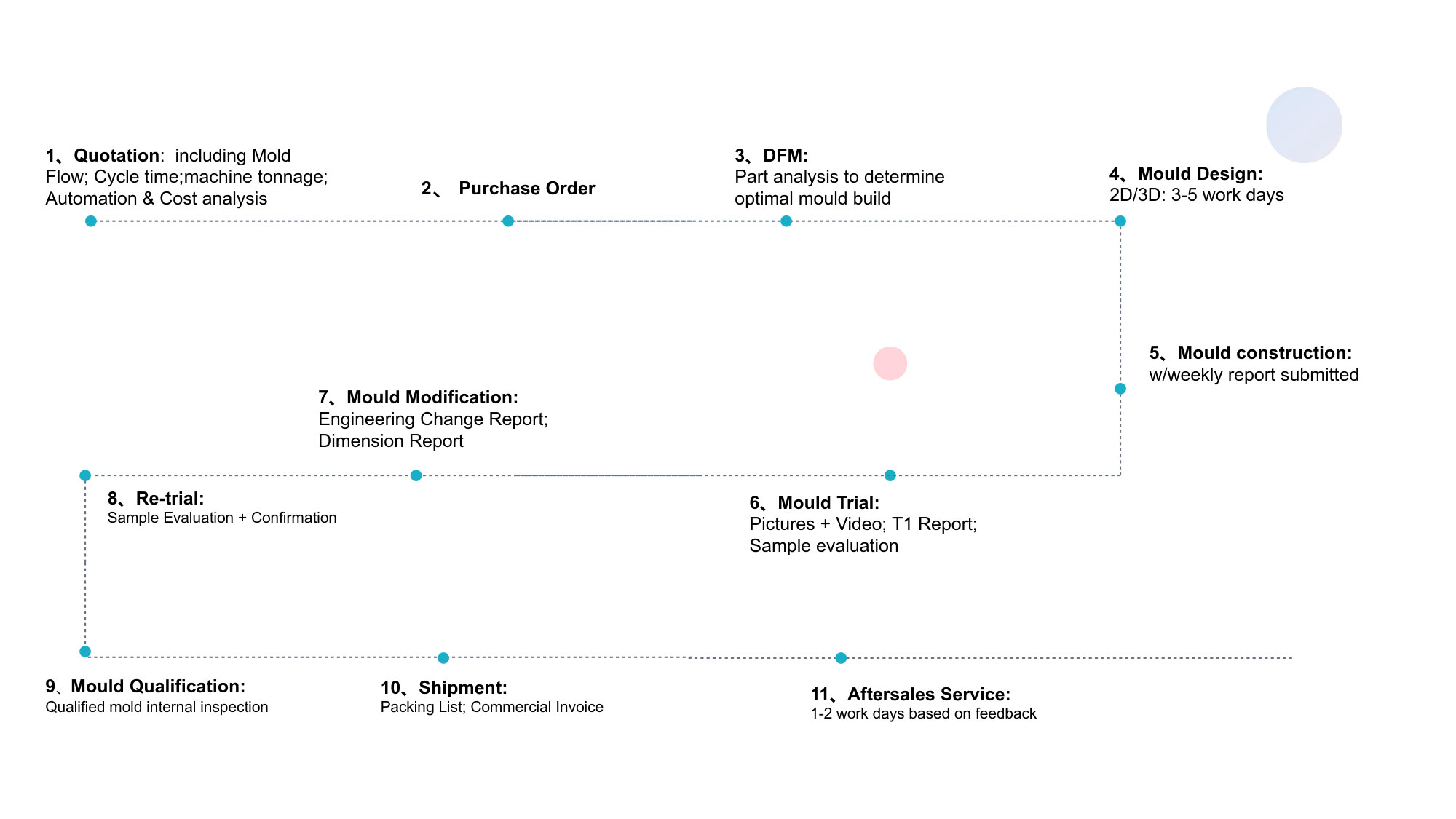
4.2 Trial Molding (T1, T2, T3) – Transparent, Documented Improvement
“We provide T1 through T3 trial samples. Each round is accompanied by a detailed improvement report.”
We also offer quick‑change mold insert capability – allowing different design variants to be tested without cutting an entire new mold.
▶ Customer value: You see progress, you see documentation, and you have a voice in each improvement round. No “black box” development.
4.3 Small‑Batch Validation – De‑Risk Mass Production
“100–500 piece trial production run before full‑scale mass production. Yield rate and CPK statistics are provided.”
▶ Risk eliminated: No “hundred‑thousand‑piece scrap event” because a process was signed off too early.
▶ Customer value: You approve production only after you see statistical evidence of a stable process.
4.4 Maintenance, Spares, and Lifetime Support
Spare parts kit (ejector pins, core pins, wear inserts) delivered with the mold
Mold preventive maintenance performed every 200,000 cycles
Lifetime repair service – billed at cost, never marked up for captive customers
▶ Customer value: Your mold does not become an orphan. We are responsible for its performance for its entire life.
SECTION FIVE – DIFFERENTIATED PROMISES: TARGETING COMMON CUSTOMER COMPLAINTS
What Customers Commonly Complain About in the Industry Our Specific, Verifiable Response
“The mold breaks down constantly, disrupting our orders.” We run a 2,000‑cycle aging test before mold delivery and issue a wear report. We also offer a 3‑year structural warranty (excluding normal wear items).
“Flash is everywhere; we spend a fortune on post‑processing.” We machine parting surfaces to 0.005 mm fit accuracy with self‑locking clamp force compensation. Flash is held under 0.03 mm – which means you can skip manual deflashing entirely.
“Dimensions change from batch to batch.” We integrate real‑time wall thickness monitoring with automatic hold pressure compensation to actively prevent drift – not just inspect it after the fact.
“Mold repairs take weeks; we lose entire production windows.” In‑house electrode manufacturing and EDM cells mean routine repairs (weld repair + insert replacement) are turned around in under 24 hours. The mold never leaves our facility.
SECTION SIX – DENSITY SPECIFICATIONS FOR PTFE FLOAT VARIANTS
For specification purposes, customers frequently ask about achievable densities across different PTFE float technologies:
Float Type Typical Density Range Primary Application
Pure PTFE float 2.15 – 2.21 g/cc Chemical processing, high‑temperature sensors, corrosion‑resistant level sensing [2†L5-L8][2†L17-L20]
PP foam float 0.3 – 0.6 g/cc Buoyancy‑sensitive applications, low‑density liquid level detection [2†L10-L12]
MuCell microcellular PTFE Variable; typically 15–30% density reduction relative to solid PTFE Weight‑optimized floats requiring PTFE chemical resistance but reduced mass for faster response
Note: Pure PTFE cannot be conventionally injection molded without a binder system, followed by debinding and sintering [9†L4-L15][9†L36-L46]. Our PTFE float production for high‑purity applications uses this binder‑assisted + sintering process. For applications where lower density is critical, PP foam or MuCell microcellular foaming technology is recommended.
SECTION SEVEN – COMPLETE PTFE FLOAT PRODUCTION SOLUTION
Product Introduction, Process Flow, Delivery, Quality, Cost, and After‑Sales
7.1 Product Introduction
PTFE (polytetrafluoroethylene) floats offer chemical inertness, continuous operation to 260°C, coefficient of friction as low as 0.04, and complete resistance to virtually all chemicals [10†L23-L28][11†L13-L18]. Applications include:
Level sensing in corrosive process tanks
Liquid level switches in pharmaceutical production
Float valves for chemical transfer systems
High‑purity semiconductor fluid handling
7.2 Manufacturing Process
Step 1 – Material compounding (binder‑assisted method): PTFE fine powder is mixed with a sacrificial binder (PFA or FEP) to create a flowable slurry [9†L26-L31].
Step 2 – Injection molding: The compound is injected into a precision float cavity at 350–420°C [10†L46-L48].
Step 3 – Debinding: The binder is thermally removed in a controlled‑atmosphere furnace [9†L36-L41].
Step 4 – Sintering: The debound part is sintered at 370–380°C, fusing PTFE particles into a dense, cohesive float [9†L41-L46][11†L37-L39].
Step 5 – Secondary processing: De‑gating, optional surface treatment, assembly, and final inspection.
7.3 Delivery Efficiency
Four production bases (China + Vietnam) provide geographic redundancy [12†L7-L8]
260 injection molding machines with capacity to support emergency surge demand [13†L10-L12]
Typical 6‑8 weeks from mold kick‑off to first mass‑production shipment
Expedited capability available for urgent programs
7.4 Quality Assurance
Pre‑production: DFM report + Moldflow simulation + raw material certification
In‑production: MES‑locked parameters + real‑time sensor feedback + CMM spot checks
Post‑production: 100% dimensional inspection (select critical dimensions) + final assembly validation
Documentation: Full PPAP (Production Part Approval Process) package available upon request
7.5 Competitive Cost Control
Three‑layer cost engineering:
Material optimization: Multi‑cavity mold designs + hot runner systems reduce PTFE material waste by 18–25%
Cycle‑time reduction: 70% automated machining + process simulation reduces average tryout shots to 2 rounds – saving weeks of development time [17†L13-L15]
Supply chain integration: Raw material procurement through certified fluoropolymer suppliers at volume‑discounted rates
Bottom line for you: A PTFE float program that might cost USD 80,000–120,000 in tooling and development from a typical supplier is typically reduced by 18–30% through Ansix Tech’s integrated cost‑engineering platform.
7.6 After‑Sales Service and Support
Service Component Commitment
Technical support 12‑hour email response; 24‑hour emergency escalation
Spare parts Stored in our controlled inventory; 72‑hour global expedited delivery
Mold maintenance On‑site and remote options; scheduled preventive maintenance every 200k cycles
Lifetime traceability Full mold genealogy; material batch traceability for the tool’s entire service life
SECTION EIGHT – SUMMARY: FROM “TECHNICAL CAPABILITY” TO “YOUR BUSINESS OUTCOME”
If You Care About… Ansix Tech Delivers…
Mold not breaking down 3‑year structural warranty; 24‑hour in‑house repair
Low part cost Multi‑cavity + hot runner + 28 years of process optimization
Consistent quality MES‑locked parameters; real‑time closed‑loop control; CPK ≥ 1.33
Predictable delivery 260 machines across four plants; 72‑hour spare‑part dispatch
Regulatory compliance ISO 9001, ISO 13485, IATF 16949, ISO 8 Cleanroom, GMP, FDA 510K
FINAL STATEMENT TO THE CUSTOMER
Dear customer – for Ansix Tech, a mold is never just a block of steel. It is your profit‑generating asset. We design every parting line, every cooling channel, every ejector pin location to ensure that when the mold reaches your production floor, it runs immediately – no debugging, no trial‑and‑error, no hidden surprises.
We would welcome the opportunity to take one of your existing PTFE float designs and run a full DFM analysis. You will see with your own eyes exactly how we eliminate weld lines, gas traps, sink marks, and shrinkage – before we ever cut the first piece of steel.
*When you are ready, contact us at info@ansixtech.com. We will respond within 12 hours
Ansix Tech Co Ltd
If you have any plans related to PTFE (polytetrafluoroethylene) float , you can contact us at any time. We will turn your ideas into reality, let you realize your dreams, and obtain large orders from the market. Our contact information is info@ansixtech.com. Or contact our CTO, mail: stephen@ansixtech.com
#www.ansixtech.com #ansixtech.com #PTFE (polytetrafluoroethylene) float #PTFE (polytetrafluoroethylene) float injection molding companies #PTFE (polytetrafluoroethylene) float Canopy Mold injection mold companies #Ansix #Ansix moulds #Ansix china #Ansix tech china #Ansix tech company #Ansix facotry #PTFE (polytetrafluoroethylene) float injection molding #PTFE (polytetrafluoroethylene) float injection tools #PTFE (polytetrafluoroethylene) float injection moulds #PTFE (polytetrafluoroethylene) float plastic mould #PTFE (polytetrafluoroethylene) float plastic tools #Ansix Tech #Ansix molds #Ansix injection molding #Ansix mold factory #injection molding PTFE (polytetrafluoroethylene) float#Ansix mold factory #PTFE (polytetrafluoroethylene) float china #PTFE (polytetrafluoroethylene) float molds #injection factory #PTFE (polytetrafluoroethylene) float injection molding #PTFE (polytetrafluoroethylene) float injection molding factory #injection molding company #PTFE (polytetrafluoroethylene) float injection mold companies #PTFE (polytetrafluoroethylene) float Tooling #PTFE (polytetrafluoroethylene) float mold limited #Ansix mold china #Ansix companies #Ansix company China #PTFE (polytetrafluoroethylene) float facotry #Ansix Tech #Ansix Tech mould #PTFE (polytetrafluoroethylene) float injection moulding #injection moulding company #Ansix PTFE (polytetrafluoroethylene) float parts injection mold companies #medical injection molding companieschina #PTFE (polytetrafluoroethylene) float china factory #Ansix moulding companies #Ansix molding company #PTFE (polytetrafluoroethylene) float injection moulding facotry #Ansix Tech mold #PTFE (polytetrafluoroethylene) float mould #PTFE (polytetrafluoroethylene) float plastic injection molding #ansix plastic mold #Mold manufacturing #PTFE (polytetrafluoroethylene) float parts manufacturing #PTFE (polytetrafluoroethylene) float plastic parts factory #PTFE (polytetrafluoroethylene) float injection parts mold #PTFE (polytetrafluoroethylene) float PRECISION MANUFACTURING #PTFE (polytetrafluoroethylene) float #China mold #PTFE (polytetrafluoroethylene) float injection moulding china #PTFE (polytetrafluoroethylene) float mould china #china precision mold #mold in china #PTFE (polytetrafluoroethylene) float mold china #Precision molds #High-precision molds #PTFE (polytetrafluoroethylene) float #Injection molds #PTFE (polytetrafluoroethylene) float Factory #PTFE (polytetrafluoroethylene) float Company #Super Large Injection Mold Factory #Large Tonnage Injection Molding Factory #PTFE (polytetrafluoroethylene) float Company #PTFE (polytetrafluoroethylene) float Factory #2800T Injection Molding Factory #3000 Ton Injection Molding #4500 Ton Injection Molding Factory #Large Mold Injection Molding #Large Plastic Mold Injection Molding Factory #Large Injection Mold Manufacturer #Plastic Mold Factory #Injection Mold #Plastic Mold