



Self-locking PET preform mold with 4-96 cavities
FEATURES
Executive Summary
In an era where every second counts and every gram matters, the injection molding industry faces relentless pressure: higher precision, faster production cycles, increasingly complex designs, and continuous cost reduction demands. Ansix Tech, a precision engineering firm with over 28 years of injection molding expertise, has established itself as a leader in advanced mold manufacturing, delivering high-quality, efficient, and reliable solutions for the PET preform industry.
This report presents a comprehensive overview of Ansix Tech's Self-locking PET Preform Mold with 4-96 cavities, encompassing product design, material selection, manufacturing processes, injection molding optimization, quality assurance, delivery efficiency, and competitive cost control. The document is structured to translate technical expertise into tangible customer value—showing how Ansix Tech solves problems, reduces costs, mitigates risks, and enhances productivity.
-
Mold Description
Product Materials:
PET PETG PS AS PP
Mold Material:
S136ESR
Number of Cavities:
1*96
Glue Feeding Method:
Hot runner
Cooling Method:
Water cooling
Molding Cycle
42.5s
- The mold manufacturing process and product material selection
Foundation of Hard Power — The Infrastructure That Earns Customer Trust
Before a single preform is molded, the foundation of manufacturing capability determines the ceiling of product quality. Ansix Tech's facility is equipped with state-of-the-art machinery that transforms engineering designs into physical precision.
Precision Mold Processing Equipment
Five-Axis High-Speed Machining Centers: Ansix Tech employs advanced five-axis high-speed machining centers capable of achieving ±0.002mm precision on complex curved surfaces. This directly translates to smooth, flash-free parting lines on every preform produced. For the customer, this means no secondary deburring operations, reduced labor costs, and consistent part quality cycle after cycle.
-
Slow Wire EDM (Wire-Cut Electrical Discharge Machining): The facility maintains slow wire EDM equipment that can machine micro-holes and narrow slots as small as 0.03mm. This capability is critical for producing thin-walled sections without deformation, ensuring that even the most delicate preform designs can be manufactured without structural compromise.
CNC Turning, Milling, EDM, Engraving, and Grinding Machines: The comprehensive suite of high-precision machining equipment ensures full CNC control and high efficiency, guaranteeing the precision manufacturing of critical components. The integration of CAD/CAE/CAM design software systems enables seamless transition from digital design to physical production.
Injection Molding Machine Fleet
Ansix Tech's injection molding machine fleet covers a clamping force range from 30 tons to 4,000 tons, enabling production of product sizes from small medical components to large industrial containers. All machines are equipped with all-servo electric drives, delivering repeatability precision of ±0.1%. For the customer, this means that every shot—whether the first or the hundred-thousandth—is identical to the last, eliminating batch-to-batch variation and ensuring consistent preform quality for downstream blow molding operations.
For high-cavity PET preform applications, Ansix Tech's machines are optimized to run molds with up to 96 cavities, supporting compatibility with major injection systems including Husky, Netstal, and Kata.
Inspection and Metrology Equipment
Coordinate Measuring Machines (CMM): Every mold undergoes full dimensional inspection before shipment, with critical dimensions verified to CPK ≥ 1.33. This statistical proof of capability provides customers with documented evidence of quality, eliminating uncertainty and enabling confident production planning.
Optical Imaging and Vision Inspection Systems: High-resolution optical metrology equipment ensures that cosmetic and geometric requirements are verified objectively. For the customer, this means no subjective "accept/reject" decisions—only data-driven quality assurance.
Industry 4.0 Intelligent Manufacturing Ecosystem
Ansix Tech has announced a comprehensive program addressing manufacturing challenges through a fully integrated Industry 4.0 intelligent manufacturing ecosystem. All machines are networked, with molding parameters (temperature, pressure, speed, time) locked within the MES (Manufacturing Execution System), accessible only by authorized engineers. This eliminates unauthorized parameter changes and ensures process repeatability across shifts and production runs.
SECTION TWO: Mold Manufacturing Core Competencies — Quantified Performance Metrics
Self-locking preform molds represent a significant advancement over non-self-locking molds. They employ a sloping locking mechanism within the mold's core and cavity. During mold closing, under the relatively small initial locking force of the injection molding machine, this mechanism automatically wedges in, achieving self-locking of the mold parting surface and thus bearing most of the expansion force of the plasticized material. Its core advantages lie in its ability to effectively prevent flash, extend mold life, and reduce the clamping force requirements of the injection molding machine.
Steel Material Selection
The journey of every preform mold begins before steel is cut—with strategic material selection. Different preform applications require different polymer properties, and Ansix Tech employs a rigorous methodology.
Mold Frame Steel (P20): Pre-hardened P20 steel provides excellent machinability and dimensional stability for the mold base. Surface hardness is maintained at 38-40 HRC, with nickel plating for enhanced corrosion resistance.
Mold Core and Cavity Materials:
S136 (Sweden ASSAB): Premium stainless mold steel for core and cavity components. Heat-treated to 48-52 HRC, providing exceptional hardness, wear resistance, and corrosion resistance. This material ensures mold longevity and consistent preform quality.
2344 / 2343 / 8407 / H13: High-performance hot-work tool steels offering excellent toughness and thermal fatigue resistance for demanding applications.
SKD11 / SKD61 / DC53: High-carbon, high-chromium tool steels providing exceptional wear resistance for high-volume production.
M340 / 4Cr13 / 9Cr18: Stainless mold steels offering superior corrosion resistance for medical and food-contact applications.
NAK80: Pre-hardened steel providing excellent mirror finish capability for cosmetic applications.
Nitriding Steel: For threaded neck sections, imported high-hardness nitriding steel provides extended service life with hardness maintained above 50 HRC.
Performance Guarantees:
Standard plastic (PET) applications: Minimum 1,000,000 mold cycles without major repair
Glass-reinforced materials: Minimum 500,000 mold cycles (or up to 5 million cycles for specialized designs)
Full material certification reports and heat treatment curves provided with every mold
Precision and Tolerances
Achievable dimensional tolerances for standard structural components: ±0.05mm. For precision gears and medical components: ±0.005mm. For PET preform molds specifically, the advanced two-stage double taper positioning technology ensures each cavity is independently self-locking, maintaining concentricity and eliminating "drift" during long production runs. Preform wall thickness variation is maintained below 0.05mm, and weight variation below 0.3g across all cavities. Each core and cavity pair is machined and finished to achieve excellent concentricity, ensuring minimum wall thickness variation and consistent dimensions across all cavities.
The advanced dipole taper positioning technology independently locks each cavity, ensuring concentricity and long-term stability. For 28/30mm neck size preform molds, the optimal controllable cavity count for self-locking molds is up to 32 cavities, while pin valve air-sealed molds can support more than 48 cavities for mass production.
Mold Type Classifications
Hot Runner Systems: Ansix Tech designs and builds hot runner systems that minimize material waste and reduce cycle times. The natural balance method enables the mold to reach equilibrium state quickly during filling. For 96-cavity bottle preform molds, Moldflow analysis optimizes runner channel dimensions to achieve flow balance and optimal process parameters. The five-layer runner structure—exceeding traditional three-layer designs—ensures uniform plastic flow into every cavity, enabling consistent product cooling times and multiple-product injection per shot.
Stack Molds: For doubling production efficiency without increasing machine size.
Two-Shot / Multi-Material Molds: For complex applications requiring different materials or colors.
High-Gloss Molds: Achieving surface roughness Ra < 0.05μm, ideal for transparent and cosmetic applications.
Gate and Runner Design
Using Moldflow CAE simulation, Ansix Tech engineers predict weld line locations, air trap positions, and filling imbalances before any steel is cut. This preemptive approach identifies potential defects such as weld lines (weak points where flow fronts meet), air traps (leading to burn marks or voids), sink marks (local depressions from uneven cooling), and excessive shear stress (causing material degradation). By optimizing gate locations, runner dimensions, and processing parameters virtually, the team delivers robust mold designs that require minimal trial shots and eliminate costly rework.
The runner system employs smooth arc connections to reduce material shear and pressure drop, minimizing stress and improving melt uniformity.
Cooling System Design
Cooling accounts for up to 80% of PET molding cycle time (20–30 seconds), severely limiting efficiency. Inadequate cooling leads to crystallization defects such as whitening, haze, or yellowing.
Ansix Tech's cooling system design incorporates:
Conformal cooling channels following the contour of the preform
Cooling water channels in gate, cavity, thread splits, and core, designed for turbulent flow at minimum flow rates
Partitioned temperature control zones with temperature differential between core and cavity maintained within 2°C to minimize warpage
Wet areas maximized in gate, cavity, thread splits, and core for fast and efficient cooling
Large channel diameters for chilled water transport, resulting in low pressure drop and energy conservation
For the customer, this engineering translates into reduced cycle times (as low as 4.8 seconds for high-cavity configurations), lower energy consumption, and superior preform quality with minimal crystallization defects.
Ejection System Design
All stack components are hardened to over 50 HRC, providing high wear resistance, resistance to plastic deformation, and long service life. Optional PVD coatings provide extremely wear-resistant surfaces and facilitate easier ejection with lower ejection forces. Ejector pins are manufactured from Japanese SKD-61, hardened to 48-50 HRC.
Lead Time Standards
Simple molds: 10 days
Medium-complexity molds: 25–45 days
Expedited delivery: As short as 20 days (with validation steps fully maintained)
All quick delivery timelines are achieved without compromising the comprehensive validation process, ensuring that accelerated schedules do not sacrifice quality.
SECTION THREE: Injection Molding Process Control — Eliminating Quality Anxiety
Customers' greatest concerns revolve around molding defects: sink marks, flash, dimensional instability, and batch-to-batch color variation. Ansix Tech addresses each through systematic process control.
Process Standardization
All injection molding machines are networked, with all molding parameters (temperature, pressure, speed, and time) locked within the MES. Only authorized engineers can modify settings, preventing unauthorized changes that could compromise quality. Every batch undergoes first-article and last-article comparison inspections, ensuring that the entire production run meets specifications.
Dimensional Stability Control
Temperature Management: The mold is equipped with partition-controlled mold temperature controllers, maintaining temperature differential between core and cavity within 2°C to minimize warpage. For the customer, this means that critical dimensional features remain stable across production runs.
Verification Data: For similar support products, three consecutive production batches over one week showed critical hole spacing variation ≤ 0.02mm. This level of repeatability eliminates the need for frequent dimensional inspections and reduces scrap rates.
Cosmetic Quality Standards
Transparent Components: Achievable quality levels include bubble-free, flow-mark-free transparency.
Plated Components: Gas-mark-free surfaces suitable for high-quality plating.
High-Gloss Components: Surface roughness Ra ≤ 0.2μm.
For products requiring painting or printing, Ansix Tech can pre-engineer warpage compensation into the mold design, achieving print registration accuracy of ±0.1mm.
Special Material Processing Capabilities
Ansix Tech has extensive experience molding a wide range of engineering thermoplastics:
Material Category Specific Grades
Standard Engineering PC/ABS, PC, PBT
High-Performance PPS+40%GF, PEEK, PEI
Fluoropolymers PTFE, PFA, PVDF
Reinforced Nylons PA6+GF30, PA66
High-Temperature LCP, PPS
Liquid Silicone LSR (Liquid Silicone Rubber)
Fire Resistance: UL94 V-0 rated components for electrical housings.
Weathering Performance: UV testing validated to 3,000 hours without color change.
For high-temperature applications such as automotive or medical containers, materials like PEEK (continuous use up to 250°C with excellent chemical resistance) and PEI (maintaining structural integrity in humid environments with superior flame retardancy) demonstrate outstanding performance.
PET Material-Specific Expertise
For beverage applications, PET remains the dominant material due to its excellent transparency, gas barrier properties, and recyclability.
Intrinsic Viscosity (IV): Ansix Tech recommends bottle-grade PET resin with IV of 0.80 dl/g—balancing processability and final bottle strength.
Acetaldehyde (AA) Control: Low-AA PET grades are essential for beverage applications where AA affects taste. Ansix Tech selects materials with AA generation characteristics appropriate for each application.
Recycled PET (rPET) Compatibility: Ansix Tech molds are designed to process up to 100% rPET content, supporting customer sustainability goals and circular economy initiatives. For lightweight applications, a 5.89-gram, 100% rPET preform can be produced in cycles as fast as 4.5 seconds on a 144-cavity mold configuration.
SECTION FOUR: Full-Service Process — Reducing Customer Management Costs
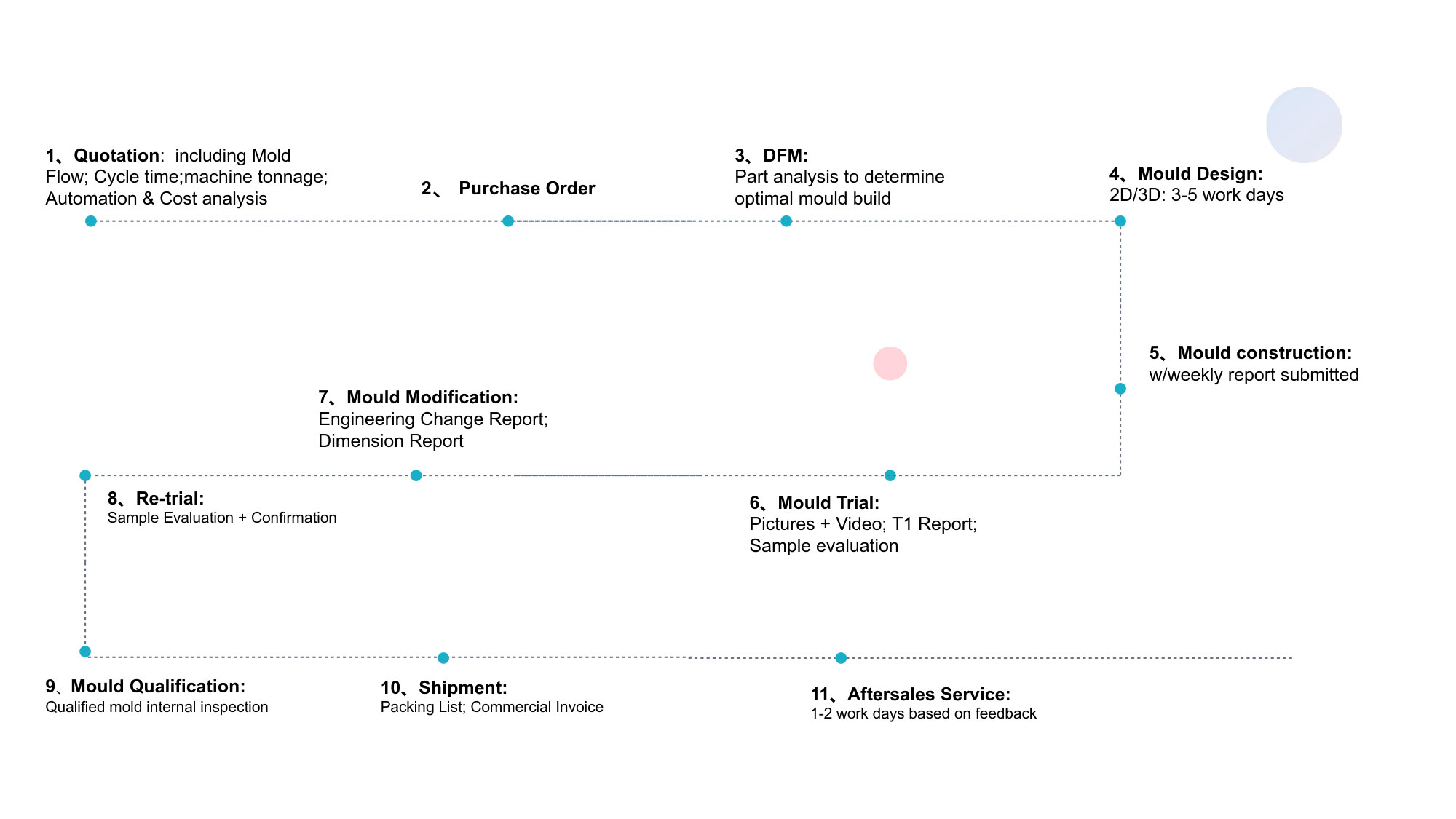
Early Engagement — DFM (Design for Manufacturing)
Before any steel is cut, Ansix Tech provides comprehensive mold feasibility analysis reports covering:
Draft angle recommendations for optimal ejection
Wall thickness optimization to prevent sink marks and voids
Gate location selection to minimize weld lines
Ejector pin mark location allowances to avoid functional surfaces
Preform stretching simulation to improve blow molding yield rates
This early-stage collaboration is the first step in cost savings, preventing expensive redesigns after molds are already cut.
Prototyping and Sampling
Full-scale prototype mold inserts using high-speed machining and additive manufacturing cooling channels enable practical validation of cooling layouts, ejection kinematics, and assembly fits.
T0 to T3 Sampling: Samples provided at each trial stage with accompanying improvement reports. Quick-change inserts allow different design variations to be validated without full mold rework.
Preform Testing: Prototype preforms undergo stretch blow molding testing at customer facilities, with resulting bottles tested for top load strength, leak integrity, and visual clarity. Any detected deviations are fed back into the CAD model for iterative improvement before final mold release.
Small-Batch Validation
Prior to full production release, Ansix Tech provides 100-500 shot trial runs, documenting yield rates and CPK values. Mass production only commences when statistical process capability is confirmed. This approach eliminates the risk of discovering quality issues only after full-scale production has begun.
Maintenance and Spare Parts
Spare wear parts (ejector pins, core inserts, cavity inserts) delivered with every mold
Mold maintenance provided every 200,000 cycles
Lifetime repair service at cost-based pricing
Service training provided to customer technicians covering mold and hot runner maintenance as well as PET processing
Standard wear parts kept in stock for immediate shipment
Modular Construction: Replaceable cavity lock rings separate wear parts from the main cavity structure, enabling inexpensive and easy replacement without major mold disassembly. No axial load on cavities allows use of lower steel section thickness and faster cooling.
SECTION FIVE: Differentiated Value Proposition — Addressing Common Pain Points
Customer Pain Point Ansix Tech Solution & Customer Value
Frequent mold repairs interrupt production 2,000-cycle aging test before delivery with wear report; 3-year mold structure warranty (excluding normal wear parts). Ansix Tech guarantees up to 1 million cycles for standard PET applications and up to 5 million cycles for specialized designs.
Excessive flash requiring secondary finishing 0.005mm parting surface fitting precision; self-locking clamping force compensation; flash controlled ≤0.03mm per batch, eliminating manual deburring
Dimensional variation between batches Ultrasonic wall thickness sensors providing real-time feedback; in-mold temperature/pressure sensors enabling closed-loop control; SPC monitoring with CPK ≥ 1.33
Long mold repair cycles In-house electrode machining center and EDM workshop; on-site repairs without external vendors; typical repair turnaround within 24 hours for welding/insert replacement
High reject rates and material waste DFM simulation identifies potential defects before manufacturing; T0-T3 sampling validates design before mass production; process parameter locking ensures repeatability
Need to reduce part weight for cost savings Process optimization reduces warpage by 4.75% (0.2mm → 0.1905mm) and weight by 2.05% (43.25g → 42.37g)
Difficulty with recycled material processing Molds designed for up to 100% rPET content; specialized screw designs optimize melt quality for lightweight preforms
SECTION SIX: Ansix Tech Material Selection Framework for PET Preforms
The selection of PET resin grades significantly impacts preform quality and economic outcomes.
PET Resin Properties
Property Specification Impact on Customer Value
Intrinsic Viscosity 0.80 dl/g (typical bottle grade) Balances melt strength for processing with final bottle mechanical properties
Crystallization Rate Carefully controlled Prevents opacity and brittleness in finished preforms while maintaining transparency for bottles
Acetaldehyde Generation Low-AA grade Prevents taste contamination in beverages, especially critical for water and carbonated soft drinks
Reheat Performance Optimized for stretch blow molding Shorter reheat times = higher line speeds = greater output
Material Cost Optimization
Ansix Tech's expertise lies in selecting the optimal material grade for each specific application—never over-specifying nor compromising on performance. Through systematic evaluation of material properties, manufacturability, life cycle costs, and end-use performance, the team delivers the right material for the right application at the right price.
For wine bottle applications, crystal-clear transparency with excellent alcohol and acid resistance is required, alongside low-AA grades to prevent taste alteration. Ansix Tech evaluates material grades based on IV (affecting melt strength and crystallization rate), AA generation, and crystallization rate to match application requirements precisely.
SECTION SEVEN: How Ansix Tech Solves Customer Problems and Delivers Value
Problem #1: High Per-Unit Production Costs
Ansix Tech Solution: Multi-cavity optimization and cycle time reduction.
Customer Value: By designing molds with cavity counts from 4 to 96, Ansix Tech enables customers to scale production output without proportionally increasing machine time. For high-volume applications, a 96-cavity mold producing 500ml bottle preforms reduces per-unit cost through:
Amortized overhead: Fixed costs (machine depreciation, labor, facility) spread across 96 parts per cycle
Reduced energy per part: All-servo electric drives with kinetic energy recuperation lower energy consumption per preform by up to 20%
Material savings: Optimized runner design reduces scrap; process optimization achieves 2.05% weight reduction
Secondary operation elimination: Flash-free molding eliminates deburring labor
Long tool life: Up to 5 million cycles before major maintenance
Quantified Savings: For a 500ml water bottle preform application, weight reduction of 2.05% on a 43.25g preform saves approximately 0.89g per preform. At 100 million preforms annually, this equals 89 metric tons of PET material saved per year.
Problem #2: Inconsistent Quality Leading to Customer Rejections
Ansix Tech Solution: Full-cycle quality control system covering design validation, material and machining supervision, prototype testing, and post-delivery maintenance.
Customer Value: Verified quality means no surprises.
Pre-manufacturing: Design validation and standardization through DFM and Moldflow simulation
During manufacturing: CMM inspection, FAI (First Article Inspection) reports, and defect mapping for every mold
Post-manufacturing: Prototype testing and full validation before mold release
In production: All machines networked with MES-locked parameters; SPC monitoring with CPK ≥ 1.33; ultrasonic wall thickness sensors providing real-time feedback
Quantified Value: Reduced risk of customer rejects, lower warranty costs, stronger customer relationships, and elimination of rework expenses.
Problem #3: Long Production Lead Times and Missed Delivery Dates
Ansix Tech Solution: Industry 4.0 intelligent manufacturing with integrated systems and optimized workflows.
Customer Value: Confidence in delivery schedules.
Rapid mold manufacturing: Simple molds in 10 days; expedited delivery to 20 days
Process stability for injection molding: Stable 10-second cycles for PET preforms; can achieve cycles as low as 4.8 seconds for high-cavity 144-cavity molds
Flexible cavity configurations: 32/48/64/72/96 cavities; 64-cavity mold fits within 48-cavity machine footprint, enabling higher output without machine replacement
Quantified Value: Faster time-to-market for new products, ability to respond to demand spikes, and reduced inventory holding costs through just-in-time production.
Problem #4: High Mold Maintenance and Repair Costs
Ansix Tech Solution: Modular construction, premium materials, and in-house repair capability.
Customer Value: Lower total cost of ownership.
Modular cavity construction: Replaceable wear parts separated from main cavity structure for inexpensive replacement
DLC coatings on neck rings: Extends maintenance intervals, lengthens mold lifespan
In-house repair capability: Electrode machining and EDM on-site; typical repair within 24 hours
Quantified Value: Reduced downtime, longer intervals between mold changes, and lower spare parts inventory requirements.
SECTION EIGHT: Assembly, Packaging, and Rapid Delivery
Assembly Process
Technicians assemble all machined parts step by step following detailed drawings. Core and cavity alignment requires perfect concentricity; guide posts and bushings maintain appropriate clearances. The advanced two-stage double cone positioning system ensures each cavity locks independently, maintaining concentricity below 0.05mm.
During heating operations, the central runner temperature control is activated first, waiting until target temperature is reached before branch runners are turned on. This prevents raw material from overheating, breaking down, or discoloring. Initial adjustments achieve smooth opening and closing action with high dimensional accuracy and fine surface finish. If any issues arise, rework is performed—turning mold making into an iterative refinement process.
Trial Runs and Final Inspection
Engineers test the complete mold on an actual injection molding machine with predetermined parameters. Preforms produced are inspected in detail for:
Dimensions
Appearance (no flash, bubbles, or cloudiness)
Uniform wall thickness
Overall physical properties
Gate area crystallinity (low crystallinity indicates proper gate thermal insulation and aggressive cooling)
A few key protocols are observed: during initial injections, cavities are filled gradually rather than all at once, adding material in small batches over several cycles. Only after all standards are met is the mold released for production use.
Packaging and Delivery
Each mold is thoroughly cleaned, corrosion-protected, and securely packaged for shipment. The package includes:
Complete mold assembly
Spare wear parts (ejector pins, core inserts, cavity inserts)
Dimensional inspection report with CMM data
Material certification and heat treatment curves
Maintenance manual with recommended service intervals
Quick-connect couplings for rapid mold change
Logistics
Standard shipping options available worldwide. Ansix Tech's logistics network supports expedited shipping for urgent orders. All molds are insured for full value during transit.
SECTION NINE: Industry Experience and Proven Reliability
Ansix Tech has over 28 years of injection molding expertise, with a precision engineering track record spanning applications from PET bottles to pharmaceutical containers.
Case Study: 96-Cavity Mineral Water Bottle Mold
Ansix Tech successfully designed, manufactured, and delivered a 96-cavity mineral water bottle mold that not only met stringent quality requirements but also significantly reduced the customer's total cost of ownership. Through careful material selection, innovative hot runner design, advanced mold flow simulation, and a rigorous rapid delivery process, Ansix Tech demonstrated how precision engineering increases output while lowering costs.
Key achievements:
Three-plate hot runner mold producing 96 PET preforms per cycle for 500ml water bottles
Five-layer runner structure ensuring uniform fill and cooling across all cavities
World-class double taper positioning technology providing independent cavity self-locking
Preform wall thickness variation below 0.05mm; weight variation below 0.3g
Full-scale prototype mold inserts using high-speed machining and additive manufacturing cooling channels
Preform stretching simulation to improve blow molding yield
Case Study: 64-Cavity Self-Locking Needle Valve Mold
This advanced mold configuration achieves 64 cavities within the same machine footprint as a standard 48-cavity mold. By mid-2022, over 10 sets had been delivered to customers.
Key achievements:
Stainless steel or nickel-plated P20 mold plates (38-40 HRC)
S136 or 2316 core and cavity components (48-52 HRC)
Japanese SKD-61 ejector pins (48-50 HRC)
Italian beryllium copper injection nozzles (38 HRC)
Italian ROTFIL or German HOTSECT heaters per cavity
American DuPont P84NT2 polyimide insulation caps (continuous service to 380°C)
Sustainability Integration
Ansix Tech supports circular economy initiatives through:
rPET processing capability: Molds designed for up to 100% recycled PET content
Energy-efficient design: Kinetic energy recuperation and system pressure reduction functions lower energy consumption; optional servo-electric drives further reduce energy use
Lightweighting expertise: Process optimization achieving 2.05% weight reduction without compromising strength
Material waste reduction: Runnerless hot runner systems eliminate sprue waste
SECTION TEN: Conclusion — The Ansix Tech Advantage
At its core, a mold is not merely a piece of steel—it is a preform production machine, a revenue generator, and the foundation of a customer's entire packaging operation. Ansix Tech designs molds with injection molding productivity, robust venting paths, and temperature balance engineered in. The result: molds that arrive at your production line ready to run with minimal setup, produce low flash, and deliver long, trouble-free service life.
The Value Equation
What Customers Get How Ansix Tech Delivers
Lower per-unit cost High cavity count (4-96), optimized cycle times (as low as 4.8 sec), reduced weight (2.05% savings), flash-free molding
Consistent quality CMM inspection (CPK≥1.33), MES-locked process parameters, in-mold sensors for closed-loop control, FAI documentation
Fast delivery 10 days for simple molds, 20 days expedited, vertical integration with in-house machining
Low maintenance Premium steels (S136/H13/SKD61) heat-treated to 48-52 HRC, modular construction with replaceable wear parts, DLC coatings
Technical support Comprehensive DFM before molding begins, T0-T3 sampling, training for customer technicians, 3-year warranty
Sustainable operations rPET-ready (up to 100%), energy-efficient servo drives, lightweighting capability, no-scrap hot runner systems
Call to Action
For a demonstration of how Ansix Tech can translate your preform requirements into a reliable, cost-effective, high-productivity molding solution, request a full-process DFM report on an existing product. This analysis will visually demonstrate how potential risks such as weld lines, air traps, and sink marks are proactively eliminated before manufacturing begins.
An early engagement is the most cost-effective path to successful mold manufacturing. Through collaborative design, advanced CAD modeling, comprehensive DFM reviews, and Moldflow simulation, Ansix Tech ensures that the final mold is optimized for quality, productivity, and longevity—delivering the lowest total cost of ownership over the mold's entire service life.
Ansix Tech — Precision Engineering for the Future of PET Preform Molding
*An ISO-compliant facility with over 28 years of injection molding expertise, serving global customers in beverage, medical, pharmaceutical, cosmetics, and industrial packaging applications.
Ansix Tech Co Ltd
If you have any plans related to Self-locking PET preform mold with 4-96 cavities , you can contact us at any time. We will turn your ideas into reality, let you realize your dreams, and obtain large orders from the market. Our contact information is info@ansixtech.com. Or contact our CTO, mail: stephen@ansixtech.com
#www.ansixtech.com #ansixtech.com #Self-locking PET preform mold with 4-96 cavities #Self-locking PET preform mold with 4-96 cavities moulds #Self-locking PET preform mold with 4-96 cavities injection molding companies #Self-locking PET preform mold with 4-96 cavities Canopy Mold injection mold companies #Ansix #Ansix moulds #Ansix china #Ansix tech china #Ansix tech company #Ansix facotry #Self-locking PET preform mold with 4-96 cavities injection molding #Self-locking PET preform mold with 4-96 cavities injection tools #Self-locking PET preform mold with 4-96 cavities injection moulds #Self-locking PET preform mold with 4-96 cavities plastic mould #Self-locking PET preform mold with 4-96 cavities plastic tools #Ansix Tech #Ansix molds #Ansix injection molding #Ansix mold factory #injection molding Self-locking PET preform mold with 4-96 cavities #Ansix mold factory #Self-locking PET preform mold with 4-96 cavities china #Self-locking PET preform mold with 4-96 cavities molds #injection factory #Self-locking PET preform mold with 4-96 cavities injection molding #Self-locking PET preform mold with 4-96 cavities injection molding factory #injection molding company #Self-locking PET preform mold with 4-96 cavities injection mold companies #Self-locking PET preform mold with 4-96 cavities#Self-locking PET preform mold with 4-96 cavities mold limited #Ansix mold china #Ansix companies #Ansix company China #Self-locking PET preform mold with 4-96 cavities facotry #Ansix Tech #Ansix Tech mould #Self-locking PET preform mold with 4-96 cavities injection moulding #injection moulding company #Ansix Self-locking PET preform mold with 4-96 cavities parts injection mold companies #medical injection molding companieschina #Self-locking PET preform mold with 4-96 cavities china factory #Ansix moulding companies #Ansix molding company #Self-locking PET preform mold with 4-96 cavities injection moulding facotry #Ansix Tech mold #Self-locking PET preform mold with 4-96 cavities mould #Self-locking PET preform mold with 4-96 cavities plastic injection molding #ansix plastic mold #Mold manufacturing #Self-locking PET preform mold with 4-96 cavities parts manufacturing #Self-locking PET preform mold with 4-96 cavities plastic parts factory #Self-locking PET preform mold with 4-96 cavities injection parts mold #Self-locking PET preform mold with 4-96 cavities PRECISION MANUFACTURING #Self-locking PET preform mold with 4-96 cavities #China mold #Self-locking PET preform mold with 4-96 cavities injection moulding china #Self-locking PET preform mold with 4-96 cavities mould china #china precision mold #mold in china #Self-locking PET preform mold with 4-96 cavities mold china #Precision molds #High-precision molds #Self-locking PET preform mold with 4-96 cavities #Injection molds #Self-locking PET preform mold with 4-96 cavities Factory #Self-locking PET preform mold with 4-96 cavities Company #Super Large Injection Mold Factory #Large Tonnage Injection Molding Factory #Self-locking PET preform mold with 4-96 cavities Company #Self-locking PET preform mold with 4-96 cavities Factory #2800T Injection Molding Factory #3000 Ton Injection Molding #4500 Ton Injection Molding Factory #Large Mold Injection Molding #Large Plastic Mold Injection Molding Factory #Large Injection Mold Manufacturer #Plastic Mold Factory #Injection Mold #Plastic Mold