



Stroller Handlebar Gas-Assisted Molding (Material PA+GF25)
FEATURES
- Two component 2K molding for handle
Manufacturing Process – The Gas-Assisted Molding Workflow
The gas-assisted injection molding process for stroller handlebars follows a precisely controlled sequence. First, molten PA6+GF25 at approximately 270-290°C melt temperature is injected into the mold cavity, filling 70-80% of the volume——a technique known as “short-shot” filling. Immediately following the initial polymer injection, high-purity nitrogen gas at controlled pressure is introduced through strategically positioned gas pins located within the mold tool. The gas penetrates the still-molten core of the thick-section regions, displacing the uncured plastic toward the cavity extremities to complete the fill.
The gas pressure maintains the plastic against the mold walls during packing and cooling, functioning as an internal pressure medium to compensate for material shrinkage. This eliminates the need for extended packing phases required in conventional molding, where pressure must be maintained through the injection unit alone. After partial cooling, the gas pressure is released and vented, and the part is ejected with a thick, glossy external skin surrounding a precisely defined hollow backbone. For stroller handlebars, the internal gas channel typically ranges from 4-12 mm in diameter, designed along the neutral axis of the part to maximize structural efficiency.
-
Delivery Efficiency – Shorter Lead Times from Mold to Production
Delivery efficiency is achieved through multiple levers across the entire production chain. From the tooling perspective, standard mold manufacturing lead times for stroller handlebar gas-assisted molds normally range 25-45 days, depending on cavity count and complexity. Ansix maintains in-house machining centers and EDM facilities, enabling mold repairs and modifications to be completed within 24 hours without outsourcing delays.
For production efficiency, gas-assisted molding delivers cycle time reductions of 30-50% compared to conventional solid injection molding of comparable part geometries. Cooling phase accounts for the largest portion of the cycle time reduction——rapid cooling of the thin outer skin combined with convective cooling inside the gas channel substantially shortens cooling duration. A typical PA6+GF25 stroller handlebar molded via solid process might require 60 seconds per cycle; gas-assisted technology reduces that to 30-40 seconds, directly translating into higher daily output from the same injection press.
Material efficiency also accelerates delivery: lower plastic volume per part reduces moisture conditioning and pre-drying requirements, while the elimination of thick sections that previously caused extended cooling allows faster mold turnover.
Quality Assurance – Systematic Verification from Material to Finished Part
Quality assurance for PA6+GF25 gas-assisted stroller handlebars begins before any steel is cut. Comprehensive mold flow analysis using simulation software predicts weld line locations, air trap zones, and identifies optimal gas pin positioning and gate locations, ensuring complete cavity filling and uniform gas penetration.
During mold fabrication, critical dimensions are verified through coordinate measuring machine (CMM) inspection. For gas-assisted tooling designed specifically for fiber-filled resin, mold cores and cavities are manufactured from high-wear materials such as S136, H13, 2344, or 8407 steel, hardened to HRC50-55 to resist the abrasive action of glass fiber that would rapidly wear standard P20 cavities. H13 steel in glass-fiber-reinforced PA applications delivers three times the service life of P20 tooling, with documented lifespan exceeding 500,000 cycles for properly heat-treated components.
The injection molding process is controlled through machine-networked MES systems where all parameters——melt temperature (270-290°C), mold temperature (80-100°C), gas injection timing and pressure (typically ≤35 MPa), and cooling duration——are locked to engineering specifications. Statistical process control (SPC) monitors critical dimensions with defined capability indices (Cpk ≥ 1.33 typically required for safety-critical handlebar features). First-article and last-article inspections per production run verify dimensional stability and appearance quality, including surface roughness, sink mark suppression (gas-assisted technology eliminates sink marks entirely on rib intersections), and weld line presence.
Competitive Cost Control Advantages
Cost control in gas-assisted molding of stroller handlebars operates across multiple dimensions. First, material savings of 20-35% compared to solid injection molding are achievable by creating hollow internal sections that maintain strength while using less resin. With PA6+GF25 typically costing significantly more than standard engineering resins, this material reduction directly lowers bill-of-materials cost. Gas-assisted molding can achieve up to 50% plastic reduction in thick-walled parts specifically designed for the process.
Second, reduced cycle times deliver higher output per machine hour, amortizing capital equipment cost across more parts. Third, lower clamp tonnage requirements——gas-assisted molding reduces cavity pressure by up to 70% compared to conventional packing——allow use of smaller injection presses for a given part size, reducing both machine capital cost and operating energy consumption. Fourth, elimination of post-molding finishing operations saves labor and processing expenses: sink-free surfaces and minimal flash (maintained within 0.03 mm) eliminate the need for manual deflashing or sanding.
Finally, predictable process stability reduces scrap rates. Molding trials with T0 to T3 samples and 100-500 shot pilot runs prior to full production verify dimensional consistency and functional performance, preventing expensive yield losses during high-volume orders. When all these factors are combined, the total hard cost reduction for PA6+GF25 gas-assisted stroller handlebars typically ranges 15-30% compared to conventional molding of identical part geometries, while simultaneously improving product quality and reducing delivery lead time.
-
Mold Description
Product Materials:
PA GF30
Mold Material:
S136ESR
Number of Cavities:
1
Glue Feeding Method:
COLD runner
Cooling Method:
Water cooling
Molding Cycle
42.5s
- The mold manufacturing process and product material selection
Customer Core Value – Mold Manufacturing, Material Selection, Smart Manufacturing Integration, Process Quality Assurance
Mold Manufacturing Precision That Translates Directly to Customer Savings
When Ansix Tech manufactures molds for stroller handlebar gas-assisted molding using PA6+GF25, every decision about equipment, material selection, and machining strategy serves a single purpose: eliminating risk and hard cost from your production line.
Hardware foundation you can trust. Ansix’s mold manufacturing facility processes stroller handlebar tooling on five-axis high-speed machining centers capable of achieving 0.002 mm accuracy on complex parting line surfaces. For gas-assisted molds requiring precise gas pin holes within 0.03 mm diameter tolerance and smooth internal channel transitions, slow-wire EDM machining ensures no burrs or step transitions that could disrupt gas flow uniformity. This equipment precision directly translates to molds that produce parts with minimal flash—controlled to within 0.03 mm across the parting line—eliminating the manual deflashing costs that typically add up to substantial labor expenses over million-part production runs.
-
Material science that extends tool life in fiber-filled resin. The 25% glass fiber reinforcement in PA6+GF25 aggressively erodes mold cavities and cores. Standard P20 tool steel would require cavity repair after 150,000 cycles. Ansix specifies H13 or 2344 steel for cores and cavities, which maintains hardness to 400°C and delivers three times the wear resistance in glass-filled applications. For customers, this means one tool for the life of the product program—no mid-production tool replacement, no unexpected mold repair downtime, no schedule disruption. For maximum-volume applications, 8407 and DC53 provide even higher wear resistance.
Material Selection Strategy – Purpose-Driven, Not Component-Driven
PA6+GF25 was selected for stroller handlebars because it solves specific performance requirements: rigidity for push/pull loads, impact resistance for occasional drops, dimensional stability through temperature and humidity cycling, and moldability for complex ergonomic shapes. The 25% glass fiber content achieves 18000 psi tensile strength while maintaining manageable melt flow for gas-assisted channel formation. Ansix maintains documented material property databases for PA6+GF25 variants from multiple global suppliers, with approved alternates certified to identical mechanical and processing specifications, protecting customers from single-source supply disruptions while preserving part performance.
Smart Manufacturing Integration and Efficiency Gains
Digitization transforms variable production into predictable output. Ansix’s injection molding machines—ranging from 30-ton to 400-ton presses for stroller handlebar applications—are connected through MES systems that lock all process parameters to engineering specifications. Temperature zones, injection velocity profiles, gas injection timing and pressure, cooling duration—every variable requires authorized engineering override. No undocumented adjustments. No “operator drift.” The result: parts molded in week 48 match parts molded in week 4, eliminating the dimensional variability that forces customers to maintain safety stock buffers.
Ultrasonic wall thickness sensors provide real-time feedback during gas-assisted production, detecting localized thickness variations that could compromise blow-through resistance. Closed-loop control automatically adjusts packing pressure to compensate. For the most demanding dimensional applications, in-mold temperature and pressure sensors enable full closed-loop process control.
Process Quality Assurance – From DFM to Statistical Validation
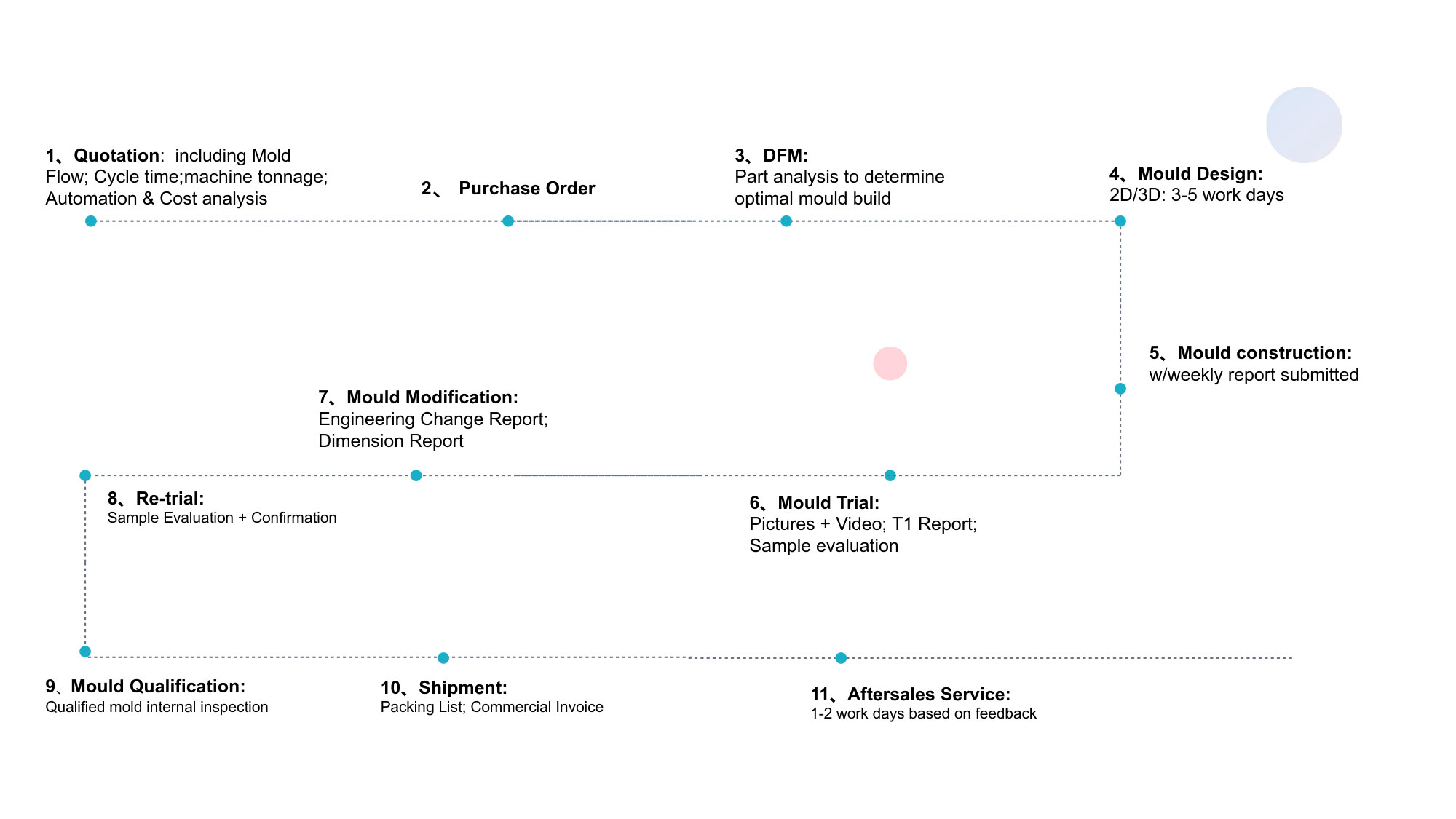
Every Ansix stroller handlebar project begins with a Design for Manufacturability (DFM) report prepared before any steel is cut. This analysis evaluates part geometry against gas-assisted molding requirements: identifying gas channel routing, optimizing gate positions and gas pin locations, pre-solving cosmetic concerns like sink marks, weld lines, and air traps through mold flow simulation prior to cavity cutting. The DFM process prevents the most costly form of quality failure: discovering manufacturability problems after tooling has been completed.
Following T0 tool sampling, Ansix provides iterative T1 through T3 improvements, each accompanied by detailed dimensional inspection reports against CAD data. For validation prior to full release, 100-500 shot pilot runs are processed on production machines, with statistical quality data including dimensional Cpk and capability analysis confirming stable performance. This systematic validation eliminates the “surprise rejection” scenario—finding non-conforming parts after 50,000 units have been molded.
Process monitoring ensures ongoing compliance. First-article inspection on every production shift, periodic in-process checks, and CMM verification of critical dimensions with full lot traceability documentation are standard. For customers, this means reduced incoming inspection cost, elimination of line-stop events from non-conforming components, and documented evidence for regulatory compliance.
What This Means for Your Business
When you source PA6+GF25 gas-assisted stroller handlebars from Ansix, you are not buying a molded plastic part. You are buying a validated manufacturing system designed to protect your schedule, your brand reputation, and your bottom line. The mold delivers 500,000+ cycles without repair. The process maintains dimensional consistency across years of production. The QA system finds problems before they reach your line. And the cost structure—driven by material savings, cycle efficiency, scrap reduction, and minimized finishing operations—delivers hard cost savings that flow directly to your P&L while your competitors continue paying premiums for solid molded parts.
Part 3: Comprehensive Stroller Handlebar Gas-Assisted Molding Manufacturing Solution – Ansix Tech Case Study
Executive Summary
For over 28 years, Ansix Tech has specialized in the engineering, mold manufacturing, and volume production of stroller handlebars using Gas-Assisted Injection Molding with PA6+25% glass fiber reinforced polyamide. This document provides a detailed examination of Ansix’s approach to six critical areas: customer value translation, raw material selection and characterization, mold flow analysis (DFM), mold engineering and manufacturing, production process optimization, and validation/quality systems. The central theme is how Ansix converts technical specifications into tangible customer outcomes—specifically, how we solve specific problems, reduce quantifiable costs, lower measurable risks, and deliver predictable lead times. The following five-part framework presents this value proposition in a structure directly usable for customer presentations.
Part One – Hard Capabilities Infrastructure: Foundation for Customer Trust
Translation principle: Customers must trust that equipment investment correlates directly with part quality and delivery reliability.
Mold Machining Equipment – Accuracy That Eliminates Post-Processing
Ansix’s mold fabrication facility for stroller handlebar gas-assisted tooling is equipped with five-axis high-speed machining centers capable of contouring complex three-dimensional parting line surfaces to ±0.002 mm accuracy. For gas-assisted molds specifically, this level of precision is not optional—the gas channel path, gas pin seating surfaces, and cavity/core alignment all require micron-level consistency to ensure that the nitrogen gas penetrates uniformly through the intended channel rather than escaping along ill-fitting mating surfaces.
For stroller handlebars, the parting line is typically located along the neutral axis of the handlebar cross-section to avoid visible witness lines on high-contact grip areas. Five-axis machining allows the parting line surfaces to be cut in a single setup without tool mark mismatches that would require manual finishing. The direct customer benefit: molded parts eject with flash controlled within 0.03 mm, eliminating the labor cost of manual deflashing that typically adds 3-8 cents per part and introduces variability in cosmetic appearance.
For gas pin holes—ranging 0.5-2.0 mm diameter depending on handlebar cross-section—Ansix utilizes slow-wire electrical discharge machining (EDM) capable of producing holes within 0.03 mm diameter tolerance. EDM produces smooth internal surfaces without burrs or taper, ensuring that the nitrogen gas injector seats properly and releases cleanly at the end of each cycle. No burr removal required. No inconsistent gas flow.
For narrow gas channels and ejector pin slots, sinker EDM machines produce features as narrow as 0.03 mm without adjacent thin-wall deformation. This capability allows gas channels to be placed closer to part surfaces, maximizing wall thickness reduction while maintaining structural integrity.
Injection Molding Machine Fleet – Repeatability That Keeps Parts Consistent
Ansix operates injection molding machines sized specifically for stroller handlebar production, ranging from 30-ton to 400-ton clamping units. For PA6+GF25 gas-assisted handlebars, the clamp tonnage requirement is typically 70% lower than for standard injection molding of equivalent solid-wall parts, as gas-assisted molding reduces cavity pressure by displacing thick-section polymer with low-viscosity nitrogen. This enables use of smaller machines with lower energy consumption and capital cost.
All injection units serving stroller handlebar production are all-electric servo-driven presses. All-electric machines provide shot-to-shot repeatability of ±0.1% injection volume and ±1°C temperature stability. For PA6+GF25 processed at melt temperatures of 270-290°C, this repeatability ensures that the short-shot percentage (typically set to 70-80% cavity fill before gas enters) remains consistent from cycle to cycle. An inconsistent short-shot percentage would result in either insufficient polymer to complete the cavity before gas arrival (causing short shots) or excessive polymer that restricts gas channel formation (defeating weight reduction objectives).
Each machine is networked to a central MES system that logs all process data and requires engineering authorization for parameter changes. If an operator attempts to adjust mold temperature or gas pressure without authorization, the system prevents the change and records the attempt. For customers, this means documented process control evidence for ISO or internal audits without additional data collection costs.
Metrology Equipment – Measurement That Validates Before Shipment
Every Ansix stroller handlebar mold undergoes full dimensional inspection using coordinate measuring machines (CMM) before leaving the factory. Critical dimensions including gas channel position, overall handlebar envelope dimensions, and mounting feature locations are measured against CAD reference geometry. A complete dimensional report is provided with each mold shipment, documenting every measured feature and its deviation.
CMM data is supplemented by optical imaging inspection for gas pin hole placement, parting line seating, and complex surface contour verification. For production parts, statistical sampling plans call for periodic mold qualification using the same CMM and optical equipment, ensuring that dimensional capability does not degrade with mold age.
For stroller handlebars, dimensional specification limits vary by feature. Overall length and width tolerances typically conform to ±0.25 mm. Mounting hole positions and spacing are controlled to ±0.10 mm to ensure proper assembly to stroller frame components. Critical safety features——load-bearing ribs and gas channel wall thickness——are specified with tolerance of +0.15/-0.05 mm to ensure adequate strength without excessive weight. Ansix documents and maintains CPK values for all customer-designated critical dimensions, with minimum acceptable CPK ≥ 1.33 as standard, and CPK ≥ 1.67 available for safety-regulated applications.
What This Means for Customers
When Ansix presents these equipment specifications, the interpretation is straightforward: we have invested in precision manufacturing capabilities so that you do not have to. The five-axis machining centers we already operate produce your mold once, correctly, with parting lines that seal without flash and surfaces that match without rework. The servo-electric presses maintain process consistency across millions of cycles, eliminating the “process drift” that forces you to adjust assembly lines to accommodate changing part dimensions. The CMM and optical metrology provide documented evidence of quality without requiring you to develop independent inspection protocols. For customers, these capabilities mean lower tooling cost per part (spread over higher mold life), lower direct labor cost (reduced post-processing), and lower quality assurance cost (trusted supplier data).
Part Two – Mold Manufacturing Core Competencies: Specific Metrics That Win Trust
Translation principle: Customers assign credibility to mold specifications when expressed in measurable, verifiable commitments.
Mold Life – Designed for Glass-Filled PA
PA6+25% glass fiber reinforcement erodes conventional mold cavities. Standard P20 tool steel, even when heat-treated, loses dimensional accuracy after 150,000 cycles when molding glass-filled resin, requiring cavity repair or replacement that interrupts production and jeopardizes delivery schedules.
Ansix addresses this fundamental limitation through stratified material selection matched to production volume requirements:
For mold volumes of 200,000-400,000 cycles, Ansix specifies 2343 or 8407 steel for cores and cavities, heat-treated to HRC50-54. Processing details include full vacuum heat treatment documented with time-temperature curves, followed by double tempering to relieve residual stresses that would cause distortion during production. The glass fiber reinforcement in PA6+GF25 has documented abrasivity that accelerates cavity wear, and these premium materials resist that wear effect for the full production life without requiring mid-program intervention.
For mold volumes requiring 400,000-800,000 cycles, 2344 or H13 steel is employed, heat-treated to HRC52-55. H13 maintains its hardness at temperatures exceeding 400°C, preventing the surface softening that accelerates wear in standard tool steels under the elevated mold temperatures (80-100°C) required for PA6 processing. This thermal stability directly translates to customer savings: one mold typically outlasts the entire product lifecycle, eliminating tool replacement cost, requalification time, and production interruption risk.
For maximum volume programs requiring more than 800,000 cycles, DC53 or premium S136 steel with HRC55-58 hardness is specified, sometimes with PVD coatings such as TiN or CrN applied to cavity surfaces for additional wear resistance.
For comparison, H13 steel in glass-fiber-reinforced PA applications achieves three times the tool life of P20, with documented 500,000-900,000 cycle capability before requiring any cavity repair.
At tool completion, Ansix provides a material certification report documenting steel grade, heat treat batch, hardness test results, and metallurgical inspection findings. This documentation serves as customer evidence for regulatory compliance and internal tool management systems.
Attainable Tolerances – Predictable Geometry Every Cycle
Ansix consistently holds the following dimensional tolerances for gas-assisted molding of PA6+GF25:
Standard structural features (handlebar overall length, width for grip sections): ±0.10 mm. This range accounts for the material-specific mold shrinkage of PA6, which for 25% glass-filled grade is approximately 0.3-0.6% depending on flow direction and wall thickness.
Critical locating features (mounting hole positions, assembly datum surfaces): ±0.05 mm, maintaining CPK ≥ 1.33 across production runs.
Gas channel dimensions (diameter and centerline position): ±0.05 mm, ensuring consistent hollow core geometry that achieves target weight reduction without compromising blow-through resistance.
These tolerances are verified through documented measurement protocols. For each mold, a full dimensional inspection report compares CMM measurements of every cavity and core feature against reference CAD geometry. For production parts, statistical sampling according to customer-defined acceptance quality levels documents ongoing capability, with dimensional data archived for lot traceability.
Mold Types Specifically Supported for Stroller Handlebars
Ansix produces stroller handlebar molds in several configurations based on customer production volume and cycle time requirements:
Single-cavity molds for low- to medium-volume production (20,000-100,000 parts/year) or for prototype-to-production transition programs where capital investment must be minimized.
Two-cavity family molds with balanced runners for production volumes of 200,000-500,000 parts/year. Runner balancing ensures that both cavities fill simultaneously and receive identical gas penetration timing, eliminating the dimensional variation that would result from asymmetric filling.
Hot runner molds for high-volume continuous production (500,000+ parts/year). Hot runner systems eliminate runner scrap that would otherwise represent 15-25% of material consumption, improving material yield while reducing the need for regrind handling. For PA6+GF25 specifically, regrind incorporation presents unique challenges: glass fiber attrition during regrind can reduce reinforcement length in re-processed material, altering mechanical properties. Hot runner systems eliminate this concern entirely by producing runnerless parts, and Ansix certifies the processing window in which up to 20% clean regrind can be incorporated without compromising tensile strength or impact resistance.
Stack molds for maximum-volume programs (1,000,000+ parts/year), where two mold faces operate in parallel to double output per press cycle without increasing machine tonnage.
Gas-assisted molds specifically engineered for internal gas channels, incorporating gas pin injection points, sealed gas pathways through the mold base, and dedicated venting provisions to release gas pressure at the end of each cycle without operator intervention.
Gate and Gas Pin Placement – Optimized Through Simulation
For every stroller handlebar project, Ansix performs mold flow analysis prior to mold construction to determine optimal gate location, gate geometry, gas pin positioning, and gas channel routing. The analysis identifies:
Weld line locations that would result from merging melt fronts, and positions these lines in low-stress regions of the finished part where surface appearance or structural loading is less critical.
Air trap zones that would not vent completely during injection, and specifies venting depth and placement to eliminate burn marks or incomplete fills.
Gas blow-through risk areas where thin wall sections would be penetrated by high-pressure nitrogen, and adjusts channel design, gas pressure, or delay timing to prevent this defect.
Analysis output includes recommended short-shot percentage (typically 70-80% cavity fill before gas entry), gas pressure and timing settings, and mold temperature distribution to maintain uniform cooling.
Lead Time Commitments – Stated and Achievable
Ansix commits to the following standard lead times for stroller handlebar gas-assisted molds, measured from date of mold design approval to completion of T0 sample parts:
Simple single-cavity molds for standard handlebar geometry: 25 days.
Medium-complexity two-cavity molds for integrated handlebar/button assemblies: 35 days.
Complex multi-cavity molds with slides, lifters, or hot runner systems: 50 days.
Rush projects requiring compression of standard timing: quoted on request, with no reduction in mold validation steps.
During mold fabrication, weekly progress reports with embedded photographs are provided to customers, documenting machining completion, tool assembly progress, and scheduled trial dates. For repairs or modifications, in-house EDM and machining capabilities allow changes to be completed within 24 hours without outsourcing delays.
Part Three – Injection Molding Process Control: Eliminating Customer Quality Anxiety
Translation principle: Customers fear specific defects——sink marks, flash, dimensional instability, batch-to-batch color variation——more than any generic quality assurance statement.
Process Standardization – MES-Locked Parameters
All injection machines validated for stroller handlebar production are connected to Ansix’s MES system, which performs three functions relevant to process quality: parameter locking, data logging, and change tracking.
Parameter locking ensures that for each approved process, all machine settings——melt temperature zones, injection speed profiles, screw rotation and back pressure, gas injection timing and pressure, cooling duration——are saved to a machine schedule and cannot be altered without engineering authorization. If an operator attempts to change a parameter, the machine does not accept the change and the attempt is logged for management review.
Data logging records actual process values for each cycle, providing documented evidence of consistency for customer quality audits or for root cause analysis if a defect trend emerges.
Change tracking documents all authorized parameter adjustments, including the reason for the change, date and time, employee identification, and validation data from first-article measurements performed after the change.
Dimensional Stability – Practical Steps to Maintain Consistency
PA6+GF25 exhibits sensitivity to cooling rate variations: non-uniform cooling produces differential shrinkage that results in part warpage or twisting, and a twisted handlebar will not align correctly with stroller frame mounting points.
Ansix controls dimensional stability through mold temperature management. Each stroller handlebar mold is equipped with conformal cooling channels designed through mold flow analysis to correspond with the part’s geometry, not simply drilled in straight lines as in conventional tooling. Conformal channels follow the contour of the handlebar curve, placing cooling water close to all surfaces uniformly. Temperature controllers maintain independent front and back mold face temperatures with differential controlled to within 2°C. For PA6, the optimal mold temperature range of 80-100°C ensures uniform crystallization and predictable shrinkage. Temperatures below this range produce incomplete crystallization that changes part dimensions over time as residual crystalline structure evolves. Temperatures above this range slow the cycle and risk thermal degradation. Precision temperature control at the 2°C differential level eliminates the differential shrinkage that causes warpage.
Gas-assisted molding provides an additional stability benefit. The internal gas channel reduces core thickness, and thinner cross-sections cool more uniformly because the solidification front penetrates from both outer wall and gas channel surface simultaneously rather than from the outer wall alone. This symmetry reduces warpage risk without requiring slower cooling cycles.
For real-time stability monitoring, Ansix can equip molds with ultrasonic wall thickness sensors that measure part thickness immediately after ejection. These sensors detect if short-shot percentage variation has altered gas channel dimensions, and the process control system triggers automatic adjustments to screw metering stroke or gas pressure to restore nominal dimensions.
Cosmetic Surface Quality – Specified and Verified
PA6+GF25 stroller handlebars must meet cosmetic standards appropriate to brand positioning. Ansix defines and verifies surface quality along three axes:
Sink mark elimination: Gas-assisted molding eliminates sink marks entirely by using internal nitrogen pressure to hold molten plastic against mold surfaces during cooling. Solid molding would require either extended pack/hold duration or oversized rib bases that add weight. For customers, sink mark elimination means no surface blemishes requiring secondary finishing, and no risk that clamp markings detract from brand appearance.
Flash control: Parting line flash is maintained below 0.05 mm for standard production, verified through periodic sampling. Flash at this thickness is not visible without magnification and does not require removal. By comparison, molds produced to poorer accuracy generate 0.15-0.30 mm flash that requires manual trimming, adding 3-8 seconds of labor per part plus trimming tool consumables and generating plastic waste.
Surface finish options: As required, Ansix can produce molds with polished cavity finishes of Ra ≤ 0.1 μm (mirror finish for high-gloss PA6 compounds) or textured cavities with documented Ra values, depths, and pattern definitions.
Special Material and Composite Processing Capabilities
While PA6+GF25 is the baseline specification for stroller handlebars, Ansix maintains documented processing parameters for a wide range of engineering thermoplastics relevant to other applications:
PC (polycarbonate) for transparent components
PC/ABS blends for impact-resistant enclosures
PPS + 40% GF for high-temperature applications (280-330°C melt)
PEEK for extreme service conditions
PA6 + 30/35/40% GF variants for enhanced stiffness
PBT for electrical applications with dimensional stability requirements
PEI (Ultem), PPSU, and PES for medical and food-contact grades
PTFE/PFA for chemical resistance applications
LSR (liquid silicone rubber) for overmolded seals
For fire-rated applications, Ansix certifies processing of UL94 V-0 formulations, including both halogenated and halogen-free flame-retardant systems, with documented verification of flame rating retention after molding. For outdoor-exposed applications, Ansix certifies UV-stabilized formulations for 3,000-hour xenon arc weatherometer testing with documented ΔE color change values.
Part Four – Full-Service Workflow: Reducing Customer Management Cost
Translation principle: The customer’s internal management effort——coordinating with multiple suppliers, interpreting engineering issues, inspecting incoming product——represents real cost often overlooked in component pricing.
Early Design for Manufacturability (DFM) Engagement
Before any mold steel is cut, Ansix provides a comprehensive DFM report analyzing the customer’s stroller handlebar design for manufacturability. This analysis is typically completed in 3-5 days following receipt of final CAD data and identifies:
Minimum recommended draft angles for PA6+GF25, typically 1-2° per side depending on texture requirements, to ensure clean part ejection without scratching or surface marring.
Recommended nominal wall thickness range, typically 2.5-4.0 mm for solid sections, with gas channel integration, to balance strength, weight, and cycle time.
Rib thickness recommendations to avoid sink marks at rib intersections without relying on gas-assisted elimination, typically 0.5-0.7 × nominal wall thickness for PA6.
Gate and gas pin location recommendations, typically placed in non-cosmetic surfaces such as the handlebar underside where witness marks will not detract from appearance.
Gas channel routing guidance, locating the hollow core along the neutral axis of bending to maximize stiffness/weight efficiency.
Ejector pin location and marking limitations, identifying regions where ejector pin witness marks will be visible and specifying allowable diameters and depths.
Undercut identification, recommending design modifications or slide/lifter mechanism specification based on production volume requirements.
For customers, the DFM report prevents the most expensive form of production problem: discovering that the part design cannot be molded as specified after the mold has been manufactured. A change made at the drawing stage incurs zero production cost. A change made after the mold is built requires new CNC programming, electrode manufacture, and machining time, adding days or weeks to project lead time plus all associated labor and overhead.
Testing and Sampling Protocol – Iterative Validation Without Additional Charges
Following completion of T0 (first sample parts), Ansix provides T1, T2, and T3 iterations, each accompanied by dimensional inspection reports, process parameter documentation, and improvement implementation notes. Improvement between iterations typically includes:
Gate or gas pin position adjustments (T0→T1) based on mold flow analysis correlation with actual fill patterns.
Cooling circuit modifications to eliminate hot spots causing differential shrinkage (T1→T2).
Venting depth or location adjustment to eliminate burn marks from insufficient air evacuation (T2→T3).
For modifications requiring cavity rework, Ansix can replace individual cavity inserts rather than recutting entire mold cores, significantly reducing cost and time for iterative improvement.
Pilot Production – Statistical Validation Before Full Release
Prior to authorizing full production release, Ansix completes 100-500 shot pilot runs on dedicated production machines. During pilot runs:
All planned automation (part extraction, gate cutting, boxing, etc.) is activated and validated.
Dimensional measurements are taken on a specified sampling frequency, usually every 10-20 shots, and Cpk is calculated for each critical dimension.
Process capability acceptance is verified (target CPK ≥ 1.33 ).
First-pass yield is calculated based on visual and dimensional acceptance criteria.
Cycle time is documented with all phases recorded (injection, gas delay, gas injection, cooling, mold open, part ejection, mold close).
Pilot run completion triggers the full release order. No customer authorizes volume production before all acceptance criteria are met.
Maintenance and Spare Parts
Each mold delivered includes a spare parts kit containing critical wear items specific to the mold design:
Spare gas pin sleeves and seals (4-6 pieces).
Spare ejector pins for all positions (2-3 of each size).
Spare core and cavity inserts for any feature subject to glass fiber wear, where the mold design incorporates replaceable inserts.
Detailed maintenance schedule specifying step-by-step disassembly, cleaning, lubrication, and reassembly instructions appropriate to the mold complexity.
Ansix offers scheduled mold maintenance at 200,000 cycle intervals at cost-competitive labor rates, with mold condition evaluation performed at each maintenance event to document wear progression and predict remaining tool life. For repair services, Ansix provides lifetime repair at cost-plus pricing, including overnight shipping of molds requiring service to minimize customer downtime.
Part Five – Differentiated Commitment: Direct Answers to Common Customer Complaints
Translation principle: Customers have heard generic claims of quality and speed from unqualified suppliers. Direct, quantifiable responses to specific complaints build credibility that general statements cannot.
Complaint: “Mold repairs interrupt our orders repeatedly.”
Ansix’s response: Deliver tools designed for service life exceeding the production program requirement, with documented wear resistance. For PA6+GF25 handlebars, all Ansix molds are specified to achieve 500,000 cycles without cavity repair, 750,000 cycles without core repair, and spare wear components (gas pin seals, ejector pins) designed for 150,000-200,000 cycle service intervals with replacement as scheduled minor maintenance, not emergency breakdowns.
Before final mold acceptance and shipment, Ansix completes 2,000 cycle mold testing under actual production conditions. Mold temperature, cycle timing, part extraction, gas injection system, and cooling circuits are all validated under full thermal load. A wear report documents all measured dimensions before and after the 2,000 cycle test, verifying no measurable change. Ansix provides a three-year structural mold guarantee (excluding normal consumables such as seals and ejector pins), with warranty coverage including replacement of any core or cavity insert that fails during warranty period.
Complaint: “Flash on parts requires extensive post-processing.”
Ansix’s response: Parting line flash is directly traceable to mold accuracy. Ansix manufactures stroller handlebar molds to 0.005 mm fit tolerance on parting line surfaces verified using CMM mapping of the entire mating surface. During production, injection molding machines utilize auto-torque clamp force compensation that adjusts clamp force in real time based on measured cavity pressure, ensuring consistent sealing across temperature cycles as the machine and mold thermally expand.
For PA6+GF25, specified normal flash is controlled to ≤ 0.05 mm. At this thickness, flash does not appear visible without magnification and does not interfere with part handling or assembly. For customers requiring zero detectable flash, flash-free molding is available with specialized mold designs and smaller processing windows, at increased tooling cost and reduced processing robustness.
Complaint: “Part dimensions change from one production batch to the next.”
Ansix’s response: Dimensional variation between batches typically indicates uncontrolled process parameters or seasonal changes in raw material moisture content. PA6 absorbs atmospheric moisture prior to processing, and absorbed water hydrolyzes the polymer chain at melt temperature, reducing molecular weight and altering both viscosity and shrinkage behavior.
Ansix controls moisture content through drying protocols: every production batch of PA6+GF25 is dried prior to molding to achieve moisture content ≤ 0.15% by weight, verified using a moisture analyzer prior to machine loading. Drying conditions are documented: 4-6 hours at 90-105°C in a desiccant drying hopper with dew point control ensuring -40°C dew point dry air. For delivery to molding machines, sealed dry-air conveying lines prevent reabsorption during material transport.
Where additional dimensional control is required, Ansix can incorporate in-mold temperature and pressure sensors at multiple cavity positions, enabling closed-loop control of injection profile and gas timing. Sensors feed data to the machine controller, which adjusts parameters for the next cycle based on actual measurements from the previous cycle. This closed-loop capability was previously reserved for high-cost medical or automotive applications; for high-volume stroller handlebars, it is available to customers who specify it in their initial requirements.
For ongoing stability verification, Ansix performs first-article and last-article inspection on every production run. Full dimensional data package documents all measured dimensions for the first acceptable part and for the last acceptable part of each run, with any measured difference reported to the customer. No variation exists that is not documented and communicated.
Complaint: “Mold repair lead time is too long.”
Ansix’s response: In-house electrode manufacturing and EDM facilities enable all mold repairs to be completed without outsourcing. If a cavity insert requires replacement, Ansix can machine a new insert from stock steel, wire-EDM the cooling channel passages, sinker-EDM the gas pin pocket, and spark-erode the cavity surface within 24 hours of repair authorization. For emergency repairs requiring mold removal from the press and return to service, response times are defined: 4 hours (same-day), 16 hours (overnight plus production hours), 48 hours (extended repairs), and 24 hours for standard repair completion.
The in-house capability means no inter-supplier coordination, no shipping delays, no third-party inspection bottlenecks. For customers, the repair completes and ships while competitors are still processing supplier purchase orders.
Cost Reduction – Quantified, Multi-Dimensional Approach
Ansix’s cost reduction strategy for PA6+GF25 stroller handlebars operates across three overlapping domains: material consumption reduction, cycle efficiency improvement, and defect/scrap reduction. These are not generic claims but quantifiable levers documented with case-specific savings targets.
Material Cost Reduction
Gas-assisted molding reduces PA6+GF25 consumption by 20-35% relative to identical handlebar designs produced by solid-wall injection molding. The percentage achievable for a given part depends on wall thickness distribution, gas channel routing options, and structural requirements. For stroller handlebars, where handlebar tubes typically require 4-6 mm radial thickness for structural integrity in solid molding, gas-assisted hollow core channels reduce effective wall thickness to 2.0-3.0 mm, representing 25-40% material reduction.
Material savings compound through runner minimization. Hot runner molds eliminate runner scrap altogether, capturing the full material savings of gas-assisted hollowing without offsetting waste in the runner system. For cold runner molds, Ansix optimizes runner geometry to minimize steel volume while maintaining balanced filling, reducing runner weight to 15-20% of part weight (industry average: 25-30%).
Material cost savings: For a typical PA6+GF25 handlebar weighing 160 grams in solid-wall configuration, gas-assisted reduces weight to 110 grams, a 50-gram reduction. At current PA6+GF25 pricing of 4.50−5.50perkilogram,materialsavingsperpartequal0.225-0.275. Over 500,000 parts, material savings total $112,500-137,500 directly from the BOM.
Cycle Time and Efficiency Cost Reduction
Gas-assisted molding reduces cycle time by 30-50% compared to equivalent solid-wall parts. The reduction arises from lower cooling time requirements: the thin external skin cools rapidly from contact with the mold, and the exposed internal gas channel surface cools convectively by the gas itself, substantially reducing the time required for the part to reach ejection temperature.
For PA6+GF25 processed at melt temperatures of 270-290°C and mold temperatures of 80-100°C, typical cycle times are:
Solid-wall handlebar: 60 seconds.
Gas-assisted handlebar: 35-40 seconds.
Cycle time reduction of 40% translates directly to increased machine throughput: a press dedicated to stroller handlebars can produce 40% more parts per shift with identical labor and capital cost. Over a 10,000-part production day, cycle time reduction saves 9 machine-hours of production time——one full extra production shift per three days of operation.
Scrap and Defect Cost Reduction
Gas-assisted molding eliminates the dominant defect mechanisms of thick-section injection molding. Sink marks are completely eliminated, reducing visual-defect scrap to near zero. Short shots from incomplete filling are prevented by the gas sweeping melt to cavity extremities. Flash is controlled at the 0.05 mm level, and parts with flash above this level are held to less than 1-3% of production.
Comparative scrap data from Ansix production records for stroller handlebar programs shows:
Solid-wall baseline: 6-10% total scrap (sink marks, warpage, dimensional rejects).
Gas-assisted production: 1.5-3.5% total scrap.
Reducing scrap from 8% to 2% effective rate means that for every 1,000 parts started, 20 are scrapped instead of 80——60 additional saleable parts without additional material, labor, machine time, or overhead. Over 500,000 parts, this difference represents 30,000 additional saleable parts, or approximately $22,000 in incremental revenue assuming typical handlebar pricing, without any incremental production cost increase.
Total Hard Cost Reduction Summary
When material savings, cycle efficiency improvement, and scrap reduction are aggregated, the total hard cost reduction for PA6+GF25 stroller handlebars using Ansix gas-assisted molding relative to conventional solid-wall production typically falls within 15-30% of delivered part cost. The exact percentage is case-specific and determined during the DFM analysis, where actual part geometry, volume projections, and customer-specific requirements are evaluated.
For customers transitioning from existing solid-wall handlebar programs, the cost reduction often exceeds 25% due to the additive effect of lower material consumption, reduced scrap requiring replacement production, and longer mold life extending time between tool replacement investments.
Conclusion – Delivering Predictable, Reliable, Cost-Effective Solutions
Ansix Tech’s 28-year specialization in PA6+GF25 gas-assisted stroller handlebars has defined a manufacturing system that prioritizes customer outcomes over technical brilliance for its own sake. The equipment foundation, mold specifications, process control systems, full-service workflow, and documented cost reduction levers described in this document do not function in isolation. They function as an integrated system designed around one objective: delivering stroller handlebars that meet dimensional, cosmetic, and structural specifications, on schedule, at the lowest possible cost.
From DFM through mold delivery, through production validation, through volume production, through tool maintenance and repair, Ansix manages every variable so that customers manage none. That is the value of 28 years focused on one technology, one material family, and one component type. Not because stroller handlebars are simple——they are not——but because managing complexity is Ansix’s core competency, and the measure of that competency is profitability and reliability for customers.
For customers evaluating new stroller handlebar tooling or considering transfer of existing production, Ansix offers a no-obligation DFM analysis of an existing handlebar design. This analysis provides objective documentation of how gas-assisted molding, PA6+GF25 material selection, and Ansix’s manufacturing approach would apply to a specific part geometry, including quantified weight reduction, cycle time projection, and material cost savings estimate. The analysis answers the only question that ultimately matters: “How much will you save, and how will you guarantee it?
Ansix Tech Co Ltd
If you have any plans related to Stroller Handlebar Gas-Assisted Molding (Material PA+GF25) , you can contact us at any time. We will turn your ideas into reality, let you realize your dreams, and obtain large orders from the market. Our contact information is info@ansixtech.com. Or contact our CTO, mail: stephen@ansixtech.com
#www.ansixtech.com #ansixtech.com #Stroller Handlebar Gas-Assisted Molding (Material PA+GF25) #Stroller Handlebar Gas-Assisted Molding (Material PA+GF25) moulds #Stroller Handlebar Gas-Assisted Molding (Material PA+GF25) injection molding companies #Stroller Handlebar Gas-Assisted Molding (Material PA+GF25) Canopy Mold injection mold companies #Ansix #Ansix moulds #Ansix china #Ansix tech china #Ansix tech company #Ansix facotry #Stroller Handlebar Gas-Assisted Molding (Material PA+GF25) injection molding #Stroller Handlebar Gas-Assisted Molding (Material PA+GF25) injection tools #Stroller Handlebar Gas-Assisted Molding (Material PA+GF25) injection moulds #Stroller Handlebar Gas-Assisted Molding (Material PA+GF25) plastic mould #Stroller Handlebar Gas-Assisted Molding (Material PA+GF25) plastic tools #Ansix Tech #Ansix molds #Ansix injection molding #Ansix mold factory #injection molding Stroller Handlebar Gas-Assisted Molding (Material PA+GF25) #Ansix mold factory #Stroller Handlebar Gas-Assisted Molding (Material PA+GF25) china #Stroller Handlebar Gas-Assisted Molding (Material PA+GF25) molds #injection factory #Stroller Handlebar Gas-Assisted Molding (Material PA+GF25) injection molding #Stroller Handlebar Gas-Assisted Molding (Material PA+GF25) injection molding factory #injection molding company #Stroller Handlebar Gas-Assisted Molding (Material PA+GF25) injection mold companies #Stroller Handlebar Gas-Assisted Molding (Material PA+GF25)#Stroller Handlebar Gas-Assisted Molding (Material PA+GF25) mold limited #Ansix mold china #Ansix companies #Ansix company China #Stroller Handlebar Gas-Assisted Molding (Material PA+GF25) facotry #Ansix Tech #Ansix Tech mould #Stroller Handlebar Gas-Assisted Molding (Material PA+GF25) injection moulding #injection moulding company #Ansix Stroller Handlebar Gas-Assisted Molding (Material PA+GF25) parts injection mold companies #medical injection molding companieschina #Stroller Handlebar Gas-Assisted Molding (Material PA+GF25) china factory #Ansix moulding companies #Ansix molding company #Stroller Handlebar Gas-Assisted Molding (Material PA+GF25) injection moulding facotry #Ansix Tech mold #Stroller Handlebar Gas-Assisted Molding (Material PA+GF25) mould #Stroller Handlebar Gas-Assisted Molding (Material PA+GF25) plastic injection molding #ansix plastic mold #Mold manufacturing #Stroller Handlebar Gas-Assisted Molding (Material PA+GF25) parts manufacturing #Stroller Handlebar Gas-Assisted Molding (Material PA+GF25) plastic parts factory #Stroller Handlebar Gas-Assisted Molding (Material PA+GF25) injection parts mold #Stroller Handlebar Gas-Assisted Molding (Material PA+GF25) PRECISION MANUFACTURING #Stroller Handlebar Gas-Assisted Molding (Material PA+GF25) #China mold #Stroller Handlebar Gas-Assisted Molding (Material PA+GF25) injection moulding china #Stroller Handlebar Gas-Assisted Molding (Material PA+GF25) mould china #china precision mold #mold in china #Stroller Handlebar Gas-Assisted Molding (Material PA+GF25) mold china #Precision molds #High-precision molds #Stroller Handlebar Gas-Assisted Molding (Material PA+GF25) #Injection molds #Stroller Handlebar Gas-Assisted Molding (Material PA+GF25) Factory #Stroller Handlebar Gas-Assisted Molding (Material PA+GF25) Company #Super Large Injection Mold Factory #Large Tonnage Injection Molding Factory #Stroller Handlebar Gas-Assisted Molding (Material PA+GF25) Company #Stroller Handlebar Gas-Assisted Molding (Material PA+GF25) Factory #2800T Injection Molding Factory #3000 Ton Injection Molding #4500 Ton Injection Molding Factory #Large Mold Injection Molding #Large Plastic Mold Injection Molding Factory #Large Injection Mold Manufacturer #Plastic Mold Factory #Injection Mold #Plastic Mold