



Toyota MPV Interior Door Handle Gas-Assist Molding
FEATURES
From a manufacturing perspective, the gas-assist process dramatically improves productivity. Nitrogen injection creates a hollow interior, which reduces cooling time by approximately 25–35%, directly shortening cycle times and lowering per-unit production costs. The process also yields superior dimensional stability, gas-penetrated channels exhibit consistent wall thickness distribution, minimizing post-molding shrinkage variations. For Toyota, this translates into consistently fitting door handles that require no secondary touch-up operations—every handle emerges from the mold ready for final assembly.
Ansix Tech‘s expertise in gas-assist molding extends beyond the molding floor. With over 28 years of manufacturing experience and more than 30,000 molds delivered, the company integrates advanced material science, predictive simulation, and collaborative engineering to address the full lifecycle of automotive interior components. For the Toyota MPV interior door handle, this means that no detail is overlooked, and every manufacturing decision is validated before production begins.
-
Mold Description
Product Materials:
PA +GF35
Mold Material:
S136ESR
Number of Cavities:
2
Glue Feeding Method:
COLD runner
Cooling Method:
Water cooling
Molding Cycle
32.5s
- The mold manufacturing process and product material selection
Core Value Proposition: Tooling, Materials, Smart Manufacturing, and Quality Assurance
When customers evaluate a supplier for Toyota MPV interior door handle tooling, what they truly seek is a guarantee of reliability, cost predictability, and production readiness. Ansix Tech translates advanced manufacturing capabilities into measurable customer value across four critical dimensions.
Tooling Manufacturing.
The quality of a molded part is fundamentally determined by the quality of its mold. Ansix Tech approaches tooling as an engineered asset designed for sustained high-volume production. The company‘s five-axis high-speed machining centers achieve contouring accuracy of ±0.002mm, ensuring that parting lines remain smooth and free of burrs without manual finishing. Slow wire EDM machines produce fine cores and narrow slots as small as 0.03mm, maintaining precision even in thin-wall sections where distortion risks are highest. After machining, every cavity and core undergoes full dimensional inspection on coordinate measuring machines (CMM), with critical dimensions validated to a CPK of 1.33 or higher before the mold ever ships.
-
Material Selection for Injection Molding.
Material choice directly impacts part performance, cycle time, and cost. For the Toyota MPV door handle, engineering thermoplastics such as PC/ABS blends provide an optimal combination of impact resistance, surface gloss, and dimensional stability for visible trim components. For components requiring enhanced structural strength and heat resistance, polyetherimide (PEI, e.g., Ultem®) with inherent UL94 V-0 flame retardancy and a high glass transition temperature (~217°C) ensures reliable performance even under prolonged sun exposure. Glass-fiber-reinforced grades (e.g., PA6+GF30 or PC+PBT+GF) deliver excellent stiffness-to-weight ratios for load-bearing sections, with Ansix Tech offering full molded part CPK analysis. Where superior chemical resistance is needed for handles exposed to hand creams and cleaning agents, PBT provides excellent durability. The investment in premium tool materials—such as S136 stainless steel for corrosion resistance or NAK80 for high-gloss polishing—yields returns measured in reduced downtime and extended tool longevity.
Smart Manufacturing and Efficiency Gains.
All injection molding machines are connected to a Manufacturing Execution System (MES), which locks every process parameter—temperature, injection pressure, injection speed, and cycle time—into a digital control framework. No parameter can be altered without engineering authorization, and an automated warning system immediately flags deviations. Each production batch undergoes first-article and last-article inspections, and SPC analysis ensures that key dimensions remain statistically controlled throughout the run. Real-time IoT sensors monitor mold temperature, cavity pressure, and material viscosity, enabling closed-loop adjustments that maintain consistency across millions of cycles. MES deployment has been shown to uplift overall equipment effectiveness from approximately 70% to 95% while reducing defect rates
Quality Assurance.
Ansix Tech‘s quality system is built on traceability and prevention rather than inspection after the fact. Every raw material shipment is verified against certified material certificates before entering inventory. In-process monitoring captures both dimensional and visual parameters automatically, and any out-of-spec condition triggers immediate corrective action without waiting for end-of-line inspection. A complete digital genealogy links each part to its production shift, machine ID, material batch, and operator, enabling root-cause traceability within minutes. For Toyota, this means risk is systematically engineered out rather than inspected in—quality is built into every shot from the first to the millionth.
三、行业生产制造方案:Ansix Tech核心价值与实践(2000+词)
Executive Summary: Value Beyond the Tool
In the competitive landscape of automotive interior component manufacturing, a mold is far more than a block of steel—it is a revenue-generating asset that directly determines production efficiency, part quality, and total cost of ownership. For the Toyota MPV Interior Door Handle Gas-Assist Molding project, Ansix Tech delivers a complete end-to-end manufacturing solution that transforms technical sophistication into measurable customer value. This document outlines how Ansix Tech addresses the four questions every customer asks: How will you solve my problems? How much cost will you save? How will you reduce my risk? And how will you ensure on-time delivery?
Part One: Hard-Asset Foundation — Building Customer Trust Through Capability
Customers trust suppliers who invest in the physical infrastructure required to deliver precision, consistency, and scale. Ansix Tech’s equipment portfolio represents the foundation upon which every performance guarantee is built.
Mold Machining Equipment.
The accuracy of a mold determines the quality of every part produced from it. Ansix Tech‘s five-axis high-speed machining centers achieve contouring precision of ±0.002mm for complex freeform surfaces. What does this mean for the customer? Parting lines on the interior door handle remain smooth and virtually invisible, eliminating the need for costly manual finishing operations. For fine core pins and narrow slots as small as 0.03mm, slow wire EDM machines deliver burr-free, dimensionally precise features that maintain integrity even in thin-wall sections without risk of deformation during ejection. This combination of high-speed milling and EDM capability ensures that the mold’s most challenging features are executed with uncompromising precision.
Injection Molding Machine Fleet.
A comprehensive range of injection molding machines from 30 tons to 4000 tons covers the full spectrum of automotive component sizes. All machines are equipped with full-servo electric drives, delivering shot-to-shot repeatability of ±0.1%. This means that the first shot of a production run is essentially identical to the millionth shot—batch-to-batch variation is virtually eliminated. For the Toyota MPV interior door handle, this translates into consistent part dimensions, predictable assembly fit, and no surprises when the part reaches the vehicle assembly line.
Inspection and Metrology Equipment.
Every mold is comprehensively inspected before shipment. Coordinate measuring machines (CMM) perform full dimensional verifications against the product specification, with critical dimensions validated to a CPK of 1.33 or higher. Optical measurement systems capture surface profiles and contour geometries for Class-A surfaces, ensuring that cosmetic requirements are met before production begins. Ansix Tech delivers a complete dimensional report with every mold, providing full transparency and eliminating the risk of undiscovered non-conformances.
Part Two: Mold Manufacturing Core Competencies — Spec-Driven Performance
Customers experience the quality of a mold through three lenses: service life, part accuracy, and reliability under production conditions. Ansix Tech delivers concrete performance commitments backed by proven material science and design discipline.
Mold Life and Material Selection.
The selection of mold materials directly determines the longevity and maintenance interval of the tool. Ansix Tech’s material strategy is tailored to the production environment:
Mold Component Material Grades Application Criteria Value to Customer
Mold Base P20, 718 (Pre-hardened) Structural support; good machinability Reduced base cost without compromising durability
Mold Core/Cavity S136, NAK80, H13, 2344, 2343, 8407, SKD11/61, DC53, M340, 4Cr13, 9Cr18 Mold-in corrosion resistance (S136 for high-humidity environments); high polishability (NAK80 for Class-A glossy surfaces); high toughness (H13 for impact loads) Extended tool life; minimized corrosion risk; superior surface quality
High-Wear Zones ASP23, Powder metallurgy steels Sections in direct contact with glass-filled materials Three-times longer wear life in abrasive conditions
For applications involving glass-fiber-reinforced materials (e.g., PC+PBT+GF, PA66+GF30), Ansix Tech guarantees a minimum of 500,000 molding cycles before requiring major refurbishment. For unfilled engineering thermoplastics (PC/ABS, ABS, PBT, POM), service life of 1,000,000 cycles is standard. Optimized mold material selection has been shown to reduce product scrap rates by up to 42% while extending tool service life by 2–3 times. Every mold ships with full material certification reports and heat treatment curves, providing documented traceability of every steel lot.
Achievable Dimensional Tolerances.
Tolerance capability is the single most important measure of mold-making expertise. For standard structural components with packaging and assembly functions, Ansix Tech consistently delivers ±0.05mm. For precision mechanical components, such as sliding latch mechanisms or gear-driven elements, tolerance down to ±0.005mm is achievable. For the interior door handle, with its blend of cosmetic visible surfaces and functional mounting interfaces, Ansix Tech applies zone-specific tolerance strategies: cosmetic Class-A surfaces receive the tightest controls, while internal ribs and bosses are optimized for function without driving unnecessary tooling costs.
Gate and Runner System Design.
Gas-assist molding requires careful orchestration of melt injection and gas injection timing. Through advanced mold flow analysis using Moldflow and Moldex3D, Ansix Tech predicts weld line locations, air entrapment zones, shear stress distribution, and volumetric shrinkage before cutting the first piece of steel. Gates are strategically positioned to achieve balanced filling across the cavity, while gas injection points are placed where the gas channel can be optimally controlled. This predictive approach eliminates traditional trial-and-error cycles, reducing T0 to production-ready iterations by up to 30%.
Mold Type Capabilities.
Ansix Tech’s in-house mold-making capabilities span the full spectrum:
Hot Runner Molds: Reduce material waste by eliminating runner scrap, lowering per-part material cost
Stack Molds: Double production output per machine without increasing machine tonnage, cutting per-part overhead by nearly 50%
Two-Shot/Overmolding Molds: Combine rigid and soft-touch materials in a single cycle, eliminating secondary assembly operations
High-Gloss Molds: Achieve surface roughness of Ra < 0.05μm for transparent lenses or piano-black trim components
Delivery Lead Times.
Time-to-market is a critical competitive advantage. Ansix Tech standard delivery times are structured to provide predictability without compromising quality validation:
Complexity Level Standard Lead Time Expedited Lead Time
Simple mold 10 days 7 days
Moderate complexity 25–45 days 20 days
High complexity 45–60 days 35 days
For expedited projects, Ansix Tech maintains full validation protocols—DFM review, mold flow analysis, and dimensional inspection—ensuring that speed does not come at the expense of quality.
Part Three: Injection Molding Process Control — Eliminating Customer Quality Anxiety
Customers universally fear the same processing defects: sink marks that mar visible surfaces, flash that requires expensive deflashing labor, dimensional drift that causes assembly failures, and color variation that spoils the visual consistency of a vehicle interior. Ansix Tech designs the production process to eliminate these concerns at their root.
Process Standardization and MES Integration.
Every injection molding machine is connected to a centralized Manufacturing Execution System. All process parameters—temperatures (barrel zones, nozzle, mold), injection pressures and speeds, gas-assist timing and pressure profiles, cooling time, and ejection sequence—are locked into the MES. Changes require multi-level engineering authorization and are logged for full audit traceability. Each production batch begins with first-article inspection and ends with last-article verification; any deviation from the qualified process range is flagged and investigated before it can produce non-conforming parts
Dimensional Stability Control.
For the interior door handle, consistent fit and function depend on controlling the part’s geometry through every phase of the injection cycle. Ansix Tech implements zone-specific mold temperature control using multiple temperature control units, maintaining core and cavity temperature differentials within 2°C. This tight thermal management minimizes warpage and differential shrinkage. In continuous production runs across three consecutive weeks, key measurements such as mounting boss center-to-center distances are maintained within ±0.02mm variation.
Cosmetic Surface Quality.
The interior door handle is a highly visible component—any surface defect is unacceptable. Ansix Tech achieves Class-A surface finishes with no visible sink marks, gas blemishes, or flow lines through:
Optimized gas channel design ensuring that nitrogen penetration follows a controlled, repeatable path
Balanced filling strategies preventing gas breakthrough or “gas finger” defects
Controlled cavity surface finishes matching customer-specified texture or gloss levels
For components that undergo secondary operations such as painting or chrome plating, Ansix Tech builds controlled shrinkage compensation into the tool design, delivering finished surfaces that accept coatings uniformly without orange peel or adhesion failure.
Specialty Material Processing Capability.
Ansix Tech has production-proven experience across a comprehensive range of engineering thermoplastics, including but not limited to:
Material Family Typical Grades Application Context in Door Handle
PC/ABS Bayblend T85, Cycoloy C1200HF High-impact visible trim requiring excellent surface finish
PC Lexan 141R, Makrolon 2805 Clear or tinted handles; high transparency and UV stability
PPS+40%GF Ryton R-4-240 Extreme heat resistance; underhood proximity components
PEEK Victrex 150G Ultimate performance; high-temperature structural integrity
PTFE/PFA Any high-purity grade Low-friction sliding contact surfaces
PA66+GF30 Zytel 70G30, Ultramid A3EG6 High-strength latch engagement zones; excellent fatigue resistance
PBT Valox 310, Celanex 2000-2 Excellent chemical resistance; maintains appearance under hand-cream exposure
PEI Ultem 1000 Inherent flame retardancy (UL94 V-0); high HDT (~210°C)
PPS/LCP Fortron 1140L4, Vectra E130i Minimal moisture absorption; outstanding dimensional stability
Liquid Silicone Rubber Any LSR molding grade Soft-touch sealing elements for noise isolation
TPE Santoprene 8211-55, Versaflex OM Integrated soft-touch grip surfaces without secondary overmolding
For flame-retardant requirements, Ansix Tech validates UL94 V-0 compliance for relevant components. For exterior-adjacent or sun-exposed interior components, UV resistance is validated to 3,000 hours of accelerated weathering with no color shift or surface degradation.
Part Four: Full-Process Service — Reducing Customer Management Burden
The true cost of a tooling project extends far beyond the invoice for the mold. Customers incur management costs in design coordination, sampling iterations, qualification testing, production ramp-up, and ongoing maintenance. Ansix Tech‘s service model is designed to systematically reduce these hidden costs.
Design for Manufacturability (DFM) — Early Engagement.
Long before steel is cut, Ansix Tech provides a comprehensive DFM report that identifies and resolves manufacturing risks:
Draft angle recommendations ensuring smooth ejection without surface drag
Wall thickness optimization to minimize sink and maximize flowability
Gate location and gas injection point prescriptions based on flow simulation
Weld line identification and mitigation strategies
Air entrapment zone analysis with venting recommendations
Ejector pin mark location agreements, ensuring that marks fall in non-visible or functionally acceptable regions
By identifying design issues before tooling begins, Ansix Tech eliminates the costly cycle of “open mold → discover problem → modify design → modify tool” that plagues less prepared suppliers.
Trial Sampling and Iterative Optimization.
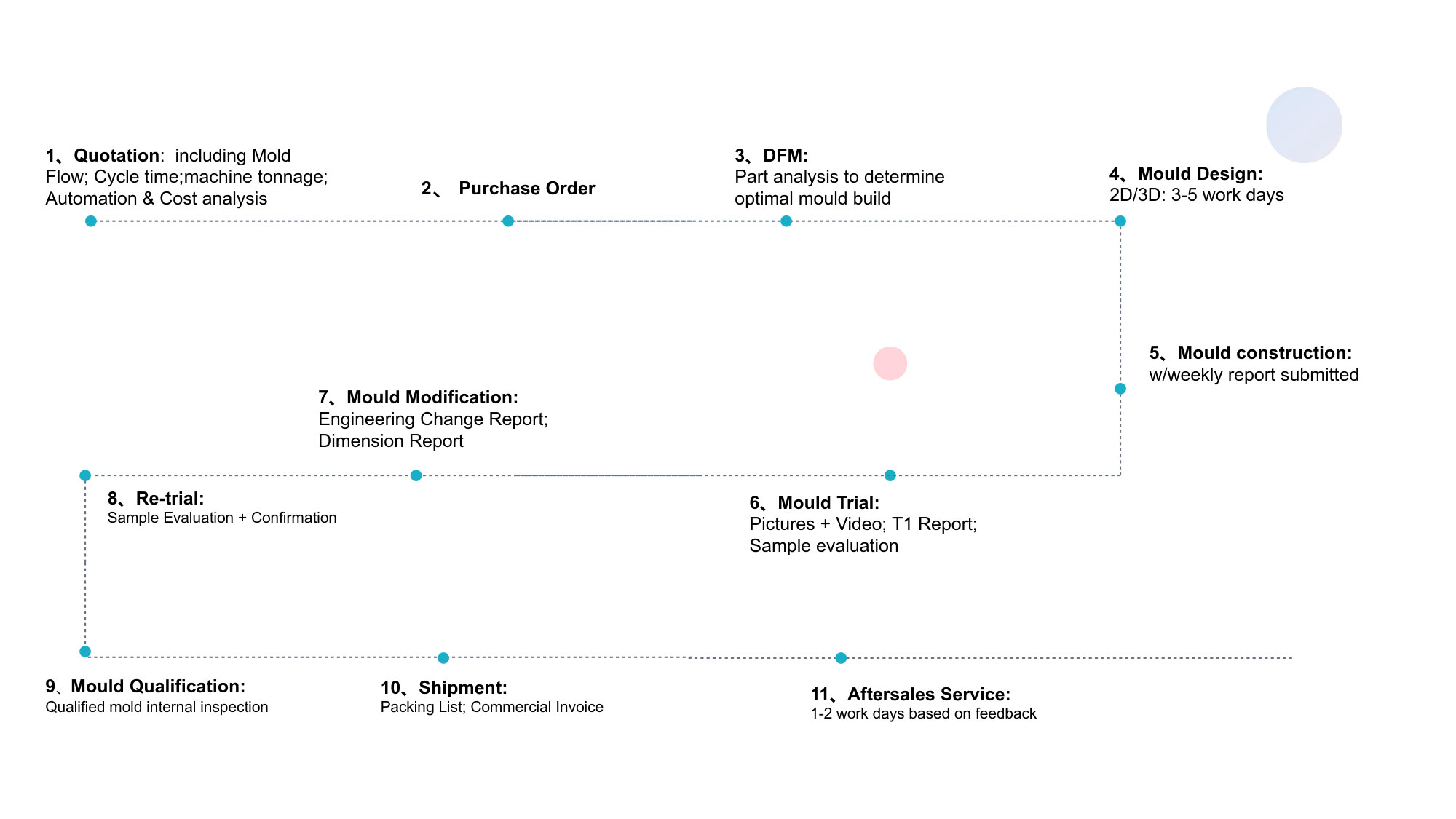
From T0 (first-shot trial) through T3, Ansix Tech provides trial samples accompanied by detailed improvement reports. Each iteration incorporates data-driven adjustments to gate locations, vent placement, gas pressure profiles, cooling channel layouts, or ejection timing. For complex challenges where multiple design variations merit exploration, Ansix Tech fabricates interchangeable mold inserts, allowing rapid A/B comparisons without building entire new tools.
Pre-Production Validation.
Production readiness is confirmed through pre-production validation runs of 100–500 shots. Statistical process control data, including CPK values for all critical dimensions, is compiled and reviewed before mass production begins. This validation phase ensures that the process is stable, the output is consistent, and no hidden variability remains to disrupt full-scale production.
Maintenance and Spare Parts.
Ansix Tech ships a complete set of wear-prone spare parts—ejector pins, core pins, and selected inserts—with every mold. Scheduled maintenance recommendations are provided for 200,000-cycle intervals, and throughout the life of the mold, Ansix Tech offers ongoing service and repair at cost, ensuring that customers never face the financial shock of unexpected tool refurbishment expenses.
Part Five: Differentiated Solutions — Turning Customer Pain Points into Concrete Commitments
The value of a supplier is most clearly demonstrated when it addresses the specific frustrations customers have experienced elsewhere. Ansix Tech responds to common complaints with specific, measurable commitments.
Customer Complaint: “My current molds corrode or wear out before they should.”
Ansix Tech Response: “Every mold is built with material selections matched to your specific resin and environment. For glass-filled materials, wear zones are fabricated from powder metallurgy steels that outlast conventional materials by a factor of three. For corrosive or high-humidity environments, S136 stainless steel cores prevent rust that would otherwise cause gate freeze-off or ejection failure. We deliver molds with documented wear life guarantees, and for standard applications, we provide a three-year structural warranty excluding normal consumable replacement.”
Customer Complaint: “Flash is everywhere—we spend hours manually deflashing every batch.”
Ansix Tech Response: “We maintain a parting line fit tolerance of 0.005mm across the entire mold surface. Our machines feature self-locking clamp force compensation, ensuring that clamp force remains consistent throughout the production run regardless of material viscosity variations. The result: flash is consistently held below 0.03mm, eliminating the need for manual deflashing operations.”
Customer Complaint: “Part dimensions drift batch to batch—every shipment is a gamble.”
Ansix Tech Response: “Our injection molding machines are equipped with in-line ultrasonic wall thickness sensors that provide real-time feedback on part geometry during each cycle. These sensors detect thickness variations at the sub-millimeter level and automatically adjust packing pressure to maintain consistency. For mission-critical dimensions, in-mold pressure and temperature sensors are installed, enabling closed-loop process control that responds to real-time conditions rather than relying on periodic offline inspection.”
Customer Complaint: “My supplier takes weeks or months to return a mold for repair.”
Ansix Tech Response: “We maintain in-house electrode manufacturing and EDM capabilities. Routine mold repairs—weld repairs, insert replacements, and dimensional adjustment—are performed without leaving our facility. Standard repair turnaround is 24 hours from receipt of the mold back to production-ready condition.”
Part Six: Cost Leadership — Systematic Reduction of Hard Costs
Ansix Tech reduces the customer‘s hard costs across multiple coordinated strategies, not through a single “cost cut” but through a disciplined, multi-front approach.
Material Cost Optimization. Ansix Tech develops material selection strategies that balance performance and procurement expense. A higher-flow resin may carry a modest premium per kilogram but reduces cycle time sufficiently to offset the premium entirely, resulting in comparable or lower per-part cost. Conversely, for applications where strength rather than stiffness is the primary requirement, a lower-cost general-purpose grade may be substituted without compromising function. Every material recommendation is justified in cost-per-part terms, not simply as a resin specification.
Cycle Time Reduction. Cycle time directly determines how many parts an injection molding machine produces per hour—and therefore the fixed overhead allocated to each part. Ansix Tech’s gas-assist process inherently reduces cooling time by 25–35% compared to solid cross-sections of equivalent strength. Conformal cooling channels machined directly into the mold core and cavity extract heat more uniformly and rapidly than conventional straight-drilled channels, further reducing the cooling phase of the cycle.
Scrap Rate Minimization. Scrap is the single most expensive form of waste because it consumes both material cost and machine time. Ansix Tech’s combination of DFM analysis, precision tooling, and closed-loop process control consistently achieves first-pass yield exceeding 98% for validated production processes. Every reduction in scrap percentage translates directly into profit.
Preventative Investment. Customers who invest slightly more in a higher-grade mold material at project initiation recover that investment within 12 to 18 months through reduced downtime, fewer unscheduled repairs, and lower long-term maintenance costs. Ansix Tech actively guides customers toward this “invest upfront, save long-term” strategy.
Part Seven: Customer Value Summary — What Ansix Tech Delivers
For the Toyota MPV Interior Door Handle Gas-Assist Molding project, Ansix Tech delivers a complete solution that addresses every dimension of customer concern:
Customer Need Ansix Tech Solution Measurable Customer Benefit
Reliable part consistency ±0.1% shot-to-shot repeatability; MES-locked parameters No assembly surprises; consistent fit across millions of parts
Low per-part cost Cycle time reduced 25–35%; gas-assist reduces weight 10–15% Direct per-part cost reduction of 15–20% vs. conventional molding
Fast time to market DFM + mold flow analysis; expedited tooling options 30% reduction in development cycles; earlier production start
Long tool life Premium tool materials; documented wear guarantees 500,000–1,000,000 cycles before refurbishment
Risk mitigation Pre-production validation; CPK ≥1.33 on critical dims Zero hidden surprises; known capability before full production
No manual processing Flash <0.03mm; no sink marks; Class-A surfaces Eliminates secondary finishing; straight to assembly
Conclusion: Mold as Revenue-Generating Asset
For Ansix Tech, a mold is not merely a block of steel—it is a revenue-generating asset engineered for production readiness from the first shot to the millionth. Every design decision, from gas channel routing to temperature control zone layout, is made with a single objective: ensuring that when the mold arrives on the customer‘s production floor, it is ready to run without first-article tuning, low-flash right out of the gate, and built for a long productive life.
The Toyota MPV interior door handle is a component where strength, aesthetics, and economy must coexist. Ansix Tech delivers that coexistence through a manufacturing solution built on precision equipment, validated processes, and a relentless focus on customer value. We invite our customers to review a DFM package for an existing product—the process reveals precisely how weld lines were eliminated from visible surfaces, how gas channel design prevented breakthrough defects, and how cooling analysis optimized cycle time. That transparency is the ultimate expression of trust.
A mold is an asset. We design every one to perform like one.
Ansix Tech Co Ltd
If you have any plans related to Toyota MPV Interior Door Handle Gas-Assist Molding , you can contact us at any time. We will turn your ideas into reality, let you realize your dreams, and obtain large orders from the market. Our contact information is info@ansixtech.com. Or contact our CTO, mail: stephen@ansixtech.com
#www.ansixtech.com #ansixtech.com #Toyota MPV Interior Door Handle Gas-Assist Molding #Toyota MPV Interior Door Handle Gas-Assist Molding moulds #Toyota MPV Interior Door Handle Gas-Assist Molding injection molding companies #Toyota MPV Interior Door Handle Gas-Assist Molding Canopy Mold injection mold companies #Ansix #Ansix moulds #Ansix china #Ansix tech china #Ansix tech company #Ansix facotry #Toyota MPV Interior Door Handle Gas-Assist Molding injection molding #Toyota MPV Interior Door Handle Gas-Assist Molding injection tools #Toyota MPV Interior Door Handle Gas-Assist Molding injection moulds #Toyota MPV Interior Door Handle Gas-Assist Molding plastic mould #Toyota MPV Interior Door Handle Gas-Assist Molding plastic tools #Ansix Tech #Ansix molds #Ansix injection molding #Ansix mold factory #injection molding Toyota MPV Interior Door Handle Gas-Assist Molding #Ansix mold factory #Toyota MPV Interior Door Handle Gas-Assist Molding china #Toyota MPV Interior Door Handle Gas-Assist Molding molds #injection factory #Toyota MPV Interior Door Handle Gas-Assist Molding injection molding #Toyota MPV Interior Door Handle Gas-Assist Molding injection molding factory #injection molding company #Toyota MPV Interior Door Handle Gas-Assist Molding injection mold companies #Toyota MPV Interior Door Handle Gas-Assist Molding#Toyota MPV Interior Door Handle Gas-Assist Molding mold limited #Ansix mold china #Ansix companies #Ansix company China #Toyota MPV Interior Door Handle Gas-Assist Molding facotry #Ansix Tech #Ansix Tech mould #Toyota MPV Interior Door Handle Gas-Assist Molding injection moulding #injection moulding company #Ansix Toyota MPV Interior Door Handle Gas-Assist Molding parts injection mold companies #medical injection molding companieschina #Toyota MPV Interior Door Handle Gas-Assist Molding china factory #Ansix moulding companies #Ansix molding company #Toyota MPV Interior Door Handle Gas-Assist Molding injection moulding facotry #Ansix Tech mold #Toyota MPV Interior Door Handle Gas-Assist Molding mould #Toyota MPV Interior Door Handle Gas-Assist Molding plastic injection molding #ansix plastic mold #Mold manufacturing #Toyota MPV Interior Door Handle Gas-Assist Molding parts manufacturing #Toyota MPV Interior Door Handle Gas-Assist Molding plastic parts factory #Toyota MPV Interior Door Handle Gas-Assist Molding injection parts mold #Toyota MPV Interior Door Handle Gas-Assist Molding PRECISION MANUFACTURING #Toyota MPV Interior Door Handle Gas-Assist Molding #China mold #Toyota MPV Interior Door Handle Gas-Assist Molding injection moulding china #Toyota MPV Interior Door Handle Gas-Assist Molding mould china #china precision mold #mold in china #Toyota MPV Interior Door Handle Gas-Assist Molding mold china #Precision molds #High-precision molds #Toyota MPV Interior Door Handle Gas-Assist Molding #Injection molds #Toyota MPV Interior Door Handle Gas-Assist Molding Factory #Toyota MPV Interior Door Handle Gas-Assist Molding Company #Super Large Injection Mold Factory #Large Tonnage Injection Molding Factory #Toyota MPV Interior Door Handle Gas-Assist Molding Company #Toyota MPV Interior Door Handle Gas-Assist Molding Factory #2800T Injection Molding Factory #3000 Ton Injection Molding #4500 Ton Injection Molding Factory #Large Mold Injection Molding #Large Plastic Mold Injection Molding Factory #Large Injection Mold Manufacturer #Plastic Mold Factory #Injection Mold #Plastic Mold