



50mm Neck Edible Oil Bottle Preform (100ml250ml) Transparent PET Plastic Oil Bottle Preform Tube Preform Material
FEATURES
Understanding the Product—50mm Neck Edible Oil Bottle Preform
1.1 Product Overview and Customer Value
The 50mm Neck Edible Oil Bottle Preform is a critical intermediate product in the production of PET bottles for cooking oils and other liquid food products. Unlike standard beverage preforms, edible oil preforms demand enhanced chemical resistance to prevent oil degradation, superior barrier properties to maintain product freshness, and robust structural integrity to withstand filling and transportation stresses. CTC (Cooking Oil) preforms are specifically engineered for packaging cooking oil and soy sauce applications. For 100ml and 250ml bottle volumes, our 50mm neck design ensures compatibility with standard capping systems while providing optimal material distribution during the stretch blow molding process.
Customer Value Realization: By selecting the correct preform weight and geometry, our customers achieve consistent bottle wall thickness, eliminate thin spots at stress points such as base corners and shoulder curves, and reduce raw material waste by optimizing the material-to-volume ratio.
-
Mold Description
Product Materials:
PET PETG
Mold Material:
S136ESR
Number of Cavities:
8
Glue Feeding Method:
Hot runner
Cooling Method:
Water cooling
Molding Cycle
22.5s
- The mold manufacturing process and product material selection
Standard Gram Weights for 50mm Neck Preforms
At Ansix Tech, our standard 50mm Neck PET preforms are available in the following gram weight configurations suitable for 100ml and 250ml edible oil bottle applications:
Preform Neck Size Suitable Bottle Volume Standard Gram Weights Typical Application
50mm CTC 100ml – 500ml 45g, 55g, 65g, 75g Mini cooking oil bottles
50mm CTC 500ml – 1L 85g, 95g, 115g Standard cooking oil bottles
55mm Wide Mouth 1L – 5L 180g, 250g, 620g, 750g Bulk edible oil containers
For 100ml bottle applications, the recommended preform weight ranges from 45g to 55g, depending on the desired wall thickness and structural requirements. For 250ml bottles, optimal performance is achieved with preform weights between 55g and 75g. These weight ranges are derived from extensive mold flow analysis and field validation across thousands of production cycles. The neck diameter for edible oil preforms is typically 29mm (CTC standard), while 50mm wide-mouth designs are available for larger containers and specialized applications.
Customer Value: Standardized weight options eliminate guesswork in procurement. Our engineering team provides specific weight recommendations based on your final bottle design, blow molding equipment capabilities, and filling line requirements, preventing costly mismatches that lead to bottle deformation or excess material consumption.
-
PET Raw Material Characteristics and Selection
PET Resin Intrinsic Viscosity (IV) Value Selection
The intrinsic viscosity (IV) value is the single most critical material parameter determining preform and final bottle performance. IV value measures the molecular chain length and degree of polymerization of PET resin, directly reflecting melt strength, molecular weight, and mechanical properties of the final product. For edible oil applications, we recommend preform-grade PET resin with an IV value of 0.78–0.85 dL/g, which strikes the optimal balance between processability and mechanical performance.
Material Selection Guide by Application:
Application Recommended IV Value Key Characteristics
Mineral water bottles (100ml-250ml) 0.72–0.78 dL/g Good fluidity, easy molding, high transparency
Carbonated beverage bottles 0.78–0.85 dL/g Higher pressure resistance, longer molecular chains
Edible oil bottles (100ml-250ml) 0.80–0.85 dL/g Superior oil resistance, enhanced structural integrity
Large-capacity edible oil bottles ≥0.85 dL/g Maximum strength for heavy-duty packaging
Why High IV Value for Edible Oil?
High IV value PET resin delivers several critical advantages for edible oil packaging. The longer molecular chain structure provides superior tensile strength and pressure resistance, ensuring bottles maintain integrity during filling and transportation. For edible oil applications, high IV preforms demonstrate burst pressure performance of up to 1.8 MPa for 500ml bottles, compared to only 1.2 MPa for low IV preforms. Drop test pass rates exceed 97% from 2m height for high IV preforms, significantly reducing in-transit breakage risks. Additionally, high IV material enables thinner wall designs without compromising strength, directly reducing material consumption per bottle.
Potential Risks of Improper IV Selection:
Too Low IV (≤0.72 dL/g): The preform strength is insufficient and can easily break during blow molding. The bottle body exhibits poor pressure resistance, and carbonated beverages may cause deformation. Wall thickness must be increased, otherwise the bottle will easily break after blowing.
Too High IV (>0.85 dL/g): Poor melt fluidity makes injection molding difficult, increasing energy consumption and production costs. While high crystallinity may slightly affect transparency, optimized cooling processes mitigate these effects.
Acetaldehyde (AA) Content Management
Acetaldehyde is a byproduct generated during PET processing at high temperatures. For edible oil applications, controlling AA content is essential as high AA levels can affect oil taste and quality. We utilize PET resin with maximum AA content of 1.0 ppm and maintain strict process temperature controls to minimize AA generation throughout the injection molding cycle.
Customer Value: Our material engineers work directly with you to select the precise IV value for your specific application. If you currently experience post-blowing breakage, we can help determine whether upgrading to higher IV material solves the problem while calculating potential material savings through lightweighting—typically 5–10% reduction in per-unit material cost.
1.4 Materials Certification and Compliance
All PET resin used in our 50mm neck preform production meets internationally recognized food safety standards, including ISO 9001, ISO 14001, and applicable food contact regulations. Our facility maintains strict material traceability from raw resin receipt through finished product shipment, ensuring complete accountability for every production batch.
Part Two: Mold Manufacturing—The Foundation of Quality and Efficiency
2.1 Hard Infrastructure: Building Customer Confidence Through Equipment Excellence
Before discussing mold design, customers must understand the precision manufacturing capabilities behind every Ansix Tech mold. Our investment in advanced manufacturing equipment directly translates into measurable product quality improvements for your business.
Mold Processing Equipment and Customer Benefits:
Equipment Type Technical Specification Customer Value Realized
Five-axis high-speed machining centers 0.002mm precision capability for complex surfaces Parting lines are smooth and burr-free—no secondary finishing required, eliminating manual deburring labor costs.
Slow wire EDM (Electrical Discharge Machining) 0.03mm fine-hole and narrow-slot machining capability Prevents thin-wall deformation during critical feature machining, ensuring thread integrity and sealing surface precision.
Precision surface grinders ±0.001mm flatness tolerance Ensures perfect mold plate parallelism, eliminating flash and reducing post-molding trimming.
Injection Molding Machine Fleet:
Our dedicated preform injection molding machines span a comprehensive lock force range from 30 tons to 4,000 tons, enabling us to produce everything from small 100ml preforms to large industrial containers. All machines feature all-servo motor drive systems delivering stable repeatable accuracy of ±0.1%, ensuring that every single shot across millions of cycles maintains identical dimensional consistency. This machine-agnostic capability means we can scale production capacity without compromising quality.
Inspection and Metrology Equipment:
Every mold leaving our facility undergoes complete dimensional verification using coordinate measuring machines (CMM) and optical imaging measurement systems. Prior to shipment, each mold receives a full dimension report comparing all critical features against design specifications, with key dimensions guaranteed to achieve CPK ≥ 1.33. This rigorous verification eliminates the risk of receiving molds that fail to meet your specifications.
Customer Value Realization: Our equipment infrastructure isn't just about technical specifications—it's about what these capabilities mean for your business. When we guarantee smooth parting lines, we are eliminating your deburring labor. When we guarantee dimensional consistency, we are preventing production line stoppages caused by out-of-tolerance preforms. When we provide full dimension reports, we are giving you documented proof of quality that supports your own ISO certification requirements.
2.2 Mold Design Life and Material Selection
Mold Steel Materials and Performance Guarantees:
Mold Component Steel Grade Properties Service Life Guarantee
Mold Base P20 Pre-hardened, excellent machinability, good wear resistance Standard plastic: 1 million shots
Cavity/Core (Standard) S136, 4Cr13, 9Cr18 Stainless steel, excellent corrosion resistance, high polishability Standard plastic: 800,000 shots
Cavity/Core (Premium) H13 (2344), 8407, NAK80 Superior toughness, excellent thermal fatigue resistance, high hardness Standard plastic: 1 million+ shots
Cavity/Core (High-Wear) SKD11/SKD61/DC53 High vanadium content, exceptional wear resistance Glass-fiber reinforced: 500,000+ shots
Cavity/Core (Corrosive Materials) M340 Proprietary stainless, superior corrosion resistance Chemical/medical applications
Customer Value: Our steel selection is not arbitrarily chosen—it is engineered based on your specific production volume targets and material requirements. If you need 2 million shots from a single mold, we build with premium H13 or NAK80 steel. If your material contains glass-fiber reinforcement, we specify SKD11/DC53 to maintain cavity geometry through aggressive wear conditions. We provide material certification reports and heat treatment curves with every mold, giving you documented proof of construction quality.
Critical Design Parameters for Oil Bottle Preforms:
Draft angles: Engineered at 1–2 degrees per side for smooth preform ejection without surface drag marks
Wall thickness distribution: Optimized through Moldflow analysis to ensure uniform material flow and consistent cooling
Gate location: Strategically positioned to minimize weld lines and ensure symmetrical filling
Venting design: Precision depth tolerances (0.02mm–0.05mm) to prevent trapped air defects
2.3 Moldflow Analysis and DFM (Design for Manufacturing)
Before any metal is cut, Ansix Tech performs comprehensive Moldflow analysis to simulate and optimize the injection molding process. This upfront engineering investment prevents costly downstream problems.
What We Analyze Before Mold Construction:
Melt flow front advancement: Predicts and optimizes filling patterns to eliminate short shots and unbalanced filling
Weld line locations: Identifies where two melt fronts meet and optimizes gate placement to position weld lines in non-critical areas
Air trap locations: Maps potential gas entrapment zones and designs venting to eliminate burning and surface defects
Temperature distribution: Models thermal gradients to optimize cooling circuit placement
Pressure drop analysis: Calculates required injection pressure to achieve complete filling without excessive shear heating
DFM Report Deliverables:
Every Ansix Tech project includes a comprehensive DFM report provided prior to mold construction sign-off. This report contains:
Wall thickness optimization recommendations: Identifying areas where thickness can be reduced for material savings or increased for structural requirements
Draft angle specifications: Confirming that all surfaces can be cleanly ejected without surface damage
Gate and runner layout: Optimized multi-cavity balancing for consistent fill across all cavities
Ejector pin placement mapping: Clearly indicating all ejector pin locations and allowable witness mark positions
Cooling circuit layout: Optimized conformal cooling channel design for cycle time reduction
Customer Value: The DFM report is not an engineering exercise—it is a risk mitigation document. By analyzing your preform design before steel cutting begins, we identify and resolve potential manufacturing issues while changes are still free. This eliminates the 50-80% cost premium associated with mold modifications after machining has begun. Typical DFM-identified improvements include 10-20% cycle time reduction through optimized cooling and 5-15% material savings through optimized wall thickness distribution.
2.4 Mold Types and Configurations
Hot Runner Systems:
Our 50mm neck preform molds utilize advanced hot runner systems specifically optimized for PET applications. Unlike cold runner systems that generate significant material waste, hot runner technology maintains the PET melt at precise temperature profiles from the injection unit to each cavity gate. Benefits include:
Zero runner scrap: Every gram of PET resin becomes a usable preform—no material waste from sprue or runner systems
Lower injection pressure requirements: Reduced pressure drop through the melt distribution system
Superior cavity-to-cavity balance: Each preform receives identical melt conditions for consistent quality across all cavities
Reduced acetaldehyde generation: Lower melt residence time at elevated temperatures minimizes AA formation
The 3-platen hot runner design specifically improves geometric thermal balancing and reduces plate bowing, directly enhancing preform quality. With compact stack height of 260mm, our systems are compatible with a wider range of injection molding machines, including older generation equipment with height limitations.
Multi-Cavity Configuration Options:
Cavity Count Typical Machine Size Estimated Output (shots/hour) Best Application
32 cavities 180–250 ton 8,000–10,000 preforms Low-volume, high-mix production
48 cavities 250–350 ton 12,000–16,000 preforms Medium-volume standard production
64 cavities 350–500 ton 18,000–24,000 preforms High-volume dedicated production
72 cavities 450–650 ton 22,000–28,000 preforms Maximum efficiency for single products
96 cavities 650–850 ton 30,000–40,000 preforms Ultra-high-volume commodity applications
2.5 Cooling System Design—The Key to Cycle Time Optimization
Cooling typically accounts for 60-70% of the total injection molding cycle time. Our advanced cooling system design directly reduces your cost per preform by minimizing cycle time while maintaining dimensional stability.
Design Innovations:
Conformal cooling channels: Follow the contour of the preform geometry rather than straight drilled lines, providing uniform cooling across complex shapes
Zoned temperature control: Independent temperature regulation for core and cavity sides to manage differential shrinkage
Bubbler and baffle systems: Enhanced cooling performance in deep core geometries where standard channels cannot reach
High-flow coolant circuits: Engineered flow paths with optimized diameters to maximize heat transfer efficiency
Measurable Results:
Through optimized cooling design, our 50mm neck preform molds achieve cycle times of 8–12 seconds for 100ml configurations and 12–16 seconds for 250ml configurations, depending on wall thickness and cavity count. Each second of cycle time reduction at 64 cavities running 24/7 represents approximately 500,000 additional preforms per year.
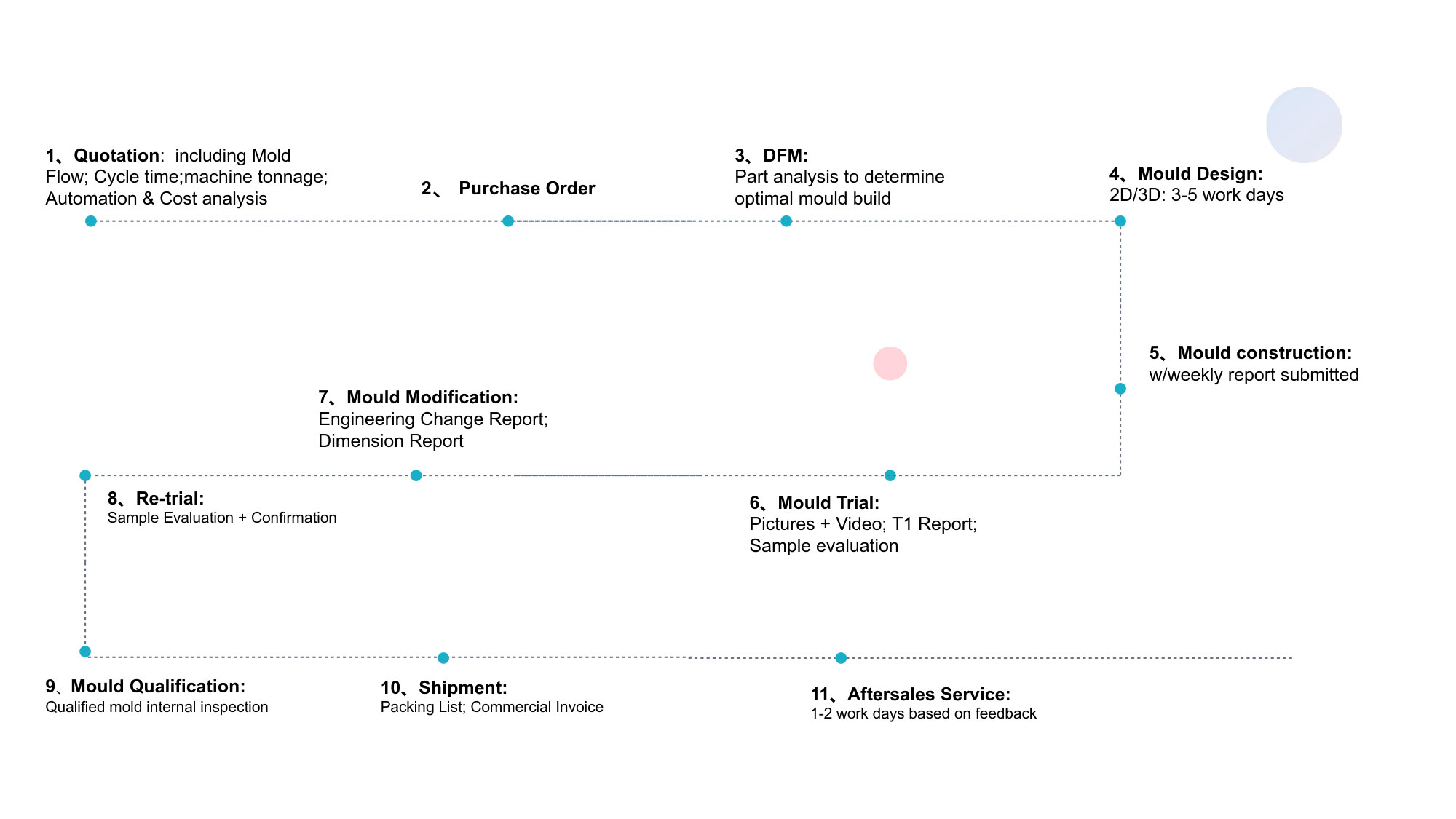
2.6 Mold Manufacturing Process Flow
Our complete mold manufacturing workflow follows a rigorous, documented process:
Project Kickoff: Customer requirements gathering and specification finalization
DFM Analysis: Moldflow simulation and feasibility assessment (typically 5–10 days)
3D Mold Design: Complete solid modeling with full assembly documentation (10–15 days)
Material Procurement: Steel ordering with material certifications (5–7 days)
CNC Rough Machining: Initial cavity and core roughing (3–5 days)
Heat Treatment: Precision hardening per material specifications (3–5 days)
CNC Finish Machining: Five-axis finishing to 0.002mm accuracy (5–10 days)
EDM Finishing: Wire and sinker EDM for fine features (3–7 days)
Manual Finishing: Polishing, spotting, and assembly (5–7 days)
Mold Trial (T0): Initial testing on injection molding machine
Inspection and Reporting: Full dimension measurement and CPK analysis
Adjustment (T1-T3): Iterative optimization based on trial results
Final Approval and Shipment: Customer sign-off and delivery
Standard Lead Times:
Mold Complexity Typical Lead Time Rush Option Rush Conditions
Simple (≤32 cavities, standard design) 25–30 days 18–20 days Requires confirmed steel availability
Medium (48 cavities, moderate complexity) 30–40 days 22–25 days Weekend work approval
Complex (64+ cavities, specialized requirements) 40–50 days 28–32 days Overtime and priority scheduling
Part Three: Injection Molding Production—Process Control and Quality Assurance
3.1 PET Resin Drying Requirements
PET is hygroscopic and must be thoroughly dried before injection molding to prevent hydrolytic degradation. Moisture reacts with PET at melt temperatures, causing IV drop, reduced mechanical properties, surface defects, and poor clarity.
Critical Drying Parameters:
Parameter Specification Why It Matters
Resin moisture content (pre-drying) <0.005% (50 ppm) Prevents hydrolytic degradation
Drying temperature 160–180°C (320–356°F) Optimal moisture removal without thermal damage
Drying time 4–6 hours Adequate time for complete moisture extraction
Dew point -40°C or lower Ensures dry air delivery to drying hopper
3.2 Injection Molding Process Parameters
Temperature Settings:
Zone Temperature Range Purpose
Drying hopper 160–170°C Dehumidification
Feeding zone 260–270°C Initial melting
Compression zone 270–280°C Complete melting and mixing
Metering zone 275–285°C Homogenization
Nozzle 270–280°C Delivery to mold
Hot runner manifold 265–275°C Distribution to cavities
Hot runner nozzles 260–270°C Injection into cavities
Mold cooling (core) 8–12°C Solidification
Mold cooling (cavity) 10–15°C Dimensional control
Injection Parameters:
Parameter Typical Setting Impact on Quality
Injection pressure 800–1,200 bar Higher pressure reduces voids but increases residual stress
Holding pressure 600–900 bar Compensates for material shrinkage
Back pressure 10–30 bar Improves melt homogeneity
Injection speed 80–150 mm/s Higher speed improves weld line strength but may cause shear heating
Screw rotation speed 60–120 RPM Affects melt quality and cycle time
Cushion 3–8 mm Ensures consistent shot-to-shot filling
3.3 Process Standardization and Control
All Ansix Tech injection molding machines are networked to our MES (Manufacturing Execution System), which locks all process parameters—temperature, pressure, speed, and time—at approved settings. Process adjustments require electronic approval from authorized engineers only, with all changes logged and traceable.
Quality Assurance Through Process Control:
First-article inspection: Complete dimensional verification of the first production run
In-process sampling: Regular sample extraction at predetermined intervals (typically every 1-2 hours)
Last-article comparison: End-of-run verification against first-article dimensions
Real-time monitoring: Continuous tracking of key parameters with automated alerts for drift detection
3.4 Quality Control and Testing Protocols
Dimensional Inspection:
Neck finish O.D. and I.D.: Critical for cap sealing performance
Thread profile: Verification against standard thread gauges
Overall length: Affects final bottle volume after blow molding
Weight per preform: ±0.2g tolerance for consistent blow performance
Wall thickness distribution: Ultrasonic measurement to verify uniformity
Visual Inspection:
Transparency and clarity: Free from haze, crystallization, or discoloration
Surface defects: No flow marks, splay, bubbles, or contamination
Gate vestige: Clean break with no sharp protrusions
Neck finish: No cracks, warpage, or short shots
Mechanical Testing:
IV retention: Maximum IV drop of 0.02 dL/g from resin to finished preform ensures stretch blow performance consistency
Top load strength: Destructive testing to verify crush resistance
Drop test: Complete bottles blown from sample preforms tested at 2m height
Customer Value: Our quality system is designed to eliminate surprises. Every shipment includes complete lot traceability documentation and test results. If you perform incoming inspection on our preforms, you will find consistent results batch after batch—not random variations that disrupt your blow molding line.
3.5 Common Defects and Our Prevention Measures
Defect Root Cause Ansix Prevention Measure
Pearlescence/whitening Over-stretching or material too cold during drawing Optimized reheat profile; strict temperature control
Haze Improper reheat profile or insufficient orientation Real-time thermal monitoring; validated process windows
Base stress cracking Concentrated stress in amorphous base/gate zones Dry resin (<0.005% moisture); optimized gate design
IV drift Thermal degradation during processing Closed-loop process control; ±0.02 dL/g monitoring
Acetaldehyde taste High-temperature degradation Minimized residence time; optimized thermal profile
Short shots Inadequate fill pressure or material starvation Real-time cavity pressure monitoring
Part Four: Customer Value Framework—Transforming Capabilities into Business Benefits
4.1 What Problems Does Ansix Tech Solve for Your Business?
Problem: Unpredictable Quality from Multiple Suppliers
When purchasing preforms from multiple sources, batch-to-batch variation causes inconsistent blow molding results—some preforms stretch perfectly while others burst or produce thin-walled bottles.
Ansix Solution: Our fully integrated manufacturing process means every preform from every cavity across every production shift meets identical specifications. We provide complete lot traceability and test documentation with every shipment.
Problem: Long Lead Times Disrupting Production Schedules
Waiting 8–12 weeks for preform deliveries forces you to carry excessive inventory or risk production stoppages.
Ansix Solution: With 28+ years of production experience and strategic material inventory, we maintain standard lead times of 15–30 days for production orders. Rush orders can be accommodated in as little as 10 days for qualifying volumes.
Problem: High Tooling Investment with Uncertain ROI
Multi-cavity molds represent significant capital expenditure, and traditional suppliers require full payment before you see any production parts.
Ansix Solution: We offer flexible payment terms and staged mold pricing that aligns payments with project milestones—deposit at kickoff, progress payment at steel cutting, milestone at T0 trial, and final payment after successful production validation. This structure reduces your financial risk.
Problem: Material Waste and Inefficiency
Cold runner molds generate substantial runner scrap that must be ground and re-processed, risking contamination and quality degradation.
Ansix Solution: All our preform molds utilize hot runner technology, eliminating runner waste entirely. Every gram of PET resin purchased becomes a usable preform, directly reducing your raw material costs by 15–30% compared to cold runner alternatives.
Problem: Quality Disputes and Returns
When preforms fail incoming inspection or cause blow molding problems, resolving responsibility and arranging replacements costs time and money.
Ansix Solution: Our quality data is transparent and accessible. We provide full inspection reports with every shipment, and we maintain retain samples for traceability. If a problem occurs, we can instantly access production records to identify root cause and initiate corrective action—no finger-pointing, no delays.
4.2 Cost Reduction Pathways
Cost Area Traditional Approach Ansix Tech Approach Potential Savings
Raw material cost Purchase standard preforms with fixed weight Lightweighting analysis to optimize material usage 5–15% material reduction
Scrap/waste Accept 2-5% production scrap rate In-mold quality monitoring; real-time defect rejection 50% reduction in scrap
Labor cost Manual inspection and handling Automated vision inspection; bulk packaging systems 30% labor reduction
Tooling amortization Pay full tooling cost upfront Staged payment aligned with milestones Reduced capital commitment
Inventory cost Hold 8–12 weeks safety stock 15-30 day lead times; JIT delivery programs 50% inventory reduction
Logistics cost Spot freight arrangements Consolidated shipping programs; dedicated lanes 10–20% freight savings
4.3 Risk Reduction and Quality Validation
Pre-Production Risk Mitigation:
Risk Ansix Mitigation Strategy
Mold design errors detected after machining Comprehensive DFM analysis before steel cutting—modifications cost zero at this stage
Material incompatibility discovered during production Material qualification testing prior to production release; alternative material validation
Process instability causing quality variation Process qualification (PQR) with documented stability data prior to full production
Unexpected mold modification costs Fixed-price mold contracts with clear scope of supply
Production Quality Validation:
Our validation process follows a four-stage approach:
T0 Trial: First test shots to verify basic mold function and dimensional accuracy
T1 Adjustment: Modifications based on T0 findings—complete parts for customer evaluation
T2 Optimization: Process refinement based on T1 feedback—stabilized production data
T3 Production Release: Fully qualified process with documented CPK data for all critical dimensions
4.4 Capacity Expansion and Delivery Assurance
We maintain redundant production capacity across multiple machine platforms, ensuring that equipment maintenance or unplanned downtime never interrupts customer supply. Key capacity metrics:
Dedicated preform machines: 8 injection molding machines configured specifically for preform production
Total clamping capacity: 2,500+ tons across all preform-dedicated machines
Multi-cavity capability: Up to 96 cavities per mold
Shift capacity: 24/7 production capability with 5-day/6-day/7-day schedules available
Warehousing: Climate-controlled finished goods storage with FIFO inventory management
Part Five: Delivery, Packaging, and Supply Chain Excellence
5.1 Packaging Solutions
Our packaging systems are designed to protect preform quality during transit while maximizing shipping efficiency:
Packaging Type Capacity Best For Protection Features
Bulk gaylord boxes 8,000–15,000 preforms Large-volume shipments Anti-static liners; moisture barriers
Stackable trays 200–500 preforms Automated blow molding feed Nested orientation for robot pick-up
Liners/bags 500–2,000 preforms Smaller quantities Heat-sealed moisture protection
5.2 Delivery Logistics
Ocean freight: FCL (full container load) shipments with pre-scheduled vessel bookings
Air freight: Available for urgent requirements (2–5 day delivery)
Incoterms: All major terms available based on customer preference
Regional warehousing: Stock located at strategic distribution points to reduce delivery times
Part Six: Industry Experience and Long-Term Partnership Value
6.1 28+ Years of Preform Manufacturing Excellence
Since our founding, Ansix Tech has specialized exclusively in PET preform injection molding. This singular focus has enabled deep expertise across every facet of preform production—from material science to mold engineering to high-cavitation production management.
Key Industry Credentials:
Thousands of preform mold projects completed across beverage, food, and industrial sectors
Proven capability with both virgin PET and post-consumer recycled (PCR) PET
Experience with all major blow molding platforms and equipment brands
Compliance with ISO 9001 quality management standards
6.2 Why Partner with Ansix Tech?
We don't just sell preforms—we engineer packaging solutions. Our team works alongside your product developers, packaging engineers, and procurement professionals to deliver preforms that exactly match your requirements.
Our Promise to You:
Every preform we ship is backed by documented quality data
Every technical question receives a detailed, actionable answer
Every delivery commitment is met or exceeded
Every partnership is built on transparency and mutual success
6.3 Getting Started—Your Next Steps
Initial Consultation: Share your bottle specifications, target volume, and quality requirements
Material and Preform Recommendation: Our engineers recommend optimal IV value and preform weight
DFM and Mold Proposal: Receive detailed mold design proposal with pricing and lead times
Sample Approval: T0-T3 trials with customer samples for physical evaluation
Production Ramp: Full-scale production with JIT delivery schedule
Conclusion
The 50mm Neck Edible Oil Bottle Preform represents a critical packaging component where quality directly impacts product integrity, production efficiency, and brand reputation. Ansix Tech combines advanced mold manufacturing capabilities, scientific injection molding process control, and 28+ years of industry experience to deliver preforms that consistently meet specifications shipment after shipment.
We understand that in your business, every gram of material, every second of cycle time, and every shipment delay affects your bottom line. That is why we have built our entire operation around measurable customer value—not just technical specifications on paper, but documented cost savings, risk reduction, and quality improvements that you can track and verify.
Contact Ansix Tech today to discuss your 50mm neck edible oil preform requirements. Our engineering team is ready to provide DFM analysis, material recommendations, and a comprehensive proposal tailored to your specific needs.
Ansix Tech Co Ltd
If you have any plans related to 50mm Neck Edible Oil Bottle Preform (100ml250ml) Transparent PET Plastic Oil Bottle Preform Tube Preform Material , you can contact us at any time. We will turn your ideas into reality, let you realize your dreams, and obtain large orders from the market. Our contact information is info@ansixtech.com. Or contact our CTO, mail: stephen@ansixtech.com
#www.ansixtech.com #ansixtech.com #50mm Neck Edible Oil Bottle Preform (100ml250ml) Transparent PET Plastic Oil Bottle Preform #50mm Neck Edible Oil Bottle Preform (100ml250ml) Transparent PET Plastic Oil Bottle Preform #50mm Neck Edible Oil Bottle Preform (100ml250ml) Transparent PET Plastic Oil Bottle Preform injection molding companies #50mm Neck Edible Oil Bottle Preform (100ml250ml) Transparent PET Plastic Oil Bottle Preform Canopy Mold injection mold companies #Ansix #Ansix moulds #Ansix china #Ansix tech china #Ansix tech company #Ansix facotry #50mm Neck Edible Oil Bottle Preform (100ml250ml) Transparent PET Plastic Oil Bottle Preform injection molding #50mm Neck Edible Oil Bottle Preform (100ml250ml) Transparent PET Plastic Oil Bottle Preform injection tools #50mm Neck Edible Oil Bottle Preform (100ml250ml) Transparent PET Plastic Oil Bottle Preform injection moulds #50mm Neck Edible Oil Bottle Preform (100ml250ml) Transparent PET Plastic Oil Bottle Preform plastic mould #50mm Neck Edible Oil Bottle Preform (100ml250ml) Transparent PET Plastic Oil Bottle Preform plastic tools #Ansix Tech #Ansix molds #Ansix injection molding #Ansix mold factory #injection molding 50mm Neck Edible Oil Bottle Preform (100ml250ml) Transparent PET Plastic Oil Bottle Preform #Ansix mold factory #50mm Neck Edible Oil Bottle Preform (100ml250ml) Transparent PET Plastic Oil Bottle Preform china #50mm Neck Edible Oil Bottle Preform (100ml250ml) Transparent PET Plastic Oil Bottle Preform molds #injection factory #50mm Neck Edible Oil Bottle Preform (100ml250ml) Transparent PET Plastic Oil Bottle Preform injection molding #50mm Neck Edible Oil Bottle Preform (100ml250ml) Transparent PET Plastic Oil Bottle Preform injection molding factory #injection molding company #50mm Neck Edible Oil Bottle Preform (100ml250ml) Transparent PET Plastic Oil Bottle Preform injection mold companies #50mm Neck Edible Oil Bottle Preform (100ml250ml) Transparent PET Plastic Oil Bottle Preform#50mm Neck Edible Oil Bottle Preform (100ml250ml) Transparent PET Plastic Oil Bottle Preform mold limited #Ansix mold china #Ansix companies #Ansix company China #50mm Neck Edible Oil Bottle Preform (100ml250ml) Transparent PET Plastic Oil Bottle Preform facotry #Ansix Tech #Ansix Tech mould #50mm Neck Edible Oil Bottle Preform (100ml250ml) Transparent PET Plastic Oil Bottle Preform injection moulding #injection moulding company #Ansix 50mm Neck Edible Oil Bottle Preform (100ml250ml) Transparent PET Plastic Oil Bottle Preform parts injection mold companies #medical injection molding companieschina #50mm Neck Edible Oil Bottle Preform (100ml250ml) Transparent PET Plastic Oil Bottle Preform china factory #Ansix moulding companies #Ansix molding company #50mm Neck Edible Oil Bottle Preform (100ml250ml) Transparent PET Plastic Oil Bottle Preform injection moulding facotry #Ansix Tech mold #50mm Neck Edible Oil Bottle Preform (100ml250ml) Transparent PET Plastic Oil Bottle Preform mould #50mm Neck Edible Oil Bottle Preform (100ml250ml) Transparent PET Plastic Oil Bottle Preform plastic injection molding #ansix plastic mold #Mold manufacturing #50mm Neck Edible Oil Bottle Preform (100ml250ml) Transparent PET Plastic Oil Bottle Preform parts manufacturing #50mm Neck Edible Oil Bottle Preform (100ml250ml) Transparent PET Plastic Oil Bottle Preform plastic parts factory #50mm Neck Edible Oil Bottle Preform (100ml250ml) Transparent PET Plastic Oil Bottle Preform injection parts mold #50mm Neck Edible Oil Bottle Preform (100ml250ml) Transparent PET Plastic Oil Bottle Preform PRECISION MANUFACTURING #50mm Neck Edible Oil Bottle Preform (100ml250ml) Transparent PET Plastic Oil Bottle Preform #China mold #50mm Neck Edible Oil Bottle Preform (100ml250ml) Transparent PET Plastic Oil Bottle Preform injection moulding china #50mm Neck Edible Oil Bottle Preform (100ml250ml) Transparent PET Plastic Oil Bottle Preform mould china #china precision mold #mold in china #50mm Neck Edible Oil Bottle Preform (100ml250ml) Transparent PET Plastic Oil Bottle Preform mold china #Precision molds #High-precision molds #50mm Neck Edible Oil Bottle Preform (100ml250ml) Transparent PET Plastic Oil Bottle Preform #Injection molds #50mm Neck Edible Oil Bottle Preform (100ml250ml) Transparent PET Plastic Oil Bottle Preform Factory #50mm Neck Edible Oil Bottle Preform (100ml250ml) Transparent PET Plastic Oil Bottle Preform Company #Super Large Injection Mold Factory #Large Tonnage Injection Molding Factory #50mm Neck Edible Oil Bottle Preform (100ml250ml) Transparent PET Plastic Oil Bottle Preform Company #50mm Neck Edible Oil Bottle Preform (100ml250ml) Transparent PET Plastic Oil Bottle Preform Factory #2800T Injection Molding Factory #3000 Ton Injection Molding #4500 Ton Injection Molding Factory #Large Mold Injection Molding #Large Plastic Mold Injection Molding Factory #Large Injection Mold Manufacturer #Plastic Mold Factory #Injection Mold #Plastic Mold