



33-tooth 39g skincare bottle PET packaging blow molding special tube preform PETG bottle preform
FEATURES
Key Specifications:
Neck Diameter: 33mm (compatible with 33/410, 33 SP400, and 33 Bericap closures)
Weight: 39 grams ± tolerance
Material: Virgin PET resin or customized PETG compound
Applications: Skincare lotions, cosmetic creams, serums, personal care products, pharmaceutical containers
End-Use Bottle Volume: Approximately 200–500ml depending on blow ratio and wall thickness design
The 33-Tooth Feature: Engineering Precision for Closure Compatibility
The "33-tooth" specification refers to the threaded neck finish design featuring a precise 33-start thread configuration. This multi-start thread system offers several performance advantages for cosmetic packaging:
Superior Sealing Performance: Multi-start thread geometry distributes closure torque evenly across multiple engagement points, reducing the risk of cross-threading during high-speed capping operations.
Consistent Closure Fit: The precision-engineered thread profile ensures compatibility with standard 33/410 dispensing closures, pumps, and caps, eliminating leakage risks common with poorly matched neck finishes.
-
Mold Description
Product Materials:
PET PETG
Mold Material:
S136ESR
Number of Cavities:
8
Glue Feeding Method:
Hot runner
Cooling Method:
Water cooling
Molding Cycle
12.5s
- The mold manufacturing process and product material selection
Enhanced Production Line Efficiency: Standardized 33mm neck dimensions enable seamless integration into existing bottling lines without costly changeover tooling or line modifications.
Standard Grammage Range for Ansix Tech PET Preforms
For customers seeking additional packaging options beyond the 39g skincare bottle configuration, Ansix Tech offers a comprehensive range of standard PET preform weights to accommodate various container sizes and application requirements:
-
Application Category Typical Weight Range (grams) Neck Size Options End Products
Personal Care / Skincare 5 – 25g 18mm, 20mm, 22mm, 24mm, 28mm, 32mm, 38mm Shampoos, lotions, perfumes, serums
Beverage Bottles 10 – 50g 28mm (PCO 1810/1881), 30mm, 38mm Water, soft drinks, juices
Pharmaceutical Containers 8 – 35g 22mm, 24mm, 28mm Liquid medicines, supplements, eye drops
Wide-Mouth Containers 12 – 180g 53mm, 63mm, 68mm, 89mm, 95mm, 110mm, 120mm Sauces, condiments, food jars
Large Containers (5–20L) 260 – 485g 55mm, 65mm, 83mm, 100mm 5-gallon water bottles, detergent containers
Industry-standard preform weights for cosmetic and beverage applications range from 18g to 69.5g, with common benchmarks including 18g, 19.5g, 20g, 21g, 22g, 23.5g, 27g, 28g, 30g, 32g, 33g, 34.5g, 35g, 38g, 39g, 39.5g, 40.5g, 41g, 43g, 44g, 45.5g, 47g, 48g, 50g, 51.5g, 52g, and 53g.
For the 28mm neck finish—one of the most widely used specifications in the industry—Ansix Tech provides preform weights ranging from 17g to 46g, with available options at 17g, 20g, 25g, 28g, 32g, 37g, 42g, and 46g to accommodate final bottle volumes from 100ml to 1.5L.
PET vs. PETG: Material Selection Guide
Standard PET (Polyethylene Terephthalate) remains the industry benchmark for blow molding applications. PET is a semi-crystalline thermoplastic polymer derived from terephthalic acid and ethylene glycol, offering exceptional clarity, mechanical strength, and gas barrier properties. Its crystallization behavior enables precise control over bottle rigidity and thermal stability through the stretch blow molding process.
PETG (Polyethylene Terephthalate Glycol-Modified) is a specialized amorphous copolymer that incorporates 1,4-cyclohexanedimethanol (CHDM) as a comonomer during polymerization. This chemical modification disrupts PET`s crystalline structure, resulting in a fully amorphous polymer with distinct performance advantages for cosmetic packaging:
PETG Key Properties & Customer Benefits:
Superior Transparency: Achieves light transmittance >90%, comparable to acrylic (PMMA) and superior to standard PET, creating a premium "glass-like" appearance for luxury skincare products
Exceptional Impact Strength: Impact resistance is 3–10 times higher than modified acrylics, significantly reducing breakage during filling, shipping, and consumer use
Outstanding Processing Versatility: Supports injection molding, extrusion blow molding, and stretch blow molding with wider processing latitude than conventional PET, enabling complex geometries and thick-wall designs
Chemical Resistance: Excellent resistance to cosmetic formulations containing oils, alcohols, surfactants, and active ingredients, with no stress whitening or environmental stress cracking
Cold-Forming Capability: Can be cold-bent without whitening or cracking, a critical advantage for tamper-evident bands and decorative features
Post-Processing Compatibility: Easy to print, decorate, metallize, and paint with excellent adhesion
Recyclability: PETG is fully recyclable within existing PET recycling streams, supporting circular economy initiatives
Material Composition Details:
PETG is synthesized from three monomers: terephthalic acid (PTA), ethylene glycol (EG), and 1,4-cyclohexanedimethanol (CHDM), with CHDM content typically ranging from 30% to 40% to achieve the desired amorphous structure. The incorporation of CHDM creates a random copolymer structure with:
Reduced melting point compared to PET
Higher glass transition temperature (Tg)
Eliminated crystallization tendency
Enhanced toughness and clarity
Superior resistance to stress-induced whitening
Selection Recommendation for the 33-Tooth 39g Skincare Bottle:
Select PET when maximum rigidity, lowest material cost, and standard cosmetic application requirements are the primary drivers. PET offers excellent value for mainstream skincare products where glass-like aesthetics are secondary.
Select PETG when premium transparency, drop-impact resistance, chemical resistance to aggressive formulations, and complex bottle geometries are required. PETG is the preferred choice for high-end serums, oil-based products, and luxury cosmetic lines where packaging quality directly influences brand perception.
Part Two: Hard Infrastructure – The Foundation of Manufacturing Excellence
At Ansix Tech, we recognize that world-class product quality begins with world-class manufacturing infrastructure. Our commitment to the 33-tooth 39g skincare bottle PET packaging project is backed by over 28 years of injection molding expertise and an extensive global manufacturing footprint. This section translates our technical capabilities into tangible customer value.
2.1 Mold Manufacturing Equipment: Precision That Eliminates Defects
Five-Axis High-Speed Machining Centers
Technical Capability: Our five-axis high-speed machining centers achieve ±0.002mm positioning accuracy and can machine complex contoured surfaces with 0.002mm geometric tolerance.
Customer Value Translation: For the 33-tooth 39g skincare bottle preform mold, this precision eliminates visible part-line flash and surface imperfections that would otherwise require secondary finishing operations. Customer impact: Elimination of manual deflashing saves $0.02–0.05 per preform in post-processing labor; flawless surface finish reduces quality inspection rejects by up to 15%; consistent mold parting line accuracy prevents premature wear on blow molding equipment.
Slow-Wire EDM (Electrical Discharge Machining)
Technical Capability: Our slow-wire EDM systems can machine micro-features down to 0.03mm in diameter, including narrow slots, fine venting channels, and complex core/cavity details.
Customer Value Translation: The 33-tooth neck finish requires extremely fine venting channels to prevent trapped air during injection—our EDM precision ensures uniform venting across all 33 thread starts. Customer impact: Elimination of burn marks and short shots reduces scrap rate by 5–8%; consistent preform quality ensures 99.7% blow molding yield (industry standard is 97–98%); thin-wall sections maintain dimensional integrity without deformation.
Coordinate Measuring Machine (CMM) & Optical Inspection Systems
Technical Capability: Our CMM achieves ±0.0015mm measurement accuracy with full 3D geometric verification; optical imaging systems provide non-contact inspection of critical surface finish and thread profiles.
Customer Value Translation: Every mold cavity is inspected before delivery, with full dimensional reports documenting CPK ≥1.33 for all critical-to-quality dimensions. Customer impact: "Fit-first-time" molds eliminate trial-and-error debugging; documented measurement traceability provides ISO 13485/compliance documentation; CPK verification reduces customer inbound inspection requirements.
2.2 Injection Molding Machine Fleet: Scale Meets Precision
Comprehensive Machine Portfolio
Ansix Tech operates 260 injection molding machines across four manufacturing facilities in China and Vietnam. Our machine tonnage spans from 30 tons to 2800 tons, enabling us to optimize cell configuration for every product geometry—from precision micro-components to large-format structural parts.
Machine Range Tonnage Primary Application Key Advantage
Precision Micro 30–120T Small preforms (<15g), thin-wall packaging Ultra-fast cycle times, micro-precision
Mid-Range Multi-Cavity 150–450T 33-tooth 39g preforms, multi-cavity molds Optimal balance of pressure and speed
High-Volume 550–1200T Large preforms, high-cavitation molds Uniform melt distribution across 96+ cavities
Heavy-Duty 1500–2800T Oversized components, industrial packaging High shot capacity for large-format parts
Exclusive Machinery Partners:
Japan: FANUC, Sumitomo, Toshiba, Nissei – industry leaders in electric servo drive precision and energy efficiency
Germany: ARBURG (primarily for liquid silicone rubber/two-component applications) – gold standard for precision molding and process stability
China: Haitian – proven workhorse for high-volume commodity preform production
All-Servo Electric Drive Systems (FANUC/Sumitomo/Toshiba)
Technical Capability: Our primary preform molding cells are equipped with all-servo electric injection molding machines offering injection speed control to ±0.1% and injection pressure repeatability within ±1 bar.
Customer Value Translation: For the 33-tooth 39g skincare bottle preform, this precision means every preform in a production run of millions is identical—cavity-to-cavity variation is statistically insignificant. Customer impact: Zero dimensional drift eliminates mid-production line stoppages; reduced variation means re-qualification frequency drops from monthly to semi-annually; consistent preform weight (±0.2g) translates directly to material savings of 2–3% over the product lifecycle.
2.3 Quality Control Equipment: Data-Driven Assurance
Full-Spectrum Metrology Capabilities:
Equipment Measurement Capability Application for 33-Tooth 39g Preform
CMM (Bridge Type) ±0.0015mm volumetric accuracy Full 3D geometry verification, core/cavity alignment
Optical Vision System ±0.002mm, 0.1μm resolution Thread profile inspection, surface finish analysis
Roughness Tester Ra measurement 0.01–10μm Mirror-finish verification for cosmetic appearance
Hardness Tester (Rockwell/Shore) HRC ±0.5 accuracy Mold steel hardness verification
Ultrasonic Wall Thickness Gauge ±0.02mm resolution In-process preform wall thickness monitoring
Color Spectrophotometer ΔE <0.2 Color consistency verification for tinted preforms
Moisture Analyzer ±0.01% resolution PET/PETG resin moisture content (critical for hydrolysis prevention)
Customer Value Translation: Every mold shipped includes a full dimensional inspection report with CPK calculations for every critical dimension. Customer impact: Incoming inspection time reduced by 80%; documented traceability supports regulatory compliance (FDA, EU 10/2011, etc.); defect root-cause analysis becomes data-driven, not guesswork.
Part Three: Mold Manufacturing Excellence – Where Precision Translates to Longevity
The injection mold is the single most influential factor in preform quality, production efficiency, and total cost of ownership. Ansix Tech`s mold engineering approach transforms technical complexity into measurable customer value.
3.1 Mold Steel Selection: Matching Metallurgy to Application
Component Recommended Steel Hardness (HRC) Selection Rationale Customer Value
Cavity (Core) S136 (ESR grade) / 420ESR 48–52 Stainless steel with exceptional corrosion resistance and mirror-polish capability (Ra ≤0.025μm). PET preform cavities require high-hardness, wear-resistant, corrosion-resistant tool steel—S136 delivers all three Mirror-smooth preform surface eliminates "orange peel" texture; mold life of 1,000,000+ cycles with proper maintenance
Core Pin S136 / 4Cr13 48–52 Same as cavity to ensure uniform wear and thermal expansion. 4Cr13 provides good toughness to prevent brittle fracture under high injection pressures Prevents wall thickness variation; consistent preform eccentricity ≤0.05mm
Neck Mold / Thread Inserts S136 / 4Cr13 48–52 High-toughness steels resist cracking under repeated impact loads during unscrewing/de-molding operations 33-tooth thread integrity maintained over millions of cycles; no thread stripping or galling
Mold Base (Frame Plates) P20 / 4Cr13 (pre-hardened) 30–36 Pre-hardened alloy steel eliminates need for post-machining heat treatment. Excellent dimensional stability and machinability Lower mold cost without sacrificing performance; faster lead times; no distortion after machining
Hot Runner Manifold H13 / SKD61 / 4Cr5MoSiV1 46–52 High-carbon, high-chromium tool steel with excellent heat resistance, thermal fatigue resistance, and wear resistance at elevated temperatures (300–400°C) Uniform melt temperature distribution; no gate freeze-off; cycle time reduction of 15–30%
Slides / Lifters DC53 / SKD11 58–62 High wear resistance for moving components subject to friction Extended maintenance intervals; reduced downtime for component replacement
Wear Plates / Guide Components Bronze alloy / Brass — Self-lubricating materials reduce friction and prevent galling Smooth mold operation; reduced lubrication requirements
Extended Steel Options:
2316 / 2343 / 2344 – European grades for corrosion-resistant applications
8407 (Uddeholm) – Premium hot-work steel for extreme cycle count applications
NAK80 – Pre-hardened steel for mirror-polish applications (38–42 HRC), suitable for medium-volume production
Customer Value Summary:
Mold Life Guarantee: Under standard conditions (≤30% glass-filled or unfilled PET), Ansix molds are guaranteed for 500,000 cycles for fiber-reinforced materials and 1,000,000+ cycles for unfilled PET/PETG.
Part Quality: Mirror-finished cavities (Ra ≤0.05μm) produce preforms that require no secondary polishing—ready for direct blow molding
Material Certification: Full material certificates and heat treatment curves provided with every mold, including chemical composition analysis and hardness verification reports
Surface Treatment Options: PVD/TiN/TiCN coatings available for enhanced wear resistance (up to 2× mold life improvement); DLC (diamond-like carbon) coating for neck rings for ultra-low friction release
3.2 Mold Design & Thermal Management
Cooling System Architecture
For the 33-tooth 39g skincare bottle preform, cooling time typically accounts for 60–75% of the total cycle time—representing the single largest opportunity for cycle time reduction. Ansix Tech designs conformal cooling channels that follow the preform`s contour, achieving:
Temperature uniformity: <2°C variation between core and cavity surfaces (industry standard is ±5°C)
Cooling time reduction: Up to 40% compared to conventional drilled cooling channels
Warpage elimination: Uniform cooling prevents residual stress accumulation that causes ovality and eccentricity
Cycle time optimization: For the 39g preform, optimized cooling achieves stable cycle times of 12–18 seconds, depending on mold cavitation and wall thickness
Hot Runner System & Gate Design
Our hot runner systems are engineered for PET/PETG`s unique rheological properties:
Multi-zone temperature control: ±1°C accuracy across all cavities ensures identical melt viscosity at each gate
Balanced flow length: Pressure drop analysis ensures all cavities fill simultaneously, eliminating short shots and over-packing
Gate design: Valve-gate nozzles prevent gate freeze and stringing, producing clean gate vestiges <0.5mm
Typical cavitation: 32, 48, 64, 72, 96 cavities per mold (with 48–72 cavities optimal for 39g preforms on 450–800T machines)
Ejection System Design
Multi-stage ejection with precision-ground ejector pins ensures:
No part deformation: Ejection force distributed evenly across preform flange
No surface marking: Ejector pin locations positioned on non-cosmetic surfaces
Automatic unscrewing: Rotating core system for multi-thread neck finishes with servo-driven control
Part Four: Process Capability – Eliminating Customer Quality Concerns
Customer concerns about injection molding are universal: shrinkage/sink marks, flash, dimensional instability, and batch-to-batch color variation. Ansix Tech addresses each of these through systematic process control.
4.1 Process Standardization & MES Integration
All molding parameters (temperature profiles, injection speeds/pressures, holding pressures/times, cooling parameters) are locked into the MES (Manufacturing Execution System), accessible only through engineer-level authorization with full audit trail
First-article and last-article inspection performed for every batch—dimensional and visual comparison ensures zero process drift
Real-time parameter monitoring with automated alerts when any process variable exceeds established control limits
4.2 Dimensional Stability Control
Control Method Implementation Customer Benefit
Mold temperature control Multi-zone mold temperature controllers, core/cavity temperature differential <2°C Warpage reduced by 50–70%; preform ovality <0.1mm
Ultrasonic wall thickness monitoring Real-time measurement during molding, closed-loop feedback to injection unit Consistent wall thickness ±0.02mm across 100,000+ cycles
Cavity pressure sensors In-cavity pressure monitoring for each cavity Early detection of fill imbalance; reject prevention
Automated statistical process control (SPC) CPK tracking for all critical dimensions (neck ID, height, OD, wall thickness) Customer confidence in batch-to-batch consistency
4.3 Cosmetic Grade Classification
Grade Surface Roughness Inspection Method Typical Application
Standard Ra ≤0.4μm Visual inspection under 500 lux Internal/premium applications
Cosmetic Ra ≤0.2μm Visual under 1000 lux + magnification Transparent cosmetics, general skincare
Premium Cosmetic Ra ≤0.1μm Visual under 1500 lux + 2% strainer Luxury skincare, serum bottles
Mirror Ra ≤0.05μm Defect detection under 2000 lux + 5% strainer Ultra-premium cosmetics, pharmaceutical
Defect-free guarantee: No flow marks, no weld lines on cosmetic surfaces, no splay/silver streaks, no black specks, no bubbles/voids in transparent sections, no whitening/stress marks.
4.4 PET/PETG Processing Conditions
Parameter PET PETG Critical Control Point
Drying temperature 160–175°C 65–71°C (or per resin supplier spec) Moisture <0.02% (critical for PET—hydrolysis causes IV drop)
Drying time 4–6 hours 3–4 hours Insufficient drying = brittle parts, splay
Melt temperature 260–280°C 230–250°C ±2°C control required
Mold temperature 10–15°C (chilled water) 15–25°C Cold mold for PET = slow crystallization control
Injection pressure 800–1500 bar 600–1200 bar Higher for PET due to higher viscosity
Holding pressure 50–80% of injection pressure 40–70% Critical for shrinkage control
Cooling time 8–15 seconds (39g preform) 10–18 seconds 60%+ of total cycle time
Cycle time (typical) 10–16 seconds 12–20 seconds 64-cavity mold produces ~14,000–20,000 preforms/hour
4.5 In-Line Quality Assurance Systems
Ansix Tech integrates automated inspection systems into our production lines, enabling:
100% dimensional inspection for critical neck dimensions (thread profile, neck OD/ID, height, eccentricity)
Visual defect detection via high-resolution cameras with AI-driven defect classification (black spots, bubbles, splay, flow marks, surface scratches, moisture splay)
Weight verification ±0.1g accuracy for every preform via automated checkweighers
Real-time data logging to MES for full traceability and continuous improvement analysis
Part Five: Intelligent Manufacturing & Efficiency Improvement
5.1 Industry 4.0 Smart Factory Ecosystem
Ansix Tech has implemented a comprehensive Industry 4.0 intelligent manufacturing ecosystem that digitizes the entire production value chain.
Connected Manufacturing Platform:
All 260 injection molding machines connected to central MES via industrial IoT gateways
Real-time OEE (Overall Equipment Effectiveness) tracking with automated downtime logging and root-cause classification
Predictive maintenance algorithms analyze machine vibration, temperature, and hydraulic pressure trends to schedule maintenance before failures occur
Digital twin simulation for mold flow analysis and process optimization prior to physical tooling
5.2 Automation Integration
Robotic Material Handling:
SCARA robots and 6-axis articulated robots for part removal, post-cooling handling, and palletizing
Automated conveyor systems with integrated inspection stations
Automated packaging and cartoning for just-in-time delivery readiness
Automated Quality Control:
In-line vision inspection systems with 7+ high-definition cameras per inspection station
AI-powered defect classification with self-learning capability
Closed-loop feedback to process control—defect detection triggers automatic process adjustment or cavity shut-off
5.3 Efficiency Gains Realized
Efficiency Metric Conventional Operation Ansix Tech Smart Manufacturing Customer Impact
Overall Equipment Effectiveness (OEE) 65–75% 85–90% 20% more output from same machine fleet
Changeover time (mold/color) 4–8 hours 1.5–3 hours Faster customer order turnaround
Scrap rate (pre-production) 5–10% <3% Less material waste, lower per-unit cost
Operator-to-machine ratio 1:4–6 1:12–16 Lower labor cost per part
Defect detection latency Post-production batch sampling Real-time (within 1 second) Zero defective parts shipped
Part Six: Full-Service Engineering – Reducing Customer Management Costs
6.1 Early Engagement: Design for Manufacturability (DFM) Reports
Process: Before any mold steel is cut or any tooling commitment made, Ansix Tech provides a comprehensive DFM (Design for Manufacturability) Analysis Report that transforms customer product concepts into manufacturing-ready designs.
DFM Report Contents for 33-Tooth 39g Skincare Bottle Preform:
Analysis Area Technical Assessment Customer Value Delivered
Draft angle optimization Recommended draft: 0.5–1.5° for side walls, 1–3° for deep features Prevents part sticking/ejection issues; eliminates post-mold finishing
Wall thickness uniformity Analysis of thickness variation across preform geometry Prevents sink marks and warpage; ensures uniform cooling and cycle time
Gate location & type Valve-gate placement optimized for balanced fill Eliminates visible gate marks; prevents flow-induced stresses
Ejector pin placement Strategic positioning on non-cosmetic surfaces Zero visible ejector marks on final bottle exterior
Thread design verification Compatibility with customer-specified closures (33/410, 33 SP400) Guarantees cap fit and sealing performance; prevents cross-threading
Material shrinkage compensation Preform geometry adjusted for PET/PETG shrinkage (0.5–1.0%) Finished bottle meets dimensional specifications without rework
Venting design Strategic vent placement at last-filled areas Eliminates burn marks and short shots
Mold flow analysis Simulation of melt front advancement, weld line prediction, air trap identification Predicts and eliminates defects before mold construction
Customer Benefit: Issues that would otherwise require expensive mold modifications are resolved during the design phase—when changes cost 1–5% of total mold cost, not 50–100% after steel is cut.
6.2 Mold Trial & Validation Protocol
T0 to T3 Validation Process:
Trial Stage Focus Deliverable to Customer
T0 – First Shot Functionality verification: full cavity fill, ejection, gate sealing First-article samples + video of mold operation
T1 – Dimensional Validation Critical dimension inspection; wall thickness measurement Preliminary CPK report; deviation analysis
T2 – Cosmetic & Performance Surface finish validation; blow molding trial on customer-specified equipment Blown bottle samples; defect identification report
T3 – Process Window Validation Parameter sensitivity analysis; stability confirmation Full qualification report; recommended process parameters
Customer Value: Ramp-up to full production capacity in days, not weeks—because the mold has been fully validated before shipping.
6.3 Small-Batch Pre-Production Validation
Prior to committing to full production quantities, Ansix Tech offers 100–500 pre-production samples with:
Full dimensional inspection report
Blow molding yield analysis
Process capability (CPK) documentation
Customer approval before mass production release
Customer Benefit: Zero risk of receiving non-conforming parts; quality is confirmed before volume production begins.
6.4 Maintenance & Spare Parts Program
Spare parts kit (ejector pins, core pins, heaters, thermocouples) provided with every mold
Preventive maintenance schedule documented for every mold
Maintenance intervals: Every 200,000 cycles—on-site or at Ansix Tech facility
Repair commitment: 24-hour turnaround for emergency repairs (insert replacement, minor welding/polishing)
Lifetime support: Spare parts availability guaranteed for the mold`s operational life
Maintenance contract options: Fixed-price annual maintenance agreements for predictable budgeting
Part Seven: Cost Control – Driving Down Total Cost of Ownership
For high-volume preform producers, eliminating just one gram of material from each preform can yield hundreds of thousands of dollars in annual savings while simultaneously reducing transportation costs and carbon emissions. Ansix Tech`s cost control philosophy focuses on reducing total cost of ownership (TCO) across the entire product lifecycle—not just unit price.
7.1 Material Cost Reduction Strategies
Lightweighting Engineering:
Preform weight optimization: Through mold flow analysis and wall thickness optimization, we reduce preform weight by 5–15% without compromising bottle performance
Resin savings example: For a 39g preform, a 10% weight reduction saves 3.9g per preform. At 10 million preforms annually, this saves 39,000 kg of resin per year
Annual savings calculation: 39,000 kg × 1.20/kg=∗∗46,800/year in material cost savings**
Secondary Material Savings:
Reduced scrap rate (2–3% vs. industry average 5–8%) saves additional 1.2–2.8g per preform in wasted resin
Regrind/recycle programs for runners (from hot runner systems, runnerless design eliminates 100% of runner waste)
7.2 Cycle Time Optimization – Production Capacity Multiplier
For the 33-tooth 39g skincare bottle preform on a 64-cavity mold:
Parameter Conventional Benchmark Ansix Tech Optimized Customer Value
Cooling time 14–16 seconds 8–10 seconds 40% faster cycles
Total cycle time 17–20 seconds 10–13 seconds 35–40% faster cycles
Output per hour (64 cavities) 11,500–13,500 preforms 17,700–23,000 preforms 50–70% more output
Annual capacity (8,000 hours) 92–108 million 142–184 million ~50 million more preforms/year
Financial Impact: 40% cycle time reduction effectively adds 50%+ production capacity without additional machine investment—equivalent to adding 3–4 injection molding machines at zero capital cost.
7.3 Energy Efficiency Gains
All-servo electric drives consume 50–70% less energy than hydraulic equivalents
Regenerative braking energy recovery systems capture energy during deceleration
Intelligent adaptive control optimizes energy consumption based on real-time demand
LED lighting throughout manufacturing facilities
Reduced cooling water consumption through optimized chilling systems
Energy savings: 40–60 kWh per 10,000 preforms vs. conventional hydraulic systems. For 100 million preforms annually: 400,000–600,000 kWh saved/year (approximate $40,000–60,000 annual energy cost reduction).
7.4 Logistics & Shipping Cost Reduction
Lightweight preform design reduces shipping weight by 5–15%
Optimized packaging density through nested pallet configurations (15–20% more preforms per container)
Local production through China and Vietnam facilities reduces international freight distances for Asia-Pacific customers
Just-in-Time delivery eliminates customer warehousing costs (consigned inventory/VMI programs available)
Example: 15% weight reduction on 39g preform = 5.85g saved per preform. For a 40′ container holding ~500,000 preforms: 2,925kg weight reduction = ~$1,500–2,500 container freight savings.
7.5 Quality-Related Cost Avoidance
Quality Issue Conventional Industry Cost Ansix Tech Solution Customer Savings
Customer returns/rejects 2–5% of annual spend <0.5% reject rate 75–90% reduction in return costs
Production line stoppages $500–2,000/hour <1 stoppage per 1,000 hours $50,000–200,000/year downtime avoidance
Customer inbound inspection Full inspection required Reduced/eliminated (supplier qualification) $20,000–50,000/year QA labor savings
Product liability/recall $250,000–2,000,000+ Documented quality system + traceability Risk reduction (unquantifiable value)
Part Eight: Ansix Tech–Specific Capabilities & Case Study
8.1 Company Profile & Experience
Ansix Tech is a precision engineering firm with over 28 years of injection molding and mold manufacturing experience. We operate four manufacturing facilities across China and Vietnam with:
260 injection molding machines (30–2800 tons), primary machines from Japan (FANUC, Sumitomo, Toshiba, Nissei) and Germany (ARBURG)
Full-service mold manufacturing capability: design, steel selection, machining, heat treatment, assembly, and validation
Comprehensive secondary operations: Assembly, decoration (printing, hot stamping, pad printing, spraying), ultrasonic welding, custom packaging
ISO 9001, ISO 13485 certified quality management systems
FDA, EU 10/2011, RoHS, REACH compliant materials and processes
8.2 Value Proposition Summary
What Customers Get From Ansix Tech:
Customer Need Ansix Tech Solution Measurable Benefit
Reliable, consistent quality 260 machines + MES + 100% automated inspection CPK ≥1.33; <0.5% reject rate
Fast time-to-market DFM reports before tooling; T0–T3 validation protocol Production-ready in 25–45 days (medium-complexity molds)
Lowest total cost Lightweighting + cycle time reduction + energy efficiency 10–20% lower TCO vs. industry average
Scalable production 4 facilities, 260 machines, 24/7 operations Unlimited capacity scaling
Regulatory compliance ISO 13485, FDA, EU 10/2011, RoHS, REACH Documentation for market access
Risk reduction 2000-cycle mold wear test before delivery; 3-year structure warranty Predictable, reliable operation
8.3 28-Year Experience Translation
Our experience isnt just a number—its a database of solved problems. Every challenge you might face (sink marks on thick sections, weld line visibility on cosmetic surfaces, thread galling on unscrewing molds, residual stresses causing ovality after blow molding) is a problem we`ve encountered and solved—many times over.
When you work with Ansix Tech, you benefit from:
Less trial and error – weve already learned what works (and what doesnt)
Faster problem-solving – we recognize symptoms and know the solutions
Lower risk – our processes are battle-tested over 3 decades
No surprises – our DFM process identifies issues before they become costly problems
Part Nine: Mold Manufacturing & Injection Molding Production Plan for the 33-Tooth 39g Skincare Bottle Preform
9.1 Mold Design Priorities
For the 33-tooth 39g skincare bottle PET preform mold, the following design priorities drive success:
Multi-cavitation balance: 48–96 cavities based on required annual volume and machine availability. For typical annual volumes of 10–50 million preforms, 48–64 cavities provide optimal balance between capital investment and production efficiency.
Thread integrity: The 33-start thread configuration requires precision-ground thread inserts with mirror finish (Ra ≤0.1μm) to ensure:
Smooth unscrewing without galling
Consistent closure torque values (±0.5 N·m)
Zero cross-threading in high-speed capping (600–1200 bottles/minute)
Gate vestige control: Valve-gate nozzles with optimized gate geometry produce gate vestiges <0.3mm, eliminating post-mold gate trimming operations.
Cooling uniformity: Conformal cooling channels around the neck finish and core pin achieve temperature variation <2°C, reducing cycle time by 30–40% and preventing warpage.
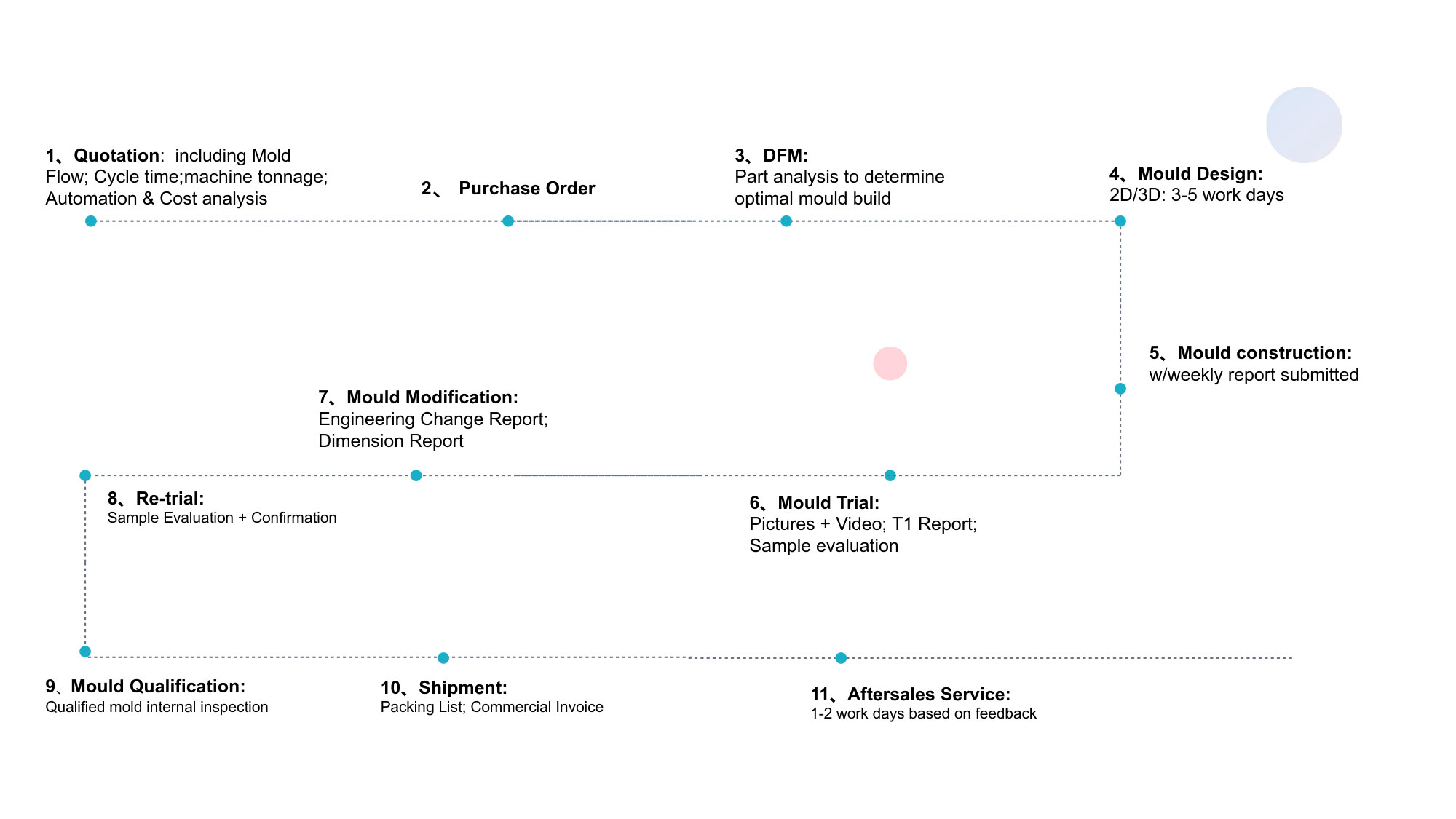
9.2 Mold Manufacturing Process Flow
Step 1: Design & DFM (5–10 days)
Customer 3D model review and DFM analysis
Mold flow simulation for fill pattern optimization
Cavitation and runner balance calculation
Cooling system design and thermal simulation
Step 2: Steel Selection & Procurement (2–5 days)
S136 ESR for core/cavity (48–52 HRC after heat treatment)
P20 pre-hardened for mold base (30–36 HRC)
H13 for hot runner manifold components (46–52 HRC)
Step 3: Rough Machining (5–8 days)
CNC milling of mold base plates
Core/cavity roughing
Step 4: Heat Treatment (3–5 days)
Vacuum hardening and tempering (S136 to 48–52 HRC)
Stress-relief annealing for complex components
Step 5: Precision Machining (8–12 days)
Five-axis high-speed milling (±0.002mm accuracy)
Slow-wire EDM for micro-features (thread details, venting slots)
CNC turning for core pins and threaded inserts
Step 6: Surface Finishing (5–7 days)
Mirror polishing of core/cavity surfaces (Ra ≤0.05μm)
Coating application (TiN/TiCN/DLC) for wear components
Step 7: Assembly & Fitting (5–7 days)
Component assembly into mold base
Clearance verification and adjustment
Hot runner system integration
Step 8: Mold Trial & Validation (5–7 days)
T0–T3 validation protocol execution
Dimensional and cosmetic inspection
Process parameter optimization
Step 9: Shipment & Documentation (1–3 days)
Mold disassembly and protective packaging
Full documentation package (drawings, material certs, inspection reports, maintenance manual, spare parts list)
Total typical lead time for 33-tooth 39g preform mold: 35–50 days (depending on cavitation and complexity)
9.3 Injection Molding Process Optimization
Critical Process Parameters for 39g PET Preform:
Parameter Target Setting Control Tolerance Impact on Quality
Drying temperature 165–175°C ±2°C Prevents IV degradation/hydrolysis
Drying time 5–6 hours ±0.5 hours Ensures moisture <0.02%
Barrel temperature (feed zone) 260–265°C ±2°C Melt viscosity control
Barrel temperature (compression) 275–280°C ±2°C Polymer melting optimization
Barrel temperature (metering) 280–290°C ±2°C Homogeneous melt
Nozzle temperature 275–285°C ±2°C Prevent freeze-off
Injection speed 80–120 mm/s ±5 mm/s Fill without shear-induced degradation
Injection pressure (peak) 1000–1400 bar ±50 bar Complete cavity fill
Holding pressure 500–800 bar ±30 bar Shrinkage compensation
Holding time 2–4 seconds ±0.5 seconds Packing optimization
Mold temperature (chilled water) 10–15°C ±1°C Crystallization control
Cooling time 8–12 seconds ±1 second Dimensional stability
Back pressure 5–10 bar ±2 bar Melt homogeneity
Screw speed 60–100 RPM ±10 RPM Consistent plastication
Optimal cycle time: 10–13 seconds
Injection time: 1.5–2.5 seconds
Cooling time: 8–10 seconds
Mold open/ejection: 0.5–1 second
9.4 Quality Control & Assurance Matrix
Quality Attribute Measurement Method Acceptance Criteria Frequency
Preform weight Electronic balance (±0.01g) Target ±0.2g Every cavity, every cycle (automated)
Neck finish dimensions CMM / Optical inspection ±0.05mm First article + every 1,000 cycles
Wall thickness Ultrasonic gauge (±0.01mm) Nominal ±0.05mm 100% in-line
Preform height Optical comparator ±0.3mm First article + SPC sampling
Eccentricity Vision system <0.15mm 100% in-line
Gate vestige Visual/microscope <0.3mm protrusion 100% visual
Surface defects Vision inspection No scratches >1mm, no bubbles/black spots 100% in-line AI inspection
Crystallinity DSC analysis As specified (30–35% typical) Qualification + periodic
Intrinsic Viscosity (IV) Solution viscometer Target ±0.02 dL/g Per resin batch + periodic
9.5 Packaging & Delivery Process
Preform packaging protocol:
Clean, dust-free environment with HEPA filtration
Preforms automatically counted and oriented by weight (pcs/kg basis)
Available packaging formats:
Gaylord boxes (600–1,000 kg capacity, palletized)
Bulk bags (250–500 kg, stackable)
Cardboard cartons (25–50 kg, for smaller shipments)
Desiccant packs included for moisture control during transit
Barcoded labels for lot traceability (date, shift, cavity, machine, material batch)
Just-in-Time delivery capabilities:
Dedicated logistics team for export documentation (commercial invoice, packing list, bill of lading, certificate of origin)
Multiple shipping options: air freight (emergency), sea freight (standard), rail freight (Europe–Asia corridor)
Warehousing services available: consigned inventory, VMI (Vendor Managed Inventory) programs
Lead time for standard orders: 15–30 days from production release
Conclusion: Why Ansix Tech for Your 33-Tooth 39g Skincare Bottle Preform Project
Ansix Tech delivers demonstrated value through:
Customer Priority How Ansix Tech Delivers Proof Point
Lower cost Lightweighting engineering; cycle time optimization; energy efficiency 10–20% lower TCO vs. industry average
Higher quality Mirror-finish molds; MES-controlled parameters; 100% automated inspection CPK ≥1.33; <0.5% reject rate
Faster delivery Lean manufacturing; 4 global facilities; robust supply chain 25–45 days typical mold lead time
Reduced risk DFM before tooling; T0–T3 validation; 2000-cycle wear testing Zero design-phase surprises; predictable ramp-up
Long-term value Premium mold steels (S136/H13/P20); spare parts included; lifetime support 1,000,000+ cycle mold life
For Ansix Tech, a mold is more than a block of steel—its your customers impression of your brand and your production line`s most critical component. We design molds that deliver consistent quality, maximum uptime, and predictable lifetime costs.
We invite you to experience our DFM process firsthand—simply provide your product design and allow us to demonstrate how we identify and eliminate potential issues before they become production problems. Contact Ansix Tech today to begin your 33-tooth 39g skincare bottle preform project.
Ansix Tech Co Ltd
If you have any plans related to 33-tooth 39g skincare bottle PET packaging blow molding special tube preform PETG bottle preform , you can contact us at any time. We will turn your ideas into reality, let you realize your dreams, and obtain large orders from the market. Our contact information is info@ansixtech.com. Or contact our CTO, mail: stephen@ansixtech.com
#www.ansixtech.com #ansixtech.com #33-tooth 39g skincare bottle PET packaging blow molding special tube preform PETG bottle preform #33-tooth 39g skincare bottle PET packaging blow molding special tube preform PETG bottle preform #33-tooth 39g skincare bottle PET packaging blow molding special tube preform PETG bottle preform injection molding companies #33-tooth 39g skincare bottle PET packaging blow molding special tube preform PETG bottle preform Canopy Mold injection mold companies #Ansix #Ansix moulds #Ansix china #Ansix tech china #Ansix tech company #Ansix facotry #33-tooth 39g skincare bottle PET packaging blow molding special tube preform PETG bottle preform injection molding #33-tooth 39g skincare bottle PET packaging blow molding special tube preform PETG bottle preform injection tools #33-tooth 39g skincare bottle PET packaging blow molding special tube preform PETG bottle preform injection moulds #33-tooth 39g skincare bottle PET packaging blow molding special tube preform PETG bottle preform plastic mould #33-tooth 39g skincare bottle PET packaging blow molding special tube preform PETG bottle preform plastic tools #Ansix Tech #Ansix molds #Ansix injection molding #Ansix mold factory #injection molding 33-tooth 39g skincare bottle PET packaging blow molding special tube preform PETG bottle preform #Ansix mold factory #33-tooth 39g skincare bottle PET packaging blow molding special tube preform PETG bottle preform china #33-tooth 39g skincare bottle PET packaging blow molding special tube preform PETG bottle preform molds #injection factory #33-tooth 39g skincare bottle PET packaging blow molding special tube preform PETG bottle preform injection molding #33-tooth 39g skincare bottle PET packaging blow molding special tube preform PETG bottle preform injection molding factory #injection molding company #33-tooth 39g skincare bottle PET packaging blow molding special tube preform PETG bottle preform injection mold companies #33-tooth 39g skincare bottle PET packaging blow molding special tube preform PETG bottle preform#33-tooth 39g skincare bottle PET packaging blow molding special tube preform PETG bottle preform mold limited #Ansix mold china #Ansix companies #Ansix company China #33-tooth 39g skincare bottle PET packaging blow molding special tube preform PETG bottle preform facotry #Ansix Tech #Ansix Tech mould #33-tooth 39g skincare bottle PET packaging blow molding special tube preform PETG bottle preform injection moulding #injection moulding company #Ansix 33-tooth 39g skincare bottle PET packaging blow molding special tube preform PETG bottle preform parts injection mold companies #medical injection molding companieschina #33-tooth 39g skincare bottle PET packaging blow molding special tube preform PETG bottle preform china factory #Ansix moulding companies #Ansix molding company #33-tooth 39g skincare bottle PET packaging blow molding special tube preform PETG bottle preform injection moulding facotry #Ansix Tech mold #33-tooth 39g skincare bottle PET packaging blow molding special tube preform PETG bottle preform mould #33-tooth 39g skincare bottle PET packaging blow molding special tube preform PETG bottle preform plastic injection molding #ansix plastic mold #Mold manufacturing #33-tooth 39g skincare bottle PET packaging blow molding special tube preform PETG bottle preform parts manufacturing #33-tooth 39g skincare bottle PET packaging blow molding special tube preform PETG bottle preform plastic parts factory #33-tooth 39g skincare bottle PET packaging blow molding special tube preform PETG bottle preform injection parts mold #33-tooth 39g skincare bottle PET packaging blow molding special tube preform PETG bottle preform PRECISION MANUFACTURING #33-tooth 39g skincare bottle PET packaging blow molding special tube preform PETG bottle preform #China mold #33-tooth 39g skincare bottle PET packaging blow molding special tube preform PETG bottle preform injection moulding china #33-tooth 39g skincare bottle PET packaging blow molding special tube preform PETG bottle preform mould china #china precision mold #mold in china #33-tooth 39g skincare bottle PET packaging blow molding special tube preform PETG bottle preform mold china #Precision molds #High-precision molds #33-tooth 39g skincare bottle PET packaging blow molding special tube preform PETG bottle preform #Injection molds #33-tooth 39g skincare bottle PET packaging blow molding special tube preform PETG bottle preform Factory #33-tooth 39g skincare bottle PET packaging blow molding special tube preform PETG bottle preform Company #Super Large Injection Mold Factory #Large Tonnage Injection Molding Factory #33-tooth 39g skincare bottle PET packaging blow molding special tube preform PETG bottle preform Company #33-tooth 39g skincare bottle PET packaging blow molding special tube preform PETG bottle preform Factory #2800T Injection Molding Factory #3000 Ton Injection Molding #4500 Ton Injection Molding Factory #Large Mold Injection Molding #Large Plastic Mold Injection Molding Factory #Large Injection Mold Manufacturer #Plastic Mold Factory #Injection Mold #Plastic Mold