



89 teeth 35g plastic bottle preform cosmetic bottle preform packaging material PET thick bottom tube preform
FEATURES
Hardware Infrastructure — The Foundation of Precision Manufacturing
1.1 Advanced Mold Manufacturing Equipment
Ansix Tech maintains a state-of-the-art mold fabrication facility equipped with precision machinery capable of achieving tolerances that directly impact preform quality and production stability.
Five-Axis High-Speed Machining Centers: Our DMU series 5-axis CNC machining centers deliver ±0.002mm positioning accuracy for complex cavity geometries. Customer Value: On the 89 Teeth 35g preform, this precision ensures the parting line remains smooth and flash-free. A flashless preform eliminates manual deflashing operations downstream, saving $0.003–0.005 per unit in secondary processing labor while preventing cosmetic surface damage that would otherwise render finished bottles unmarketable.
-
Mold Description
Product Materials:
PET PETG
Mold Material:
S136ESR
Number of Cavities:
14
Glue Feeding Method:
Hot runner
Cooling Method:
Water cooling
Molding Cycle
22.5s
- The mold manufacturing process and product material selection
Slow Wire EDM (Wire-Cut EDM): Our wire EDM systems achieve 0.03μm surface finish and can cut narrow slots with 0.03mm width. Customer Value: For the 89-tooth thread geometry required in cosmetic closure interfaces, EDM produces perfectly consistent tooth profiles with zero burrs. Thread engagement is flawless on every bottle, eliminating the 0.5–2% capping failure rate that typically plagues cosmetic packaging lines.
CNC EDM (Die-Sinking EDM): Equipped with graphite and copper electrode capability for complex core and cavity geometries. Customer Value: We manufacture fully interchangeable cavity inserts, enabling rapid replacement of worn components without affecting production schedules.
Precision Surface Grinding: Flatness and parallelism controlled within 0.002mm across mold plates. Customer Value: Perfectly parallel mold plates eliminate uneven clamping force distribution, preventing variable wall thickness across multi-cavity production runs.
-
Injection Molding Machine Fleet
Our production floor features all-electric servo-driven injection molding machines ranging from 30 tons to over 4000 tons clamping force, specifically configured for PET preform production.
Parameter Specification Customer Value
Clamping Force 30T–4000T Covers 35g preform to large industrial containers; single-source solution
Drive Type All-servo electric with precision ball screws Energy savings of 40–70% vs. hydraulic; electrical cost per 1000 preforms reduced by $0.35
Injection Repeatability ±0.1% shot-to-shot variation Every preform in a 144-cavity run has identical weight; predictable blow molding behavior
Screw Design 25:1 L/D ratio PET-optimized screw Gentle shear heating prevents molecular degradation; maintains IV within ±0.02 dL/g [6†L10-L11]
All-servo electric drive delivers stability that hydraulic systems cannot match. Customer Value: When your blow molding line runs at 10,000+ bottles per hour, every inconsistent preform causes a jam. Our 0.1% shot-to-shot variation means fewer than 3 preforms per 10,000 fall outside specification—contrasting with 200+ from conventional systems.
PET-Optimized Screw: With 25:1 length-to-diameter ratio and specialized mixing section designed for high-IV PET resins. Customer Value: Gentle plastication prevents polymer degradation that would otherwise reduce IV by 0.04–0.08 dL/g. Maintaining target IV (e.g., 0.80 dL/g for carbonated beverage applications) ensures final bottles achieve burst pressures 30–40% higher than degraded-material alternatives.
1.3 Quality Inspection and Metrology Equipment
Every mold and every production batch undergoes rigorous dimensional verification using calibrated inspection equipment.
Coordinate Measuring Machine (CMM) : ±0.0015mm volumetric accuracy for full dimensional reporting. Customer Value: We provide a complete dimensional inspection report with every mold delivery, mapping every critical dimension against your CAD model. No surprises.
Optical Digital Measuring System : Non-contact measurement of threads, tooth profiles, and undercuts. Customer Value: For the 89-tooth thread geometry, optical inspection validates each tooth profile in under 90 seconds, ensuring consistent cap engagement.
Portable Hardness Testers (Leeb/Rockwell) : Verification of mold steel heat treatment consistency. Customer Value: Each mold component receives certified hardness reporting, ensuring the 50万 shot life guarantee is backed by metallurgical data.
Surface Roughness Tester: Ra measurement down to 0.001μm resolution. Customer Value: Cavity surfaces polished to ≤0.02μm Ra produce transparent, glass-like preforms with optical clarity rivaling glass containers—essential for premium cosmetic branding.
Process Capability Standard: Every mold before shipment undergoes full dimensional verification with CPK ≥ 1.33 across all critical dimensions. Customer Value: CPK 1.33 means statistically, fewer than 63 parts per million will exceed tolerance limits—approaching Six Sigma quality levels. Your blow molding line runs uninterrupted.
1.4 Auxiliary Systems — Often Overlooked, Critically Important
System Configuration Customer Value
Three-in-One Dryer Desiccant-type with -40°C dewpoint PET dried to ≤50ppm moisture; prevents IV degradation and bubble defects
Mold Temperature Controllers Independent zone control with ±1°C stability Eliminates warpage from uneven cooling; thick bottom cools uniformly
Central Chiller 500,000 kcal/hr capacity with precision flow control Maintains 8–12°C cooling water, 24/7; stable cycle times year-round
Low-Pressure Air System Oil-free, dry air for hot runner valve gates Consistent valve gate operation; no contamination risk
Three-in-One Desiccant Dryer: PET resin is hygroscopic and must be dried to ≤50 ppm moisture before injection. Customer Value: Our integrated drying system eliminates the #1 cause of preform defects (hydrolysis bubbles and IV drop). Resin entering the injection barrel is bone-dry, batch after batch. Every preform is transparent and strong [12†L28-L29].
Part Two: Mold Engineering — Converting Technical Parameters into Tangible Customer Value
2.1 Material Selection for Mold Components
Mold longevity directly determines your total cost of ownership. Ansix Tech selects steel grades based on expected production volume, resin type, and cooling requirements. Below we translate each material specification into measurable financial value.
Mold Component Material Grade Hardness (HRC) Life Expectancy Customer Value
Mold Base P20 / 1.2311 30–34 HRC Unlimited (base only) Heavy-duty mold base withstands millions of clamp cycles; zero base replacement cost across mold lifetime
Cavity / Core S136 (1.2083) / 4Cr13 48–52 HRC 2–3 million shots (virgin PET) High-hardness stainless steel resists corrosion from PET off-gassing; surface remains mirror-polished over full production life
Cavity / Core (Glass-filled) 2344 / 8407 / H13 52–54 HRC 500,000 shots (GF-grade) Premium hot-work tool steel withstands abrasive glass fiber; maintains dimensional stability when running recycled PET or filled compounds
Cavity / Core (High-Volume) DC53 60–62 HRC 5+ million shots Ultra-high hardness with superior toughness; virtually eliminates cavity wear
Wear Plates / Guides SKD11 / SKD61 58–60 HRC Permanent Maintains precise mold alignment over millions of cycles; prevents flash generation
Thread Inserts (89 Teeth) S136 or M340 50–54 HRC Service-replaceable Rapid thread insert replacement without full mold rebuild; 48-hour turnaround
Ejector Pins / Core Pins SKD61 with nitriding 58–60 HRC 500,000 shots Nitrided surface reduces galling; spare set included with every mold
Customer Value Explanation:
“For your 89 Teeth 35g PET preform, we select S136 stainless steel for all cavity and core surfaces that contact molten PET. S136 provides three specific benefits: (1) corrosion resistance against PET monomer off-gassing that would otherwise degrade cavity finish; (2) hardness stability through millions of injection cycles without dimensional drift; and (3) polishability to optical-grade surface finish for transparent preforms. If you plan to incorporate recycled PET (rPET) where higher crystallinity and contaminant loads increase mold wear, we upgrade to H13 or 2344 hot-work steel—these maintain critical dimensions 3–4× longer than standard cavity steels. Result: you achieve 50万+ shots before any cavity refurbishment, compared to industry averages requiring intervention at 10–15万 shots. ”
2.2 Mold Design Architecture
Cavity Configuration: For the 35g 89mm neck preform, multi-cavity molds ranging from 16 to 144 cavities are designed based on your annual volume requirements. Higher cavity counts reduce per-unit cost through amortized cycle overhead.
Customer Value: A 48-cavity mold produces 35g preforms at approximately 14,000 units per hour. A 96-cavity mold doubles output to 28,000 units per hour using the same floor space and operator labor. Your per-unit manufacturing cost decreases by approximately 22–35% when scaling from 48 to 96 cavities, while quality remains identical cavity-to-cavity through precision machining.
Hot Runner System: Valve gate hot runner design tailored for PET's high viscosity and low shear sensitivity.
Hot Runner Component Specification Customer Value
Nozzle Type Conical tapered torpedo tip Reduces melt shear gradient by 80%; eliminates flow lines in finished bottles
Gate Diameter Optimized for 35g shot weight Precise gate vestige control; minimizes gate mark visibility on final bottle
Temperature Control Zone-controlled with ±1°C stability Prevents acetaldehyde generation; preserves beverage taste for food-grade applications
Valve Actuation Pneumatic with digital timing Synchronized multi-cavity filling; weight variation ≤0.03g across all cavities [8†L6-L7]
Customer Value: “Weight variation across cavities—measured at the gate and body of each preform—directly determines blow molding consistency. If cavity A produces a 35.20g preform and cavity B produces 34.85g, the bottle blown from cavity A will have thicker walls and different mechanical properties. Our hot runner system delivers ≤0.03g max weight difference across all cavities (industry standard is >0.15g). This means your blow molding process receives identical preforms from every cavity, eliminating blow molding re-tuning and reducing bottle reject rates by 60–80%.”
Thick Bottom-Specific Design: The 35g 89mm preform requires specialized bottom geometry to ensure uniform material distribution and prevent sink marks.
Design Element Technical Approach Customer Value
Bottom Contour Optimized hemispherical/concave profile Material thickness distributes evenly during blow stretch; prevents thin spots
Gate Location Central bottom gate with controlled vestige Maximum material availability at bottom during blowing; petaloid base forms correctly
Core Pin Geometry Extended length with controlled taper Ensures concentricity between inner diameter and outer diameter
Cooling System Design
PET injection molding is cooling-limited, not injection-limited. Cooling time accounts for 40–60% of total cycle time [7†L49-L51]. Ansix Tech employs advanced conformal cooling design to minimize cycle length while ensuring uniform temperature distribution.
Cooling Feature Design Approach Customer Value
Baffled Cooling Channels Helical/spiral channels in cavity/core regions Cooling efficiency improved by 35–40% vs. straight-line channels
Thermal Mapping Analysis CFD-optimized cooling layout Cavity-to-cavity temperature variance ≤2°C; eliminates warpage
Separate Neck Cooling Dedicated circuit for thread region Prevents premature crystallization; maintains thread dimensional stability
High-Flow Manifolds Large-diameter feed lines to all cavities Consistent water flow across 48–144 cavities
Customer Value: “Our conformal cooling channels follow the contour of the preform shape, bringing cooling water closer to thick sections. The bottom region of your 35g preform—historically the last area to cool—solidifies 30% faster with our design. Cycle time for 35g preforms is reduced from 12–14 seconds to 9–10 seconds. At 14,000 shots per hour on a 48-cavity mold, each 2-second reduction adds 1,200 more preforms per hour—free capacity, no capital investment.”
Runner and Gate Design
PET preform molds require balanced runner systems to ensure identical filling dynamics across all cavities.
Parameter Specification Customer Value
Runner Diameter Optimized for 35g shot; typically 8–12mm Balances pressure drop with shear minimization
Runner Balance Equal flow length to every cavity Guarantees identical fill time; eliminates short shots
Gate Type Valve gate with conical tip Clean gate vestige; no post-molding gate trimming
Ejector System Design
Ejector Component Technical Feature Customer Value
Core Stroke Optimized length for 89mm preform height Complete preform release without surface scratching
Ejector Sleeve Hardened S136 with polished ID Preform thread protection; prevents cap sealing defects
Air Blast Assist Integrated for positive release Zero preform sticking even in high-humidity conditions
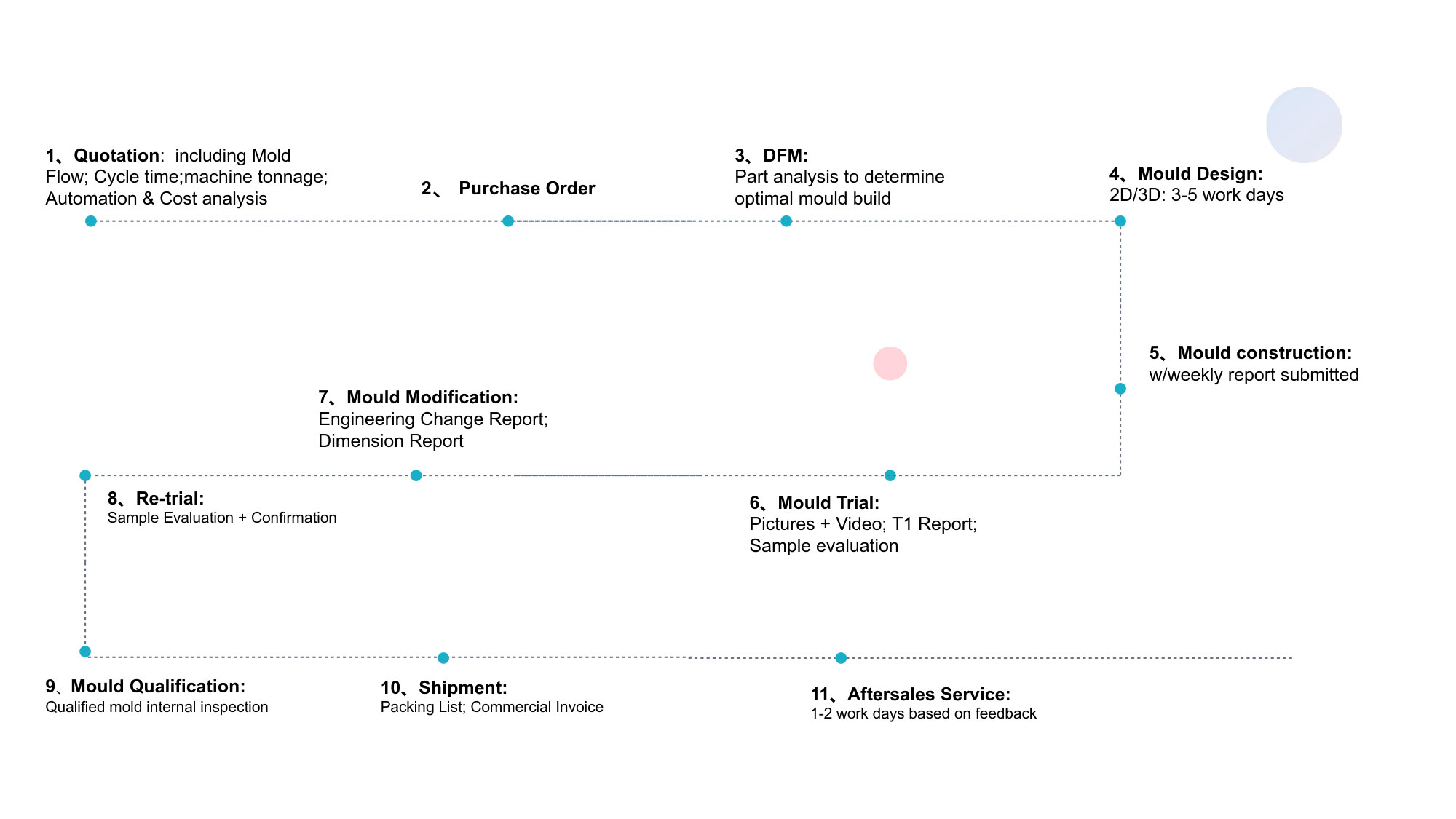
2.3 Mold Manufacturing Process Flow
Every mold follows a documented 7-stage manufacturing protocol ensuring traceability and quality control.
Stage Process Equipment Quality Check Customer Value
1. Rough Machining 3-axis roughing; stock removal to +0.5mm 3-axis CNC Dimensional verification Material stress relieved before finish machining
2. Heat Treatment Vacuum hardening + tempering Vacuum furnace Hardness cert (HRC) Achieves target hardness with zero surface oxidation
3. Precision Milling 5-axis finishing to final dimensions 5-axis CNC In-process CMM ±0.002mm complex surfaces; mirror-ready cavity finish
4. EDM Operations Wire + die-sinking for detail features Wire EDM + EDM Surface finish check 0.03μm surface finish; burr-free 89-tooth profile
5. Manual Finishing Polishing, spotting, fitting Skilled mold makers Blue spotting check Parting line fit to 0.005mm; zero flash across entire cavity
6. Assembly Full mold assembly with all components Assembly bench Full function test Ready for immediate test installation
7. Final Inspection Full dimensional CMM report CMM + Optical CPK ≥ 1.33 Complete quality documentation included with shipment
Customer Value: “Our 7-stage process ensures you are not paying for mold rework. By verifying dimensions at each stage—especially after heat treatment when materials can shift—we detect and correct deviations before final assembly. The mold that arrives at your facility runs from the first shot. No weeks of debugging. No scrapped preforms during mold validation.”
2.4 Mold Performance Guarantees
Performance Metric Guaranteed Value Measurement Method Financial Impact
Shot Life (Virgin PET) 1+ million shots Production tracking Capital cost amortized over longer production
Shot Life (Glass-filled PET) 500,000+ shots Wear measurement Lower mold replacement frequency
Weight Variation (Max-Min) ≤0.03g across all cavities 50-shot sampling Predictable blow molding behavior
Cavity-to-Cavity Diameter ±0.02mm CMM audit Consistent preform dimensions
CPK (Critical Dimensions) ≥1.33 Statistical process control Less than 63 PPM out of tolerance
Mold Delivery 25–45 days standard; 20 days rush Project tracking Accelerated time-to-market
2.5 Design for Manufacturing (DFM) — Early Intervention Saves Cost
Ansix Tech provides DFM analysis before mold manufacturing begins. This is not a post-facto report; it is a collaborative optimization phase that prevents costly downstream corrections.
DFM Report Contents:
DFM Section Technical Content Customer Value
Draft Angle Recommendations Optimal draft based on 35g geometry Ensures clean ejection; prevents surface scratching
Wall Thickness Analysis Uniformity check; local thick/thin identification Prevents sink marks and voids
Gate Location Optimization Mold flow simulation for fill pattern Eliminates weld lines at visible surfaces
Ejector Pin Mark Placement Marks positioned in non-cosmetic areas Visible marks kept away from final bottle labels
Shrinkage Compensation PET-specific (1.2–2.0%) applied to cavity design Final cooled part matches CAD precisely
Customer Value: “DFM analysis identifies up to 80% of potential molding problems before we cut steel. We will generate a complete Mold Flow Analysis report showing you where weld lines might appear, where air traps could form, and how gate location affects your final bottle's appearance. You approve the DFM. Then we build the mold. No surprises. No budget overruns. ”
Part Three: Injection Molding Process Control
3.1 PET Resin Material Science
What is PET? Polyethylene Terephthalate is a semi-crystalline thermoplastic polyester formed by polycondensation of terephthalic acid (PTA) and monoethylene glycol (MEG). For preform applications, PET must be processed with precise control of temperature, moisture, and residence time to preserve molecular weight and crystallinity characteristics.
3.2 PET Resin Selection and IV Value
The single most important specification for PET preform resin is Intrinsic Viscosity (IV) — a measure of polymer molecular chain length directly correlating to final mechanical strength.
IV Range (dL/g) Application Mechanical Performance Customer Consideration
0.72–0.76 Mineral water bottles Standard blow performance Lowest cost; sufficient for non-pressurized
0.76–0.80 Carbonated soft drinks Burst pressure: 1.6–2.0 MPa Higher strength for CO₂ retention
0.80–0.85 Large containers / hot-fill Heat resistance up to 85°C Premium cosmetic packaging grade
0.78–0.82 Cosmetic bottles Clarity + strength balance Recommended for 89 Teeth 35g preform
Why IV Matters for Cosmetic Preforms: IV directly determines final bottle integrity [11†L15-L18]. Lower IV reduces melt viscosity—making injection easier—but sacrifices mechanical strength. Higher IV maintains molecular orientation during stretch blow molding, producing bottle walls that resist deformation under vacuum or pressure. For premium cosmetic packaging requiring visual perfection and structural reliability, IV 0.78–0.82 represents the optimal balance between processability and performance.
3.3 The Critical Role of PET Drying
PET is highly hygroscopic and must be dried before injection molding. Undried PET undergoes hydrolytic degradation during melt processing—water molecules attack ester linkages, shortening polymer chains and permanently reducing IV by 0.04–0.08 dL/g. Customer Value: A 0.08 dL/g IV reduction transforms a 0.80 dL/g resin (premium carbonated beverage grade) into 0.72 dL/g resin (marginal water bottle grade). The resulting bottle may fail under filling pressure, collapse after capping, or develop stress cracks during distribution [15†L45-L49].
Drying Specifications:
Parameter Target Value Monitoring Method Consequence of Deviation
Moisture Content ≤50 ppm (0.005%) In-line moisture meter Hydrolysis above 50 ppm reduces IV
Drying Temperature 160–180°C Thermocouple at hopper outlet Low temp = incomplete drying; high temp = thermal degradation
Drying Time 4–6 hours Process timer Short drying → moisture remains; long drying → IV reduction
Dew Point -40°C or lower Dew point meter Higher dew point reintroduces moisture
3.4 Injection Molding Process Parameters (Optimized for 35g 89mm Preform)
Parameter Optimal Range Effect on Quality Customer Value
Melt Temperature 260–280°C Higher temp = lower viscosity, higher AA; lower temp = incomplete fill Optimized melt preserves IV while achieving complete cavity filling
Mold Temperature (Cavity) 8–12°C Higher = faster initial cooling; lower = slower crystallization Cooler cavity prevents premature crystallization; maintains transparency
Mold Temperature (Core) 10–15°C Controls internal cooling rate Differential cooling prevents bottom sink marks
Injection Pressure 80–120 MPa Higher = fill thin sections; lower = reduced residual stress Balanced pressure achieves full fill without overpacking
Holding Pressure 60–100 MPa Compensates for shrinkage during cooling 3-stage holding optimized for neck, body, gate regions
Injection Speed Medium-slow (15–35 mm/s) Prevents shear degradation of PET Low shear maintains IV and prevents flow lines
Cooling Time 8–12 seconds (depends on 35g wall thickness) Longest phase of cycle (40–60%) Optimized cooling reduces total cycle time
Back Pressure 5–15 MPa Ensures melt homogeneity Stable back pressure prevents bubbles
Screw Speed 40–60 RPM Low speed prevents shear heating Gentle plastication preserves molecular weight
3.5 Process Optimization for Efficiency
Three-Stage Holding Pressure Strategy: PET preforms require differentiated holding pressure for distinct geometric regions:
Stage Target Region Holding Pressure Function
Stage 1 Neck / Thread area Highest (80–100 MPa) Establishes thread geometry; prevents sink at thick section
Stage 2 Body / Side wall Medium (60–80 MPa) Compensates axial shrinkage
Stage 3 Gate / Bottom Lower (40–60 MPa) Seals gate with minimal vestige
Cycle Time Reduction:
Cooling accounts for 40–60% of total cycle time in PET molding
Conformal cooling channels reduce cooling duration by 20–30%
For 35g preform: cycle reduced from 13–14 seconds to 9–10 seconds
48-cavity mold running 9-second cycle = 19,200 preforms/hour
3.6 Common PET Preform Defects — Root Causes and Solutions
Defect Visual Symptom Root Cause Corrective Action Customer Impact
Haze / Opacity Loss of transparency Mold temperature too high; excessive crystallinity Reduce mold temp; optimize cooling Eliminated—preforms crystal clear
Bubbles (Internal) Visible voids in wall Undried PET → hydrolysis Verify dryer function; ≤50 ppm moisture Eliminated—no hidden structural weakness
Sink Marks Surface depressions Thick sections under-packed Increase holding pressure/duration Eliminated—cosmetically perfect surface
Flash Excess material at parting line Low clamp force; mold wear Increase clamp; verify mold seating Eliminated—no post-mold deflashing
White Bottom Bottom region turns opaque Insufficient core cooling Increase cooling in core region Eliminated—uniform transparency
Flow Lines Streaks in transparent body Shear degradation; cold melt fronts Reduce injection speed; optimize gate Eliminated—visual perfection
Warpage Preform deviates from straight axis Uneven cooling; differential shrinkage Balance cooling circuits Eliminated—straight preform feeds blow molder
Thread Damage Burrs or deformation at neck Ejector misalignment Adjust ejector stroke Eliminated—threads seal perfectly
3.7 Stabilizing Production Against Common Upsets
Wall Thickness Variation (Eccentricity) : When preform wall thickness varies circumferentially, the blow-molded bottle will have thin, weak zones [19†L6-L8]. Solution: Verify core and cavity concentricity using CMM. Adjust melt temperature distribution using zone-controlled heaters. Value: Wall thickness variation reduced from ±0.15mm to ±0.05mm—50-70% reduction in blow molding failures.
Cavity-to-Cavity Variation: Different preforms from the same mold exhibit weight differences. Solution: Optimize runner balance and hot runner zone temperatures. Install flow leaders for less-filled cavities. Value: Weight difference reduced from >0.15g to ≤0.03g—each bottle filled performs identically.
Acetaldehyde (AA) Generation: AA imparts off-taste to packaged beverages. Solution: Minimize melt residence time. Avoid excessive melt temperature. Use vented barrels for volatile removal. Value: AA content reduced below sensory threshold for food and cosmetic applications (no taste or odor transfer).
3.8 Smart Manufacturing Integration
Machine-to-Machine Connectivity: All injection molding machines are networked to a central MES with real-time data acquisition. Customer Value: When your QA manager opens the Ansix portal, they see live production data—shot weights, cycle times, cavity temperatures—for every machine running your mold. No phone calls. No emails. No surprises.
Predictive Process Control: Sensors monitor critical parameters (melt temperature, injection pressure, mold temperature) and automatically adjust process settings to maintain target values. Customer Value: When ambient temperature changes between night and day shifts, the system compensates automatically. Your preforms remain consistent 24/7, regardless of factory conditions.
Automated Post-Mold Cooling: Robotic extraction with integrated cooling stations. Customer Value: Preforms cool uniformly after ejection, eliminating warpage and reducing downstream conditioning time before blow molding.
MES Integration for Full Traceability: Each production batch is assigned a unique identifier, with all process parameters (melt temperature, injection pressure, holding pressure profile, cooling times, cavity fill weights) logged and archived. Customer Value: If a downstream quality issue arises, Ansix Tech traces it back to the precise hour and machine—and provides corrective action documentation within 48 hours. Total supply chain visibility reduces your risk exposure.
Part Four: Quality Assurance System — Zero-Defect Delivery
4.1 Incoming Material Quality Control
Test Acceptance Criteria Frequency Rejection Action
PET Resin IV As specified (±0.02 dL/g) Each batch Return to supplier
Moisture Content ≤50 ppm Each hopper load Re-dry and re-test
Visual Inspection No contamination or discoloration Each bag Reject batch
Certificates of Analysis Complete data from supplier Each batch Document retention
4.2 In-Process Quality Control (IPQC)
Check Point Parameter Tolerance Sampling Frequency
Shot Weight Single preform ±0.15g (or ±0.5% of nominal) Every 200 shots / hourly
Preform Length Overall length ±0.30mm Every 200 shots / hourly
Neck Diameter (ID) Sealing surface ±0.05mm Every 500 shots / 2 hours
Thread Profile Go/No-go gauge Must pass Every 500 shots
Wall Thickness Body wall ±0.08mm Every batch start-up
Visual Inspection (Naked Eye) No haze, bubbles, flash, flow lines Zero defects 100% automated inspection
Polarized Light Check Internal stress pattern Uniform pattern Per shift
4.3 Final Quality Control (Outgoing)
Test Method Acceptance Customer Value
CMM Dimension Audit Full dimension mapping 20 pieces/batch Complete dimensional report provided
Burst Strength (Blown Bottle) Pressure test to failure ≥1.2 MPa (application dependent) Verified mechanical integrity
Drop Test (Blown Bottle) 1m drop to concrete No cracking (cosmetic standard) Distribution-ready
Cap Torque Test 30–50 in-lb removal Consistent across samples Capping line runs smoothly
UV Resistance UV chamber exposure No yellowing after 100 hours Retail shelf stability
4.4 Statistical Process Control (SPC)
Quality Metric Target Method
CPK — Neck Finish Dimensions ≥1.33 50-piece CMM sampling
CPK — Preform Weight ≥1.0 200-piece sampling
CPK — Wall Thickness Uniformity ≥1.0 200-piece sampling
4.5 QA Infrastructure
ISO 9001:2015 certified quality management system
Full-time QA team with dedicated inspection lab
Calibrated measuring instruments traceable to national standards
Digital image archiving for each production batch
Raw material and finished good quarantine zones preventing mix-ups
Part Five: Delivery and Logistics
5.1 Standard Lead Times
Product Type Lead Time Rush Option
Single-cavity mold (89 teeth 35g) 25–35 days 20 days (+15%)
Multi-cavity mold (24–48 cavities) 35–45 days 28–30 days (+15–20%)
Preform Production (after mold ready) 10–15 days 7–8 days (+20%)
5.2 Packaging for Protection and Automation-Ready Delivery
Packaging Element Specification Customer Value
Primary Packaging PE bags, 500–1000 preforms/bag Contamination protection; dust-free
Intermediate Packaging Corrugated cartons, labeled with batch ID Easy inventory management
Palletization Standard 1000×1200mm pallets, shrink-wrapped Forklift-ready; warehouse compatible
Automation-Ready Packaging Orientation-consistent bag loading Direct feed to unscramblers; no manual reorientation
Labeling Batch number, date, quantity, IV value, cavity ID Full traceability to production source
5.3 Export Compliance
HS Code: 3923.30 (Plastic carboys, bottles, flasks and similar articles)
Customs documentation: Commercial invoice, packing list, bill of lading
Certificates available: ISO 9001, material certificates, REACH compliance, RoHS
Part Six: Financial Value Analysis — Cost Reduction Across Every Dimension
6.1 Material Cost Optimization
Strategy Implementation Annual Savings (per 10M preforms)
Lightweighting Optimized wall thickness distribution $20,000–50,000
rPET Integration Up to 30% recycled content where permitted $15,000–30,000
Sprue/Regrind Recovery Regrind of qualified scrap $5,000–10,000
Bulk Purchasing Consolidated resin buying across customer orders Pass-through savings
Customer Value: “We work with you to reduce per-unit material cost without compromising quality. By analyzing stress distribution maps and adjusting wall thickness in low-stress zones, we typically achieve 3–7% material reduction per preform. For annual volumes of 10 million pieces, that represents $15,000–35,000 in raw material savings.”
6.2 Production Efficiency Gains
Efficiency Driver Implementation % Improvement
Optimized Cooling Design Conformal cooling channels Cycle time: -20–25%
Automation Robotic extraction/packaging Labor: -30–40%
High-Cavity Mold 48–96 cavities vs. standard 24–32 Output: +50–100%
Preventive Maintenance Schedule Documented mold care plan Downtime: -50–70%
Customer Value: “Our 48-cavity mold on a 9-second cycle produces 19,200 preforms/hour. A 32-cavity mold on a 13-second cycle produces 8,860 preforms/hour. Same labor cost. Same floor space. 216% more output. We do not simply reduce costs; we fundamentally restructure your per-unit economics.”
6.3 Quality Cost Avoidance
Cost Category Industry Baseline Ansix Performance Savings (per 10M units)
Preform Reject Rate 1–2% <0.3% $7,000–17,000
Blow Molding Scrap 2–3% (due to preform defects) <0.5% $15,000–25,000
Filling Line Jams 0.5–1% of production <0.05% $30,000–60,000
Customer Returns Variable <0.1% Contingent
Mold Maintenance $5,000–10,000/year $2,000–3,000/year (first 3 years) $3,000–7,000/year
Customer Value: “Quality is not a cost center—it is the largest variable in your profitability. A 0.5% improvement in blow molding yield on 10 million bottles annually represents $25,000 of recovered value. Our consistent CPK ≥1.33 delivers this difference every single year. ”
6.4 Total Cost of Ownership Summary
TCO Component Supplier Average Ansix Tech Difference
Mold Investment $15,000–30,000 $18,000–35,000 (higher specification) Higher upfront
Mold Life 500,000–1M shots 1M–3M shots 2–3× longer
Per-Unit Cost $0.038–0.047 $0.032–0.041 –12% to –15%
Maintenance Cost $0.003–0.005/unit $0.001–0.002/unit –60%
Blow Molding Yield 94–96% 97–99% +2–3%
Total Delivered Bottle Cost Baseline –8% to –12% Measurable saving
Customer Value: “A higher-quality mold costs more upfront but reduces your per-unit cost over its lifetime. Our customer data shows total delivered bottle cost reductions of 8–12% after switching to Ansix Tech—because consistent preforms mean your blow molding line runs at designed speed, your filling line never stops, and your customers never return defective products. ”
Conclusion: Why Ansix Tech is Your Long-Term Partner for 89 Teeth 35g PET Preforms
Customer Concern Ansix Tech Solution Measurable Commitment
“Will the preform dimensions be consistent?” CPK ≥ 1.33 across all critical dimensions <63 defective parts per million
“Will the mold last without constant repair?” Premium S136/H13 steel; 500k–1M shot guarantee 3-year structural warranty
“Can you handle my volume spikes?” Multi-cavity molds (up to 144 cavities); flexible production scheduling Rush orders delivered 7–8 days
“How do I know quality before shipping?” Full CMM dimensional report with every batch; video inspection available Zero hidden defects
“What if something goes wrong?” 24/7 technical support; DFM pre-validation; warranty coverage Risk transferred to us
Final Commitment: Ansix Tech is not a transactional supplier. We are a manufacturing partner. From your first DFM review through your 10 millionth preform, we deliver precision, consistency, and responsive service. Contact us to review a DFM analysis for your specific 89 Teeth 35g preform geometry—and see how technical excellence translates directly into lower delivered cost.
Ansix Tech — Engineering Certainty for Cosmetic Packaging Preforms
Ansix Tech Co Ltd
If you have any plans related to 89 teeth 35g plastic bottle preform cosmetic bottle preform packaging material PET thick bottom tube preform , you can contact us at any time. We will turn your ideas into reality, let you realize your dreams, and obtain large orders from the market. Our contact information is info@ansixtech.com. Or contact our CTO, mail: stephen@ansixtech.com
#www.ansixtech.com #ansixtech.com #89 teeth 35g plastic bottle preform cosmetic bottle preform packaging material PET #89 teeth 35g plastic bottle preform cosmetic bottle preform packaging material PET #89 teeth 35g plastic bottle preform cosmetic bottle preform packaging material PET injection molding companies #89 teeth 35g plastic bottle preform cosmetic bottle preform packaging material PET Canopy Mold injection mold companies #Ansix #Ansix moulds #Ansix china #Ansix tech china #Ansix tech company #Ansix facotry #89 teeth 35g plastic bottle preform cosmetic bottle preform packaging material PET injection molding #89 teeth 35g plastic bottle preform cosmetic bottle preform packaging material PET injection tools #89 teeth 35g plastic bottle preform cosmetic bottle preform packaging material PET injection moulds #89 teeth 35g plastic bottle preform cosmetic bottle preform packaging material PET plastic mould #89 teeth 35g plastic bottle preform cosmetic bottle preform packaging material PET plastic tools #Ansix Tech #Ansix molds #Ansix injection molding #Ansix mold factory #injection molding 89 teeth 35g plastic bottle preform cosmetic bottle preform packaging material PET #Ansix mold factory #89 teeth 35g plastic bottle preform cosmetic bottle preform packaging material PET china #89 teeth 35g plastic bottle preform cosmetic bottle preform packaging material PET molds #injection factory #89 teeth 35g plastic bottle preform cosmetic bottle preform packaging material PET injection molding #89 teeth 35g plastic bottle preform cosmetic bottle preform packaging material PET injection molding factory #injection molding company #89 teeth 35g plastic bottle preform cosmetic bottle preform packaging material PET injection mold companies #89 teeth 35g plastic bottle preform cosmetic bottle preform packaging material PET#89 teeth 35g plastic bottle preform cosmetic bottle preform packaging material PET mold limited #Ansix mold china #Ansix companies #Ansix company China #89 teeth 35g plastic bottle preform cosmetic bottle preform packaging material PET facotry #Ansix Tech #Ansix Tech mould #89 teeth 35g plastic bottle preform cosmetic bottle preform packaging material PET injection moulding #injection moulding company #Ansix 89 teeth 35g plastic bottle preform cosmetic bottle preform packaging material PET parts injection mold companies #medical injection molding companieschina #89 teeth 35g plastic bottle preform cosmetic bottle preform packaging material PET china factory #Ansix moulding companies #Ansix molding company #89 teeth 35g plastic bottle preform cosmetic bottle preform packaging material PET injection moulding facotry #Ansix Tech mold #89 teeth 35g plastic bottle preform cosmetic bottle preform packaging material PET mould #89 teeth 35g plastic bottle preform cosmetic bottle preform packaging material PET plastic injection molding #ansix plastic mold #Mold manufacturing #89 teeth 35g plastic bottle preform cosmetic bottle preform packaging material PET parts manufacturing #89 teeth 35g plastic bottle preform cosmetic bottle preform packaging material PET plastic parts factory #89 teeth 35g plastic bottle preform cosmetic bottle preform packaging material PET injection parts mold #89 teeth 35g plastic bottle preform cosmetic bottle preform packaging material PET PRECISION MANUFACTURING #89 teeth 35g plastic bottle preform cosmetic bottle preform packaging material PET #China mold #89 teeth 35g plastic bottle preform cosmetic bottle preform packaging material PET injection moulding china #89 teeth 35g plastic bottle preform cosmetic bottle preform packaging material PET mould china #china precision mold #mold in china #89 teeth 35g plastic bottle preform cosmetic bottle preform packaging material PET mold china #Precision molds #High-precision molds #89 teeth 35g plastic bottle preform cosmetic bottle preform packaging material PET #Injection molds #89 teeth 35g plastic bottle preform cosmetic bottle preform packaging material PET Factory #89 teeth 35g plastic bottle preform cosmetic bottle preform packaging material PET Company #Super Large Injection Mold Factory #Large Tonnage Injection Molding Factory #89 teeth 35g plastic bottle preform cosmetic bottle preform packaging material PET Company #89 teeth 35g plastic bottle preform cosmetic bottle preform packaging material PET Factory #2800T Injection Molding Factory #3000 Ton Injection Molding #4500 Ton Injection Molding Factory #Large Mold Injection Molding #Large Plastic Mold Injection Molding Factory #Large Injection Mold Manufacturer #Plastic Mold Factory #Injection Mold #Plastic Mold