



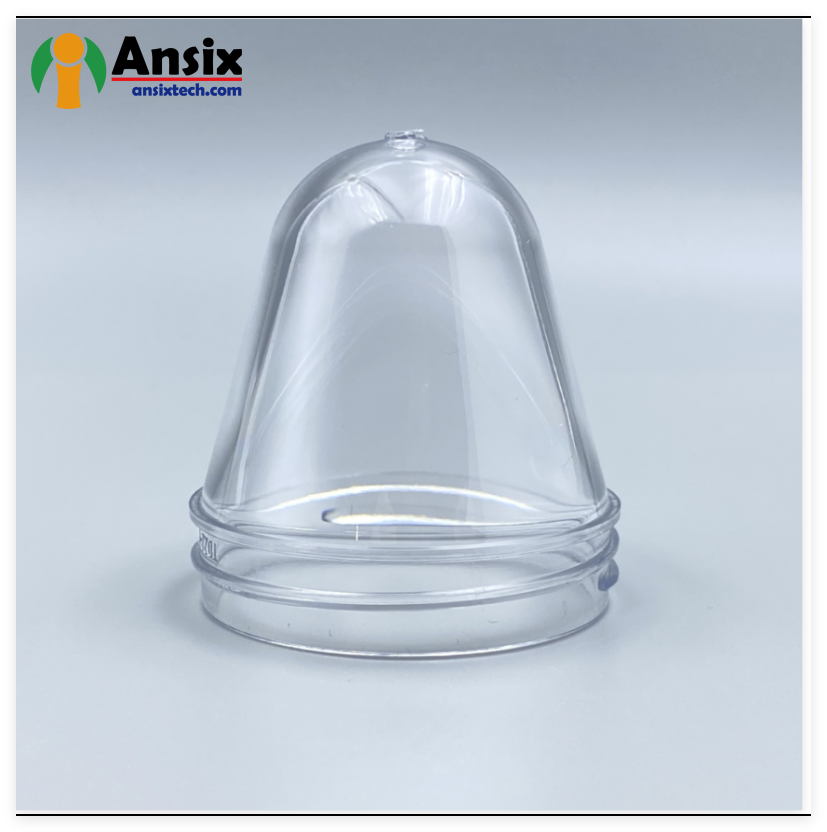


PET Raw Material Characteristics and Selection PET Resin Intrinsic Viscosity (IV) Value Selection The intrinsic viscosity (IV) value is the single most critical material parameter determining preform
FEATURES
Standard Grammage Options for 53mm Neck PET Preforms
Ansix Tech offers a comprehensive range of standard preform weights for the 53mm neck configuration, based on industry-proven designs and verified blow-molding performance. The selection of appropriate grammage is determined by the final blown container volume, wall thickness requirements, and mechanical strength specifications of the finished bottle.
Standard Available Grammages for 53mm Neck Preforms:
Grammage (grams) Typical Blown Container Volume Range Primary Applications
8.5g – 8.7g 100ml – 150ml Small personal care, travel-size bottles
11g – 12g 150ml – 200ml Cosmetics, facial cleanser, lotions
13.5g – 14.9g 200ml – 250ml Food condiments, sauce jars
15g – 18g 250ml – 350ml Pickles, ghee, edible oils
18.5g – 19.5g 350ml – 400ml Household cleaners, medium jars
22g – 25g 400ml – 500ml Large food jars, bulk packaging
28g – 30g 500ml – 600ml Heavy-duty containers, hot-fill applications
33g – 40g 600ml – 800ml Industrial, chemical, and heavy packaging
65g – 75g 800ml – 1,500ml Large jars, premium thick-wall containers
180g >2,000ml Extra-large containers, 5-gallon equivalent
Industry data confirms that for 53mm SP400 neck finishes, available preform weights include 8.7g, 11g, 13.5g, 15g, 18g, 19.5g, 22g, 25g, and 28g as standard offerings. Higher grammage variants (33g, 40g, 65g, 75g, 180g) are also manufactured for heavy-duty and large-volume applications. Trypet SIA reports 25g and 30g options enabling 200ml–500ml jar blowing depending on wall stiffness requirements.
-
Mold Description
Product Materials:
PET PETG
Mold Material:
S136ESR
Number of Cavities:
24
Glue Feeding Method:
Hot runner
Cooling Method:
Water cooling
Molding Cycle
22.5s
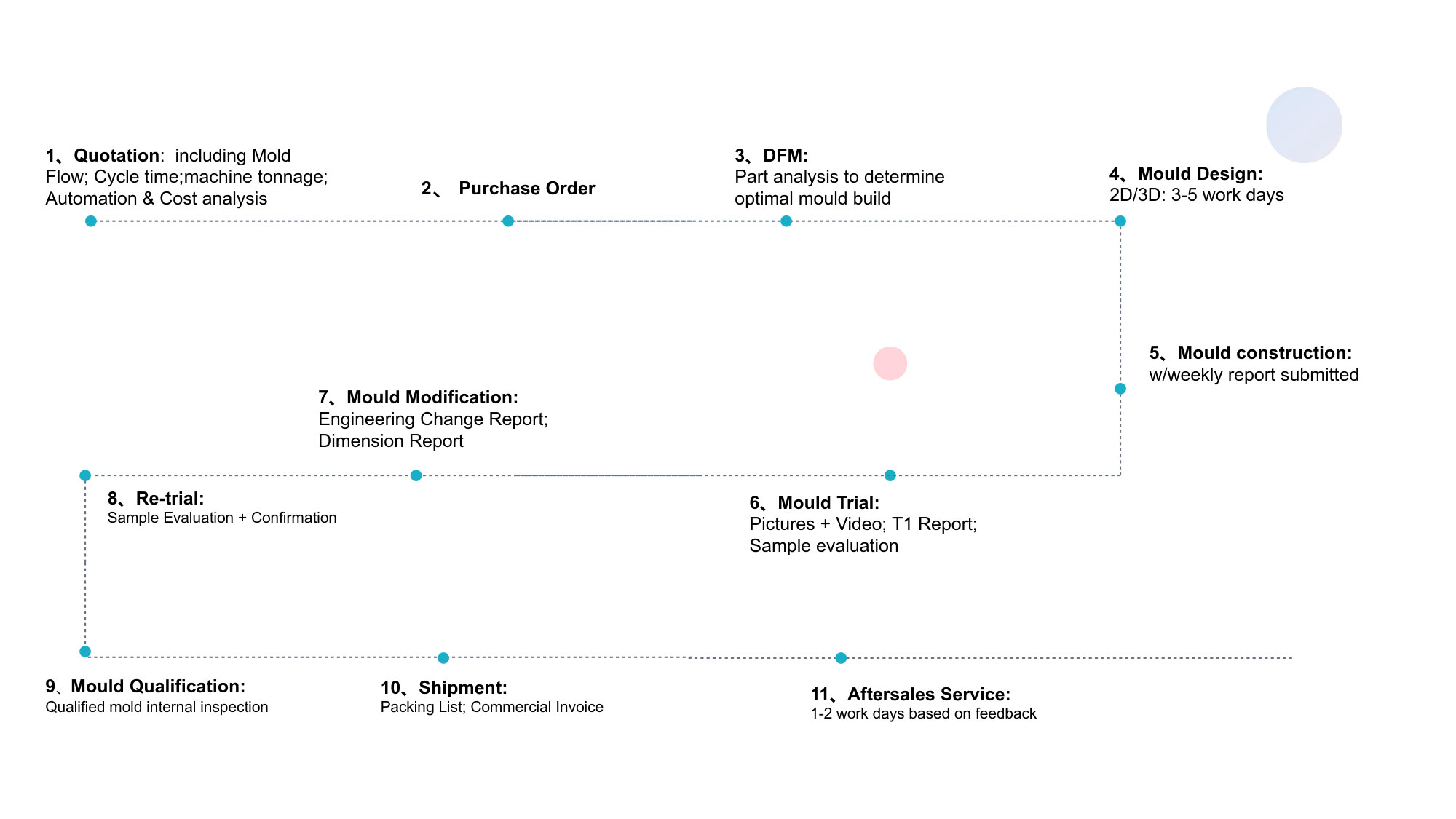
- The mold manufacturing process and product material selection
Standard Grammage Classification:
Light-weight range (8.5g – 15g): Optimized for still beverage applications, facial cleansers, and lightweight food packaging. Industry standard: 500ml still water bottle typically uses 10–14g preforms.
Medium-weight range (15g – 28g): Designed for carbonated beverages, CSD bottles (38–42g for 1.5L carbonated drinks), pickles, and hot-fill food applications.
Heavy-weight range (28g – 180g): Engineered for high-strength requirements including hot-fill bottles, industrial chemical containers, and premium packaging where thick walls and impact resistance are critical.
Custom Grammage Development:
Ansix Tech recognizes that not all applications conform to standard weight options. Through mold flow analysis and customized cavity design, we develop bespoke preform weights tailored to your specific bottle geometry, wall thickness distribution, and performance requirements. Custom development typically adds 3–5 weeks to lead time and includes up to three iterative validation shots before production release.
Material Type Options:
Virgin PET (100%): Maximum clarity, consistent viscosity, superior mechanical properties, and compliance with food-contact regulations (FDA, EU 10/2011)
Recycled PET (rPET): Configurable from 25% up to 100% rPET content, supporting sustainability initiatives with minimal clarity and processing impact
Hot-fill PET grade: Higher crystallinity resistance for filling temperatures up to 85°C (185°F)
UV-blocking PET: Integrated UV inhibitors for light-sensitive product protection
Color masterbatch: Custom colors for brand differentiation (minimum order quantities apply)
-
Ansix Tech Hard Power Infrastructure: Building Trust Through Equipment Excellence
Ansix Tech has established a manufacturing ecosystem designed for precision, consistency, and scalability. With over 28 years of industry experience, our infrastructure represents a strategic investment in quality assurance and production reliability.
2.1 Advanced Mold Manufacturing Equipment
Five-Axis High-Speed Machining Centers:
Our five-axis high-speed CNC machining centers are capable of achieving positional accuracies of ±0.002mm. This precision ensures:
Smooth, burr-free parting lines – Eliminating secondary finishing operations on injection-molded parts
Complex curved surface machining – Enabling sophisticated preform geometries with undercuts, threads, and contours maintained to tight tolerances
Reduced manual polishing – Lowering labor costs by 15–20% while eliminating human error-induced surface defects
Client Value: When your product has exacting surface quality requirements—transparent preforms for cosmetic bottles where clarity is paramount—our five-axis capability delivers mold surfaces that transfer directly to your preforms without polishing marks or flow-line artifacts.
Slow Wire EDM (Electrical Discharge Machining):
Our slow-wire EDM systems are calibrated for precise machining of fine micro-holes (0.03mm minimum diameter) and narrow slots, critically important in preform tooling for:
Venting channels – Essential for air evacuation during injection filling, preventing burn marks and incomplete fills
Thin-wall cooling channels – Conformal cooling designs that reduce cycle times by up to 10%
Intricate thread geometry – Maintaining complete thread integrity without thin-wall deformation
Precision Surface Grinding and Polishing:
All mold components receive final treatment through:
Surface grinding with parallelism tolerances ≤0.003mm
Mirror polishing achieving surface roughness Ra ≤0.02μm for transparent preforms
Automated lapping processes ensuring consistency across multi-cavity tools
2.2 Injection Molding Machine Fleet
Ansix Tech operates a total of 260 injection molding machines across four production bases in China and Vietnam, with clamping forces ranging from 30 tons to 2,800 tons.
Machine Portfolio:
Brand Origin Quantity Application Focus
Fanuc Japan 65+ High-speed precision molding, all-electric servo drives
Sumitomo Japan 40+ Thin-wall packaging, high-cavitation preforms
Toshiba Japan 35+ General-purpose PET processing
Nissei Japan 30+ Small-to-medium preform production
Engel Austria 25+ Large-component molding, multi-cavity systems
Arburg Germany 20+ Two-component molding, liquid silicone rubber
Haitian China 45+ High-volume commodity production
Client Value: This diversified machine portfolio eliminates single-source constraints. If a machine is scheduled for preventive maintenance, we shift production across comparable platforms without downtime to your production schedule. The 30-ton to 2,800-ton range means we can mold preforms from 5g up to 800g—all within one manufacturing partner.
Servo-Electric Drive Technology:
All principal machines are equipped with all-electric or hybrid servo-electric drives, delivering:
±0.1% shot-to-shot repeatability – Critical for maintaining weight uniformity across multi-cavity tools
Energy consumption reduced by 40–60% compared to hydraulic equivalents, lowering both operational costs and carbon footprint
Thermal stability – Eliminating hydraulic oil temperature fluctuation variables
PET-Specific Injection Unit Configuration:
PET is a demanding material that degrades easily if overheated and must be cooled rapidly. Our injection units feature:
L/D Ratio of 24:1 or higher (industry standard for PET is minimum 24:1, compared to 18:1–22:1 for general plastics)– ensuring gradual compression and low-shear melting
Accumulator-assisted injection – Rapid mold filling across all cavities simultaneously (fill times typically 0.5–1.2 seconds for 96-cavity preform tools)
Melt residence time optimization – PET held in the heated barrel for less than 3 minutes, preventing yellowing or black specks from degradation
Shot volume sizing – Preform shot weight maintained at ≤75% of machine’s maximum shot capacity for stability and efficiency
2.3 Quality Inspection and Metrology Equipment
Coordinate Measuring Machines (CMM):
Our CMM systems provide traceable dimensional verification across all critical preform dimensions:
Measurement accuracy: ±0.001mm
Full mold dimensional reporting prior to customer shipment
Automated cavity-to-cavity comparison for 96-cavity tools
Optical Vision Inspection Systems:
Automated optical inspection is integrated into every production shift, detecting:
Surface defects (black specks, bubbles, flow lines)
Dimensional deviations (±0.01mm threshold)
Gate vestige height variations (±0.05mm)
Thread finish integrity
Digital Quality Management Framework:
Every mold shipped includes a full dimensional report comparing measured values to CAD nominal with deviation analysis
Critical dimension CPK ≥1.33 confirmed prior to production release
Batches tracked with full traceability – Each production run includes material certification (virgin PET batch number, rPET content verification), machine parameter logs, and inspection results archived for 10 years
3. Mold Manufacturing Core Competencies: Performance Metrics That Matter to You
3.1 Mold Life and Durability Guarantees
Mold Steel Selection Framework:
Steel Grade Category Typical Application in Preform Mold Hardness (HRC) Estimated Mold Life
P20 Pre-hardened mold steel Mold base plates, support pillars 30–34 500,000 cycles
718H Pre-hardened, high toughness Mold bases, clamp plates 33–37 1,000,000 cycles
H13 Hot-work tool steel Cavity inserts, gate areas 45–55 1,500,000 cycles
S136 Stainless, corrosion-resistant Core pins, cavity surfaces for transparent parts 48–52 2,000,000+ cycles
2343 / 2344 High-performance hot-work steel High-cycle cavity systems 48–52 2,000,000+ cycles
8407 Premium-grade H13 variant Complex geometry cavities 48–52 2,000,000+ cycles
SKD11 / SKD61 Japanese tool steel Wear components, slide blocks 58–62 2,500,000+ cycles
DC53 High toughness, high wear resistance High-wear core pins, gate inserts 60–63 3,000,000+ cycles
M340 / 4Cr13 / 9Cr18 Martensitic stainless High-corrosion applications 50–55 2,000,000+ cycles
NAK80 Pre-hardened, excellent polishability High-gloss optical surfaces 38–42 1,000,000+ cycles
S136 stainless steel can guarantee a minimum of 1,000,000 molds when properly maintained. For PET applications requiring high cavity pressure resistance and thin-wall mold strength, high-hardness, high-toughness steel combinations are essential.
Mold Life Commitments:
Standard applications (non-abrasive PET): 1,000,000 cycles with S136-grade cavities
Glass-fiber reinforced PET (GF-PET): 500,000 cycles with H13 or 8407 cavity steel
100% virgin PET: 2,000,000 cycles with proper maintenance (coating selection below)
Mold steel material certificates and heat treatment curves provided with every mold delivery
Surface Coating for Extended Life:
We apply industry-proven coatings for high-volume preform production:
Titanium Nitride (TiN): Applied to core surfaces, hardness up to 85 HRC equivalent, reducing friction and wear
Diamond-Like Carbon (DLC): Applied to neck rings (standard for high-end preform tooling), providing ultra-low coefficient of friction and exceptional wear resistance
Hard Chrome Plating: Wear resistance improvement and corrosion prevention across mold components
Nitriding: Surface hardness enhancement through nitrogen gas exposure, minimizing cracking risk
3.2 Achievable Tolerances
Component Type General Tolerance Precision/Elective Tolerance
Preform overall length ±0.08mm ±0.05mm
Neck finish diameter ±0.05mm ±0.03mm
Thread profile ±0.03mm ±0.02mm
Wall thickness uniformity ±0.02mm across cross-section ±0.01mm
Gate vestige height ≤0.08mm ≤0.05mm
Ejector pin mark depth ≤0.05mm ≤0.03mm
3.3 Mold Types and Configurations
Hot Runner Systems:
Our hot runner designs are critical to achieving balanced filling across multi-cavity tools:
Multi-zone independent temperature control: Hot runner plates divided into autonomous control zones, providing targeted temperature compensation to “weaker” runners further from the main inlet, ensuring consistent melt state at each nozzle tip
Multi-point valve pin + simultaneous opening: Ensures melt fills all cavities simultaneously with consistent pressure and temperature, fundamentally reducing cavity-to-cavity variation
Gate cooling with aggressive top panel cooling: Ensures rapid freeze-off and effective mold decompression, minimizing cycle time
Cavity Configurations Available:
Cavity Count Mold Pitch Typical Machine Requirement Daily Output Estimate
32 cavities 45mm 300–400 tons 80,000–120,000 preforms
48 cavities 45mm 400–600 tons 120,000–180,000 preforms
72 cavities 45mm 600–900 tons 180,000–270,000 preforms
96 cavities 45mm 900–1,500 tons 240,000–360,000 preforms
144 cavities 45mm 1,500–2,800 tons 360,000–540,000 preforms
Industry benchmark: 144 cavities on a 400-ton machine represents the trend toward smaller, lighter preforms with ultra-fast cycle times.
Specialized Mold Capabilities:
Stack molds (double-face): Doubles output per machine cycle for high-volume commodity applications, reducing capital equipment requirements by up to 50%
Two-component / multi-material molds: Enable production of preforms with integrated barrier layers or multiple material zones
High-gloss mirror finish molds: Surface roughness Ra <0.05μm for optical-grade transparent preform applications
3.4 Gating and Runner Optimization
Melt Flow Verification Protocol:
Prior to mold fabrication, we perform comprehensive Moldflow or Moldex3D analysis covering:
Fill simulation: Identifying weld-line locations, air entrapment zones, and flow-front behavior
Packing analysis: Optimizing pressure profiles for uniform density distribution
Cooling analysis: Validating channel placement and temperature uniformity
Warpage prediction: Anticipating and compensating for shrinkage direction
This pre-fabrication simulation identifies potential defects before tool manufacturing, ensuring optimized gate placement, balanced runner layouts, and proper venting positions.
3.5 Mold Delivery Standards
Mold Complexity Standard Lead Time Expedited Lead Time
Simple single-cavity 10–15 days 7 days
32–48 cavity standard 25–30 days 20 days
72–96 cavity complex 35–45 days 28–30 days
144 cavity high-cavitation 45–60 days 35–40 days
Expedited delivery notes: Rush orders maintain all validation steps (including 2000-cycle mold testing) without compromise. Overtime machining adds 15–20% to base mold cost.
4. Injection Molding Process Control: Eliminating Quality Anxiety
4.1 Process Standardization and MES Integration
All injection molding machines are networked to a centralized Manufacturing Execution System (MES) that:
Locks and logs all molding parameters – temperature profiles, injection speeds, packing pressures, cooling times, and back pressure settings
Engineer-only parameter modification authorization – preventing unauthorized adjustments
Real-time OEE (Overall Equipment Effectiveness) tracking – pushing alerts when production deviates from standard
Automated parameter backup – machine settings restored instantly following maintenance or mold changes
First-article and last-article inspection comparison – each production batch verified against baseline samples before shipment release
4.2 Dimensional Stability Control
Temperature Management:
Mold temperature maintained within ±2°C between cavity and core sides using:
Zone-dedicated mold temperature controllers (water or oil-based)
Temperature mapping sensors installed at strategic mold locations
Automated PID (Proportional-Integral-Derivative) control loops
Cooling System Design:
Conformal cooling channels following preform geometry rather than straight-line drilling
Internal spiral turbulent cooling channels within core pins for uniform heat extraction
Cooling efficiency deviation across cavities controlled to ≤5%
Cycle time reduction: Up to 10% reduction achievable through advanced cooling solutions
Stability Data Example:
For a standard 20g 53mm neck preform produced on a 96-cavity tool:
Critical dimension (neck finish diameter): Fluctuation ≤0.02mm across three consecutive production weeks
Weight variation: ≤0.15g standard deviation across all cavities
Crystallinity uniformity: ≤2% deviation between cavities
4.3 Visual and Appearance Quality Standards
Appearance Attribute Standard Performance Level Premium Performance Level
Bubbles / voids None visible to unaided eye None detectable under 10× magnification
Flow lines / streaks ≤2mm length, ≤1 per preform surface None visible
Gate vestige ≤0.08mm protrusion ≤0.05mm, flush finish
Black specks (degradation) ≤3 specks per preform, <0.3mm each ≤1 speck per 100 preforms
Haze / crystallinity ≤5% haze value ≤2% haze value
Surface roughness Ra ≤0.4μm Ra ≤0.2μm
4.4 Special Material Processing Capabilities
Beyond standard PET, Ansix Tech has validated processing expertise across:
Material Grade Characteristics Application in Preform/Bottle Production
PET virgin High clarity, food-contact approved Standard beverage, food, personal care
PET + rPET (25–100%) Variable clarity, sustainability-focused Eco-packaging, regulatory compliance
PC (Polycarbonate) High impact strength, heat resistance up to 120°C Reusable bottles, medical packaging
PC/ABS blends Toughness + heat resistance Industrial containers
PPS + 40% GF High chemical resistance, low moisture absorption Chemical and aggressive product packaging
PEEK Continuous service up to 250°C, excellent chemical resistance High-temperature medical, industrial
PBT Good mechanical properties, electrical insulation Electronics packaging
PEI (Ultem) Structural integrity in humid environments, excellent flame retardancy Aerospace, medical sterilization packaging
PP Lower cost, flexible Non-transparent commodity packaging
HDPE Chemical resistance, lower clarity Industrial chemical containers
Additional Material Capabilities:
UL94 V-0 rating: Flame-retardant materials for regulated applications
UV stabilizers: 3,000-hour accelerated weathering testing without significant color shift
Antimicrobial additives: FDA-approved for food-contact applications
Oxygen scavengers: Extended shelf life for oxygen-sensitive products
4.5 Advanced Quality Assurance Systems
In-Process Monitoring:
Ultrasonic wall thickness sensors: Real-time feedback on wall thickness distribution, enabling automated packing pressure compensation
Cavity pressure sensors: In-mold pressure monitoring with closed-loop control adjustment during each injection cycle
Infrared thermal imaging: Verifying uniform cooling and detecting hot spots before parts are ejected
Post-Production Inspection:
Automated vision inspection at 100% throughput: Inspection speeds up to 36,000 preforms per hour on automated lines
Weight sorting systems: Rejecting preforms outside ±0.5% of target weight
Dimensional laser scanning: Random sampling with 100% dimensional verification per batch
Leak testing (blow-molded bottles): Vacuum decay and pressure decay testing for finished container integrity
5. Full-Process Service Capabilities: Reducing Your Management Burden
5.1 Early-Stage Engineering Support – DFM (Design for Manufacturability) Report
Provided BEFORE Mold Construction Agreement:
Our DFM report delivers actionable recommendations covering:
Draft angle recommendations (0.5–2°) based on preform geometry and material shrinkage characteristics
Wall thickness optimization – Uniform wall thickness (variations ≤25%) to avoid sink marks and uneven cooling
Gate location and number – Minimizing weld lines and ensuring balanced filling
Venting and air evacuation positioning – Preventing burn marks and incomplete fills
Ejector pin mark location tolerance – Placing marks in non-critical areas or accepting specified offset limits
Material-specific shrinkage compensation – PET shrinks 0.5–1.5% depending on crystallinity and cooling rate
“The vast majority (80%) of molding defects can be eliminated at the drawing stage; by the time tooling is cut, 20% of potential defects are already locked in.” Industry best practice confirms that 80% of defects are preventable through proper design-phase optimization.
Cost-Benefit Analysis of DFM Investment:
The industry-proven correlation: Approximately 10% of design-phase optimization investment prevents 90% of downstream mold modification costs. Our DFM engagement typically identifies:
DFM Finding Category Average Impact
Draft angle adjustments Reduces ejector pin marks by 50–70%
Gate position optimization Eliminates flow-induced surface defects
Wall thickness corrections Prevents sink marks and warpage
Cooling channel redesign Reduces cycle time by 8–12%
Venting placement Eliminates burn marks
5.2 Mold Trials and Sampling (T0 to T3)
Trial Stage Milestone Deliverables
T0 (First shot) Initial mold test, verification of complete filling First sample batch, initial dimensional report
T1 Parameter refinement, gate balance adjustment Optimized dimensional report, cavity-to-cavity uniformity data
T2 Full process window establishment CPK analysis, molding parameter specification sheet
T3 Pre-production validation 500–1,000 parts for customer approval, final quality documentation
Quick-change Insert Capability: Our molds allow rapid evaluation of different runner configurations, venting designs, or gate geometries by swapping pre-machined inserts – eliminating the cost and timeline of full mold redesign.
5.3 Small-Batch Pre-Production Validation
Prior to full commercial production release, we offer 100 to 500 injection cycles in a controlled pre-production run to validate:
Statistical quality metrics (CPK ≥1.33 on critical dimensions)
First-pass yield rates (target ≥99.5%)
Blow-molding performance – Testing sample preforms on your blow-molding equipment or our partner facilities
Dimensional stability across multi-batch runs
Color and appearance consistency
Customer approval is obtained at this stage BEFORE transitioning to mass production.
5.4 Maintenance and Spare Parts Service
Included in Every Mold Shipment:
Complete set of spare wear parts: ejector pins (25% over quantity), core pins (10% over quantity), hot runner nozzles (10% over quantity), and thread split inserts (10% over quantity)
Detailed maintenance schedule: published intervals for cleaning, lubrication, and wear inspection
Documentation package: part drawings, assembly drawings, steel certification, heat treatment curves, hot runner wiring diagrams
Maintenance Commitment:
Preventative maintenance performed every 200,000 cycles as part of our standard service agreement
Lifetime repair pricing at cost – No markup on replacement components
24-hour emergency repair service for critical production stoppages
Remote diagnostic support – Real-time troubleshooting via video link
6. Differentiated Value Propositions: Direct Answers to Common Industry Pain Points
6.1 How We Solve Your Problems
Common Customer Complaint Ansix Tech Solution with Proof Metrics
“Our molds need repairs constantly, disrupting production orders.” We deliver every mold only after 2,000 cycles of in-house validation testing, with a detailed wear report documenting condition. Three-year mold structural warranty provided (excluding normal wear of consumable components).
“Excessive flash on molded parts means costly secondary deburring.” We maintain parting line fit tolerance of ≤0.005mm through precision grinding and fitting. Combined with self-locking clamp force compensation, flash is controlled to ≤0.03mm, eliminating manual deflashing operations.
“Dimension change between batches forces re-validation.” Ultrasonic wall thickness sensors in injection unit provide real-time feedback, automatically adjusting packing pressure to maintain dimension stability. In-mold pressure and temperature sensors enable closed-loop process control.
“Mold repair takes weeks, losing production time.” Our in-house electrode machining center and EDM workshop mean mold repairs never leave our facility. Standard rework (welding repair / core pin replacement / gate cleaning) restored to production within 24 hours.
“Our transparent preforms show gate blush and flow marks.” Our Moldflow simulation identifies optimal gate location and cooling design before tool steel is cut. Process parameters then locked in MES to ensure every shot replicates the validated quality.
6.2 How We Reduce Your Costs
Hard Cost Reduction – Material Savings:
Lightweighting through simulation: Weight reduction by 0.5–1.5g per preform while maintaining burst pressure and top-load strength. For a 96-cavity 25g preform running at 240,000 parts/day, 1g weight reduction = 87.6 metric tons of resin saved annually.
Material utilization optimization: Hot runner systems with zero-runner designs eliminate cold runner waste entirely (0% regrind generation from runner systems)
rPET processing capability: Up to 100% rPET content reduces material cost by 15–25% compared to virgin resin
Hard Cost Reduction – Cycle Time Optimization:
Optimization Method Cycle Time Reduction Annual Production Gain (1 mold, 24/7 operation)
Conformal cooling redesign 8–10% +70,000–87,000 cycles
High-efficiency cooling channel layout 5–8% +44,000–70,000 cycles
Process parameter optimization 3–5% +26,000–44,000 cycles
These savings are additive. A standard 96-cavity preform mold running at 12-second cycles produces approximately 691,000 preforms per day. A 15% cumulative cycle time reduction yields over 3.7 million additional preforms per month from the same capital equipment.
Hard Cost Reduction – Energy Savings:
All-electric servo machines: Consume 40–60% less energy than hydraulic equivalents
Mold insulation and hot runner optimization: Reduce heat loss by 15–20%
Drying system optimization: Quick-dry technology reduces drying energy consumption
Soft Cost Reduction – Headcount and Management:
Automated vision inspection at 100% throughput: Eliminates 2–4 quality control personnel per shift
MES-integrated parameter management: No re-validation required when operators change shifts
Spare parts included with mold shipment: No separate procurement process for initial wear components
6.3 How We Increase Your Capacity and Guarantee Delivery
Capacity Enhancement:
Stack molds (double-face): Doubles output per machine – one mold replacing two injection molding machines
Multi-cavity optimization: 96-cavity and 144-cavity configurations maximize output per press hour
24/7 production availability: Predictive maintenance alerts before equipment failure occurs
Capacity scaling: Four production facilities distributed across China and Vietnam, with plans for additional expansion
Delivery Assurance:
Material safety stock: 30–60 days of resin inventory maintained at all facilities
Mold changeover capability: Less than 90 minutes for complete tool exchange on any machine
Backup mold availability: Strategic customers with critical programs offered duplicate tool manufacturing
Expedited production lanes: 7–15 day lead time availability for urgent orders (subject to capacity)
Risk Mitigation:
Supplier concentration elimination: Four independent production sites ensure no single-point failure risk
Geographic diversification: China-based manufacturing for cost advantage; Vietnam-based production for tariff mitigation
Process duplication at multiple facilities: One product, validated at two or more production sites simultaneously
7. Conclusion: Why Ansix Tech Is Your Strategic Partner for 53mm Neck PET Preform Manufacturing
7.1 The Value We Bring to Your Business
Ansix Tech transforms what many customers see as a commodity purchase – injection molds and preform production – into a competitive advantage for your business. With over 28 years of specialized PET preform experience, we have built a manufacturing ecosystem designed for precision, consistency, and scalability.
What We Deliver:
Customer Outcome Ansix Capability Enabling Outcome
Faster time to market DFM reports before tooling begins, eliminating costly mid-project design changes
Lower total cost of ownership Long-life tool steel selection, three-year mold warranty, lifetime repair at cost
Consistent part quality MES-locked process parameters, real-time in-process monitoring, automated defect detection
Reduced production risk Four-site geographic distribution, predictive maintenance, backup tooling options
Scalable production capacity 260 injection molding machines, 30–2,800 ton range, 96–144 cavity capability
7.2 The Ansix Tech Manufacturing Distinction
In the PET preform industry, many manufacturers view molds as passive tools that simply shape plastic. At Ansix Tech, we view molds differently – not just as tools, but as profit generators.
Every mold we engineer is designed with simultaneous consideration of:
Rigidity analysis – Ensuring stability across millions of cycles
Venting and air evacuation pathing – Eliminating burn marks and incomplete fills
Temperature balance across all cavities – Uniform cooling = consistent part dimensions
Ease of maintenance – Replaceable wear components, accessible cleaning ports
Decompression management – Preventing preform deformation upon mold opening
This integrated design philosophy means the mold reaching your production floor requires:
No on-site debugging – All process parameters pre-validated
Minimal flash – ≤0.03mm across parting line
Fast cycle times – 8–12 seconds standard for most applications
Long tool life – 1–2 million cycles between major rebuilds
7.3 Our Commitment to You
Quality Assurance: All production facilities certified to ISO9001, IATF16949, ISO13485, and ISO14001.
Technical Support: Our engineering team responds to inquiries within 12 hours. On-site support provided within 48 hours for emergencies requiring physical presence.
Continuous Improvement: Quarterly design review meetings track your production performance, with proactive recommendations for cycle time reduction, material cost savings, and quality improvement based on your actual production data.
Full Transparency: You receive complete documentation – mold steel certificates, heat treatment curves, dimensional inspection reports, CPK analysis, process parameter specification sheets – for full traceability of every mold and every production batch.
8. Standard Grammage Reference Table – 53mm Neck PET Preforms
Below is a comprehensive reference of standard grammage options verified for 53mm (SP400) neck finish preforms, presented for easy customer specification:
Preform Weight (g) Blown Bottle / Jar Volume Primary Industry Applications
8.5 – 8.7 100 – 150 ml Travel-size personal care, small samples
11 150 – 200 ml Facial cleanser, lotions, cosmetics
12 150 – 200 ml Lightweight food packaging
13.5 – 15 200 – 250 ml Sauces, condiments, salad dressings
14.9 200 – 250 ml Ghee, pickles, household products
18 – 18.5 250 – 350 ml Oils, medium food jars
19.5 350 – 400 ml Jams, preserves, spreads
22 – 25 400 – 500 ml Large food jars, CSD bottles
25 – 30 400 – 500 ml Heavy-duty jars, hot-fill applications
28 500 – 600 ml Premium packaging, thick-wall containers
33 – 40 600 – 800 ml Industrial, chemical containers
40 – 50 800 – 1,000 ml Large volume food and chemical containers
65 – 75 1,000 – 1,500 ml Bulk packaging, gallon-equivalent containers
180 > 2,000 ml 5-gallon / 18.9L water bottles
Note: Standard grammage options sourced from industry data. Custom grammage development available with minimum order quantity commitments. Variations in final blown container volume depend on stretch ratio, wall thickness distribution, and container design specifications.
9. Additional Resources and Next Steps
For customers seeking to initiate a new 53mm neck PET preform development program, Ansix Tech provides the following engineering services at no cost before project commitment:
DFM (Design for Manufacturability) assessment – Review of customer part drawings with written recommendations
Material selection consultation – Recommendation of optimal PET grade based on application requirements
Mold configuration proposal – 32, 48, 72, 96, or 144 cavity recommendation with lead time and cost estimates
Preliminary cycle time estimate – Based on preform geometry and weight
Quality specification workshop – Alignment on inspection standards before production begins
To Request a DFM Analysis or Production Quote:
Email: info@ansixtech.com
Ansix Tech – Transforming Mold Manufacturing from Cost Center to Profit Center
Document Control Information:
Field Value
Document Title Advanced PET Preform Manufacturing Solutions – 53mm Neck PET Preforms
Version 1.0
Issue Date May 22, 2026
Prepared By Ansix Tech Engineering Team
Review Status Final – Approved for External Distribution
Target Audience Packaging Procurement, Engineering, Quality Management
Applicable Standards ISO9001, IATF16949, ISO13485, ISO14001
Ansix Tech Co Ltd
If you have any plans related to 53mm Neck Plastic Preform PET Transparent Food Packaging Beverage Facial Cleanser Bottle , you can contact us at any time. We will turn your ideas into reality, let you realize your dreams, and obtain large orders from the market. Our contact information is info@ansixtech.com. Or contact our CTO, mail: stephen@ansixtech.com
#www.ansixtech.com #ansixtech.com #53mm Neck Plastic Preform PET Transparent Food Packaging#53mm Neck Plastic Preform PET Transparent Food Packaging#53mm Neck Plastic Preform PET Transparent Food Packaginginjection molding companies #53mm Neck Plastic Preform PET Transparent Food PackagingCanopy Mold injection mold companies #Ansix #Ansix moulds #Ansix china #Ansix tech china #Ansix tech company #Ansix facotry #53mm Neck Plastic Preform PET Transparent Food Packaginginjection molding #53mm Neck Plastic Preform PET Transparent Food Packaginginjection tools #53mm Neck Plastic Preform PET Transparent Food Packaginginjection moulds #53mm Neck Plastic Preform PET Transparent Food Packagingplastic mould #53mm Neck Plastic Preform PET Transparent Food Packagingplastic tools #Ansix Tech #Ansix molds #Ansix injection molding #Ansix mold factory #injection molding 53mm Neck Plastic Preform PET Transparent Food Packaging #Ansix mold factory #53mm Neck Plastic Preform PET Transparent Food Packagingchina #53mm Neck Plastic Preform PET Transparent Food Packagingmolds #injection factory #53mm Neck Plastic Preform PET Transparent Food Packaginginjection molding #53mm Neck Plastic Preform PET Transparent Food Packaginginjection molding factory #injection molding company #53mm Neck Plastic Preform PET Transparent Food Packaginginjection mold companies #50mm Neck Edible Oil Bottle Preform (100ml250ml) Transparent PET Plastic Oil Bottle Preform#53mm Neck Plastic Preform PET Transparent Food Packagingmold limited #Ansix mold china #Ansix companies #Ansix company China #53mm Neck Plastic Preform PET Transparent Food Packagingfacotry #Ansix Tech #Ansix Tech mould #53mm Neck Plastic Preform PET Transparent Food Packaginginjection moulding #injection moulding company #Ansix 53mm Neck Plastic Preform PET Transparent Food Packagingparts injection mold companies #medical injection molding companieschina #53mm Neck Plastic Preform PET Transparent Food Packagingchina factory #Ansix moulding companies #Ansix molding company #53mm Neck Plastic Preform PET Transparent Food Packaginginjection moulding facotry #Ansix Tech mold #53mm Neck Plastic Preform PET Transparent Food Packagingmould #53mm Neck Plastic Preform PET Transparent Food Packagingplastic injection molding #ansix plastic mold #Mold manufacturing #53mm Neck Plastic Preform PET Transparent Food Packagingparts manufacturing #53mm Neck Plastic Preform PET Transparent Food Packagingplastic parts factory #53mm Neck Plastic Preform PET Transparent Food Packaginginjection parts mold #53mm Neck Plastic Preform PET Transparent Food PackagingPRECISION MANUFACTURING #53mm Neck Plastic Preform PET Transparent Food Packaging#China mold #53mm Neck Plastic Preform PET Transparent Food Packaginginjection moulding china #53mm Neck Plastic Preform PET Transparent Food Packagingmould china #china precision mold #mold in china #53mm Neck Plastic Preform PET Transparent Food Packagingmold china #Precision molds #High-precision molds #53mm Neck Plastic Preform PET Transparent Food Packaging#Injection molds #53mm Neck Plastic Preform PET Transparent Food PackagingFactory #53mm Neck Plastic Preform PET Transparent Food PackagingCompany #Super Large Injection Mold Factory #Large Tonnage Injection Molding Factory #53mm Neck Plastic Preform PET Transparent Food PackagingCompany #53mm Neck Plastic Preform PET Transparent Food PackagingFactory #2800T Injection Molding Factory #3000 Ton Injection Molding #4500 Ton Injection Molding Factory #Large Mold Injection Molding #Large Plastic Mold Injection Molding Factory #Large Injection Mold Manufacturer #Plastic Mold Factory #Injection Mold #Plastic Mold