



Aquarium hydraulic float switch, 2-point float, water purifier, food-grade water tank, aquaculture float valve
FEATURES
End-to-End In-House Capability: Ansix controls the entire manufacturing chain—from material selection and mold design to tool fabrication, injection molding, assembly validation, and just-in-time delivery. This vertical integration eliminates supply chain inefficiencies, accelerates iteration cycles, and provides a single point of accountability.
Proactive Quality Assurance: Rather than merely inspecting defects after production, Ansix builds quality into every stage of the manufacturing process—from raw material composition analysis and mold flow simulation to in-process metrology and final assembly verification. This approach delivers CPK ≥ 1.33 on all critical dimensions and reduces field failure rates significantly.
Customer-Centric Cost Engineering: Ansix does not treat cost reduction and quality as tradeoffs. By optimizing part geometry, selecting cost-efficient yet high-performance mold materials, adopting high-cavitation tool designs, and implementing fully automated injection molding cells, Ansix achieves cost reductions of 18–30% for its customers without compromising functional integrity.
-
Mold Description
Product Materials:
PP FOAM ABS
Mold Material:
S136ESR
Number of Cavities:
4
Glue Feeding Method:
Hot runner
Cooling Method:
Water cooling
Molding Cycle
22.5s
- The mold manufacturing process and product material selection
The Full-Service Customer Journey: From Concept to Commercial Launch
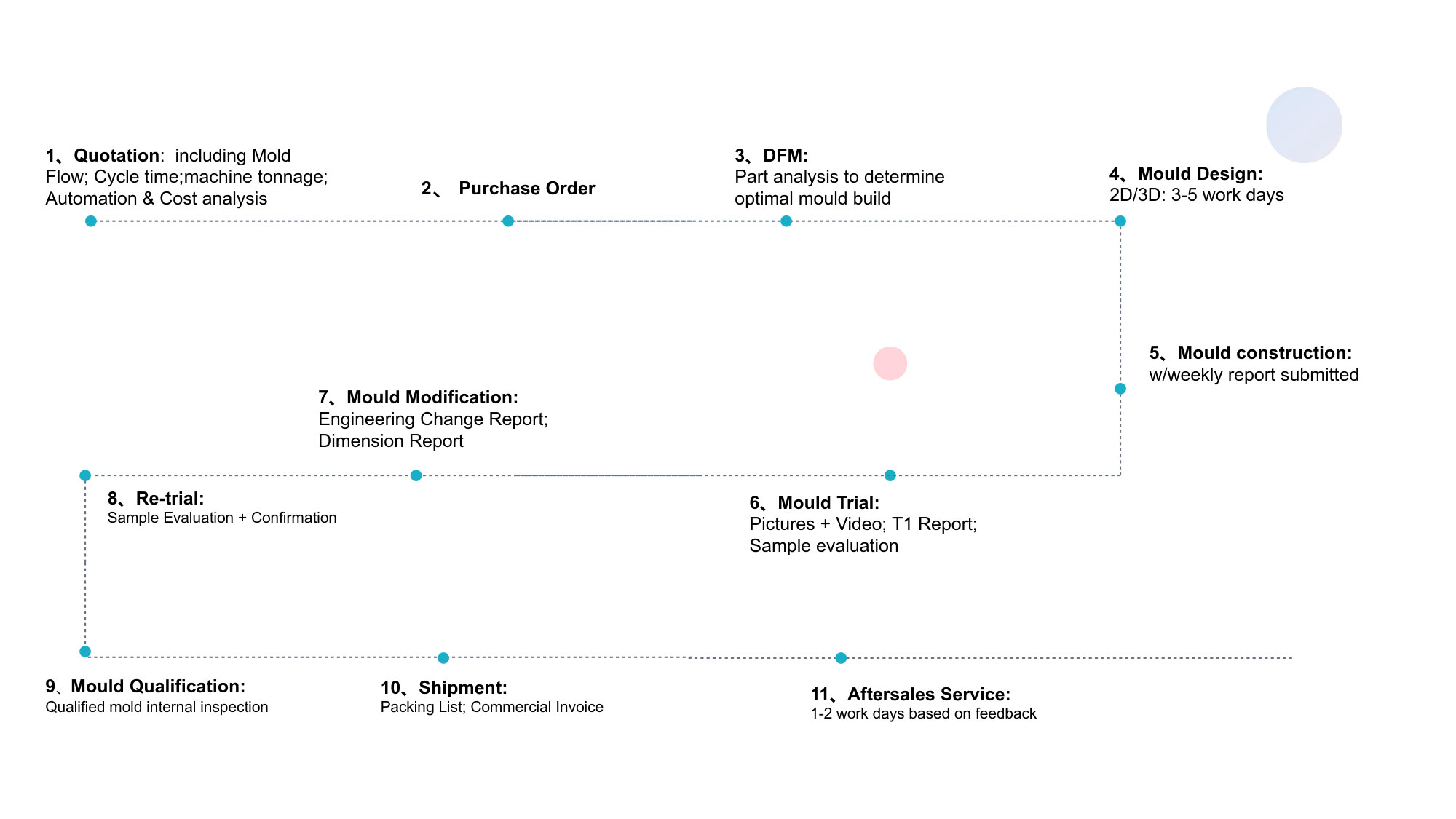
When a customer engages Ansix Tech for the design and production of aquarium hydraulic float switches, 2-point floats, water purifier components, food-grade water tanks, or aquaculture float valves, the journey flows through the following integrated service stages:
Product Design & Development: Ansix works from customer-supplied CAD models or conceptual sketches to optimize product designs for injection molding. DFM analysis identifies weld lines, air traps, and sink-mark risks and proposes design modifications that preserve functionality while maximizing manufacturability.
Mold Design & Tool Fabrication: Using industry-leading CAD/CAM software, Ansix designs multicavity molds tailored to each product’s volume requirements. Mold steel selection—including hardened tool steels such as S136, 2344, 8407, NAK80, and DC53—is matched to projected shot counts and material characteristics to ensure long tool life.
Product Validation & Prototyping: Ansix provides T0 through T3 trial shots with comprehensive dimensional reports and defect analysis. Each iteration closes the gap between nominal design and production-ready parts. For high-risk or highly regulated applications, Ansix conducts 500–1000-shot pilot runs to validate CPK and process repeatability before full production.
-
Mass Production (Injection Molding): Ansix operates a fleet of 30-ton to 4000-ton all-servo-electric injection molding machines, achieving repeatability precision of ±0.1%. Each machine is integrated with a MES (Manufacturing Execution System) that locks all process parameters—temperature, pressure, injection speed, and cooling time—to an authorized engineering baseline, eliminating operator-induced variation.
Quality Assurance & Metrology: An in-house metrology lab equipped with CMM (Coordinate Measuring Machines), optical comparators, and vision measurement systems inspects each production batch. First-article inspection reports are provided before shipment. For quality-critical components such as float switch bodies and water purifier housings, 100 percent inline inspection is performed using automated vision systems.
Packaging & Delivery: Ansix employs automated packaging cells and optimized logistics networks to meet tight delivery windows. Standard lead times for medium-complexity tools range from 25 to 45 days, with expedited options available for customers requiring accelerated market entry.
After-Sales Support & Spare Parts: Ansix ships a complete set of mold spare parts—ejector pins, core inserts, and wear plates—with every new mold. On-site mold maintenance is provided every 200,000 cycles at cost. Lifetime mold repair is offered at component-only pricing, and emergency repairs are typically completed within 24 hours.
PART TWO: PRODUCT PROFILE — ADVANCED MATERIALS, ENGINEERED PRECISION, AND MANUFACTURING EXCELLENCE
Product Line Overview
Aquarium Hydraulic Float Switch: A liquid-level sensing device that triggers pumps, alarms, or valves based on water level changes. Housed in a hermetically sealed, buoyant enclosure with an internal magnetic reed switch, these devices must resist continuous water immersion, temperature fluctuations, and mechanical cycling without leakage or performance degradation.
2-Point Float: A dual-level sensing system that provides independent low-level and high-level detection for automated filling or emptying operations. This configuration is essential for aquariums requiring automated top-up and drainage with safety redundancy.
Water Purifier Components: Including filter housings, cartridge bodies, quick-connect fittings, and manifold blocks. These components must maintain dimensional stability under hydrostatic pressure, resist long-term chemical attack from chlorinated or treated water, and comply with food-contact safety regulations.
Food-Grade Water Tank: Large-capacity storage tanks for potable water applications. These tanks require low-warpage materials with excellent impact resistance, UV stability, and regulatory compliance for food contact.
Aquaculture Float Valve: A mechanically actuated valve that maintains precise water levels in fish farming and hatchery tanks. These valves must operate reliably in saline environments, resist biofouling, and provide thousands of maintenance-free cycles.
Material Selection & Engineering Properties
The correct material selection is the single most important determinant of product performance in fluid-contact applications. Ansix Tech maintains a comprehensive material matrix tailored to the specific demands of each product category:
Polypropylene (PP): Density 0.90–0.91 g/cm³, operating temperature up to 80°C, excellent chemical resistance to acids, alkalis, and salt water. Food-grade PP (FDA and NSF compliant) is used for water purifier housings and food-grade water tanks. PP float balls provide the buoyancy required for float switches and two-point float systems.
Polyoxymethylene (POM / Acetal): High mechanical strength, low friction coefficient, and excellent dimensional stability. Used for 2-point float mechanical linkages and aquaculture valve bodies where wear resistance and smooth articulation are required. POM maintains stiffness even in high-humidity environments.
Polycarbonate (PC): Exceptional impact resistance and transparency (light transmission up to 90%). Used for aquarium float switch housings where visual inspection of internal components is desirable. PC grades with UV stabilizers maintain clarity and mechanical properties even under aquarium lighting.
ABS (Acrylonitrile Butadiene Styrene): Good impact resistance and surface finish characteristics. Used for water purifier external housings and aesthetic covers where appearance is important.
Nylon (PA6 / PA66 with or without glass fiber reinforcement): High strength-to-weight ratio, excellent wear resistance, and good chemical compatibility with water treatment chemicals. Glass-filled grades (PA6+GF30 or PA66+GF30) are used for water purifier manifold blocks requiring high burst strength and dimensional stability under sustained pressure.
Acrylic (PMMA): Superior optical clarity and UV resistance. Used for high-end aquarium float switch covers and viewing windows for food-grade water tanks.
High-Density Polyethylene (HDPE): Excellent chemical resistance and impact strength at low temperatures. Used for large-scale food-grade water tanks requiring blow-molding or rotational molding compatibility.
Polyvinylidene Fluoride (PVDF): High-purity, high-temperature resistance (up to 120°C), and exceptional chemical resistance to aggressive fluids. Used for float switches in corrosive aquaculture environments and industrial water treatment applications. PVDF meets USP Class VI and FDA requirements for high-purity water systems.
Liquid Silicone Rubber (LSR): Biocompatible, flexible, and thermally stable. Used for one-way duckbill valves and sealing diaphragms in aquaculture float valve assemblies and water purifier check valves.
For critical fluid-contact applications, all material grades selected by Ansix Tech are fully traceable and accompanied by comprehensive compliance documentation including FDA 21 CFR (food-contact compliance certificates), NSF/ANSI 61 (drinking water system components certification), UL94 V-0 (flammability rating for fire-resistant components), RoHS (Restriction of Hazardous Substances directive), REACH (Registration, Evaluation, Authorisation and Restriction of Chemicals compliance), and full SDS/MSDS safety data sheets.
Manufacturing Process Excellence
The production of high-reliability fluid control components requires rigorous process control from material drying through to final packaging:
Material Preconditioning: Hygroscopic materials (nylon, PC, PET, and PEEK) are dried in dehumidifying hopper dryers to moisture levels specified by the resin supplier—typically below 0.02% for nylons and below 0.01% for PC. Inadequate drying leads to splay, surface defects, and hydrolytic degradation of mechanical properties.
Injection Molding Process Parameters: Each tool is validated using a structured process development protocol. Key parameters include barrel zone temperatures (matched to material melt temperature), injection pressure profile (typically ramped to achieve uniform cavity filling), injection speed (optimized to prevent jetting while avoiding flow hesitation), packing pressure and duration (to compensate for volumetric shrinkage during crystallization), cooling time (determined by part wall thickness and material thermal diffusivity), and mold temperature (controlled via independent hot-water or oil temperature controllers for each cavity half).
Process Monitoring & SPC: All injection molding machines are networked to a central MES database. Real-time process parameters are compared against an engineering baseline. Any deviation beyond established control limits triggers an automatic alarm and segregates affected parts. Statistical Process Control (SPC) charts are maintained for all critical dimensions.
Post-Molding Operations: Depending on product requirements, secondary operations may include ultrasonic welding of multi-component assemblies, leak testing under hydrostatic pressure (float switches, water purifier housings), helium mass spectrometry for hermetic seal verification, magnetic reed switch insertion and functional testing (float switches), automated assembly of 2-point float linkage mechanisms, hot-stamp or pad printing for branding and identification marks, and robotic deburring and parts handling for high-volume production.
Production Capacity & Delivery Efficiency
Ansix Tech operates a fleet of injection molding presses ranging from 30 tons to 4000 tons clamping force, enabling production of products from miniature 2‑point float components weighing less than 1 gram up to food-grade water tanks requiring 4000‑ton clamping capacity. All presses are all-servo motor-driven, which consumes 40–70 percent less energy than equivalent hydraulic presses and maintains repeatability precision of ±0.1 percent from first shot to millionth shot.
Changeover times between production runs have been reduced to under 15 minutes through standardized machine interfaces and quick-change tooling systems. Where conventional equipment requires eight hours of downtime, Ansix’s quick-change cells complete the transition in 90 minutes, increasing effective production capacity by up to 30 percent and enabling tight delivery windows without overtime premiums.
Quality Assurance System
Ansix Tech operates under an ISO 9001:2015-certified quality management system with documented procedures covering all aspects of design, procurement, manufacturing, inspection, and customer communication. Key elements include:
Incoming material verification with material certificates and sample retention
In-process inspection at defined intervals (typically every 2 to 4 hours) for dimensional conformity and surface quality
First-article inspection (FAI) per AS9102 standard or customer-specific requirements
Final outgoing quality control (OQC) including 100 percent functional testing for safety-critical products such as aquarium float switches and aquaculture valves
Nonconforming material handling and root cause / corrective action tracking per 8D methodology
Calibration and maintenance records for all inspection equipment traceable to national standards
Cost Competitiveness Framework
Ansix Tech achieves industry-leading cost competitiveness through four integrated strategies:
High Cavitation Tooling: Water purifier cartridge molds are built with 4‑cavity or 8‑cavity configurations, producing multiple parts per cycle and amortizing tooling costs over larger volumes. Cycle times as low as 32.5 seconds for filter cartridges yield per‑part cost structures that are competitive with high-volume producers.
Automated Material Handling: Central drying and material conveying systems reduce manual labor and material waste.
Efficient Cooling Design: Optimized cooling channel layouts reduce cycle times, increase machine utilization, and lower per‑part energy consumption.
Lean Secondary Processing: In-mold automation including pick-and-place robots and parts separators eliminates downstream manual operations.
After-Sales Service Commitment
24‑hour response time for technical inquiries and warranty claims
Spare parts shipped with every mold
200,000‑cycle preventive maintenance at material cost
Lifetime mold repair at component-only pricing
PART THREE: MOLD MANUFACTURING & INJECTION MOLDING — DELIVERING CORE VALUE THROUGH MATERIAL SELECTION, SMART MANUFACTURING, AND PROCESS EXCELLENCE
Mold Manufacturing Capabilities That Convert Technical Precision into Customer Value
Ansix Tech operates a comprehensive in-house mold manufacturing facility that translates every machining capability into a measurable customer benefit:
Five-Axis High-Speed Machining Centers
These centers achieve contouring precision to ±0.002 mm (2 microns). For float switch housings and water purifier components, this eliminates parting line mismatch, reduces manual deburring operations, and saves customers 15–20 percent in secondary finishing costs. The ultra-smooth surface finish also ensures leak-free sealing under sustained pressure, preventing costly warranty claims.
Slow Wire EDM (Wire Electrical Discharge Machining)
Slow wire EDM is capable of producing micro-pores as small as 0.03 mm in diameter and narrow slots with exceptional aspect ratios. For aquarium float switch bodies requiring internal ribs, pressure-relief vents, and multi-faceted geometries, this capability ensures clean, burr-free precision that prevents thin-wall warpage and eliminates post-molding rework.
Electrical Discharge Machining (EDM) with Precision Electrode Fabrication
Ansix maintains dedicated EDM electrode machining capacity, enabling on-site mold repair without outsourcing. Tool changes that typically require two to three weeks at external vendors are completed in 24 to 48 hours in‑house.
Mold Steel Selection for Long Service Life
Mold Component Recommended Steel Grade Hardness (HRC) Application Justification
Mold Base P20 or 50# 28–32 HRC Weldable, machineable, dimensional stability
Cavity / Core Inserts (General) S136, 2344, 8407, 2343 48–52 HRC Stainless, corrosion-resistant, good polishability
Cavity / Core Inserts (High Wear) DC53, SKD11, H13 54–60 HRC Excellent wear resistance, high compressive strength
High-Gloss / Transparent Parts NAK80, M340, 4Cr13, 9Cr18 38–42 HRC (pre-hardened) Mirror finish, excellent polishability
Glass-Filled / Abrasive Resins S136, 8407, H13 50–54 HRC Superior wear resistance for GF/CF materials
For glass-fiber-reinforced resins (such as PA6+GF30 used in water purifier manifold blocks), Ansix specifies S136 or 8407 mold steels with surface treatments (hard chrome plating or PVD coating) to extend tool life. Customers receive full material certification reports and heat-treatment curves as part of the mold documentation package.
Injection Molding Smart Manufacturing & Efficiency Enhancements
All molding machines are connected to an MES (Manufacturing Execution System)
Closed-loop process control with real‑time parameter adjustment
Quick-change tooling systems: mold swaps in under 15 minutes
Servo-electric drives consume 40–70 percent less energy
Process Quality Assurance for Customer Peace of Mind
Mold Flow Analysis: Performed on every production tool. Prevents weld lines, air traps, and sink marks before steel is cut.
CPK Monitoring: All critical dimensions maintained at CPK ≥ 1.33
Online Vision Inspection: 100 percent inspection for key functional features
Full Material Traceability: Every production batch linked to material certificates
PART FOUR: MOULD FLOW ANALYSIS — THE CRITICAL ENABLER
Mold flow analysis is a software-based simulation tool that models the flow of molten plastic inside a mold cavity before any steel is cut. Ansix Tech runs mold flow analysis on every new production tool—making it a non‑negotiable step in the project initiation process.
How Mold Flow Analysis Prevents Defects
The simulation generates:
Fill Time Maps: Visualizing how the melt front progresses through the cavity
Pressure Distribution Charts: Identifying locations that require higher or lower packing
Temperature Contour Plots: Highlighting thermal hot spots that risk material degradation
Weld Line Positioning Maps: Showing exactly where flow fronts converge
Air Trap Predictions: Flagging regions that will trap gas during filling
Sink Mark & Warpage Simulations: Predicting shrinkage-induced defects
Translating Mold Flow Outputs into Customer Value
By conducting mold flow analysis before tooling begins, Ansix Tech systematically eliminates:
Short shots (incomplete cavity filling)—saving customers from having to re‑run partial batches
Air traps (burn marks on part surfaces)—avoiding cosmetic rejection
Weld lines (structural weak points)—ensuring mechanical integrity
Sink marks (cosmetic depressions)—eliminating the need for secondary finishing
Excessive warpage (dimensional non‑conformance)—preventing assembly issues
Early defect elimination, prior to tooling investment, reduces mold rework costs by 50–60 percent compared to discovering defects during T1 trials, compresses project timelines by 3 to 5 weeks, and eliminates the need for mold steel modifications.
PART FIVE: REDUCING COSTS — THE MULTI-LEVEL APPROACH
Ansix Tech achieves sustainable cost reductions without sacrificing quality through the following integrated strategies:
Material-Level Cost Optimization
Recommending cost-effective alternatives that maintain functional requirements
Eliminating over‑specification by matching material performance to actual service conditions
Bulk purchasing and material consolidation across multiple customer programs
Recycled content and regrind strategies where permitted by product specifications
Process-Level Cost Reduction
High cavitation tooling amortizing fixed cycle costs over more parts
Conformal cooling channels reducing cycle times by 15 to 25 percent
Automated parts handling eliminating manual labor for sprue removal and degating
Hot runner systems eliminating runner scrap for high-volume parts
Design-Level Cost Savings
DFM reviews identifying geometry changes that eliminate secondary operations
Part consolidation (multi‑function components) reducing assembly costs and component count
Design for automation (part symmetry, orientation features) lowering downstream costs
Tolerancing optimization avoiding unnecessarily tight tolerances on non‑critical features
Operational Cost Advantages
Energy-efficient servo-electric machines consuming 40–70 percent less electricity
In‑house mold maintenance eliminating freight and vendor markup
Single‑source accountability reducing customer procurement management overhead
Virtual mold flow analysis eliminating physical trial costs for design iterations
SUMMARY: THE ANSIX VALUE PROPOSITION
When you partner with Ansix Tech for aquarium hydraulic float switches, 2-point floats, water purifier components, food-grade water tanks, and aquaculture float valves, you gain:
Certainty: DFM analysis, mold flow simulation, and first‑article inspection eliminate guesswork
Speed: 25–45 day standard lead times; 24‑hour emergency repair response
Quality: CPK ≥ 1.33 on all critical dimensions; 100 percent traceability
Lower Total Cost: 18–30 percent total cost reduction without sacrificing quality
Peace of Mind: 200,000‑cycle preventive maintenance; lifetime mold repair at component cost
For Ansix Tech, a mold is not a block of steel—it is your revenue generator. We invite you to experience a full DFM report walk‑through on an existing product and see firsthand how we eliminate weld lines, air traps, sink marks, and critical risks before tooling even begins.
Ansix Tech Co Ltd
If you have any plans related to Aquarium hydraulic float switch, 2-point float, water purifier, food-grade water tank, aquaculture float valve , you can contact us at any time. We will turn your ideas into reality, let you realize your dreams, and obtain large orders from the market. Our contact information is info@ansixtech.com. Or contact our CTO, mail: stephen@ansixtech.com
#www.ansixtech.com #ansixtech.com #Aquarium hydraulic float switch, 2-point float, water purifier #Aquarium hydraulic float switch, 2-point float, water purifier #Aquarium hydraulic float switch, 2-point float, water purifier Canopy Mold injection mold companies #Ansix #Ansix moulds #Ansix china #Ansix tech china #Ansix tech company #Ansix facotry #Aquarium hydraulic float switch, 2-point float, water purifier injection molding #Aquarium hydraulic float switch, 2-point float, water purifier injection tools #Aquarium hydraulic float switch, 2-point float, water purifier injection moulds #Aquarium hydraulic float switch, 2-point float, water purifier plastic mould #Aquarium hydraulic float switch, 2-point float, water purifier plastic tools #Ansix Tech #Ansix molds #Ansix injection molding #Ansix mold factory #injection molding Aquarium hydraulic float switch, 2-point float, water purifier#Ansix mold factory #Aquarium hydraulic float switch, 2-point float, water purifier china #Aquarium hydraulic float switch, 2-point float, water purifier molds #injection factory #Aquarium hydraulic float switch, 2-point float, water purifier injection molding #Aquarium hydraulic float switch, 2-point float, water purifier injection molding factory #injection molding company #Aquarium hydraulic float switch, 2-point float, water purifier injection mold companies #Aquarium hydraulic float switch, 2-point float, water purifier Tooling #Aquarium hydraulic float switch, 2-point float, water purifier mold limited #Ansix mold china #Ansix companies #Ansix company China #Aquarium hydraulic float switch, 2-point float, water purifier facotry #Ansix Tech #Ansix Tech mould #Aquarium hydraulic float switch, 2-point float, water purifier injection moulding #injection moulding company #Ansix Aquarium hydraulic float switch, 2-point float, water purifier parts injection mold companies #medical injection molding companieschina #Aquarium hydraulic float switch, 2-point float, water purifier china factory #Ansix moulding companies #Ansix molding company #Aquarium hydraulic float switch, 2-point float, water purifier injection moulding facotry #Ansix Tech mold #Aquarium hydraulic float switch, 2-point float, water purifier mould #Aquarium hydraulic float switch, 2-point float, water purifier plastic injection molding #ansix plastic mold #Mold manufacturing #Aquarium hydraulic float switch, 2-point float, water purifier parts manufacturing #Aquarium hydraulic float switch, 2-point float, water purifier plastic parts factory #Aquarium hydraulic float switch, 2-point float, water purifier injection parts mold #Aquarium hydraulic float switch, 2-point float, water purifier PRECISION MANUFACTURING #Aquarium hydraulic float switch, 2-point float, water purifier #China mold #Aquarium hydraulic float switch, 2-point float, water purifier injection moulding china #Aquarium hydraulic float switch, 2-point float, water purifier mould china #china precision mold #mold in china #Aquarium hydraulic float switch, 2-point float, water purifier mold china #Precision molds #High-precision molds #Aquarium hydraulic float switch, 2-point float, water purifier #Injection molds #Aquarium hydraulic float switch, 2-point float, water purifier Factory #Aquarium hydraulic float switch, 2-point float, water purifier Company #Super Large Injection Mold Factory #Large Tonnage Injection Molding Factory #Aquarium hydraulic float switch, 2-point float, water purifier Company #Aquarium hydraulic float switch, 2-point float, water purifier Factory #2800T Injection Molding Factory #3000 Ton Injection Molding #4500 Ton Injection Molding Factory #Large Mold Injection Molding #Large Plastic Mold Injection Molding Factory #Large Injection Mold Manufacturer #Plastic Mold Factory #Injection Mold #Plastic Mold