



Car Volume Knob Mold
FEATURES
Section I: The “Hard Power” Foundation—Equipment Capabilities That Build Trust
Before discussing what we can do for you, let us show you what we are equipped to achieve. At Ansix Tech, our machinery infrastructure represents a multi-million dollar investment in precision manufacturing, designed to eliminate the two things customers fear most: inconsistency and delays.
Mold Manufacturing Equipment: Precision at the Micron Level
Five-Axis High-Speed Machining Centers — Our advanced five-axis CNC machining centers achieve positional accuracy of ±0.002mm, enabling the creation of complex contoured surfaces that define modern automotive interior aesthetics. For a car volume knob, this precision ensures that parting lines are virtually invisible to the naked eye, while mating surfaces between rotating and stationary components produce a smooth, premium tactile experience with zero burrs or sharp edges. 70% of our machining operations are automated, eliminating human error and ensuring that every mold cavity is a perfect replica of the digital design.
-
Mold Description
Product Materials:
ABS/PC
Mold Material:
S136ESR
Number of Cavities:
2
Glue Feeding Method:
Hot runner
Cooling Method:
Water cooling
Molding Cycle
23.5s
Slow Wire EDM (Electrical Discharge Machining) — When your car volume knob requires micro-slots as narrow as 0.03mm or delicate internal gear features, our slow wire EDM technology delivers. The process generates minimal heat-affected zones, preventing thin-wall warpage and preserving the structural integrity of intricate features that encoder knobs demand.
EDM and Electrode Machining In-House — Unlike competitors who outsource electrode fabrication, we operate our own electrode machining center and EDM workshop. This vertical integration means that when mold modifications or repairs are needed, the entire process stays within our facility. Conventional weld repairs or insert replacements can be completed on-site and returned to production within 24 hours—not weeks.
Injection Molding Machine Fleet: Scale That Matches Your Production Volume
Ansix Tech operates 260 injection molding machines, with clamping forces ranging from 30 tons to 2800 tons. This breadth of capacity means we can accommodate everything from low-volume prototype runs to high-volume mass production for global automotive platforms. Our fleet includes premium brands including Japan‘s Fanuc, Sumitomo, Toshiba, Nissei, Germany’s Engel and Arburg (specializing in liquid silicone rubber two-color injection molding), as well as China‘s Haitian and Victor Taichung Machinery.
-
What This Means for Your Car Volume Knob Project: With 30-ton machines ideal for small, precision knobs and 2800-ton machines capable of large integrated dashboard assemblies, we can scale production seamlessly as your product evolves. No need to requalify at a new supplier when volumes increase.
Fully Electric Servo-Driven Machines — Our machines feature all-electric servo drives that deliver repeatability accuracy of ±0.1% . In practical terms, whether we run 1,000 parts or 1,000,000, every single car volume knob off the line exhibits identical dimensions, weight, and tactile feel. No batch-to-batch variation. No surprises when your assembly line expects consistent components.
Quality Inspection Equipment: Every Dimension Measured, Every Risk Quantified
Coordinate Measuring Machines (CMM) — Before any mold ships to production, we generate a full dimensional inspection report comparing every critical dimension against the CAD master. We guarantee a Cpk (Process Capability Index) of ≥ 1.33 for all key dimensions, meaning your product’s critical features will consistently fall within specification tolerances across millions of cycles.
Optical Imaging Measurement Systems — For complex features like the tactile detent patterns on a volume knob’s underside, our optical measurement systems capture and analyze surface topography with sub-micron resolution, ensuring that rotational torque feels consistent from knob to knob.
Clean Environment & Certification Infrastructure
Ansix Tech holds ISO 9001, IATF 16949 (automotive quality management), ISO 13485 (medical devices), ISO 14001 (environmental management), and BSCI certifications, supported by an ISO 8 Cleanroom facility that meets medical-grade FDA 510K standards. These certifications are not wall decorations—they are operational filters that enforce rigorous documentation, traceability, and process control on every project.
Customer Value Translation: When you partner with Ansix Tech, your car volume knob project benefits from a quality system that has already been audited and approved by top-tier automotive OEMs. Less of your team‘s time spent auditing suppliers. Less risk of quality system non-conformances. More focus on your core business.
Section II: Mold Manufacturing Core Competencies—Delivering on What Matters Most
Our customers care about four things: lifespan, precision, delivery, and rework cost. Here is how we deliver on each with specific, verifiable metrics.
Mold Lifespan: Engineered for Longevity, Priced for ROI
The table below illustrates how we right-size mold steel selection to your production needs, ensuring you never pay for capability you don‘t need or suffer failures you could have prevented:
Mold Steel Type Typical Hardness (HRC) Best For Expected Lifespan
P20 28-34 Standard ABS/PP parts, low-cost applications ≤300,000 shots
718 / 718H 30-38 Automotive interiors, cosmetic surfaces 500,000–1,000,000 shots
NAK80 38-42 High-gloss and transparent components, lens-grade ≤800,000 shots
S136 / S136H 48-54 (post-HT) Corrosive plastics (PVC, POM), medical/food contact ≤1,000,000 shots
H13 / SKD61 / 8407 50-56 (post-HT) Glass fiber-reinforced materials (PPS+40%GF, PA66+GF30) ≥1,000,000 shots
For a car volume knob molded in PC/ABS, we typically select 718H grade steel—the workhorse of automotive interior molds. With its excellent polishability (achieving surface roughness Ra≤0.4μm) and wear resistance, 718H consistently delivers 500,000 to 800,000 shots without degradation. If your application involves glass fiber-reinforced materials such as PPS+40%GF or PA66+GF30, we upgrade to H13 or SKD61, which withstand the abrasive action of glass fibers while maintaining dimensional stability under high-temperature molding conditions. All mold materials are supplied with full mill certificates and heat treatment curves—complete traceability for your quality records.
Achievable Tolerances: From Everyday Precision to Ultra-Fine
General structural components: ±0.05mm — suitable for cosmetic housings and non-critical mating interfaces
Precision gear and encoder components: ±0.005mm — required for the detent mechanism that gives a volume knob its distinctive “click” feedback
High-gloss surfaces (transparent lenses, piano-black finishes): Ra≤0.05μm — achieved through S136 or NAK80 with specialized polishing protocols
Mold Type Capabilities: Covering the Full Spectrum
Ansix Tech designs and builds multiple mold architectures to match your production economics:
Hot Runner Systems — Eliminate runner waste entirely, reducing material consumption by 60–70% compared to cold runner designs. Each shot produces only the finished part, no scrap. For high-volume car volume knobs, this translates into tens of thousands of dollars in material savings annually.
Multi-Cavity Molds — For applications demanding extreme throughput, our 16-cavity configurations multiply output per machine cycle. A car volume knob that takes 25 seconds to produce in a single-cavity mold with conventional cooling can be produced in 13 seconds per 16-cavity cycle with our optimized designs—equivalent to 5× the daily output.
Two-Shot / Multi-Material Molds — When your knob requires a soft-touch overmold or a transparent light pipe integrated with opaque material, our two-shot molding expertise delivers the finished assembly in a single automated cycle, eliminating secondary assembly operations.
High-Gloss Mirror-Finish Molds — For knob surfaces that demand luxury automotive aesthetics, we achieve Ra≤0.01μm surface finishes using NAK80-grade steel, rendering the knob ready for showroom presentation directly from the mold [13†L19-L20].
Gate and Runner Design: Eliminating Defects Before They Happen
Every car volume knob presents unique challenges. The gate (where molten plastic enters the cavity) must be positioned to avoid visible vestiges on cosmetic surfaces. The runner system must balance flow to multiple cavities. The parting line must align with aesthetic zones where any witness marks remain invisible to the end user.
Using Moldflow simulation software, we analyze:
Fill patterns to predict and eliminate short shots
Weld line locations to position them in non-structural, non-cosmetic areas of the knob
Air trap positions to design strategic venting in problem zones
Shear heating to prevent material degradation in thin sections
Gate location optimization to balance filling across all cavities
We provide a full DFM (Design for Manufacturability) report before contract signing, including specific recommendations for draft angles, wall thickness optimization, gate placement, and even the allowed ranges for ejector pin witness marks.
Delivery Standards: Speed Without Sacrificing Quality
Simple molds (single-cavity, standard material, ≤50 components): 10–15 days
Medium-complexity molds (multi-cavity, hot runner, automotive-grade): 25–45 days
Complex molds (16-cavity, two-shot, conformal cooling, high-gloss finish): 50–70 days
Emergency expedite option: 20-day compressed timeline available with dedicated shift resources—but we absolutely do not skip or truncate validation steps when expediting
Section III: Injection Molding Process Control—Eliminating Quality Anxiety
Our customers lose sleep over four risks: sink marks, flash (excess plastic), dimension drift across batches, and color inconsistency. Here is the systematic approach we deploy to ensure none of these reach your production line.
Process Standardization and Lock-Down
Every injection molding machine in our 260-machine fleet is connected to a central MES (Manufacturing Execution System) . All process parameters—temperature profiles, injection pressure, screw speed, holding time, cooling time—are locked in the system. Only authorized engineers can modify parameters, and every change is logged with timestamp and personnel identification. Each production batch is validated with first-article inspection (FAI) and end-of-batch comparison to detect any process drift before defective parts are produced.
Dimensional Stability Control
Customer Problem: “Every time we receive a batch of knobs, the critical mounting dimensions are different. We have to re-fixture our assembly line constantly.”
Ansix Solution: Our molds incorporate zoned temperature control using independent manifold systems. By maintaining core temperature within 2°C of cavity temperature across the entire molding surface, we eliminate the thermal imbalances that cause warpage and post-mold shrinkage. For a typical car volume knob, the critical hub-to-hub spacing across three consecutive production weeks fluctuates by ≤0.02mm—well within any reasonable assembly tolerance.
Appearance Quality Standards
Transparent components: Zero bubbles, zero flow marks, zero visible knit lines. Achieved through 100% first-piece optical inspection and process stabilization.
Electroplating-ready surfaces: No gas marks or flow hesitation lines that would telegraph through chrome plating. Verified by surface roughness metrology.
High-gloss black components: Surface roughness Ra≤0.2μm, glass-like finish ready for showroom use.
Printed or painted components: We design mold geometry with built-in compensation for painting/printing shrinkage. Print registration accuracy is maintained within ±0.1mm, ensuring graphics align perfectly on every knob.
Special Material Capabilities: Proven Across Difficult Resins
Ansix Tech has accumulated production experience with a wide spectrum of engineering thermoplastics relevant to automotive interior applications:
Material Family Typical Applications Key Processing Challenges Ansix Solves
PC/ABS Dashboard trim, knob bodies (impact-resistant, aesthetic) Preventing flow marks on high-gloss surfaces
PC (Polycarbonate) Transparent light pipes, illuminated knobs Eliminating bubbles & birefringence stress
PPS + 40% GF High-heat under-hood components, structural knobs Cavity wear management, consistent fiber orientation
PA6 + GF30 (Nylon) Structural supports, wear-resistant detent mechanisms Moisture control, warp prevention
PBT Electrical insulation, switch housings Flatness control, creep resistance
ABS Basic cosmetic knobs, housings Surface finish optimization
PEEK / PEI (Ultem) High-performance automotive electronics High-temp tooling (350°C+ melt), corrosion management
LSR (Liquid Silicone Rubber) Soft-touch overmolds, sealing features Two-shot precision, cure time control
POM (Acetal) Gears, detent mechanisms Sink mark elimination, wear surface optimization
For each material, we document fire safety ratings (UL94 V-0/V-2 as required) and provide UV weathering data supporting 3,000 hours of exposure without discoloration—critical for automotive interior components that see sunlight through windshields.
In-Process Quality Monitoring (Closed-Loop Control)
For high-risk or extremely high-volume car knob programs, we deploy mold-mounted pressure and temperature sensors at strategic cavity locations. These sensors feed real-time data to the injection machine controller, which automatically adjusts packing pressure to compensate for:
Ambient temperature fluctuations in the factory
Melt viscosity variations between material lots
Machine wear effects over long production runs
This closed-loop system ensures that the 1,000,000th knob is dimensionally identical to the first knob off the line.
Section IV: End-to-End Service Ecosystem—Reducing Your Management Overhead
Many mold makers focus exclusively on the mold itself. At Ansix Tech, we believe your total cost of ownership includes design, validation, ramp-up, production support, and long-term maintenance. Our integrated service model reduces the hidden costs that drain your team‘s time and your project‘s budget.
Early Engagement: DFM (Design for Manufacturability) Reports Before You Commit
The Problem: Many customers receive a mold after tooling is complete, only to discover that the design cannot be molded efficiently. Draft angles are insufficient. Wall thickness varies arbitrarily. Gate placement would leave visible marks on cosmetic surfaces. Ejector pins would strike critical features.
The Ansix Solution: We provide a comprehensive DFM feasibility report before any tooling contract is signed. This document includes:
Draft angle recommendations specific to your material‘s shrinkage characteristics
Nominal wall optimization to eliminate sink and reduce cycle time
Gate location proposals with visualizations of flow patterns and weld line predictions
Ejector pin placement maps identifying where witness marks will appear (and confirming they are acceptable)
Cooling channel layouts showing thermal uniformity predictions
The DFM process is collaborative. We review the report with your engineering team, incorporate feedback, and iterate until everyone agrees the mold design is optimized for manufacturability. Only then do we begin metal cutting.
Trial Molding and Iteration Transparency
T0 (first shots): The first physical parts from the new mold. We document every dimension, photograph every surface, and generate a complete inspection report alongside a detailed corrective action plan.
T1, T2, T3 (consecutive trial iterations): Each trial incorporates modifications based on previous results. We share improvement reports after every iteration, with full transparency about what changed, why, and what was achieved.
Quick-change insert capability: When multiple design variants are under consideration, we design mold inserts that can be swapped without remaking the entire mold. You can validate thick vs. thin wall sections, alternate gate placements, or different surface finishes without paying for a whole new tool.
Pre-Production Validation (100–500 Shot Pilot Run)
Before we commit to mass production, Ansix Tech executes a pilot run of 100 to 500 shots. We provide you with:
Yield and defect rate statistics
Cpk calculations for all critical-to-quality dimensions
Cycle time data for production planning
Samples for your assembly line fit-check
Only after you sign off on the pilot run—confirming that every quality and performance parameter meets your requirements—do we proceed to full-scale production.
Maintenance, Spares, and Long-Term Support
Spare parts package: Each mold ships with a complete set of wear-prone components: extra ejector pins, core inserts, and replacement wear plates. Your team has on-site spares before any failure occurs.
Preventive maintenance schedule: We provide detailed documentation specifying lubrication intervals, cleaning protocols, and inspection checkpoints every 200,000 cycles.
Life-of-tool support: Ansix Tech provides structural warranty coverage (excluding normal wear items) for three years from delivery. Beyond that coverage period, we perform maintenance and repairs at cost-plus pricing only—no captive-parts markup.
And since our electrode machining and EDM facilities are on-site, most repair work stays in our own shop, not outsourced to third parties. Standard weld repairs or insert replacements completed and returned to production within 24 hours.
Section V: Differentiated Commitments That Directly Address Customer Pain Points
Competitors talk about capability. We talk about guarantees—specific, measurable outcomes that address the most common complaints we hear from customers who switched to Ansix.
Complaint 1: “My mold is always in the repair shop. It keeps disrupting my production schedule.”
Customer Value Commitment from Ansix: We perform a 2,000-shot aging test before final mold delivery. During this test, we monitor and record wear patterns, dimension drift, and surface degradation. We provide you with a formal wear report documenting that the mold has been validated for immediate high-volume production. Additionally, we offer a three-year structural warranty on the mold—covering breakdowns that are not attributable to normal wear or operator error. If the mold fails due to an engineering or manufacturing defect within three years, we repair or replace it at no cost to you.
Complaint 2: “Parts come off the mold with excessive flash. We spend hours manually trimming excess plastic before assembly.”
Customer Value Commitment from Ansix: We machine all parting surfaces to a fitment tolerance of ±0.005mm. Our molds are built with self-locking clamp force compensation that maintains consistent pressure across the parting plane even as the machine thermocycles. As a result, flash height is consistently controlled at ≤0.03mm—thin enough to be invisible and non-interfering, eliminating the need for manual deflashing operations. In a typical automotive interior program, this single improvement saves 10–15 seconds of post-processing per part and eliminates the labor cost of a dedicated trimming station.
Complaint 3: “I cannot get consistent dimensions from batch to batch. I need to re-qualify every shipment.”
Customer Value Commitment from Ansix: Our molding machines are equipped with ultrasonic wall thickness sensors that measure part geometry in real time during the molding cycle. This data feeds back to the machine controller, which automatically adjusts packing pressure to compensate for any detected variation. For high-criticality applications, we also install in-cavity pressure and temperature sensors that enable true closed-loop process control. On typical automotive interior components, running 2,000 parts per day, we maintain Cpk ≥ 1.33 for all critical dimensions across the entire production run. Every shipment meets the same specification as the pre-production samples we provided. Period.
Complaint 4: “Mold repairs take weeks and cost a fortune.”
Customer Value Commitment from Ansix: We maintain our own in-house electrode machining center and EDM workshop. Conventional weld repairs and minor insert replacements are performed on-site, without outsourcing delays. Under our expedited service agreement, we return repaired molds to production status within 24 hours of receiving them in our facility. Because we control the entire repair chain in-house, there is no third-party markup, no scheduling friction, and no lost production days beyond the minimum required to perform competent repairs.
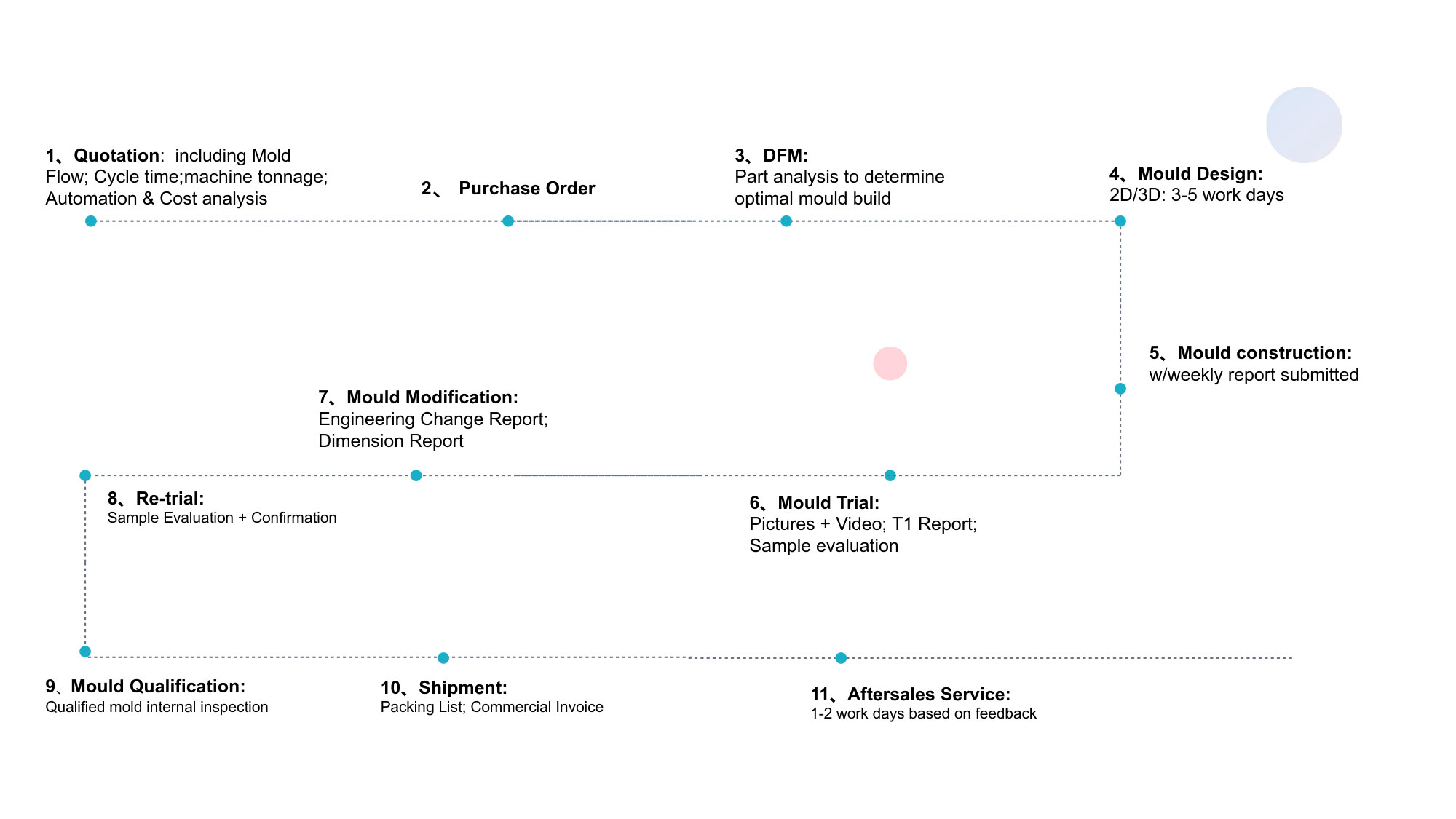
Section VI: Car Volume Knob Mold Project—End-to-End Manufacturing Workflow
Having established our capabilities and commitments, let us walk through the complete manufacturing lifecycle for a typical automotive car volume knob project at Ansix Tech.
Phase 1: Product Design Confirmation and Prototyping
Every car volume knob project begins with a thorough review of the customer‘s design intent. We work from your 3D CAD data or, if you prefer, we can assist with design refinement to optimize for manufacturability without compromising functional performance.
Material Selection Consultation: Based on the knob’s functional requirements—rotational torque, wear resistance, aesthetic finish, UV exposure, and cost targets—we recommend specific material grades. For a typical volume knob requiring both structural integrity and tactile feel, PC/ABS blends offer an ideal balance of impact resistance, processability, and cosmetic surface quality. For applications requiring exceptional wear resistance in the detent mechanism, we may suggest POM (acetal) or PA6+GF30 for those load-bearing features.
Prototype Validation: Before committing to full tooling, we produce functional prototypes to confirm:
Hand-feel and ergonomics of the knob geometry
Assembly fit with the underlying encoder switch
Tactile feedback from detent features
Light transmission for backlit applications
Phase 2: DFM Analysis and Mold Flow Simulation
This is where our engineering team adds the greatest value—predicting and preventing problems before a single chip of steel is cut.
Using Moldflow simulation, we model the injection molding process virtually:
Fill analysis: Visualizes how molten plastic travels through the runner system into the cavity, identifying potential short shots, hesitation issues, and race-tracking effects
Weld line prediction: Locates exactly where separate flow fronts meet, enabling us to position weld lines in non-critical zones or adjust gate placement to eliminate them entirely
Air trap identification: Reveals where gas becomes trapped in the cavity, guiding vent placement to ensure complete filling and prevent burn marks
Cooling analysis: Predicts temperature distribution across the molded part, highlighting zones where uneven cooling would cause warpage
Warpage simulation: Calculates predicted deformation after ejection, allowing us to modify geometry or process conditions to minimize distortion
The DFM report we deliver includes specific, actionable recommendations written in plain language, not engineering jargon. We specify precisely which mold features need design modifications and why those changes improve your outcome.
Phase 3: Mold Design—The Intersection of Art and Engineering
Once DFM is approved, our design team transitions to detailed mold CAD, optimizing every subsystem for performance and maintainability.
Cooling System Design: This is arguably the most critical element affecting both quality and productivity. Car volume knobs typically have complex internal features that resist uniform cooling with traditional straight-drilled water channels. For the highest-performance applications, Ansix employs 3D-printed conformal cooling channels that follow the part contour precisely.
Case study data from automotive knob applications shows that conformal cooling reduces:
Cooling time from 25 seconds to 13 seconds per cycle
Core-to-cavity temperature differential from 20°C to 5°C
Post-mold part warpage from 0.35mm to 0.10mm
Dimensional accuracy improvement from MT5 to MT3 (GB/T 14486–2008 standard)
Furthermore, uniform cooling enabled by conformal channels allows 16-cavity mold configurations where conventional cooling could only support 4 cavities. The result: 5× higher daily production capacity from the same molding machine and facility footprint.
Runner and Gate System: For high-volume car knob programs, we strongly recommend hot runner systems. Although the initial mold cost is higher, the elimination of runner waste reduces material consumption by 60–70%, and the elimination of runner separation labor reduces post-molding handling time by approximately 25–30%. The payback period depends on annual volume, but for any program producing over 500,000 units annually, hot runners are typically cost-positive within 12–18 months.
Ejector System: The car volume knob‘s geometry—particularly if it includes undercuts, detent features, or light-pipe passages—requires careful ejector pin placement to avoid leaving visible witness marks on cosmetic surfaces. Our DFM process identifies acceptable ejector locations early, and we design ejector pin tip geometries that minimize visible evidence while ensuring reliable part ejection for millions of cycles.
Phase 4: Mold Manufacturing—Precision Execution
With design finalized, our manufacturing team executes the tool build through a disciplined sequence of operations:
Rough machining (CNC): Material stock cut to approximate shape
Heat treatment (if applicable): For H13, S136, and other heat-treatable grades, we follow precise temperature and quench schedules to achieve target hardness without distortion
Finish machining (5-axis): Final contour generation at ±0.002mm accuracy
EDM (if required): For features impossible to machine with conventional cutters—fine ribs, sharp internal corners, micro-slots down to 0.03mm
Polishing: Progressive grit sequences from coarse to mirror-finish, with surface roughness verified by optical metrology
Assembly: Fitting of core pins, ejectors, cooling fittings, and hot runner components
Mold trial: First shots (T0) followed by inspection and documentation
Throughout machining, we maintain 70% automated operations to eliminate human variability and accelerate delivery.
Phase 5: Mold Validation and Pilot Production
Before the mold ever ships to your facility, we validate its performance on our own injection molding machines:
2000-cycle wear test with full dimensional monitoring every 200 shots
Flash measurement and documentation
CPK calculation for every critical dimension
Visual inspection under magnified lighting
Functional testing of rotational feel and detent engagement
Only when all criteria meet or exceed the specifications we committed to does the mold ship for customer acceptance.
Phase 6: Mass Production—Scaling Without Loss of Quality
When your production volumes increase, Ansix Tech can operate as your contracted manufacturer as well as your mold supplier. With 260 injection molding machines across our four production bases, we have the capacity to support even the most aggressive production schedules.
Quality control during mass production:
First-article inspection (FAI) at start of every batch
In-process sampling at statistically determined intervals
End-of-batch dimensional verification
SPC (Statistical Process Control) charts maintained for every active part number
Immediate process correction when any parameter trends outside control limits
Secondary operations (pad printing, laser engraving, ultrasonic welding, assembly) can be integrated into our production line, delivering finished, ready-to-ship components directly from our facility to your assembly plant.
Phase 7: Packaging and Logistics
We design packaging solutions that protect your components during transit while maximizing shipping density to reduce freight costs:
Anti-static trays for ESD-sensitive applications
Layer pads and corrugated dividers for surface-critical finishes
Vacuum-sealed moisture barrier bags for hygroscopic materials (Nylon, PEEK, PET)
Returnable containers compatible with automated assembly lines
Our logistics team coordinates with global freight partners to provide door-to-door delivery with real-time tracking and customs documentation support.
Section VII: The Cost Advantage—How Ansix Tech Reduces Your Total Cost of Ownership
Every decision we make—from steel selection to cooling design to process control—is evaluated through the lens of customer cost reduction. Here is how we systematically lower your project costs without compromising quality or capability.
Material Cost Reduction
Runnerless molding (hot runners) eliminates 60–70% of material waste compared to cold runner systems. For a product consuming 10 grams of material per shot, producing 1 million units per year, that equates to 6–7 metric tons of annual material savings.
Multi-cavity optimization spreads mold cost across more parts per cycle, reducing per-part tooling amortization. A 16-cavity mold producing 13-second cycles yields approximately 3,700 parts per hour per press—lowering both machine-hour cost and labor cost per part.
Process Efficiency Savings
Cycle time reduction through conformal cooling cuts shot-to-shot time by 25–50%. Every second shaved from cycle time multiplies across millions of cycles into significant cost savings.
Elimination of secondary operations: When we hold flash to ≤0.03mm, you eliminate manual trimming stations. When we optimize gate placement and surface finish, you eliminate polishing and deflashing. Each eliminated operation reduces direct labor and work-in-process inventory.
Automation integration: Our machines are pre-integrated with robotic part removal, degating, and inspection systems. For high-volume car knob programs, fully automated cells operate 24/7 with minimal human intervention.
Reliability and Maintenance Savings
Correct steel selection prevents premature mold failure. A single mold replacement costs not only the new tool but also weeks of lost production. Using S136 for PA66+GF30 applications—rather than P20—extends mold life from 20,000 to 800,000 shots, saving over 300,000 RMB in unplanned tooling costs across the program‘s lifecycle.
Standardized spare parts inventory means you do not need to maintain a large warehouse of components. We stock common wear parts and ship replacements within 24 hours when needed.
Predictive maintenance scheduling prevents unplanned downtime by alerting you to wear trends before they cause failures.
Risk Reduction Savings (The Hidden Cost)
DFM before tooling ensures that the mold works as intended the first time. No expensive rework after cutting steel. No delayed product launches. According to industry data, design-phase error correction costs 1/100th of post-production correction.
Upfront process validation eliminates the risk of shipping nonconforming parts to your assembly line. A single field failure that requires recall costs exponentially more than preventive quality systems.
Section VIII: Why Ansix Tech for Your Car Volume Knob Project
With over 28 years of mold-making experience and having built more than 30,000 sets of molds since our founding, Ansix Tech has accumulated institutional knowledge that cannot be replicated by newer competitors. We have served customers across automotive, medical, personal care, commercial communications, mobile and wearable devices, and smart home products.
Key differentiators that matter to you:
Factor Typical Competitor Ansix Tech
Experience 5–15 years 28+ years, 30,000+ molds
Global footprint Single country China + Vietnam, 4 production bases
Machine fleet <100 machines 260 machines, 30–2800 tons
Certifications ISO 9001 only ISO 9001, IATF 16949, ISO 13485, ISO 14001, BSCI
Automation 20–40% 70% automated machining
In-house repair Outsourced → weeks On-site in 24 hours
Mold validation Minimal or none 2000-cycle test + wear report
Warranty 1 year 3 years structural
Our corporate mission is not a slogan—it is the operational filter for every decision: “Make Our Customers Successful”. When you succeed, we succeed. When your car volume knob reaches the market on time, at cost, with flawless quality, that is the measure of our performance.
Conclusion: From Mold to Money-Printing Machine
At Ansix Tech, we do not view the Car Volume Knob Mold as just another tool—we treat it as your strategic asset for production success. From the initial DFM review that prevents costly design mistakes, to the precision 5-axis machining that eliminates cosmetic defects, to the conformal cooling that triples your throughput, every element of our process is engineered to translate technical excellence into tangible customer value.
The difference between a mold and a money-printing machine is execution. Execution on material selection. Execution on thermal management. Execution on dimensional validation. Execution on post-delivery support. Over 28 years, we have perfected that execution across thousands of customer projects, and we are ready to apply that expertise to your Car Volume Knob program.
Appendix: Quick Reference—What to Ask Your Next Mold Supplier
When evaluating mold makers for your car volume knob project, ask these questions:
“What is your five-axis CNC positioning accuracy? Can you show me a Cpk report from a recent automotive project?”
“What mold steels do you recommend for my material, and what is the guaranteed shot life?”
“Do you provide DFM reports before contract signing, and do they include specific recommendations on gate placement, ejector witness marks, and draft angles?”
“What is your average number of trial iterations (T0 to production release)?”
“Do you perform pre-shipment wear testing, and will you provide the wear report to me?”
“What is your on-site repair turnaround time for common mold issues?”
“Can you run pilot production (100–500 shots) and provide CPK data before we commit to mass volume?”
Ask any supplier these questions. When you ask Ansix Tech, you will receive detailed, verifiable answers supported by data, not promises. That transparency—combined with our technical depth, global capacity, and cost-optimization expertise—is why leading automotive manufacturers choose Ansix Tech for their critical interior components.
For a complete DFM walkthrough specific to your Car Volume Knob design, including weld line prediction, thermal analysis, and a cost-reduction proposal tailored to your annual volume, please contact the Ansix Tech engineering team. We will prepare a preliminary analysis at no cost or obligation, demonstrating exactly how we would solve your specific manufacturing challenges before we ask for your commitment.
Ansix Tech Co Ltd
If you have any plans related to Car Volume Knob Mold , you can contact us at any time. We will turn your ideas into reality, let you realize your dreams, and obtain large orders from the market. Our contact information is info@ansixtech.com. Or contact our CTO, mail: stephen@ansixtech.com
#www.ansixtech.com #ansixtech.com #Car Volume Knob Mold #LEGO Brick Molds molds #LEGO Brick Molds injection molding companies #LEGO Brick Molds Canopy Mold injection mold companies #Ansix #Ansix moulds #Ansix china #Ansix tech china #Ansix tech company #Ansix facotry #LEGO Brick Molds injection molding #LEGO Brick Molds injection tools #LEGO Brick Molds injection moulds #LEGO Brick Molds plastic mould #LEGO Brick Molds plastic tools #Ansix Tech #Ansix molds #Ansix injection molding #Ansix mold factory #injection molding LEGO Brick Molds #Ansix mold factory #LEGO Brick Molds china #LEGO Brick Molds molds #injection factory #LEGO Brick Molds injection molding #LEGO Brick Molds injection molding factory #injection molding company #LEGO Brick Molds injection mold companies #LEGO Brick Molds#LEGO Brick Molds mold limited #Ansix mold china #Ansix companies #Ansix company China #LEGO Brick Molds facotry #Ansix Tech #Ansix Tech mould #LEGO Brick Molds injection moulding #injection moulding company #Ansix LEGO Brick Molds parts injection mold companies #medical injection molding companieschina #LEGO Brick Molds china factory #Ansix moulding companies #Ansix molding company #LEGO Brick Molds injection moulding facotry #Ansix Tech mold #LEGO Brick Molds mould #LEGO Brick Molds plastic injection molding #ansix plastic mold #Mold manufacturing #LEGO Brick Molds parts manufacturing #LEGO Brick Molds plastic parts factory #LEGO Brick Molds injection parts mold #LEGO Brick Molds PRECISION MANUFACTURING #LEGO Brick Molds #China mold #LEGO Brick Molds injection moulding china #LEGO Brick Molds mould china #china precision mold #mold in china #LEGO Brick Molds mold china #Precision molds #High-precision molds #LEGO Brick Molds #Injection molds #LEGO Brick Molds Factory #LEGO Brick Molds Company #Super Large Injection Mold Factory #Large Tonnage Injection Molding Factory #LEGO Brick Molds Company #LEGO Brick Molds Factory #2800T Injection Molding Factory #3000 Ton Injection Molding #4500 Ton Injection Molding Factory #Large Mold Injection Molding #Large Plastic Mold Injection Molding Factory #Large Injection Mold Manufacturer #Plastic Mold Factory #Injection Mold #Plastic Mold